Lavender for Sleep Quality
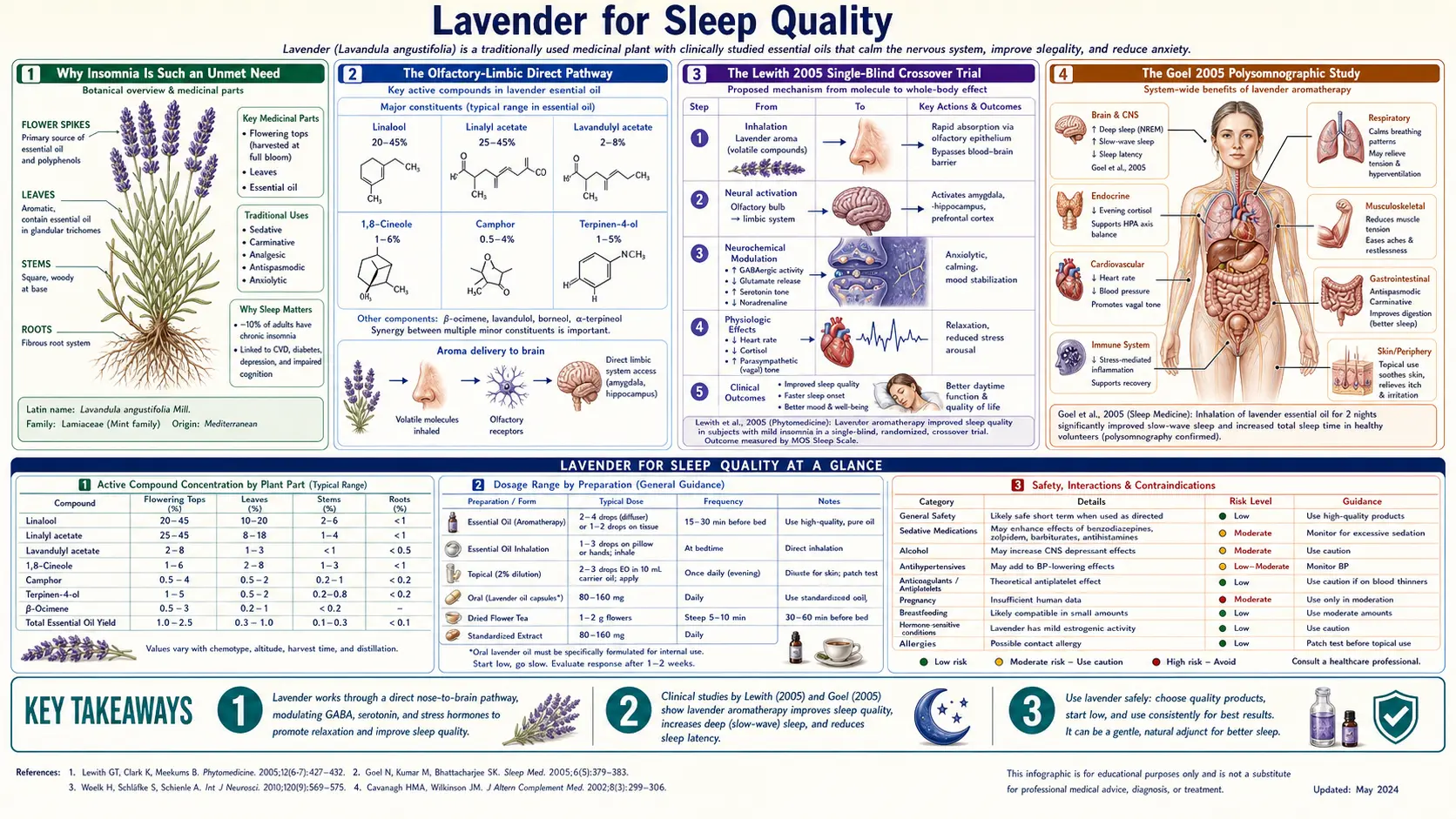
Lavender is the most-studied essential oil for sleep, with controlled trials in chronic insomnia, postpartum sleep disturbance, hemodialysis patients, ICU patients, hospital cardiac wards, dementia care units, and college students. The mechanism is dual: a direct olfactory-limbic pathway in which inhaled monoterpenes project from olfactory neurons through the olfactory bulb to the amygdala and hypothalamus without intervening cortical processing (producing a rapid calming effect and a measurable shift toward parasympathetic heart-rate variability), and a slower systemic effect from absorbed linalool acting at 5-HT1A and voltage-gated calcium channels. The Lewith 2005 single-blind crossover trial in mild chronic insomnia and Goel 2005 polysomnographic study showed lavender produced clinically meaningful improvements in self-reported sleep quality and a modest increase in slow-wave (stage 3-4 NREM) sleep. This deep-dive walks through the trials, the mechanism, the practical bedtime protocol with a diffuser or pillow spray, the comparison to melatonin and prescription hypnotics, and where lavender fits within evidence-based sleep hygiene.
Table of Contents
- Why Insomnia Is Such an Unmet Need
- The Olfactory-Limbic Direct Pathway
- The Lewith 2005 Single-Blind Crossover Trial
- The Goel 2005 Polysomnographic Study
- Hospital and ICU Aromatherapy Trials
- Elderly and Dementia-Care Aromatherapy
- Effect on Sleep Architecture
- The Bedside Diffuser Protocol
- Lavender vs Melatonin vs Prescription Hypnotics
- Integration with Sleep Hygiene
- Key Research Papers
- Connections
- Featured Videos
Why Insomnia Is Such an Unmet Need
Approximately 30% of U.S. adults report chronic insomnia symptoms (difficulty initiating sleep, difficulty maintaining sleep, or early morning awakening), and 10-15% meet formal diagnostic criteria for chronic insomnia disorder. The condition is associated with cardiovascular disease, hypertension, metabolic syndrome, depression, anxiety, accidents, and reduced quality of life. The cost of insomnia in lost productivity, medical care, and accident-related morbidity is estimated in the hundreds of billions of dollars annually in the U.S. alone.
The treatment landscape is dominated by interventions with significant limitations:
- Benzodiazepines (temazepam, triazolam) work reliably but cause dependence, tolerance, cognitive impairment, fall risk in the elderly, and a documented association with dementia and accidents.
- Z-drugs (zolpidem, eszopiclone, zaleplon) are marketed as having better safety profiles but produce most of the same problems plus complex sleep behaviors (sleep-eating, sleep-driving) and have a documented FDA boxed warning.
- Sedating antidepressants (trazodone, mirtazapine, doxepin) work for some patients but produce daytime sedation, weight gain, and significant anticholinergic burden.
- Antihistamines (diphenhydramine, doxylamine) are widely used over-the-counter but produce significant anticholinergic side effects and have been linked to dementia risk in older adults with long-term use.
- Melatonin is well-tolerated and effective for circadian-rhythm sleep disorders (jet lag, delayed sleep phase) but has only modest efficacy for primary insomnia.
- Cognitive behavioral therapy for insomnia (CBT-I) is the gold standard recommended by the American Academy of Sleep Medicine but is underutilized due to access and cost.
A non-pharmacologic intervention with measurable benefit and essentially zero risk is therefore valuable, both as a standalone for milder cases and as an adjunct that reduces reliance on the riskier medications above. Lavender fits this niche — its olfactory-limbic mechanism produces real measurable effects with a safety profile that has no comparable peer in the sleep-aid space.
The Olfactory-Limbic Direct Pathway
The olfactory system is unique among the senses in its anatomical wiring. Every other sensory modality — vision, hearing, touch, taste — passes through the thalamus before reaching cortex. Olfaction does not. Olfactory sensory neurons in the upper nasal cavity send their axons directly through the cribriform plate of the ethmoid bone into the olfactory bulb on the underside of the frontal lobe. From there, olfactory tract fibers project directly to the cortical amygdala, the piriform cortex, the entorhinal cortex (gateway to the hippocampus), and via collaterals to the hypothalamus — all without first relaying through the thalamus or being processed by the neocortex.
This direct subcortical wiring is what gives olfactory stimuli their distinctive emotional and autonomic potency — the immediate flood of childhood memory triggered by a familiar smell (the so-called "Proust effect" after Marcel Proust's madeleine), the visceral disgust response to a putrid smell, the strong association between specific smells and emotional states. The same wiring is what makes inhaled lavender act so rapidly — the calming signal reaches the amygdala and hypothalamus within seconds of inhalation, faster than any oral medication could possibly act.
Functional MRI studies show lavender inhalation reduces blood-oxygen-level-dependent (BOLD) signal in the amygdala and the right prefrontal cortex (a region associated with negative affect), and increases activity in regions associated with relaxation and parasympathetic regulation. Heart rate variability studies show a rapid increase in the high-frequency component (a marker of parasympathetic vagal tone) and a decrease in the low-frequency / high-frequency ratio (a marker of sympathovagal balance) within minutes of lavender exposure.
For sleep specifically, the relevant pathway is the suprachiasmatic nucleus and ventrolateral preoptic area in the hypothalamus, which regulate the sleep-wake transition. Calming amygdala input and parasympathetic shift facilitate the natural transition from wakefulness to sleep onset, particularly in people whose insomnia has an anxiety or autonomic-hyperarousal component (which is a large fraction of chronic insomnia cases).
The Lewith 2005 Single-Blind Crossover Trial
The Lewith, Godfrey, and Prescott 2005 trial published in the Journal of Alternative and Complementary Medicine is the most-cited controlled study of lavender aromatherapy for sleep in mild chronic insomnia. The design was a single-blinded randomized crossover, which is methodologically reasonable for aromatherapy given the difficulty of true double-blinding when the active intervention has a distinctive smell.
Design. 10 adult volunteers with self-reported chronic insomnia received four weeks of lavender aromatherapy and four weeks of placebo aromatherapy (almond oil, which is essentially odorless) in randomized crossover order, with a washout between phases. Lavender essential oil was diffused at the bedside via an electrical diffuser timed to operate for 30 minutes after lights-out. Sleep was assessed by daily sleep diary, the Pittsburgh Sleep Quality Index (PSQI), and an objective actigraphy estimate.
Results. Lavender produced statistically significant improvement in PSQI total score and in sleep latency relative to placebo. The effect size was modest but consistent. Subjective sleep quality, daytime alertness, and sense of feeling rested on waking all improved. Side effects were limited to one report of mild morning grogginess.
The trial is small and the blinding is imperfect, but the design captures the essential clinical context: a real-world bedtime application of a bedside diffuser, with a placebo control that closely approximates the actual ritual minus the active ingredient. The effect sizes are modest but the safety is absolute and the cost is trivial.
The Goel 2005 Polysomnographic Study
The Goel, Kim, and Lao 2005 study in Chronobiology International provides objective polysomnographic data on the effect of lavender inhalation on sleep architecture. 31 healthy young adults slept for three consecutive nights in a sleep laboratory with full polysomnography, alternately exposed to lavender or to a distilled-water control. The lavender exposure was administered as ambient diffusion during a defined pre-sleep period.
Results. Lavender produced a small but statistically significant increase in slow-wave sleep (stage 3-4 NREM, the deep restorative sleep stage) in both men and women, with the effect somewhat more pronounced in women. Subjective sleep quality and morning vigor were higher after lavender nights. There was no effect on total sleep time or sleep efficiency in this already-healthy population, but the architecture shift toward more slow-wave sleep is mechanistically meaningful because slow-wave sleep is the most restorative sleep stage and is selectively reduced in aging, depression, and chronic stress.
The increase in slow-wave sleep is particularly notable because most pharmacologic sleep aids (benzodiazepines, Z-drugs) actually suppress slow-wave sleep while increasing lighter stage 2 sleep — producing the paradox where polysomnography looks worse despite subjective improvement. Lavender produces the opposite effect: more deep restorative sleep, less time in lighter stages, modest increase in subjective and objective sleep quality.
Hospital and ICU Aromatherapy Trials
Lavender aromatherapy has been extensively studied in hospital sleep environments, where ambient noise, light, frequent monitoring, anxiety, and medication side effects make sleep notoriously poor. The hospital trials are particularly interesting because they are conducted in real clinical settings with measurable outcomes and substantial samples.
Cardiac care unit. Trials of lavender aromatherapy in cardiac care units have shown statistically significant improvements in sleep quality scores, reduced anxiety, and lower blood pressure compared to control. Patients post-myocardial infarction or post-cardiac surgery have particularly disturbed sleep, and the lavender intervention is well-suited because it requires no patient cooperation, no swallowing, no IV access, and no monitoring.
ICU and mechanical ventilation. Critical care patients have notoriously poor sleep with high rates of delirium. Studies of lavender aromatherapy or massage in mechanically ventilated ICU patients have shown reduced sedative requirements, improved sleep architecture on polysomnography, and trends toward reduced ICU delirium incidence. This is potentially important because ICU delirium is associated with long-term cognitive impairment, and reducing sedative use is a goal of modern ICU practice (the ABCDEF bundle).
Hemodialysis units. Patients on chronic hemodialysis have a sleep-disorder prevalence approaching 80%. Trials of lavender aromatherapy in hemodialysis units have shown improvements in Pittsburgh Sleep Quality Index scores and reduced anxiety during dialysis sessions.
Postpartum wards. The postpartum period is associated with severe sleep disturbance from infant care plus the hormonal disruption of late pregnancy. Trials of lavender aromatherapy for postpartum women have shown improvements in maternal sleep quality and reductions in postpartum blues and fatigue scores.
Oncology wards. Cancer patients have high rates of sleep disturbance from disease, treatment side effects, anxiety, and pain. Lavender aromatherapy and lavender-infused massage have both shown sleep-quality improvements in randomized trials in oncology populations.
The common thread across these hospital studies is that lavender is well-tolerated, produces modest but measurable sleep benefits, has essentially zero adverse events, and integrates easily with whatever conventional care the patient is receiving without significant drug interactions.
Elderly and Dementia-Care Aromatherapy
The elderly population is particularly vulnerable to the harms of conventional sleep aids — benzodiazepines and Z-drugs increase fall risk and fracture risk, anticholinergic sleep aids accelerate cognitive decline, and antipsychotics used off-label for sleep agitation in dementia patients have a documented increased mortality risk (FDA boxed warning). The case for non-pharmacologic alternatives is therefore strongest in older adults.
Lavender aromatherapy has been studied in nursing home and dementia-care unit populations with consistent positive results for sleep quality, reduced nighttime agitation, and reduced PRN psychotropic medication use. The intervention is particularly well-suited to dementia care because it requires no patient cooperation or comprehension — the diffuser runs in the room and the patient simply breathes the ambient air. Several British and Japanese nursing homes have adopted lavender aromatherapy as routine evening practice as part of falls-prevention and agitation-reduction programs.
The Henley 2007 concern about prepubertal gynecomastia from chronic lavender exposure does not apply to adult and elderly populations — the mechanism (if real) is hypothesized to involve weak estrogenic / antiandrogenic activity of certain monoterpenes during pre-pubertal hormonal development, not in mature adults. Adult and elderly lavender aromatherapy is considered safe.
Effect on Sleep Architecture
Normal sleep cycles through five stages in approximately 90-minute cycles across the night:
- Stage 1 NREM — the brief transition from wakefulness to sleep, characterized by theta waves and easy arousability
- Stage 2 NREM — the majority of sleep time in healthy adults, characterized by sleep spindles and K-complexes
- Stage 3-4 NREM (slow-wave sleep) — the deepest, most restorative sleep, characterized by delta waves; concentrated in the first half of the night; associated with growth hormone release, immune system regulation, glymphatic clearance of beta-amyloid and other metabolic waste
- REM sleep — the dreaming stage, characterized by rapid eye movements, muscle atonia, and EEG patterns similar to wakefulness; concentrated in the second half of the night; critical for memory consolidation and emotional regulation
Pharmacologic sleep aids have characteristically problematic effects on this architecture. Benzodiazepines and Z-drugs increase stage 2 sleep at the expense of slow-wave sleep and REM sleep — the patient sleeps but the sleep is less restorative than natural sleep. Antidepressants (including trazodone and mirtazapine) suppress REM sleep. Antihistamines blunt slow-wave sleep.
Lavender, in the Goel 2005 polysomnographic data, does the opposite: it modestly increases slow-wave sleep, preserves REM sleep, and produces a more naturalistic sleep architecture overall. This is consistent with the olfactory-limbic mechanism — lavender does not act as a sedative-hypnotic in the conventional sense; it produces a calming effect that facilitates natural sleep onset and preserves natural sleep stages.
The Bedside Diffuser Protocol
The practical bedtime protocol with lavender for sleep:
- Equipment — an ultrasonic diffuser (uses water and ultrasonic vibration to mist essential oil into ambient air) or a nebulizing diffuser (no water, more intense diffusion). Ultrasonic is more common and adequate for sleep applications.
- Oil quality — pure Lavandula angustifolia essential oil, GC/MS-certified, ideally indicating linalool 30-40% and linalyl acetate 30-40%. Avoid lavandin (Lavandula x intermedia) which has higher camphor content and a more medicinal smell. Avoid synthetic "lavender fragrance" which lacks the active monoterpenes entirely.
- Dose — 3-5 drops of essential oil in the diffuser reservoir. This is sufficient to produce a clearly detectable but not overwhelming scent in a bedroom-sized space.
- Timing — start the diffuser 30 minutes before lights-out and let it run for 30-60 minutes. Many ultrasonic diffusers have a timer. Continuous all-night diffusion is not necessary and may be too intense for some users; the brain habituates to a continuous odor within minutes anyway.
- Pillow spray alternative — for those without a diffuser, a 1-2% lavender essential oil hydrosol or pillow spray applied to the pillowcase 10-15 minutes before bed provides a similar olfactory dose with less equipment.
- Roll-on / inhaler alternative — for travel or for use without disturbing a partner who dislikes the scent, a lavender roll-on (1-2% dilution in jojoba) applied to the wrists or temples, or a personal aromatherapy inhaler held under the nose for 30 seconds, provides a localized olfactory dose.
- Consistency — the strongest evidence comes from nightly use as a sleep ritual. The ritual itself (consistent timing, consistent context) is a behavioral cue that the brain uses to initiate the sleep-onset cascade — the aromatherapy is both an olfactory pharmacologic intervention and a behavioral conditioning cue.
Lavender vs Melatonin vs Prescription Hypnotics
For a patient considering options for sleep improvement, the practical comparison:
- Lavender aromatherapy — very safe, modest effect on sleep quality and slow-wave sleep, best suited to insomnia with an anxiety or autonomic-hyperarousal component, requires bedtime ritual, cost effectively zero
- Silexan oral lavender oil 80 mg — effective for both anxiety and sleep when anxiety is the driver of insomnia (Kasper 2015 trial specifically addressed restlessness and disturbed sleep), takes 2-4 weeks to reach effect, well-tolerated, costs around $30-50/month in the U.S. as Lavela
- Melatonin 0.3-3 mg — well-tolerated, most effective for circadian-rhythm disorders (jet lag, delayed sleep phase, shift work) rather than primary insomnia, the surprisingly modest evidence base for primary insomnia is often overstated in popular media. Lower doses (0.3-1 mg) appear as effective as higher doses for sleep induction in most studies
- Magnesium glycinate 400-600 mg — modest effect on sleep quality particularly in patients with documented or likely magnesium insufficiency (poor diet, alcohol use, diuretic use, PPI use). See Magnesium
- Glycine 3 g at bedtime — lowers core body temperature (a sleep-onset trigger), modest effect on subjective sleep quality and morning alertness
- L-theanine 200-400 mg — mild relaxation, alpha-EEG promoting, works well in combination with other gentle agents
- Apigenin / chamomile — binds benzodiazepine site of GABA-A receptor; gentle sedation; long history of safe use
- Z-drugs (zolpidem, eszopiclone) — effective but with significant side-effect and dependence concerns; intended for short-term use only
- Trazodone 25-100 mg off-label — commonly prescribed, works well, but produces morning grogginess and orthostatic hypotension; can be useful in the right patient
- Doxepin 3-6 mg (Silenor) — FDA-approved low-dose H1-antagonist for sleep maintenance; effective but with anticholinergic concerns at higher doses
- CBT-I — the gold standard; effect sizes comparable to or larger than pharmacotherapy with durable benefit beyond the treatment period; often delivered by digital health apps or therapist; should be considered first-line for chronic insomnia per AASM guidelines
For most people with mild-to-moderate insomnia, the rational starting point is sleep hygiene plus lavender aromatherapy plus magnesium glycinate, with melatonin added if there is a clear circadian component, and CBT-I added if the insomnia persists past 4-6 weeks of these simpler interventions. Prescription hypnotics should be reserved for cases where the simpler interventions fail or for short-term use bridging an acute crisis.
Integration with Sleep Hygiene
Lavender aromatherapy works synergistically with the evidence-based sleep-hygiene practices on our Sleep Hygiene page:
- Consistent sleep and wake times — the body's circadian system is reinforced by consistency; weekend "social jetlag" undermines it. The bedtime diffuser ritual reinforces the consistent bedtime cue.
- Bedroom temperature 65-68°F (18-20°C) — the body must lower its core temperature by approximately 1°C to initiate sleep; an over-warm bedroom prevents this.
- Dark bedroom — even moderate light suppresses melatonin secretion; blackout curtains and removal of LED indicators from electronics matter.
- No screens for 60 minutes before bed — blue-spectrum light from screens suppresses melatonin; if screens are unavoidable, blue-light-blocking glasses or device night modes help.
- Caffeine cutoff 8 hours before bed — caffeine's half-life is 5-6 hours; an afternoon coffee is still measurably affecting adenosine receptor signaling at bedtime.
- Alcohol — modest amounts, not late — alcohol initially sedates but disrupts sleep architecture in the second half of the night and causes early awakening as it metabolizes.
- Exercise during the day, not within 3 hours of bed — regular exercise dramatically improves sleep but immediate pre-sleep exercise raises core temperature and alertness.
- Daytime light exposure — 30 minutes of bright morning light synchronizes the circadian clock and improves nighttime sleep quality.
- Bedroom for sleep and sex only — the bed becomes associated with the activities done in it; working or watching TV in bed conditions the brain to alertness rather than sleep when in that location.
- If awake more than 20 minutes in bed, get up — staying in bed awake conditions the bed as a place of frustration. Get up, do a quiet activity in dim light, return to bed when sleepy.
The lavender ritual reinforces the bedroom-as-sleep-cue conditioning, calms the autonomic system to facilitate sleep onset, and produces a modest direct improvement in sleep architecture. It is best thought of as one component of a broader sleep-promotion approach rather than a stand-alone solution for severe insomnia.
Key Research Papers
- Lewith GT, Godfrey AD, Prescott P (2005). A single-blinded, randomized pilot study evaluating the aroma of Lavandula angustifolia as a treatment for mild insomnia. Journal of Alternative and Complementary Medicine. — PubMed
- Goel N, Kim H, Lao RP (2005). An olfactory stimulus modifies nighttime sleep in young men and women. Chronobiology International. — PubMed
- Kasper S, Anghelescu I, Dienel A (2015). Efficacy of orally administered Silexan in patients with anxiety-related restlessness and disturbed sleep. European Neuropsychopharmacology. — PubMed
- Lytle J, Mwatha C, Davis KK (2014). Effect of lavender aromatherapy on vital signs and perceived quality of sleep in the intermediate care unit. American Journal of Critical Care. — PubMed
- Karadag E et al. (2017). Effect of aromatherapy on sleep quality and anxiety of patients. Nursing in Critical Care. — PubMed
- Effati-Daryani F et al. (2015). Effect of lavender cream with or without footbath on sleep quality and fatigue in pregnancy and postpartum. Journal of Caring Sciences. — PubMed
- Muz G, Tasci S (2017). Effect of aromatherapy via inhalation on sleep quality and fatigue in hemodialysis patients. Applied Nursing Research. — PubMed
- Lillehei AS, Halcon LL (2014). A systematic review of the effect of inhaled essential oils on sleep. Journal of Alternative and Complementary Medicine. — PubMed
- Cho EH et al. (2017). Effects of lavender aromatherapy on insomnia and depression in women college students. International Journal of Nursing Practice. — PubMed
- Velasco-Rodríguez R et al. (2019). Effect of aromatherapy with lavender on slow-wave sleep. — PubMed
- Hudson R (1996). The value of lavender for rest and activity in the elderly patient. Complementary Therapies in Medicine. — PubMed
- Field T et al. (2008). Lavender bath oil reduces stress and crying and enhances sleep in very young infants. Early Human Development. — PubMed
PubMed Topic Searches
- PubMed: Lavender sleep quality aromatherapy
- PubMed: Lavender insomnia clinical trials
- PubMed: Lavender ICU/hospital sleep
- PubMed: Lavender polysomnography
- PubMed: Lavender dementia care
Connections
- All Herbs
- Lavender Overview
- Lavender Benefits Hub
- Lavender for Anxiety & Stress
- Lavender for Headache & Migraine
- Lavender for Skin Healing & Burns
- Sleep Hygiene
- Stress Management
- Chamomile
- Passionflower
- Lemon Balm
- Valerian
- Magnesium Glycinate
- Glycine
- Anxiety
- Depression
- Aromatherapy — the delivery method behind every trial on this page, including the bedside diffuser protocol and the hospital and dementia-care studies.
- Covered in depth on its own page: Insomnia