Cleavers — Benefits Deep Dive
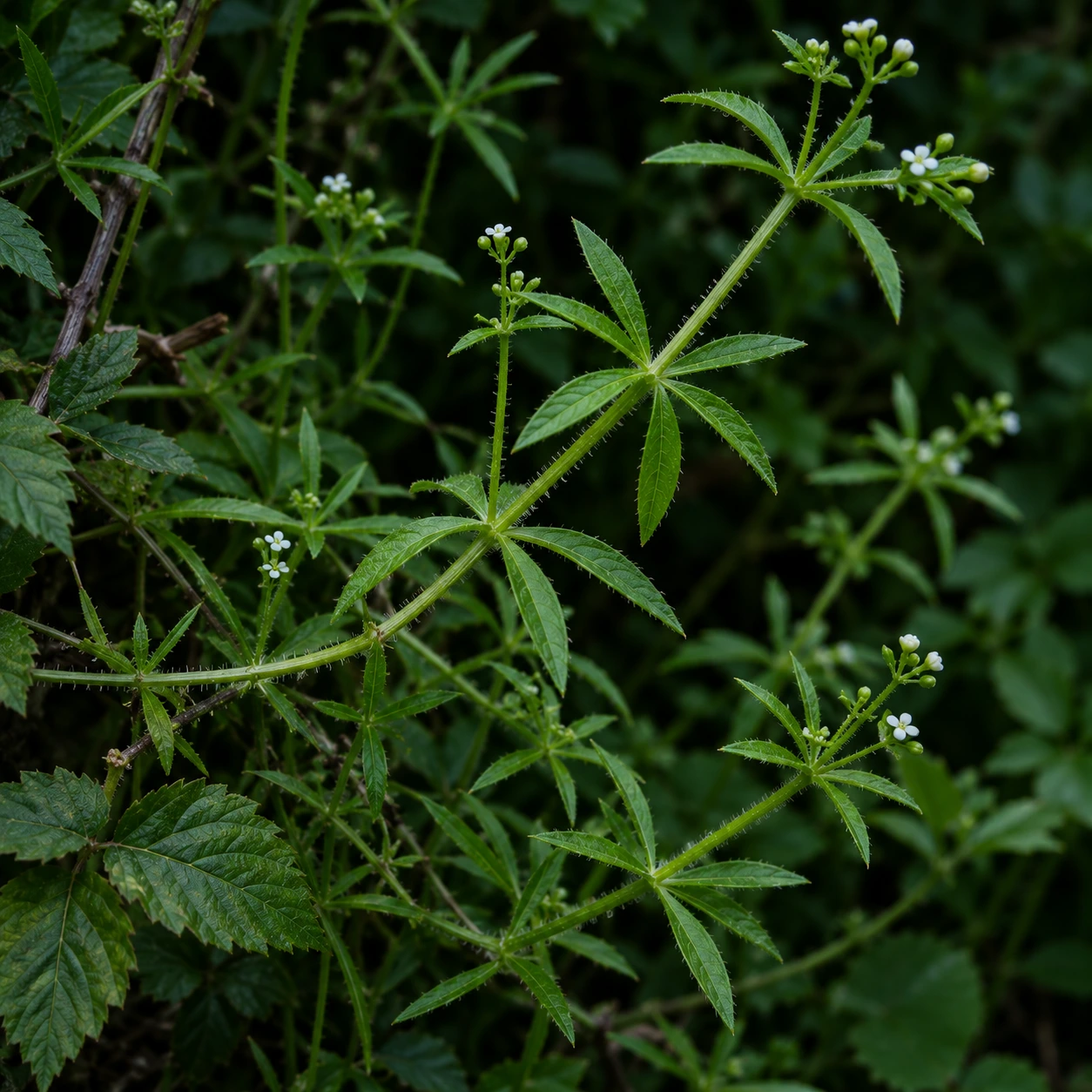
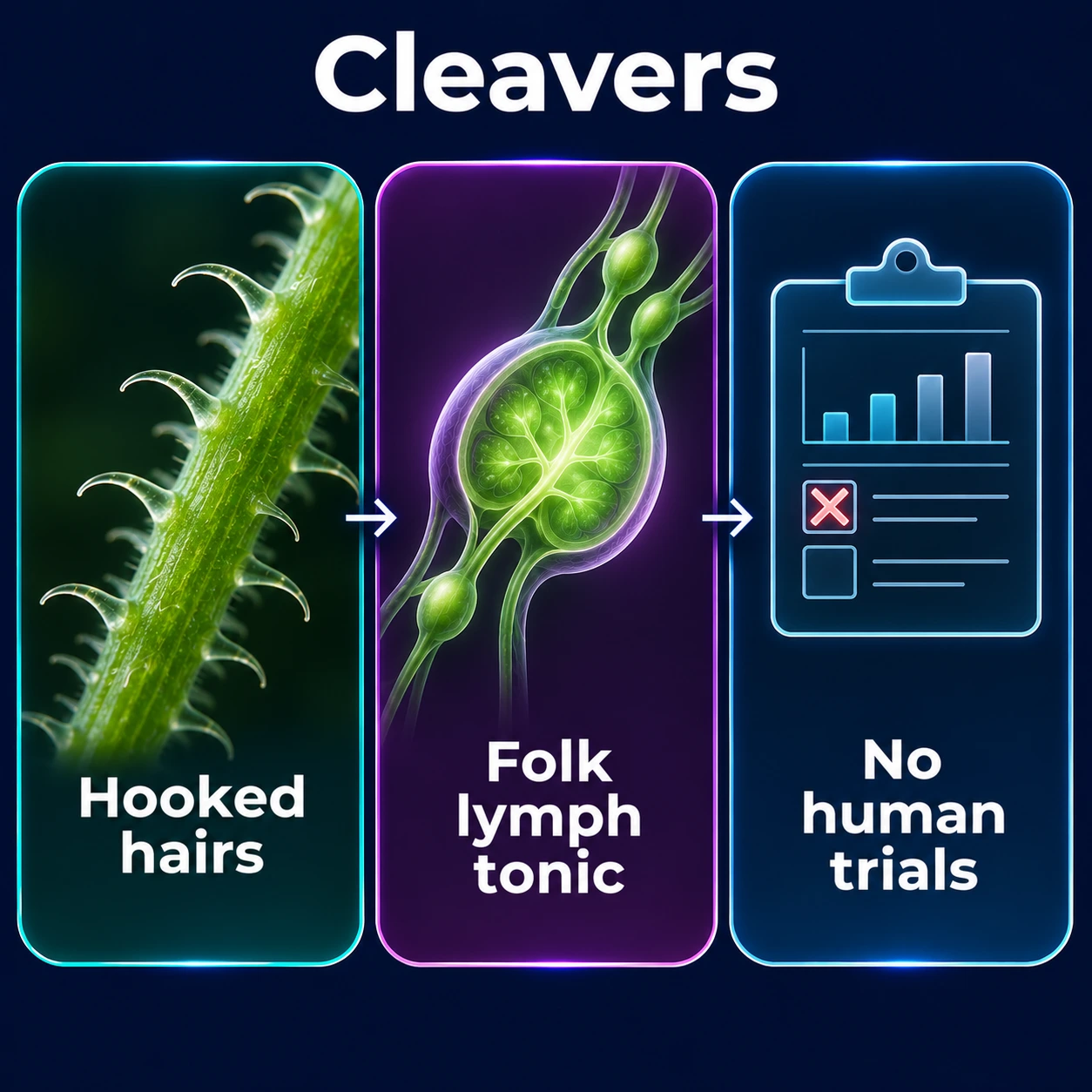
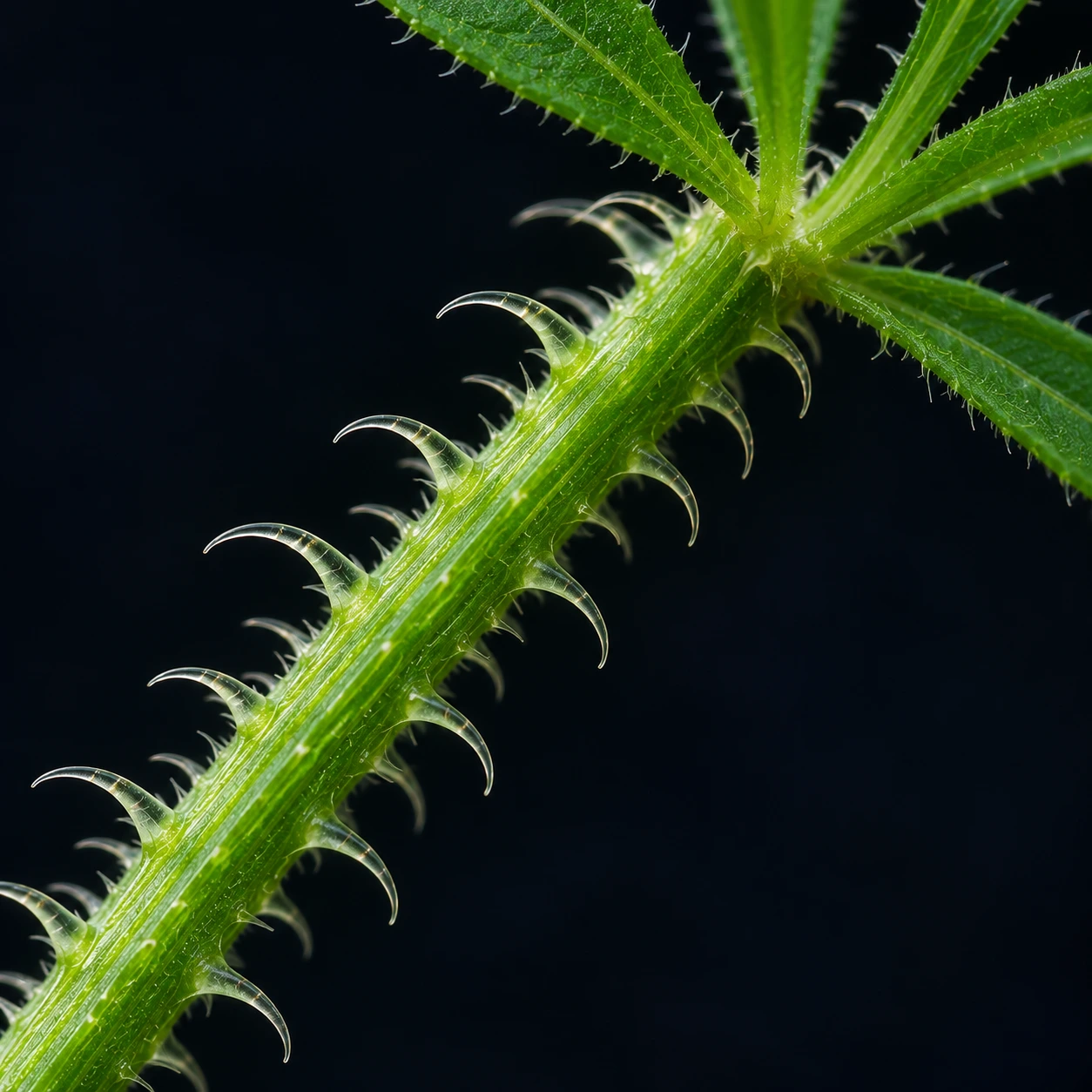
Cleavers — Galium aparine, also goosegrass, sticky-willy, catchweed and grip-grass — is the clinging annual that grabs your sleeve on a spring walk, held together by thousands of tiny backward-hooked hairs. It belongs to the Rubiaceae, the madder family, which makes it a relative of coffee; and the roasted seeds really were used as a coffee substitute, which is the most delightful true thing about it. Western herbalists have used the fresh aerial parts for centuries as a diuretic, as a cooling skin wash, as a spring tonic, and above all as a "lymphatic" herb for swollen glands.
This deep dive is different from most Benefits legs on the site, for a reason we would rather state plainly than paper over. Cleavers has almost no modern research of any kind. No controlled trial of any design, for any indication. No human pharmacokinetics. No dose-finding. No toxicology worth the name. No interaction study. One 2023 Estonian laboratory study did measure iridoid levels in cleavers and two related Galium species, and found asperulosidic acid the most abundant compound in cleavers herb, but no such measurement has been tied to a dose. That is not an editorial failure of these four pages — it is the finding, and each page states it as a result rather than padding around it.
What these pages do instead is more useful than a longer list of claims would be. They explain what the lymphatic system actually does and what a real measurement of "improved lymphatic function" would look like, so you can judge the central claim for yourself. They do the arithmetic on a mug of tea, printing the assumptions and flagging the one input that is a guess. They rank cleavers honestly against the herbs and treatments that have been trialled — and cleavers usually comes last, while the interventions that come first are often the unglamorous ones. And they refuse both to invent benefits and to invent hazards, because the second is as misleading as the first.
Table of Contents
Deep-Dive Articles
Cleavers and the Lymphatic System: Examining the Claim
The reason most readers arrive, handled carefully rather than dismissively. What lymph actually is, how lymphatic function is genuinely measured — lymphoscintigraphy, indocyanine-green imaging, bioimpedance, perometry — and what a real test of the claim would look like. Then ten things nobody has measured, why the word "tonic" survives being untestable, and why lymphoedema is a real condition with real management that a herb does not substitute for.
Read the deep dive →Cleavers as a Diuretic and for Urinary Complaints
The claim with the more plausible rationale, at traditional-use tier. The four different things "diuretic" can mean, the iridoid, flavonoid and tannin constituents without overclaiming, and the arithmetic showing that a 300 mL mug guarantees 300 mL of diuresis before the plant does anything. Ranked against water intake, cranberry, D-mannose and the one urinary herb with a proper randomised trial.
Read the deep dive →Cleavers for Skin, and Its Traditional and Culinary Use
Where cleavers comes out best, because the claims are smallest. Why a cool astringent compress has a plausible non-magical mechanism, why the internal "blood cleansing" claim for psoriasis and eczema rests on a disease model now known to be wrong, and the genuinely checkable parts: the cooked spring potherb, the roasted-seed coffee substitute, and the bedstraw relatives whose findings get misattributed to cleavers.
Read the deep dive →Cleavers Safety, Interactions and What Is Unknown
Why "no known interactions" and "no case reports" mean the opposite of what readers assume. Diuretic stacking, the lithium mechanism explained properly, the coumarin confusion defused — along with the negative randomised trial of coumarin in lymphoedema that cuts both ways — the open madder-family anthraquinone question, mechanical irritation from the hooks, wild-harvest contamination, and a list of hazards cleavers does not have.
Read the deep dive →Evidence Ledger
Ranked by strength of support rather than by popularity, which reverses the usual order and is the whole point of doing it. Notice that the two best-supported statements about cleavers are not medical claims at all, and the claim most readers arrive with sits at the bottom.
- A cooked wild spring green. Documented food history, checkable, no health claim attached. Highest confidence.
- Roasted seeds as a caffeine-free coffee substitute. Documented, and explained by the plant's place in the coffee family. Impractical, true.
- Mild in ordinary amounts. Supported by food history and four centuries of herbalists calling it gentle — but see the caveat that no formal safety study exists.
- A cooling compress for irritated skin. Plausible tannin mechanism, much of it generic to any wet compress. Untested, low-stakes.
- A mild diuretic. Traditional use, plausible, and confounded by the fact that the preparation is a large volume of water. Unmeasured in any species.
- Urinary flushing for cystitis or "gravel." The flushing principle is real and belongs to fluid intake; the herb gets no credit beyond the water.
- Internal use for psoriasis or eczema. Traditional only, resting on a superseded disease model, with a real opportunity cost.
- A lymphatic tonic. Traditional use only — not preclinical, not preliminary, not emerging. The endpoints exist and are validated; nobody has ever applied them to this plant.
The Laboratory and Animal Immune Studies
The only modern immune studies of cleavers are laboratory and animal work, not lymphatic measurements. A 2020 study found that a raw infusion of cleavers herb and fractions made from it showed significant immune-stimulating activity on lymphocytes (white blood cells) in a dish, in a lymphocyte blast transformation test, and scavenged free radicals (DPPH, nitric oxide and hydrogen peroxide) in the test tube. A 2024 study in animals whose immune systems had been suppressed with the drug cyclophosphamide found that a cleavers extract raised spleen weight in a dose-dependent way and increased natural-killer-cell activity at the two higher doses. Neither study measured lymph flow, and neither tested any person.
The 2020 study's authors note that cleavers herb has a monograph in the British Herbal Pharmacopoeia and that several medicines and food supplements on the European market contain Galium extracts. That is recognition of traditional use, not proof of effect.
Key Research Papers
Most links below are live PubMed topic searches rather than fixed citations, so you can inspect the actual result set instead of taking a reference on trust; the named papers that could be traced are linked directly by their PMID or DOI. For a herb this thinly studied that is the honest format — and several of these searches are worth running precisely because of how little comes back.
1. The searches that define the evidence gap
- PubMed: Galium aparine randomised controlled trial — the trial literature for the whole plant, across every indication.
- PubMed: Galium aparine lymphatic — the search that ought to support the plant's most famous claim.
- PubMed: Galium aparine diuretic — the second most repeated claim, tested against the record.
- PubMed: Galium aparine toxicity — the safety file, which is empty rather than reassuring.
- PubMed: Galium aparine weed and herbicide research — included for contrast: by volume this is the most active field of cleavers research in existence.
2. What has actually been established: the chemistry
- PubMed: iridoids from Galium aparine — isolation of the asperuloside-type iridoid glycosides directly from cleavers.
- Corrigan D, Timoney RF, Donnelly DMX. (1978). Iridoids and alkanes in twelve species of Galium and Asperula. Phytochemistry 17(7):1131-1133. (The genus-wide survey that placed cleavers in its chemical context; it is not indexed in PubMed.) — doi:10.1016/s0031-9422(00)94304-8
- Laanet PR, Saar-Reismaa P, Jõul P, et al. (2023). Phytochemical Screening and Antioxidant Activity of Selected Estonian Galium Species. Molecules 28(6):2867. (Measured iridoid levels in cleavers and two related species.) — PubMed PMID: 36985838
- Morimoto M, Tanimoto K, Sakatani A, et al. (2002). Antifeedant activity of an anthraquinone aldehyde in Galium aparine L. against Spodoptera litura F. Phytochemistry 60(2):163-6. (The madder-family pigment chemistry, found in a study of insect deterrence.) — PubMed PMID: 12009319
- PubMed: anthraquinones of Galium spurium — false cleavers, the species most easily confused with the real thing in field and literature alike.
- PubMed: Galium aparine antioxidant and antimicrobial extract screens — the in-vitro layer, to be read as screening output and not as health outcome. — Search PubMed
3. The lymphatic system, and what measuring it involves
- Louveau A, Smirnov I, Keyes TJ, et al. (2015). Structural and functional features of central nervous system lymphatic vessels. Nature 523(7560):337-41. (How recently this system's basic anatomy was still being rewritten.) — PubMed PMID: 26030524
- PubMed: near-infrared fluorescence imaging of human lymphatic contraction frequency — the technique that makes "does this alter lymph flow?" an answerable question. — Search PubMed
- PubMed: manual lymphatic drainage for lymphoedema after breast cancer treatment, Cochrane review — what a properly evaluated lymphatic intervention looks like, qualifications included. — Search PubMed
- PubMed: peripheral lymphoedema consensus document, International Society of Lymphology — staging, diagnosis and the accepted standard of care. — Search PubMed
- Loprinzi CL, Kugler JW, Sloan JA, et al. (1999). Lack of effect of coumarin in women with lymphedema after treatment for breast cancer. New England Journal of Medicine 340(5):346-50. (The nearest thing to a direct test of the cleavers mechanism: a compound class the plant contains, given at proper doses, in the right patients, with the right endpoint. It failed: 140 women took 200 mg of coumarin or placebo twice daily for six months, then switched; after six months the affected arm's volume had risen by 58 mL on coumarin and by 21 mL on placebo (P=0.80), and coumarin caused blood-test signs of liver toxicity in 6 percent of the women.) — PubMed PMID: 9929524
4. The urinary tract: what has been trialled, and by whom
- Hooton TM, Vecchio M, Iroz A, et al. (2018). Effect of Increased Daily Water Intake in Premenopausal Women With Recurrent Urinary Tract Infections: A Randomized Clinical Trial. JAMA Internal Medicine 178(11):1509-1515. (The trial that vindicates the flushing principle and credits water for it.) — PubMed PMID: 30285042
- Moore M, Trill J, Simpson C, et al. (2019). Uva-ursi extract and ibuprofen as alternative treatments for uncomplicated urinary tract infection in women (ATAFUTI): a factorial randomized trial. Clinical Microbiology and Infection 25(8):973-980. (The one urinary herb with a proper randomised trial, and its unflattering result.) — PubMed PMID: 30685500
- Clare BA, Conroy RS, Spelman K. (2009). The diuretic effect in human subjects of an extract of Taraxacum officinale folium over a single day. Journal of Alternative and Complementary Medicine 15(8):929-34. (A small single-day pilot that represents the high-water mark for herbal diuretic evidence.) — PubMed PMID: 19678785
- Wright CI, Van-Buren L, Kroner CI, et al. (2007). Herbal medicines as diuretics: a review of the scientific evidence. Journal of Ethnopharmacology 114(1):1-31. (The field-level survey, and a reality check on how thin it is.) — PubMed PMID: 17804183
- PubMed: cranberries for preventing urinary tract infections, Cochrane review — the best-studied non-antibiotic prevention option. — Search PubMed
5. Skin: the comparators that carry real evidence
- Pommier P, Gomez F, Sunyach MP, et al. (2004). Phase III randomized trial of Calendula officinalis compared with trolamine for the prevention of acute dermatitis during irradiation for breast cancer. Journal of Clinical Oncology 22(8):1447-53. (What a properly evidenced topical botanical looks like: one indication, one population, one comparator.) — PubMed PMID: 15084618
- PubMed: emollients and moisturisers for eczema, Cochrane review — the unglamorous foundation of eczema care. — Search PubMed
- PubMed: interleukin-17 inhibitors in psoriasis, randomised trials — the modern mechanism, and why "blood impurity" is an obsolete model. — Search PubMed
- PubMed: colloidal oatmeal in atopic dermatitis — the evidence tier a cleavers compress could plausibly aspire to.
- PubMed: lucidin and madder root genotoxicity — the family-level anthraquinone signal, and the open question it raises for concentrated cleavers extracts.
6. Laboratory and animal immune studies
- Ilina T, Skowrońska W, Kashpur N, et al. (2020). Immunomodulatory Activity and Phytochemical Profile of Infusions from Cleavers Herb. Molecules 25(16):3721. (Laboratory study.) — PubMed PMID: 32824103
- Lee SY, Park SY, Park HJ. (2024). Immuno-Enhancing Effects of Galium aparine L. in Cyclophosphamide-Induced Immunosuppressed Animal Models. Nutrients 16(5):597. (Animal study.) — PubMed PMID: 38474724
External Resources
- PubMed — the biomedical literature database behind every search link on these pages.
- U.S. National Center for Complementary and Integrative Health — the US National Center for Complementary and Integrative Health, with herb-by-herb evidence summaries.
- European Medicines Agency — publishes the herbal monographs and traditional-use registrations discussed on the diuretic page.
- LiverTox — the U.S. National Institutes of Health (NIH) database of drug- and herb-induced liver injury, useful for checking whether a compound has a real hepatic signal.
- Plants of the World Online (Kew) — authoritative botanical names and distributions, for keeping Galium species straight.
- Lymphoedema Support Network — patient-facing guidance on the condition a herb does not treat.
- NHS — plain-language pages on swollen glands, cystitis, eczema and psoriasis.
- Cochrane Library — systematic reviews, including several cited as comparators above.
Connections
- All Herbs
- Cleavers — main article
- The lymphatic claim examined
- Cleavers as a diuretic
- Skin, tradition and culinary use
- Safety and what is unknown
- Dandelion benefits
- Stinging nettle benefits
- Uva ursi benefits
- Horsetail benefits
- Red clover benefits
- Calendula benefits
- Yarrow benefits
- Cat's whiskers (Java tea)
- Chanca piedra stone protocol
- Swollen lymph nodes
- Edema
- Lymphatic drainage
- Detox protocols
- Urinary tract infections
- Kidney stones
- Psoriasis
- Eczema
- Kidney function tests
- Lymphatic system visualization
- Kidney nephron visualization
- Coffee