⚠ Evidence warning: Clinical trials or other evidence do not support the claim that cleavers is a lymphatic tonic that improves lymph drainage or detoxifies the body. This page keeps it as a report of what people, websites or other media say.
Cleavers and the Lymphatic System: Examining the Claim
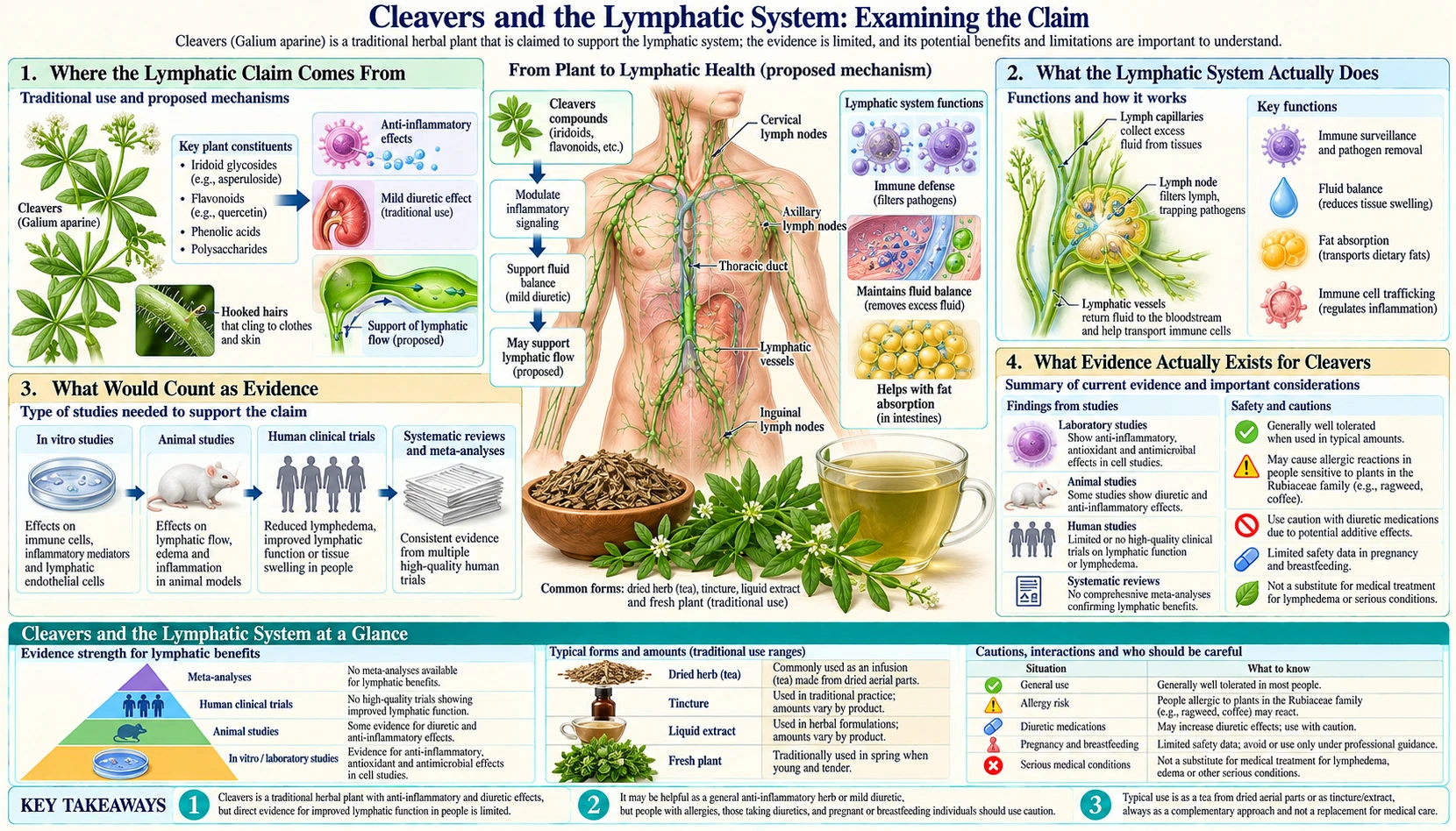
If you searched for cleavers, there is a good chance the phrase lymphatic tonic is what brought you here. It is by far the most repeated thing said about Galium aparine, and it is also the hardest claim about the plant to test. This page does not set out to mock it or to endorse it. It sets out to do something more useful: explain what the lymphatic system actually does, describe what a real measurement of "improved lymphatic function" would look like, and then place cleavers honestly against that standard. By the end you should be able to judge the claim yourself rather than take anyone's word for it — including ours.
Table of Contents
- Where the Lymphatic Claim Comes From
- What the Lymphatic System Actually Does
- What Would Count as Evidence
- What Evidence Actually Exists for Cleavers
- Ten Things Nobody Has Measured
- Why the Word "Tonic" Survives Being Untestable
- The Detox Framing Is a Different Claim Again
- Lymphoedema Is Real, and It Has Real Treatment
- Swollen Glands: Signs That Need a Diagnosis
- The Honest Place for Cleavers
- Key Research Papers
- Connections
- Featured Videos
Where the Lymphatic Claim Comes From
Cleavers entered the English herbal record as an alterative — an old category meaning a herb that slowly "corrects the constitution" or "cleanses the blood." Alteratives were the background herbs of a long treatment: burdock, red clover, nettle, yellow dock, cleavers. They were never expected to do anything dramatic in an afternoon.
The specific lymphatic label is more recent than most readers assume. It attaches to cleavers largely through nineteenth- and twentieth-century Anglo-American herbal writing, where the plant was recommended for "swollen glands," for enlarged tonsils, and for cystic or boggy swellings. Once anatomy had named the lymphatic vessels and nodes, an older observation — that this herb was given for lumps in the neck — was re-described in the new vocabulary. That re-description was reasonable bookkeeping. It was not a discovery. Nothing new had been measured; a traditional indication had simply been given a modern-sounding address.
This matters because the modern reader meets the claim in its re-described form. "Cleavers is a lymphatic tonic" sounds like a statement of pharmacology, the same type of sentence as "aspirin inhibits cyclo-oxygenase." It is not. It is a traditional indication wearing anatomical clothing. Recognising that is not an attack on the tradition — it is reading the label correctly.
What the Lymphatic System Actually Does
Most descriptions of cleavers assume you already know what lymph is. Most readers do not, and that vagueness is exactly where unfalsifiable claims live. So, plainly:
Your blood capillaries leak, and they are supposed to. Under the pressure gradients Ernest Starling described more than a century ago, fluid and small proteins are continually pushed out of capillaries into the spaces between your cells, and most — but not all — is reabsorbed. The remainder, a few litres a day in an adult, has to get back to the bloodstream somehow. That returning fluid is lymph, and the vessels carrying it are the lymphatic system.
Three features of that system decide whether "lymphatic tonic" is even a coherent idea:
- There is no lymphatic heart. Lymph moves because the collecting vessels contract rhythmically themselves — each valved segment, a lymphangion, carries smooth muscle and behaves like a small pump in series with its neighbours — and because skeletal muscle contraction, breathing and arterial pulsation squeeze the vessels from outside. One-way valves prevent backflow. This is why movement genuinely does assist lymph flow, and why immobility genuinely does hinder it.
- It is an immune organ, not merely plumbing. Lymph passes through nodes where antigen-presenting cells hand material to lymphocytes. A node swells because it is working — proliferating in response to something — or because something has invaded it. A swollen node is a signal, and the useful question is always what the signal is about, never how to make it smaller.
- It carries fat and it carries cells. Dietary long-chain fats leave the gut as chylomicrons in lymph, not in portal blood, and immune cells traffic through the system constantly. "Lymphatic flow" is therefore not a waste chute; it is a transport network doing several unrelated jobs at once.
The system has also been rewritten scientifically within living memory. Lymphatic vessels were identified in the dural coverings of the central nervous system in 2015, overturning the textbook statement that the brain had none — see PubMed: structural and functional features of central nervous system lymphatic vessels (Nature, 2015) and the companion description of a PubMed: dural lymphatic vascular system draining brain interstitial fluid (Journal of Experimental Medicine, 2015). If the basic anatomy was still being revised in 2015, the confident nineteenth-century vocabulary of "lymphatic cleansing" deserves proportionate humility. Worth adding: those discoveries are frequently cited in supplement marketing as if they supported herbal lymph products. They do not. They are anatomy.
If you would rather watch the mechanism than read about it, the site has an interactive lymphatic system visualization where you can drive the pump and deliberately break it.
What Would Count as Evidence
Here is the part most cleavers pages skip, and it is the part that actually settles the question. Lymphatic function is measurable. Researchers and clinicians measure it routinely, by several methods:
- Lymphoscintigraphy — a radiolabelled tracer injected into tissue and tracked as it moves up a limb. Transit time and nodal uptake are quantifiable.
- Near-infrared fluorescence lymphatic imaging with indocyanine green, which resolves individual contracting vessels and yields a contraction frequency and propulsion velocity in real time.
- Bioimpedance spectroscopy, which detects extracellular fluid accumulation in a limb before it is visible to the eye.
- Perometry or circumferential volume measurement, the workhorse endpoint of lymphoedema trials.
- Isotope clearance from a subcutaneous depot, a direct read on local removal rate.
So a genuine test of the cleavers claim is not exotic. It would look like this: recruit people, image lymphatic contraction frequency or measure limb volume, randomise them to a defined cleavers preparation or a matched placebo, re-measure. Nothing in that design is beyond an ordinary university department, and the endpoints are already validated because they have been used to evaluate compression garments, exercise regimens and manual drainage techniques.
It has not been done. That is the finding of this page, and it should be read as a result rather than a gap. Note what it does to the familiar defence that "nobody trials traditional herbs, so of course there is no evidence." In this case they could. The instruments exist, the outcome measures exist, the condition is common, and the plant is free and grows in every hedgerow in Europe. The absence of data is not a limitation of science; it is the absence of anyone having looked.
What Evidence Actually Exists for Cleavers
Search the literature and you find that essentially everything published on Galium aparine falls into three buckets, none of which concerns lymph:
- Phytochemistry. Iridoid glycosides have been isolated and characterised from the plant — see PubMed: iridoids from Galium aparine and a wider survey of the genus, in which 24 compounds, including 16 iridoid glucosides, were isolated from 19 Galium species with a nearly uniform iridoid pattern across most of them — PubMed: iridoid patterns in Galium L. (Zeitschrift für Naturforschung C, 2002). An anthraquinone aldehyde was isolated as well — in a paper about deterring insects rather than treating people: PubMed: antifeedant activity of an anthraquinone aldehyde in Galium aparine.
- In-vitro assays. Extract-level antioxidant and antimicrobial screens of the sort performed on hundreds of plants. A reasonable first pass; not evidence of anything happening in a person. Browse them via PubMed: Galium aparine antioxidant and antimicrobial extract studies.
- Weed science. Cleavers is an economically important arable weed in cereal crops, and a large share of papers carrying its name are about herbicide resistance and competition with wheat. Try PubMed: Galium aparine weed and herbicide research and note that by sheer volume this is the most active field of cleavers research in existence.
Now run the searches that matter and watch what happens: PubMed: Galium aparine lymphatic, then PubMed: Galium aparine lymphoedema, then PubMed: Galium aparine randomised controlled trial. What those three searches return is the honest content of this section. This page does not dress an empty result set as "emerging research."
One clarification, because it comes up. A handful of laboratory papers report that Galium extracts affect immune-cell behaviour or cytokine output in culture, and one 2024 study did so in immunosuppressed animals. In that study, animals whose immune systems had been suppressed with cyclophosphamide were given cleavers extract; spleen weight and spleen-cell (splenocyte) proliferation rose with the dose, natural killer (NK) cell activity rose significantly at the two higher doses, and IL-6, TNF-α and IFN-γ levels rose in stimulated spleen cells from treated animals. This concerns immune cells in animals, not lymph flow, and it has not been tested in people. Even taken at face value, an effect on lymphocytes in a dish or in an animal’s spleen is not an effect on lymphatic drainage. Those are two different systems that share a Greek root. Conflating them is one of the commonest sleights of hand in herbal writing about this plant.
Ten Things Nobody Has Measured
Absent data is easier to reason about when it is written out rather than implied. Each line below is a study that has not been published for Galium aparine:
- Lymphatic contraction frequency before and after dosing, in any species.
- Limb volume or bioimpedance change in anyone with measurable swelling.
- Lymphoscintigraphic transit time with and without the herb.
- Human pharmacokinetics of asperuloside or monotropein from a cleavers preparation — no absorption, distribution or half-life figures exist.
- A dose-response curve for any endpoint whatsoever, which is precisely why no honest source can hand you a milligram number.
- A fresh-versus-dried comparison, despite the tradition insisting emphatically that fresh is stronger.
- Content assay across harvest times and populations, so the iridoid content of the plant in your hand is genuinely unknown.
- Repeat-dose toxicology at any duration, in any animal.
- Interaction studies with diuretics, lithium, anticoagulants or anything else.
- Any controlled human trial, for any indication at all.
Read that as a description of the state of knowledge, not an accusation against the plant. Cleavers is not suspected of anything. It is un-investigated, which is a different and far more common condition — and what fits it is calibrated uncertainty rather than either enthusiasm or alarm.
Why the Word "Tonic" Survives Being Untestable
There is a reason "lymphatic tonic" has outlived sharper claims about cleavers. Vagueness is durable. A specific claim — "increases urine output by twenty per cent" — can be measured and can therefore fail. A claim that a herb "supports lymphatic drainage" has no defined endpoint, no dose, no timeframe and no failure condition. It cannot be falsified, so it cannot be refuted, so it survives indefinitely.
Naming this explains a pattern readers find genuinely confusing: the herbs with the most confident-sounding claims are often the least studied. Where trials exist, claims narrow and become boring. Where trials do not exist, claims stay broad and appealing. Confidence of language runs inversely to weight of evidence more often than anyone would like.
Set it against a lymphatic intervention that has actually been evaluated. Manual lymphatic drainage has been examined in systematic reviews — see PubMed: manual lymphatic drainage for lymphoedema following breast cancer treatment (Cochrane review) — and the conclusions are modest, hedged and conditional, because that is what real evidence about a real therapy usually looks like. A herb with no endpoint at all can promise more than a therapy with a measured one. That asymmetry is a property of the language, not of the biology.
The Detox Framing Is a Different Claim Again
Most "cleavers for lymph" content slides quickly into "cleavers for detox," and the two deserve separating, because they fail for different reasons.
The lymphatic claim is untested. The detox claim is ill-defined. In its marketing sense, "detox" rarely names a toxin, a measurement or an excretory route. Where those three things are named, you are in clinical medicine: chelation for documented heavy-metal poisoning, N-acetylcysteine for paracetamol overdose, dialysis for renal failure. Each has an identified substance, a measured concentration and a quantified clearance. A commercial cleanse tea has none of the three, which is what makes the claim unanswerable rather than merely unproven.
A critical review of commercial detox diets in the Journal of Human Nutrition and Dietetics put it bluntly, finding no compelling controlled evidence that such regimens eliminate any specific toxin or produce sustained weight loss — see PubMed: detox diets for toxin elimination and weight management, a critical review of the evidence. Nothing in the cleavers literature exempts it. Meanwhile the actual detoxification apparatus — hepatic phase I and phase II metabolism, biliary excretion, renal filtration and tubular secretion — runs continuously and has no idle setting for a tea to switch off. The site's page on detox protocols works through the general form of this argument.
One honest concession. People who start a "lymph cleanse" usually also drink more water, eat more vegetables and move more during the same fortnight, and they often genuinely feel better. The error is attributing that to the herb. The behaviours are doing the work.
Lymphoedema Is Real, and It Has Real Treatment
This is the most important section here, because it is where a harmless herbal belief can turn into a delayed diagnosis.
Lymphoedema is a chronic condition in which lymph fails to drain adequately from a body part, producing swelling that becomes progressively fibrotic if untreated. It has identifiable causes: surgical removal or irradiation of lymph nodes (most often in breast, gynaecological, urological or melanoma treatment), primary developmental abnormalities of the lymphatic vessels, severe chronic venous disease, obesity, and — worldwide, most commonly of all — lymphatic filariasis. It is not a vague sluggishness. It is a diagnosable condition with a formal staging system.
It also has an established management standard, usually called complete decongestive therapy, combining:
- Compression — multilayer bandaging during the intensive phase, then correctly fitted flat-knit garments for maintenance. This is the backbone of treatment, not an accessory to it.
- Manual lymphatic drainage by a trained therapist: a specific light-pressure sequence, nothing like a deep-tissue massage.
- Exercise and movement, since muscle contraction is a real pump for lymph rather than a metaphorical one.
- Meticulous skin care, because cellulitis is the main acute complication and every episode further damages drainage.
- Weight management, which has a measurable effect on limb volume.
- Surgery in selected cases — lymphovenous anastomosis, vascularised lymph node transfer, debulking procedures.
For the consensus framing of diagnosis and staging see the International Society of Lymphology’s 2023 consensus document, PubMed: the diagnosis and treatment of peripheral lymphoedema (Lymphology 56(4):133–151), and for the evidence base behind the physical therapies, PubMed: complete decongestive therapy for lymphoedema, systematic reviews.
The Cochrane review of manual lymphatic drainage after breast cancer treatment included six small trials (24 to 45 participants each). In two trials, compression bandaging alone gave per cent reductions in excess arm volume of 30% to 38.6%, and adding manual lymphatic drainage gave an additional 7.11% reduction (83 participants). For symptoms such as pain and heaviness, 60% to 80% of participants reported feeling better regardless of which treatment they received. The site’s pages on lymphedema and manual lymphatic drainage cover the condition and the therapy in more depth.
None of that is replaceable by an infusion, and no peer-reviewed source has suggested otherwise. Persistent swelling in a limb — particularly after cancer surgery or radiotherapy — is what lymphoedema clinics and certified lymphoedema therapists assess. Compression fitted early prevents fibrosis that is much harder to reverse later, which is the entire argument in one line: the cost of trying cleavers instead is not the herb. It is the months.
Swollen Glands: Signs That Need a Diagnosis
The traditional indication for cleavers was swollen glands, and this is exactly where an outdated framework becomes risky, because "swollen glands" spans everything from a viral sore throat to lymphoma.
Most enlarged lymph nodes are reactive and settle on their own. But a node warrants prompt medical assessment rather than herbal management when it is:
- persistent beyond a few weeks with no obvious infection to explain it;
- hard, fixed, rubbery or painless rather than tender and mobile;
- larger than roughly two centimetres, or steadily growing;
- supraclavicular — just above the collarbone — at any size, since this location carries a high rate of serious underlying disease;
- accompanied by unexplained fever, night sweats, weight loss or generalised itching;
- generalised, appearing in more than one region at once;
- accompanied by spreading redness, heat and fever, which suggests cellulitis needing antibiotics promptly.
The site's pages on swollen lymph nodes and lymphoma set out the diagnostic pathway. The reason a list like this belongs on a herb page is simple: the most plausible harm from cleavers is not toxicity. It is a fortnight of "let me try the lymph tea first."
The Honest Place for Cleavers
So where does that leave a plant with a real tradition and no data? Somewhere quite specific, and not nowhere:
- It is a genuine piece of Western herbal heritage, recorded across centuries of English-language herbals, and worth knowing for that reason alone.
- It is a wild spring green with an authentic food history, including the roasted-seed coffee substitute that its membership of the coffee family, the Rubiaceae, makes rather charming.
- In ordinary tea amounts it is a mild, low-drama herb with no documented pattern of harm — while remembering that this reflects thin surveillance as much as genuine safety.
- It is not a treatment for lymphoedema, swollen glands, cancer, infection or "congestion" of any organ.
- Its lymphatic reputation sits at one evidence tier only: traditional use. Not preclinical. Not preliminary. Not emerging. Tradition.
That is a smaller claim than the internet makes for it, and it has the advantage of being true. If you enjoy a cold infusion of fresh cleavers in April because it tastes green, costs nothing and grows on your fence, that is a perfectly good reason to drink it. It simply is not a medical one.
Key Research Papers
Because the direct literature is empty, the reading below is deliberately in two parts: the real cleavers literature, then the physiology and clinical evidence you would need in order to evaluate the claim at all. Entries are live PubMed topic searches or PubMed records, so you can inspect the result set yourself instead of taking a citation on trust.
- PubMed: Galium aparine lymphatic — the search that ought to return the evidence for the central claim. Note the outcome carefully.
- PubMed: Galium aparine lymphoedema — the same question aimed at the one condition where lymphatic drainage is definitely impaired.
- PubMed: Galium aparine randomised controlled trial — the entire trial literature for the plant, across all indications.
- PubMed: iridoids from Galium aparine — isolation work establishing that the plant contains asperuloside-type iridoid glycosides. Chemistry, not effect.
- Mitova MI, Anchev ME, Handjieva NV, Popov SS: iridoid patterns in Galium L. and some phylogenetic considerations, Zeitschrift für Naturforschung C (2002) — 19 Galium species, 16 iridoid glucosides; genus-wide mapping of iridoid chemistry in the genus cleavers belongs to. — PubMed PMID: 12064718
- PubMed: antifeedant activity of an anthraquinone aldehyde in Galium aparine — a madder-family pigment isolated from cleavers, in a study of insect deterrence rather than human medicine. — PubMed PMID: 12009319
- Lee SY, Park SY, Park HJ: immuno-enhancing effects of Galium aparine L. in cyclophosphamide-induced immunosuppressed animal models, Nutrients (2024) — immune-cell effects in animals, not lymph flow. — PubMed PMID: 38474724
- PubMed: Galium aparine antioxidant and antimicrobial extract screens — the in-vitro layer, to be read as screening output and not as a health outcome. — Search PubMed
- PubMed: structural and functional features of central nervous system lymphatic vessels, Nature (2015) — evidence of how recently this system's basic anatomy was still being rewritten. — PubMed PMID: 26030524
- PubMed: a dural lymphatic vascular system draining brain interstitial fluid, Journal of Experimental Medicine (2015) — the companion 2015 finding, and one routinely misappropriated by supplement marketing. — PubMed PMID: 26077718
- PubMed: near-infrared fluorescence imaging of human lymphatic contraction frequency — the imaging technique that turns "does this change lymph flow?" into an answerable question. — Search PubMed
- PubMed: lymphangion contraction physiology — the intrinsic pump described in section two, and the reason movement matters more than any infusion.
- PubMed: manual lymphatic drainage for lymphoedema after breast cancer treatment, Cochrane review — what a properly evaluated lymphatic intervention looks like, qualifications included. — PubMed PMID: 25994425
- PubMed: peripheral lymphoedema consensus document, International Society of Lymphology, 2023 revision, Lymphology 56(4):133–151 — staging, diagnosis and the accepted standard of care. — PubMed PMID: 39207406
- PubMed: detox diets for toxin elimination and weight management, a critical review — the general evidential position on commercial cleanse regimens. — PubMed PMID: 25522674
- PubMed: evaluation of lymphadenopathy in adults, including supraclavicular nodes — the clinical reasoning underlying the red-flag list above. — Search PubMed