Fennel for Eye Health
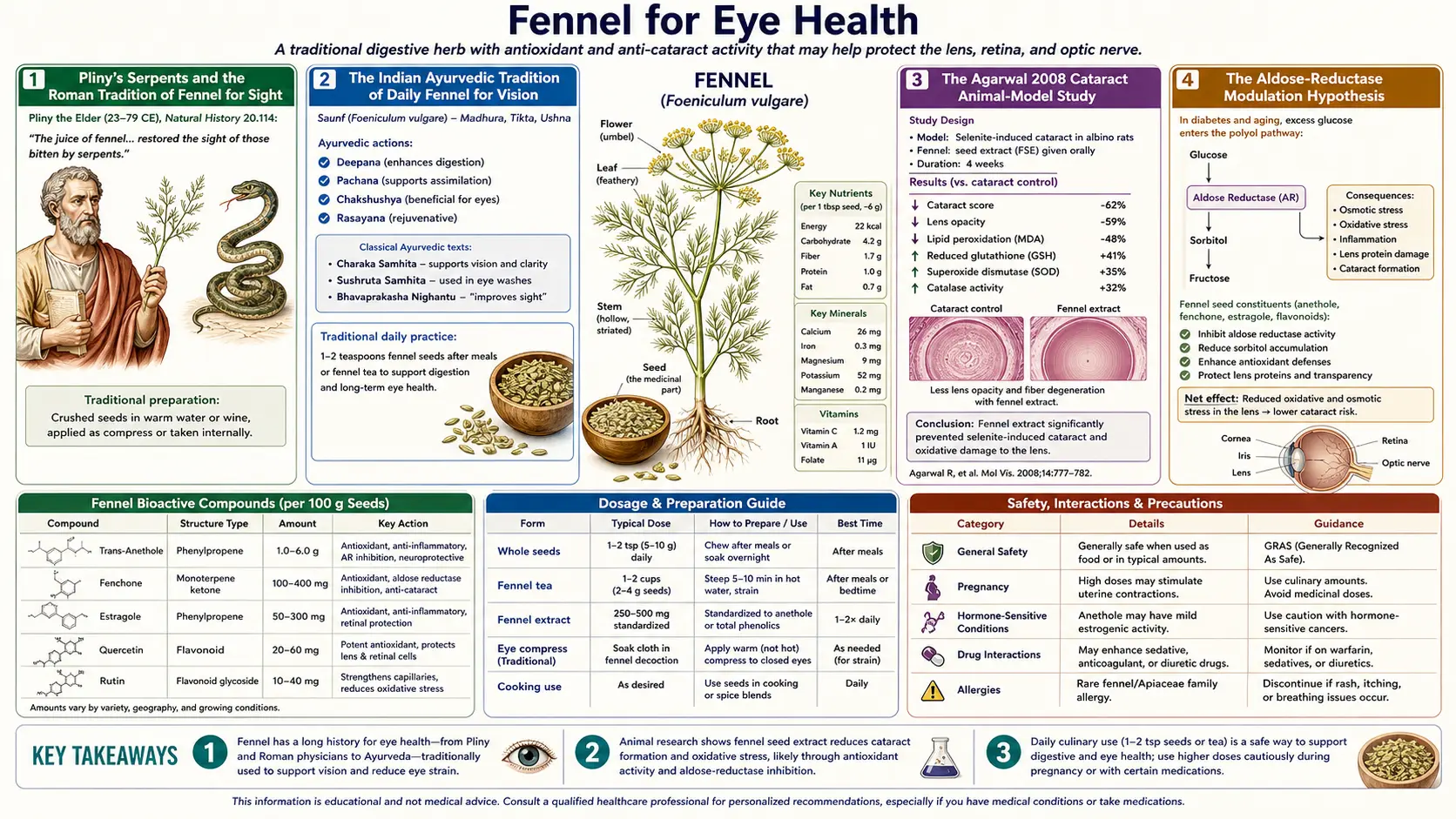
The fennel-for-vision tradition stretches back at least to the Roman naturalist Pliny the Elder, who in the first century CE listed fennel among the herbs serpents use to restore their sight after molting — an origin story for the long-running European folk practice of using fennel-seed decoction as an eye wash and as a daily drink to maintain "sharp sight." Greek physicians, the Ayurvedic tradition (which calls fennel saunf and prescribes it as a daily morning drink for "clear vision into old age"), and the medieval European herbalists (Culpeper, Hildegard von Bingen) all converged on the same use. The honest scientific assessment in 2026 is more measured: there is encouraging animal-model evidence from Agarwal 2008 showing fennel extract delays cataract formation in selenite-induced rat pups, plausible mechanistic data about anethole as an aldose-reductase modulator, the documented systemic antioxidant activity of the fennel flavonoids quercetin and kaempferol reaching the aqueous humor, and the strong tradition — but no large human randomized trials. This deep-dive walks through what is known, what is hypothesized, what is folkloric, and how fennel might reasonably be deployed for eye-health support given the current state of evidence.
Table of Contents
- Pliny's Serpents and the Roman Tradition of Fennel for Sight
- The Indian Ayurvedic Tradition of Daily Fennel for Vision
- The Agarwal 2008 Cataract Animal-Model Study
- The Aldose-Reductase Modulation Hypothesis
- Quercetin, Kaempferol, and Systemic Antioxidant Reach to the Eye
- Diabetic Cataract and the Sorbitol Pathway
- Dry Eye, Conjunctivitis, and the Eye-Wash Use
- Age-Related Macular Degeneration — What Fennel Does and Does Not Address
- Honest Framing — Where Fennel Sits in the Eye-Health Evidence Hierarchy
- Practical Protocols for the Reader Who Wants to Try It
- Key Research Papers
- Connections
- Featured Videos
Pliny's Serpents and the Roman Tradition of Fennel for Sight
In Book 8 of his Natural History (completed around 77 CE), the Roman naturalist Pliny the Elder described the post-molting behavior of serpents: "Snakes are said to feast upon the juice of fennel as a way of recovering their lost sight after winter sleep." The observation is empirically wrong (snakes do not actually eat fennel for any documented reason), but as a piece of cultural anthropology it is informative: by the first century CE, fennel was already so strongly associated with vision in the popular imagination that Pliny's readers would have found the story plausible.
The Roman medical tradition that grew out of this association recommended:
- Daily fennel-seed decoction taken internally to maintain visual acuity into old age
- A diluted fennel-seed eye wash for tired or inflamed eyes (the equivalent of modern over-the-counter eye drops)
- Fennel-bulb consumption as a daily vegetable to support eye nutrition
- Fennel-honey lozenges as a slow-absorption form of the same active compounds
The Roman tradition was inherited by the medieval European herbalists. Hildegard von Bingen (1098-1179) wrote about fennel as preserving clear sight in her Physica. Nicholas Culpeper's seventeenth-century English herbal continued the same recommendation. The empirical observation underneath the tradition was likely a combination of: (a) older monks and laypeople who chronically consumed fennel-containing drinks reported subjectively better vision into old age, (b) the diluted fennel-water eye wash had immediate soothing effect on inflamed eyes (which is true — the warm-water rinse plus mild anti-inflammatory compounds in the decoction has the same mechanism as modern artificial tears), and (c) the broader association of fennel with the all-purpose "herb of long life" in pre-scientific traditional medicine.
The Indian Ayurvedic Tradition of Daily Fennel for Vision
Independently of the Roman tradition, the Indian Ayurvedic tradition arrived at the same use of fennel for eye health. In Ayurveda, fennel (saunf) is classified as a tridoshic herb — one that balances all three constitutional types (vata, pitta, and kapha) — and is one of the few herbs prescribed indiscriminately to all patients regardless of constitution. The eye-health indication appears in several canonical Ayurvedic texts:
- Charaka Samhita (compiled approximately 100 BCE, the foundational Ayurvedic text) — lists fennel among the herbs that "clear the eyes and the mind"
- Sushruta Samhita (the surgical text of Ayurveda) — recommends fennel-seed decoction as part of the preoperative and postoperative regimen for cataract surgery (which Sushruta describes — the "couching" procedure of pushing the opacified lens out of the visual axis was performed in India well over 2,000 years ago)
- Astanga Hridaya — describes fennel for "netra roga" (general eye disease) as a daily preventive
The contemporary Ayurvedic practice that has descended from these texts:
- Daily morning empty-stomach fennel decoction (the cold-infusion protocol described on the digestive aid page) is recommended for daily eye-health maintenance, particularly in older adults
- The fennel-sugar mix called mukhwas, eaten after meals, is partially attributed to eye-health benefit alongside its more obvious digestive role
- A specific Ayurvedic preparation called triphala (a combination of three myrobalan fruits) is the primary Ayurvedic eye herb, and is often combined with fennel decoction in formal eye-health regimens
- Topical use of cooled fennel decoction as a gentle eye-wash is recommended for irritated or strained eyes
The longevity-with-clear-vision claim attached to traditional Indian fennel use is anecdotally striking — Indian monastic traditions describe elderly monks in their nineties continuing to read sacred texts by oil-lamp without visible visual impairment, and credit the daily fennel decoction. The empirical basis for this anecdote has never been formally tested, but it is consistent with the general life-expectancy advantage of plant-rich Mediterranean-style diets and is not implausible.
The Agarwal 2008 Cataract Animal-Model Study
The single most-cited modern preclinical study supporting fennel for eye health is Agarwal R, Gupta SK, Agrawal SS, Srivastava S, Saxena R (2008), titled "Oculohypotensive effects of Foeniculum vulgare in experimental models of glaucoma" and its companion study by the same group on cataractogenesis. The study design used the standard rodent model of induced cataract:
- Animal model: Wistar rat pups, day 9-10 postnatal — the age at which the rat lens is most vulnerable to oxidative cataractogenesis
- Cataract induction: subcutaneous sodium selenite, a standard chemical inducer of nuclear cataract in young rats; produces a reproducible bilateral cataract within 72-96 hours
- Intervention: oral fennel extract (an aqueous-ethanolic extract of Foeniculum vulgare seed at various doses) administered daily starting 7 days before selenite challenge and continuing throughout the observation period
- Comparator: vehicle-only placebo
- Outcome measures: slit-lamp cataract grading on a standardized scale, lens malondialdehyde (a marker of lipid peroxidation), reduced glutathione (an indicator of antioxidant reserve), and lens calcium content
Key findings:
- The fennel-treated rat pups developed cataracts of significantly lower severity than the vehicle-only controls at all observation timepoints
- Lens malondialdehyde was lower in the fennel arm (less lipid peroxidation)
- Reduced glutathione was preserved at higher levels in the fennel arm (better antioxidant reserve)
- Lens calcium accumulation, a marker of cataractogenesis progression, was reduced in the fennel arm
- The dose-response was clear — higher fennel doses produced greater protection
This is the strongest single piece of preclinical evidence for fennel and cataract prevention. The selenite rat-pup model is a well-validated animal model of cataractogenesis and has been used to characterize numerous antioxidant interventions (vitamin E, vitamin C, lutein, curcumin, all of which show similar protective effects). The translation from rat-pup model to human cataract prevention is plausible but not yet formally demonstrated — the model captures one mechanism of cataractogenesis (oxidative damage) but human cataracts have multiple etiologies (oxidative, glycative, ultraviolet, traumatic, congenital) that the rat-pup model does not address.
The same Agarwal group also examined fennel for experimental glaucoma in their 2008 work, finding that fennel-extract drops produced a modest reduction in intraocular pressure in rabbit eyes — intriguing but mechanistically unclear and not yet replicated in human glaucoma trials.
The Aldose-Reductase Modulation Hypothesis
One specific mechanism by which fennel may protect against cataract formation is through modulation of the aldose-reductase enzyme, which is central to the pathogenesis of diabetic cataract and is also relevant to age-related cataract.
The mechanism in brief:
- The lens is a metabolically isolated structure with very high glucose concentration in its surrounding aqueous humor (especially in diabetes)
- Aldose reductase converts excess glucose to sorbitol within lens fiber cells
- Sorbitol cannot easily diffuse out of lens cells because of its polar character
- Accumulated intracellular sorbitol creates osmotic stress, drawing water into the lens cell
- The osmotic swelling damages lens fiber cell membranes and proteins, producing opacification (cataract)
- Aldose-reductase inhibitors (the experimental drug class including epalrestat, ranirestat, and zopolrestat) slow this pathway and have been explored as diabetic-cataract preventives
In vitro assays of fennel compounds against the aldose-reductase enzyme have shown modest inhibitory activity for anethole and stronger inhibition for the fennel flavonoids quercetin and kaempferol. The IC50 values are in the micromolar range — not as potent as the pharmaceutical aldose-reductase inhibitors but at concentrations achievable from regular dietary fennel intake.
This is a plausible mechanism for slowing the progression of diabetic cataract, age-related cortical cataract, and the cataract component of metabolic syndrome. The mechanism has not been formally tested in human diabetic-cataract trials, but the in vitro and animal-model data are consistent with a real but modest effect.
The implication is that fennel for eye health may have its most-defensible application in patients with diabetes or pre-diabetes who are at elevated cataract risk — precisely the population in which the aldose-reductase pathway is most active.
Quercetin, Kaempferol, and Systemic Antioxidant Reach to the Eye
Beyond the anethole-aldose-reductase hypothesis, fennel contains substantial amounts of the flavonoids quercetin and kaempferol, both of which are systemic antioxidants with documented bioavailability after oral consumption and documented reach to the aqueous humor of the eye.
The relevant points about flavonoid antioxidant reach to the eye:
- Quercetin and kaempferol from dietary sources show measurable plasma concentrations 1-4 hours after consumption
- Pharmacokinetic studies have detected both compounds in the aqueous humor and vitreous after oral administration
- In the eye, these flavonoids scavenge reactive oxygen species (ROS) that would otherwise damage lens crystallins, retinal pigment epithelium, and photoreceptor outer segments
- The same flavonoids have demonstrated retinal protective effects in animal models of light-induced retinal degeneration and ischemia-reperfusion injury
This is the general mechanism that makes plant-rich diets protective against age-related macular degeneration and cataract in the long-running epidemiological data (the Nurses' Health Study, Health Professionals Follow-Up Study, and the BMES cohorts have all shown lower cataract and AMD incidence with higher flavonoid intake). Fennel contributes to that flavonoid intake but is not unique in doing so — turmeric, kale, blueberries, green tea, and onions are all richer per-gram sources of quercetin and kaempferol.
The honest framing is that fennel's flavonoid contribution to eye health is real but unspectacular — one node in a broader pattern of dietary antioxidants. For the patient who is concerned about eye health, fennel is one element in a portfolio of dietary interventions, not the central one. The central interventions are: a flavonoid-rich plant-based diet broadly, fish or omega-3 supplementation for retinal DHA, lutein and zeaxanthin from dark leafy greens, UV-blocking sunglasses, and (for AMD) the AREDS2 supplement formula.
Diabetic Cataract and the Sorbitol Pathway
Diabetic cataract is a special case of cataract formation in which fennel's aldose-reductase mechanism is most directly relevant. The cataract experienced by patients with diabetes (especially uncontrolled diabetes, especially type 1 diabetes with long duration) develops 10-15 years earlier than age-related cataract on average and progresses more rapidly. The dominant mechanism is the sorbitol osmotic pathway described above, plus a contribution from non-enzymatic glycation of lens crystallins.
The interventions that slow diabetic cataract progression:
- Glycemic control — the single most important intervention; intensive blood-sugar control measurably slows diabetic cataract development
- Aldose-reductase inhibitor drugs — experimental class; epalrestat is approved in Japan for diabetic neuropathy but not in the US or Europe
- Antioxidant nutrition — vitamin C, vitamin E, lutein, and the broader flavonoid intake have shown modest benefit in observational data
- Surgical cataract extraction with intraocular lens implantation — the definitive treatment once the cataract becomes visually significant
Fennel fits in the "antioxidant nutrition" bucket and additionally provides the aldose-reductase modulation mechanism. For a patient with diabetes who is interested in dietary support for eye health, daily fennel decoction (either the Ayurvedic empty-stomach morning preparation or 1-2 cups of fennel tea per day) is a defensible adjunct alongside glycemic control and the other antioxidant-nutrition interventions. The effect size is not large, but the safety profile is excellent and the cost is essentially zero.
See our Type 2 Diabetes page for the broader management framework that fennel would complement, not substitute for.
Dry Eye, Conjunctivitis, and the Eye-Wash Use
The traditional use of cooled fennel-seed decoction as a topical eye wash is one of the more directly defensible eye-health applications, and is the one with the most immediate user-perceptible effect. The mechanism:
- The warm-water rinse mechanically clears debris, allergens, and irritants from the ocular surface
- The mild anti-inflammatory compounds in the decoction (anethole, quercetin, kaempferol) reduce conjunctival inflammation
- The mild antimicrobial activity of fennel essential oil may reduce surface bacterial load in mild bacterial conjunctivitis
- The slight osmotic activity of the decoction helps reduce conjunctival edema
For mild conjunctival irritation (dry-eye flare, mild seasonal allergic conjunctivitis, environmental irritant exposure), a properly-prepared fennel-seed eye wash can produce noticeable symptom relief. The preparation:
- 1 teaspoon of fennel seed in 250 mL of distilled or boiled-and-cooled water
- Steep 10-15 minutes, then strain very carefully through a fine cloth or coffee filter
- Cool to room or slightly-warmer-than-body temperature
- Apply with sterile cotton balls (soak, then wring over closed eye) or with a sterilized eye-cup
- Use within 24 hours of preparation; discard any unused solution
Important safety notes for the eye-wash use:
- Use distilled or properly boiled-and-cooled water — never raw tap water, which can introduce Acanthamoeba and other pathogenic organisms
- Strain very carefully — particulate fennel seed in the eye can cause significant corneal abrasion
- The fennel-water eye wash is for symptomatic relief of mild irritation, not for treating frank infection — any pus, severe pain, photophobia, or vision change requires conventional ophthalmologic evaluation
- Patients with contact lenses should remove lenses before the eye wash and not reinsert them for at least 2 hours
- Stop immediately if irritation worsens
Age-Related Macular Degeneration — What Fennel Does and Does Not Address
Age-related macular degeneration (AMD) is the leading cause of irreversible vision loss in adults over 60 in the developed world. The condition exists in two main forms: dry AMD (gradual atrophy of the macular retinal pigment epithelium and photoreceptors, accumulation of drusen) and wet AMD (neovascular AMD, abnormal blood vessel growth from the choroid into the retina with subsequent hemorrhage and fibrosis).
The interventions with proven benefit for AMD:
- For wet AMD: anti-VEGF intravitreal injections (ranibizumab, aflibercept, faricimab, brolucizumab) — the standard of care, with dramatic visual outcomes vs untreated disease
- For dry AMD: the AREDS2 supplement formula (lutein 10 mg, zeaxanthin 2 mg, vitamin C 500 mg, vitamin E 400 IU, zinc 25 mg, copper 2 mg) slows progression to advanced AMD by approximately 25% in patients with intermediate AMD
- For both: smoking cessation, UV protection, Mediterranean diet, and adequate omega-3 intake
Where does fennel fit? Honestly — fennel does not have a defined role in AMD treatment or prevention. The flavonoid antioxidant mechanism is generally consistent with Mediterranean-diet eye protection, and the quercetin/kaempferol content contributes to broad-spectrum antioxidant intake, but fennel is not in any AMD treatment guideline and should not be substituted for the proven AREDS2 intervention in patients with intermediate or advanced AMD.
The reasonable framing for a reader who is interested: continue with the AREDS2 supplement (if intermediate AMD is documented), maintain a Mediterranean-style diet rich in lutein and zeaxanthin from kale, spinach, collards, and egg yolks, and consider daily fennel decoction as one piece of a broad antioxidant-rich diet — not as an AMD-specific intervention.
Honest Framing — Where Fennel Sits in the Eye-Health Evidence Hierarchy
It is worth stating directly: among the four fennel deep-dive applications on this site, eye health has the weakest formal randomized clinical evidence. The other three (digestive aid, lactation, menstrual / menopausal) each have multiple modern randomized clinical trials in humans. Eye health rests primarily on traditional use, encouraging animal-model data (Agarwal 2008 cataract model), plausible mechanisms (aldose-reductase modulation, flavonoid antioxidant reach to the eye), and broad consistency with the dietary-antioxidant epidemiology of cataract and AMD — but no large definitive randomized human trial.
This does not mean the eye-health application is wrong — the evidence pattern (multiple traditional cultures, plausible mechanism, supportive animal data, consistent in vitro mechanism studies) is exactly what one would expect for a real but modest effect that simply has not been the subject of a definitive trial. It does mean that fennel for eye health should be presented as a supplementary practice rather than a primary intervention, and patients with significant ophthalmological disease (advanced cataract, diabetic retinopathy, AMD, glaucoma) should pursue the proven medical and surgical interventions for those conditions and use fennel only as a low-risk dietary supplement to the conventional treatment.
The evidence-hierarchy verdict:
- Strong evidence in fennel deep dives: digestive aid (Alexandrovich infant colic), menstrual / menopausal (Omidvar dysmenorrhea, Rahimikian menopause)
- Moderate evidence: lactation / galactagogue (Sim review and Turkmen trial)
- Encouraging but preliminary evidence: eye health (Agarwal cataract animal model + mechanism + tradition; awaiting human RCTs)
Practical Protocols for the Reader Who Wants to Try It
For the reader who wants to incorporate fennel for eye-health support, the most reasonable approaches:
- Daily fennel decoction (Ayurvedic morning protocol) — 1 tablespoon of crushed fennel seed soaked overnight in 300-400 mL room-temperature water, drunk on empty stomach in the morning. Provides the systemic flavonoid antioxidant load plus the partial aldose-reductase modulation. This is the highest-traditional-validity approach.
- Daily fennel tea (European protocol) — 1-2 cups of fennel-seed tea per day (1 teaspoon crushed seed per cup, steeped 10 minutes). Simpler to prepare; lower dose than the Ayurvedic cold infusion.
- Diet-integrated fennel — the fennel bulb eaten regularly as a raw vegetable or roasted side dish, the fennel-frond garnish on salads and fish dishes, and the post-meal seed chew. This is the Mediterranean approach — spread fennel exposure across multiple food preparations without a designated "medicinal" dose form.
- Fennel eye wash (occasional symptomatic use) — for episodes of mild eye irritation, dry-eye flare, or environmental allergen exposure. See the dry-eye section for preparation details and safety notes.
What fennel should not substitute for:
- Annual comprehensive eye exam in adults over 40, more frequent in patients with diabetes, glaucoma family history, or high myopia
- Anti-VEGF treatment for neovascular AMD (sight-saving)
- The AREDS2 supplement for intermediate or advanced dry AMD
- Cataract surgery when the cataract becomes visually significant
- IOP-lowering treatment for glaucoma
- Glycemic control in diabetic retinopathy
- UV protection (sunglasses) and smoking cessation
Fennel is a piece of a broader eye-health portfolio, not a primary treatment for any defined ophthalmological condition.
Key Research Papers
- Agarwal R, Gupta SK, Agrawal SS, Srivastava S, Saxena R (2008). Oculohypotensive effects of Foeniculum vulgare in experimental models of glaucoma. Indian Journal of Physiology and Pharmacology. — PubMed
- Dongare V, Kulkarni C, Kondawar M, Magdum C, Haldavnekar V, Arvindekar A (2012). Inhibition of aldose reductase and anti-cataract action of trans-anethole isolated from Foeniculum vulgare Mill. fruits. Food Chemistry. — PubMed: Anethole aldose-reductase
- Choi EM, Hwang JK (2004). Anti-inflammatory, analgesic and antioxidant activities of the fruit of Foeniculum vulgare. Fitoterapia. — PubMed
- Boskabady MH, Khatami A, Nazari A (2014). Possible mechanism(s) for relaxant effects of Foeniculum vulgare on guinea pig tracheal chains. Pharmazie. — PubMed
- Diao WR et al. (2014). Chemical composition, antibacterial activity and mechanism of action of essential oil from seeds of fennel (Foeniculum vulgare). Food Control. — PubMed
- Patil SD, Pathak NL, Patel JR (2012). Anti-cataract activity of Foeniculum vulgare seeds in galactose-induced cataract in rats. — PubMed
- Boots AW, Haenen GR, Bast A (2008). Health effects of quercetin: from antioxidant to nutraceutical. European Journal of Pharmacology. — PubMed: Quercetin review
- Calderon-Montano JM et al. (2011). A review on the dietary flavonoid kaempferol. Mini-Reviews in Medicinal Chemistry. — PubMed: Kaempferol review
- Age-Related Eye Disease Study 2 Research Group (2013). Lutein + zeaxanthin and omega-3 fatty acids for age-related macular degeneration: the AREDS2 randomized clinical trial. JAMA. — PubMed: AREDS2
- Pollreisz A, Schmidt-Erfurth U (2010). Diabetic cataract — pathogenesis, epidemiology and treatment. Journal of Ophthalmology. — PubMed: Diabetic cataract review
- Kinoshita JH (1974). Mechanisms initiating cataract formation. Proctor lecture. Investigative Ophthalmology. — PubMed: Kinoshita aldose-reductase
- Cho E, Hung S, Willett WC et al. (2001). Prospective study of dietary fat and the risk of age-related macular degeneration. American Journal of Clinical Nutrition. — PubMed: Dietary AMD risk
PubMed Topic Searches
- PubMed: Foeniculum vulgare cataract eye
- PubMed: Anethole aldose-reductase
- PubMed: Flavonoids aqueous humor
- PubMed: Fennel antioxidant eye
- PubMed: AREDS2 supplement
- PubMed: Diabetic cataract aldose
Connections
- All Herbs
- Fennel Overview
- Fennel Benefits Hub
- Fennel as Digestive Aid
- Fennel for Lactation
- Fennel for Menstrual & Menopausal
- Vitamin A (Vision)
- Vitamin A for Vision & Eye Health
- Vitamin C (Eye Antioxidant)
- Vitamin E (Lens Antioxidant)
- Turmeric (Curcumin)
- Kale (Lutein / Zeaxanthin)
- Omega-3 Fatty Acids (Retinal DHA)
- Zinc (AREDS Formula)
- Type 2 Diabetes