⚠ Evidence warning: Clinical trials or other evidence do not support the claim that haritaki is more tannin-dense than tea by weight. This page keeps it as a report of what people, websites or other media say.
Haritaki — Benefits Deep Dive
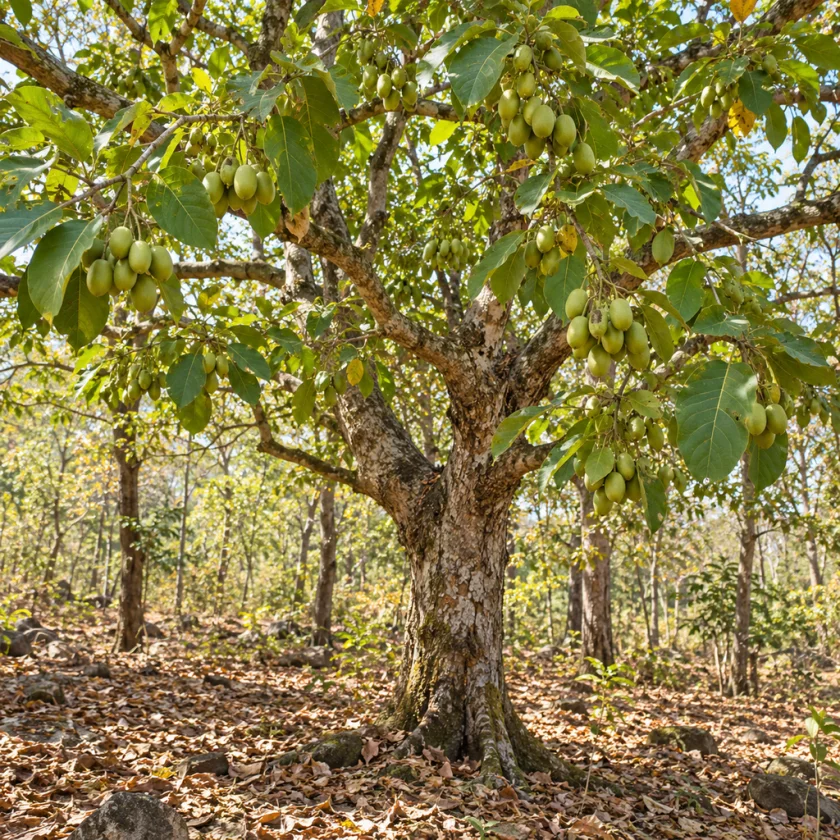
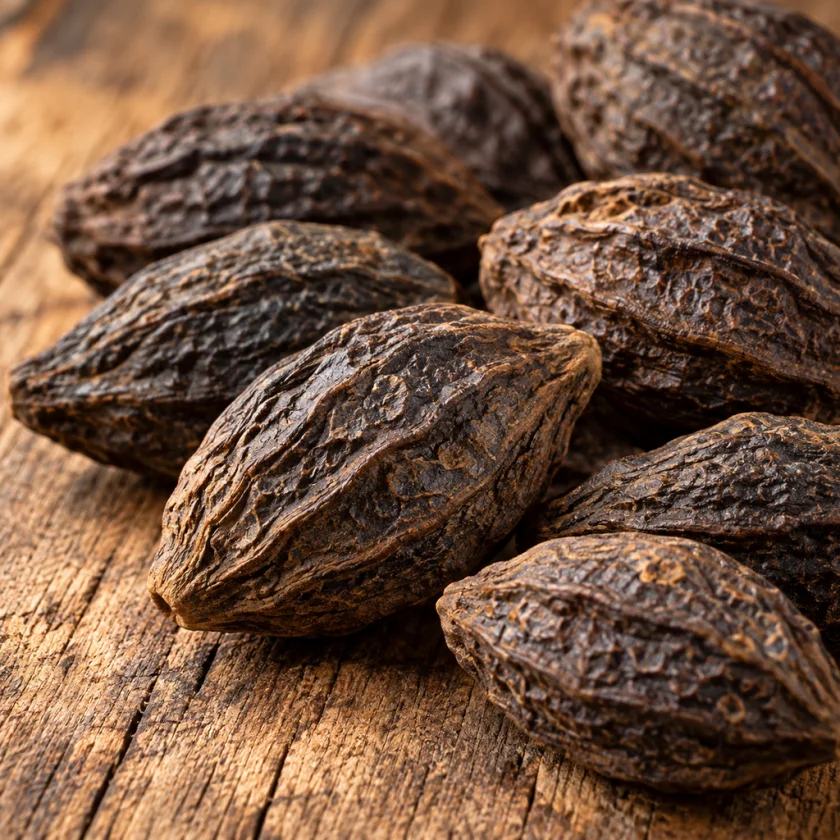
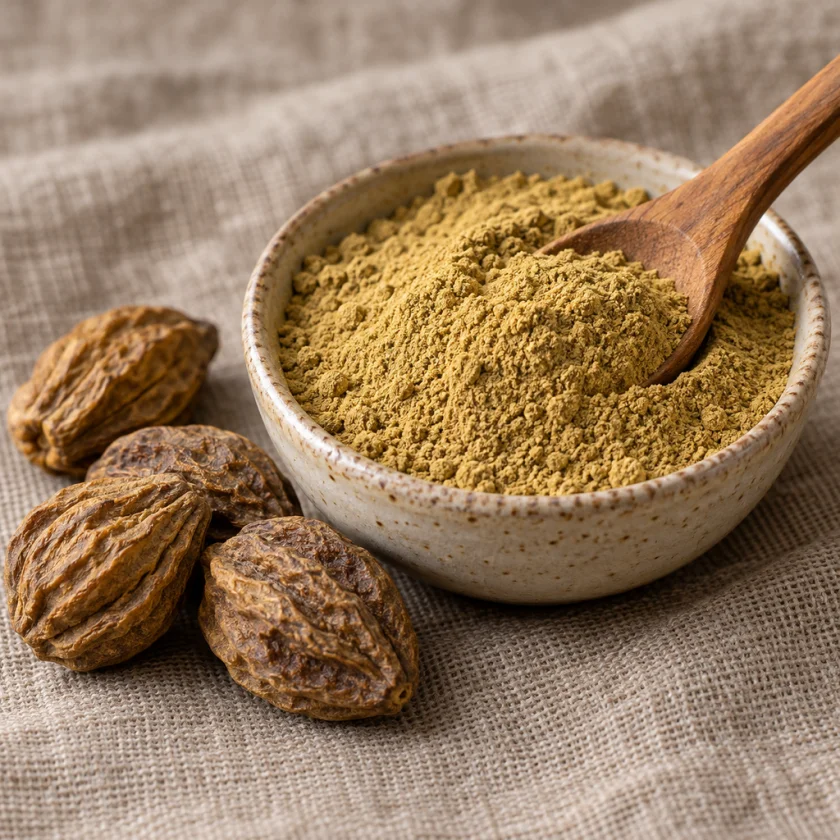
Haritaki is the dried fruit of Terminalia chebula, and it is one of the most talked-about herbs in Ayurveda — sold as a bowel regulator, a rejuvenative, a “brain tonic”, a detoxifier and, in some corners of the internet, as a treatment for almost everything. These four deep-dive articles take the four claims that actually have something behind them and separate what has been tested in people from what has only been tested in a dish or a rodent, or never tested at all.
There is one thing to understand before reading any research on haritaki, and it changes what nearly every citation shows. Haritaki is the first of the three fruits in Triphala — the classical Ayurvedic mixture of Terminalia chebula (haritaki), Terminalia bellirica (baheda or bibhitaki) and Emblica officinalis, now usually written Phyllanthus emblica (amla). Almost all of the human clinical evidence people cite for “haritaki” was collected on Triphala, not on haritaki alone. A Triphala result cannot be attributed to haritaki: amla contributes ascorbic acid that neither Terminalia fruit has, baheda has its own distinct tannin profile, and no trial has ever dismantled the mixture to see which fruit did what. Every page in this set labels the difference explicitly, because supplement marketing systematically does not.
The honest hierarchy, stated once up front:
- Bowel regulation — the traditional use, near-universal across Ayurvedic, Tibetan, Unani and Persian practice, with a plausible chemical basis but no adequate controlled trial of the single herb. Traditional use plus mechanism, not proof.
- Oral health — the only place where randomised human trials genuinely exist. Several small trials of a T. chebula or Triphala mouthrinse report plaque and gingivitis reductions comparable to chlorhexidine. Small, short, mostly single-centre. Comparable in a small trial is not equivalent.
- Metabolic and lipid effects — a coherent laboratory story (α-glucosidase inhibition, peroxisome proliferator-activated receptor gamma (PPARγ) signalling) and one well-designed European randomised trial of a Triphala-containing product that came out negative on cholesterol. Preliminary at best.
- Everything else — anticancer, antiviral, neuroprotective, anti-ageing. Cell culture and rodents only. Interesting chemistry, no clinical claim.
Table of Contents
- Deep-Dive Articles
- The Triphala Problem
- Evidence Map: Tier by Tier
- The Tannin Caveat That Applies to Every Benefit
- Key Research: Bowel and Digestion
- Key Research: Oral Health
- Key Research: Metabolic and Lipids
- Key Research: Tannins, Iron and Absorption
- Key Research: Chemistry and Toxicology
- External Resources
- Connections
- Featured Videos
Deep-Dive Articles
Digestion and Constipation
The use haritaki is actually famous for. Why it is not simply a weaker senna, how a small anthraquinone fraction and a very large tannin fraction pull in opposite directions at low and high dose, why Traditional Chinese Medicine uses the same fruit to stop diarrhoea, and why nightly stimulant laxative use for years is not a benign habit however old the tradition.
Read the deep dive →Oral Health and Gums
The strongest modern evidence strand, and it is a mouthrinse you spit out rather than a capsule you swallow. Small randomised trials against 0.2% chlorhexidine, honest trial sizes, what “non-inferior in a 60-day single-centre study” does and does not license you to say, and the staining and taste trade-off that makes the comparison interesting at all.
Read the deep dive →Metabolic and Cholesterol Health
Carbohydrate-enzyme inhibition, peroxisome proliferator-activated receptor gamma signalling by chebulagic acid, and the rodent glucose data — set against the one properly blinded European trial of a Triphala preparation for high cholesterol, which found no benefit over placebo. Includes the hypoglycaemia stacking risk for anyone on metformin, a sulfonylurea or insulin.
Read the deep dive →Triphala, Dosing and Safety
What Triphala is, why its evidence keeps being borrowed for single-herb products, the traditional dose ranges and why there is no evidence-based dose, plus the practical safety list: iron absorption, the two-hour spacing rule for medicines, pregnancy, children, product quality and heavy-metal contamination of imported Ayurvedic products.
Read the deep dive →The Triphala Problem
This deserves its own section because it is the single most common error in writing about haritaki, and it is made by supplement labels, by wellness sites and sometimes by review articles.
Triphala is a three-herb formula. Equal parts by weight, traditionally, of haritaki (Terminalia chebula), baheda (Terminalia bellirica) and amla (Emblica officinalis / Phyllanthus emblica), although classical texts and commercial products both vary the ratio. It is the most widely used compound preparation in Ayurveda and it is what almost every human study in this field actually administered.
Why the substitution is not harmless. The three fruits are chemically different in ways that matter for exactly the outcomes being claimed:
- Amla is a genuine ascorbic acid source; the two Terminalia fruits are not. Ascorbate is a reducing agent that promotes non-haem iron absorption, which is the opposite of what haritaki's tannins do. A mixture containing amla therefore does not predict what haritaki alone does to iron status — and iron is the most consequential practical issue with this herb.
- Haritaki carries the highest tannin load of the three and the signature molecules chebulagic and chebulinic acid; the others contribute different galloyl and ellagitannin profiles. A 2024 Scientific Reports metabolome study by Hegde and colleagues profiled all three fruits side by side precisely because nobody could otherwise say which contributed what.
- The traditional rationale for combining them is that they balance each other. Ayurveda does not treat Triphala as three interchangeable laxatives; it treats the combination as doing something the parts do not. If you accept the tradition's reasoning about the formula, you cannot then also claim the formula's trial results for one fruit.
How to read a citation. When a haritaki product cites “clinical research”, the intervention line of the study shows what was actually tested. If it says Triphala, the study is evidence about Triphala. That is still useful — a bowel-regulating formula containing haritaki working in people is worth knowing — but it is a different claim from one about haritaki alone.
The site has pages for the other two fruits: Amla — Triphala and digestive use covers the same formula from the amla side, and Baheda covers the third fruit.
Evidence Map: Tier by Tier
Every claim in these four articles is labelled with one of four tiers. They are used consistently so you can skim for them.
- Randomized clinical trial — a controlled human trial. In this topic that means, in practice, the mouthrinse trials and the negative cholesterol trial, and almost nothing else. Where the intervention was Triphala rather than haritaki, the label says so.
- Preliminary — animal or in-vitro. Most of the haritaki literature. Genuinely informative about mechanism, silent about outcome. Haritaki extracts score spectacularly on laboratory antioxidant assays for a boring chemical reason: hydrolysable tannins donate electrons superbly in a test tube. That number tells you nothing about a person who swallows the powder, because large tannins are poorly absorbed intact and what reaches the blood is mostly bacterial metabolites.
- Traditional use only — documented, consistent, sometimes for well over a thousand years, and not evidence of effect. It is a guide to where researchers look, and the bowel use is the most consistent of these traditions.
- Caution — a documented or strongly predicted harm. The tannin–iron interaction and the absorption-interference problem sit here, and they are better characterised than most of the benefits.
The Tannin Caveat That Applies to Every Benefit
Haritaki is among the most tannin-dense medicinal fruits in ordinary use, and specifically it is rich in galloyl-bearing hydrolysable tannins — the structural class that human absorption studies single out as the strong inhibitors of non-haem iron uptake. Brune, Rossander and Hallberg reported in European Journal of Clinical Nutrition in 1989 that the inhibition tracks the number of galloyl groups, while catechin added to a test meal caused no inhibition; they concluded that condensed tannins do not appear to interfere with iron absorption. Hurrell, Reddy and Cook showed in British Journal of Nutrition in 1999 how large the everyday version of the effect is with polyphenol-rich beverages: black tea reduced iron absorption from a bread meal by 79–94% and cocoa by 71%.
Three practical consequences that recur on every page in this set:
- Iron. The iron effect matters most for people who are iron-deficient, anaemic, pregnant, menstruating heavily, donating blood, or eating a plant-based diet that depends on non-haem iron; for them it is the herb's headline problem rather than a footnote. See iron deficiency and ferritin testing.
- Other medicines. Tannins bind many drug molecules non-specifically in the gut, and haritaki's bowel effect shortens transit time, which shortens the window for absorption of anything else. The effect depends on timing, which is why a gap of about two hours either side of medication is commonly described; it matters most for narrow-margin drugs.
- The gut itself. Astringent, tannin-heavy preparations commonly cause nausea, cramping and loose stools before they cause anything else, particularly on an empty stomach or at the doses some products suggest.
Key Research: Bowel and Digestion
Tier: traditional use, plus preliminary animal work. No adequate controlled trial of single-herb haritaki as a laxative exists.
- Nigam and colleagues, Phytotherapy Research, 2020 — “Fruits of Terminalia chebula Retz.: a review on traditional uses, bioactive chemical constituents and pharmacological activities”. The standard modern review and the best single starting point. PubMed PMID: 32307775.
- Wang and colleagues, Molecules, 2024 — a comprehensive review of T. chebula covering traditional uses, phytochemistry, pharmacology, toxicity and pharmacokinetics. Useful specifically for the pharmacokinetic section, which is where the gap between test-tube potency and oral exposure becomes visible. PubMed PMID: 39683707.
- Peterson, Denniston and Chopra, Journal of Alternative and Complementary Medicine, 2017 — a review of the therapeutic uses of Triphala, including its gastrointestinal and microbiome-related effects. Read it as a map of claims, not as an evidence appraisal. PubMed PMID: 28696777.
- Antispasmodic and gut-motility work on Terminalia species in isolated rodent tissue — consistent with a smooth-muscle effect, and rodent tissue is not a person. Topic search.
- Laxative and gastrointestinal-transit studies of T. chebula and Triphala in animal models — the whole literature, so you can see how thin the human end of it is. Topic search.
Key Research: Oral Health
Tier: randomized clinical trial — the only strand with real human data, mostly on Triphala rather than haritaki alone, all of it small and short.
- Pradeep and colleagues, Journal of Periodontology, 2016 — a randomised controlled trial of a Triphala mouthwash for chronic generalised gingivitis, with placebo and 0.2% chlorhexidine arms, ninety participants, followed to 60 days. Both active rinses beat placebo and the two active rinses did not differ significantly from each other. PubMed PMID: 27442086. Triphala, not haritaki alone.
- Naiktari and colleagues, Journal of Periodontal and Implant Science, 2014 — a randomised clinical trial comparing Triphala mouthwash with 0.2% chlorhexidine in hospitalised patients with periodontal disease. PubMed PMID: 24921057. Triphala, not haritaki alone.
- Jagtap and Karkera, Journal of Ethnopharmacology, 1999 — the early work on an aqueous extract of Terminalia chebula as an anticaries agent, including its effect on salivary bacterial counts. One of the few strands that is genuinely about haritaki alone. PubMed PMID: 10624892.
- T. chebula mouthrinse versus chlorhexidine, plaque and gingival indices — the accumulated small trials, several of them in schoolchildren and adolescents, several crossover in design. Sample sizes are small. Topic search.
- Systematic reviews and meta-analyses of Triphala versus chlorhexidine — favourable conclusions drawn from that same limited base, which is the honest way to describe them. Topic search.
Key Research: Metabolic and Lipids
Tier: preliminary (cell and rodent) for the mechanism; one randomized clinical trial of a Triphala-containing product, and it was negative.
- Donato and colleagues, Complementary Medicine Research, 2021 — a placebo-controlled, double-blind randomised trial of a guggul-plus-Triphala preparation for high cholesterol in ninety people over three months. No benefit over placebo on total or low-density lipoprotein (LDL) cholesterol, or on body mass index (BMI) or waist circumference, and a small excess of hypersensitivity rash in the herb group. The best-designed trial in this area and the one least often quoted. PubMed PMID: 33242870.
- Shyni and colleagues, BioFactors, 2014 — chebulagic acid from T. chebula enhanced insulin-mediated glucose uptake in 3T3-L1 adipocytes, apparently via peroxisome proliferator-activated receptor gamma signalling. Cell culture. PubMed PMID: 25529897.
- Carbohydrate-digesting-enzyme inhibition by Terminalia and Triphala extracts — α-amylase, α-glucosidase and dipeptidyl peptidase-4 (DPP-IV) inhibition in vitro with glucose-lowering in diabetic rodent models. Plausible, and a long way from a clinical endpoint. Topic search.
- Human trials of Triphala or its Unani equivalent for obesity and metabolic outcomes — a handful of small randomised studies with mixed and generally modest results. Topic search.
- Terminalia chebula and lipid profile — the animal and human literature together, so the imbalance is visible. Topic search.
Key Research: Tannins, Iron and Absorption
Tier: human absorption studies — ironically the best-established human pharmacology on this page, and it concerns a harm rather than a benefit.
- Brune, Rossander and Hallberg, European Journal of Clinical Nutrition, 1989 — iron absorption and phenolic compounds, establishing that galloyl group number drives the inhibition and that condensed tannins do not behave the same way. This is the mechanistic anchor for the whole caution. PubMed PMID: 2598894.
- Hurrell, Reddy and Cook, British Journal of Nutrition, 1999 — inhibition of non-haem iron absorption in man by polyphenol-containing beverages, with black tea among the strongest inhibitors tested (79–94%) and cocoa at 71%. Haritaki is more tannin-dense than tea by weight. PubMed PMID: 10999016.
- Thankachan and colleagues, American Journal of Clinical Nutrition, 2008 — iron absorption in young Indian women, and how iron status interacts with tea and ascorbic acid. One or two cups of black tea cut iron absorption from a rice meal by 49–67%, and the inhibition was similar in women with iron-deficiency anaemia and in women with normal iron stores. PubMed PMID: 18400710.
- Tannin–drug and polyphenol–drug interaction in the gut — the general literature behind the two-hour spacing practice. Topic search.
Key Research: Chemistry and Toxicology
Tier: analytical chemistry and rodent toxicology. Establishes a margin, not human safety.
- Dhanani, Shah and Kumar, Journal of Chromatographic Science, 2015 — a validated high-performance liquid chromatography (HPLC) method for gallic acid, corilagin, chebulagic acid, ellagic acid and chebulinic acid across four Indian Terminalia species. The reference point for reading a certificate of analysis. PubMed PMID: 25190275.
- Han and colleagues, Journal of Separation Science, 2006 — preparative isolation of chebulagic and chebulinic acids from T. chebula by high-speed counter-current chromatography. PubMed PMID: 16922284.
- Pfundstein and colleagues, Phytochemistry, 2010 — characterisation, quantitation and antioxidant capacities of the polyphenols in T. bellerica, T. chebula and T. horrida fruits. A useful corrective to marketing antioxidant figures. PubMed PMID: 20451939.
- Kim and colleagues, Phytotherapy Research, 2012 — mutagenicity and oral toxicity studies of Terminalia chebula. PubMed PMID: 21538627.
- Hegde and colleagues, Scientific Reports, 2024 — comparative metabolome profiling of T. chebula, T. bellerica and P. emblica, done explicitly to work out what each fruit contributes to Triphala. PubMed PMID: 39738152.
- Heavy-metal contamination of imported Ayurvedic and traditional herbal products — a repeatedly documented problem. Topic search.
External Resources
- PubMed — Terminalia chebula, all literature. Then filter to clinical trials only to see how short the list becomes.
- PubMed — Triphala and Triphala randomised trials. Comparing these two lists is the fastest way to see the problem this hub describes.
- PubMed Central — free full text, which matters here because much of this literature is in journals without institutional access.
- ClinicalTrials.gov — registered Triphala trials. Registered, which is not the same as completed or published.
- U.S. National Center for Complementary and Integrative Health (NCCIH) — Ayurvedic Medicine: In Depth. Includes the US National Institutes of Health position on quality and heavy-metal contamination of Ayurvedic products.
- MedlinePlus — herbs and supplements index.
- Plants of the World Online (Kew) — for settling botanical identity and synonymy, which matters because “myrobalan” alone identifies at least four unrelated plants.
Connections
- All Herbs
- Haritaki (Terminalia chebula) — the main topic page: botany, names, compounds, forms, dosage and cautions.
- Amla / Indian Gooseberry — the third fruit of Triphala, and the only one that is a real vitamin C source.
- Amla — Triphala and Digestive Use — the same formula viewed from the amla side.
- Baheda (Terminalia bellirica) — the second fruit, haritaki's closest relative here.
- Senna — the stimulant laxative haritaki is constantly compared with, and the one whose mechanism is actually nailed down.
- Senna — Dependence and Long-Term Risk — the best case on this site for why nightly laxative use needs a reason.
- Constipation — causes, red flags and the non-herbal measures that come first.
- Gingivitis — the condition the mouthrinse trials were actually treating.
- Periodontitis — where the stakes are higher and a herbal rinse is an adjunct at best.
- Iron Deficiency — why the tannin interaction is the headline caution rather than a footnote.
- Ferritin — the blood test that measures the body's iron stores.
- Vitamin C — the counterweight to tannin inhibition of iron absorption.
- Cholesterol Management — context for the negative Triphala lipid trial.
Safety and disclaimer. This page is health information, not medical advice, and nothing here is a treatment recommendation. Haritaki is a bowel-active, strongly tannin-rich herb with almost no single-herb human trial evidence. Its laxative action adds to fluid loss during diarrhoea or dehydration and to the strain on the bowel in a suspected bowel obstruction, an inflammatory bowel disease flare or unexplained abdominal pain. There is no human safety data for pregnancy or breastfeeding. Its tannins lower iron absorption, which matters most for people who are iron-deficient or anaemic. The same tannins can bind medicines in the gut, and the shorter gut transit time leaves less time for them to be absorbed, which is why a gap of about two hours from medicines is commonly described. The drugs where lower absorption matters most are glucose-lowering drugs (where adding a glucose-lowering herb also raises the risk of low blood sugar), thyroid hormone, anticonvulsants, digoxin, lithium, immunosuppressants and oral contraceptives. New, persistent or changing bowel symptoms, rectal bleeding, unexplained weight loss or anaemia are warning signs that doctors investigate for an underlying bowel disease.