Haritaki for Metabolic and Cholesterol Health
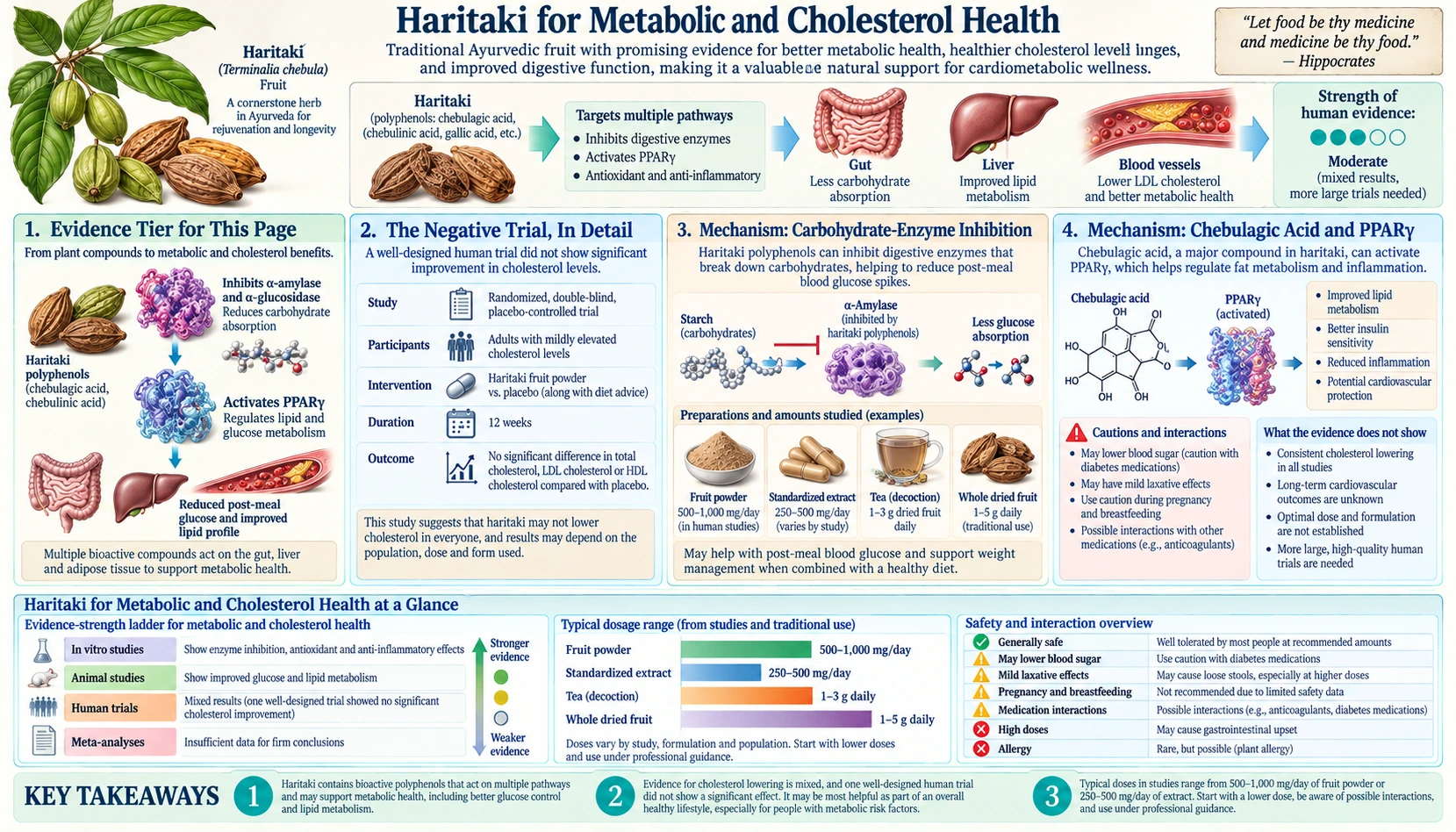
Haritaki is widely sold for blood sugar, cholesterol and weight, and there is a genuinely coherent laboratory story behind those claims — carbohydrate-enzyme inhibition, a plausible receptor-level effect on insulin signalling, and consistent glucose-lowering in diabetic rodents. It is the sort of mechanism package that makes a compelling product page.
It is also the area where the largest placebo-controlled trial found here came out negative. A placebo-controlled, double-blind randomised trial in Italy by Donato and colleagues, published in Complementary Medicine Research in 2021, gave ninety people with high cholesterol a guggul-plus-Triphala preparation or placebo three times daily for three months. Total and low-density lipoprotein (LDL) cholesterol, body mass index (BMI) and waist circumference all failed to separate from placebo, and there was a small excess of hypersensitivity rash in the herb group. That trial is rarely quoted in marketing material, and it belongs at the top of this page rather than the bottom. Two smaller double-blind trials report positive results and are described below.
As everywhere in this topic, note what was tested. Almost every human metabolic study used Triphala — haritaki plus baheda plus amla — and often in combination with yet another herb. The exception found is a 2020 trial that used an aqueous T. chebula extract alone. A three- or four-herb result cannot be assigned to haritaki. That distinction is particularly sharp here, because amla has its own metabolic literature and is the fruit most likely to be doing the work in any positive Triphala metabolic finding.
Table of Contents
- Evidence Tier for This Page
- The Negative Trial, In Detail
- Mechanism: Carbohydrate-Enzyme Inhibition
- Mechanism: Chebulagic Acid and PPARγ
- The Rodent Glucose Data
- The Bioavailability Gap That Undercuts It All
- Lipids: Claimed Versus Shown
- Why Amla Confounds Every Triphala Result
- Weight Loss, “Detox” and the Laxative Illusion
- The Hypoglycaemia Stacking Risk
- What Can Be Monitored in People Who Take It
- What Actually Moves These Numbers
- Key Research Papers
- Connections
- Featured Videos
Evidence Tier for This Page
- Randomized clinical trial — negative. The Donato trial of a guggul-plus-Triphala preparation for high cholesterol. Placebo-controlled, double-blind, three months, ninety participants. No benefit on the primary lipid outcomes. Multi-herb formula, not haritaki alone.
- Randomized clinical trials — positive, small, not repeated. Pingali 2020 (haritaki extract alone, 60 people with type 2 diabetes, blood-vessel function) and Kamali 2012 (a Triphala formula, 62 obese adults, body weight). Both double-blind and placebo-controlled.
- Preliminary (in vitro). α-amylase, α-glucosidase and dipeptidyl peptidase-4 (DPP-IV) inhibition; chebulagic acid and insulin-mediated glucose uptake in cultured adipocytes via peroxisome proliferator-activated receptor gamma (PPARγ).
- Preliminary (animal). Glucose-lowering and lipid effects of T. chebula and Triphala extracts in diabetic and high-fat-fed rodent models.
- Traditional use only. Haritaki as a rasayana and digestive corrective. Ayurveda did not have blood glucose or low-density lipoprotein cholesterol as concepts, so nothing in the tradition speaks directly to these endpoints.
- Caution. Additive glucose-lowering with diabetes medication is biologically plausible and unquantified; tannins reduce iron and drug absorption; and the metabolic framing invites people to substitute a herb for treatment that works.
- Trial under way. A published 2026 protocol describes a double-blind trial of 220 people with type 2 diabetes and hemoglobin A1c of 8–10%, adding a six-herb Ayurvedic formula that contains haritaki, baheda and amla to their usual tablets for 180 days, with hemoglobin A1c as the main outcome. No results yet.
The Negative Trial, In Detail
Because negative trials are the ones that go missing, this one gets described properly.
Design. Donato and colleagues, Complementary Medicine Research, 2021. A placebo-controlled, double-blind, randomised trial in ninety people with hypercholesterolaemia, comparing a preparation containing guggul (Commiphora resin) plus Triphala against placebo, taken three times daily for three months. Primary outcomes were serum lipids.
Result. Total cholesterol fell 3.3% on the herb (46 people) and 1.9% on placebo (44 people), and low-density lipoprotein cholesterol fell 4.8% and 4.9% in the two arms, with no advantage to the herb. Body mass index and waist circumference likewise did not separate. The preparation did not beat placebo on the outcomes it was given for.
Harms. Two participants in the herb arm (4.3%) developed a hypersensitivity rash, and none did on placebo. That is a small number in a small trial and is not a large signal, but it is the direction of the asymmetry that matters: the herb arm had the rashes.
Why this trial carries weight. It is placebo-controlled, double-blind, adequately long for a lipid endpoint, and conducted outside the traditional-medicine research environment where nearly all the positive findings originate. Those are exactly the design features that positive Triphala studies most often lack.
Two things it does not show. It does not show that haritaki alone is useless for lipids — it tested a multi-herb product, and the guggul component muddies attribution as much as the Triphala component does. And it does not address blood glucose, which was not its endpoint. What it does show is that a placebo-controlled, double-blind test of a Triphala-containing product with lipids as its main outcome failed.
Mechanism: Carbohydrate-Enzyme Inhibition
Tier: preliminary (in vitro), with rodent support.
This is the most chemically believable of the metabolic mechanisms, and also the one whose limits are easiest to state.
The idea. Starch has to be broken down before it can be absorbed. Salivary and pancreatic α-amylase cut starch into oligosaccharides; intestinal brush-border α-glucosidases cut those into glucose. Inhibit either and starch digestion slows, glucose enters the blood more gradually, and the post-meal spike flattens. This is a real drug mechanism — acarbose works exactly this way.
Why haritaki does it. Hydrolysable tannins are broadly, non-specifically inhibitory of digestive enzymes because they bind proteins. That is the same chemistry that makes them astringent and that makes them bind iron. So haritaki extracts inhibit α-amylase and α-glucosidase in a test tube, and they do it well. Reports also describe inhibition of DPP-IV, the enzyme that degrades the incretin hormone glucagon-like peptide-1 (GLP-1), which is the target of the gliptin drug class.
Four reasons this is weaker evidence than it sounds:
- Non-specific protein binding is not selective pharmacology. A tannin that inhibits α-amylase in a cuvette also binds dietary protein, digestive proteases, and iron. “Inhibits enzyme X in vitro” is nearly a generic property of tannin-rich extracts rather than a distinctive property of haritaki.
- Concentration. In-vitro inhibition is demonstrated at concentrations that may not be achieved in the gut lumen at a realistic dose, and certainly not in blood.
- Acarbose sets the bar and shows the cost. Genuine intestinal α-glucosidase inhibition produces flatulence, bloating and diarrhoea, because undigested carbohydrate reaches the colon. A herb claimed to do this meaningfully should produce some of the same effects — and if it does not, that is evidence the inhibition is not clinically large.
- The endpoint is missing. No trial found has shown that haritaki reduces post-meal glucose excursions in people. One double-blind trial of haritaki extract alone, in 60 people with type 2 diabetes, measured hemoglobin A1c (HbA1c) (Pingali 2020), but its abstract gives no hemoglobin A1c figure and the full paper could not be read for this page.
Mechanism: Chebulagic Acid and PPARγ
Tier: preliminary (cell culture).
Shyni and colleagues reported in BioFactors in 2014 that chebulagic acid — one of haritaki's two signature tannins — enhanced insulin-mediated glucose uptake in 3T3-L1 adipocytes, a standard cultured fat-cell model, apparently through PPARγ signalling. The paper reports that signalling and fat-cell formation rose with dose “in a moderate way, less than rosiglitazone”, with more of the glucose transporter GLUT4 and more adiponectin, and it describes chebulagic acid as behaving like a partial agonist.
PPARγ is a nuclear receptor that governs adipocyte differentiation and insulin sensitivity, and it is the target of the thiazolidinedione (glitazone) drug class. So this is a mechanistically serious finding: it is not a vague antioxidant claim but a specific molecule acting on a specific receptor pathway relevant to insulin resistance.
And the caveats are equally specific:
- Cultured adipocytes are bathed in the compound. The cell sees a controlled concentration directly. A person who swallows haritaki does not deliver chebulagic acid to their fat cells at anything like that concentration — see the next section.
- PPARγ agonism is not automatically desirable. The glitazones improve insulin sensitivity and also cause fluid retention, weight gain, heart-failure risk and bone loss. A weak PPARγ effect from a herb is more likely to be too small to matter than to be a clean version of the drug.
- One molecule is not the herb. Chebulagic acid is one constituent of a complex extract, and its behaviour in isolation does not predict the extract's.
The Rodent Glucose Data
Tier: preliminary (animal).
Extracts of T. chebula and of Triphala consistently lower blood glucose in diabetic rodent models — usually streptozotocin-induced diabetes or high-fat, high-sugar diet models — and often improve lipid parameters in the same animals. Work formulating foods with all three Triphala herbs has reported enzyme inhibition together with glucose-lowering in diabetic rats.
This is real data and it justifies further study. What it does not do is establish a human effect, for reasons that are structural rather than a matter of study quality:
- Streptozotocin diabetes is not type 2 diabetes. It is chemically induced destruction of beta cells — closer to type 1 in mechanism. Many agents that lower glucose in that model do nothing for human insulin resistance.
- Doses are usually high on a milligram-per-kilogram basis, and scaling a rodent dose to a human is not a matter of multiplying by body weight.
- Rodent gut flora differ from human gut flora, which matters more for haritaki than for most herbs because most of the dose is metabolised by bacteria before anything systemic happens.
- The translation rate is poor. Plant extracts that lower glucose in rodents very often fail in human trials. That is the base rate, and it applies here.
The Bioavailability Gap That Undercuts It All
This section is why the mechanism package, however coherent, does not add up to a benefit — and it is the single most useful thing to understand about haritaki pharmacology.
Hydrolysable tannins are large, highly hydroxylated molecules that are poorly absorbed intact. Chebulagic and chebulinic acid are big galloyl-bearing structures; they do not cross the intestinal wall efficiently, and what does cross is a small fraction. Most of an oral dose travels to the colon, where the microbiota hydrolyse it into much smaller phenolics — gallic acid, pyrogallol, and urolithins from the ellagitannin fraction. Those metabolites, not the parent tannins, are what reach the bloodstream in any quantity, and their pharmacology is different.
So there is a systematic mismatch running through the whole metabolic literature:
- The in-vitro studies test parent tannins on cells or enzymes at controlled concentrations.
- The body mostly sees bacterial metabolites at low and variable concentrations.
- Therefore the effects most likely to survive in a person are the ones that happen in the gut lumen — enzyme inhibition, iron binding, effects on the microbiota, the bowel effect — and the ones least likely to survive are the systemic receptor-level ones such as PPARγ signalling in fat tissue.
Notice which way that cuts. The luminal effects that survive include the iron problem, which is a harm, and the reviews with pharmacokinetic sections — Wang and colleagues in Molecules in 2024 is the accessible one — set this out clearly. It is the same logic that explains why the mouthrinse evidence is the strongest strand in the whole topic: in the mouth, contact is direct and absorption is irrelevant.
Lipids: Claimed Versus Shown
Sorting the lipid claims by what supports them:
- Claimed: lowers total and low-density lipoprotein cholesterol, raises high-density lipoprotein (HDL), lowers triglycerides, reverses fatty liver, prevents atherosclerosis.
- Shown in rodents: improved lipid parameters in high-fat-fed and diabetic animals, often alongside glucose improvements. Preliminary (animal).
- Shown in vitro: antioxidant activity on low-density lipoprotein oxidation systems, and inhibition of pancreatic lipase in some extracts. Preliminary (in vitro).
- Shown in humans: the Donato trial, which found no lipid benefit over placebo. A 2020 double-blind trial gave 60 people with type 2 diabetes an aqueous haritaki extract (250 or 500 mg twice daily) or placebo for 12 weeks. Blood-vessel function improved more on haritaki (reflection index change -2.55% and -5.21% against +1.40% on placebo), and the authors report that other cardiovascular risk markers improved; it is one small trial and has not been repeated. A small number of other human studies of Triphala or Triphala-containing formulas report modest changes, many of them unblinded or uncontrolled, in small numbers, and with the multi-herb attribution problem. Randomized clinical trial of a formula — negative; one small positive trial of haritaki alone; plus weak uncontrolled data.
A plausible-but-unproven mechanism worth naming, because if haritaki does anything to lipids this is the most likely route: tannins bind bile acids in the gut, much as bile-acid sequestrant drugs do. Losing bile acids in the stool forces the liver to make more from cholesterol, which lowers serum cholesterol. Fibre and some polyphenols do this to a modest degree. It is a luminal mechanism, so unlike PPARγ it survives the bioavailability objection — but it has not been demonstrated for haritaki in people, and the Donato trial, with lipids as its main outcome, did not find the effect it predicts.
Why Amla Confounds Every Triphala Result
This deserves its own section because it is a specific, avoidable error.
Amla (Emblica officinalis / Phyllanthus emblica) has a metabolic literature of its own, including human trials on lipids and glucose, and it is the fruit in Triphala most often credited with metabolic effects. It is also the only one of the three that contributes meaningful ascorbic acid and a distinct polyphenol profile.
The consequence is simple. When a Triphala study reports a metabolic benefit, amla is at least as plausible a source of that benefit as haritaki, and there is no experiment in the literature that separates them. A haritaki product citing a positive Triphala metabolic result is therefore doing something worse than over-claiming — it is claiming a result that may belong to a different fruit. See Amla — Cholesterol and Metabolic Health for that side of the story.
Weight Loss, “Detox” and the Laxative Illusion
Haritaki and Triphala appear constantly in weight-loss and “detox” products, and the reason is not metabolic.
It is the bowel effect. Anything that empties the bowel produces a rapid drop on the scale that consists of stool and water. It reverses within a day or two of stopping. It is not fat loss, it does not improve any metabolic marker, and it is the same illusion that senna in weight-loss teas exploits.
Three real problems with using it this way:
- The dose creeps up. Weight-loss use pushes toward the purgative end of the dose range, which is where cramping, loose stools and fluid and potassium loss live.
- It overlaps with disordered eating. Laxatives used for weight control are a recognised pattern in eating disorders and cause real harm. A herbal label does not change that.
- The iron cost compounds. Daily high-dose tannin exposure in someone eating less food and less iron is a worse combination than either alone. See iron deficiency.
No human trial measuring fat loss from haritaki alone was found. The nearest is a Triphala formula: a 2012 double-blind trial gave 62 obese adults Itrifal Saghir (5 g twice daily) or placebo for 12 weeks and reported a mean weight difference of 4.82 kg and a waist difference of 4.01 cm in favour of the formula. It tests three fruits together, not haritaki alone. As for “detox”: the word does not correspond to a measurable process, and the organs that actually clear compounds are the liver and kidneys, neither of which is helped by emptying the colon.
The Hypoglycaemia Stacking Risk
Tier: caution — plausible, unquantified, and the reason this page has a practical warning at all.
Here is the honest asymmetry: the evidence that haritaki lowers blood glucose enough to help is weak, but the evidence is not weak enough to ignore the possibility that it lowers glucose enough to matter when stacked on medication. A herb with in-vitro α-glucosidase and DPP-IV inhibition, a PPARγ signal, and consistent rodent glucose-lowering is treated in this section as capable of additive effect, because nothing has shown otherwise.
The drugs where that matters:
- Insulin — the highest risk. Any added glucose-lowering effect can produce hypoglycaemia at an unchanged dose.
- Sulfonylureas (gliclazide, glipizide, glimepiride) — these push insulin secretion regardless of glucose level and cause hypoglycaemia on their own.
- Meglitinides (repaglinide, nateglinide) — same concern.
- Metformin — rarely causes hypoglycaemia alone, but the combination is worth watching.
- Acarbose or other α-glucosidase inhibitors — potentially the same mechanism twice, with additive gastrointestinal effects.
There is a second, quieter interaction that is arguably more likely than the first. Haritaki's tannins bind drug molecules in the gut, and its bowel effect speeds transit — so it can reduce absorption of the medicine taken with it. For a diabetes drug, that means erratic control in either direction. Two hours' separation from all medicines is a commonly repeated practice; no source that measured the gap was found.
Signs of hypoglycaemia to know: shakiness, sweating, hunger, palpitations, anxiety, confusion, difficulty concentrating, slurred speech, and in severe cases seizures or loss of consciousness. It is treated with fast-acting carbohydrate; seizures and loss of consciousness are signs that hospitals treat as urgent.
What Can Be Monitored in People Who Take It
People take it regardless, so the hazards and the measurements are set out here as facts. This is not a recommendation to start.
- Medication history. Herbal products are the most commonly omitted item in a medication history, so a change in glucose control on a glucose-lowering drug can go unexplained.
- Glucose. The usual caution for people on insulin or a sulfonylurea is more frequent glucose checks for the first two to three weeks, including before driving.
- Baseline and follow-up bloods. A lipid panel and hemoglobin A1c before starting and at about three months show whether anything is happening. Without a baseline there is nothing to compare.
- Ferritin and a full blood count. This is the haritaki-specific one. Long-term tannin exposure erodes iron stores quietly, and ferritin falls long before haemoglobin does.
- The two-hour gap from every medicine and from iron-containing meals or supplements is the commonly repeated spacing; no source that measured it was found.
- A stop date. Three months with no change in any measured number is an answer. Continuing indefinitely on the assumption that something invisible is happening is how supplements accumulate.
- Prescribed medication. No trial supports stopping or reducing prescribed medication on the strength of this herb, and low blood sugar and erratic control are the hazards when doses and a herb change together.
What Actually Moves These Numbers
It would be misleading to write this page without noting that the interventions with strong evidence for glucose and lipids are not herbal, and most of them are free.
- Weight loss where there is excess weight — the single most effective lever on insulin resistance, triglycerides and blood pressure together.
- Physical activity — improves insulin sensitivity independently of weight change, including resistance training, not just aerobic exercise.
- Replacing refined carbohydrate with whole foods. Whole fruit rather than juice, beans and lentils, brown rice and whole grains, nuts and seeds, plenty of vegetables, and eggs, fish and meat as they come rather than processed.
- Fibre, particularly viscous soluble fibre — oats and barley beta-glucan have a real, if modest, low-density lipoprotein-lowering effect. This is the evidence-backed version of the mechanism haritaki is speculated to share.
- Stopping smoking, and moderating alcohol — both act on lipids and cardiovascular risk directly.
- Sleep — short and disrupted sleep measurably worsens insulin sensitivity.
- Medication where indicated. Statins for cardiovascular risk and metformin for type 2 diabetes have outcome evidence — heart attacks and deaths prevented, not just numbers moved. No herb in this field has anything comparable.
See cholesterol management, type 2 diabetes and prediabetes for the substance of each.
Key Research Papers
Named papers link to their PubMed record; entries describing a body of work link to a PubMed topic search. Where the intervention was Triphala or a larger formula rather than haritaki alone, the entry says so.
- Donato F, Raffetti E, Toninelli G, et al. Guggulu and Triphala for the Treatment of Hypercholesterolaemia: A Placebo-Controlled, Double-Blind, Randomised Trial. Complementary Medicine Research, 2021 — guggul and Triphala for hypercholesterolaemia, a placebo-controlled, double-blind randomised trial in ninety people over three months. Negative on total and LDL cholesterol, BMI and waist circumference, with a small excess of hypersensitivity rash. Randomized clinical trial; multi-herb formula, not haritaki alone. PubMed PMID: 33242870
- Pingali U, Sukumaran D, Nutalapati C. Effect of an aqueous extract of Terminalia chebula on endothelial dysfunction, systemic inflammation, and lipid profile in type 2 diabetes mellitus: A randomized double-blind, placebo-controlled clinical study. Phytotherapy Research, 2020 — aqueous extract of Terminalia chebula alone, 250 or 500 mg twice daily against placebo, 60 people with type 2 diabetes, 12 weeks. Randomized clinical trial; haritaki alone. PubMed PMID: 32618037
- Kamali SH, Khalaj AR, Hasani-Ranjbar S, et al. Efficacy of 'Itrifal Saghir', a combination of three medicinal plants in the treatment of obesity; A randomized controlled trial. Daru, 2012 — Itrifal Saghir, a Triphala formula, 5 g twice daily against placebo, 62 obese adults, 12 weeks. Randomized clinical trial; three fruits, not haritaki alone. PubMed PMID: 23351558
- Chaudhary S, Das JR, Gavali K, et al. A Randomized Double-Blind Placebo-Controlled Multicentric Clinical Trial of an Ayurvedic Intervention, Varadi Kwatha Ghana Vati, as an Adjunct vs Treatment as Usual in the Management of Type-2 Diabetes Mellitus: A Study Protocol. Current Protocols, 2026 — protocol for a double-blind trial of Varadi Kwath Ghana Vati, a six-herb formula containing haritaki, baheda and amla, added to usual tablets for 180 days in 220 people with type 2 diabetes. Protocol; no results yet. PubMed PMID: 42467504
- Shyni GL, Kavitha S, Indu S, et al. Chebulagic acid from Terminalia chebula enhances insulin mediated glucose uptake in 3T3-L1 adipocytes via PPARγ signaling pathway. BioFactors, 2014 — chebulagic acid from Terminalia chebula enhanced insulin-mediated glucose uptake in 3T3-L1 adipocytes via PPARγ signalling. Preliminary (cell culture). PubMed PMID: 25529897
- Wang C, Zhang H, Wang X, et al. Comprehensive Review on Fruit of Terminalia chebula: Traditional Uses, Phytochemistry, Pharmacology, Toxicity, and Pharmacokinetics. Molecules, 2024 — comprehensive review of Terminalia chebula, including the pharmacokinetic section that documents poor absorption of the parent tannins. Review; the key corrective to in-vitro enthusiasm. PubMed PMID: 39683707
- α-amylase, α-glucosidase and DPP-IV inhibition by Triphala and Terminalia extracts, with glucose-lowering in diabetic rodent models. Preliminary (in vitro and animal); Triphala in most reports. Topic search
- Antidiabetic activity of Terminalia chebula in streptozotocin-induced and diet-induced rodent models. Preliminary (animal). Topic search
- Hamood MF, Abdaljaleel RA, Alsadwi AM. The Effect of Adding Terminalia chebula Powder to Broilers Subjected to Salmonella spp. on Performance, Immunity, Lipid Profile and Histology. Veterinary Medicine and Science, 2026 — Terminalia chebula powder and lipid profile in broiler chickens challenged with Salmonella. Preliminary (animal). PubMed PMID: 42777779
- Human trials of Triphala for obesity, weight and metabolic outcomes, including its Unani equivalent. Randomized clinical trials, small; Triphala, not haritaki alone. Topic search
- Metabolic and lipid trials of amla (Emblica officinalis / Phyllanthus emblica) — the fruit most plausibly responsible for any positive Triphala metabolic finding. Randomized clinical trials; a different fruit. Topic search
- Hegde SN, K LD, Choudhary M, et al. A comprehensive metabolome profiling of Terminalia chebula, Terminalia bellerica, and Phyllanthus emblica to explore the medicinal potential of Triphala. Scientific Reports, 2024 — comparative metabolome profiling of the three Triphala fruits, the groundwork needed before any effect can be attributed to one of them. Analytical chemistry. PubMed PMID: 39738152
- Tannins, polyphenols and bile-acid binding in the intestine — the luminal mechanism by which a tannin-rich food could plausibly lower cholesterol. Preliminary / mechanistic. Topic search
- Colonic microbial metabolism of ellagitannins and gallotannins to urolithins and simple phenolics — what actually reaches the circulation after an oral dose. Preliminary / mechanistic. Topic search
- Herb–drug interactions with glucose-lowering medication and the risk of additive hypoglycaemia. Reviews and case reports. Topic search
- Brune M, Rossander L, Hallberg L. Iron absorption and phenolic compounds: importance of different phenolic structures. European Journal of Clinical Nutrition, 1989 — iron absorption and phenolic structure. Included here because the luminal effects that survive digestion include this one. Human absorption study. PubMed PMID: 2598894
Connections
- All Herbs
- Haritaki (Terminalia chebula) — the main topic page.
- Haritaki, Triphala, Dosing and Safety — interactions, dose ranges and product quality.
- Haritaki for Oral Health and Gums — why the strongest evidence is where absorption does not matter.
- Amla — Cholesterol and Metabolic Health — the fruit that may own the Triphala results.
- Amla and Baheda — the other two Triphala fruits.
- Cholesterol Management — what actually lowers cardiovascular risk.
- Type 2 Diabetes — and Prediabetes.
- Diabetes — the overview page.
- Senna in Weight-Loss and Detox Teas — the same laxative illusion, documented.
- Haritaki for Digestion and Constipation — the bowel effect behind the weight-loss claims.
- Iron Deficiency and Ferritin — the monitoring that matters most.
- Berberine — Cholesterol — a herbal metabolic agent with a stronger human trial base, for comparison.
- Fenugreek — Cholesterol — another comparison point.
Safety and disclaimer. This article is health information, not medical advice, and nothing here is a treatment recommendation. The human evidence that haritaki improves blood glucose, cholesterol or body weight is thin: two small double-blind trials report benefits (Pingali 2020, haritaki alone, blood-vessel function; Kamali 2012, a Triphala formula, weight) and have not been repeated, and the largest placebo-controlled trial of a Triphala-containing preparation for cholesterol found no benefit over placebo. No trial tests haritaki in place of prescribed treatment for diabetes or high cholesterol. In people on insulin, a sulfonylurea or any glucose-lowering drug, an added glucose-lowering effect can cause low blood sugar, and the tannins can reduce absorption of medicines taken with it; a two-hour gap is the commonly repeated spacing. The concerns raised for this herb also cover pregnancy and breastfeeding, diarrhoea or dehydration, and iron deficiency or anaemia, because its tannins bind iron.