Haritaki, Triphala, Dosing and Safety

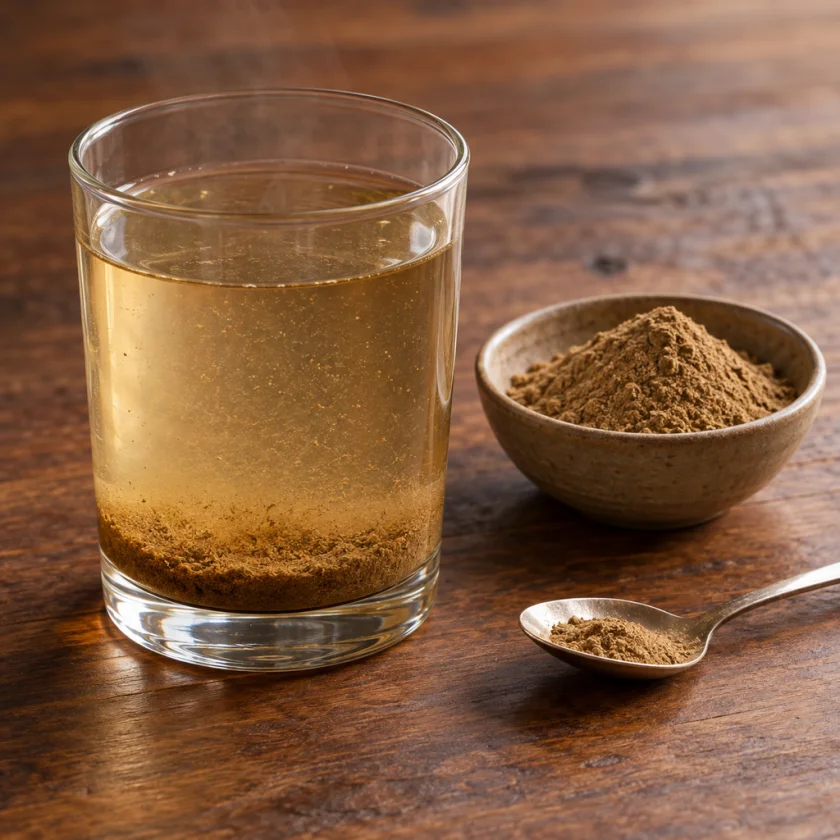

Two things belong on one page because they are entangled. The first is what Triphala actually is, and why nearly every clinical claim made for single-herb haritaki is borrowed from a formula that contains two other fruits. The second is how haritaki is dosed and where it goes wrong — the tannin–iron interaction, the absorption interference with medicines, the pregnancy question, gastrointestinal upset, and the product-quality problem that affects imported Ayurvedic goods generally.
They belong together because the borrowing is not only a citation problem. A single-herb haritaki product taken on the strength of Triphala evidence delivers the fruit with the highest tannin load of the three, without amla's ascorbic acid, which is the one component of the formula that pushes back against the iron problem. The substitution is not neutral. It concentrates the harm and discards the hedge.
Table of Contents
- Evidence Tier for This Page
- What Triphala Is
- How the Formula's Evidence Gets Borrowed
- Grades, Ratios and Why Two Bottles Differ
- There Is No Evidence-Based Dose
- Traditional and Commercial Dose Ranges
- Forms and What to Look For on a Label
- Tannins and Iron: The Headline Caution
- The Two-Hour Rule for Medicines
- Gastrointestinal Upset and What It Feels Like
- Pregnancy, Breastfeeding and Children
- Glucose-Lowering Drugs and Other Interactions
- Product Quality and Heavy Metals
- Who the Cautions Concern
- Key Research Papers
- Connections
- Featured Videos
Evidence Tier for This Page
- Human absorption studies — the tannin–iron interaction. Better established than any benefit on the haritaki pages. This is the strongest human pharmacology in the whole topic and it describes a harm.
- Randomized clinical trial — the Triphala mouthrinse trials and the negative guggul-plus-Triphala lipid trial, which is also the source of the hypersensitivity-rash observation. Formula, not haritaki alone.
- Preliminary (animal) — rodent toxicology, which establishes a margin of safety in rats rather than in people.
- Traditional use only — every dose figure on this page. There is no dose-finding trial for single-herb haritaki.
- Caution / documented harm — iron absorption, drug absorption interference, gastrointestinal upset, hypersensitivity reaction, heavy-metal contamination of some imported products, and the absence of any pregnancy safety data.
What Triphala Is
Triphala means “three fruits”. It is the most widely used compound preparation in Ayurveda, and it is made of:
- Haritaki — Terminalia chebula, the chebulic myrobalan. Family Combretaceae. The most tannin-dense of the three, carrying chebulagic and chebulinic acid as its signature molecules. Traditionally the bowel-regulating component.
- Baheda or bibhitaki — Terminalia bellirica, the belleric myrobalan. Same genus, same family, a different tannin and ellagitannin profile. See Baheda.
- Amla or amalaki — Emblica officinalis, now usually written Phyllanthus emblica, the emblic myrobalan. A different family entirely (Phyllanthaceae, formerly Euphorbiaceae), and the only one of the three that is a serious ascorbic acid source. See Amla.
The naming is a genuine trap. All three are called “myrobalans” in English. Two are Terminalia and one is not even in the same family. And in European horticulture “myrobalan” usually means Prunus cerasifera, the cherry plum rootstock, which has nothing to do with any of them. If a label, a supplier or an old text says only “myrobalan”, it has not identified the plant; only the binomial (the two-part Latin name) does.
Classical proportions are equal parts by weight, though classical texts and commercial products both vary the ratio — some traditions weight amla more heavily, others haritaki. The formula is normally taken as a powder (churna) at night in warm water, and Ayurveda treats the combination as doing something the individual fruits do not, which is the tradition's own reason for not substituting one for the whole.
How the Formula's Evidence Gets Borrowed
The pattern is consistent enough to describe as a recipe:
- A trial is run on Triphala — usually the mouthrinse trials, sometimes a metabolic or wound-healing study.
- A review article summarises it, correctly, as a Triphala finding.
- A secondary source describes it as evidence for “the Ayurvedic fruit Terminalia chebula”, because haritaki is the first-named and best-known of the three.
- A product page for single-herb haritaki capsules cites step 3 as “clinical research”.
Why it is not a technicality. Three concrete reasons, in order of how much they matter:
- Amla's ascorbate runs opposite to haritaki's tannins on iron. Ascorbic acid is a reducing agent that promotes non-haem iron absorption; galloyl tannins block it. The formula contains both. A single-herb haritaki product removes the promoter and keeps the blocker — so the formula's safety experience does not transfer to the single fruit on the issue that matters most.
- Amla has its own metabolic literature. Where a Triphala study finds a lipid or glucose benefit, amla is at least as plausible a source as haritaki, and no experiment has separated them. See the metabolic article.
- Nobody has dismantled the formula. There is no trial comparing Triphala against haritaki alone, against baheda alone, and against amla alone for any outcome. Until that exists, attribution to one fruit is speculation dressed as a citation. Hegde and colleagues published a comparative metabolome profile of all three fruits in Scientific Reports in 2024 specifically because that groundwork was missing.
What the intervention line shows: when a haritaki product cites clinical research, the trial's intervention line states what was actually tested. If it says Triphala, the tested intervention is Triphala, not single-herb haritaki.
Grades, Ratios and Why Two Bottles Differ
Haritaki is one of the more variable herbal products on the shelf, and there are structural reasons rather than merely commercial ones.
It is mostly wild-collected. Most haritaki still comes from wild or semi-wild trees, gathered by hand, dried on mats or on the ground, sold to village traders, aggregated at regional markets, and graded only afterwards. Drying conditions, time to market and storage all affect the tannin fraction.
Tradition grades the fruit, and the grades are not interchangeable. Classical Ayurveda distinguishes several types by size, maturity and origin, and holds that immature, smaller fruit is more strongly purgative while fully ripe fruit is the gentler tonic. Unani grades halela as zard (yellow), siyah (black) and kabuli (large). A commercial powder is frequently a blend of grades from several sources, which is a large part of why the same nominal dose from two brands can behave quite differently in the same person.
Tannin content itself is wide. Reported figures for the dried fruit span roughly a fifth to two-fifths by weight depending on grade and origin. That is close to a two-fold difference in the fraction that drives both the astringency and the iron interaction — enough that “one gram of haritaki” is not a defined exposure.
Powder ages. Ground fruit oxidises and loses potency faster than whole fruit.
There Is No Evidence-Based Dose
Said plainly because it is easy to skip past. No dose-finding trial has been conducted for single-herb haritaki in humans, for any indication. There is no established therapeutic dose, no established maximum, and no characterised dose–response curve.
Worse, the dose–response is probably not monotonic. As the digestion article sets out, the fruit contains an abundant astringent tannin fraction that tightens the gut and a minor anthraquinone fraction that loosens it, plus bulk and osmotic contributions. Traditional practice reflects this by describing low-dose and high-dose use as different actions, and Traditional Chinese Medicine uses the same fruit, differently processed, to stop diarrhoea. Where the crossover sits is unknown and product-dependent.
The consequence: a figure printed on a label is not a tested dose, and with an uncharacterised curve nobody knows where a given amount falls on it.
Traditional and Commercial Dose Ranges
Given so you can interpret what you are handed. Traditional use only — not a recommendation.
- Haritaki powder (churna). Traditional range roughly 1–6 g of dried fruit powder daily, most often as a single evening dose in warm water.
- Triphala churna. Commonly 3–6 g at night; some traditions go to about 10 g. This is the form the human studies used.
- Capsules and tablets. Typically 500–1,000 mg once or twice daily — often well below the traditional powder dose. Convenient and dose-consistent; rarely standardised to any marker compound.
- Decoction (kwath). A simmered water extract, traditional and cheap, strongly astringent. Concentration is whatever you make it, which is a disadvantage for dosing.
- Mouthrinse. The trials used a dilute aqueous Triphala rinse, in the region of a fraction of one percent, twice daily, spat out. Covered in the oral health article.
Timing. Traditionally taken in the evening, on a relatively empty stomach. The iron and medicine interactions described below are the reason for the gap of at least two hours from medicines, iron-containing meals and iron supplements discussed on this page. A bulking or osmotic agent taken without enough fluid can make constipation worse.
Forms and What to Look For on a Label
- Whole dried fruit — longest shelf life, and you can see what you are buying, which is a real advantage with a wild-collected product.
- Powder — the commonest form, and the one that ages fastest.
- Standardised extract — occasionally standardised to chebulagic acid, chebulinic acid or total tannins. A product that names and quantifies a marker is telling you meaningfully more than one that says only “fruit extract”.
A label that fully identifies the product states:
- The binomial, Terminalia chebula — not just “haritaki” and certainly not just “myrobalan”.
- The plant part. The medicinal part is the fruit. The seed is discarded traditionally; the pulp around it is the medicine.
- Whether it is single-herb haritaki or Triphala, and if Triphala, the ratio.
- A marker compound with a number, such as one of the five covered by Dhanani, Shah and Kumar's validated high-performance liquid chromatography (HPLC) method: gallic acid, corilagin, chebulagic acid, ellagic acid, chebulinic acid.
- Country of origin and evidence of heavy-metal testing.
Tannins and Iron: The Headline Caution
Tier: human absorption studies — the best-established human pharmacology in this topic.
Haritaki is dominated chemically by hydrolysable tannins: large molecules built from a sugar core studded with gallic acid units. The galloyl group is the specific structural feature that binds non-haem iron — the plant-food form of iron — in the gut and holds it in a complex the intestine cannot take up.
Three human studies anchor this:
- Brune, Rossander and Hallberg, European Journal of Clinical Nutrition, 1989, showed that the inhibition tracks the number of galloyl groups and is strongly dose-related, and — crucially — that its results suggest condensed tannins do not interfere with iron absorption. It is the galloyl-rich hydrolysable tannins that do. Haritaki is exactly that type.
- Hurrell, Reddy and Cook, British Journal of Nutrition, 1999, showed how large the everyday version of the effect is with polyphenol-rich beverages: black tea cut iron absorption from a bread meal by 79–94% and cocoa by 71%. Haritaki is more tannin-dense than tea by weight.
- Thankachan and colleagues, American Journal of Clinical Nutrition, 2008, showed in young Indian women that one or two cups of black tea cut iron absorption from a rice meal by 49–67%, in anaemic and non-anaemic women alike, and that added ascorbic acid (vitamin C) raised absorption by 270–350%. The study tested black tea, not haritaki; it shows the size of the effect a tannin-rich drink can have.
Who this matters most for:
- Anyone with iron-deficiency anaemia or low ferritin, or being treated for either.
- People with heavy menstrual bleeding.
- Vegetarians and vegans, who depend on non-haem iron and have no haem iron to fall back on.
- Regular blood donors.
- Pregnancy — where iron requirement rises sharply, and where there is no human safety data for haritaki.
- Infants, young children and older adults with marginal intake.
Spacing and testing. The spacing described for this interaction is at least two hours between haritaki and iron-containing meals or iron supplements, with a longer gap reducing the overlap further. Vitamin C partly counteracts tannin inhibition of iron, which is why iron-rich meals are often paired with citrus rather than with tannin-rich preparations; it only partly offsets a tannin taken at the same meal. Blood tests show what symptoms do not: ferritin falls long before haemoglobin does, so a baseline and a follow-up test show a drift that symptoms will not. See iron deficiency and iron.
The Two-Hour Rule for Medicines
The spacing described on this page is about two hours between haritaki and any medicine. There are two independent reasons, and they compound:
- Tannins bind drug molecules non-specifically in the gut. The same protein-and-cation-binding chemistry that grabs iron also complexes with many drug molecules, reducing how much is absorbed. This is not a hypothetical interaction class; tannin-rich foods and beverages are a documented cause of reduced absorption for several drugs.
- Faster transit shortens the absorption window. A bowel-active herb moves gut contents along, and a drug that needs time in the small intestine to be absorbed gets less of it.
Where this matters most — narrow-margin drugs, where a modest change in absorption changes the effect:
- Levothyroxine and other thyroid hormone. Notoriously sensitive to anything taken alongside it.
- Anticonvulsants — phenytoin, carbamazepine, valproate, lamotrigine.
- Digoxin.
- Lithium.
- Immunosuppressants — ciclosporin, tacrolimus, mycophenolate.
- Warfarin and other anticoagulants, where absorption variability translates into bleeding or clotting risk.
- Oral contraceptives — reduced absorption means reduced contraceptive reliability, and this is a commonly overlooked consequence of any laxative-leaning herb.
- Antiretrovirals and antibiotics, where under-dosing has consequences beyond the individual.
For these drugs both mechanisms above lower the amount absorbed, and a small change in the amount absorbed shifts the drug's effect.
Gastrointestinal Upset and What It Feels Like
The commonest adverse effect, and the most predictable. Haritaki is intensely astringent and bowel-active, and at a dose above a person's own threshold it produces:
- Abdominal cramping, often within hours.
- Loose stools or diarrhoea, with the fluid and potassium cost that goes with them.
- Nausea, particularly on an empty stomach, which is also the traditional way to take it — a genuine tension.
- Bloating and wind, consistent with fermentable material and enzyme inhibition delivering carbohydrate to the colon.
- A dry, puckering mouth and a temporary blunting of taste, from the astringency.
What the symptoms mean. Cramping or loose stools are signs that the dose is above the person's threshold. Persistent diarrhoea carries a risk of dehydration and potassium loss. And no effect at the top of the traditional range is also information: it suggests the problem you are treating is not the one this herb addresses.
Hypersensitivity. In the Donato trial of guggul (Commiphora mukul) plus Triphala, taken three times daily for three months, two of 46 participants (4.3%) in the herb arm developed a hypersensitivity rash and none of 44 did on placebo. Small numbers, but all the cases were in the herb arm. A rash is the usual sign of this reaction; facial or throat swelling, wheeze or difficulty breathing are signs of a severe allergic reaction (anaphylaxis) that hospitals treat as an emergency.
Pregnancy, Breastfeeding and Children
Pregnancy: no safety data. Three facts bear on it, and the first is the most important.
- There is no human safety data. No trial has assessed haritaki in pregnancy for any outcome. Absence of evidence of harm is not evidence of safety.
- Strongly purgative and stimulant-leaning herbs are conventionally avoided in pregnancy as a class.
- The iron problem is at its worst here. Iron requirement rises substantially in pregnancy, iron-deficiency anaemia in pregnancy is common and consequential, and a potent inhibitor of non-haem iron absorption taken daily is directly counterproductive.
Breastfeeding: no safety data either, and iron demand stays high.
Children. There is no established paediatric dose for internal use. Note that some of the mouthrinse trials were conducted in schoolchildren under supervision — that is a rinse, spat out, and it is a different exposure entirely from swallowing the powder, and the rinse results do not carry over to it.
Glucose-Lowering Drugs and Other Interactions
Tier: caution — plausible and unquantified.
Haritaki inhibits α-amylase, α-glucosidase and dipeptidyl peptidase-4 (DPP-IV) in vitro, chebulagic acid acts on peroxisome proliferator-activated receptor gamma (PPARγ) in cultured cells, and extracts lower glucose in diabetic rodents. That is not enough evidence to say it treats anything, but it means an added effect on top of a glucose-lowering drug cannot be ruled out. The metabolic article covers this in full; the short version:
- Highest concern: insulin and sulfonylureas (gliclazide, glipizide, glimepiride) and the meglitinides, because these cause hypoglycaemia on their own.
- Glucose readings in the first weeks of combined use are where an added effect would show; low blood sugar is most dangerous while driving.
- The absorption interference runs the other way too — a diabetes drug taken with haritaki may be less well absorbed, producing erratic control rather than simply lower glucose.
Other interaction concerns worth naming:
- Anticoagulants and antiplatelets. Absorption variability matters here more than most; with warfarin, a change in absorption shows up as a change in the INR (international normalised ratio) clotting test.
- Other laxatives. Stacking bowel-active agents is a common route to cramping, diarrhoea and electrolyte loss.
- Diuretics. Combined fluid and potassium loss in an older person is the classic setting for a preventable problem.
- Mineral supplements generally — not only iron. Tannins bind divalent cations, so zinc and calcium supplements taken at the same time can also be absorbed less.
Product Quality and Heavy Metals
Tier: documented harm, repeatedly.
This is not haritaki-specific but it applies to haritaki as much as to any imported traditional product. Contamination of Ayurvedic and other imported traditional herbal medicines with lead, mercury and arsenic has been documented repeatedly in published surveys of retail products. The US National Center for Complementary and Integrative Health carries a warning to that effect in its Ayurvedic medicine overview.
Two distinct sources, worth separating:
- Accidental contamination — from soil, from industrial pollution near collection sites, from processing equipment, from adulterated packaging.
- Deliberate inclusion. Some traditional Ayurvedic preparations of the rasa shastra type contain metals and minerals as intended ingredients. Those products are a different category from a plain herbal powder, and they carry a different risk profile.
What lowers the risk: batch testing for heavy metals with a certificate of analysis; plain single-herb or plain Triphala powders, whose composition is clear, rather than complex proprietary formulas whose full composition is not; and a full ingredient list. Unusually cheap products carry more uncertainty. Unexplained anaemia, abdominal pain or neurological symptoms in a long-term user of imported traditional medicine are recognised signs of possible lead exposure. See toxic minerals for background on those metals.
Formal toxicology. Kim and colleagues published mutagenicity and oral toxicity studies of Terminalia chebula in Phytotherapy Research in 2012, and rodent acute and chronic oral toxicity assessments of Triphala preparations have been published since. Rodent toxicology establishes a margin; it does not establish human safety in any of the populations excluded on this page.
Who the Cautions Concern
These are the situations in which the facts on this page weigh most heavily.
- Pregnancy and breastfeeding.
- Iron-deficiency anaemia, low ferritin, or active iron replacement.
- Current diarrhoea, vomiting or dehydration.
- Suspected or known bowel obstruction, or severe constipation with vomiting and no passage of gas — a laxative is dangerous here.
- Inflammatory bowel disease in flare.
- Undiagnosed abdominal pain, rectal bleeding, or any recent unexplained change in bowel habit — these can be signs of serious bowel disease that a laxative can mask. See constipation.
- Children, for internal use — there is no established paediatric dose.
- Transplant recipients and anyone on immunosuppressants or narrow-margin medication, because of the two absorption mechanisms described above.
- Weight loss or “detox” as the reason. The scale movement is stool and water, and the dose creep is where the harm lives. See senna in weight-loss teas for the documented version of the same pattern.
- Anyone with a previous hypersensitivity reaction to haritaki, Triphala or another Terminalia product.
Key Research Papers
Specific papers are cited by their PubMed identifier; the remaining entries are PubMed topic searches. Where the intervention was Triphala rather than haritaki alone, the entry says so.
- Brune M, Rossander L, Hallberg L. Iron absorption and phenolic compounds: importance of different phenolic structures. European Journal of Clinical Nutrition. 1989;43(8):547-57. — establishing that galloyl group number drives the inhibition and that condensed tannins behave differently. The mechanistic anchor of the whole iron caution. Human absorption study. PubMed PMID: 2598894
- Hurrell RF, Reddy M, Cook JD. Inhibition of non-haem iron absorption in man by polyphenolic-containing beverages. British Journal of Nutrition. 1999;81(4):289-95. — Black tea cut iron absorption by 79–94% and cocoa by 71%. Human absorption study. PubMed PMID: 10999016
- Thankachan P, Walczyk T, Muthayya S, Kurpad AV, Hurrell RF. Iron absorption in young Indian women: the interaction of iron status with the influence of tea and ascorbic acid. American Journal of Clinical Nutrition. 2008;87(4):881-6. — Black tea, not haritaki; the inhibition by tea and the enhancement by ascorbic acid were similar in anaemic and iron-replete women. Human trial. PubMed PMID: 18400710
- Kim JH, Koo YC, Hong CO, et al. Mutagenicity and oral toxicity studies of Terminalia chebula. Phytotherapy Research. 2012;26(1):39-47. — Preliminary (rodent toxicology). PubMed PMID: 21538627
- Donato F, Raffetti E, Toninelli G, et al. Guggulu and Triphala for the treatment of hypercholesterolaemia: a placebo-controlled, double-blind, randomised trial. Complementary Medicine Research. 2021;28(3):216-225. — Negative on the primary outcomes, and the source of the hypersensitivity-rash observation. Randomized clinical trial; multi-herb formula, not haritaki alone. PubMed PMID: 33242870
- Dhanani T, Shah S, Kumar S. A validated high-performance liquid chromatography method for determination of tannin-related marker constituents gallic acid, corilagin, chebulagic acid, ellagic acid and chebulinic acid in four Terminalia species from India. Journal of Chromatographic Science. 2015;53(4):625-32. — The reference for reading a certificate of analysis. Analytical chemistry. PubMed PMID: 25190275
- Hegde SN, K LD, Choudhary M, Menon N, Singh G. A comprehensive metabolome profiling of Terminalia chebula, Terminalia bellerica, and Phyllanthus emblica to explore the medicinal potential of Triphala. Scientific Reports. 2024;14(1):31635. — The groundwork for ever attributing a formula effect to a fruit. Analytical chemistry. PubMed PMID: 39738152
- Wang C, Zhang H, Wang X, et al. Comprehensive review on fruit of Terminalia chebula: traditional uses, phytochemistry, pharmacology, toxicity, and pharmacokinetics. Molecules. 2024;29(23). — Review. PubMed PMID: 39683707
- Nigam M, Mishra AP, Adhikari-Devkota A, et al. Fruits of Terminalia chebula Retz.: a review on traditional uses, bioactive chemical constituents and pharmacological activities. Phytotherapy Research. 2020;34(10):2518-2533. — Review. PubMed PMID: 32307775
- Heavy metals in Ayurvedic and imported traditional herbal medicines — retail surveys and case reports of lead, mercury and arsenic exposure. Documented harm. Topic search
- Acute and chronic oral toxicity of Triphala preparations in rodents. Preliminary (animal toxicology); Triphala, not haritaki alone. Topic search
- Tannin and polyphenol interference with drug absorption in the gastrointestinal tract. Reviews and mechanistic studies. Topic search
- Herbal medicine use in pregnancy — prevalence, safety data gaps and the herbs conventionally avoided. Reviews. Topic search
- Peterson CT, Denniston K, Chopra D. Therapeutic uses of Triphala in Ayurvedic medicine. Journal of Alternative and Complementary Medicine. 2017;23(8):607-614. — Useful as a map of the claim set the formula carries. Review; Triphala, not haritaki alone. PubMed PMID: 28696777
Connections
- All Herbs
- Haritaki (Terminalia chebula) — the main topic page.
- Haritaki — Benefits Deep Dive — the hub for these four articles.
- Haritaki for Digestion and Constipation — the dose paradox in detail.
- Haritaki for Metabolic and Cholesterol Health — the negative trial and the glucose interaction.
- Haritaki for Oral Health and Gums — the rinse, where systemic cautions do not apply.
- Amla — the ascorbate-bearing third fruit.
- Amla — Triphala and Digestive Use — the formula from the amla side.
- Baheda (Terminalia bellirica) — the second fruit.
- Iron and Iron Deficiency — the headline caution.
- Ferritin — test rather than guess.
- Vitamin C — the counterweight to tannin inhibition of iron.
- Constipation — the red flags that come before any herb.
- Senna and its long-term risks — the comparison case for habitual laxative use.
- Toxic Minerals — background on the heavy metals found in some imported products.
Safety and disclaimer. This article is health information, not medical advice, and no dose figure on this page is a recommendation. No dose-finding trial exists for single-herb haritaki; every range given is traditional or commercial practice. There is no safety data for haritaki in pregnancy, breastfeeding or children, and the concerns on this page weigh most during diarrhoea or dehydration, suspected bowel obstruction, an inflammatory bowel disease flare, undiagnosed abdominal pain, and iron deficiency or anaemia. Tannins bind medicines and minerals in the gut and faster transit shortens absorption, which matters most for thyroid hormone, anticonvulsants, digoxin, lithium, immunosuppressants, anticoagulants, oral contraceptives and glucose-lowering drugs; the spacing described on this page is about two hours. A rash is the usual sign of a hypersensitivity reaction; facial or throat swelling or breathing difficulty is an emergency. Heavy-metal contamination has been documented in imported traditional products, and batch testing is how it is detected.