⚠ Evidence warning: Clinical trials or other evidence do not support the claim that Triphala regulates the bowels and relieves constipation, which rests on traditional use and on what users report. This page keeps it as a report of what people, websites or other media say.
Triphala and Digestive Use
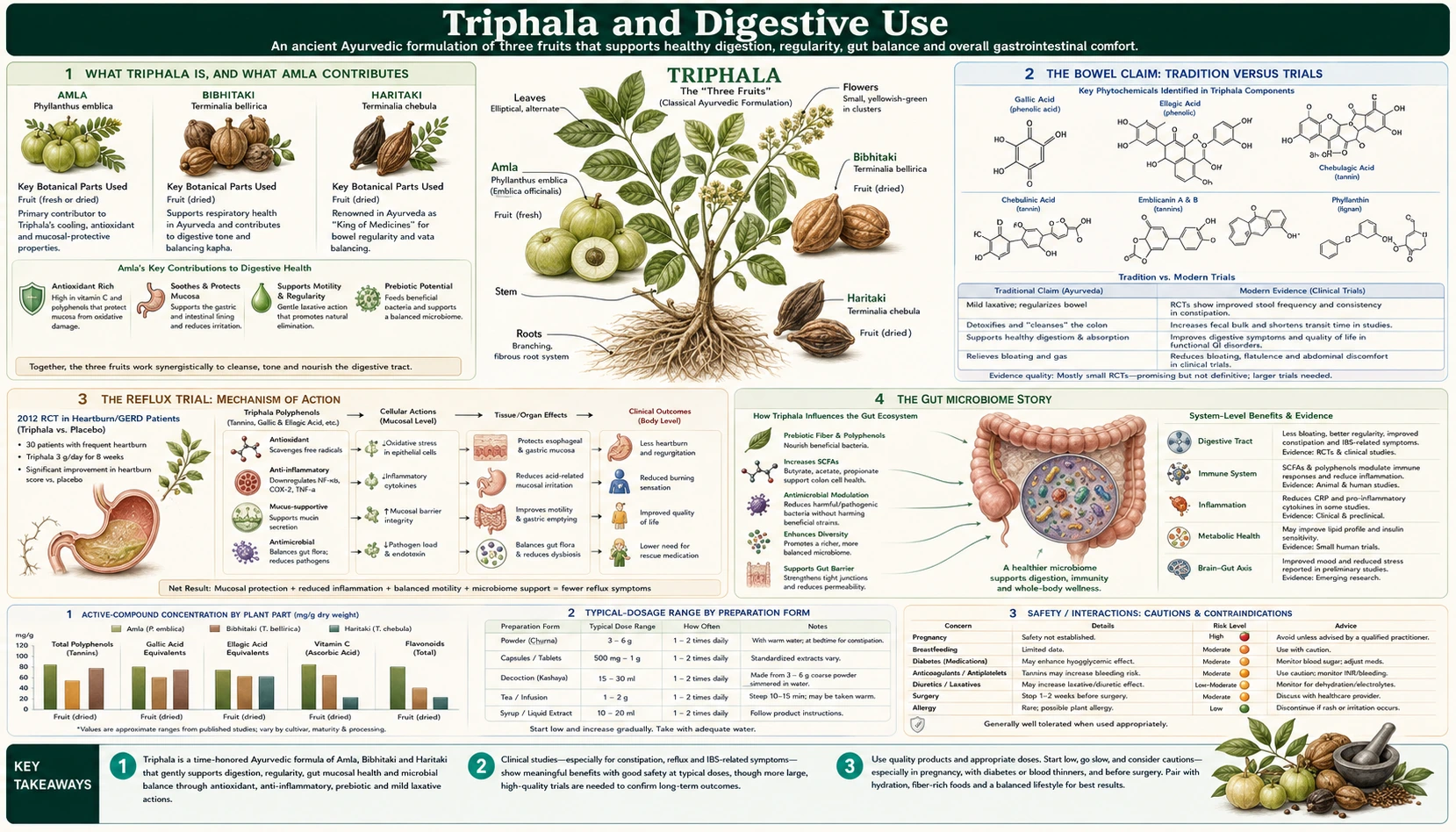
Triphala — Sanskrit for “three fruits” is the most widely used compound preparation in Ayurveda, and amla is one of its three components. The other two are haritaki (Terminalia chebula) and baheda (Terminalia bellirica), classically combined in equal parts by weight.
Most people meet Triphala as a bowel remedy, which is its traditional use. But the honest evidence picture is genuinely surprising, and it is worth stating up front because it inverts what the marketing emphasises: the best-evidenced use of Triphala is not something you swallow. It is a mouthwash. Several randomised trials and a systematic review with meta-analysis have tested Triphala mouthrinse against chlorhexidine for dental plaque and gum inflammation, and that body of work is larger and more consistent than anything supporting the digestive claims.
This article covers what amla contributes to the formula, what the digestive evidence actually is, why the microbiome claims are weaker than they sound, the negative cholesterol trial in its Triphala context, and — the practical point that is rarely mentioned — what these tannins do to iron absorption.
Table of Contents
- What Triphala Is, and What Amla Contributes
- The Bowel Claim: Tradition Versus Trials
- The Reflux Trial
- The Gut Microbiome Story
- The Mouth: the Strongest Evidence on This Page
- The Cholesterol Trial That Failed
- Gastroprotection
- The Iron Problem, in Numbers
- Laboratory Cancer Work — What It Means
- Dosing, Timing and Forms
- Product Quality and Heavy Metals
- Cautions
- Key Research Papers
- Connections
- Featured Videos
What Triphala Is, and What Amla Contributes
Triphala is a powder (churna) of three dried fruits in equal parts. What is easy to miss is that they are not three versions of the same thing:
| Fruit | Species and family | Traditional role | Distinctive chemistry |
|---|---|---|---|
| Haritaki | Terminalia chebula, Combretaceae | The purgative and bowel-regulating member | Chebulagic and chebulinic acids, anthraquinone-type constituents |
| Baheda | Terminalia bellirica, Combretaceae | Respiratory and mucous membranes | Gallic acid, ellagic acid, belleric tannins |
| Amla | Phyllanthus emblica, Phyllanthaceae | Cooling; the rasayana of the three | Ascorbic acid, mucic acid gallates, the disputed emblicanins |
Amla is the odd one out. The other two are Terminalia species in the Combretaceae; amla belongs to an entirely different family, and it is the only one of the three that contributes meaningful vitamin C. Hegde and colleagues published a comparative metabolome profile of all three fruits in 2024, which is the most useful single reference for who brings what to the blend.
A practical consequence follows directly. Most of the bowel-moving action in Triphala is haritaki's, not amla's. Someone taking Triphala specifically for constipation is mostly taking it for one of its three ingredients, and the other two are along for the ride. That is not an argument against the traditional formula — combination is the point of it — but effects that belong to a different fruit are not amla’s.
The reverse also holds: a trial of Triphala is not a trial of amla. One-third of a 3 g dose is about a gram of amla powder, which is a fraction of what the amla extract trials used. That matters for the negative cholesterol trial below.
The Bowel Claim: Tradition Versus Trials
Triphala's reputation as a gentle bowel regulator is centuries old and widely reported by people who use it. The traditional framing is careful and worth respecting: it is described as a regulator rather than a purgative — something taken nightly, long-term, that normalises bowel function rather than forcing an evacuation.
The published clinical evidence for that specific claim is thin. Reviews of Triphala — the most-cited being Peterson, Denniston and Chopra in 2017 — describe a wide range of traditional and laboratory-supported uses, but a review is a summary of a literature, not an addition to it, and the constipation literature it is summarising consists mainly of small studies, non-English publications and traditional texts rather than the placebo-controlled trials that would settle the question.
What can be said fairly:
- Haritaki has recognised laxative constituents. A mild laxative effect from Triphala is chemically expected, not mysterious.
- Many users report it works and does not cause the cramping that stimulant laxatives do. That is worth something, and it is not a controlled trial.
- Tannins are astringent, which is the opposite of laxative — so the formula contains constituents pulling in both directions. This may be exactly why the traditional description is “regulating”.
- No adequately powered placebo-controlled trial of Triphala for chronic constipation is available in the indexed English-language literature.
In practice: the traditional use is for mild, ordinary constipation, at 3–6 g at night, alongside the things that actually have evidence — fibre, fluid and movement. A bowel habit that has changed recently is a different matter. New constipation in an adult over 45, or constipation with bleeding, weight loss, anaemia or a change in stool calibre, are warning signs that doctors investigate; a herbal powder does not address their cause. Colorectal cancer presents this way, and time spent self-treating is the one cost that cannot be recovered.
The Reflux Trial
The best digestive evidence for amla specifically comes from an unexpected direction. Karkon Varnosfaderani and colleagues in Tehran ran a double-blind, randomised, placebo-controlled trial of amla tablets in non-erosive reflux disease (NERD).
NERD means classic reflux symptoms — heartburn, regurgitation, epigastric pain — with no visible damage to the oesophagus on endoscopy. It is a genuinely awkward condition: it is common, it impairs quality of life, and it responds noticeably less well to acid-suppressing drugs than erosive oesophagitis does. That treatment gap is why the trial was worth running.
The design and result
- 68 patients with at least three months of classic reflux symptoms, randomised into two parallel groups.
- Intervention: two 500 mg amla tablets twice daily, after meals, for four weeks. Control: matching placebo.
- Symptoms scored for frequency and severity at baseline, two weeks and four weeks using a reflux quality-of-life questionnaire.
- Both groups improved significantly in heartburn and regurgitation frequency (p < 0.001) — note that, because it is what a placebo arm is for.
- On repeated-measures analysis, the amla group improved significantly more than placebo on regurgitation frequency, heartburn frequency, regurgitation severity and heartburn severity (p < 0.001).
Reading it fairly
- It is a properly blinded, placebo-controlled trial with a registered protocol (Iranian Registry of Clinical Trials) — better methodology than much of the amla literature.
- It is 68 people for four weeks at one centre, and it has not been replicated.
- Reflux symptom scores are subjective and highly placebo-responsive — which the placebo arm's own significant improvement demonstrates neatly.
- It fits amla's classical Ayurvedic role as a cooling remedy for acidity, which is satisfying but is not evidence.
The tension worth naming: amla is intensely sour, and plenty of people with reflux find sour foods provoke symptoms. A concentrated tablet is not the same exposure as biting into the fruit, and heartburn that gets worse on amla is real information, not a failure to persist. Reflux that is new, worsening, or accompanied by difficulty swallowing, vomiting, weight loss or anaemia is an alarm sign that doctors investigate promptly; a supplement does not address its cause.
The Gut Microbiome Story
“Triphala is a prebiotic that rebalances your gut microbiome” is now standard supplement copy. Here is what actually stands behind it.
Peterson and colleagues published a 2018 study of the prebiotic potential of herbal medicines used in digestive health and disease, examining how Triphala and related botanicals affect bacterial growth. The key methodological fact: this work was done in in vitro faecal culture — human stool bacteria grown in a laboratory vessel with the herb added — not in living people. In those cultures Triphala significantly raised butyrate-producing bacteria, and across the three herbs tested the cultures gained Bifidobacterium, Lactobacillus and Bacteroides species and lost potential disease-causing bacteria such as Klebsiella pneumoniae. The authors themselves wrote that human clinical trials are still needed to test whether these laboratory results hold. Westfall and colleagues, also in 2018, reported synergistic effects of a polyphenolic prebiotic and probiotic formulation on the gut microbiota, in a laboratory and model-organism setting. More recently, Upadhyay and colleagues published work on Triphala modulating the gut–brain axis in a murine (mouse) model.
The underlying biology is real and worth understanding, because it is genuinely interesting. Hydrolysable tannins are large molecules and are poorly absorbed in the small intestine. That means most of what you swallow arrives intact in the colon, where gut bacteria metabolise it into smaller compounds — the same broad pathway that turns pomegranate ellagitannins into urolithins. Two consequences follow: the polyphenols act as substrate for bacteria, and the metabolites your body actually sees are bacterial products, not the original plant compounds. Which bacteria you have therefore changes what you get from the herb — a legitimately fascinating idea.
What has not been shown:
- That taking Triphala produces a specific, reproducible, beneficial shift in the human gut microbiome in vivo.
- That any such shift improves a symptom or a health outcome.
- That the effect differs meaningfully from what any tannin-rich plant food — tea, pomegranate, berries, nuts — would do.
A dish of faecal bacteria is a legitimate screening tool and a poor model of a human colon: it has no immune system, no mucus layer, no epithelium, no bile flow, no transit time and no host. Labelled honestly, the claim shrinks to “plausible, being investigated” — which is still interesting, and is not what the bottle says.
The Mouth: the Strongest Evidence on This Page
Here is the genuinely surprising part. The best-supported use of any amla-containing product in the peer-reviewed literature is Triphala as a mouthwash.
AlJameel and Almalki published a systematic review and meta-analysis of randomised controlled trials of Triphala mouthrinse for plaque and gingival inflammation in 2020. Beneath it sit multiple individual randomised trials, including Pradeep and colleagues' 2016 trial in the Journal of Periodontology testing Triphala mouthwash for gingivitis, and Baratakke and colleagues' 2017 trial comparing Triphala extract against chlorhexidine rinse for plaque accumulation and gingival inflammation.
The 2020 review pooled 7 randomised trials comparing Triphala rinse with chlorhexidine rinse, and its authors concluded that Triphala improved gum inflammation with clinical efficacy equal to chlorhexidine. The pooled mean differences between the two rinses were −0.29 on the gingival index and −0.43 on the plaque index, and the trials varied widely from one another (heterogeneity I² 91.76% for the gingival index and 96.10% for the plaque index). In the 2016 Journal of Periodontology trial, 90 people with chronic generalised gingivitis rinsed twice daily with placebo, Triphala or chlorhexidine; Triphala and chlorhexidine both reduced plaque, gum inflammation and bacterial counts more than placebo, and did not differ from each other at 7, 30 or 60 days.
Why this use has better evidence than the digestive ones is not a mystery:
- The endpoints are objective and easy to measure. Plaque index and gingival index are counted on tooth surfaces by an examiner who can be blinded. Compare that with “how was your digestion this week”.
- The site of action is the site of application. No absorption, no first-pass metabolism, no dilution across the body. Tannins swill directly over the bacteria you are trying to affect at full concentration.
- The mechanism is straightforward. Tannins precipitate proteins and have direct antibacterial activity. Astringency is exactly the property you want in a plaque rinse.
- There is a good active comparator. Chlorhexidine works well but stains teeth brown, alters taste and is not recommended for indefinite use — so a comparably effective rinse without those drawbacks would be genuinely useful. That gives the research a real clinical question to answer.
Caveats, as everywhere: the trials are mostly small, mostly Indian, and often short. Dental plaque trials are prone to a large Hawthorne effect — people brush better when someone is counting their plaque. And a herbal rinse will stain too, in its own way; tannins are what tea stains teeth with.
Still: the amla-containing product with the most evidence behind it is not the capsule. It is a rinse that is spat out.
The Cholesterol Trial That Failed
The metabolic health article covers this trial in full. It belongs here too, because it is the only large, independent, Western, placebo-controlled test of a Triphala-containing product in the literature, and because of one detail that gets overlooked.
Donato and colleagues at the University of Brescia randomised 90 people with high cholesterol to a guggul-plus-Triphala preparation or placebo, three times daily for three months, with three months of follow-up. Results:
- Total cholesterol fell 1.9% on placebo, 3.3% on treatment.
- Low-density lipoprotein (LDL) cholesterol fell 4.9% on placebo, 4.8% on treatment.
- No difference in body mass index (BMI) or waist circumference.
- 4.3% of the treated group developed a hypersensitivity rash. Zero on placebo.
- Conclusion: no better than placebo.
The detail worth pausing on is the placebo arm. Cholesterol fell by nearly 2% and low-density lipoprotein by nearly 5% in people taking nothing active. That is enrolment, monitoring, mild behaviour change and regression to the mean. Any uncontrolled before-and-after study — and there are several in the amla literature — would have reported that drift as a treatment effect and published it. This is the clearest available demonstration of why the control group is not a formality.
And the safety signal is real. A 4.3% hypersensitivity rash rate against zero on placebo, in a product routinely described as gentle and food-like, is relevant to long-term daily use.
Gastroprotection
Amla appears in traditional practice for acidity and gastric complaints, and there is animal work consistent with it. Al-Rehaily and colleagues in 2002 reported gastroprotective effects of amla across several in vivo test models in rats.
Label this accurately: it is a rodent study. Animal gastroprotection models — typically induced ulceration from alcohol, aspirin or restraint stress — are useful for screening and are a long way from a person with dyspepsia. The most that can be said is that the traditional use and the animal pharmacology point the same way, and that the one human trial in an upper-gastrointestinal condition (the reflux trial above) was positive.
What amla is not is a treatment for peptic ulcer disease. Most peptic ulcers are caused by Helicobacter pylori infection or by anti-inflammatory drugs, and both have specific, effective, evidence-based management. Testing for H. pylori is how the infection behind ulcer symptoms is found.
The Iron Problem, in Numbers
This is the interaction most likely to affect readers and the one least likely to be mentioned on the label.
The anchor study is not about amla or Triphala. In 1989, Brune, Rossander and Hallberg at the University of Göteborg measured non-haem iron absorption in humans using the extrinsic tag method, against measured amounts of phenolic compounds of different chemical structure. Their results are unusually clean:
- Tannic acid inhibited iron absorption in a strongly dose-related way: 5 mg cut absorption by 20%, 25 mg by 67%, 100 mg by 88%.
- Gallic acid inhibited to the same extent as tannic acid per mole of galloyl groups — so it is the galloyl group doing the work, not molecular size.
- Catechin produced no inhibition at all. Chlorogenic acid inhibited less.
- Oregano and tea inhibited in proportion to their galloyl-group content.
- Condensed tannins did not interfere with iron absorption.
- Conclusion: iron-binding galloyl groups are the major determinant; catechol groups are minor.
Two further human studies fill in the picture. Tuntawiroon and colleagues confirmed a dose-dependent inhibitory effect of phenolic compounds in foods on non-haem iron absorption in men. And Hallberg and colleagues showed that ascorbic acid counteracts inhibition of iron absorption — in their case against phytate — which is the other half of amla's story.
Why this lands squarely on amla and Triphala
All three Triphala fruits are dominated by hydrolysable, galloyl-type tannins: gallic acid, ellagic acid, chebulagic and chebulinic acids, and in amla the mucic acid gallates and the disputed emblicanins. This is precisely the chemistry Brune identified as the strongest inhibitor of non-haem iron absorption. It is not a theoretical concern extrapolated from an unrelated plant; it is the same class of compound, measured in humans, with a dose-response.
Amla complicates its own case, because it also contains substantial ascorbic acid, and vitamin C is the strongest known enhancer of non-haem iron absorption. Within whole fresh fruit those two effects oppose each other, and nobody has measured the net result directly. In a tannin-rich extract or a Triphala powder with little surviving vitamin C, the inhibition is expected to dominate.
Who this matters most for
Non-haem iron is the form in plants, fortified foods and most iron supplements; haem iron from meat is absorbed by a different route and is far less affected. So this matters most for:
- Anyone with iron-deficiency anaemia or low ferritin
- Vegetarians and vegans, whose iron is essentially all non-haem
- Menstruating people with heavy periods
- Pregnant people, whose iron requirement roughly doubles
- Regular blood donors
- Infants, young children and older adults with marginal intake
- Anyone with coeliac disease, inflammatory bowel disease, or after bariatric surgery
What changes the size of the effect
- Time apart. The inhibition happens when tannins and iron are in the gut together. A gap of at least two hours from iron supplements and iron-rich meals is the usual separation, and it costs nothing.
- Night-time Triphala, the traditional timing, is naturally distant from meals.
- During treatment of iron deficiency, tannin-rich supplements work against the iron until ferritin has recovered. Tea and coffee with meals do the same; Brune’s group measured tea inhibiting in proportion to its galloyl content.
- A ferritin level that stops rising during iron treatment can have a tannin-rich supplement behind it, an explanation that is easy to miss when the supplement is not on record.
- Vitamin C taken with the iron — a glass of orange juice or a vitamin C tablet with an iron supplement — is described as partly offsetting phenolic inhibition. Hallberg’s group found that ascorbic acid significantly counteracted the inhibition of iron absorption by phytate.
Laboratory Cancer Work — What It Means
Search Triphala on PubMed and you will find cancer papers. Vadde and colleagues reported in 2015 that Triphala extract suppressed proliferation and induced apoptosis in human colon cancer stem cells. Wang and colleagues reported in 2018 that chebulinic acid derived from Triphala was a promising antitumour agent in human colorectal carcinoma cells.
Both are cell-culture studies. This needs saying plainly, because “kills cancer cells” is the single most misleading phrase in supplement marketing.
Killing cancer cells in a dish is easy. Bleach kills cancer cells in a dish. So does salt water at the right concentration, and so do most plant extracts if you use enough. The questions that separate a laboratory result from a medicine are the ones a dish cannot answer:
- Does the compound reach the tumour at that concentration in a living person? For poorly absorbed tannins that are extensively metabolised by gut bacteria, usually no.
- Does it spare normal cells at that concentration? Selectivity is the whole difficulty of oncology.
- Does it shrink a tumour or extend a life in a randomised trial? For Triphala, that trial does not exist.
There is no human evidence that Triphala or amla treats or prevents any cancer. There is a further, serious concern: some antioxidants can interfere with chemotherapy and radiotherapy, both of which work partly by generating oxidative damage in tumour cells. Oncology teams ask about every supplement during cancer treatment because interactions in this setting are documented and can matter.
Dosing, Timing and Forms
| Form | Typical dose | Notes |
|---|---|---|
| Triphala churna (powder) | 3–6 g at night, in warm water | The traditional form and timing. About a third is amla. Intensely astringent |
| Triphala tablets or capsules | Manufacturer's dose, usually 500–1,000 mg twice daily | More palatable, less traditional. The weight of herb, not of the capsule, is the figure that counts |
| Triphala mouthwash | Typically a 6% aqueous extract, rinse twice daily | The best-evidenced use. Rinsed and spat out, not swallowed |
| Amla tablets (reflux trial) | 2 × 500 mg twice daily after meals, 4 weeks | The exact regimen used in the NERD trial |
| Amla standardised extract | 500 mg twice daily | The metabolic trials' dose — a different product from Triphala |
| Fresh or dried amla fruit | 1–2 fruits, or 3–6 g powder daily | Food. The only form delivering meaningful vitamin C |
Practical timing
- Triphala at night is traditional and also conveniently distant from meals, which limits the iron interference.
- Amla tablets after meals is what the reflux trial did.
- Two hours away from any medication, as a general tannin precaution — tannins can bind drugs and reduce their absorption.
- Lower starting doses. Loose stools and cramping are the common early effects, and they are dose-related, so a first week at half the intended dose brings fewer of them.
- Four weeks is the length of the reflux trial. A supplement that has changed nothing in that time is not neutral — it costs money, interacts with iron, and can occupy the space where a real diagnosis belongs.
Product Quality and Heavy Metals
This is not a scare paragraph; it is a documented, published problem with a specific paper behind it. Saper and colleagues published a study in JAMA in 2008 analysing Ayurvedic medicines sold via the internet, manufactured in both the United States and India, and found lead, mercury and arsenic in a meaningful proportion of them. Of 193 products bought online and tested, 20.7% contained detectable lead, mercury or arsenic — 21.7% of US-made and 19.5% of Indian-made products — rising to 40.6% for products of the rasa shastra tradition described below (17.1% for the others). Of the metal-containing products, 95% were sold by US websites and 75% claimed Good Manufacturing Practices (GMP), and every one exceeded at least one standard for acceptable daily intake of toxic metals.
The contamination has two quite different sources, and it is worth knowing which is which:
- Accidental — from soil, water, roadside growing conditions, or processing equipment. This is the usual cause in ordinary herbal powders and is reduced by testing and good sourcing.
- Deliberate — rasa shastra is a branch of Ayurveda in which metals and minerals are intentionally incorporated after processing that is held to render them safe. Products from that tradition can contain metals by design. Plain Triphala and amla are not rasa shastra preparations, but they are sold in the same marketplace by the same suppliers.
What a well-documented supplier provides:
- Third-party heavy-metal testing by a named laboratory, with a certificate of analysis available on request. “GMP” on the label is not a test result.
- A batch or lot number that matches the certificate.
- The binomial and plant part on the label — Phyllanthus emblica or Emblica officinalis, fruit.
- No proprietary blend hiding the per-herb amounts.
- A supplier who answers the question when asked. A vendor who cannot produce a certificate of analysis has told the buyer something useful.
Cautions
- Iron absorption — the most likely interaction to affect you. Galloyl tannins inhibit non-haem iron absorption in a strong dose-dependent way in humans. A two-hour gap from iron supplements and iron-rich meals is the usual separation, and in iron deficiency the tannins keep working against the iron until ferritin recovers.
- Loose stools, cramping and wind are the common effects, and they are dose-related, so a smaller dose brings fewer of them.
- Indefinite daily laxative use leaves the cause of constipation unknown. New or changed bowel habit in an adult over 45, or at any age with bleeding, weight loss, anaemia or a change in stool calibre, are warning signs that doctors investigate.
- Hypersensitivity. The Italian trial found a 4.3% rash rate versus zero on placebo. A new rash, itching or swelling are signs of such a reaction; swelling of the face or throat with trouble breathing is a sign hospitals treat as urgent.
- Bleeding risk. Amla extract showed significant antiplatelet activity in a human crossover study, alone and combined with clopidogrel and aspirin, with prolonged bleeding and clotting times. The study (Fatima and colleagues, 2014) was small and open-label: 10 adults with type 2 diabetes took 500 mg of amla extract as a single dose and then twice daily for 10 days, alone or with clopidogrel or aspirin. Platelet clumping (aggregation) fell, and bleeding and clotting times lengthened, with every regimen, including amla alone. The effect adds to that of an anticoagulant or antiplatelet drug, and blood-thinning supplements are commonly stopped about two weeks before planned surgery or dental extraction.
- Blood-sugar medication. Possible additive lowering for people on metformin, sulfonylureas or insulin; the first two to three weeks are when a change in blood-sugar readings would show.
- Drug absorption generally. Tannins bind proteins and can reduce absorption of a range of medicines. Two hours’ separation is the usual precaution — particularly for thyroid hormone, antibiotics and antiretrovirals.
- Pregnancy and breastfeeding. Triphala is traditionally avoided in pregnancy because of its bowel action, and no safety data support supplement doses. Amla as a food is a different matter and is eaten routinely in South Asia.
- Children. Bowel-active herbal preparations have no established dosing or safety data in children.
- Cancer treatment. Antioxidants can interact with treatments that work through oxidative damage, which is why oncology teams ask about every supplement.
- Dehydration. Any laxative effect over days can lose fluid and potassium, and the losses add to those from a diuretic.
- Product quality. Heavy-metal contamination of imported Ayurvedic products is documented in the peer-reviewed literature. Tested product comes with a certificate of analysis the supplier can show.
Key Research Papers
Every identifier below was checked live against NCBI E-utilities before publication — first author, title, journal and year all had to match. Study type is labelled on every entry.
The mouth — the strongest evidence
- AlJameel AH, Almalki SA. Effect of triphala mouthrinse on plaque and gingival inflammation: a systematic review and meta-analysis of randomized controlled trials. International Journal of Dental Hygiene. 2020;18(4):344–351 — PubMed PMID: 32383334 — Systematic review and meta-analysis of human RCTs.
- Pradeep AR, Suke DK, Martande SS, et al. Triphala, a new herbal mouthwash for the treatment of gingivitis: a randomized controlled clinical trial. Journal of Periodontology. 2016;87(11):1352–1359 — PubMed PMID: 27442086 — Human RCT.
- Baratakke SU, Raju R, Kadanakuppe S, Savanur NR, Gubbihal R, Kousalaya PS. Efficacy of triphala extract and chlorhexidine mouth rinse against plaque accumulation and gingival inflammation among female undergraduates: a randomized controlled trial. Indian Journal of Dental Research. 2017;28(1):49–54 — PubMed PMID: 28393817 — Human RCT — active comparator.
Digestive and upper-gastrointestinal
- Karkon Varnosfaderani S, Hashem-Dabaghian F, Amin G, et al. Efficacy and safety of Amla (Phyllanthus emblica L.) in non-erosive reflux disease: a double-blind, randomized, placebo-controlled clinical trial. Journal of Integrative Medicine. 2018;16(2):126–131 — PubMed PMID: 29526236 — Human RCT — 68 patients, 2 × 500 mg twice daily for 4 weeks; amla beat placebo on heartburn and regurgitation frequency and severity, though both arms improved significantly.
- Peterson CT, Denniston K, Chopra D. Therapeutic uses of Triphala in Ayurvedic medicine. Journal of Alternative and Complementary Medicine. 2017;23(8):607–614 — PubMed PMID: 28696777 — Narrative review.
- Al-Rehaily AJ, Al-Howiriny TA, Al-Sohaibani MO, Rafatullah S. Gastroprotective effects of ‘Amla’ Emblica officinalis on in vivo test models in rats. Phytomedicine. 2002;9(6):515–522 — PubMed PMID: 12403160 — Animal.
Microbiome
- Peterson CT, Sharma V, Uchitel S, et al. Prebiotic potential of herbal medicines used in digestive health and disease. Journal of Alternative and Complementary Medicine. 2018;24(7):656–665 — PubMed PMID: 29565634 — In vitro faecal culture — not a human microbiome trial.
- Westfall S, Lomis N, Prakash S. A novel polyphenolic prebiotic and probiotic formulation have synergistic effects on the gut microbiota. Artificial Cells, Nanomedicine, and Biotechnology. 2018;46(sup2):441–455 — PubMed PMID: 29644870 — Laboratory / model organism.
- Upadhyay P, Tyagi A, Agrawal S, Kumar A, Gupta S. Bidirectional effect of Triphala on modulating gut-brain axis to improve cognition in the murine model of Alzheimer's disease. Molecular Nutrition & Food Research. 2024;68(13):e2300104 — PubMed PMID: 37767948 — Mouse model.
Iron, cholesterol and safety
- Brune M, Rossander L, Hallberg L. Iron absorption and phenolic compounds: importance of different phenolic structures. European Journal of Clinical Nutrition. 1989;43(8):547–557 — PubMed PMID: 2598894 — Human absorption study — 5 mg tannic acid inhibited iron absorption 20%, 25 mg by 67%, 100 mg by 88%; galloyl groups are the determinant; condensed tannins do not interfere.
- Tuntawiroon M, Sritongkul N, Brune M, et al. Dose-dependent inhibitory effect of phenolic compounds in foods on nonheme-iron absorption in men. American Journal of Clinical Nutrition. 1991;53(2):554–557 — PubMed PMID: 1989426 — Human absorption study.
- Hallberg L, Brune M, Rossander L. Iron absorption in man: ascorbic acid and dose-dependent inhibition by phytate. American Journal of Clinical Nutrition. 1989;49(1):140–144 — PubMed PMID: 2911999 — Human absorption study — ascorbic acid counteracts inhibition, the other half of amla's story.
- Donato F, Raffetti E, Toninelli G, Festa A, Scarcella C, Castellano M. Guggulu and Triphala for the treatment of hypercholesterolaemia: a placebo-controlled, double-blind, randomised trial. Complementary Medicine Research. 2021;28(3):216–225 — PubMed PMID: 33242870 — Human RCT, n = 90, Italy — negative. Total cholesterol fell 1.9% on placebo vs 3.3% on treatment; LDL 4.9% vs 4.8%; hypersensitivity rash 4.3% vs 0%.
- Fatima N, Pingali U, Muralidhar N. Study of pharmacodynamic interaction of Phyllanthus emblica extract with clopidogrel and ecosprin in patients with type II diabetes mellitus. Phytomedicine. 2014;21(5):579–585 — PubMed PMID: 24291054 — Human randomised open-label crossover, n = 10 — 500 mg amla extract alone or with clopidogrel or aspirin; platelet aggregation fell and bleeding and clotting times lengthened with every regimen.
- Saper RB, Phillips RS, Sehgal A, et al. Lead, mercury, and arsenic in US- and Indian-manufactured Ayurvedic medicines sold via the Internet. JAMA. 2008;300(8):915–923 — PubMed PMID: 18728265 — Product testing.
Chemistry and laboratory work
- Hegde SN, K LD, Choudhary M, Menon N, Singh G. A comprehensive metabolome profiling of Terminalia chebula, Terminalia bellerica, and Phyllanthus emblica to explore the medicinal potential of Triphala. Scientific Reports. 2024;14(1):31635 — PubMed PMID: 39738152 — Comparative chemistry of the three fruits.
- Vadde R, Radhakrishnan S, Reddivari L, Vanamala JK. Triphala extract suppresses proliferation and induces apoptosis in human colon cancer stem cells via suppressing c-Myc/cyclin D1 and elevation of Bax/Bcl-2 ratio. BioMed Research International. 2015;2015:649263 — PubMed PMID: 26167492 — Cell culture only.
- Wang M, Li Y, Hu X. Chebulinic acid derived from triphala is a promising antitumour agent in human colorectal carcinoma cell lines. BMC Complementary and Alternative Medicine. 2018;18(1):342 — PubMed PMID: 30587184 — Cell culture only.
- Scartezzini P, Antognoni F, Raggi MA, Poli F, Sabbioni C. Vitamin C content and antioxidant activity of the fruit and of the Ayurvedic preparation of Emblica officinalis Gaertn. Journal of Ethnopharmacology. 2006;104(1–2):113–118 — PubMed PMID: 16226416 — Analytical.
- Majeed M, Bhat B, Jadhav AN, Srivastava JS, Nagabhushanam K. Ascorbic acid and tannins from Emblica officinalis Gaertn. fruits — a revisit. Journal of Agricultural and Food Chemistry. 2009;57(1):220–225 — PubMed PMID: 19063633 — Analytical — mucic acid gallates and the missing emblicanins.
PubMed Topic Searches
- PubMed: Triphala — all literature
- PubMed: Triphala mouthwash versus chlorhexidine
- PubMed: Triphala and constipation
- PubMed: Triphala and the gut microbiota
- PubMed: Amla and reflux
- PubMed: Tannins, galloyl groups and iron absorption
- PubMed: Hydrolysable tannin metabolism by gut bacteria
- PubMed: Terminalia chebula (haritaki)
- PubMed: Terminalia bellirica (baheda)
- PubMed: Ayurvedic products and heavy metals
Connections
- All Herbs
- Amla Benefits — the hub, with the evidence map and forms table.
- Amla / Indian Gooseberry (Phyllanthus emblica) — the main article.
- Haritaki (Terminalia chebula) — the first fruit of Triphala, and the one carrying most of the bowel action.
- Baheda (Terminalia bellirica) — the second fruit, and the least researched of the three.
- Cholesterol and Metabolic Health — the negative Triphala trial in its lipid context.
- Vitamin C and Antioxidant Chemistry — why amla's tannin chemistry cuts both ways.
- Hair, Skin and Traditional Cosmetic Use — where iron status matters for a different reason.
- Chanca Piedra (Phyllanthus niruri) — same genus as amla, entirely different plant and use.
- Vitamin C — including its role in enhancing iron absorption.