⚠ Evidence warning: Clinical trials or other evidence do not support the claim that sage slows Alzheimer's disease or has a disease-modifying effect, or that it helps mild cognitive impairment: the human evidence is one 42-patient, 16-week trial in Alzheimer's disease, no trial in mild cognitive impairment, and neuroprotection seen only in cell and animal studies. This page keeps it as a report of what people, websites or other media say.
Sage for Cognitive Function
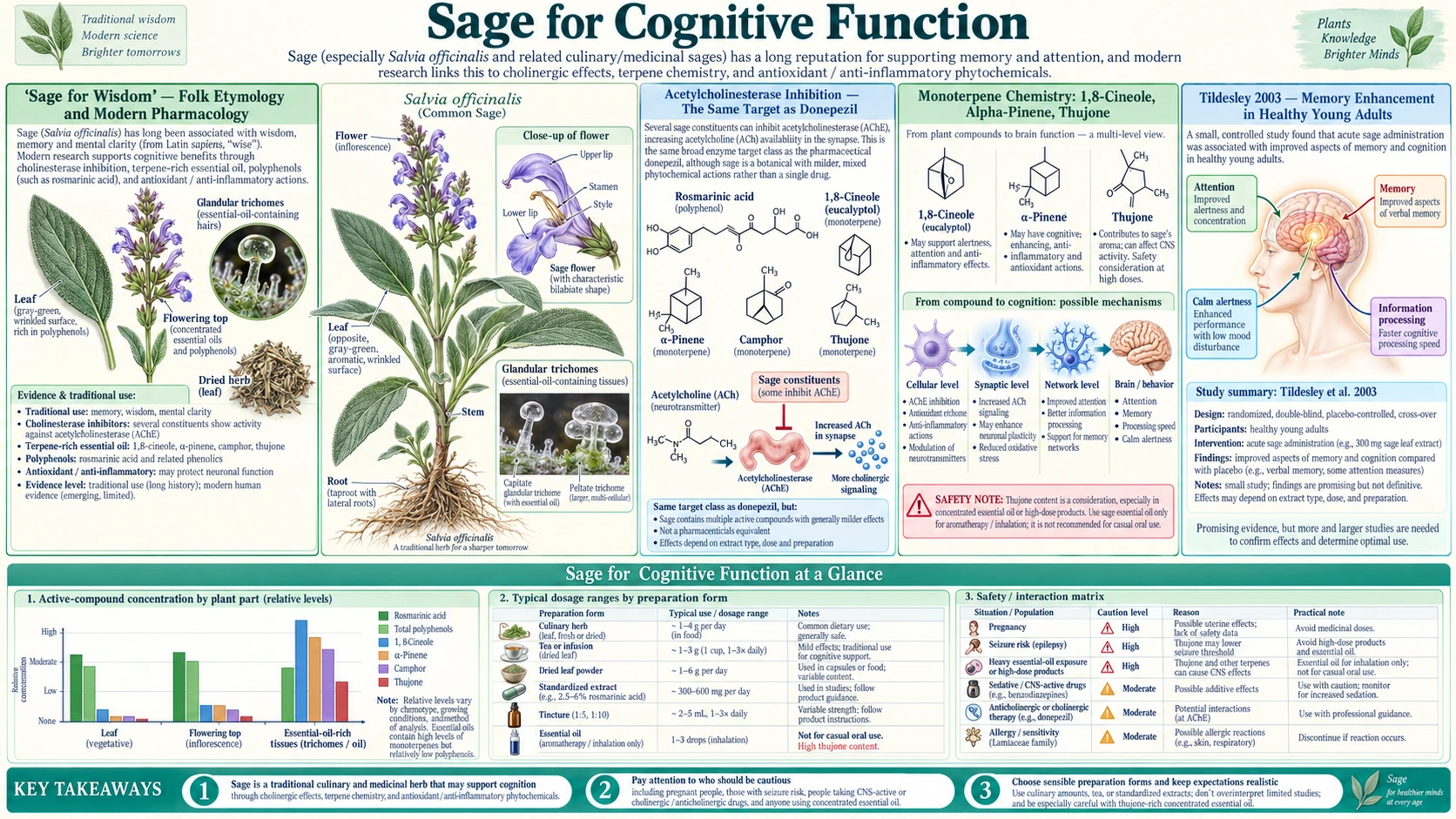
"Sage for wisdom" is one of the oldest claims in European herbalism — the Greek-derived English word "sage" applied to wise elders shares its conceptual root with the herb's use to "strengthen the memory." It is unusual for a folk-medicine claim that old to survive scrutiny by a placebo-controlled randomized trial, but sage's does. Two independent 2003 papers showed it: Tildesley, in two crossover trials in healthy young adults, found that a single 50-microlitre oral dose of Salvia lavandulaefolia essential oil significantly improved immediate word recall compared with placebo in both trials (testing ran 1 to 6 hours after dosing); Akhondzadeh, in a four-month double-blind randomized controlled trial in 42 patients with mild-to-moderate Alzheimer's disease, showed Salvia officinalis tincture produced statistically significantly better scores than placebo on the Alzheimer's Disease Assessment Scale cognitive subscale (ADAS-cog) and the Clinical Dementia Rating Sum of Boxes (CDR-SB). The proposed mechanism: in test-tube work, sage essential oil and two of its monoterpenes — 1,8-cineole and alpha-pinene — inhibit acetylcholinesterase (AChE), the same enzyme target as the prescription Alzheimer's drugs donepezil, rivastigmine, and galantamine. The wise elders of medieval villages may have been drinking, in effect, a low-potency natural cholinesterase inhibitor.
Table of Contents
- "Sage for Wisdom" — Folk Etymology and Modern Pharmacology
- Acetylcholinesterase Inhibition — The Same Target as Donepezil
- Monoterpene Chemistry: 1,8-Cineole, Alpha-Pinene, Thujone
- Tildesley 2003 — Memory Enhancement in Healthy Young Adults
- Akhondzadeh 2003 — The Alzheimer's Randomized Controlled Trial
- Scholey, Kennedy & Newcastle Follow-Up Work
- Rosmarinic Acid, Carnosic Acid, and Anti-Amyloid Activity
- Practical Dosing for Cognitive Use
- Sage vs Prescription Cholinesterase Inhibitors
- Cautions — Thujone, Epilepsy, Pregnancy, Drug Interactions
- Key Research Papers
- Connections
- Featured Videos
"Sage for Wisdom" — Folk Etymology and Modern Pharmacology
The English word "sage" carries two meanings simultaneously — the perennial Mediterranean kitchen herb (Salvia officinalis) and a wise elder (from Old French sage, Latin sapere, "to be wise"). These are technically separate etymological lineages, but medieval herbalists treated them as one phenomenon. The 12th-century Schola Medica Salernitana — the first true medical school in Christian Europe — immortalized the claim in a Latin couplet:
Cur moriatur homo cui salvia crescit in horto?
Contra vim mortis non est medicamen in hortis.
"Why should a man die who has sage in his garden? There is no medicine in the garden against the power of death" — a half-acknowledgment that sage was the closest thing the medieval pharmacy had to a panacea, including for the failing memory of old age. The 16th-century English herbalist John Gerard repeated the formula: sage "is singularly good for the head and brain, it quickens the senses and memory, strengtheneth the sinews."
This kind of testimonial chain is usually treated as folklore. What makes sage unusual is that when modern researchers actually ran the trials — Tildesley in 2003 with healthy young volunteers, Akhondzadeh in 2003 in Alzheimer's patients, Scholey in 2008 with healthy older adults — the memory effect was statistically significant. The proposed mechanism is the same one that the prescription Alzheimer's cholinesterase-inhibitor drugs work by. Folk-medicine pluripotency, when run through randomized controlled trials, usually disintegrates into placebo response. Sage was one of the rare exceptions.
Acetylcholinesterase Inhibition — The Same Target as Donepezil
To understand why sage works for memory you need to understand acetylcholine, the neurotransmitter at the neuromuscular junction and also a central neurotransmitter in the basal forebrain's cholinergic projection to the hippocampus and cerebral cortex. Acetylcholine is released from cholinergic neurons, binds nicotinic and muscarinic receptors on target neurons, and is then rapidly degraded by the enzyme acetylcholinesterase (AChE) in the synaptic cleft. AChE is one of the fastest enzymes known — a single molecule can hydrolyze about 25,000 acetylcholine molecules per second.
Alzheimer's disease selectively destroys the basal forebrain cholinergic neurons that project to the hippocampus and cortex. This is the basis of the "cholinergic hypothesis" of Alzheimer's dementia: as cholinergic neurons die, acetylcholine release drops, and cognitive function declines. Four of the U.S. Food and Drug Administration (FDA)-approved Alzheimer's drugs from the 1990s and 2000s — tacrine, donepezil, rivastigmine, and galantamine — are acetylcholinesterase inhibitors; a fifth, memantine, approved in 2003, is not a cholinesterase inhibitor, and no new Alzheimer's drug was approved by the FDA after it until the antibody drugs aducanumab (2021) and lecanemab (2023). The cholinesterase inhibitors block AChE so that whatever acetylcholine the surviving cholinergic neurons can still release stays in the synapse longer and produces a longer signal at the target receptor. They do not stop disease progression. They produce a modest, time-limited symptomatic benefit that, on average, delays cognitive decline by 6 to 12 months.
The Newcastle group (Perry, Tildesley, Kennedy, Scholey, Wesnes) systematically tested sage and several other Mediterranean labiate herbs for AChE inhibition starting in the late 1990s. The motivating insight was simple: Salvia officinalis and Salvia lavandulaefolia had been on the EU Alzheimer's herbal-medicine radar because of the folk tradition, and the Perry group's preliminary in-vitro work (2000) showed that Spanish sage essential oil inhibits acetylcholinesterase taken from human red blood cells (erythrocytes) in a test tube, with an IC50 (the concentration that inhibits 50% of the enzyme) of 0.03 microlitres of oil per millilitre. The oil batch tested was about 27% camphor, 13% 1,8-cineole, 10 to 15% alpha- and beta-pinene and 10% bornyl acetate. 1,8-Cineole and alpha-pinene were the main inhibitors (IC50 0.67 mM and 0.63 mM); camphor was weak (IC50 above 10 mM). Because no single constituent was particularly potent, the authors proposed that the constituents act together, and they wrote that it remains to be determined whether this test-tube inhibition is relevant to what swallowing the oil does to acetylcholinesterase in the brain.
This in-vitro evidence motivated the human trials. The Tildesley single-dose memory study in healthy young adults and the Akhondzadeh four-month Alzheimer's randomized controlled trial (RCT) both found a measurable behavioral benefit consistent with that mechanism.
Monoterpene Chemistry: 1,8-Cineole, Alpha-Pinene, Thujone
Sage essential oil is a mixture of around 30 volatile compounds, with the precise composition depending on the chemotype, geography, and harvest season. The major and most pharmacologically relevant constituents are:
- 1,8-Cineole (eucalyptol) — 5 to 15% of S. officinalis oil, up to 30% in S. lavandulaefolia (Spanish sage). 1,8-cineole is itself a documented mild AChE inhibitor and crosses the blood-brain barrier readily. The same molecule is the dominant constituent of eucalyptus oil and rosemary oil — both of which also have inhalation-based cognitive arousal effects (the Moss group's work on rosemary aroma and memory).
- Alpha-pinene and beta-pinene — bicyclic monoterpenes (5 to 15% combined) that contribute additively to AChE inhibition and have independent anti-inflammatory and bronchodilator activity.
- Thujone (alpha and beta isomers) — 30 to 50% of common-sage oil (and the constituent that defines high-thujone chemotypes). Thujone is the constituent that limits high-dose internal use because it is a noncompetitive gamma-aminobutyric acid-A receptor antagonist (the same mechanism that gave absinthe its reputation). Thujone was not among the constituents tested for acetylcholinesterase inhibition in the Perry 2000 study. At large sustained doses, it lowers seizure threshold and produces hepatic stress.
- Camphor — 10 to 25%, a bicyclic monoterpene ketone with mild central stimulant action and topical counterirritant effects.
- Borneol and bornyl acetate — minor constituents (5 to 15%) that contribute to the herbal aroma profile.
The Newcastle group's rationale for testing Salvia lavandulaefolia (Spanish sage) alongside S. officinalis (common kitchen sage) was that the Spanish species contains essentially no thujone but retains the 1,8-cineole and alpha-pinene content that does the cognitive work. This made it a safer experimental subject for repeat-dose human studies. Both species produce the AChE-inhibition cognitive effect, but Spanish sage is the preferred ingredient for cognitive-supplement formulations because it sidesteps the thujone exposure ceiling.
Outside the essential-oil fraction, sage leaf also contains rosmarinic acid (a phenolic acid that contributes anti-amyloid and antioxidant activity in the brain), carnosic acid (a diterpene phenolic with neuroprotective activity), and luteolin and apigenin flavonoids. These water-soluble constituents are present in aqueous extracts (teas, hydroalcoholic tinctures) and in the dried leaf, but not in the steam-distilled essential oil. A well-designed sage supplement therefore needs to specify both the essential-oil fraction (for the rapid AChE effect) and the polyphenol fraction (for the slower antioxidant and anti-amyloid effect).
Tildesley 2003 — Memory Enhancement in Healthy Young Adults
The landmark single-dose memory study by Tildesley and colleagues at Northumbria University's Human Cognitive Neuroscience Unit (in collaboration with the Newcastle group) was published in Pharmacology, Biochemistry and Behavior in 2003. The protocol:
- 20 healthy young adult volunteers (mean age ~20)
- Double-blind crossover design — each participant received placebo or one of three doses of Salvia lavandulaefolia essential oil (50 µL, 100 µL, or 150 µL of essential oil in soft-gel capsules) on four separate test days with a 7-day washout
- Cognitive testing battery (immediate and delayed word recall, attention, simple and choice reaction time) at baseline and at 1, 2.5, 4, and 6 hours after dosing
- Subjective mood ratings (alertness, calmness, contentedness) at the same time points
- A second trial in the same paper gave 24 participants 25 µL and 50 µL doses and placebo with the same crossover design
The primary positive finding was that the 50 µL dose significantly improved immediate word recall compared with placebo in both trials, with the effect peaking at the 1- and 2.5-hour time points and waning by 4 to 6 hours — the same pharmacokinetic profile that would be expected for an essential-oil constituent absorbed orally, passed first through the liver, and crossing the blood-brain barrier. Higher doses showed smaller or non-significant effects, consistent with an inverted-U dose-response that is common for cognitive enhancers (too much cholinergic tone can be as bad as too little). Mood and alertness were unaffected, ruling out a "feeling alert → performs better" confound.
This was the first placebo-controlled human evidence that a single oral dose of sage essential oil could measurably enhance memory in non-impaired adults. It also set the practical dosing range — 50 to 100 microliters of essential oil per dose is roughly equivalent to about 25 to 50 mg of sage essential oil, which corresponds to the essential-oil content of roughly 1 to 2 grams of dried sage leaf.
Akhondzadeh 2003 — The Alzheimer's Randomized Controlled Trial
The other landmark 2003 paper, published in Journal of Clinical Pharmacy and Therapeutics, was the Akhondzadeh group's four-month (16-week) double-blind placebo-controlled trial in 42 patients with mild-to-moderate Alzheimer's disease at three centres in Tehran, Iran. The protocol:
- 42 patients (18 women) aged 65 to 80 meeting Diagnostic and Statistical Manual of Mental Disorders, 4th edition (DSM-IV) criteria for probable Alzheimer's, entering with a score of 12 or more on the ADAS-cog and 2 or less on the Clinical Dementia Rating (mild to moderate)
- Randomized to a fixed dose of Salvia officinalis hydroalcoholic extract (60 drops per day, roughly equivalent to 2 mL or about 1 gram of dried-leaf-equivalent) vs placebo
- Treatment duration: 4 months (16 weeks); side effects recorded on a checklist throughout
- Primary outcome: ADAS-cog (Alzheimer's Disease Assessment Scale — cognitive subscale, where lower is better) and CDR-SB (Clinical Dementia Rating, Sum of Boxes, where lower is better)
Results at 4 months:
- ADAS-cog — the sage group improved by a mean of ~1.8 points; the placebo group worsened by a mean of ~3.6 points. The between-group difference was statistically significant (F = 4.77, P = 0.03).
- CDR-SB — also significantly better on sage than on placebo (F = 10.84, P < 0.003), with the sage group stable or slightly improved and the placebo group declining.
- Adverse events — side effects did not differ significantly between the two groups. Agitation appeared more frequent in the placebo group, but that difference was not statistically significant (P = 0.09); the authors wrote that a calming effect of sage on agitation needs to be confirmed.
This was one small trial of 42 patients over 16 weeks, and it has not been repeated at a larger scale; the abstract reports significance tests but no effect size that can be set beside donepezil's. The Akhondzadeh paper has been replicated in spirit by subsequent smaller studies and is the most-cited support for sage as a candidate adjunct in mild-to-moderate Alzheimer's disease.
Scholey, Kennedy & Newcastle Follow-Up Work
The Tildesley single-dose work was extended through the 2000s by Scholey, Kennedy, and Wesnes, who tested sage on a broader cognitive battery (the Cognitive Drug Research battery) in healthy older adults. The Scholey 2008 Psychopharmacology paper demonstrated that a standardized anticholinesterase sage extract improved memory and attention in healthy older volunteers, with the effect appearing within 1 hour of dosing and persisting for several hours. In that crossover trial, 20 volunteers over 65 took single doses of 167, 333, 666 and 1,332 mg of extract and a placebo on separate days a week apart; the 333 mg dose improved secondary memory at every test time (1, 2.5, 4 and 6 hours) and improved the accuracy of attention. The Kennedy 2006 Neuropsychopharmacology paper tested single doses of 300 mg and 600 mg of dried sage leaf in 30 healthy young adults: both doses improved mood ratings, the lower dose reducing anxiety and the higher dose raising alertness, calmness and contentedness. During a stressful 20-minute multitasking test, the higher dose improved performance, while the lower dose's anxiety-reducing effect disappeared once the test began.
Together with the Akhondzadeh Alzheimer's trial, this body of work positioned sage as one of the few herbal cognitive enhancers with positive Phase II-quality human evidence in both healthy and impaired populations. The Lopresti 2017 review in Drugs in R&D summarizes the literature through that date, including the completed human trials, and proposes directions for further research.
One practical observation from this body of work: fresh-frozen or recently dried sage leaf retains the essential-oil profile far better than long-stored dried leaf, which loses 1,8-cineole and other volatiles to evaporation. For cognitive applications, freshness matters. Many of the trials that used standardized extracts found greater effects than trials that used unspecified dried-leaf preparations, almost certainly because of essential-oil retention in the standardized product.
Rosmarinic Acid, Carnosic Acid, and Anti-Amyloid Activity
Beyond the AChE-inhibition mechanism, sage contains two phenolic constituents — rosmarinic acid and carnosic acid — that have independent neuroprotective activity in cell-culture and animal-model studies of Alzheimer's pathology.
Rosmarinic acid is a caffeic-acid ester (caffeic acid + dihydroxyphenyllactic acid) that is also abundant in rosemary, lemon balm, and many other labiates. In Alzheimer's pathology, rosmarinic acid binds the beta-amyloid peptide and inhibits its aggregation into the toxic oligomeric forms that disrupt synaptic function. In transgenic mouse models of Alzheimer's disease, oral rosmarinic acid reduces amyloid plaque burden and improves cognitive performance. The mechanism is direct binding of the rosmarinic-acid hydroxyl groups to specific residues in the amyloid peptide, sterically blocking aggregation.
Carnosic acid is a phenolic diterpene unique to Salvia and Rosmarinus. It is a potent antioxidant that crosses the blood-brain barrier and activates the Nrf2 pathway, which upregulates endogenous antioxidant enzymes (glutathione peroxidase, superoxide dismutase, NQO1). In cell-culture studies, carnosic acid protects neurons from amyloid-induced oxidative stress at submicromolar concentrations. The neuroprotective effect is mechanistically distinct from the AChE inhibition and would be expected to act over a longer timeline.
The proposed picture is that sage provides a fast-acting AChE-inhibition cognitive enhancement (essential-oil monoterpenes, peak effect 1 to 2.5 hours) plus a possible slower neuroprotective effect (rosmarinic and carnosic acids, over weeks to months of consistent intake). That second, slower effect rests on the cell-culture and animal studies described above.
Practical Dosing for Cognitive Use
The published trials used three dosing patterns:
- Acute single-dose cognitive enhancement (Tildesley protocol) — 50 microliters of Salvia lavandulaefolia (Spanish sage) essential oil in a soft-gel capsule, with testing from 1 hour after the dose. This is approximately 25 to 50 mg of essential oil and corresponds to the dose that produced the largest memory effect with no obvious adverse effects. Common sage (S. officinalis) essential oil was not the oil tested; it is 30 to 50% thujone (see Monoterpene Chemistry above).
- Single doses in healthy older adults (Scholey protocol) — the 2008 trial gave single doses of 167, 333, 666 and 1,332 mg of a standardized Salvia officinalis extract on separate days; 333 mg gave the clearest memory and attention gains. No twice-daily or long-term dose was tested in that trial. Products differ in whether they state their rosmarinic-acid content and a thujone limit.
- Adjunct in mild-to-moderate Alzheimer's (Akhondzadeh protocol) — Salvia officinalis hydroalcoholic tincture at 60 drops per day (approximately 2 mL), divided into two doses, for 16 weeks. Sage taken together with a prescribed cholinesterase inhibitor has not been formally studied; the theoretical risk is an added cholinergic effect such as a slow pulse or nausea.
Culinary doses (a teaspoon of dried sage in a roast-chicken stuffing) deliver minimal pharmacologically active essential oil and are not expected to produce cognitive effects. The traditional "sage tea" used in many Mediterranean countries (10 to 15 grams of dried leaf steeped in a liter of boiling water and drunk over the day) does deliver a relevant essential-oil dose and was almost certainly the form referenced in the medieval testimonials.
Sage vs Prescription Cholinesterase Inhibitors
The natural follow-up question is: if sage works through the same mechanism as donepezil, why use sage instead of donepezil? The honest answer is that for established Alzheimer's disease, prescription cholinesterase inhibitors are more potent, more thoroughly studied, and more reliably standardized in dose. Donepezil's effect on AChE is roughly 1000-fold more potent on a molar basis than sage's effect, and donepezil's long half-life allows once-daily dosing with stable plasma levels.
The situations in which sage is discussed as an option:
- Subjective cognitive decline and mild cognitive impairment — the gray zone before formal Alzheimer's diagnosis, where prescription cholinesterase inhibitors are not yet indicated by the U.S. Food and Drug Administration (FDA) but where a patient is already aware of cognitive slowing. The Scholey 2008 trial studied healthy older adults, not people with subjective cognitive decline or mild cognitive impairment; it found memory and attention gains after single doses (clearest at 333 mg).
- Acute cognitive demand — students preparing for an exam, professionals before a high-stakes meeting. A single 50 microliter dose of Spanish sage essential oil has positive single-dose memory evidence and a very clean safety profile at that dose.
- Patients who refuse or cannot tolerate prescription cholinesterase inhibitors — donepezil's gastrointestinal side effects (nausea, diarrhea, weight loss) cause about 20% of patients to discontinue. Sage at the Akhondzadeh dose did not produce these effects in the published trial, although the sample size was small.
- Adjunct to a prescription cholinesterase inhibitor — uncertain risk/benefit; no formal trial. The non-AChE mechanisms of sage (rosmarinic-acid anti-amyloid, carnosic-acid antioxidant) are not redundant with prescription cholinesterase inhibitors and could in principle add benefit. The combination is untested; the theoretical risk is additive cholinergic effects such as a slow pulse and nausea.
Antibody drugs since 2023. The U.S. also has antibody drugs aimed at amyloid for early Alzheimer's disease. In the 18-month phase 3 trial of lecanemab (1,795 people aged 50 to 90 with mild cognitive impairment or mild dementia due to Alzheimer's, with amyloid confirmed by a brain scan or spinal-fluid test), the Clinical Dementia Rating Sum of Boxes score (0 to 18, higher is worse) worsened by 1.21 points on lecanemab and 1.66 points on placebo. Brain swelling or fluid seen on scans (amyloid-related imaging abnormalities with edema or effusions) occurred in 12.6% of people on lecanemab, and infusion-related reactions in 26.4%.
Cautions — Thujone, Epilepsy, Pregnancy, Drug Interactions
- Thujone and seizure threshold — common sage essential oil (high-thujone chemotype) lowers seizure threshold in animal models, so epilepsy or any history of seizures is the main concern raised. Spanish sage (S. lavandulaefolia) essential oil contains essentially no thujone, and some standardized extracts declare a thujone limit.
- Pregnancy — high-dose sage essential oil internally is uterotonic (induces uterine contractions) and is traditionally used to suppress lactation, both of which raise a concern about anything above culinary amounts in pregnancy and breastfeeding. Culinary use of dried leaf in food is safe.
- Drug interactions with cholinergic agents — theoretical additive effect with prescription cholinesterase inhibitors (donepezil, rivastigmine, galantamine) and with cholinergic agents used in glaucoma or myasthenia gravis (pilocarpine, pyridostigmine). Not formally studied; the theoretical risk is additive cholinergic effects such as a slow pulse and nausea.
- Drug interactions with anticonvulsants — the thujone effect on gamma-aminobutyric acid-A signaling could theoretically reduce the efficacy of anticonvulsants. This adds to the thujone concern for people with epilepsy.
- Hepatic stress at high sustained dose — isolated case reports of hepatotoxicity from chronic high-dose sage essential oil. In the 16-week Akhondzadeh trial (60 drops a day of leaf extract), side effects did not differ significantly from placebo.
- Hypoglycemia in diabetics — sage extract has insulin-sensitizing effects (see the Blood Sugar & Lipids deep-dive) and may potentiate the blood-sugar-lowering effects of metformin and insulin.
Key Research Papers
- Tildesley NTJ, Kennedy DO, Perry EK, Ballard CG, Savelev S, Wesnes KA, Scholey AB (2003). Salvia lavandulaefolia (Spanish sage) enhances memory in healthy young volunteers. Pharmacology Biochemistry and Behavior. — PubMed PMID: 12895685
- Akhondzadeh S, Noroozian M, Mohammadi M, Ohadinia S, Jamshidi AH, Khani M (2003). Salvia officinalis extract in the treatment of patients with mild to moderate Alzheimer's disease: a double blind, randomized and placebo-controlled trial. Journal of Clinical Pharmacy and Therapeutics. — PubMed PMID: 12605619
- Perry NSL, Houghton PJ, Theobald A, Jenner P, Perry EK (2000). In-vitro inhibition of human erythrocyte acetylcholinesterase by Salvia lavandulaefolia essential oil and constituent terpenes. Journal of Pharmacy and Pharmacology. — PubMed PMID: 10933142
- Scholey AB, Tildesley NTJ, Ballard CG, Wesnes KA, Tasker A, Perry EK, Kennedy DO (2008). An extract of Salvia (sage) with anticholinesterase properties improves memory and attention in healthy older volunteers. Psychopharmacology. — PubMed PMID: 18350281
- Kennedy DO, Pace S, Haskell C, Okello EJ, Milne A, Scholey AB (2006). Effects of cholinesterase inhibiting sage on mood, anxiety, and performance on a psychological stressor battery. Neuropsychopharmacology. — PubMed PMID: 16205785
- Lopresti AL (2017). Salvia (sage): A review of its potential cognitive-enhancing and protective effects. Drugs in R&D. — PubMed PMID: 27888449
- Perry NSL, Bollen C, Perry EK, Ballard CG (2003). Salvia for dementia therapy: review of pharmacological activity and pilot tolerability clinical trial. Pharmacology, Biochemistry and Behavior. — PubMed PMID: 12895683
- Savelev S, Okello E, Perry NSL, Wilkins RM, Perry EK (2003). Synergistic and antagonistic interactions of anticholinesterase terpenoids in Salvia lavandulaefolia essential oil. Pharmacology, Biochemistry and Behavior. — PubMed PMID: 12895684
- Iuvone T, De Filippis D, Esposito G, D'Amico A, Izzo AA (2006). The spice sage and its active ingredient rosmarinic acid protect PC12 cells from amyloid-beta peptide-induced neurotoxicity. Journal of Pharmacology and Experimental Therapeutics. — PubMed PMID: 16495207
- Habtemariam S (2016). The therapeutic potential of rosemary (Rosmarinus officinalis) diterpenes for Alzheimer's disease. Evidence-Based Complementary and Alternative Medicine. — PubMed
- Hamidpour M et al. (2014). Chemistry, pharmacology, and medicinal property of sage (Salvia). Journal of Traditional and Complementary Medicine. — PubMed PMID: 24860730
- Miroddi M et al. (2014). Salvia officinalis in dementia: review of clinical and preclinical evidence. CNS Neuroscience & Therapeutics. — PubMed
- van Dyck CH, Swanson CJ, Aisen P, et al. (2023). Lecanemab in early Alzheimer's disease. New England Journal of Medicine 388(1):9-21. — PubMed PMID: 36449413
- Cacabelos R, Martínez-Iglesias O, Cacabelos N, Carrera I, Corzo L, Naidoo V (2024). Therapeutic options in Alzheimer's disease: from classic acetylcholinesterase inhibitors to multi-target drugs with pleiotropic activity. Life (Basel) 14(12):1555. — PubMed PMID: 39768263
PubMed Topic Searches
Connections
- All Herbs
- Sage Overview
- Sage Benefits Hub
- Sage for Menopause
- Sage for Antimicrobial & Throat
- Sage for Blood Sugar & Lipids
- Rosemary (Carnosic Acid)
- Lemon Balm (Rosmarinic Acid + AChE)
- Bacopa Monnieri (Cognitive)
- Ginkgo Biloba
- Alzheimer's Disease
- Dementia
- Oxidative Stress
- Gut-Brain Axis
- Lavender (Aromatherapy)
- History