⚠ Evidence warning: Clinical trials or other evidence do not support the claims that sage treats oral thrush, restores mouth flora after antibiotics and clears denture yeast. This page keeps it as a report of what people, websites or other media say.
Sage for Antimicrobial Use & Sore Throat
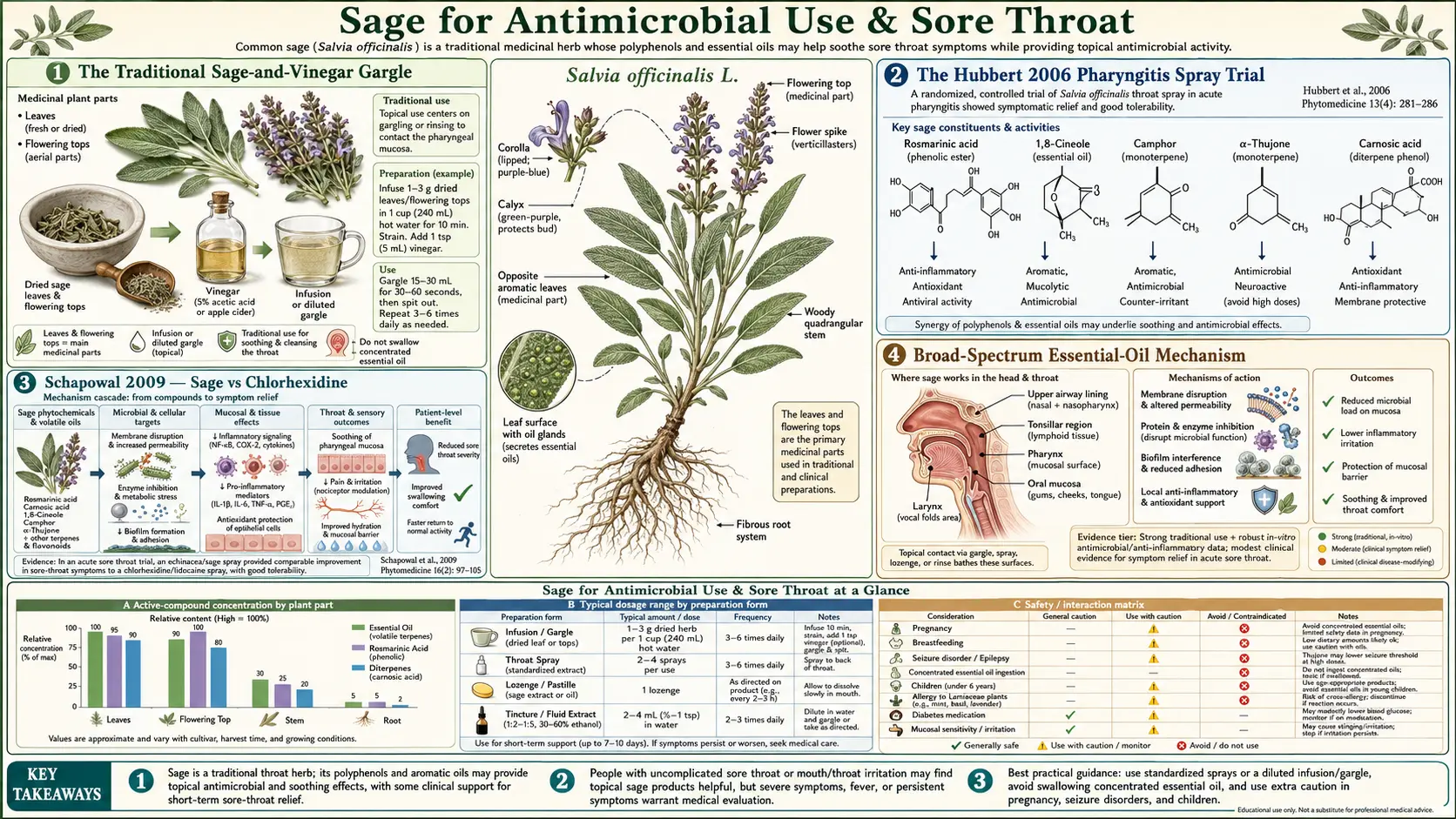
A sage-and-vinegar gargle for sore throat is one of the most universally taught home remedies in European folk medicine, recommended in 16th-century herbals and still in the front pages of every Mediterranean grandmother's health notebook. The traditional indication tracks well to modern microbiology: sage essential oil shows broad-spectrum activity against the bacterial and fungal species that colonize the oral cavity and oropharynx, including Streptococcus pyogenes (the cause of bacterial sore throat / "strep throat"), Staphylococcus aureus, Candida albicans, and several oral biofilm species. The clinical anchor is the Hubbert 2006 multicenter randomized double-blind placebo-controlled trial of a 15% sage fluid-extract spray in 286 patients with acute viral pharyngitis: symptom relief within the first two hours after the first dose, statistically significantly better than placebo. A subsequent Schapowal 2009 trial in acute sore throats found an echinacea-sage spray as efficacious and well tolerated as a chlorhexidine-lidocaine spray; it tested the combination, so it says nothing about sage alone. The traditional gargle, the modern lozenge, the mouthwash for gingivitis, and the legendary plague-era reputation are all attributed to the same broad-spectrum essential-oil pharmacology.
Table of Contents
- The Traditional Sage-and-Vinegar Gargle
- The Hubbert 2006 Pharyngitis Spray Trial
- Schapowal 2009 — Echinacea-Sage Spray vs Chlorhexidine-Lidocaine Spray
- Broad-Spectrum Essential-Oil Mechanism
- Sage vs Streptococcus pyogenes
- Sage vs Candida albicans and Oral Thrush
- Sage Mouthwash for Gingivitis & Oral Biofilm
- The Plague-Doctor Vinegar & Sage History
- Practical Preparations — Gargle, Lozenge, Spray, Mouthwash
- Cautions for Topical & Oropharyngeal Use
- Key Research Papers
- Connections
- Featured Videos
The Traditional Sage-and-Vinegar Gargle
The traditional Mediterranean preparation for a sore throat is a hot tea of one tablespoon of dried sage leaf in 250 mL of water steeped 10 minutes covered, strained, and combined with one tablespoon of apple-cider vinegar and a teaspoon of honey. The mixture is used to gargle for 30 seconds, swish through the front of the mouth for another 15 seconds, and either spat out or swallowed. The frequency traditionally described for active sore throat is every 2 to 3 hours during the acute phase.
Each component has a pharmacological role:
- Sage essential oil (extracted into the hot water during the 10-minute steep) — the primary antimicrobial agent, with broad-spectrum activity at the concentrations achieved in a strong tea
- Sage polyphenols (rosmarinic acid, carnosic acid, flavonoids) — anti-inflammatory and astringent effects on the inflamed mucosal surface
- Acetic acid from vinegar — lowers local pH, which is itself bactericidal at the levels reached in a gargle, and is the basis of the "vinegar tea-cleanse" tradition for oral biofilm
- Honey — provides demulcent coating of the inflamed pharyngeal mucosa, has its own antimicrobial activity through hydrogen peroxide generation and high osmolarity, and makes the gargle palatable
The German Commission E monograph for Folium Salviae explicitly lists "inflammation of the mucous membranes of the mouth and throat" as an established indication and describes the dilute tea-gargle as a recognized therapeutic preparation. The European Medicines Agency's 2016 herbal monograph lists sage leaf as a "traditional herbal medicinal product for relief of inflammations in the mouth or the throat", "exclusively based upon long-standing use"; its well-established-use column is empty.
The Hubbert 2006 Pharyngitis Spray Trial
The pivotal modern clinical trial of sage for sore throat is the Hubbert and colleagues multicenter randomized double-blind placebo-controlled study published in European Journal of Medical Research in 2006. The protocol:
- 286 patients with acute viral pharyngitis (122 in the first study part, 164 in the second, treated for 3 days) — defined as sore throat onset within 72 hours, with at least moderate throat pain and no clinical suspicion of bacterial (strep) etiology
- Randomized to a spray containing a Salvia officinalis fluid extract (not essential oil) or placebo spray. The first study part tested 30%, 15% and 5% preparations; after the interim analysis the 15% spray, with 140 microlitres of sage extract per dose, went on to the second part
- Two sprays applied to the throat every 2 hours during waking hours
- Primary outcome: area under the curve for change in throat pain, recorded every 15 minutes for the first 2 hours after the first dose (100 mm visual analog scale)
- Secondary outcomes: throat pain reduction at later time points, tolerability, global assessment
The headline results:
- 15% sage spray — significantly faster throat-pain reduction than placebo at 2 hours after first dose. The abstract reports this as statistically significant superiority on the area-under-the-curve measure, with relief within the first two hours. The figure of about 60% symptomatic improvement from baseline long quoted here is not in the abstract and has not been checked against the full paper.
- 5% and 30% sage sprays — at the interim analysis, the results of both made superiority over placebo unlikely, so the three strengths do not show a rising dose-response
- Placebo spray — the placebo response itself was substantial (typical for self-reported throat-pain trials), but the 15% sage spray clearly exceeded it
- Tolerability — the abstract states: "Only minor side effects such as dry pharynx or burning of mild intensity were seen."
The two-hour timeline is notable. A bacterial culture takes 24 to 48 hours, and even the rapid streptococcal antigen test takes 5 to 10 minutes. A sore-throat patient who feels meaningfully better within two hours of starting a treatment is getting symptom relief on a clinically relevant timescale. The trial measured pain, not microbes, in acute viral pharyngitis, and it did not test why the spray worked. Essential-oil antimicrobial action and a mild local-anaesthetic and anti-inflammatory effect of the sage polyphenols are proposed explanations, not results of this trial.
Sage throat sprays are sold as herbal medicines in several European countries; the Hubbert abstract does not name its product. In the U.S., people use carefully prepared concentrated sage tea or commercial throat-spray products that combine sage with thyme, echinacea, or other antimicrobial botanicals. The trial's 15% is a share of fluid extract, and it does not establish that a home tea matches that strength.
Schapowal 2009 — Echinacea-Sage Spray vs Chlorhexidine-Lidocaine Spray
The Schapowal, Berger and colleagues 2009 trial published in European Journal of Medical Research compared an echinacea-sage combination spray against a chlorhexidine-lidocaine combination spray (an antiseptic plus a numbing drug) in 154 patients at least 12 years old with acute sore throat (133 analyzed per protocol), in eleven general practices in Switzerland. The two products were compared head-to-head, double-blind, double-dummy, at two puffs every 2 hours, up to 10 times daily, for at most 5 days.
The authors report similar efficacy. After 3 days, 63.8% responded with the echinacea-sage spray and 57.8% with the chlorhexidine-lidocaine spray (a response meant symptoms at least halved), with no difference in time to becoming symptom free, throat pain or global assessments. Both were "very well tolerated", and the abstract reports no tolerability edge for either one. Outside this trial, chlorhexidine is known for transient tongue and dental staining with repeated use, and lidocaine for brief numbing of the tongue that some patients dislike.
The finding places this echinacea-sage spray level with an antiseptic-and-numbing spray in acute sore throats generally, not specifically viral pharyngitis. The trial had no placebo arm, and because it tested a combination it says nothing about sage alone.
A 2023 study with no comparison group, run by the company that makes the product, gave 74 people aged 13 to 69 with sudden sore throat echinacea and sage lozenges, five a day for 4 days. A single lozenge cut throat pain by 48%. Eighteen people tested positive for a virus, and their viral load was 96% lower after 4 days than before treatment. With no comparison group, the study cannot separate these changes from natural recovery.
Broad-Spectrum Essential-Oil Mechanism
The antimicrobial mechanism of sage essential oil is largely shared with the essential oils of related labiate herbs (thyme, oregano, rosemary, marjoram). The dominant pharmacology is membrane-disruption by lipophilic monoterpenes:
- The essential-oil constituents are small lipophilic molecules that partition into the bacterial cell membrane (or fungal cell membrane / yeast cell wall)
- At threshold concentrations, the accumulated membrane perturbation disrupts membrane integrity, leaks intracellular contents (adenosine triphosphate (ATP), potassium, nucleotides), and kills the cell
- This is a relatively non-specific mechanism, which is why a broad range of unrelated microbes is susceptible — gram-positive bacteria (Strep pyogenes, Staph aureus), gram-negative bacteria (E. coli), fungi (Candida albicans), and biofilm communities
- The same non-specific membrane mechanism means resistance does not develop the way it does with targeted antibiotics — there is no enzyme to mutate, no efflux pump to upregulate, no target receptor to modify
Among the sage essential-oil constituents, 1,8-cineole, thujone, camphor, and alpha-pinene all contribute to the antimicrobial effect, with the relative contribution varying by target organism. Laboratory figures quoted for the minimum inhibitory concentrations (MICs) of sage essential oil against most relevant respiratory pathogens are in the 0.05 to 0.5% range; this page has no single paper for that range. These essential-oil percentages cannot be compared with the 5% or 15% in the Hubbert trial spray, which are shares of a fluid extract, a different quantity.
The laboratory papers listed below are narrower than the broad claim. In a study of rosemary and sage oils against 13 bacterial strains and 6 fungi (Bozin 2007), the strongest antibacterial action was on Escherichia coli, Salmonella typhi, S. enteritidis and Shigella sonnei, and the antifungal activity was especially that of rosemary oil, so throat and mouth germs were not its headline. A 2015 laboratory paper on clary sage (Salvia sclarea, a different species from garden sage) reported an MIC of 0.05% and a minimum bactericidal concentration of 0.1% against seven pathogens, with damage to the cell membrane and leakage of cell contents in E. coli and Staphylococcus aureus. These are test-tube results, and none of them measures what happens in a throat.
The clinical reach of this mechanism is limited. Topical and oropharyngeal application reaches relevant concentrations at the mucosal surface, but systemic absorption from a swallowed gargle does not produce the serum concentrations needed for systemic antibacterial action. Sage is not a substitute for antibiotics in bacterial pneumonia, urinary tract infection, or skin/soft-tissue infection. Its useful niche is local: gargles for pharyngitis, mouthwashes for gingivitis, and topical applications for minor oral and skin infections.
Sage vs Streptococcus pyogenes
Streptococcus pyogenes (group A streptococcus, "strep") is the causative organism in 5 to 15% of adult sore throats and 15 to 30% of pediatric sore throats. Strep is the one bacterial pharyngitis that requires antibiotic treatment because of the small but real risk of rheumatic fever and post-streptococcal glomerulonephritis in untreated cases. Sage is not a substitute for penicillin or amoxicillin in confirmed strep throat — the systemic antibiotic prevents the post-streptococcal complications, which the topical gargle cannot.
That said, laboratory figures quoted for sage essential oil put its inhibition of S. pyogenes at MICs of 0.1 to 0.5%, and some people with confirmed strep who have started antibiotics also use a sage gargle for throat pain. The acute pain and the discomfort with swallowing typically dominate the first 24 to 48 hours of strep throat treatment before antibiotic effects take hold, and this is the gap the gargle is used for.
Viral pharyngitis makes up the majority of adult sore throats, and strep is told apart by rapid antigen test or culture. The Centor criteria estimate the odds: fever, tonsillar exudate, tender anterior cervical lymphadenopathy and absence of cough. In the original 1981 emergency-room study, the chance of a positive culture was 56% with all four signs, 32% with three, 15% with two, 6.5% with one and 2.5% with none. Where strep has been excluded, sage gargle or spray is used for symptoms only, and the Hubbert trial is the evidence for the fluid-extract spray.
For more on pharyngitis evaluation and treatment, see our Sinusitis & Upper Respiratory Infection page and the Streptococcus pyogenes page.
Sage vs Candida albicans and Oral Thrush
Candida albicans is the most common cause of oral thrush, particularly in immunocompromised patients, denture wearers, patients on inhaled corticosteroids for asthma or chronic obstructive pulmonary disease (COPD), and patients on broad-spectrum antibiotics. Topical antifungal nystatin suspension is the standard treatment, with oral fluconazole reserved for severe or refractory cases.
Laboratory figures quoted for sage essential oil put its activity against Candida albicans at MICs of approximately 0.1 to 0.25%. A sage mouthwash or gargle (held in the mouth for 30 seconds, swished through the front of the mouth, and either spat out or swallowed) is used alongside topical antifungal therapy in mild oral thrush and is described by some as enough by itself in early or mild presentations. The combined antimicrobial-plus-astringent action of the sage polyphenols is also described as helping with the discomfort and altered taste (dysgeusia) that typically accompany active oral thrush.
Particular populations where this use is described: inhaled-corticosteroid users (a rinse with sage tea or sage mouthwash after each inhaled-steroid dose, described as reducing candidal colonization), denture wearers (overnight soaking of dentures in a 1:10 dilute sage tea, described as reducing candidal biofilm), and post-antibiotic users (a 5- to 7-day course of sage mouthwash twice daily after a course of broad-spectrum antibiotics, described as helping restore the normal oral flora balance).
Sage Mouthwash for Gingivitis & Oral Biofilm
Gingivitis — the early reversible inflammatory stage of periodontal disease — is caused by accumulated dental biofilm (plaque) of mixed-species bacterial origin. The standard treatment is improved mechanical oral hygiene (brushing, flossing, professional cleaning) with antimicrobial mouthwash adjunct as needed. Chlorhexidine mouthwash is the gold-standard pharmaceutical antimicrobial rinse but has the side effects of tongue and tooth staining and altered taste sensation with prolonged use, limiting it to short courses.
Multiple smaller trials have evaluated sage-containing mouthwashes for gingivitis. The aggregate finding reported is that sage mouthwash reduces gingival inflammation indices and plaque accumulation. Commercial sage mouthwash products are widely available in European pharmacies; people also use homemade sage tea cooled to room temperature as a daily rinse (one to two cups of cooled sage tea swished through the mouth twice daily after toothbrushing).
Three trials give the numbers:
- Young adults, 12 weeks (2026) — 175 healthy young adults were split equally among 2% water infusions of sage, chamomile and ginger, placebo, and chlorhexidine, used three times daily. All active rinses did better than placebo on plaque and gum scores, and the three herbs did not differ from one another. The authors report no staining, taste change or mouth irritation with the herbal rinses. Longer daily use was outside this trial, and mild tooth staining with long-term daily use is noted under Cautions below.
- Children, 21 days (2015) — 70 girls aged 11 to 14 used a sage or placebo mouthwash. Streptococcus mutans colonies in plaque fell from 3,900 to 300 per sample with sage and from 4,400 to 4,000 with placebo. This trial counted a decay-linked germ and did not measure gingivitis.
- Hospice patients, 4 days (2021) — 88 adults with late-stage cancer used a sage tea rinse or salt water (saline), and 73 finished. Overall mouth health improved about equally, and the authors found no overall significant difference. Dry mouth improved more with sage, while tongue plaque and redness improved only with salt water.
For active periodontal disease (with attachment loss or pocketing), sage mouthwash is an adjunct only, not a substitute for professional scaling and root planing. The mechanical biofilm disruption from professional cleaning is the necessary primary intervention.
The Plague-Doctor Vinegar & Sage History
The legendary "Four Thieves Vinegar" of 17th-century plague-era France (versions also documented in Italy and England) was a herbal vinegar that, according to several recipe variants, contained sage, rosemary, thyme, lavender, mint, garlic, wormwood, and rue infused in red-wine vinegar. The legend held that four thieves in Marseilles or Toulouse used the preparation to protect themselves from plague while robbing the dead, were caught, and traded the recipe for their freedom. The recipe survived in European folk pharmacopoeias well into the 19th century.
Modern microbiology cannot validate or refute the plague-specific claim — Yersinia pestis spreads primarily through flea bites in bubonic plague and through respiratory droplets in pneumonic plague, neither of which a topical or oral herbal vinegar would meaningfully address. But the recipe is reasonable as a broad-spectrum oral and topical antimicrobial in a pre-antibiotic era: each ingredient has independent in-vitro antimicrobial activity, the vinegar base lowers pH to bactericidal levels, and the combination was used both as a topical wash and as an oral rinse/swallow.
By legend, the historical role of sage in this kind of formulation, and in plague-era practice more broadly, was as a reliable broad-spectrum antimicrobial in a pharmacy that had no antibiotics. That role is largely obsolete now for serious systemic infection; its remaining use is in topical oral, oropharyngeal, and skin complaints, where sage essential oil is described as reaching working concentrations.
Practical Preparations — Gargle, Lozenge, Spray, Mouthwash
- Sage tea gargle (traditional use, no trial of this recipe in the sources read) — the folk recipe is 1 tablespoon dried S. officinalis leaf in 250 mL just-off-boil water, steeped covered for 10 minutes and strained, with 1 tablespoon apple-cider vinegar and 1 teaspoon honey added. It is gargled for 30 seconds, swished for 15 seconds, then spat out or swallowed, every 2 to 3 hours during waking hours for the first 48 hours of an acute sore throat, until symptoms resolve. The EU herbal monograph gives a different strength for adults: 2.5 g of cut leaf in 100 mL boiling water, used warm as a gargle 3 times daily.
- Sage fluid-extract throat spray (the Hubbert trial product type) — the spray that beat placebo was a 15% fluid-extract spray with 140 microlitres of sage extract per dose; the 5% and 30% preparations did not go forward. The use described here is 2 sprays to the back of the throat every 2 to 3 hours during waking hours. Commercial sage throat sprays are sold in Germany and elsewhere.
- Sage essential oil (a different, more concentrated product) — no throat trial of an essential-oil spray was found among the sources read. The EU herbal monograph reports thujone, a constituent of the oil, as neurotoxic, and reports that intake of sage oil corresponding to more than 15 g of sage leaf has caused a sensation of heat, a fast heartbeat, vertigo and seizures.
- Sage lozenge — widely available commercial lozenges containing sage essential oil, often combined with honey, lemon, or eucalyptus. People use them for mild sore throat or in place of a gargle when one is impractical (during travel, work, etc.)
- Sage mouthwash (for gingivitis or recurrent oral thrush) — cooled sage tea prepared as above, used as a 30-second rinse twice daily after toothbrushing. The 2026 trial above ran a 2% infusion three times daily for 12 weeks and reported no staining or taste change.
- Topical application for minor skin infection or insect bite — cooled strong sage tea applied with a clean cloth as a compress; or, as a home practice, a 1:10 dilution of sage essential oil in a carrier oil (jojoba, sweet almond) applied 2 to 3 times daily. This practice is not described for broken skin in young children or for burns. The EU herbal monograph's skin use is an infusion only (2.5 g in 100 mL water, applied 2 to 4 times daily, for minor skin inflammations), and it lists no essential-oil skin use.
Cautions for Topical & Oropharyngeal Use
- Sage does not replace antibiotic therapy in confirmed strep throat or any bacterial infection requiring systemic antibiotics — the gargle and spray have local effect only and do not prevent rheumatic fever or other post-streptococcal complications
- Pregnancy and breastfeeding — the EU herbal monograph states: "Safety during pregnancy and lactation has not been established. In the absence of sufficient data, the use during pregnancy and lactation is not recommended." It makes no exception for gargles or sprays. Swallowed sage tea in repeated daily use raises the uterotonic and lactation-suppression concerns covered in the Menopause & Hot Flashes page.
- Children — the EU herbal monograph states that use in children and adolescents under 18 years "is not recommended" and "has not been established due to lack of adequate data." Essential-oil sprays and concentrated tinctures raise a swallowing risk and a thujone exposure concern in children under 6. Traditional practice uses cooled dilute sage tea (one teaspoon of dried leaf in 250 mL water) as a gargle in children old enough to gargle reliably (typically age 6 and up).
- Asthma — the essential-oil aerosol from a throat spray can occasionally trigger bronchospasm in patients with reactive airway disease. A common precaution is trying one or two sprays first.
- Hypersensitivity — rare but documented allergic contact stomatitis to sage and the related labiate herbs. Oral burning, swelling (edema) or rash are the signs of this reaction. The EU herbal monograph lists hypersensitivity to sage as its one contraindication.
- Dental restorations — long-term daily use of sage tea as a mouthwash can produce mild tooth staining, similar to but less severe than chlorhexidine. Less of an issue with intermittent acute-treatment use.
- Thujone — the EU herbal monograph reports thujone as neurotoxic, states that low-thujone chemotypes (plant strains) are preferred, and sets daily thujone exposure in a product below 6.0 mg.
- How long symptoms last — for mouth and throat use, the EU herbal monograph sets 1 week of persisting symptoms, or any worsening, as the point at which a doctor or qualified practitioner is consulted.
Key Research Papers
- Hubbert M, Sievers H, Lehnfeld R, Kehrl W (2006). Efficacy and tolerability of a spray with Salvia officinalis in the treatment of acute pharyngitis — a randomised double-blind, placebo-controlled study with adaptive design and interim analysis. European Journal of Medical Research 11(1):20-26. — PubMed PMID: 16504956
- Schapowal A, Berger D, Klein P, Suter A (2009). Echinacea/sage or chlorhexidine/lidocaine for treating acute sore throats: a randomized double-blind trial. European Journal of Medical Research. — PubMed PMID: 19748859
- Bozin B, Mimica-Dukic N, Samojlik I, Jovin E (2007). Antimicrobial and antioxidant properties of rosemary and sage (Rosmarinus officinalis L. and Salvia officinalis L., Lamiaceae) essential oils. Journal of Agricultural and Food Chemistry. — PubMed PMID: 17708648
- Beheshti-Rouy M, Azarsina M, Rezaie-Soufi L, Alikhani MY, Roshanaie G, Komaki S (2015). The antibacterial effect of sage extract (Salvia officinalis) mouthwash against Streptococcus mutans in dental plaque: a randomized clinical trial. Iranian Journal of Microbiology. — PubMed PMID: 26668706
- Pedrazzi V, Leite MF, Tavares RC, Sato S, do Nascimento GC, Issa JP (2015). Herbal mouthwash containing extracts of Baccharis dracunculifolia as agent for the control of biofilm: clinical evaluation in humans. Scientific World Journal. (Comparison context for herbal antimicrobial mouthwashes.) — PubMed PMID: 25874255
- Walch SG et al. (2011). Antioxidant capacity and polyphenolic composition as quality indicators for aqueous infusions of Salvia officinalis. Frontiers in Pharmacology. — PubMed PMID: 22194722
- Cui H, Zhang X, Zhou H, Zhao C, Lin L (2015). Antimicrobial activity and mechanisms of Salvia sclarea essential oil. Botanical Studies 56(1):16. (Clary sage, not garden sage.) — PubMed PMID: 28510825
- Centor RM, Witherspoon JM, Dalton HP, Brody CE, Link K (1981). The diagnosis of strep throat in adults in the emergency room. Medical Decision Making 1(3):239-246. (Centor criteria for strep-throat clinical evaluation.) — PubMed PMID: 6763125
- Lopes-Lutz D, Alviano DS, Alviano CS, Kolodziejczyk PP (2008). Screening of chemical composition, antimicrobial and antioxidant activities of Artemisia essential oils. Phytochemistry 69(8):1732-1738. (Wild sages of the genus Artemisia, not Salvia; comparison context only.) — PubMed PMID: 18417176
- European Medicines Agency (2016). European Union herbal monograph on Salvia officinalis L., folium. EMA/HMPC/277152/2015, 20 September 2016. — European Medicines Agency: Salviae officinalis folium
- Lile IE, Samoilă AOJ, Cojocariu C, Tapalagă G, Oláh NK, Stana OL, Berari A, Marian D (2026). Comparative Clinical Evaluation of Chamomile, Sage, and Ginger Mouthwashes in Reducing Plaque and Gingival Inflammation. Antibiotics (Basel) 15(5):433. — PubMed PMID: 42192655
- Monsen RE, Herlofson BB, Gay C, Fjeld KG, Hove LH, Malterud KE, Saghaug E, Slaaen J, Sundal T, Tollisen A, Lerdal A (2021). A mouth rinse based on a tea solution of Salvia officinalis for oral discomfort in palliative cancer care: a randomized controlled trial. Supportive Care in Cancer 29(9):4997-5007. — PubMed PMID: 33586003
- Weishaupt R, Buchkov A, Kolev E, Klein P, Schoop R (2023). Reduction of Viral Load in Patients with Acute Sore Throats: Results from an Observational Clinical Trial with Echinacea/Salvia Lozenges. Complementary Medicine Research 30(4):299-306. — PubMed PMID: 36889292
PubMed Topic Searches
Connections
- All Herbs
- Sage Overview
- Sage Benefits Hub
- Sage for Cognitive Function
- Sage for Menopause
- Sage for Blood Sugar & Lipids
- Thyme (Sister Essential-Oil Herb)
- Oregano (Carvacrol)
- Echinacea
- Eucalyptus (1,8-Cineole)
- Sinusitis & URI
- Streptococcus Pyogenes
- Staphylococcus Aureus
- Immune Boosting
- Honey (Throat Demulcent)
- Covered in depth on its own page: Sore Throat
- History