Oregano for Antifungal Use — Candida, Dermatophytes, and Carvacrol Mechanism
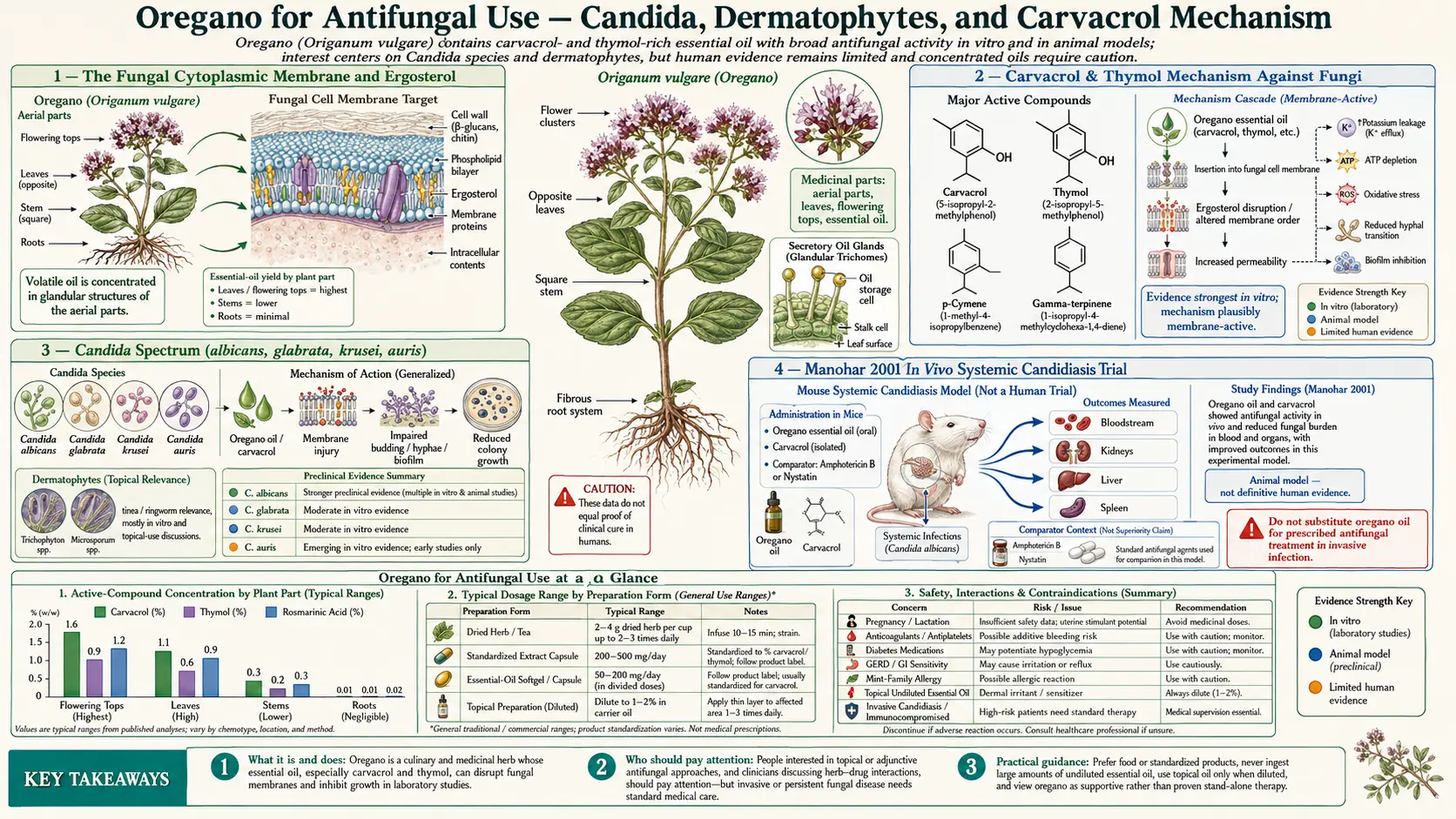
Oregano essential oil and its main phenol, carvacrol, inhibit Candida yeasts and skin fungi in laboratory studies, including Candida isolates resistant to fluconazole. In a 2001 mouse study, oregano oil given by mouth was followed by 80% survival in mice with systemic Candida albicans infection, while untreated mice died within 10 days (Manohar 2001), and carvacrol reduced oral Candida in immunosuppressed rats about as well as nystatin (Chami 2004). No randomized trial of oregano oil for a fungal infection in people was found for this page. This deep-dive covers how the phenols act on fungal cells, the laboratory and animal evidence for Candida and dermatophytes, the comparisons with standard antifungal drugs, and the safety findings.
Table of Contents
- The Fungal Cytoplasmic Membrane and Ergosterol
- Carvacrol & Thymol Mechanism Against Fungi
- Candida Species: Laboratory Data
- Manohar 2001 Mouse Systemic Candidiasis Study
- Oral Candidiasis (Thrush): What Has Been Studied
- Vaginal Candidiasis: What Has Been Studied
- Dermatophytes — Athlete's Foot, Tinea, Onychomycosis
- Comparisons with Nystatin and Azoles
- Activity Against Fluconazole-Resistant Strains
- Doses and Preparations: What Studies Used
- Cautions and Mucosal-Burn Risk
- Key Research Papers
- Connections
- Featured Videos
The Fungal Cytoplasmic Membrane and Ergosterol
Fungal cells differ from bacterial cells in fundamental ways — they are eukaryotic, have a nucleus and mitochondria, and have a cell wall built from chitin and glucans rather than peptidoglycan. Most antifungal drugs exploit one difference between fungal and human cells: the fungal cell membrane uses ergosterol as its main sterol, where human membranes use cholesterol. Azoles (fluconazole, itraconazole, voriconazole) block lanosterol 14-alpha-demethylase, an enzyme in ergosterol synthesis. Polyenes (amphotericin B, nystatin) bind ergosterol directly and form pores in the membrane. Echinocandins (caspofungin, micafungin) block the enzyme that makes the cell wall's 1,3-beta-D-glucan.
Oregano phenols act differently, on the membrane and wall themselves. In a 2003 study of a carvacrol-rich Origanum virens oil, flow cytometry showed that the fungicidal effect was primarily due to an extensive lesion of the Candida membrane (Salgueiro 2003). Electron microscopy in a 2016 study found that essential oils, oregano among them, damaged mainly the cell wall and membranes of C. albicans, with stronger damage than clotrimazole (Bona 2016).
Membrane-active phenols are not selective for fungal cells. Concentrated oregano oil can also irritate human skin and mucous membranes; a 2020 case report describes irritant contact dermatitis after a therapeutic use of oregano essential oil (Lauriola 2020).
Carvacrol & Thymol Mechanism Against Fungi
The laboratory findings on how oregano oil and carvacrol act against Candida albicans:
- Membrane damage — the fungicidal effect of O. virens oil was primarily due to an extensive lesion of the membrane, shown by uptake of the dye propidium iodide (Salgueiro 2003).
- Blocking the switch to invasive forms — concentrations below the MIC strongly prevented germ-tube formation (Salgueiro 2003), and oregano oil and carvacrol inhibited both germination and mycelial growth of C. albicans in a dose-dependent way (Manohar 2001).
- Biofilms — developing and mature C. albicans biofilms were highly resistant to fluconazole but susceptible to carvacrol, eugenol and thymol; sub-inhibitory carvacrol combined with fluconazole prevented biofilm formation at a fluconazole concentration of 0.032 mg/ml (fractional inhibitory concentration index 0.311), and 0.5 mg/ml carvacrol let 0.032 mg/ml fluconazole inhibit mature biofilms (Doke 2014).
- Virulence factors — in 25 clinical isolates of the multidrug-resistant yeast Candida auris, low concentrations of carvacrol significantly inhibited adherence to epithelial cells and proteinase production (Shaban 2020).
All of these are test-tube findings. How much carvacrol reaches infected tissue after an oral dose has not been measured in people.
Candida Species: Laboratory Data
Laboratory studies have tested oregano oils against several Candida species:
- Cleff 2010 (Brazil) — an Origanum vulgare oil (terpinen-4-ol 47.95%, carvacrol 9.42%, thymol 8.42%) inhibited all 16 isolates tested, including standard strains of C. albicans, C. parapsilosis and C. krusei and isolates from dogs and a capuchin monkey. MICs were 2.97 µL/mL for C. albicans standard strains (MFC 3.54), 2.72 µL/mL for C. albicans from animal mucous membranes (MFC 5) and 2.10 µL/mL for non-albicans species (MFC 2.97) (Cleff 2010).
- Salgueiro 2003 (Portugal) — a carvacrol-rich Origanum virens oil (carvacrol 68.1%) had MIC and minimal lethal concentration values of 0.16 to 0.32 µL/mL against 7 clinical isolates and 3 type strains of Candida (Salgueiro 2003).
- Pozzatti 2008 (Brazil) — of eight spice essential oils tested against C. albicans, C. dubliniensis, C. tropicalis, C. glabrata and C. krusei, oregano oil was the most efficient (Pozzatti 2008).
- Candida auris — in 25 clinical isolates, carvacrol was the most active of the phenols tested, with a median MIC of 125 µg/ml (Shaban 2020). No study testing oregano oil itself against C. auris was found for this page.
The two oils in the chart differed sharply in carvacrol content, which is one reason published MICs for "oregano oil" vary so much. No verified data for C. lusitaniae drug resistance or for Cryptococcus were found for this page.
Manohar 2001 Mouse Systemic Candidiasis Study
Manohar V, Ingram C, Gray J, Talpur NA, Echard BW, Bagchi D and Preuss HG (2001), "Antifungal activities of origanum oil against Candida albicans," published in Molecular and Cellular Biochemistry from Georgetown University Medical Center, is the study most often cited for oregano oil against systemic yeast infection. According to its abstract:
- In culture — oregano oil at 0.25 mg/ml completely inhibited the growth of C. albicans; growth inhibition was 75% at 0.125 mg/ml and over 50% at 0.0625 mg/ml. Oregano oil, carvacrol, nystatin and amphotericin B were compared in vitro.
- In mice — groups of mice (n = 6) were infected with C. albicans at 5 times the lethal dose 50 and fed varying amounts of oregano oil in olive oil. Daily oral oregano oil at 8.6 mg per kg of body weight for 30 days resulted in 80% survival, with no C. albicans found in the kidneys, while mice fed olive oil alone died within 10 days. Carvacrol gave similar results, though mice fed oregano oil had a better clinical appearance.
The abstract does not describe an amphotericin B treatment group in the mice, blinding, or measurement of carvacrol levels in tissue. The groups were small, and the result has not been tested in people. The authors wrote that their results "encourage examination" of oregano oil in other fungal infections.
No randomized trial of oral oregano oil in human systemic or mucosal candidiasis was found for this page. Invasive candidiasis is treated with antifungal drugs such as echinocandins, azoles and amphotericin B.
Oral Candidiasis (Thrush): What Has Been Studied
Oral candidiasis (thrush) is common in people using inhaled corticosteroids, people with dentures, dry mouth or diabetes, and people with weakened immunity. Standard treatment uses antifungal drugs such as nystatin or fluconazole, and recurrence is common.
No human trial or published case series of oregano oil for oral thrush was found for this page. The closest evidence is an animal model: in immunosuppressed rats with experimental oral candidiasis, carvacrol given for eight consecutive days significantly reduced Candida counts from the mouth, with microbiological results similar to nystatin; on histology, no hyphae colonized the tongue epithelium in carvacrol-treated rats, while hyphae were found in the tongue folds of nystatin-treated rats (Chami 2004).
Mouth rinses of essential oil in olive oil are described in naturopathic sources; they have not been tested in trials, and concentrated oil can irritate the mucosa. Recurrence of thrush is tied to the underlying cause, such as steroid inhalers, dentures, blood sugar control or dry mouth. See also our Antibacterial Spectrum deep-dive for the antibacterial evidence.
Vaginal Candidiasis: What Has Been Studied
Recurrent vulvovaginal candidiasis is difficult to manage, in part because of reduced azole susceptibility in some strains. The oregano evidence here is laboratory only:
- In a 2016 Italian study of 30 C. albicans strains isolated from vaginal swabs, mint, basil, lavender, tea tree, winter savory and oregano essential oils inhibited the growth and activity of C. albicans more efficiently than clotrimazole, and caused stronger cell damage on electron microscopy. The authors write that the results support research into new alternative or complementary therapies (Bona 2016, in vitro).
- No clinical trial of oral or vaginal oregano oil for vaginal candidiasis was found for this page. Vaginal suppositories and carrier-oil preparations containing oregano oil are described in practitioner sources and sold commercially; they have not been tested in trials, and vaginal mucosa is sensitive to irritation from concentrated essential oils.
Dermatophytes — Athlete's Foot, Tinea, Onychomycosis
Dermatophyte infections are caused by three genera of fungi that live on keratin: Trichophyton, Microsporum and Epidermophyton. They cause athlete's foot (tinea pedis), ringworm (tinea corporis), jock itch (tinea cruris), scalp ringworm (tinea capitis) and nail fungus (onychomycosis). Topical azoles and terbinafine are standard treatments.
- In a 2007 Japanese laboratory model of a foot bath, agar blocks carrying Trichophyton mentagrophytes were immersed in essential-oil solutions. Oregano oil was among the most fungicidal of 11 essential oils, together with thyme (thymol type) and cinnamon bark. Treating at 42 °C for 20 minutes reduced the minimum fungicidal concentration to between 1/4 and 1/32 of that at 27 °C, and adding 10% salt reduced it further; heat at 42 °C alone killed 99.7% of the fungal mycelia (Inouye 2007, in vitro).
- In a 2011 Indian laboratory study of 21 essential oils and active compounds against drug-resistant Trichophyton rubrum and Aspergillus fumigatus, ten showed promising activity, and cinnamaldehyde (from cinnamon) was the most active (Khan 2011, in vitro).
No clinical trial of oregano oil for athlete's foot, ringworm, jock itch or nail fungus was found for this page, and no verified MIC data for Microsporum or Epidermophyton were found. Topical dilutions of around 2% and treatment courses of weeks to months are described in practitioner sources; they have not been tested in trials. Concentrated oil applied to the skin can cause irritant contact dermatitis (Lauriola 2020).
Comparisons with Nystatin and Azoles
Comparisons between oregano oil and standard antifungal drugs come from laboratory and animal studies:
- Clotrimazole — against 30 vaginal C. albicans strains, oregano oil was one of six essential oils that inhibited the yeast more efficiently than clotrimazole (Bona 2016, in vitro).
- Nystatin — in immunosuppressed rats with oral candidiasis, carvacrol reduced oral Candida counts about as much as nystatin, and the tongue tissue of carvacrol-treated rats showed no hyphae (Chami 2004, animal study).
- Nystatin and amphotericin B in culture — the 2001 Manohar study compared oregano oil, carvacrol, nystatin and amphotericin B in broth culture; the abstract reports only the oregano oil figures (Manohar 2001).
- Fluconazole — fluconazole-resistant Candida isolates were more susceptible to oregano oil than fluconazole-susceptible isolates (Pozzatti 2008, in vitro).
Because essential oils are tested in units of oil volume and drugs in micrograms of a pure compound, the two are not directly comparable by potency. No trial has compared oregano oil with nystatin, clotrimazole or an azole in people.
Activity Against Fluconazole-Resistant Strains
Candida albicans becomes resistant to fluconazole mainly through drug-efflux pumps, changes in the target enzyme gene ERG11, and the tolerance of cells living in biofilms. Membrane-active phenols act on a different target. Laboratory findings:
- Oregano oil — in the 2008 Brazilian study, fluconazole-resistant C. albicans, C. dubliniensis and non-albicans Candida were more susceptible to Mexican oregano, oregano, thyme and ginger oils than their fluconazole-susceptible counterparts (P < 0.05); cinnamon oil showed the opposite pattern (Pozzatti 2008).
- Carvacrol with fluconazole — carvacrol and eugenol were synergistic with fluconazole against free-floating C. albicans and made biofilms sensitive to low fluconazole concentrations; thymol with fluconazole showed no interaction (Doke 2014).
- Candida auris — in 25 clinical isolates, carvacrol combined with fluconazole, amphotericin B, nystatin and caspofungin was synergistic or additive in 68%, 64%, 96% and 28% of isolates respectively, and lowered the drugs' MICs (Shaban 2020).
- A related comparison — eugenol and methyleugenol, phenylpropanoids found in clove rather than oregano, were synergistic with fluconazole against 64 fluconazole-sensitive and 34 fluconazole-resistant clinical Candida isolates (Ahmad 2010).
Whether oregano oil helps people with azole-resistant candidiasis, including C. auris, has not been studied in clinical trials.
Doses and Preparations: What Studies Used
No dose of oregano oil for a fungal infection has been established by a clinical trial. The amounts used in the animal studies were:
- Manohar 2001 (mice, systemic candidiasis) — 8.6 mg of oregano oil per kg of body weight a day in olive oil, by mouth, for 30 days.
- Chami 2004 (rats, oral candidiasis) — carvacrol for eight consecutive days.
The preparations described in naturopathic and aromatherapy sources — oral capsules for 4 to 6 weeks or longer, topical dilutions of around 2% in olive or coconut oil, nail applications for months, vaginal suppositories, and oil mouth rinses — come from practice and product labels, not trials. Decisions about supplements and about treating a fungal infection belong with a clinician.
Cautions and Mucosal-Burn Risk
- Concentrated oil on skin and mucosa — undiluted essential oils can irritate skin and mucous membranes; a 2020 case report describes irritant contact dermatitis after a therapeutic use of oregano essential oil (Lauriola 2020). See also the safety section of the Antibacterial Spectrum page.
- Allergy — a 1996 case report describes three systemic allergic reactions to oregano and thyme in one patient, with test results suggesting cross-sensitivity among Lamiaceae (mint-family) herbs (Benito 1996). The NIH's LactMed database notes that gastrointestinal upset and allergic skin reactions have been reported rarely (LactMed 2024).
- Pregnancy and breastfeeding — no human safety data on oregano oil supplements or topical oregano oil in pregnancy were found. In laboratory studies on isolated uterine tissue from pregnant rats, carvacrol and thymol relaxed contractions rather than stimulating them (Muñoz-Pérez 2020; Muñoz-Pérez 2024). LactMed states that no data exist on oregano in nursing mothers or infants, notes that oregano oil has been advocated for nipple Candida infection during breastfeeding without clinical studies confirming its safety or efficacy, and states that oregano "in amounts higher than those found in foods as a flavoring should probably be avoided during breastfeeding" (LactMed 2024). Oregano is "generally recognized as safe" as a food ingredient by the U.S. Food and Drug Administration (LactMed 2024).
- Vaginal and gut microbiome — the effect of oregano oil on the vaginal or gut microbiome in people has not been measured.
- Combining with antifungal drugs — carvacrol combined with fluconazole and other antifungals was synergistic or additive in laboratory studies (Doke 2014; Shaban 2020); combinations have not been studied in people.
- Invasive infection — invasive candidiasis, candidemia and catheter-related Candida bloodstream infection are treated with antifungal drugs such as echinocandins or amphotericin B; no study has tested oregano oil in these infections.
- Nail fungus — no trial of oregano oil for onychomycosis was found, so no cure rate for it can be given.
- Children — no studies of oregano oil supplements or topical oregano oil in children were found.
Key Research Papers
- Manohar V, Ingram C, Gray J, et al. (2001). Antifungal activities of origanum oil against Candida albicans. Molecular and Cellular Biochemistry. 2001;228(1–2):111–117. — PubMed PMID: 11855736
- Pozzatti P, Scheid LA, Spader TB, et al. (2008). In vitro activity of essential oils extracted from plants used as spices against fluconazole-resistant and fluconazole-susceptible Candida spp. Canadian Journal of Microbiology. 2008;54(11):950–956. — PubMed PMID: 18997851
- Bona E, Cantamessa S, Pavan M, et al. (2016). Sensitivity of Candida albicans to essential oils: are they an alternative to antifungal agents? Journal of Applied Microbiology. 2016;121(6):1530–1545. — PubMed PMID: 27568869
- Ahmad A, Khan A, Khan LA, Manzoor N (2010). In vitro synergy of eugenol and methyleugenol with fluconazole against clinical Candida isolates. Journal of Medical Microbiology. 2010;59(Pt 10):1178–1184. — PubMed PMID: 20634332 (Year corrected from 2011. A study of clove-type phenylpropanoids, not of oregano.)
- Doke SK, Raut JS, Dhawale S, Karuppayil SM (2014). Sensitization of Candida albicans biofilms to fluconazole by terpenoids of plant origin. Journal of General and Applied Microbiology. 2014;60(5):163–168. — PubMed PMID: 25420420
- Chami N, Chami F, Bennis S, Trouillas J, Remmal A (2004). Antifungal treatment with carvacrol and eugenol of oral candidiasis in immunosuppressed rats. Brazilian Journal of Infectious Diseases. 2004;8(3):217–226. — PubMed PMID: 15476054
- Inouye S, Uchida K, Nishiyama Y, Hasumi Y, Yamaguchi H, Abe S (2007). Combined effect of heat, essential oils and salt on fungicidal activity against Trichophyton mentagrophytes in a foot bath. Nihon Ishinkin Gakkai Zasshi (Japanese Journal of Medical Mycology). 2007;48(1):27–36. — PubMed PMID: 17287720
- Khan MS, Ahmad I (2011). Antifungal activity of essential oils and their synergy with fluconazole against drug-resistant strains of Aspergillus fumigatus and Trichophyton rubrum. Applied Microbiology and Biotechnology. 2011;90(3):1083–1094. — PubMed PMID: 21336686
- Cleff MB, Meinerz AR, Xavier M, et al. (2010). In vitro activity of Origanum vulgare essential oil against Candida species. Brazilian Journal of Microbiology. 2010;41(1):116–123. — PubMed PMID: 24031471
- Shaban S, Patel M, Ahmad A (2020). Improved efficacy of antifungal drugs in combination with monoterpene phenols against Candida auris. Scientific Reports. 2020;10(1):1162. — PubMed PMID: 31980703 (Replaces an entry, "Nostro A et al. (2009), Candida albicans susceptibility to oregano essential oil and carvacrol, Journal of Applied Microbiology," that could not be found in PubMed or Crossref.)
- Salgueiro LR, Cavaleiro C, Pinto E, et al. (2003). Chemical composition and antifungal activity of the essential oil of Origanum virens on Candida species. Planta Medica. 2003;69(9):871–874. — PubMed PMID: 14598221 (Corrected from an entry giving the species as Origanum vulgare and the journal as Phytotherapy Research.)
- Stringaro A, Colone M, Angiolella L (2018). Antioxidant, antifungal, antibiofilm, and cytotoxic activities of Mentha spp. essential oils. Medicines (Basel). 2018;5(4):112. — PubMed PMID: 30347861 (A review of mint essential oils; it is not a study of oregano or carvacrol.)
- Lauriola MM, Sena P, De Bitonto A, Corazza M (2020). Irritant contact dermatitis after a curious therapeutic use of oregano essential oil. Contact Dermatitis. 2020;83(2):129–130. — PubMed PMID: 32232859
- Benito M, Jorro G, Morales C, Peláez A, Fernández A (1996). Labiatae allergy: systemic reactions due to ingestion of oregano and thyme. Annals of Allergy, Asthma and Immunology. 1996;76(5):416–418. — PubMed PMID: 8630713
- Muñoz-Pérez VM, Ortiz MI, Gerardo-Muñoz LS, et al. (2020). Tocolytic effect of the monoterpenic phenol isomer, carvacrol, on the pregnant rat uterus. Chinese Journal of Physiology. 2020;63(5):204–210. — PubMed PMID: 33109786
- Muñoz-Pérez VM, Pérez-Sánchez A, Salas-Casas A, Ortíz MI (2024). Thymol and carvacrol as potential tocolytic and anti-inflammatory agents in pregnant rat uterus. Current Molecular Pharmacology. 2024;17:e18761429342128. — PubMed PMID: 39806980
- Drugs and Lactation Database (LactMed) (2024). Oregano. National Institute of Child Health and Human Development, Bethesda (MD); updated 2024. — PubMed PMID: 30000904