Oregano for Antibacterial Spectrum — Carvacrol, Thymol, and MRSA
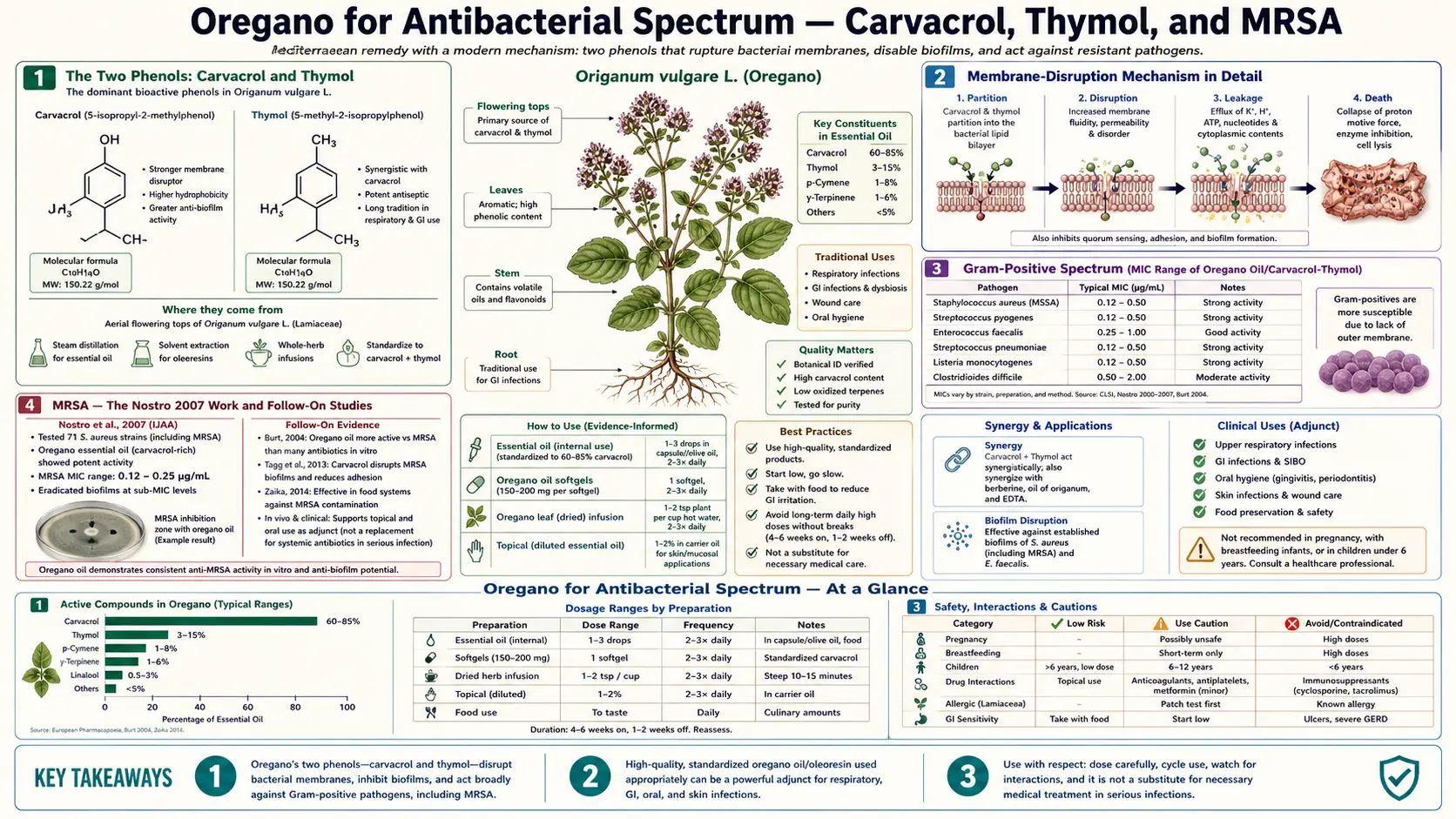
Oregano essential oil and its two main phenols, carvacrol and thymol, inhibit a wide range of bacteria in laboratory tests, including methicillin-resistant Staphylococcus aureus (MRSA), Escherichia coli, Salmonella and Pseudomonas aeruginosa. Laboratory studies describe the phenols increasing the permeability of the bacterial cell membrane, dissipating its pH gradient and causing leakage of ions (Lambert 2001; Ultee 2002). The human evidence is thin: one small randomized trial of a 3% oregano extract ointment on surgical wounds (Ragi 2011), and no trial of oral oregano oil for a bacterial infection was found for this page. This deep-dive sets out the laboratory data on the two phenols and their mechanism, on Gram-positive and Gram-negative bacteria and on MRSA, the differences between culinary oregano, diluted supplements and the essential oil, and the safety findings.
Table of Contents
- The Two Phenols: Carvacrol and Thymol
- Membrane-Disruption Mechanism in Detail
- Gram-Positive Bacteria (Staphylococcus, Listeria, Bacillus)
- MRSA — The Nostro 2004 and 2007 Studies
- Gram-Negative Bacteria (E. coli, Salmonella, Pseudomonas, Klebsiella)
- Oral Candidiasis: What the Studies Show
- "Oil of Oregano" vs Essential Oil vs Culinary Oregano — Concentrations
- Carvacrol-Standardized Commercial Oils
- Doses and Dilutions: What Studies Used
- Cautions, Drug Interactions, and Mucosal-Burn Risk
- Key Research Papers
- Connections
- Featured Videos
The Two Phenols: Carvacrol and Thymol
Most of the antibacterial activity of oregano essential oil is attributed to two closely related phenolic monoterpenoids, which differ only in the position of the hydroxyl group on the ring:
- Carvacrol (5-isopropyl-2-methylphenol) — the main component of many, but not all, oregano oils.
- Thymol (2-isopropyl-5-methylphenol) — the main phenol of many thyme oils, and present in oregano oils in varying amounts.
How much of each an oil contains depends on the plant. An Origanum virens oil analysed in a 2003 Portuguese study contained 68.1% carvacrol, with its precursors gamma-terpinene (9.9%) and p-cymene (4.5%) (Salgueiro 2003). An Origanum vulgare oil tested in a 2010 Brazilian study contained only 9.42% carvacrol and 8.42% thymol, and was dominated by terpinen-4-ol (47.95%) (Cleff 2010). Mexican oregano (Lippia graveolens), from a different botanical family (Verbenaceae), also yields an oil whose main compound is carvacrol (Pilau 2011).
How the two phenols combine has been measured. In a 2001 laboratory study against Pseudomonas aeruginosa and Staphylococcus aureus, mixtures of carvacrol and thymol had an additive effect, and the authors attributed the overall inhibition by oregano oil mainly to the additive action of these two compounds (Lambert 2001). A 2004 review reports synergism between carvacrol and its precursor p-cymene (Burt 2004). In a 2002 study of related compounds, the hydroxyl group of carvacrol and its system of delocalized electrons were important for its activity against Bacillus cereus (Ultee 2002).
Membrane-Disruption Mechanism in Detail
The mechanism has been studied mainly in laboratory cultures and model membranes. The findings, in the order the authors describe them:
- Partitioning into the membrane — carvacrol strongly prefers fatty (hydrophobic) phases; its partition coefficients were 3.64 in octanol-water and 3.26 in liposome-buffer, and adding it to liposomes expanded their membranes (Ultee 2002).
- Loss of membrane integrity — low amounts of carvacrol, thymol or oregano oil increased the permeability of P. aeruginosa and S. aureus cells to a nuclear stain, dissipated pH gradients and caused leakage of inorganic ions (Lambert 2001).
- Proton motive force collapse — working with Bacillus cereus, the authors hypothesize that carvacrol destabilizes the cytoplasmic membrane and also acts as a proton exchanger, reducing the pH gradient across it; the resulting collapse of the proton motive force and depletion of the ATP pool eventually lead to cell death (Ultee 2002).
- Gram-negative outer membrane — Gram-negative bacteria have an extra outer membrane. A 2004 review reports that they are slightly less susceptible to essential oils than Gram-positive bacteria (Burt 2004); the action of essential-oil components on Gram-negative bacteria was characterized by Helander and colleagues (Helander 1998).
Resistance: because the membrane rather than a single enzyme is the target, it is often said that bacteria cannot become resistant to oregano oil. Laboratory work does not fully support this. In a 2017 study, exposing four S. aureus strains to sub-inhibitory carvacrol for 3 to 10 days produced direct protection against carvacrol that was most evident in two of the four strains after 10 days, along with slower growth, small-colony-like variants and more biofilm; there was no significant cross-protection against antibiotics, and at concentrations above the MIC the mutation frequency was very low (Nostro 2017).
Gram-Positive Bacteria (Staphylococcus, Listeria, Bacillus)
Laboratory data for Gram-positive bacteria come mostly from staphylococci, Listeria and Bacillus:
- Staphylococcus aureus and other staphylococci — in a 2004 study of 26 methicillin-susceptible and 21 methicillin-resistant staphylococcal isolates, the MICs were 0.015–0.03% v/v for carvacrol, 0.03–0.06% for thymol and 0.06–0.125% for oregano oil, with no significant difference between the two groups (Nostro 2004). Oregano oil was also cidal to S. aureus in a 2005 study (Preuss 2005).
- Listeria monocytogenes — oregano oil was among the most active of 96 essential oils, the most active group having BA50 values (the percentage of oil that halves bacterial counts) of 0.057 to 0.092 (Friedman 2002).
- Bacillus — carvacrol's action on B. cereus is the basis of the mechanism work above (Ultee 2002); oregano oil was static rather than cidal to Bacillus anthracis Sterne (Preuss 2005).
No verified data for streptococci, enterococci, Clostridium species or acne bacteria were found for this page. All of these are test-tube results: oral oregano oil is diluted in gut contents and metabolized, and the concentration reaching tissue has not been measured in people.
The one randomized human trial concerns the skin. In 40 people after surgical skin excision, a 3% oregano extract ointment was compared with petrolatum: cultures grew S. aureus in 19% of the oregano group against 41% of the petrolatum group, and 1 patient against 3 developed cellulitis; overall scar appearance was equivalent (Ragi 2011).
MRSA — The Nostro 2004 and 2007 Studies
The two most cited laboratory studies of oregano oil and drug-resistant staphylococci come from a research group at the University of Messina, Italy.
- Nostro 2004, "Susceptibility of methicillin-resistant staphylococci to oregano essential oil, carvacrol and thymol" (FEMS Microbiology Letters): oil hydrodistilled from commercial oregano was tested by agar dilution against 26 methicillin-susceptible and 21 methicillin-resistant staphylococcal isolates, whose resistance was confirmed by E-test, PCR for the mecA gene and a PBP2' latex test. Susceptibility did not differ significantly between the two groups (Fisher's exact test, P > 0.05). The MICs were 0.015–0.03% v/v for carvacrol, 0.03–0.06% for thymol and 0.06–0.125% for oregano oil.
- Nostro 2007, "Effects of oregano, carvacrol and thymol on Staphylococcus aureus and Staphylococcus epidermidis biofilms" (Journal of Medical Microbiology): for most of the 6 S. aureus and 6 S. epidermidis strains, the biofilm inhibitory concentration (0.125–0.5% v/v for oregano oil, 0.031–0.125% for carvacrol and thymol) and the biofilm eradication concentration (0.25–1.0% for oregano oil, 0.125–0.5% for carvacrol and thymol) were twofold or fourfold greater than the concentrations that inhibited free-floating cells. Sub-inhibitory concentrations reduced biofilm formation on polystyrene plates.
- Nostro 2017: repeated low-level exposure to carvacrol reduced the susceptibility of some S. aureus strains to carvacrol, without cross-protection against antibiotics (see the mechanism section above).
These are laboratory concentrations. A 2001 mouse study often cited alongside this work concerned Candida albicans, not bacteria, and did not measure tissue concentrations of carvacrol (Manohar 2001; see the Antifungal deep-dive).
No randomized trial of oregano oil, oral or topical, in people with MRSA infection or MRSA carriage was found for this page; no study was found of oregano oil as an adjunct to mupirocin decolonization. For more on MRSA and antibiotic resistance generally, see our Staphylococcus aureus / MRSA page and the Antibacterial Herbs overview.
Gram-Negative Bacteria (E. coli, Salmonella, Pseudomonas, Klebsiella)
A 2004 review reports that Gram-negative organisms are slightly less susceptible to essential oils than Gram-positive bacteria (Burt 2004). Laboratory findings for oregano oil against Gram-negative bacteria:
- Escherichia coli and Salmonella enterica — in a 2002 U.S. Department of Agriculture screen of 96 essential oils, oregano oil was among the most active against E. coli O157:H7 (most active group BA50 0.046–0.14) and S. enterica (most active group BA50 0.045–0.14); carvacrol and thymol were among the most active single compounds (Friedman 2002).
- Clinical E. coli and Pseudomonas aeruginosa strains — oil of Origanum heracleoticum inhibited all 20 clinical E. coli and 20 clinical P. aeruginosa strains tested, whatever their antibiotic-resistance pattern, with E. coli the more sensitive (Sienkiewicz 2012). Oregano oil, carvacrol and thymol also inhibited P. aeruginosa in the 2001 MIC study (Lambert 2001).
- Klebsiella pneumoniae and Helicobacter pylori — oregano oil was cidal to E. coli, K. pneumoniae and H. pylori in a 2005 study (Preuss 2005).
- Pathogens versus gut commensals — in a 2006 Canadian laboratory study aimed at pathogens in the pig gut, most of nine essential oils and related compounds selected from 66 screened strongly inhibited Salmonella Typhimurium DT104 and E. coli O157:H7 with little inhibition of lactobacilli and bifidobacteria, and kept their effect in pig cecal contents (Si 2006). The abstract does not say which oils were among the nine.
No verified MIC data for Vibrio, Yersinia or ESBL-producing strains were found for this page. Oregano is used in Mediterranean and Latin American folk medicine for stomach upsets; no clinical trial of oregano oil in acute gastroenteritis or traveler's diarrhea was found. See also the parallel coverage of intestinal parasites and SIBO in our Antiparasitic and SIBO deep-dive.
Oral Candidiasis: What the Studies Show
No human pilot study of oregano oil capsules for oral thrush was found in PubMed for this page; the 2001 Manohar paper sometimes cited as one was a laboratory and mouse study. In it, oregano oil at 0.25 mg/ml completely inhibited Candida albicans in culture, and in mice with systemic C. albicans infection, 8.6 mg/kg of oregano oil a day for 30 days was followed by 80% survival, while mice given olive oil alone died within 10 days (Manohar 2001).
The nearest model of oral thrush is in animals: in immunosuppressed rats with oral candidiasis, carvacrol given for eight days reduced oral Candida counts with results similar to nystatin, and no hyphae were seen on the tongue epithelium of carvacrol-treated rats (Chami 2004). Whether oregano oil's antibacterial action changes the oral bacterial community in people with thrush has not been studied. The antifungal evidence is covered on the Antifungal deep-dive.
"Oil of Oregano" vs Essential Oil vs Culinary Oregano — Concentrations
Three forms of oregano are sold, and they differ greatly in strength:
- Culinary dried oregano leaf — a seasoning. Dried oregano was among the herbs with the highest antioxidant concentrations in a 2003 survey (Dragland 2003). The amount of essential oil eaten with food is small, and no study has shown culinary amounts reaching antibacterial concentrations in the body.
- "Oil of oregano" (carrier-diluted) — essential oil diluted in a carrier oil such as olive oil, sold in capsules or dropper bottles. Strength varies between products, and dietary supplements do not need premarket approval from the U.S. Food and Drug Administration (LactMed 2024).
- Pure essential oil — the steam-distilled concentrate. Its carvacrol content depends on the plant, from 9.42% to 68.1% in the two analyses cited above (Cleff 2010; Salgueiro 2003). Concentrated essential oils can irritate skin and mucous membranes; a 2020 case report describes irritant contact dermatitis after a therapeutic use of oregano essential oil (Lauriola 2020). Aromatherapy and naturopathic sources describe diluting the essential oil in a carrier oil before any use on the skin or by mouth, at ratios such as 1:4 or one drop per teaspoon; these ratios have not been tested in trials.
The human studies of oregano used prepared forms, not the neat oil: 600 mg a day of emulsified oregano oil (Force 2000, covered on the Antiparasitic and SIBO page) and a 3% extract ointment (Ragi 2011).
Carvacrol-Standardized Commercial Oils
Some commercial oregano oils are marketed as wild Mediterranean oils standardized to a high carvacrol content. Whether a label carvacrol percentage predicts any clinical effect has not been tested: the published laboratory work (above) and the small human studies, including the Force 2000 enteric parasite study covered on the Antiparasitic and SIBO deep-dive, did not compare oils of different carvacrol content in people.
The 2000 parasite study lists a supplement manufacturer among the authors' affiliations (Force 2000). Promotional claims for high-carvacrol oils, for example for viral infections or serious systemic disease, go beyond the published evidence, which for bacteria is almost entirely laboratory work. No trial has compared oregano oil with standard antibiotics in serious infection. For the wider picture of plant antimicrobials, see our Antibacterial Herbs overview.
Doses and Dilutions: What Studies Used
No dose of oregano oil for a bacterial infection has been established by a clinical trial. The amounts used in the human studies of oregano were:
- Force 2000 (intestinal parasites) — 600 mg of emulsified oregano oil a day for 6 weeks.
- Ragi 2011 (surgical wounds) — a 3% oregano extract ointment.
- Chedid 2014 (SIBO) — commercial multi-herb capsules, one ingredient of which was oregano oil, 2 capsules twice daily for 4 weeks (covered on the Antiparasitic and SIBO page).
Capsule counts, drops per dose, dilution ratios, course lengths and on/off cycling schedules appear on product labels and in naturopathic sources; they come from practice, not trials. Whether courses of oregano oil disturb the gut microbiome in people has not been measured. Decisions about supplements belong with a clinician.
Cautions, Drug Interactions, and Mucosal-Burn Risk
- Concentrated essential oil — undiluted essential oils can irritate skin and mucous membranes; a 2020 case report describes irritant contact dermatitis after a therapeutic use of oregano essential oil (Lauriola 2020). No published case report of oesophageal injury from oregano oil was found for this page.
- Allergy — a 1996 case report describes three systemic allergic reactions to oregano and thyme in one patient, with test results suggesting cross-sensitivity among Lamiaceae (mint-family) herbs (Benito 1996). The NIH's LactMed database notes that gastrointestinal upset and allergic skin reactions have been reported rarely (LactMed 2024).
- Pregnancy and breastfeeding — no human safety data on oregano oil supplements in pregnancy were found. The idea that carvacrol stimulates the uterus could not be traced to a study; in laboratory studies on isolated uterine tissue from pregnant rats, carvacrol and thymol relaxed contractions (Muñoz-Pérez 2020; Muñoz-Pérez 2024). LactMed states that no data exist on oregano in nursing mothers or infants and that oregano "in amounts higher than those found in foods as a flavoring should probably be avoided during breastfeeding" (LactMed 2024). Oregano is "generally recognized as safe" as a food ingredient by the U.S. Food and Drug Administration (LactMed 2024).
- Anticoagulants, antiplatelet drugs and surgery — an interaction with blood thinners is commonly raised in supplement references; no human study of oregano oil with warfarin, the newer anticoagulants, clopidogrel or aspirin was found for this page.
- Diabetes medicines — no human study of oregano oil with insulin or sulfonylureas was found for this page.
- Iron absorption — in a 1989 Swedish study of iron absorption from test meals, oregano inhibited non-heme iron absorption in proportion to its content of iron-binding galloyl groups (Brune 1989). This raises a concern for people with low iron stores.
- Commensal gut bacteria — whether oregano oil reduces Lactobacillus, Bifidobacterium or other beneficial gut bacteria in people has not been measured; in a pig-gut laboratory model, several essential oils and related compounds inhibited pathogens with little effect on lactobacilli and bifidobacteria (Si 2006). Gut recovery after antimicrobial courses is discussed on our gut-healing page.
- Children — no studies of oregano oil supplements in children were found.
- Serious infection — no trial has compared oregano oil with standard antibiotic treatment for invasive or life-threatening bacterial infection; the antibacterial evidence for oregano oil is almost entirely laboratory work.
Key Research Papers
- Nostro A, Blanco AR, Cannatelli MA, et al. (2004). Susceptibility of methicillin-resistant staphylococci to oregano essential oil, carvacrol and thymol. FEMS Microbiology Letters. 2004;230(2):191–195. — PubMed PMID: 14757239 (Corrects an entry, "Nostro A et al. (2007), Effects of Origanum vulgare essential oil on methicillin-resistant staphylococci, Letters in Applied Microbiology," that could not be found in PubMed or Crossref; this is the group's MRSA study.)
- Manohar V, Ingram C, Gray J, et al. (2001). Antifungal activities of origanum oil against Candida albicans. Molecular and Cellular Biochemistry. 2001;228(1–2):111–117. — PubMed PMID: 11855736
- Burt S (2004). Essential oils: their antibacterial properties and potential applications in foods — a review. International Journal of Food Microbiology. 2004;94(3):223–253. — PubMed PMID: 15246235
- Lambert RJ, Skandamis PN, Coote PJ, Nychas GJ (2001). A study of the minimum inhibitory concentration and mode of action of oregano essential oil, thymol and carvacrol. Journal of Applied Microbiology. 2001;91(3):453–462. — PubMed PMID: 11556910
- Ultee A, Bennik MH, Moezelaar R (2002). The phenolic hydroxyl group of carvacrol is essential for action against the food-borne pathogen Bacillus cereus. Applied and Environmental Microbiology. 2002;68(4):1561–1568. — PubMed PMID: 11916669
- Friedman M, Henika PR, Mandrell RE (2002). Bactericidal activities of plant essential oils and some of their isolated constituents against Campylobacter jejuni, Escherichia coli, Listeria monocytogenes, and Salmonella enterica. Journal of Food Protection. 2002;65(10):1545–1560. — PubMed PMID: 12380738
- Chouhan S, Sharma K, Guleria S (2017). Antimicrobial activity of some essential oils — present status and future perspectives. Medicines (Basel). 2017;4(3):58. — PubMed PMID: 28930272
- Si W, Gong J, Tsao R, et al. (2006). Antimicrobial activity of essential oils and structurally related synthetic food additives towards selected pathogenic and beneficial gut bacteria. Journal of Applied Microbiology. 2006;100(2):296–305. — PubMed PMID: 16430506
- Helander IM, Alakomi HL, Latva-Kala K, et al. (1998). Characterization of the action of selected essential oil components on Gram-negative bacteria. Journal of Agricultural and Food Chemistry. 1998;46(9):3590–3595. — doi:10.1021/jf980154m (Not indexed in PubMed; identified through Crossref.)
- Preuss HG, Echard B, Enig M, Brook I, Elliott TB (2005). Minimum inhibitory concentrations of herbal essential oils and monolaurin for gram-positive and gram-negative bacteria. Molecular and Cellular Biochemistry. 2005;272(1–2):29–34. — PubMed PMID: 16010969
- Sienkiewicz M, Wasiela M, Głowacka A (2012). The antibacterial activity of oregano essential oil (Origanum heracleoticum L.) against clinical strains of Escherichia coli and Pseudomonas aeruginosa [in Polish]. Medycyna Doświadczalna i Mikrobiologia. 2012;64(4):297–307. — PubMed PMID: 23484421
- Cui H, Bai M, Sun Y, Abdel-Samie MAS, Lin L (2018). Antibacterial activity and mechanism of Chuzhou chrysanthemum essential oil. Journal of Functional Foods. 2018;48:159–166. — doi:10.1016/j.jff.2018.07.021 (Year corrected from 2019; not indexed in PubMed. A study of chrysanthemum oil; it is not a study of oregano or carvacrol.)
- Nostro A, Roccaro AS, Bisignano G, et al. (2007). Effects of oregano, carvacrol and thymol on Staphylococcus aureus and Staphylococcus epidermidis biofilms. Journal of Medical Microbiology. 2007;56(Pt 4):519–523. — PubMed PMID: 17374894
- Nostro A, Marino A, Ginestra G, et al. (2017). Effects of adaptation to carvacrol on Staphylococcus aureus in the planktonic and biofilm phases. Biofouling. 2017;33(6):470–480. — PubMed PMID: 28521511
- Ragi J, Pappert A, Rao B, Havkin-Frenkel D, Milgraum S (2011). Oregano extract ointment for wound healing: a randomized, double-blind, petrolatum-controlled study evaluating efficacy. Journal of Drugs in Dermatology. 2011;10(10):1168–1172. — PubMed PMID: 21968667
- Salgueiro LR, Cavaleiro C, Pinto E, et al. (2003). Chemical composition and antifungal activity of the essential oil of Origanum virens on Candida species. Planta Medica. 2003;69(9):871–874. — PubMed PMID: 14598221
- Cleff MB, Meinerz AR, Xavier M, et al. (2010). In vitro activity of Origanum vulgare essential oil against Candida species. Brazilian Journal of Microbiology. 2010;41(1):116–123. — PubMed PMID: 24031471
- Pilau MR, Alves SH, Weiblen R, et al. (2011). Antiviral activity of the Lippia graveolens (Mexican oregano) essential oil and its main compound carvacrol against human and animal viruses. Brazilian Journal of Microbiology. 2011;42(4):1616–1624. — PubMed PMID: 24031796
- Chami N, Chami F, Bennis S, Trouillas J, Remmal A (2004). Antifungal treatment with carvacrol and eugenol of oral candidiasis in immunosuppressed rats. Brazilian Journal of Infectious Diseases. 2004;8(3):217–226. — PubMed PMID: 15476054
- Force M, Sparks WS, Ronzio RA (2000). Inhibition of enteric parasites by emulsified oil of oregano in vivo. Phytotherapy Research. 2000;14(3):213–214. — PubMed PMID: 10815019
- Dragland S, Senoo H, Wake K, Holte K, Blomhoff R (2003). Several culinary and medicinal herbs are important sources of dietary antioxidants. Journal of Nutrition. 2003;133(5):1286–1290. — PubMed PMID: 12730411
- Lauriola MM, Sena P, De Bitonto A, Corazza M (2020). Irritant contact dermatitis after a curious therapeutic use of oregano essential oil. Contact Dermatitis. 2020;83(2):129–130. — PubMed PMID: 32232859
- Benito M, Jorro G, Morales C, Peláez A, Fernández A (1996). Labiatae allergy: systemic reactions due to ingestion of oregano and thyme. Annals of Allergy, Asthma and Immunology. 1996;76(5):416–418. — PubMed PMID: 8630713
- Brune M, Rossander L, Hallberg L (1989). Iron absorption and phenolic compounds: importance of different phenolic structures. European Journal of Clinical Nutrition. 1989;43(8):547–557. — PubMed PMID: 2598894
- Muñoz-Pérez VM, Ortiz MI, Gerardo-Muñoz LS, et al. (2020). Tocolytic effect of the monoterpenic phenol isomer, carvacrol, on the pregnant rat uterus. Chinese Journal of Physiology. 2020;63(5):204–210. — PubMed PMID: 33109786
- Muñoz-Pérez VM, Pérez-Sánchez A, Salas-Casas A, Ortíz MI (2024). Thymol and carvacrol as potential tocolytic and anti-inflammatory agents in pregnant rat uterus. Current Molecular Pharmacology. 2024;17:e18761429342128. — PubMed PMID: 39806980
- Drugs and Lactation Database (LactMed) (2024). Oregano. National Institute of Child Health and Human Development, Bethesda (MD); updated 2024. — PubMed PMID: 30000904