Makrut Lime: Essential Oil, Photosensitivity and Safety
This is the most practically important page in this set, and the only one where the evidence base is clinical rather than laboratory. Here is the single sentence it exists to deliver: citrus peel oils can react with sunlight and blister your skin, and the reaction is delayed, so you will not know it is happening until many hours later. It is written for anyone planning to make a hair oil, a scalp treatment, a body oil or a home insect repellent from makrut lime (still widely sold as kaffir lime).
The mechanism has a name — phytophotodermatitis — and a nickname that tells you how ordinary it is: “margarita burn.” Bartenders who cut limes all evening and then work in sunlight get it on their hands. Holidaymakers who squeeze citrus at a beach bar get it in odd streaks and drips. The people most at risk from makrut lime specifically are the ones with the best intentions: home formulators making a leave-on skin or hair preparation from citrus peel oil.
The rest of this page covers the chemistry, the timeline of the reaction, the single most useful distinction in citrus-oil safety (steam-distilled versus cold-pressed), how exposures happen on skin and hair, dilution and patch testing, contact allergy as a separate problem, and the hazards of swallowing the oil.
Table of Contents
- The Key Safety Facts in Brief
- Furocoumarins: What They Are
- How Phytophotodermatitis Happens
- “Margarita Burn”: the Everyday Version
- Steam-Distilled Versus Cold-Pressed
- Leaf Oil Versus Peel Oil
- Skin and Hair: How Exposures Happen
- Dilution and Patch Testing
- Contact Allergy and Oxidation
- Swallowing Essential Oil: The Hazards
- Pregnancy, Breastfeeding and Children
- Furocoumarins and Medication
- Buying, Labelling and Storing
- If a Reaction Happens
- Key Research Papers
- Connections
- Featured Videos
The Key Safety Facts in Brief
The whole page compressed, for anyone who reads one section:
- Cold-pressed citrus peel oil plus ultraviolet light equals a burn. Not an allergy, not an irritation — a chemical photoreaction that produces redness and blistering, followed by pigmentation that can last months.
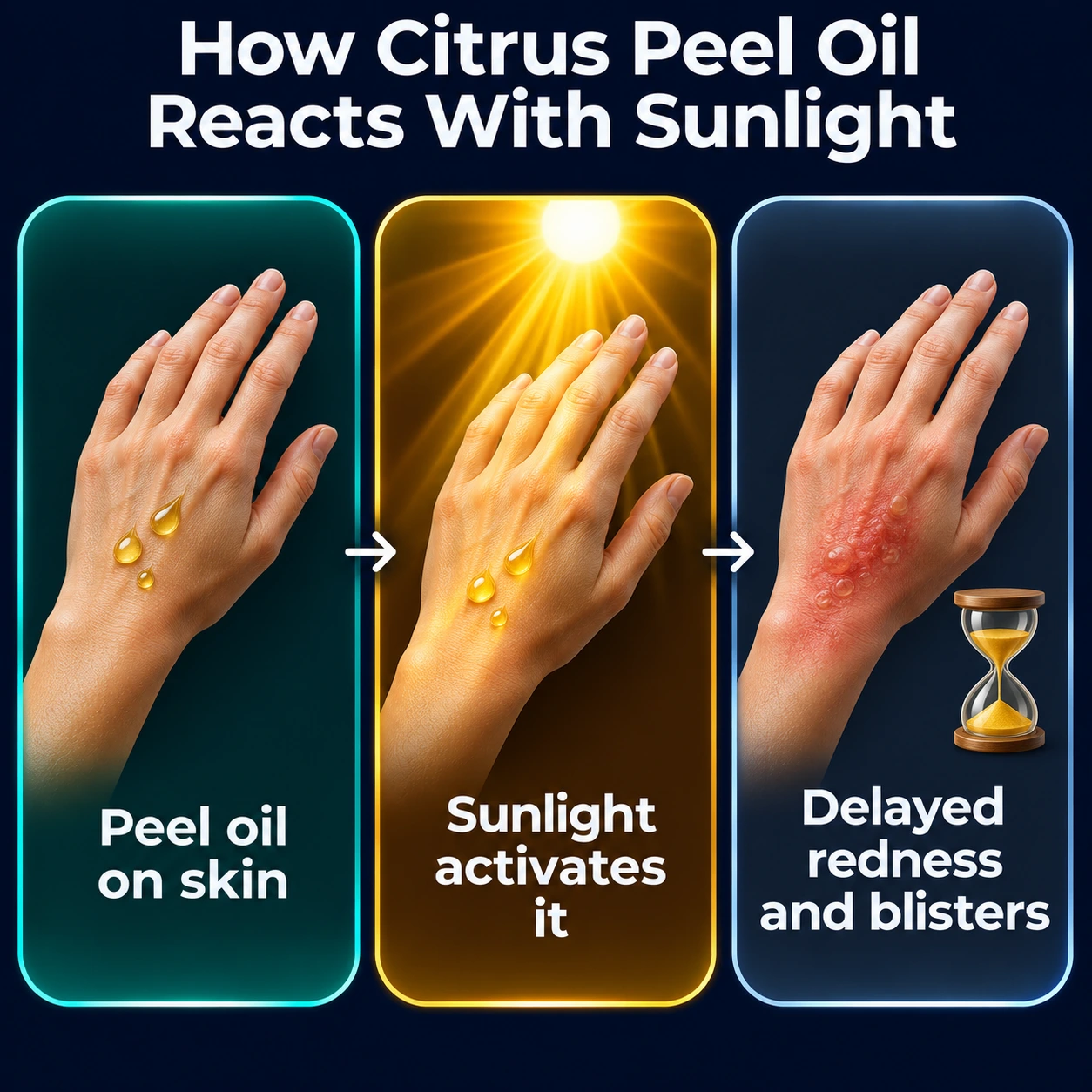
- The reaction is delayed. Nothing happens while you are in the sun. Redness typically begins roughly 12 to 24 hours later and peaks around 48 to 72 hours. By the time you know, the damage is done. Less often, the only sign is painless brown staining that appears days to weeks later.
- Steam-distilled oils are typically much lower in the responsible compounds than cold-pressed ones, because furocoumarins are heavy and non-volatile and largely stay behind in the still. This is the single most useful thing to know when buying.
- The safety window given on this page for expressed citrus peel oil is at least 12–18 hours between applying it and sunlight on that skin. Tanning beds count as sunlight here.
- Leaf oil is a lower-risk choice than peel oil for a leave-on skin preparation, because furocoumarins are principally a peel phenomenon.
- Undiluted essential oil irritates skin and raises the risk of a lasting allergy, and swallowed essential oil can burn the mouth, throat and stomach and has poisoned children.
- Eating makrut lime is not the issue. The leaf in your soup and the zest in your curry paste are not a phototoxicity risk. This page is about concentrated oil and about handling large quantities of peel.
Furocoumarins: What They Are
Furocoumarins — also written furanocoumarins, and the subgroup most relevant here is the psoralens — are a family of plant compounds built from a coumarin ring fused to a furan ring. They are produced by a number of plant families as chemical defences, and two families are notorious for them: the carrot family (Apiaceae — giant hogweed, cow parsley, celery, parsnip) and the citrus family (Rutaceae — every citrus, plus rue itself, which is where the family name comes from).
The individual compounds you will see named:
- Bergapten (5-methoxypsoralen, 5-MOP) — the classic citrus phototoxin, named after bergamot, where it occurs at high levels. The bergapten-type compounds are the main reason citrus peel oils are phototoxic.
- Bergamottin — a larger furocoumarin abundant in citrus peel, best known outside dermatology as a component of the grapefruit–drug interaction.
- Xanthotoxin (8-methoxypsoralen, 8-MOP) — the psoralen used medically in PUVA phototherapy for psoriasis, which is the clearest possible proof that these molecules do what is claimed: dermatologists deliberately combine a psoralen with ultraviolet A light to produce a controlled skin effect.
- Psoralen itself, oxypeucedanin, epoxybergamottin and a long tail of related structures.
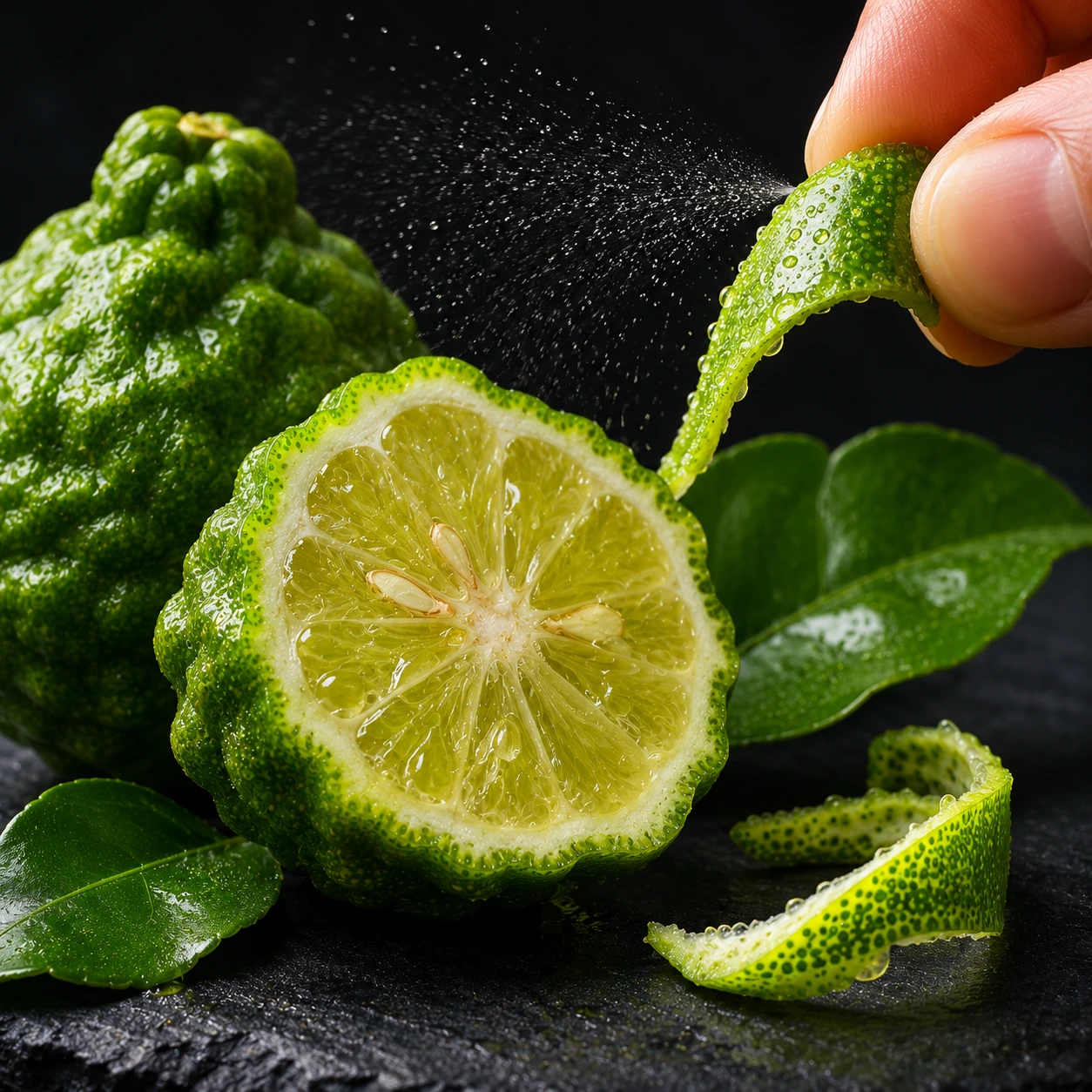
Where they sit in the fruit. Furocoumarins are concentrated in the peel — in the flavedo, the coloured outer rind where the oil glands are. The juice contains far less, the leaves less again. This distribution is the reason nearly every practical rule on this page is a rule about peel oil.
What is known about makrut, and what is not. Furocoumarins have been found in makrut lime itself. In 1999 chemists isolated bergamottin, oxypeucedanin and a related psoralen from Citrus hystrix fruit, and in 2010 another group isolated furanocoumarins including 6′,7′-dihydroxybergamottin and (+)-isoimperatorin from the fruit peel — the same family behind citrus phototoxicity and the grapefruit–drug interaction. What has not been well quantified in the published literature is how much of these compounds a given makrut peel or oil contains. Bergamot and expressed lime oil are the well-characterised offenders; makrut is under-studied. Because makrut peel carries the same compounds, expressed makrut peel oil is expected to behave like expressed lime oil, although this has not been tested directly. If that expectation were wrong, the cost would be a slightly over-cautious hair oil; if the opposite assumption were wrong, the cost would be a blistered face.
How Phytophotodermatitis Happens
This is a well-understood photochemical reaction, and knowing the steps makes the practical rules obvious.
- Contact. A psoralen-containing substance reaches the skin — peel oil in a blend, juice from a squeezed fruit, sap from a cut stem, oil transferred from your fingers to your face.
- Absorption. Psoralens are small and lipophilic. They penetrate the epidermis readily and reach cell nuclei, where they intercalate between the base pairs of DNA. At this stage nothing is happening and nothing can be felt.
- Activation by ultraviolet A (UVA). Psoralens absorb ultraviolet A light, roughly 320–400 nm. Ultraviolet A is the long-wavelength component of sunlight that passes through window glass and through cloud, and it is the dominant output of tanning beds. Being in the shade or behind glass is not reliable protection.
- Cross-linking. The energised psoralen forms covalent adducts with pyrimidine bases and can cross-link the two DNA strands. Cross-linked DNA cannot be replicated or transcribed. The keratinocyte dies. Reactive oxygen species add further damage to membranes and proteins.
- Inflammation — delayed. The cell death and cytokine release that follow take hours to produce a visible reaction. Erythema typically begins around 12 to 24 hours after exposure and peaks at roughly 48 to 72 hours. Severe cases blister, sometimes dramatically, in the exact shape of wherever the substance was — drips, handprints, streaks, the outline of a leaf.
- Post-inflammatory hyperpigmentation. As the acute reaction settles, melanocytes respond and the affected skin darkens in the same pattern. This pigmentation commonly lasts weeks to many months, and it is the reason the reaction matters cosmetically long after the pain has gone. On darker skin it can be both more pronounced and more persistent.
The three features that make this reaction easy to misdiagnose: it is delayed, so people do not connect it to the exposure; it is phototoxic rather than allergic, meaning it can happen to anyone on first exposure with no prior sensitisation and does not require an immune memory; and its bizarre shapes — streaks, drips, sharp margins — look nothing like sunburn and are frequently mistaken for burns, infection or abuse. Tier for all of the above: established clinical dermatology, supported by a substantial literature of case reports, reviews and the entire practice of PUVA therapy.
Not every case starts with a red burn. A 2026 case report and literature review of lime-associated phytophotodermatitis counted 14 people whose reaction showed up as painless (asymptomatic) brown pigmentation, most often on the backs of the hands (11 people) and otherwise on the back (3 people). The staining appeared from two days up to three to seven weeks after contact with lime and sun (median seven days). The review notes that patients often do not link the marks to the lime and the sun, and that the condition is often first diagnosed as something else.
“Margarita Burn”: the Everyday Version
The classic scenario appears every summer in dermatology clinics. Someone cuts and squeezes limes — making drinks at a barbecue, working a bar, preparing food at a beach — then spends time in the sun with the residue on their hands. A day later the backs of the hands and fingers are red, itching or burning, sometimes blistered, in streaks and patches that follow where the juice ran. The pigmentation that follows can last for months. It is variously called margarita burn, margarita dermatitis or lime disease, and it is textbook phytophotodermatitis.
Related and equally well documented:
- Citrus-peel handling in food work — zesting or juicing large quantities of lime, lemon or bergamot, then going outdoors.
- Sunbathing with citrus juice on the skin — including the old and genuinely harmful practice of using citrus juice as a hair lightener at the beach, which puts psoralens on scalp, hairline, ears and neck in strong sun.
- Perfume and fragrance reactions — historically a well-known problem when high-furocoumarin bergamot oil was common in perfumery, and part of why the fragrance industry restricts furocoumarin levels in leave-on products today.
- Aromatherapy massage with expressed citrus oils followed by sun exposure — documented in the clinical literature and directly analogous to a home-made makrut body oil.
- Giant hogweed and other Apiaceae — the same chemistry in another family, and the source of the most severe cases seen.
A 2021 dermatology review describes children and teenagers as particularly prone, because they spend time in the sun and may come into contact with wild parsley in lawn grass or with drinks flavoured with lime. Symptoms typically appear within 24 hours. The reaction may be mild, or severe with painful blisters, and it is sometimes noticed mainly as the brown marks (postinflammatory hyperpigmentation) left afterwards. The same review describes phytophotodermatitis as a possible serious occupational skin disease, not only a holiday one.
In each case, the people at risk are not people eating citrus, but people with concentrated peel material on their skin in daylight. That is exactly the position a home formulator puts themselves in.
Steam-Distilled Versus Cold-Pressed
For a buyer, this is the most useful distinction on the page.
Citrus peel oil is produced two ways, and they yield chemically different products:
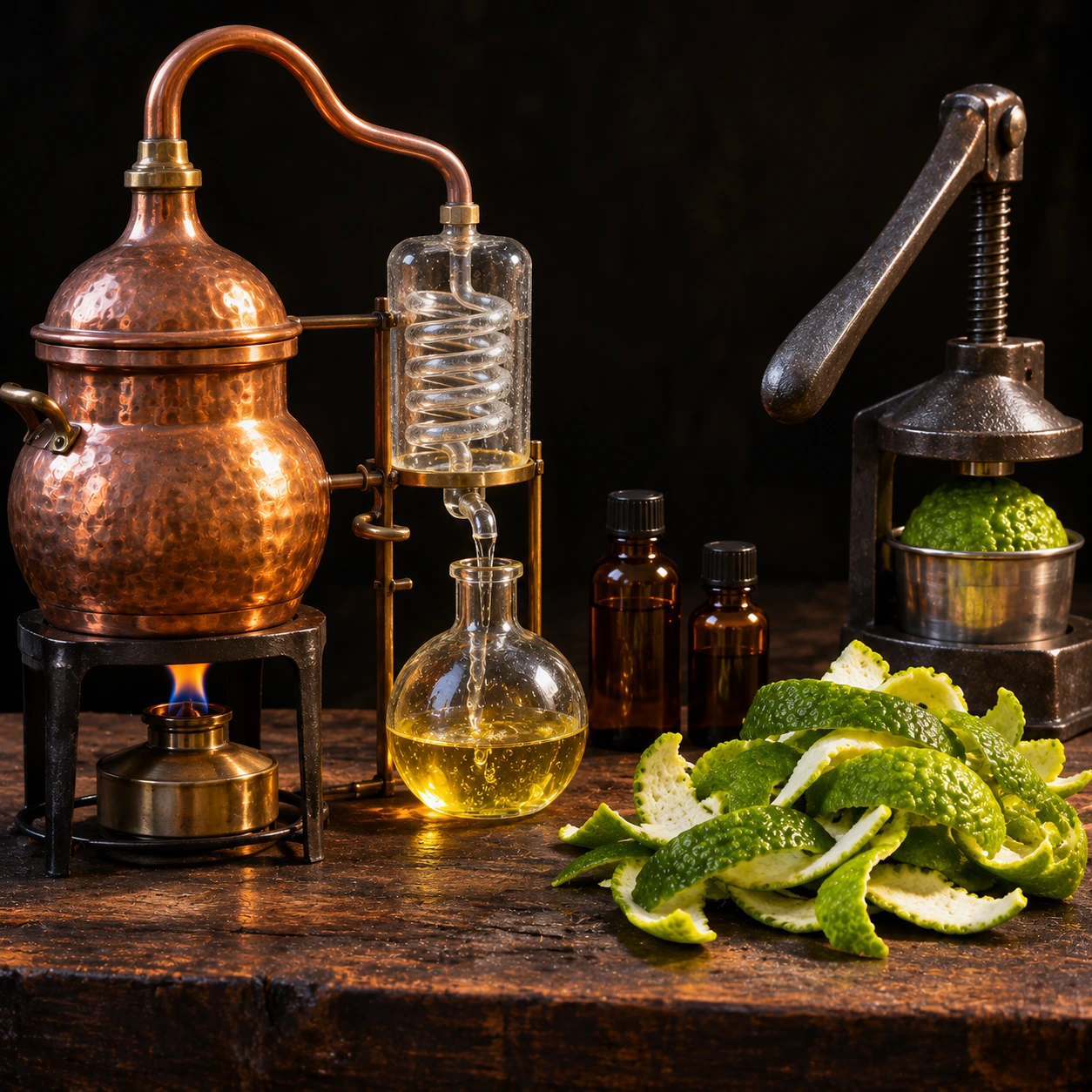
- Cold-pressed / expressed. The rind is mechanically pressed or abraded and the oil is separated. Nothing is heated, nothing is fractionated, and everything that was in the oil glands ends up in the bottle — including the heavy, non-volatile furocoumarins. This is the standard method for citrus peel oils because it gives the freshest, truest aroma. It is also the reason expressed citrus oils are the phototoxic ones.
- Steam-distilled. Steam is passed through the plant material and the volatile compounds carry over with it and are condensed. Furocoumarins are comparatively large, heavy and non-volatile, so they largely do not make the journey and remain in the still residue. Steam-distilled citrus oils are therefore typically far lower in furocoumarins — often to the point of being treated as non-phototoxic. The trade-off is aroma: distilled citrus oil smells flatter and less vivid than expressed.
- Furocoumarin-free (FCF) oils. A third category, produced by further processing — distillation or chromatographic removal — specifically to strip the phototoxic fraction. Bergamot FCF is the well-known example. If you see “FCF” or “bergapten-free” on a label, that is what it means.
Three practical consequences:
- The extraction method belongs on the label. A reputable supplier states it. An oil whose label is silent, and whose supplier cannot say how it was made, may well be expressed — the phototoxic kind.
- “Cold-pressed” sounds gentler and is riskier here. This is genuinely counter-intuitive, because in food oils cold-pressing is a quality marker. For citrus peel oil on skin, it is the opposite.
- The fragrance industry already treats this as a hard limit. The International Fragrance Association restricts furocoumarin-containing ingredients in leave-on skin products to very low total furocoumarin levels — on the order of a part per million — precisely because of phototoxicity. A commercial cosmetic containing citrus oil has been formulated to that constraint. Your kitchen-table blend has not.
Leaf Oil Versus Peel Oil
Makrut lime is unusual among citrus in being sold as two distinct essential oils, and the distinction matters for safety as much as for smell.
- Leaf oil — steam-distilled from the double-lobed leaves. Chemistry is citronellal-led, with citronellol, linalool, sabinene, β-pinene, isopulegol, terpinen-4-ol and 1,8-cineole. A 2022 survey of citrus leaf essential oils by Clery and colleagues in Chemistry & Biodiversity identified citronellal as the characteristic compound of the Citrus hystrix group. Furocoumarins are principally a peel phenomenon, and steam distillation removes most of what little might be present, so distilled leaf oil is the lower-risk option for any leave-on preparation. It still carries ordinary irritation and sensitisation risk.
- Peel oil — from the thick, bumpy rind. Limonene-led, with β-pinene, sabinene, γ-terpinene and a citronellal contribution. This is the oil that carries the phototoxicity question, and if it is expressed rather than distilled, it is expected to be phototoxic.
What this means for a home preparation: among the makrut oils, steam-distilled leaf oil, properly diluted, is the lower-risk choice for a leave-on body or hair oil. Peel oil, with its brighter aroma, carries far less phototoxic risk in something that is rinsed off, in something not worn in daylight, or when it is steam-distilled or FCF.
One further note that affects the whole subject: makrut leaves lose most of their volatile oil on drying, and distillation itself selects for what carries over in steam. Dried leaf, fresh leaf, expressed peel oil and distilled leaf oil are four different materials. Safety information about one does not transfer automatically to another, and neither does aroma or chemistry.
Leaf oil also varies by place. A 2010 analysis of Citrus hystrix leaf oil from New Caledonia found a different profile from the citronellal-led oils described above: its main components were terpinen-4-ol (13.0%), β-pinene (10.9%), α-terpineol (7.6%), 1,8-cineole (6.4%) and citronellol (6.0%), with limonene at only 4.7%. In laboratory tests that oil was inactive against all five bacteria studied. Its 1,8-cineole content links to the point about small children under Dilution and Patch Testing below.
Skin and Hair: How Exposures Happen
The situations below are where citrus-oil burns come from, set out concretely, because vague information is how people get hurt.
- Expressed citrus peel oil on skin that sees sunlight within 12–18 hours is the core risk. Sunscreen is not a reliable substitute: it is imperfect ultraviolet A protection, is applied unevenly and wears off, and this reaction needs very little ultraviolet A.
- Ultraviolet A passes through glass and cloud. An overcast day, a car window and an office window are not protection. A tanning bed is worse than sunlight.
- Rinse-off applications of peel oil leave far less on the skin. The traditional makrut hair wash is a rinse-off, which is one reason a centuries-old practice has not produced a catalogue of injuries. A leave-in oil is a different proposition entirely.
- Citrus oil used on the face before going outside is the highest-stakes use. Face, neck, chest, ears and the backs of the hands are the highest-exposure sites and the least forgiving cosmetically, because that is where months-long pigmentation shows.
- A beach day, a hike, gardening or a run after applying it are the typical exposures. Home-made insect repellent is an unfortunate collision: repellent is applied precisely before going outdoors. In a makrut repellent, distilled leaf oil carries far less of this risk than expressed peel oil — see the repellent page; botanical repellents are short-acting anyway.
- Most everyday cases start with unwashed hands after zesting or juicing. Soap and water, used thoroughly, including under the nails and around the cuticles, removes the residue.
- Volume work is a bigger exposure. Processing a bag of fruit for zest or juice puts far more material on your skin than a recipe does; gloves keep it off.
- Citrus juice or oil used as a hair lightener in the sun is an old practice; it works partly by exactly the photochemistry described above, and it exposes scalp, hairline, ears and neck.
- Broken, inflamed or freshly shaved skin absorbs much more, and irritation there is much worse.
- Eyes and mucous membranes are especially vulnerable. Because essential oils are not water-soluble, the usual first aid for oil in an eye is a bland carrier oil rather than water, then a water rinse; pain or blurring that persists is a sign that needs medical care.
Dilution and Patch Testing
Essential oils are concentrated to a degree most people underestimate. A single drop can represent a large quantity of plant material, and the difference between a pleasant blend and a chemical burn is arithmetic.
Dilution, in general terms
- Neat (undiluted) oil. Undiluted essential oil on skin causes irritation and substantially raises the risk of developing a lasting allergy to it. “Neat application” advice circulating online has no safety basis.
- General adult body use: roughly 1–2% essential oil in a carrier — about 6 to 12 drops per 30 mL. Common carriers are jojoba, sweet almond, olive and fractionated coconut oil.
- Face and sensitive areas: lower — on the order of 0.5–1%, and citrus peel oil arguably not at all on the face if it is expressed.
- Older adults, anyone with sensitive or eczema-prone skin, and anyone with a history of fragrance allergy: lower still, and a patch test matters most for them.
- Children: much lower, if at all. Concentrated monoterpene oils are not considered suitable for infants or toddlers, and oils containing 1,8-cineole applied near a small child's face have caused documented cases of respiratory distress.
- Blends do not dilute each other. Two oils at 2% each is a 4% total load, not 2%.
- Water does not dilute oil. Adding oil to a bowl of water leaves undiluted droplets floating on the surface, which then contact skin at full strength. Dilution means a carrier oil, or a proper emulsifier.
Patch testing
A patch test, as it is usually described, runs like this:
- The blend is mixed at the concentration actually intended for use.
- A small amount goes on the inner forearm or behind the ear.
- It stays on for 24 hours — longer is better, since allergic contact reactions are delayed and can take 48 to 72 hours to appear.
- Redness, itching, small bumps, burning or scaling count as a reaction.
- A patch test does not test for phototoxicity. It is a test of irritation and allergy on covered skin. Phototoxicity requires ultraviolet light, and there is no safe way to test for it at home; the peel-oil facts above are what apply.
- Each new bottle gets its own patch test. Composition varies between batches and suppliers, and oxidised oil behaves differently from fresh.
Eating a plant does not predict tolerating its concentrated oil on skin. Makrut leaf in soup is a few micrograms of volatile oil, dispersed and swallowed. A 2% skin blend is orders of magnitude more, held against a barrier that absorbs it.
Contact Allergy and Oxidation
Phototoxicity is not the only skin risk, and it is worth keeping the two apart because they behave differently. Phototoxicity is a chemical reaction requiring light, can affect anyone on first exposure, and is dose-dependent. Allergic contact dermatitis is an immune response requiring prior sensitisation, recurs on every subsequent exposure, and can be triggered by tiny amounts once established.
Makrut lime oils contain several of the best-documented fragrance allergens in cosmetic dermatology:
- Limonene — abundant in peel oil.
- Linalool — present in leaf oil.
- Citral, citronellal and citronellol — the citronellal family that defines makrut leaf oil.
Several of these are among the fragrance substances the European Union requires to be declared on cosmetic labels specifically because of contact-allergy risk. Their presence on that list is not decoration; it reflects patch-test clinic data.
The oxidation point is the practically useful one. A substantial body of Scandinavian dermatology research, published largely in Contact Dermatitis, has established that air-oxidised limonene and linalool are far more sensitising than the fresh compounds. Exposure to oxygen converts them into hydroperoxides, and it is the hydroperoxides that the immune system reacts to. Fresh limonene is a weak allergen; aged, air-exposed limonene is a significant one.
What that means for a bottle on your shelf:
- Small bottles are finished before they age; a large one kept for years has time to oxidise.
- Tightly closed, cool and dark storage slows oxidation. Amber or cobalt glass, a fridge or a cool cupboard. Every opening admits oxygen.
- Citrus oils have short shelf lives — commonly cited as around a year, less once opened frequently. They oxidise faster than most other essential-oil families.
- Oil that smells sharp, turpentine-like, flat or “off,” or that has thickened or gone cloudy, has oxidised. That smell means the allergen load has gone up.
- Using more is not a test of tolerance. Once you are sensitised to a fragrance allergen, you are sensitised for life, and it will cross-react with a great many products you did not expect.
Swallowing Essential Oil: The Hazards
This is where the most serious harm happens. Makrut lime essential oil has no established safe internal use — not neat, not in water, not in a capsule, not a drop under the tongue, not in tea, not in honey, not in cooking.
The reasons:
- No established oral dose exists for this species, from any authority. Nobody has determined a safe intake, because nobody has studied it.
- Concentrated monoterpene oils injure mucosa. They can cause chemical burns of the mouth, pharynx, oesophagus and stomach.
- Aspiration is a specific hazard. Volatile hydrocarbon oils that reach the airway can cause a chemical pneumonitis, which is why ingestion of monoterpene-rich oils is a recognised poisoning presentation and why inducing vomiting after such an ingestion is the wrong move.
- Children are at serious risk. Small volumes of concentrated essential oil have caused significant toxicity in children. Bottles that are capped, out of reach and out of sight, with child-resistant closures and integral drop restrictors, lower that risk.
- “Food grade” and “therapeutic grade” are marketing terms, not regulatory categories, and neither implies that swallowing a concentrated oil is safe.
If you swallow essential oil, or a child does, contact a poisons information centre or emergency service immediately. Do not induce vomiting. Take the bottle with you.
None of this applies to culinary use of the plant. Makrut leaves and zest in cooking are food, they are used across Southeast Asia daily, and they are unremarkable. The distinction is between a leaf and a distillate.
Pregnancy, Breastfeeding and Children
The right distinction here is not “makrut lime: safe or unsafe?” but which form.
- Culinary leaf and zest in pregnancy and breastfeeding: customary and unremarkable. Torn leaves in soup, shreds over a salad, zest in a curry paste — this is ordinary food throughout a region where a great many people are pregnant at any given moment, and there is no signal of harm. Nothing on this page argues against Thai food.
- Concentrated essential oil in pregnancy: not studied. No adequate safety data exists for Citrus hystrix oil in pregnancy, so there is no known safe internal amount and no tested topical strength. Furocoumarin phototoxicity plus the increased tendency to pigmentation in pregnancy is a poor combination on the face.
- Breastfeeding. Culinary use is ordinary food. Concentrated oil on the chest and nipple area reaches the infant by direct oral contact.
- Infants and young children. Food use is ordinary. Concentrated essential oils are not considered suitable for infants and young children: applied near the face, oils containing 1,8-cineole in particular have caused respiratory distress in small children, and small swallowed volumes have caused significant toxicity.
- A note on inhalation. Aerosolised terpenes from diffused oils can irritate airways, which matters in a room with a baby or a person with asthma; birds have exceptionally sensitive respiratory systems.
Furocoumarins and Medication
The same compound family that causes phototoxicity on skin has a second, unrelated relevance inside the body: citrus furocoumarins inhibit intestinal cytochrome P450 3A4 (CYP3A4), the enzyme responsible for first-pass metabolism of a great many drugs. This is the grapefruit-juice interaction, and it can raise blood levels of certain statins, some calcium-channel blockers, certain immunosuppressants and a long list of others, sometimes substantially.
Applied honestly to makrut lime:
- Makrut contains the same compounds. Bergamottin was isolated from makrut fruit in 1999 and 6′,7′-dihydroxybergamottin from makrut fruit peel in 2010 — furanocoumarins of the family behind the grapefruit interaction. How much of them makrut peel contains has not been quantified, and no case of a makrut-related drug interaction appears to have been reported.
- Culinary amounts are very small. The zest in a curry paste serving four to six people is a fraction of a fruit's rind. This is not the same exposure as a daily glass of grapefruit juice.
- Concentrated peel preparations are a different matter. An extract, a tincture of peel, or a supplement is not a curry.
- A drug label's grapefruit warning exists because furanocoumarins block cytochrome P450 3A4 in the gut and raise blood levels of that drug. Makrut peel contains bergamottin-type furanocoumarins, so concentrated peel preparations raise the same question for such drugs; the zest in a curry is a far smaller exposure.
Tier: the cytochrome P450 3A4 mechanism is established clinical pharmacology; its application to makrut lime specifically is inference from the plant family, and is stated as such.
Buying, Labelling and Storing
What a label and a bottle of makrut lime essential oil can tell a buyer.
- Which part? A clear label names leaf or peel (or rind / zest). If it does not, that is a poor sign. They are different products with different chemistry and different risk.
- Which method? Steam-distilled or cold-pressed/expressed. For anything leave-on, steam-distilled is the lower-risk method.
- Botanical name. Citrus hystrix appears on a correctly labelled bottle. Mislabelling between citrus species is common in the aromatics trade.
- Country of origin and batch or lot number. Both are marks of a supplier who can answer questions about composition.
- Packaging. Amber or cobalt glass, tight cap, ideally child-resistant with a drop restrictor. Clear glass and plastic give none of that protection.
- Small volume. A bottle used up within a year is a fresher bottle. Citrus oils oxidise quickly.
- “Therapeutic grade” and “food grade” mean nothing official. Neither is a regulatory standard; both are marketing.
- Storage. Cool, dark, sealed. A refrigerator is genuinely better than a shelf for citrus oils. An opening date written on the bottle shows its age.
If a Reaction Happens
General first-aid information, not a substitute for medical advice.
- Staying out of the sun while the reaction runs its course stops further activation; clothing covers the area more reliably than sunscreen.
- Washing the area with soap and water removes any remaining oil.
- Cool compresses and bland emollients are the usual comfort measures. More essential oil, or anything “natural” and untested, adds a new irritant to damaged skin.
- An intact blister roof is a sterile dressing, which is why blisters are left unbroken.
- Signs that need medical care: extensive blistering; involvement of the face, eyes or genitals; significant pain; signs of infection (increasing redness, warmth, pus, fever); or an unclear cause. A short course of a topical corticosteroid is often prescribed for the inflammatory phase.
- The pigmentation lingers. Post-inflammatory hyperpigmentation from phytophotodermatitis commonly persists for weeks to many months. Strict sun protection of the affected area is the single most useful thing for helping it fade and stopping it darkening further.
- A delayed, painless form exists. A 2026 review counted 14 people whose lime-related reaction showed only as painless brown pigmentation, mostly on the backs of the hands, appearing from two days up to three to seven weeks after the lime and sun (median seven days).
- The history is the diagnosis. The bizarre streaky pattern is frequently misread: the 2026 review notes that people with lime phytophotodermatitis are often first diagnosed with something else, including blistering skin diseases, bruising, other dermatitis, infections, drug reactions, pigment disorders and, in children, abuse. “I had lime oil on my hands and then spent the afternoon outside” is diagnostic information that saves a lot of guessing.
Key Research Papers
Where a specific paper is named, the citation links to its PubMed record. Where a body of literature is described, the link runs a PubMed topic search against it.
- Phytophotodermatitis from limes and citrus peel — the clinical literature of case reports and reviews describing the delayed erythema, blistering and long-lasting hyperpigmentation, including the “margarita burn” pattern. Tier: established clinical dermatology. Run the topic search
- Furocoumarins, bergapten and the phototoxicity of expressed citrus peel oils — the chemistry and testing behind the rule, and the basis for restricting these compounds in leave-on cosmetics. Tier: mechanistic and regulatory science. Run the topic search
- Psoralen photochemistry and DNA cross-linking — how a psoralen plus UVA damages a cell, established through decades of PUVA research. Tier: mechanistic. Run the topic search
- PUVA therapy — psoralen plus UVA in dermatology — the deliberate clinical use of this reaction, which is the strongest possible evidence that the mechanism is real. Tier: randomized clinical trials and long-term clinical practice. Run the topic search
- Bullous phototoxic reactions to bergamot and citrus aromatherapy oils — case reports in the dermatology literature of blistering after topical citrus oil and sun exposure; the closest published analogue to a home-made makrut body oil. Tier: clinical case reports. Run the topic search
- Oxidised limonene and linalool as contact allergens — the body of Scandinavian dermatology research, largely in Contact Dermatitis, showing that air-aged terpenes form sensitising hydroperoxides. Tier: clinical dermatology and patch-test research. Run the topic search
- Fragrance contact allergy and the EU labelled allergens — why citral, citronellol, limonene and linalool are declared on cosmetic labels. Tier: clinical epidemiology. Run the topic search
- Clery RA, Armendi A, Franco V, Furrer S, Genereux JC, Kahn TL, Koshiro K. Chemical diversity of citrus leaf essential oils. Chemistry & Biodiversity 2022;19(3):e202100963. Identifies citronellal as the characteristic compound of the Citrus hystrix leaf-oil cluster, and the reason leaf oil and peel oil are considered separately. Tier: analytical chemistry. PubMed PMID: 35061334
- Waikedre J, Dugay A, Barrachina I, Herrenknecht C, Cabalion P, Fournet A. Chemical composition and antimicrobial activity of the essential oils from New Caledonian Citrus macroptera and Citrus hystrix. Chemistry & Biodiversity 2010;7(4):871-7. New Caledonian makrut leaf oil was led by terpinen-4-ol (13.0%), β-pinene (10.9%), α-terpineol (7.6%), 1,8-cineole (6.4%) and citronellol (6.0%), and was inactive against the five bacteria tested — a measure of how far makrut leaf-oil composition can vary. Tier: analytical chemistry. PubMed PMID: 20397222
- Murakami A, Gao G, Kim OK, Omura M, Yano M, Ito C, Furukawa H, Jiwajinda S, Koshimizu K, Ohigashi H. Identification of coumarins from the fruit of Citrus hystrix DC as inhibitors of nitric oxide generation in mouse macrophage RAW 264.7 cells. Journal of Agricultural and Food Chemistry 1999;47(1):333-9. Isolated the furocoumarins bergamottin, oxypeucedanin and a dihydroxygeranyl psoralen from makrut fruit. Tier: analytical chemistry and cell culture. PubMed PMID: 10563895
- Youkwan J, Sutthivaiyakit S, Sutthivaiyakit P. Citrusosides A-D and furanocoumarins with cholinesterase inhibitory activity from the fruit peels of Citrus hystrix. Journal of Natural Products 2010;73(11):1879-83. Isolated furanocoumarins including 6′,7′-dihydroxybergamottin and (+)-isoimperatorin from makrut fruit peel. Tier: analytical chemistry. PubMed PMID: 20964319
- Citrus peel furocoumarins and CYP3A4 inhibition — the grapefruit-interaction mechanism, relevant to concentrated peel preparations. Tier: clinical pharmacology. Run the topic search
- Essential-oil poisoning and paediatric ingestion — the toxicology literature behind the swallowing hazards and behind keeping bottles out of children's reach. Tier: clinical toxicology. Run the topic search
- 1,8-Cineole and eucalyptus-type oils applied near the face of young children — the respiratory-distress reports behind that specific prohibition. Tier: clinical case reports. Run the topic search
- Post-inflammatory hyperpigmentation — why the mark left by a phototoxic reaction lasts so long and why sun protection is the main intervention. Tier: clinical dermatology. Run the topic search
- Giant hogweed and Apiaceae phytophotodermatitis — the same chemistry in another plant family, and the source of the most severe reported cases. Useful for calibrating how serious psoralens can be. Tier: clinical case reports and reviews. Run the topic search
- Janusz SC, Schwartz RA. Botanical Briefs: Phytophotodermatitis is an occupational and recreational dermatosis in the limelight. Cutis 2021;107(4):187-189. Symptoms typically within 24 hours; children and adolescents particularly prone; reactions mild or severe with painful blisters, sometimes noticed mainly as later pigmentation; also an occupational skin disease. Tier: clinical review. PubMed PMID: 34096846
- Cohen PR, Ramsay BL. Margarita dermatitis revisited: a case report and literature review of lime-associated phytophotodermatitis. Cureus 2026;18(9):e116249. Fourteen reported people with painless, delayed lime-related pigmentation (median onset seven days; range two days to three to seven weeks), and the conditions it is often first mistaken for. Tier: clinical case report and literature review. PubMed PMID: 42889495
Connections
- All Herbs
- Makrut Lime (Citrus hystrix) — the main topic page: botany, names, compounds, forms and cautions.
- Makrut Lime Benefits Hub — the four deep dives and how the evidence tiers work.
- Aroma, Stress and Insect Repellent Use — where the “apply before going outside” conflict arises.
- Antimicrobial and Oral-Health Research — the scalp and oral applications people most often improvise with oil.
- Digestion and Bloating — and why the answer there is a leaf, never the oil.
- Contact Dermatitis — the allergic reaction that is distinct from phototoxicity.
- Eczema — a damaged barrier absorbs far more of anything applied to it.
- Psoriasis — the condition PUVA therapy was developed for, using this very photochemistry deliberately.
- Seborrheic Dermatitis — the scalp condition behind the traditional makrut hair wash.
- Actinic Keratosis — the longer-term consequence of cumulative ultraviolet damage.
- Dermatology — the full skin-conditions index.
- Tea Tree — the essential oil with the best-documented contact-allergy literature, oxidation included.
- Lemongrass — citral-rich, and subject to the same fragrance-allergen cautions.
- Eucalyptus — the 1,8-cineole oil behind the paediatric face-application warning.
- Lavender — linalool-rich, and another oil whose oxidised form is the sensitiser.
- Chen Pi — citrus peel used as a medicine, and the same furocoumarin family.
- Clove — eugenol, another concentrated oil routinely misused neat.
- Aromatherapy — where these preparations are used, and the safety practices that go with them.
- Massage — carrier oils, dilution and the setting where phototoxic reactions have been reported.
- Hesperidin — the non-volatile citrus flavonoid fraction, distinct from the essential oil.
Safety and disclaimer. This page is general information, not medical advice, and it is not a formulation manual. Cold-pressed citrus peel oil on skin followed by ultraviolet exposure can cause a genuine chemical burn with pigmentation lasting months; the reaction is usually delayed by 12 to 24 hours, so you cannot judge it as it happens. Swallowed essential oil can burn the mouth, throat and stomach and has poisoned children; undiluted oil on skin causes irritation and raises the risk of a lasting allergy. Culinary use of makrut lime leaf and zest is ordinary food and is not what this page is about. A blistering, streaky or unexplained skin reaction — especially on the face, eyes or genitals, or with signs of infection — is a sign that needs medical care. If essential oil is swallowed, contact a poisons information centre or emergency service immediately and do not induce vomiting. No adequate safety data exist for concentrated makrut oil in pregnancy, breastfeeding or young children, and concentrated peel preparations may raise blood levels of drugs that carry a grapefruit warning.