Makrut Lime Aroma: Stress, Alertness and Insect Repellent Use
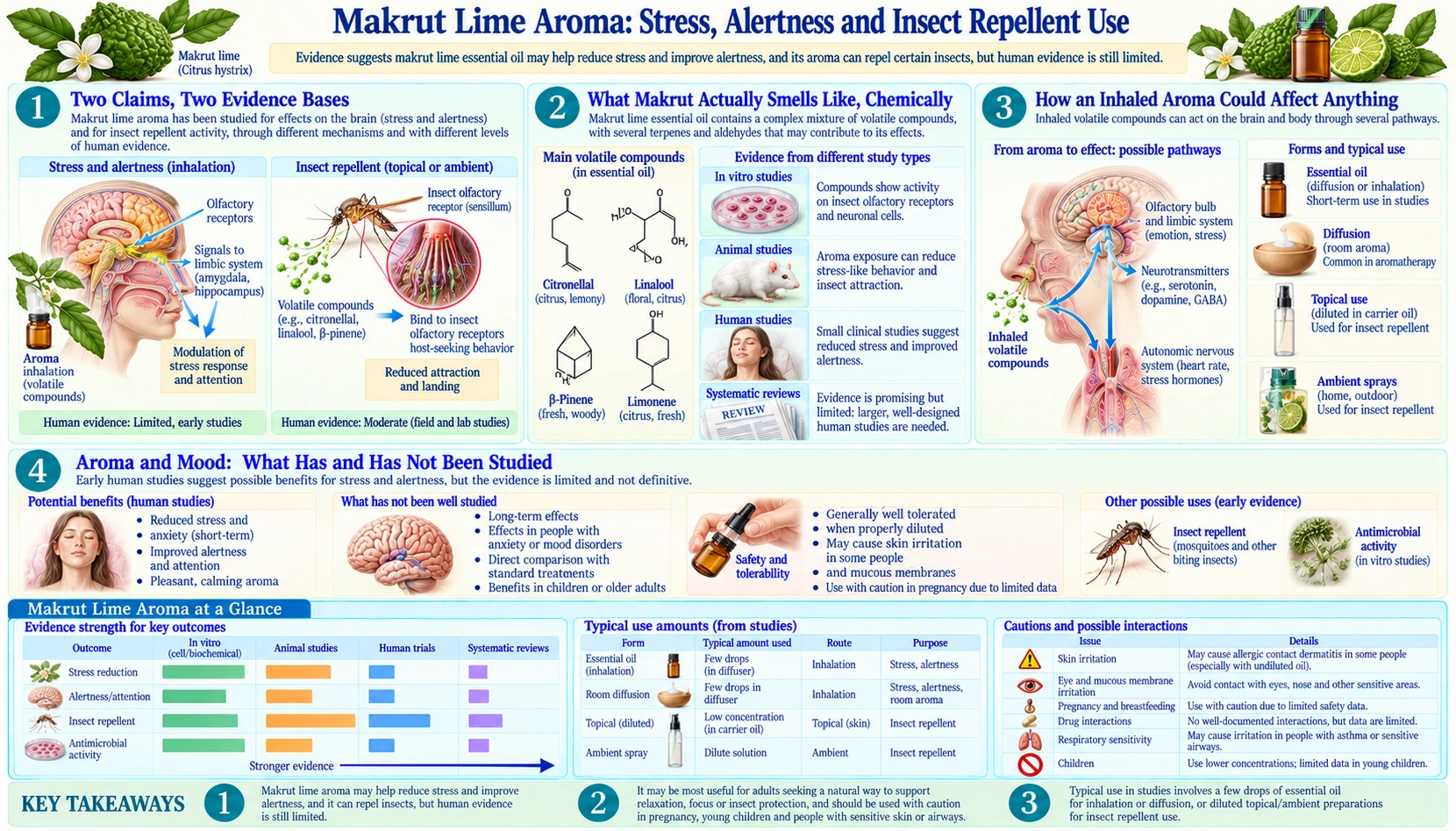
Two claims get made for makrut lime's smell, and they need to be kept apart because their evidence is completely different in kind. The first is that the aroma does something for a person — lifts mood, reduces stress, sharpens attention. The second is that it does something to mosquitoes. The first is almost entirely borrowed from research on other citrus species. The second is genuinely makrut's own chemistry, and its problem is not whether it works but for how long.
Both claims sit below the level of clinical proof, and this page says so throughout. What it can offer instead is an accurate account of the molecules involved, what the nearest real studies actually measured, and how to get whatever benefit there is without burning your skin or trusting a torn leaf to protect you from dengue. (Findability note: this plant is Citrus hystrix, still widely sold as kaffir lime.)
Table of Contents
- Two Claims, Two Evidence Bases
- What Makrut Actually Smells Like, Chemically
- How an Inhaled Aroma Could Affect Anything
- Aroma and Mood: What Has and Has Not Been Studied
- Alertness, Arousal and Citrus
- Using the Aroma Sensibly
- Insect Repellency: the Real Chemistry
- Arm-in-Cage Testing and the Duration Problem
- When a Botanical Repellent Is Not Adequate
- Burning Leaves, Coils and Spatial Repellency
- Putting Repellent Oil on Skin
- Key Research Papers
- Connections
- Featured Videos
Two Claims, Two Evidence Bases
A summary table in prose, so the rest of the page can be read without confusion:
- “Makrut aroma reduces stress / lifts mood / helps you concentrate.” There is a real research field on citrus fragrance and psychological state, with randomized and crossover designs, autonomic measurements and validated mood scales. Almost none of it used Citrus hystrix. The published human aroma work involves yuzu, bergamot, sweet orange, lemon and grapefruit. Tier for makrut specifically: traditional and anecdotal, with borrowed context from related species.
- “Makrut repels mosquitoes.” Chemically well founded: citronellal is a genuine arthropod repellent and it is makrut leaf oil's signature compound. Human forearm testing of plant essential oils as a class shows repellency that is real but short-lived, generally under two hours and often far less. Tier: preliminary human laboratory measure for the class; for makrut itself, laboratory cage and chamber tests of its own oil.
Neither claim is fabricated. Neither is a treatment. Both are worth understanding properly, because the second one has a genuine public-health consequence if you get it wrong in a place where mosquitoes carry disease.
What Makrut Actually Smells Like, Chemically
Tear a fresh makrut leaf and the smell is instant and disproportionate to the size of the leaf: sharp, green, floral, unmistakably citrus but not like any citrus fruit. That specific character comes from a small number of molecules.
- Citronellal — the signature. A monoterpene aldehyde with an intense lemony-green, slightly waxy scent and a very low odour threshold, which is why a single leaf can perfume a room. A 2022 survey of citrus leaf essential oils by Clery and colleagues in Chemistry & Biodiversity identified citronellal as the characteristic compound of the Citrus hystrix group, distinguishing it from the linalyl acetate of bitter orange leaf and the sabinene of sweet orange leaf.
- Citronellol — the corresponding alcohol. Softer, rosier, more persistent than the aldehyde. It is what gives makrut its floral edge rather than a purely lemon-sherbet character.
- Linalool — floral, faintly woody, ubiquitous in aromatic plants and one of the most studied fragrance molecules in existence. Also, in its air-oxidised form, a well-documented contact allergen.
- Sabinene and β-pinene — woody, peppery, resinous hydrocarbon monoterpenes. They supply the green, slightly turpentine-like backbone under the citrus.
- Terpinen-4-ol, α-terpineol, 1,8-cineole, isopulegol, nerol — supporting notes: medicinal, camphoraceous, minty-cooling, floral.
- Limonene — abundant in the peel oil rather than the leaf. Bright, clean, sweet-citrus. This is why makrut zest smells like a lime and makrut leaf does not.
The composition is not fixed. A 2010 analysis of C. hystrix leaf oil from New Caledonia, by Waikedre and colleagues, found an oil dominated by terpinen-4-ol, β-pinene and α-terpineol rather than citronellal — a far more medicinal, less lemony profile. Its main components were terpinen-4-ol (13.0%), β-pinene (10.9%), α-terpineol (7.6%), 1,8-cineole (6.4%) and citronellol (6.0%), with limonene at 4.7%, and the oil was inactive against the bacteria tested. Growing region, chemotype, leaf age and distillation method all move the numbers. A confident percentage found online describes one batch, not the species.
And volatiles leave. Dried makrut leaves lose most of their aromatic oil; the lightest and most characteristic molecules go first. A dried leaf is faintly grassy where a fresh one is overwhelming. Anything written about makrut aroma applies to fresh or frozen leaves and to distilled oil, not to a jar of pale dried leaf.
How an Inhaled Aroma Could Affect Anything
Three mechanisms are proposed in the aromatherapy literature. All three describe real biology; none has been demonstrated for makrut lime.
- The olfactory route. Odorant molecules bind receptors in the nasal epithelium, and olfactory signals reach the amygdala and hippocampus with unusually few synapses in between — a more direct connection to emotion and memory circuitry than any other sense has. This is why smell triggers feeling and recall so vividly, and it is the strongest reason to expect aroma to influence mood at all.
- Learned association. A large part of any aroma's effect on a given person is what that person has learned to associate with it. For someone raised in Thailand, makrut smells like home cooking. For someone who has never eaten Thai food, it smells like an unfamiliar cleaning product. Expectation and association are not artefacts to be controlled away here — in aroma research they are much of the effect, which is exactly why blinding is so difficult.
- Pharmacological absorption. Inhaled monoterpenes do reach the bloodstream through the lungs, and some can cross the blood–brain barrier. But the quantity absorbed from smelling a leaf or a diffuser is very small, and for makrut lime nobody has measured plasma concentrations of anything. Attributing a mood change to a pharmacological action of inhaled citronellal is, at present, speculation.
Aroma and Mood: What Has and Has Not Been Studied
The honest headline: there is essentially no published human study of makrut lime aroma. Run the topic search at the bottom of this page and see. That absence is the finding, and no amount of adjacent research fills it.
What does exist, and is worth knowing as context:
- Yuzu fragrance and premenstrual symptoms. Matsumoto and colleagues published a single-blind randomized controlled crossover study in BioPsychoSocial Medicine in 2016, examining the aromatic effects of yuzu (Citrus junos) on psychoemotional states and autonomic nervous system activity across the menstrual cycle. Tier: randomized crossover trial — in a different species. It is the closest well-designed citrus-aroma study to the claims made for makrut, and it is not about makrut.
- Ambient orange and lavender in a dental waiting room. Lehrner and colleagues reported in Physiology & Behavior in 2005 that ambient odours of orange and lavender reduced anxiety and improved mood among patients waiting for dental treatment. Tier: controlled human study — different species, and a setting with unusually high baseline anxiety, which makes an effect easier to detect.
- Bergamot, lemon and grapefruit aroma studies. A scattered literature, much of it small, with heterogeneous outcomes: self-reported mood scales, heart-rate variability, salivary cortisol, blood pressure. Effects reported are typically small and short-lived, and the field has well-known methodological problems — you cannot blind a person to a smell, sample sizes are small, and publication favours positive findings.
What it is fair to conclude. Pleasant smells make people feel somewhat better, briefly, and citrus smells are widely liked. That is a defensible statement supported by a real if imperfect literature. It is also a statement about pleasant smells in general, not a pharmacological property of Citrus hystrix. Anyone selling makrut oil for anxiety is selling you a pleasant smell with a research-shaped label on it.
Persistent anxiety, low mood and insomnia are conditions in their own right, and the aroma research above does not address them. Aroma can be a genuinely nice part of a wind-down routine, and a wind-down routine has value — but that value comes from the routine, the pause and the warm water, not from a molecule.
Alertness, Arousal and Citrus
A related claim deserves its own treatment: that citrus aromas are “stimulating” or “improve concentration,” usually contrasted with lavender as “relaxing.”
The research behind this is a body of work on odour and cognitive performance — reaction times, sustained-attention tasks, driving simulators, electroencephalogram (EEG) measures. The findings are genuinely mixed. Some studies find small improvements in vigilance with bright, sharp odours including citrus and peppermint; others find nothing; some find that any sufficiently novel or arousing odour produces a small effect regardless of its character, which points to general arousal rather than a specific pharmacology. Tier: preliminary human laboratory measures, inconsistent.
Two honest caveats:
- The stimulating/relaxing dichotomy is largely a marketing construct. It maps poorly onto the data. Sharp, high-intensity odours tend to be arousing because they are sharp and high-intensity; there is no good evidence that citrus molecules act on wakefulness pathways in the way caffeine acts on adenosine receptors.
- Nothing in this literature used makrut lime. Once again, the studies are on lemon, orange, peppermint and rosemary.
If tearing a makrut leaf over a desk feels a little waking, that observation may well be accurate. It is just not a research finding.
Using the Aroma Sensibly
All of the following is low-risk, cheap and enjoyable, and none of it is a treatment.
- Tear a fresh or frozen leaf. The single best and safest way to experience this aroma. Tearing ruptures the oil glands; scratching the surface with a fingernail does the same. Costs nothing, no dilution to get wrong.
- A bowl of hot water with torn leaves. Two or three torn leaves in just-boiled water, in a room, is a gentle continuous release. Steam burns are the actual risk here, not the plant, and a child leaning over a bowl of very hot water is the person most at risk.
- Zest in the moment. Grating makrut peel releases a burst of limonene-rich oil. It is one of the sharpest, cleanest smells available in a kitchen.
- A diffuser, if you use one. Water-based ultrasonic diffusers keep concentrations low, and exposure is lower in a ventilated room and with intermittent rather than continuous use. Aerosolised terpenes can irritate airways and trigger bronchospasm in susceptible people, which matters for a baby, a cat or anyone with asthma in an enclosed space.
- Steam inhalation and herbal compresses are traditional Thai practices with makrut among the ingredients. They are pleasant. They are traditional-tier, and hot-water safety is the real precaution.
Known hazards: undiluted oil applied to skin as a “perfume” causes irritation and sensitisation; humidifiers not designed for oil are not built to take it; birds have exceptionally sensitive respiratory systems; oil near an infant's face is a known hazard; and cold-pressed peel oil on skin that will see daylight can cause phototoxic burns — see the photosensitivity page.
Insect Repellency: the Real Chemistry
Here the tradition and the chemistry agree, and the honest caveat is about duration rather than existence.
Across Thailand, Malaysia and Indonesia, crushed makrut leaves and peel have long been rubbed on skin or clothing, and leaves burned or hung in the house, to drive off mosquitoes and other insects. Citronellal is a genuine arthropod repellent. It belongs to the same chemical family as the principal constituents of citronella oil — the best-known plant-derived repellent in the world, registered as a repellent active ingredient in many countries. Citronellol and, more weakly, limonene and β-pinene contribute.
How repellents of this kind are thought to work: they interfere with the insect's ability to locate you. Mosquitoes home in using carbon dioxide, body heat, humidity and a specific bouquet of skin volatiles including lactic acid. Repellent molecules disrupt that detection — by masking your odour signature, by acting on odorant receptors, or by being actively aversive at close range. The effect is on the mosquito's navigation, not on the mosquito's health.
One more accurate detail worth having: citronella-type oils are not the family behind the one botanical repellent with real regulatory standing. That is oil of lemon eucalyptus and its refined constituent PMD (para-menthane-3,8-diol), which performs far better in duration testing than citronella-type oils and is recommended by public-health bodies alongside synthetic actives. Makrut is chemically in the citronella camp, which is the weaker one.
Arm-in-Cage Testing and the Duration Problem
The evidence here is unusually concrete, because repellency has a clean laboratory endpoint: put a treated forearm into a cage of hungry mosquitoes and time how long until the first bite.
The 2005 Thai screening study. Trongtokit and colleagues, publishing in Phytotherapy Research, screened 38 plant essential oils for repellency against Aedes aegypti using human volunteers, applying 0.1 mL of oil per 30 cm² of exposed forearm skin. The findings, which are the most useful single result on this page:
- At 10% or 50% dilution, none of the 38 oils prevented mosquito bites for as long as two hours.
- Only a few undiluted oils — citronella, patchouli, clove and makaen (Zanthoxylum limonella) — achieved two hours of complete repellency.
- Clove oil was the best performer, giving roughly two to four hours against three mosquito species.
Tier: preliminary, human laboratory measure. Note carefully that the study did not single out makrut lime, and its result generalises to the category of plant essential oils rather than to this plant; makrut oil’s own tests are described below. But the lesson applies directly, and it is the lesson: botanical essential-oil repellents are short-acting because they evaporate. That is a physical property of small volatile molecules and no formulation trick at home will change it.
Makrut oil’s own test. In a 2001 Thai study, Tawatsin and colleagues tested steam-distilled makrut (kaffir lime) oil in mosquito cages and in a large room against three disease-carrying mosquito species, Aedes aegypti, Anopheles dirus and Culex quinquefasciatus. The oil alone, and with 5% vanillin added, was effective for up to three hours. In the same study, DEET alone protected for at least eight hours against Aedes aegypti and Culex quinquefasciatus, and for six hours against Anopheles dirus.
A comparison of products sold in the United States. In a 2002 controlled laboratory study with 15 volunteers, Fradin and Day found that a product containing 23.8% DEET had a mean complete-protection time of 301.5 minutes, a soybean-oil-based repellent 94.6 minutes and a repellent containing IR3535 22.9 minutes. All other botanical repellents tested protected for a mean of less than 20 minutes, and repellent-impregnated wristbands offered no protection.
For comparison, and this is the number that matters practically: DEET (N,N-diethyl-meta-toluamide, now called N,N-diethyl-3-methylbenzamide) at 20–30% typically gives five to twelve hours of protection; picaridin at 20% is broadly comparable; PMD-based lemon eucalyptus products give several hours. A citronellal-type botanical gives roughly one to three hours at best, and only when applied heavily.
So: a crushed makrut leaf rubbed on the forearms on a verandah at dusk probably helps somewhat for a short while. It is a gesture at the low end of a spectrum whose high end is a registered repellent.
When a Botanical Repellent Is Not Adequate
This is the part of the page with real stakes, and it deserves to be blunt.
The 2002 controlled comparison by Fradin and Day concluded that non-DEET repellents “cannot be relied on to provide prolonged protection in environments where mosquito-borne diseases are a substantial threat” — and makrut lime, citronella and home-made botanical preparations are all non-DEET repellents. Those diseases include malaria, dengue, chikungunya, Zika, yellow fever and Japanese encephalitis. In those settings the failure mode of a one-hour repellent is not an itchy arm; it is an infection. The protections used there are registered repellents, bed nets, clothing that covers the skin at the biting hours of the local vector, and local public-health advice.
Botanical repellents match a narrower set of situations: a temperate area with nuisance biting and no significant disease risk, a short and defined period outdoors, a preference for the smell, or a documented problem with synthetic repellents — with frequent reapplication and some bites to be expected.
Two further practical notes:
- Coverage matters more than product. Mosquitoes find the patch you missed. An unevenly applied strong repellent underperforms an evenly applied weaker one on the area you actually covered.
- Permethrin on clothing is a different tool. Treating clothing and gear rather than skin is a well-established approach for high-risk settings and lasts through several washes. It is not a plant, and it is not for skin.
Burning Leaves, Coils and Spatial Repellency
The traditional practice of burning or hanging makrut leaves in a room is a different intervention from putting oil on skin, and it is worth separating.
Spatial repellency — making an area less attractive to mosquitoes rather than protecting a specific body surface — is a real category. Mosquito coils, which release a pyrethroid as they smoulder, do reduce biting in a room, and vaporiser mats and spatial emanators are actively researched public-health tools. Traditional plant smoke has been studied in this frame too, mostly in African and South Asian settings, with modest and inconsistent effects.
Makrut oil itself has been tested as a spatial repellent. In laboratory chamber tests, Nararak and colleagues (2017) exposed Aedes aegypti and Anopheles minimus to makrut leaf and peel oils at 0.5% to 5%. The oils worked mainly by making mosquitoes leave a space rather than by contact: leaf oil at 1% and 2% gave 85.9% and 87.2% spatial-repellent escape of Anopheles minimus. The oils were more active against Anopheles minimus than against Aedes aegypti, and leaf oil was more active than peel oil against Anopheles minimus at every concentration except the highest (5%).
Two honest points about burning plant material indoors:
- Any effect is modest and highly dependent on airflow. An open verandah disperses everything; a closed room concentrates it.
- Smoke is itself a respiratory irritant. Indoor smoke exposure is a well-documented health problem, and mosquito coils have been examined for their own emission hazards. Burning plant material to avoid mosquito bites trades one exposure for another, which matters most for children, older adults and anyone with asthma or chronic lung disease.
A screened window and a fan are underrated. Mosquitoes are weak fliers, and moving air is a genuinely effective and completely non-toxic deterrent.
Putting Repellent Oil on Skin
This section covers the basic hazards of a makrut-based skin preparation. The full treatment is on the essential-oil safety page, which covers peel oil in detail.
- Undiluted essential oil irritates skin. Neat oil on skin causes irritation and raises sensitisation risk substantially. General guidance for adult body use is roughly 1–2% oil in a carrier oil, which is about 6–12 drops per 30 mL, with less on the face and much less on children, if any.
- Patch testing. A patch test places a small amount of the diluted blend on the inner forearm for 24 hours and checks for redness, itching or bumps before wider use. Food tolerance does not predict skin tolerance to a concentrated oil, so this applies even to a plant people eat.
- Cold-pressed citrus peel oil plus sunlight can burn you. Citrus peels contain furocoumarins that react with ultraviolet light to cause phototoxic blistering — the mechanism behind “margarita burn.” Steam-distilled oils are typically far lower in these compounds than cold-pressed ones. Expressed peel oil on skin that is exposed to sunlight within 12–18 hours can cause this reaction. Since repellent is exactly what you put on before going outside, this is a direct and easily missed conflict.
- Leaf oil is not a peel oil. Furocoumarins are principally a peel phenomenon. Steam-distilled leaf oil is the lower-risk choice for a skin preparation, though it still carries ordinary irritation and sensitisation risk.
- Fragrance allergens. Citronellal, citronellol, citral, linalool and limonene are all recognised contact allergens, and several must be declared on cosmetic labels in the European Union for that reason. Oxidised, air-aged oil is considerably more sensitising than fresh — oil stored sealed, cool and dark oxidises more slowly, and old bottles carry the most risk.
- Not for swallowing. There is no established oral dose for this species, whether in water, in a capsule or as “a drop under the tongue”, and concentrated monoterpene oils injure mucosa.
- Pregnancy, breastfeeding and children. Culinary leaf and zest are unremarkable and customary. Concentrated oil has not been studied in pregnancy, taken internally or on skin. Essential oils near infants and young children, and above all near a small child's face, are a known hazard.
Key Research Papers
Citations with a confirmed PubMed record link to it by PMID; the rest link to a PubMed topic search. Titles, journals and years appear in the text. Where a study concerns a different species, that is stated explicitly.
- Comparative repellency of 38 essential oils against mosquito bites — Trongtokit and colleagues, Phytotherapy Research, 2005. The forearm study that establishes the duration problem for the whole botanical-repellent category. Tier: preliminary, human laboratory measure. PubMed PMID: 16041723
- Chemical diversity of citrus leaf essential oils — Clery and colleagues, Chemistry & Biodiversity, 2022. Citronellal as the characteristic Citrus hystrix leaf-oil compound. Tier: analytical chemistry. PubMed PMID: 35061334
- Chemical composition and antimicrobial activity of the essential oils from New Caledonian Citrus macroptera and Citrus hystrix — Waikedre and colleagues, Chemistry & Biodiversity, 2010. The chemotype study showing a terpinen-4-ol-dominant makrut leaf oil, and why aroma descriptions vary. Tier: analytical chemistry. PubMed PMID: 20397222
- Aromatic effects of yuzu (Citrus junos) on psychoemotional states and autonomic nervous system activity during the menstrual cycle — Matsumoto and colleagues, BioPsychoSocial Medicine, 2016. A single-blind randomized crossover design — and a different citrus species. Tier: randomized crossover trial, other species. PubMed PMID: 27103942
- Ambient odors of orange and lavender reduce anxiety and improve mood in a dental office — Lehrner and colleagues, Physiology & Behavior, 2005. Tier: controlled human study, other species. PubMed PMID: 16095639
- Repellency of volatile oils from plants against three mosquito vectors — Tawatsin and colleagues, Journal of Vector Ecology, 2001. Steam-distilled makrut (kaffir lime) oil effective for up to three hours in cage tests. Tier: laboratory cage and room testing. PubMed PMID: 11469188
- Excito-repellency of Citrus hystrix DC leaf and peel essential oils against Aedes aegypti and Anopheles minimus (Diptera: Culicidae), vectors of human pathogens — Nararak and colleagues, Journal of Medical Entomology, 2017. Makrut leaf and peel oils as spatial repellents. Tier: laboratory chamber testing. PubMed PMID: 28082646
- Comparative efficacy of insect repellents against mosquito bites — Fradin and Day, New England Journal of Medicine, 2002. DEET, soybean-oil, IR3535 and botanical products compared under controlled conditions. Tier: controlled human laboratory testing. PubMed PMID: 12097535
- Citrus hystrix and inhaled-aroma effects in humans — run this search and note how little comes back. The absence is the finding. Run the topic search
- Citronellal and citronella-type repellents: protection time — the literature quantifying how quickly this chemical family evaporates off skin. Tier: preliminary, laboratory and field. Run the topic search
- DEET and picaridin efficacy comparisons — the benchmark any botanical repellent must be measured against. Tier: randomized and controlled human testing. Run the topic search
- Oil of lemon eucalyptus and PMD as repellents — the one botanical family with genuine regulatory standing, and a fair benchmark within the plant world. Tier: controlled human testing. Run the topic search
- Mosquito host-seeking cues and repellent mechanism — carbon dioxide, skin volatiles, lactic acid and odorant receptors: how repellents interfere with navigation. Tier: mechanistic. Run the topic search
- Spatial repellents, mosquito coils and emanators — the evidence for making a space less attractive rather than protecting skin, plus coil emission concerns. Tier: mixed, including field trials. Run the topic search
- Odour and cognitive performance — the vigilance and reaction-time literature behind “citrus is stimulating,” including the general-arousal interpretation. Tier: preliminary, inconsistent. Run the topic search
- Oxidised limonene and linalool as contact allergens — why an old bottle of citrus oil is riskier than a fresh one. Tier: clinical dermatology and patch-test research. PubMed PMID: 37852634
- Phytophotodermatitis from limes and citrus peel — the reason a peel-oil repellent applied before going outside is a bad idea. Tier: clinical case reports and reviews. Run the topic search
Connections
- All Herbs
- Makrut Lime (Citrus hystrix) — the main topic page: botany, names, chemistry and culinary use.
- Makrut Lime Benefits Hub — the four deep dives and the evidence tiers.
- Essential Oil, Photosensitivity and Safety — read before applying any peel oil to skin.
- Antimicrobial and Oral-Health Research — the laboratory strand of makrut research.
- Lemongrass — the citral-rich partner oil, and the other great Southeast Asian aromatic.
- Eucalyptus — source of PMD, the one botanical repellent with regulatory standing.
- Clove — the oil that outlasted all 37 others in the 2005 repellency study.
- Neem — the other major traditional repellent plant of tropical Asia.
- Lavender — the aroma most often studied opposite citrus in mood research.
- Rosemary — the aroma most used in alertness and cognition studies.
- Peppermint — the other “stimulating” aroma in that literature.
- Galangal — the third aromatic of the tom yum trio.
- Thai Basil — the anise aromatic finished into Thai curries.
- Pandan — the sweet aromatic leaf of the same kitchens.
- Torch Ginger — another Southeast Asian aromatic used fresh for scent.
- Vietnamese Coriander — a pungent regional herb used in the same way.
- Aromatherapy — how inhaled-aroma evidence is generated, and its limits.
- Massage — the practice that Thai herbal compress balls belong to.
- Contact Dermatitis — what a reaction to a diluted oil looks like.
- Dermatology — the full skin-conditions index.
Safety and disclaimer. No randomized clinical trial supports makrut lime aroma for stress, mood, anxiety, sleep or concentration; the human aroma research cited here is on other citrus species. As an insect repellent, makrut lime is short-acting, and a controlled comparison found that non-DEET repellents “cannot be relied on to provide prolonged protection” where mosquito-borne diseases are a substantial threat. Essential oils are not for swallowing, and undiluted oil irritates skin; cold-pressed citrus peel oil can cause phototoxic burns on sun-exposed skin. Nothing here is a diagnosis, a prescription or a substitute for care from a qualified clinician. Concentrated oil is unstudied in pregnancy, aerosolised terpenes can trigger bronchospasm in people with asthma, and essential oils near an infant's face are a known hazard.