Makrut Lime — Benefits Deep Dive
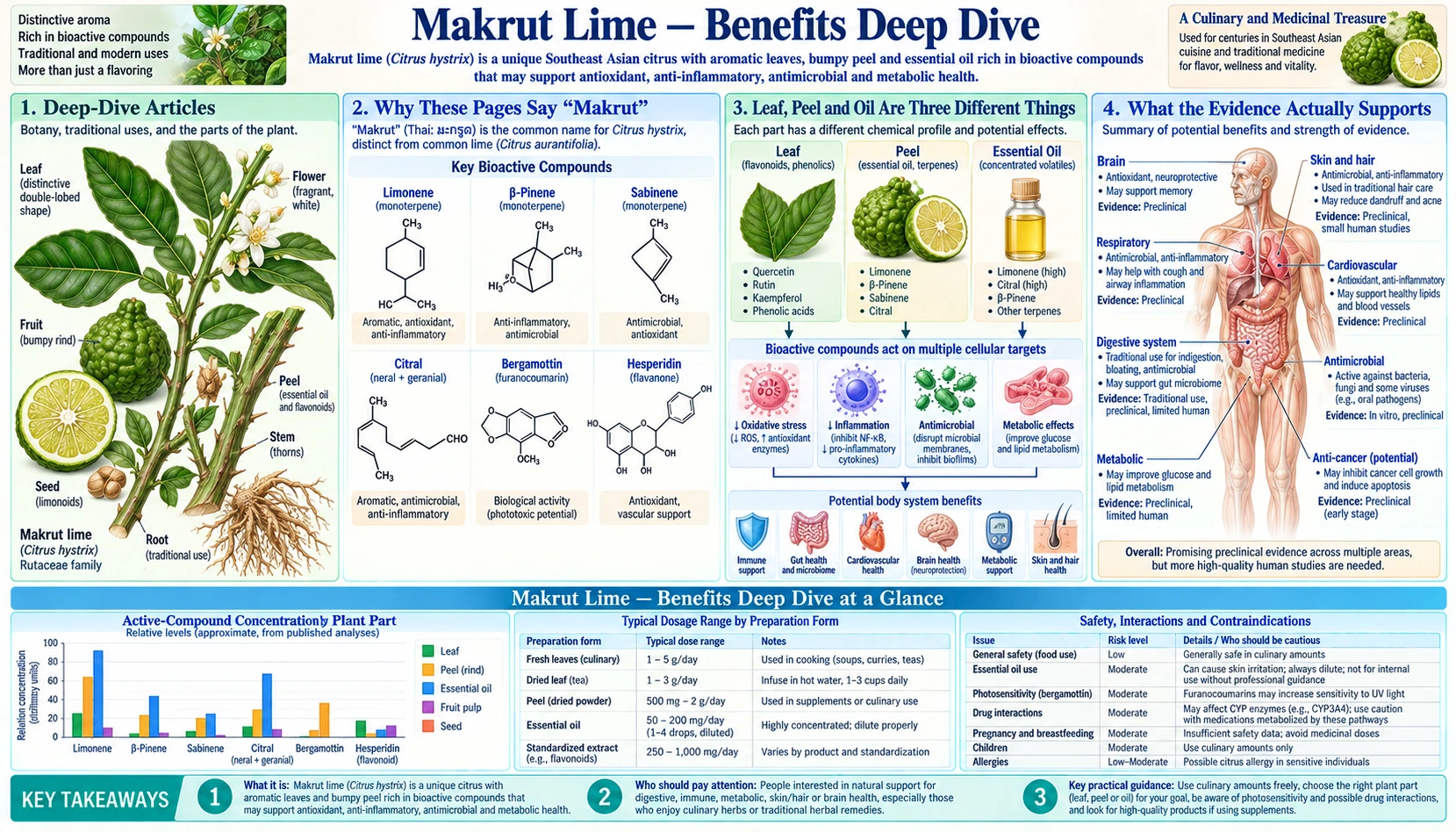
Makrut lime (Citrus hystrix) is one of the great flavour plants of the world and one of the thinnest medicinal files in this category. Tear a leaf and the smell arrives before your hand reaches your face — a sharp, green, floral citrus driven by an aldehyde called citronellal. That smell is why the plant is in tens of thousands of kitchens. It is also, more or less, the whole of the pharmacology: nearly everything published about makrut lime concerns its essential oils, tested in glassware.
These four articles take the claims people actually make for makrut lime and sort them by how much evidence stands behind each one. Some hold up modestly — the antifungal work on the scalp yeast Malassezia, the repellent chemistry of citronellal. Some are traditional practice with a plausible mechanism and no trials, like the carminative use for a heavy stomach. And one is a genuine safety issue that gets almost no attention in the enthusiast literature: citrus peel oils can burn skin in sunlight. For anyone planning a hair oil or a home skin blend, the safety article is the most relevant of the four.
A note for searchers: this plant is still widely sold and labelled as kaffir lime, so if that is the name on your packet of frozen leaves, you are in the right place.
Table of Contents
Deep-Dive Articles
Makrut Lime for Digestion and Bloating
The oldest household use, and an honest look at what a carminative aromatic can and cannot do. Why the leaf and zest are the useful parts, why the fruit's juice is almost never the answer, and how makrut compares with peppermint and ginger — two aromatics that do have randomized trials behind them.
Read the deep dive →Makrut Lime: Antimicrobial and Oral-Health Research
The best-developed strand of makrut research is also the most easily overstated. What the laboratory work on bacteria, dandruff yeast and oral biofilm really showed, why a minimum inhibitory concentration in a well plate does not become a treatment, and what an honest reading leaves you with.
Read the deep dive →Makrut Lime Aroma: Stress, Alertness and Insect Repellent Use
Two claims with two different evidence bases. The mood-and-alertness research on citrus aroma is real but almost entirely about other species; the repellent chemistry is genuinely makrut's own, and its limitation is duration — botanical repellents evaporate in an hour or two.
Read the deep dive →Makrut Lime: Essential Oil, Photosensitivity and Safety
The most practically important page here. Citrus peel oils carry furocoumarins — psoralen-type compounds that react with sunlight and blister skin. This is the cause of “margarita burn.” It covers what matters before making any leave-on skin or hair preparation from citrus peel oil.
Read the deep dive →Why These Pages Say “Makrut”
For most of the twentieth century, English-language cookbooks called this plant kaffir lime. That name is now widely avoided, because kaffir is a severe racial slur against Black people in southern Africa — in South Africa it is treated in law as hate speech. Botanists, chefs, food writers and suppliers have moved to makrut lime, from the Thai makrut (มะกรูด), with Thai lime as a secondary option.
The old name still appears on packaging, in cookbook indexes and in the titles of published research papers, which is why it is mentioned once on each of these pages: a reader holding a bag labelled “kaffir lime leaves” needs to be able to find the right plant. Elsewhere these pages use makrut lime.
Leaf, Peel and Oil Are Three Different Things
Almost every confused claim about this plant comes from treating it as one substance. It is not. The parts differ in chemistry, in how they are used, and in what has been tested.
- The leaf. The famous double-lobed, hourglass leaf — botanically a single leaf whose lower lobe is a hugely expanded winged petiole. Thick, leathery, studded with visible oil glands. Its volatile oil is citronellal-led, with citronellol, linalool, sabinene, isopulegol and β-pinene. This is the culinary workhorse: torn into soups, shredded hair-thin over salads and fish cakes.
- The fruit peel (zest). A thick, bumpy, hedgehog-like rind — the species epithet hystrix means hedgehog. Its oil is limonene-led like other citrus peel oils, with β-pinene, sabinene and a citronellal contribution that makes it recognisably makrut rather than lemon. Zest is the citrus element in Thai curry pastes. Crucially, the peel is also where citrus furocoumarins live, which is why the safety article is about peel oil specifically. Chemists analysing makrut fruit peels isolated several furanocoumarins, including 6′,7′-dihydroxybergamottin (Youkwan 2010).
- The juice. There is almost none, and what there is tastes harshly sour and resinous. Thai cooks reach for ordinary lime (Citrus aurantifolia) whenever a dish needs sourness. A recipe calling for “kaffir lime juice” is nearly always a mistake — it means ordinary lime juice plus makrut leaf or zest for aroma. The juice's real traditional home is the hair wash, not the pot.
- The distilled essential oil. Sold from either leaf or peel, and they are different products. This is what nearly all the research used, at concentrations no cook or home formulator would ever encounter. An in-vitro result obtained with neat oil says very little about a torn leaf in a litre of broth.
One more practical point that runs through all four articles: dried makrut leaves lose most of their volatile oil. A dried leaf is pale, papery and faintly grassy. Fresh and frozen leaves are aromatic; dried leaves are a weak substitute. That means culinary material, commercial dried herb and research-grade distilled oil are not interchangeable, and results obtained with one do not transfer to another.
What the Evidence Actually Supports
Stated as plainly as possible, so nothing here is oversold:
- Traditional use only — makrut as a digestive aromatic and carminative; makrut juice as a hair and scalp wash; leaves in Thai herbal compress balls and steam baths; peel in warming tonics. These are documented household and folk practices with centuries of continuity. That is ethnography, not efficacy.
- Preliminary (in vitro) — antifungal activity of leaf and peel oils, including a synergy with lemongrass oil against the dandruff-associated yeast Malassezia furfur; activity against oral bacteria in culture; broad cytotoxicity in cancer cell-line screens, which concentrated terpenes show routinely and which predicts nothing clinically.
- Preliminary, and partly negative — antibacterial testing. One careful study of C. hystrix leaf oil found it inactive against every bacterium tested. The honest summary is: some antifungal activity, little antibacterial activity.
- Real chemistry, limited practical effect — insect repellency. Citronellal genuinely repels mosquitoes; the problem is that it evaporates. Laboratory arm tests of plant essential oils generally show protection measured in tens of minutes to two hours, against five to twelve hours for a registered synthetic repellent.
- No randomized clinical trials at all. Not for digestion, not for dandruff, not for oral health, not for anxiety, not for anything. There is no established medicinal dose of makrut lime for any condition, and any dose printed on a supplement label is a marketing number. A 2026 systematic review and meta-analysis of makrut's anti-inflammatory effect found only 9 eligible studies, all laboratory work (7 in vitro, 2 in animals); the pooled inhibition of the inflammatory signal tumour necrosis factor-alpha (TNF-alpha) was 36.43%, results varied widely between studies (I² above 80%), and the authors called for clinical trials in humans (Buakaew 2026).
- A real, documented hazard — phototoxicity from cold-pressed citrus peel oil. This is the one item on the page with a solid clinical literature behind it, and it is a warning rather than a benefit. One case is makrut-specific: a 1999 report in the British Journal of Dermatology describes extensive phytophotodermatitis in a hiker who had applied Citrus hystrix juice as a folk remedy to ward off biting insects — the juice-on-skin and repellent traditions meeting the sunlight burn directly (Koh 1999).
How to Read the Evidence Tiers
Every claim across these four articles carries one of four labels, used consistently:
- Randomized clinical trial — people, randomized, with a comparison group. For makrut lime specifically, this tier is empty. Where you see it used on these pages, it refers to a different plant being offered as a comparison.
- Preliminary — in vitro — cells, microbes or enzymes in a dish. Useful for generating hypotheses and for choosing what to test next. It establishes that a molecule can do something to a target under laboratory conditions, and nothing about what happens in a body.
- Preliminary — animal or human laboratory measure — rodent studies, and human tests of a narrow endpoint such as mosquito landings on a forearm or a change in heart-rate variability while smelling something. Better than a dish, still a long way from a clinical outcome.
- Traditional use only — recorded practice, sometimes for centuries, with no controlled test. This is worth documenting and worth respecting; it is not proof.
Key Research Papers
Citations to a single paper close with its PubMed record number (PMID); entries that describe a wider literature link to a PubMed topic search. Titles, journals and years are given in the text.
1. Essential-oil chemistry and chemotype variation
- Chemical diversity of citrus leaf essential oils — Clery and colleagues, Chemistry & Biodiversity, 2022. Surveyed leaf oils across a large citrus collection and identified citronellal as the characteristic compound of the Citrus hystrix group, distinct from the linalyl acetate of bitter orange leaf or the sabinene of sweet orange leaf. PubMed PMID: 35061334
- Chemical composition and antimicrobial activity of the essential oils from New Caledonian Citrus macroptera and Citrus hystrix — Waikedre and colleagues, Chemistry & Biodiversity, 2010. A leaf oil dominated by terpinen-4-ol and β-pinene rather than citronellal — the clearest published demonstration that “makrut leaf oil” is not one fixed composition. PubMed PMID: 20397222
- Chemotype and cultivation effects on citrus volatile profiles — a broad literature rather than a single paper, and the reason percentages quoted online should be treated as ranges. Run the topic search
2. Antimicrobial and antifungal laboratory work
- Synergistic antifungal properties of essential oils from lemongrass, kaffir lime, lime, dill and shatavari against Malassezia furfur — Tadtong and colleagues, International Journal of Molecular Sciences, 2025. Lemongrass oil was the strongest single agent; a one-to-one combination with makrut lime oil was synergistic, halving the minimum inhibitory concentration. Activity tracked citral and citronellal. The study tested makrut peel oil and makrut leaf oil. In numbers: lemongrass oil alone had a minimum inhibitory concentration of 0.125% v/v; the one-to-one lemongrass and makrut mix 0.0625% v/v; pure citral 0.03125% v/v and pure citronellal 0.125% v/v. Tier: preliminary, in vitro. PubMed PMID: 40565064
- The negative antibacterial result — in the same 2010 New Caledonian study above, both citrus leaf oils were inactive against every bacterial strain tested. Negative results are the part of this literature that marketing copy omits. Run the topic search
- Oral bacteria and biofilm — several in-vitro reports test citrus peel and leaf oils against Streptococcus mutans and other plaque organisms. All are culture work; none is a clinical trial. Run the topic search
3. Insect repellency
- Comparative repellency of 38 essential oils against mosquito bites — Trongtokit and colleagues, Phytotherapy Research, 2005. Human forearm testing against Aedes aegypti: at 10% or 50% dilution, none of the 38 oils prevented bites for as long as two hours. Only a few undiluted oils reached two hours, with clove oil longest. Tier: preliminary, human laboratory measure. PubMed PMID: 16041723
- Citronellal and citronella-type repellents — the chemical family behind the traditional use, with a substantial literature on short protection times. Run the topic search
- Comparisons with registered repellents — the benchmark any botanical has to be measured against. Run the topic search
4. Aroma, mood and alertness
- Aromatic effects of yuzu (Citrus junos) on psychoemotional states and autonomic nervous system activity — Matsumoto and colleagues, BioPsychoSocial Medicine, 2016. A single-blind randomized crossover study — and a different citrus species. Included as the closest available context, not as evidence about makrut. PubMed PMID: 27103942
- Ambient odors of orange and lavender reduce anxiety and improve mood in a dental office — Lehrner and colleagues, Physiology & Behavior, 2005. Again a different species, and again the pattern: citrus-aroma research exists, but not for this plant. PubMed PMID: 16095639
- Makrut-specific human aroma studies — search for yourself; the file is very thin, and that absence is the finding. Run the topic search
5. Skin safety: photosensitivity and contact allergy
- Phytophotodermatitis from limes and citrus peel — a well-established clinical literature of case reports and reviews, including the pattern popularly called “margarita burn” in bartenders and holidaymakers. This is the highest-quality human evidence about makrut lime's plant family on this page, and it is a hazard. Run the topic search
- Furocoumarins, bergapten and phototoxicity of expressed peel oils — the mechanism, and the reason steam-distilled oils behave differently from cold-pressed ones. Run the topic search
- Air oxidation of d-limonene (the citrus solvent) creates potent allergens — Karlberg, Magnusson and Nilsson, Contact Dermatitis, 1992;26(5):332-40. In guinea-pig tests, d-limonene became a sensitiser after prolonged exposure to air, while d-limonene not exposed to air gave no significant response; the authors concluded that air oxidation of d-limonene is essential for its sensitising potential. Directly relevant to an old bottle of oil. Tier: preliminary, animal. PubMed PMID: 1395597
- Contact allergy to oxidized d-limonene among dermatitis patients — Karlberg and Dooms-Goossens, Contact Dermatitis, 1997;36(4):201-6. In patch tests of dermatitis patients, the proportion of positive reactions to oxidised d-limonene was comparable to several allergens in the standard series. PubMed PMID: 9165203
- Patterns of simultaneous contact allergies in patients with contact sensitization to oxidised linalool and oxidised limonene — Sukakul and colleagues, Contact Dermatitis, 2024;90(2):134-142. A retrospective analysis of 4192 consecutive dermatitis patients patch-tested in 2015–2020; patients allergic to both linalool and limonene hydroperoxides had contact allergies to many other screening and fragrance allergens. PubMed PMID: 37852634
- Phytophotodermatitis due to the application of citrus hystrix as a folk remedy — Koh and Ong, British Journal of Dermatology, 1999;140(4):737-8. A case of extensive phytophotodermatitis in a hiker who applied makrut juice to ward off biting insects. PubMed PMID: 10233333
- Citrusosides A-D and furanocoumarins with cholinesterase inhibitory activity from the fruit peels of Citrus hystrix — Youkwan, Sutthivaiyakit and Sutthivaiyakit, Journal of Natural Products, 2010;73(11):1879-83. Furanocoumarins, including 6′,7′-dihydroxybergamottin, isolated from makrut fruit peels. PubMed PMID: 20964319
- Citrus peel furocoumarins and CYP3A4 — the grapefruit-interaction mechanism, relevant to concentrated peel preparations rather than to a bowl of curry. Run the topic search
6. Anti-inflammatory laboratory work
- The anti-inflammatory effects of Citrus hystrix DC.: a systematic review and meta-analysis of in vitro and in vivo studies — Buakaew, Thongsri, Mahikul and Usuwanthim, Scientific Reports, 2026;16(1). Nine eligible studies (7 in vitro, 2 in vivo); pooled TNF-alpha inhibition 36.43%, heterogeneity I² above 80%; no human trials. Tier: preliminary, in vitro and animal. PubMed PMID: 42032128
External Resources
- PubMed — the biomedical literature database behind every citation on these pages.
- PubMed Central — free full text for a large share of the essential-oil literature.
- PubChem — structures, properties and safety records for citronellal, citronellol, limonene, β-pinene and bergapten.
- Plants of the World Online (Kew) — the accepted botanical treatment of Citrus hystrix and its synonyms.
- World Flora Online — a second nomenclatural check.
- U.S. National Institutes of Health (NIH) National Center for Complementary and Integrative Health — plain-language reviews of herb and supplement evidence.
- U.S. National Institutes of Health Office of Dietary Supplements — how supplement labelling and regulation actually work.
- US EPA — Insect Repellents — registered repellents and how to choose one, the benchmark for the repellency article.
- American Academy of Dermatology — patient guidance on photosensitivity reactions and contact dermatitis.
- International Fragrance Association (IFRA) — the industry standards that restrict furocoumarin levels in leave-on skin products.
Connections
- All Herbs
- Makrut Lime (Citrus hystrix) — the main topic page: botany, names, compounds, culinary use, forms and dosage.
- Lemongrass — makrut's constant partner in Thai soups, and the oil it acted synergistically with against dandruff yeast.
- Galangal — the third member of the tom yum aromatic trio.
- Thai Basil — the anise-scented basil finished into the curries makrut leaf starts.
- Pandan — the other Southeast Asian leaf used by infusion rather than eaten.
- Chen Pi — aged tangerine peel, the East Asian tradition of using citrus rind as a medicine in its own right.
- Fingerroot — another Thai kitchen rhizome with a similar evidence profile.
- Peppermint — the carminative aromatic that does have randomized trials, and the fair comparison for makrut's digestive claim.
- Ginger — the other well-trialled digestive aromatic.
- Fennel — the classic European carminative seed.
- Clove — one of four undiluted oils that gave two hours of complete protection in the 2005 repellency screen of 38 oils, and the longest-lasting in its follow-up tests; also a mainstay of oral-care research.
- Tea Tree — another essential oil with strong in-vitro antifungal data and thin clinical evidence.
- Neem — the other great traditional repellent plant of tropical Asia.
- Eucalyptus — the source of the one botanical repellent family with regulatory standing.
- Antibacterial Herbs — the category overview, and where in-vitro claims get put in perspective.
- Aromatherapy — how inhaled-aroma evidence is generated, and its limits.
- Oil Pulling — the oral practice people most often try to combine with citrus oils.
- Hesperidin — the citrus flavanone family found across the genus.
- Rutin — another flavonoid common in citrus leaf and peel.
- Contact Dermatitis — what an essential-oil skin reaction actually is.
- Seborrheic Dermatitis — the Malassezia-associated condition behind the scalp-wash tradition.
- Functional Dyspepsia — the modern diagnosis that best matches the traditional “heavy stomach.”
- Gingivitis — the oral condition essential-oil rinses are actually trialled against.
Safety and disclaimer. Makrut lime as food is about as safe as an ingredient gets. Its concentrated essential oils are not food: they are not meant to be swallowed undiluted, skin preparations use them heavily diluted, and — if cold-pressed from the peel — they can cause phototoxic burns on sun-exposed skin. Nothing on these pages is a diagnosis, a prescription or a substitute for care from a qualified clinician. There is no established medicinal dose of makrut lime for any condition, and no randomized clinical trial supports its use as a treatment for anything. Citrus peel furocoumarins inhibit the drug-metabolising enzyme CYP3A4 (the grapefruit-interaction mechanism), which matters for people taking prescription medication alongside concentrated peel preparations. None of the research on these pages tested concentrated makrut preparations in pregnancy, breastfeeding or children.