Codonopsis (Dang Shen) Benefits
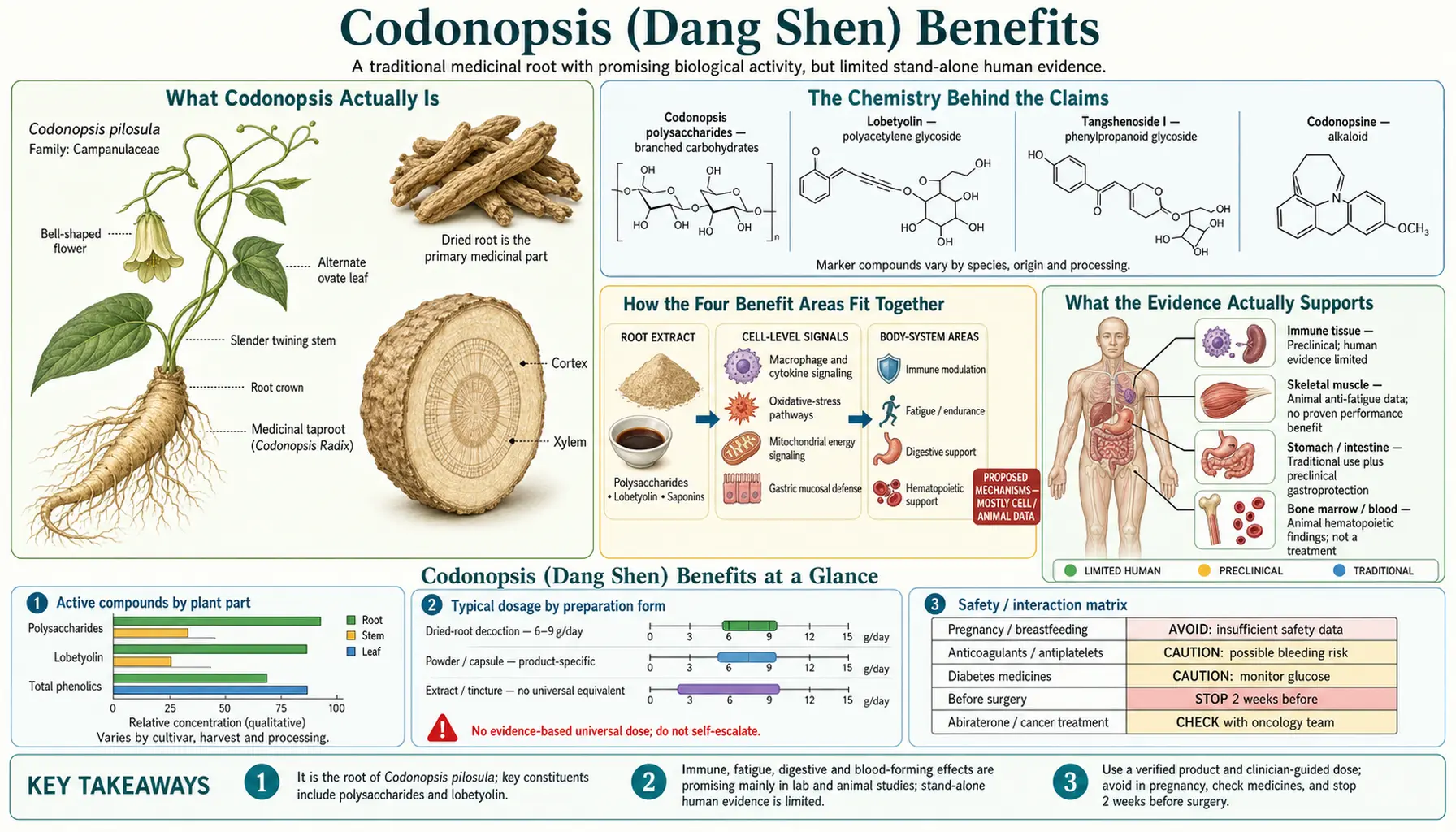
Codonopsis — Codonopsis pilosula (Franch.) Nannf., in the bellflower family Campanulaceae — is the root sold in Chinese herb shops as dǎng shēn (党参) and in Vietnamese markets as đảng sâm. It is often introduced to English-speaking readers as "poor man's ginseng," which is a useful economic description and a misleading botanical one. Codonopsis is not related to Panax ginseng, which sits in a completely different family (Araliaceae), and it contains no ginsenosides at all. What it does contain is its own distinctive chemistry: polyacetylene glycosides such as lobetyolin, pyrrolidine alkaloids, phenylpropanoid glycosides, and a large fraction of inulin-type fructans and immune-active polysaccharides.
In traditional Chinese medicine Codonopsis is classified as a sweet, neutral qi tonic for the Spleen and Lung — the gentle, non-stimulating workhorse used in daily soups and in classical formulas such as Si Jun Zi Tang, Bu Zhong Yi Qi Tang, and Shen Ling Bai Zhu San. This page is the hub for four deep dives into what modern research does and does not show about that traditional role.
Read the evidence note before you read anything else. The human clinical evidence for Codonopsis as a single herb is thin. Nearly everything published is cell-culture work, rodent experiments, or Chinese-language trials of multi-herb formulas in which Codonopsis is one of six or eight ingredients and its individual contribution cannot be separated out. Traditional use across many centuries is a real and interesting signal, but it is not the same as proof. Each sub-article below says so plainly rather than dressing up a mouse study as a treatment.
Immune Modulation
What Codonopsis polysaccharides actually do to macrophages and lymphocytes in the lab, why "immune boosting" is the wrong frame, and who should stay away.
Digestive and Gut Health
The Spleen-qi picture translated into plain symptoms, the prebiotic fructans, and the honest caveat that fermentable fibre can make bloating worse.
Energy and Fatigue
Why a non-stimulant tonic feels nothing like caffeine, what the rodent swim-test literature can and cannot tell you, and a realistic time course.
Blood and Circulation
The classical "tonifies blood" claim, the haematopoietic animal data, and the correction that Codonopsis is not an iron source and does not treat anaemia.
Table of Contents
- What Codonopsis Actually Is
- The Chemistry Behind the Claims
- How the Four Benefit Areas Fit Together
- What the Evidence Actually Supports
- Forms, Dose, and Reading a Label
- Safety at a Glance
- Key Research Papers
- External Resources
- Connections
- Featured Videos
What Codonopsis Actually Is
Codonopsis is a perennial twining herb native to northern and western China, Korea, Japan, Mongolia, and the eastern Himalaya. The part used medicinally is the root — long, tapering, pale yellow-brown, with a wrinkled "head" of stem scars at the crown that Chinese herbalists call the "lion's head." Sliced, the root is starchy and faintly sweet, closer in taste to a dried parsnip than to the bitter bite of ginseng. In the Chinese Pharmacopoeia the official drug is Radix Codonopsis, and three species are accepted: Codonopsis pilosula, C. pilosula var. modesta, and C. tangshen.
The single most useful fact for a Western reader is the one about family. Panax ginseng belongs to Araliaceae; Codonopsis pilosula belongs to Campanulaceae, the bellflowers — the same family as the garden campanula. They are not close relatives, they do not share a biosynthetic pathway, and Codonopsis produces no ginsenosides. Any product marketing Codonopsis on a ginsenoside content claim is either mislabelled or adulterated. The nickname "poor man's ginseng" survives because Codonopsis was, historically, the affordable substitute a village doctor reached for when Panax was priced out of reach — a role, not a chemistry.
That substitution is not arbitrary. Classical Chinese medicine describes both as qi tonics, but with different personalities: Panax is warm and stimulating, capable of causing insomnia, agitation, and headache in someone who does not need it; Codonopsis is described as sweet and neutral, gentler, tolerated in larger quantities, and safe enough in traditional practice to be simmered into everyday chicken soup. That difference in "temperature" is the practical reason Codonopsis is still used rather than simply replaced by ginseng now that ginseng is affordable.
The Chemistry Behind the Claims
Four groups of compounds carry most of the research interest:
- Polyacetylene glycosides — lobetyolin and lobetyolinin. These are the compounds analytical chemists use as HPLC quality markers for authenticating Radix Codonopsis, because they are characteristic of the genus and reasonably stable. Lobetyolin is also the most studied single molecule in the plant, mostly in cancer-cell work centred on glutamine transport.
- Pyrrolidine alkaloids — codonopsine and codonopsinine. These are minor constituents, first isolated from Central Asian Codonopsis species in the late 1960s, and reported in older pharmacological literature to lower blood pressure in animals. Read the name carefully: these are pyrrolidine alkaloids, not pyrrolizidine alkaloids. Pyrrolizidine alkaloids are the liver-toxic compounds found in comfrey, borage, and coltsfoot. The two words look almost identical and are constantly confused online. Codonopsis is not a pyrrolizidine-containing plant and does not carry that class of hepatotoxicity risk.
- Phenylpropanoids and sesquiterpenes — tangshenoside I, syringin, atractylenolide III. Tangshenoside I is named for C. tangshen; syringin also appears in eleuthero; atractylenolide III is shared with Atractylodes, the herb Codonopsis is most often paired with in Spleen-qi formulas.
- Polysaccharides and inulin-type fructans — the "CPP" fraction. Quantitatively this is the biggest part of the root and the fraction behind almost all the immune and gut research. Inulin-type fructans are the same class of fermentable prebiotic fibre found in chicory root and Jerusalem artichoke, which matters both for the possible benefit and for the possible bloating.
How the Four Benefit Areas Fit Together
The four deep dives are not four unrelated topics. In classical terms they are one claim viewed from four angles: Codonopsis is said to tonify Spleen and Lung qi and, secondarily, to nourish blood and generate fluids. Translated out of the classical vocabulary, the traditional picture is a person with poor appetite, loose stools, tiredness that gets worse after eating rather than better, a weak voice, easy shortness of breath, pallor, and a tendency to catch every passing cold.
Modern research has largely picked apart that composite picture into separate laboratory questions. The polysaccharide fraction gets tested on immune cells, which produces the immune modulation literature. The same fraction gets tested on gut barrier, gastric mucosa, and microbiota, producing the digestive literature. Whole extracts get put through rodent endurance protocols, producing the anti-fatigue literature. And extracts get tested on bone marrow and red-cell parameters in animals, producing the blood literature. Each strand is plausible; none of them has yet been carried through to a clean human trial of Codonopsis alone.
What the Evidence Actually Supports
A blunt summary, because this is the part most websites skip:
- Well established: the botany, the chemistry, the pharmacopeial identity, and the long documented history of traditional use. Lobetyolin as an authentication marker is solid analytical chemistry.
- Reasonably supported in animals and cells: that Codonopsis polysaccharides alter immune-cell activity in culture; that extracts reduce gastric mucosal damage in rodent injury models; that extracts extend swim time in mice; that fructans feed gut bacteria.
- Not established in humans: essentially every clinical claim. There is no good evidence that Codonopsis alone prevents infections, treats fatigue syndromes, raises haemoglobin, corrects anaemia, or treats any disease. It does not treat cancer.
- Structurally difficult to test: Codonopsis almost never appears alone in Chinese clinical practice. It is a formula herb. Trials of Si Jun Zi Tang or Bu Zhong Yi Qi Tang cannot tell you what Codonopsis did on its own, and many such trials are small, unblinded, or published only in Chinese-language journals without registration.
None of that makes Codonopsis worthless. It makes it a food-grade traditional tonic with an interesting chemistry and an unfinished evidence base — which is a fair and honest description, and a very different thing from a proven remedy.
Forms, Dose, and Reading a Label
Dried sliced root is the traditional and by far the most common form. The classical decoction range is 9–30 g of dried root per day, simmered in water for 30–45 minutes, often as part of a multi-herb formula or a soup with chicken, jujube, and goji. At the culinary end of that range it is genuinely a food.
Tinctures and fluid extracts are convenient but poorly suited to this herb: the polysaccharide and fructan fraction — the part most of the research is about — is water-soluble and does not extract well into high-percentage alcohol. If you want the researched fraction, use a water decoction or a hot-water extract powder.
Extract powders and capsules should state a ratio (for example 5:1) and ideally a marker. The meaningful marker for Codonopsis is lobetyolin, not ginsenosides — a product listing a ginsenoside percentage on a Codonopsis label is a red flag for mislabelling or adulteration with cheaper material. Adulteration and species substitution are documented problems in the Radix Codonopsis trade, which is precisely why the HPLC marker work exists.
Onset is slow. Traditional practice treats Codonopsis as something taken daily for weeks, not as an acute pick-me-up. If you are expecting a caffeine-like lift within an hour, you have the wrong herb and will conclude it does nothing.
Safety at a Glance
Codonopsis has a good traditional safety record and is used as a food in soups across China, Korea, and Vietnam. Reported adverse effects in the literature are uncommon and mild. Still, a real cautions list:
- Digestive upset. The fructan content is fermentable. In people with irritable bowel syndrome or small intestinal bacterial overgrowth, that can mean gas, bloating, and cramping rather than relief.
- Autoimmune disease and immunosuppressant drugs. Because the polysaccharides measurably activate immune cells in the laboratory, Codonopsis is best avoided by people on transplant immunosuppression or biologics for autoimmune disease unless their specialist agrees. The interaction is theoretical rather than documented, but the direction of risk is clear.
- Blood pressure medication. Animal data suggest a mild blood-pressure-lowering effect; combining it with antihypertensives could in principle add up.
- Pregnancy and breastfeeding. Traditionally used in some postpartum recovery soups, but there is no modern safety data. Standard advice is to avoid concentrated extracts and defer to a qualified practitioner.
- Not a pyrrolizidine-alkaloid herb. Worth repeating because the confusion is so common: Codonopsis contains pyrrolidine alkaloids (codonopsine, codonopsinine), which are chemically unrelated to the hepatotoxic pyrrolizidine alkaloids of comfrey.
Key Research Papers
This site does not print PubMed ID numbers it cannot verify. Where a paper's record has been checked against PubMed and its title, first author, journal and year all match, the year and page numbers link straight to that record. Where no single paper could be confirmed, the link opens a PubMed topic query instead, so you can see the current literature for yourself.
Reviews, Phytochemistry, and Quality Control
- He JY, Ma N, Zhu S, Komatsu K, Li ZY, Fu WM. The genus Codonopsis (Campanulaceae): a review of phytochemistry, bioactivity and quality control. Journal of Natural Medicines. 2015;69(1):1–21.
- Gao SM, Liu JS, Wang M, Cao TT, Qi YD, Zhang BG, Sun XB, Liu HT, Xiao PG. Traditional uses, phytochemistry, pharmacology and toxicology of Codonopsis: a review. Journal of Ethnopharmacology. 2018;219:50–70.
- Liang W, Sun J, Bai G, Qiu D, Li Q, Dong P, Chen Y, Guo F. Codonopsis radix: a review of resource utilisation, postharvest processing, quality assessment, and its polysaccharide composition. Frontiers in Pharmacology. 2024;15:1366556.
Polysaccharides and Immune Activity
- Luan F, Ji Y, Peng L, Liu Q, Cao H, Yang Y, He X, Zeng N. Extraction, purification, structural characteristics and biological properties of the polysaccharides from Codonopsis pilosula: a review. Carbohydrate Polymers. 2021;261:117863.
- Sun QL, Li YX, Cui YS, Jiang SL, Dong CX, Du J. Structural characterization of three polysaccharides from the roots of Codonopsis pilosula and their immunomodulatory effects on RAW264.7 macrophages. International Journal of Biological Macromolecules. 2019;130:556–563. Two pectin-type fractions raised nitric-oxide output from cultured macrophages.
Gastrointestinal and Microbiota Work
- Chen Q, Sun Y, Hu X, Xie Q, Liu W, Lei J, Cheng X, Li W, Wang C. The effect and mechanism of Codonopsis Radix and its active components tangshenoside I and lobetyolin on preventing gastric ulcer based on spectrum-effect relationship. Journal of Ethnopharmacology. 2025;353(Pt A):120281. Ethanol-induced rat gastric ulcer model.
- Zhou J, Yang Q, Wei W, Huo J, Wang W. Codonopsis pilosula polysaccharide alleviates ulcerative colitis by modulating gut microbiota and SCFA/GPR/NLRP3 pathway. Journal of Ethnopharmacology. 2025;337(Pt 2):118928.
Fatigue, Blood, and Cardiovascular
- Xie Q, Sun Y, Cao L, Chen L, Chen J, Cheng X, Wang C. Antifatigue and antihypoxia activities of oligosaccharides and polysaccharides from Codonopsis pilosula in mice. Food & Function. 2020;11(7):6352–6362. Swimming and hypoxia-tolerance endpoints in mice.
- Liu M, Tan H, Zhang X, Liu Z, Cheng Y, Wang D, Wang F. Hematopoietic effects and mechanisms of Fufang E'jiao Jiang on radiotherapy and chemotherapy-induced myelosuppressed mice. Journal of Ethnopharmacology. 2014;152(3):575–584. Note this tests a five-herb formula containing Codonopsis alongside donkey-hide gelatin, red ginseng, hawthorn and prepared rehmannia — it cannot isolate what Codonopsis itself contributed.
- Codonopsine and codonopsinine: isolation and reported hypotensive pharmacology of the Codonopsis pyrrolidine alkaloids. Browse the current record set. The hypotensive reports trace to mid-twentieth-century Soviet pharmacology that is not indexed in PubMed and could not be verified, so this stays a topic search.
Lobetyolin
- Cheng L, Zhai H, Du J, Zhang G, Shi G. Lobetyolin inhibits cell proliferation and induces cell apoptosis by downregulating ASCT2 in gastric cancer. Cytotechnology. 2023;75(5):435–448. ASCT2 is the glutamine transporter; this is cell-culture pharmacology and is not evidence that Codonopsis treats cancer.
- Bailly C. Anticancer properties of lobetyolin, an essential component of Radix Codonopsis (Dangshen). Natural Products and Bioprospecting. 2021;11(2):143–153. Review of the same preclinical literature, with the same caveat.
Live PubMed Searches
- codonopsis pilosula
- radix codonopsis
- dangshen
- codonopsis polysaccharide
- lobetyolin codonopsis
- tangshenoside
- si jun zi tang
- bu zhong yi qi tang
- shen ling bai zhu san
- codonopsis adulteration authentication
External Resources
- PubMed — Codonopsis pilosula
- Plants of the World Online (Kew) — botanical nomenclature
- NCCIH — Herbs at a Glance
- Memorial Sloan Kettering — About Herbs database
- LiverTox — herbal and dietary supplement hepatotoxicity
- NCBI Taxonomy Browser
Connections
- All Herbs
- Codonopsis (Dang Shen) — the main research article: botany, compounds, dosage, cautions.
- Codonopsis: History and Traditional Use — the materia medica record and how it reached modern research.
- Astragalus — the other great qi tonic, and Codonopsis's most frequent formula partner.
- Ginseng — the herb Codonopsis substitutes for, and the one it is not related to.
- Licorice — the harmonising fourth herb of Si Jun Zi Tang.
- Atractylodes — the Spleen-drying partner herb; shares atractylenolide chemistry.
- Poria Mushroom — the damp-draining third herb of the classical four.