Chanca Piedra for Liver Protection
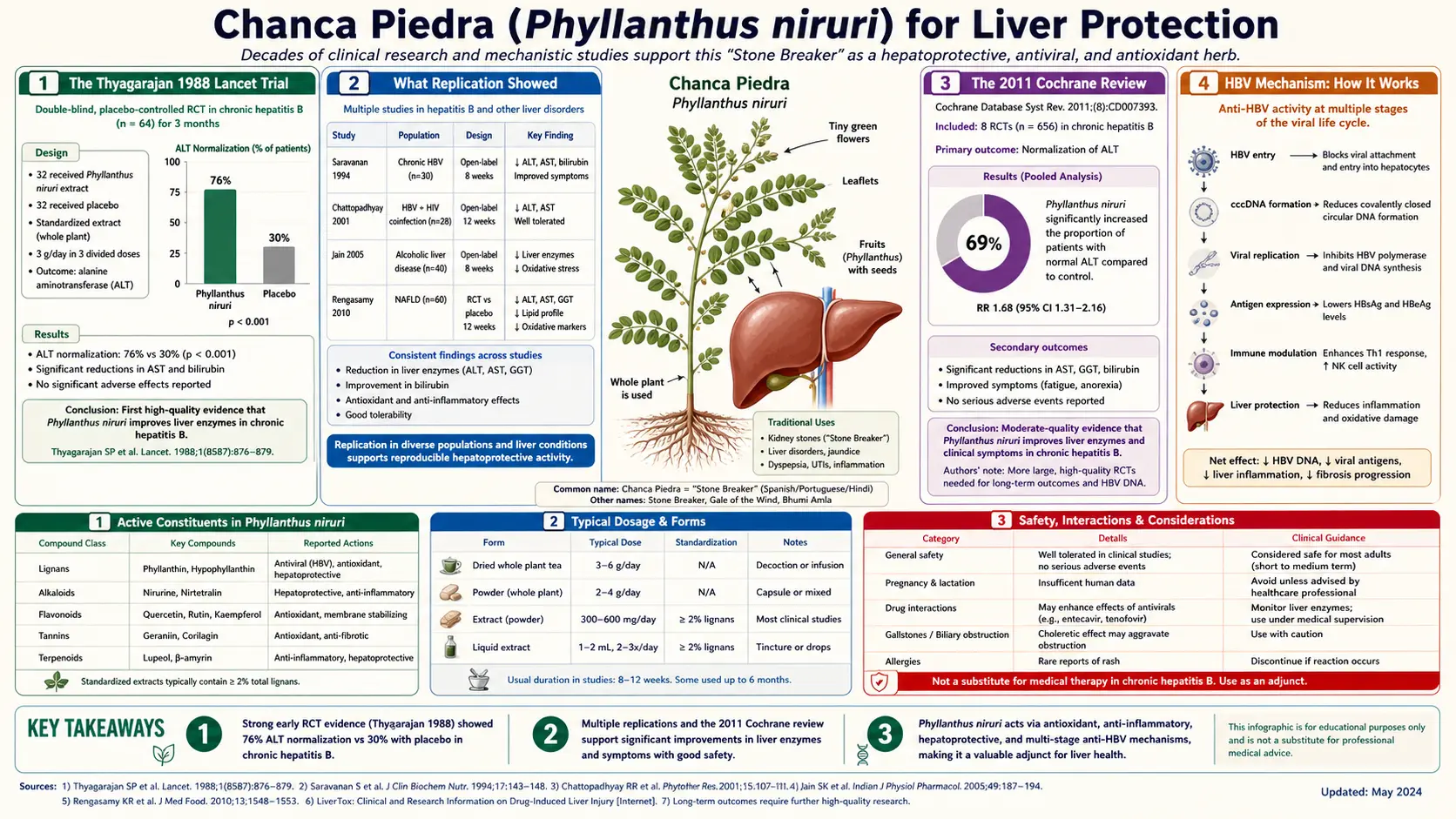
Chanca Piedra's second-most-famous use is liver protection, particularly chronic hepatitis B. The story begins with a 1988 Lancet paper that reported 59% of HBV carriers cleared their surface antigen after 30 days of Phyllanthus amarus. The number was eye-popping. It launched a generation of follow-up research that has filled in nuance, tempered expectations, and produced a 2011 Cochrane review whose careful conclusions still anchor clinical thinking today. This page covers the evidence honestly — what was shown, what was reproduced, what wasn't, and where Chanca Piedra reasonably fits in modern liver care.
Table of Contents
- The Thyagarajan 1988 Lancet Trial
- What Replication Showed
- The 2011 Cochrane Review
- HBV Mechanism
- Which Species Has the HBV Evidence
- Non-Viral Liver Disease (NAFLD, ALD, Drug-Induced)
- CYP450 and Drug-Metabolism Implications
- Comparison and Combination with Other Liver Herbs
- Patient-Facing Protocol
- Key Research Papers
- Connections
- Featured Videos
The Thyagarajan 1988 Lancet Trial
Thyagarajan, Subramanian, Thirunalasundari et al., "Effect of Phyllanthus amarus on chronic carriers of hepatitis B virus," Lancet 1988;2(8614):764–6.
- Design: Open-label trial of 37 chronic HBV carriers
- Intervention: 200 mg powdered P. amarus three times daily for 30 days
- Outcome: 22 of 37 (59%) lost HBsAg at 1–3 month follow-up; 1 of 23 placebo-treated controls cleared
Strengths: The endpoint — HBsAg loss — is biologically hard. The extract was a reasonably standardized surfactant-resistant tannin preparation. The protocol was clearly described.
Limitations: Small sample size, open-label (no blinding), no HBV-DNA measurement (PCR was not yet routine in 1988), unusually high spontaneous-clearance baseline that puzzled subsequent investigators, never independently replicated at the same magnitude. The 59% number drove decades of follow-up research that mostly couldn't reach the original ceiling.
What Replication Showed
Indian, Chinese, and Brazilian replications through the 1990s and 2010s produced a more modest but more consistent picture:
- ALT/AST normalization — reasonable signal; most patients see liver enzyme improvement on Phyllanthus
- HBV-DNA reductions — in a minority of patients, modest in magnitude (typically 1–2 log reduction in some studies, none in others)
- HBeAg seroconversion — 10–30% in some arms (closer to spontaneous rates)
- HBsAg loss — well under 10% in most replication trials, far below the 1988 ceiling
The pattern is consistent with a real but modest antiviral effect rather than a "cure." Modern HBV antivirals (tenofovir, entecavir) can suppress HBV-DNA below detection in nearly all patients but rarely produce HBsAg loss either. Chanca Piedra is a plausible adjunct to these drugs, not a replacement.
The 2011 Cochrane Review
Xia Y, Luo H, Liu JP, Gluud C. "Phyllanthus species for chronic hepatitis B virus infection." Cochrane Database of Systematic Reviews 2011;(4):CD008960.
- Studies included: 16 randomized trials, 1,326 patients
- Findings: Phyllanthus better than placebo or no intervention on HBV-DNA clearance, HBeAg loss, and ALT normalization — but trials were small, low-quality, and species/preparation heterogeneous
- Conclusion: Evidence not strong enough to recommend single-agent use; co-administration with interferon or nucleoside analogs looked more promising than monotherapy
The Cochrane authors flagged the heterogeneity problem — different Phyllanthus species, different doses, different extraction methods, different durations — that makes meta-analysis genuinely shaky. The signal is real; the strength is uncertain.
HBV Mechanism
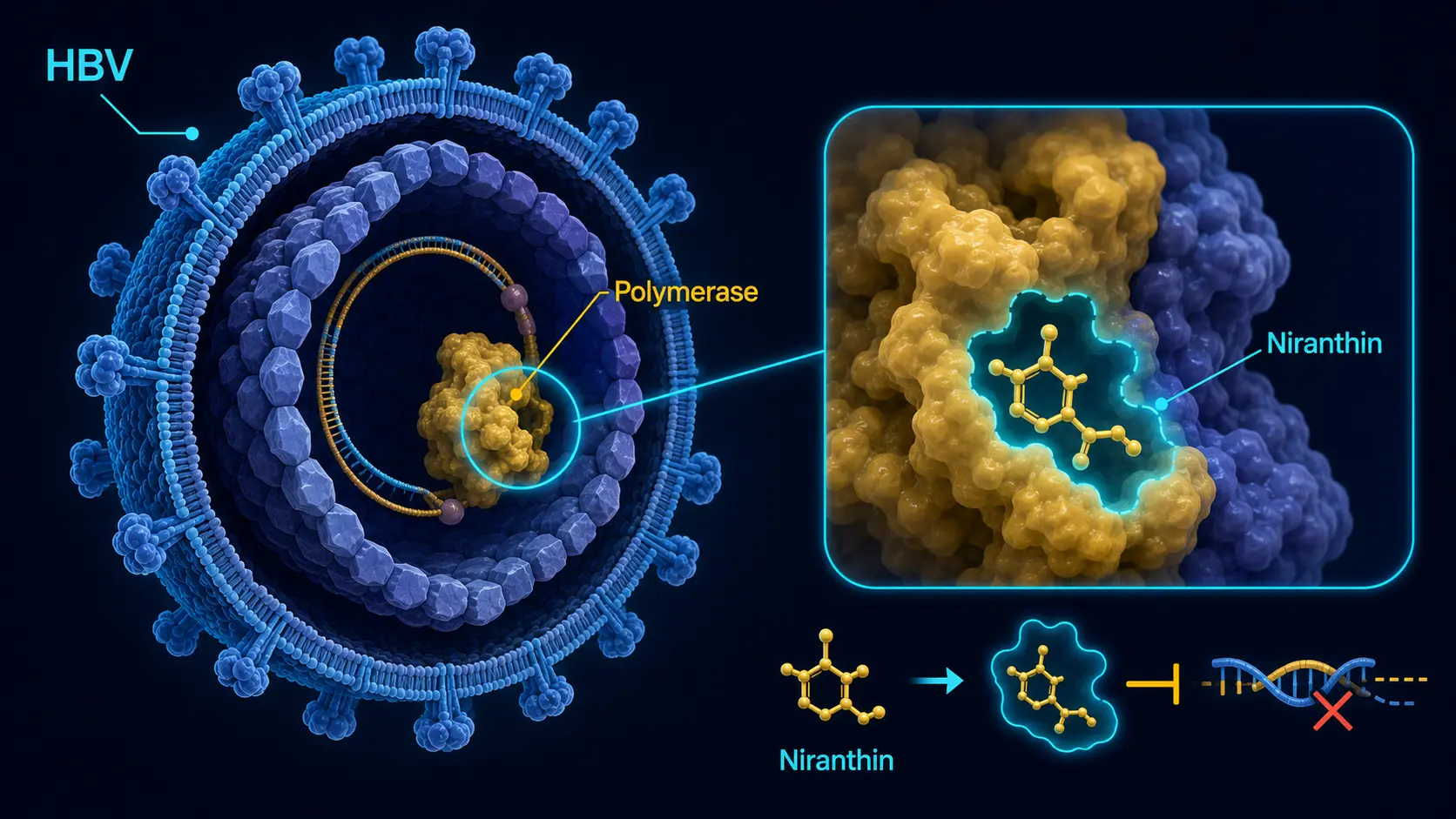
- HBV polymerase / reverse-transcriptase inhibition — Venkateswaran 1987 and Shead 1992 showed direct enzyme inhibition in cell-culture and duck-HBV models
- Geraniin and corilagin bind HBV polymerase
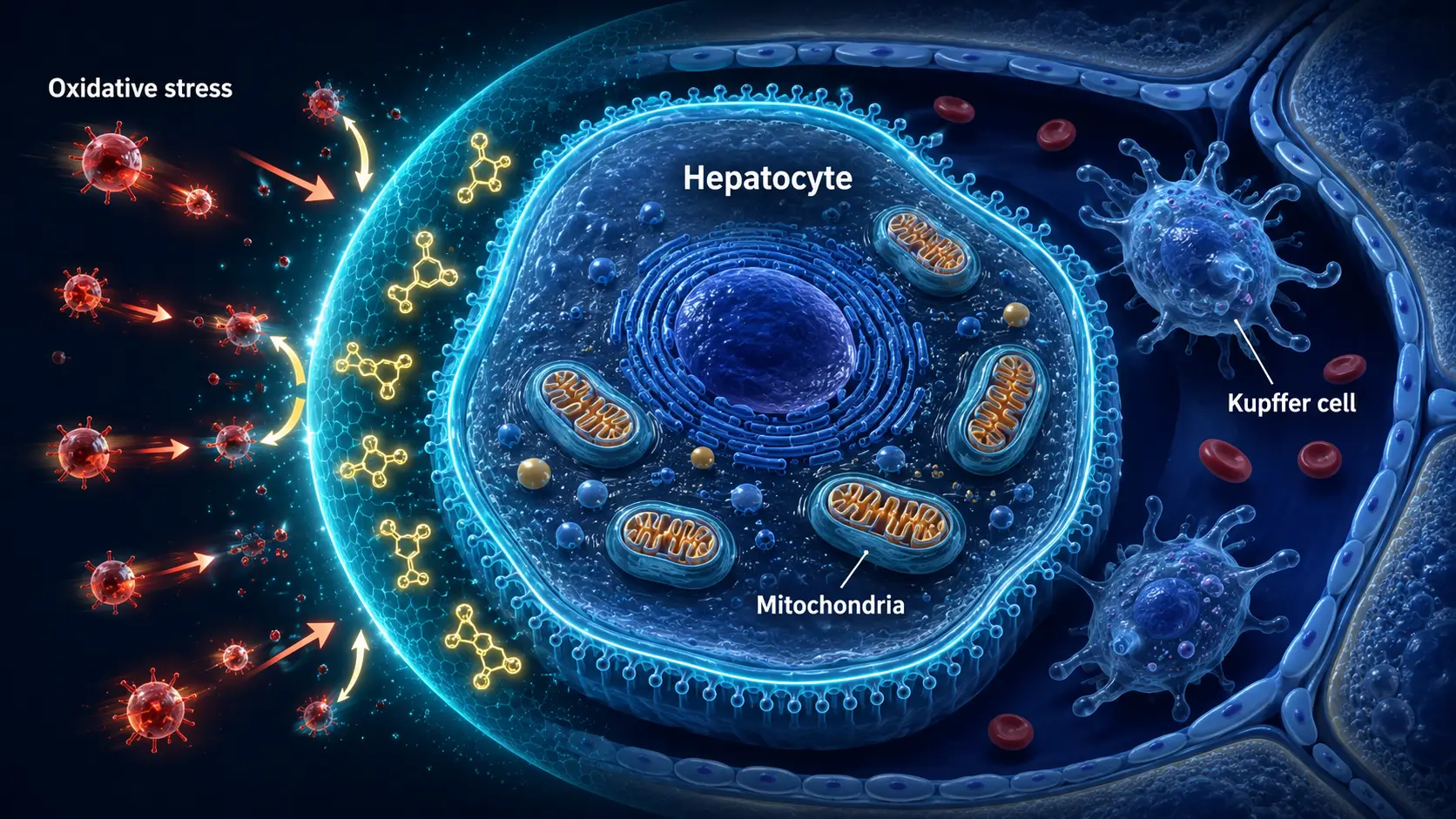
- Phyllanthin and hypophyllanthin show hepatocyte-protective antioxidant activity
- Niranthin inhibits HBeAg secretion in HepG2.2.15 cells
- Immune modulation — shifts Th1/Th2 balance, increases NK cell activity in animal models
The mechanism is multi-pronged and plausible. The clinical effect size is what's uncertain.
Which Species Has the HBV Evidence
This matters more than supplement labels suggest. The strongest HBV trial evidence is for Phyllanthus amarus, which descends directly from the Thyagarajan lineage. P. niruri — what's most often sold as "Chanca Piedra" — has overlapping phytochemistry but less direct HBV trial data, and many older "P. niruri" papers were later taxonomically reclassified as P. amarus. P. urinaria shows the strongest in-vitro HBV polymerase inhibition.
For HBV-related use, look for products labeled P. amarus, or P. niruri (syn. amarus), with standardization to phyllanthin and hypophyllanthin. See the Species Comparison page.
Non-Viral Liver Disease (NAFLD, ALD, Drug-Induced)
Beyond hepatitis B, ALT/AST reductions have been reported in small trials of:
- Non-alcoholic fatty liver disease (NAFLD) — small Indian and Brazilian trials with 8–12 week dosing, modest enzyme improvement
- Anti-tuberculosis drug hepatotoxicity — Phyllanthus reduced ALT/AST elevations in patients on isoniazid, rifampin, pyrazinamide regimens
- Alcoholic liver injury — mostly animal data; modest human trials
The effect sizes are modest. None of these trials should be interpreted as evidence Chanca Piedra cures fatty liver or replaces lifestyle therapy in NAFLD. As an adjunct in patients already pursuing weight loss, alcohol reduction, and metabolic-syndrome management, the herb has a reasonable safety record and a plausible mechanism.
CYP450 and Drug-Metabolism Implications
This is the practical safety issue. Chanca Piedra inhibits CYP3A4 (mechanism-based, irreversible binding), CYP2C9, CYP1A2, CYP2D6, and CYP2E1 in vitro and in animal studies. Patients on the following drugs should not combine without medical supervision:
- Warfarin — CYP2C9 inhibition raises INR risk
- Statins — CYP3A4 inhibition raises plasma levels (atorvastatin, simvastatin most affected)
- Calcineurin inhibitors — tacrolimus, cyclosporine; narrow therapeutic window
- HIV antiretrovirals — protease inhibitors particularly
- Tamoxifen — activation pathway
- Oral contraceptives — theoretical efficacy reduction
- Many calcium-channel blockers, certain anticonvulsants
Comparison and Combination with Other Liver Herbs
- Milk thistle (silymarin) — stronger NAFLD/cirrhosis trial base, no antiviral claim. The default first choice for general hepatoprotection.
- NAC (N-acetylcysteine) — superior for acetaminophen toxicity and oxidative liver injury; glutathione precursor
- Alpha-lipoic acid — diabetic/metabolic liver support
- Phyllanthus — the only herb in this group with a (contested) HBV-specific antiviral signal
Combination protocols (Phyllanthus + silymarin + NAC) appear in clinical practice but lack head-to-head trials. There is no evidence that combining is better than the strongest single agent for any specific indication.
Patient-Facing Protocol
Consider for:
- Chronic HBV adjunct — alongside, never replacing, tenofovir or entecavir
- Persistent ALT elevation despite lifestyle changes
- Recovery from anti-tuberculosis or other drug-induced hepatotoxicity
- NAFLD as part of a broader metabolic intervention
Typical dosing: 500–1000 mg standardized P. amarus extract twice or three times daily for 3–6 months
Monitor: ALT, AST, GGT, HBV-DNA at baseline, 3 months, 6 months
Stop if: liver enzymes worsen, new bruising or bleeding, jaundice
Avoid: Pregnancy, breastfeeding, anticoagulants/immunosuppressants, before surgery (2 weeks). Never substitute for prescribed antivirals.
Key Research Papers
- Thyagarajan SP, Subramanian S, Thirunalasundari T, et al. Effect of Phyllanthus amarus on chronic carriers of hepatitis B virus. Lancet 1988;2(8614):764–6. — PubMed
- Xia Y, Luo H, Liu JP, Gluud C. Phyllanthus species for chronic hepatitis B virus infection. Cochrane Database Syst Rev 2011;(4):CD008960. — PubMed
- Venkateswaran PS, Millman I, Blumberg BS. Effects of an extract from Phyllanthus niruri on hepatitis B and woodchuck hepatitis viruses. PNAS 1987;84:274–8. — PubMed
- Shead A, Vickery K, Pajkos A, et al. Effects of Phyllanthus plant extracts on duck hepatitis B virus in vitro and in vivo. Antiviral Res 1992;18:127–38. — PubMed
- Bhattacharyya R, Medda S, Chakraborti A, et al. Phyllanthus and chronic hepatitis B. World Journal of Gastroenterology. — PubMed
- Liu J, Lin H, McIntosh H. Genus Phyllanthus for chronic hepatitis B virus infection: a systematic review. Journal of Viral Hepatitis. — PubMed
PubMed Topic Searches
- PubMed: P. amarus HBV trials
- PubMed: Phyllanthus & HBV DNA
- PubMed: HBV polymerase inhibition
- PubMed: Geraniin and HBV
- PubMed: Phyllanthus & NAFLD
- PubMed: Anti-TB hepatotoxicity
- PubMed: CYP450 interactions
Connections
- All Herbs
- Chanca Piedra Benefits Hub
- Chanca Piedra Overview
- Kidney Stones
- Uric Acid and Gout
- Blood Sugar
- Phyllanthus Species Comparison
- Active Compounds
- Safety and Drug Interactions
- Chanca Piedra: Liver Protection and Hepatitis B — HBV-specific antiviral mechanism, niranthin vs nucleoside analogs, trial evidence on HBsAg/HBV-DNA, and adjunctive use with entecavir/tenofovir.
- Hepatitis B
- Hepatitis
- Liver Disease
- Cirrhosis
- Non-Alcoholic Fatty Liver Disease
- Milk Thistle
- NAC
- Liver Cleansing
- GGT
- Comprehensive Metabolic Panel