Chanca Piedra for Blood Sugar
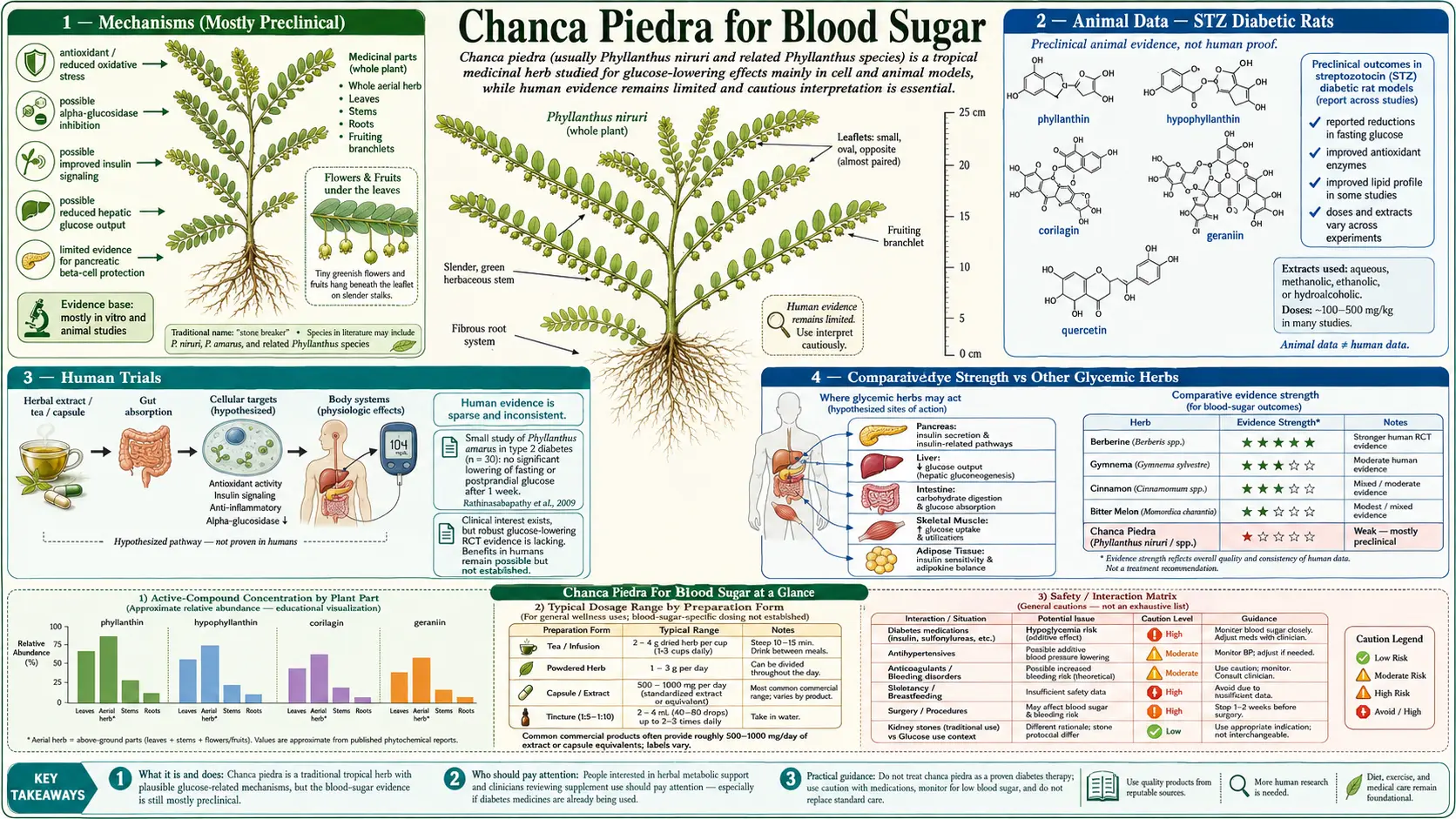
Chanca Piedra is sometimes promoted as a "natural metformin." It is not. The plant has documented glucose-lowering effects in cell culture and rodent models, and a handful of small human studies have suggested modest benefit. But the magnitude is small, the human evidence is thin, and the same plant family contains compounds (berberine in particular) with substantially stronger glycemic-control evidence. This page covers the actual mechanisms, the real effect sizes, where Chanca Piedra fits, and where the marketing oversells it.
Table of Contents
- Mechanisms (Mostly Preclinical)
- Animal Data — STZ Diabetic Rats
- Human Trials
- Comparative Strength vs Other Glycemic Herbs
- Lipids, Weight, and Metabolic Syndrome
- Practical Use Case
- Drug Interactions in Diabetics
- Dosing
- Realistic Expectations
- Key Research Papers
- Connections
- Featured Videos
Mechanisms (Mostly Preclinical)
Four mechanisms have been proposed and supported in cell-culture or rodent studies:
- Alpha-glucosidase / alpha-amylase inhibition — Phyllanthus extracts inhibit these carbohydrate-digesting enzymes in vitro at IC50 values around 100–500 µg/mL. For comparison, the prescription alpha-glucosidase inhibitor acarbose has an IC50 around 10 µg/mL — about 10–50× more potent. Real but weak.
- AMPK activation — corilagin and geraniin tannins activate AMPK in HepG2 hepatocytes, mimicking the metabolic-sensor pathway that metformin and berberine target. Effect size in cell culture is modest compared to those drugs.
- Insulin sensitization — rodent data only; mechanism via PPAR-gamma partial agonism has been proposed but not confirmed at the molecular level.
- Hepatic gluconeogenesis suppression — PEPCK and G6Pase downregulation in streptozotocin-treated rats; effect smaller than metformin.
The mechanisms are mechanistically plausible. The translation to human clinical effect is what's uncertain.
Animal Data — STZ Diabetic Rats
Streptozotocin-induced diabetic rats are the standard preclinical model. Results from the Phyllanthus literature:
- Methanolic or aqueous extracts at 200–500 mg/kg for 21–45 days reduce fasting glucose by 25–45% from baseline
- Body weight typically preserved or modestly improved (vs untreated diabetic controls who lose weight)
- HbA1c equivalents (rodent fructosamine) drop ~15–25%
- Triglycerides and total cholesterol fall 20–30%; HDL rises modestly
These are clean preclinical results. The translation factor — rat-mg/kg to human equivalent dose — usually shrinks effect size substantially when extrapolated to clinical practice.
Human Trials
The clinical literature is dominated by kidney stones and hepatitis B; diabetes-specific human trials are scarce. What exists:
- No large randomized controlled trials specifically for diabetes
- A handful of small open-label or pilot studies (n=20–60) using 500 mg two or three times daily for 8–12 weeks
- Reported fasting glucose reductions of 10–20 mg/dL and A1c drops of 0.2–0.5%
- Quality issues: no placebo arms, no blinding, heterogeneous extracts, no standardization of phyllanthin/hypophyllanthin content across trials
The signal is real but small and not robustly supported. The 0.2–0.5% A1c effect — if reproducible — would be comparable to what cinnamon trials suggest, and substantially less than berberine, gymnema, or fenugreek at clinically used doses.
Comparative Strength vs Other Glycemic Herbs
Strongest to weakest evidence for glycemic control among the major herbal options:
- Berberine — multiple RCTs, A1c reduction 0.7–1.0%, comparable to metformin in some head-to-head studies. The strongest herbal glycemic agent by a clear margin.
- Gymnema sylvestre — moderate RCT data, A1c reduction 0.5–0.8%
- Fenugreek — moderate, A1c reduction 0.3–0.9%, dose-dependent (5–10 g/day)
- Cinnamon (cassia) — weak/inconsistent, A1c reduction 0.0–0.3%, meta-analyses split
- Bitter melon — weak, A1c reduction 0.1–0.4%, GI side effects common
- Chanca Piedra — weakest of the group for diabetes specifically. Promising preclinical, sparse clinical.
If a patient asks "which herbal helps diabetes most," the honest answer is berberine. Chanca Piedra has its strengths elsewhere (kidney stones, liver) but is not a leading diabetes intervention.
Lipids, Weight, and Metabolic Syndrome
Small human signals exist for:
- Modest triglyceride reduction (5–15%)
- Modest LDL reduction (5–10%)
- Negligible weight effect
Chanca Piedra is not a metabolic-syndrome treatment in any meaningful clinical sense. The lipid effects are small and inconsistent across trials.
Practical Use Case
Reasonable scenarios for Chanca Piedra in patients with metabolic concerns:
- Already taking it for kidney stone prophylaxis — the modest glycemic effect is a small bonus
- Already taking it for liver support (NAFLD) — same logic
- Prediabetes patient declining medication, looking for any plant-based glucose support — reasonable but modest expectations
- Patient already on metformin who wants additional support and prefers Chanca Piedra over berberine for other reasons (e.g., concurrent stone history)
Unreasonable scenarios:
- Substituting Chanca Piedra for metformin, GLP-1 agonist, or insulin in any patient with type 2 diabetes
- Using it as the primary glycemic intervention in newly diagnosed type 2 diabetes
- Choosing it over berberine specifically for glucose control
Drug Interactions in Diabetics
- Sulfonylureas (glyburide, glipizide, glimepiride) — theoretical additive hypoglycemia; monitor glucose more frequently in the first 2–4 weeks
- Insulin — same caution; dose adjustment may be needed
- Metformin — negligible additive hypoglycemia risk; mechanistically compatible
- GLP-1 agonists (semaglutide, liraglutide) — no documented interactions; theoretical additive effect minor
- SGLT2 inhibitors (empagliflozin, dapagliflozin) — no documented interactions
- DPP-4 inhibitors (sitagliptin, linagliptin) — no documented interactions
Dosing
Trial doses for blood-sugar-related use:
- Standardized extract: 500 mg two or three times daily
- Whole-herb capsules: 1–2 g/day total
- Tea: 1–2 g dried herb in 8 oz water, twice daily
- Duration: 8–12 weeks before reassessing fasting glucose, A1c, and any subjective symptoms
- Cycling: 8 weeks on, 2 weeks off if used long-term
Realistic Expectations
- Fasting glucose: 5–15 mg/dL reduction in some patients; no reliable change in others
- A1c: 0.2–0.5% reduction at best; many patients see no change
- Effect typically takes 8–12 weeks to develop, comparable to other herbal glucose interventions
- Stop and reassess if no measurable benefit at 12 weeks
- Most online claims of 40% glucose drops or "natural metformin" are extrapolating rat data inappropriately
Key Research Papers
- Raphael KR, Sabu MC, Kuttan R. Hypoglycemic effect of methanol extract of Phyllanthus amarus on alloxan-induced diabetic rabbits. Indian Journal of Experimental Biology. — PubMed
- Okoli CO et al. Antidiabetic activities of Phyllanthus niruri Linn extract in streptozotocin-induced diabetic rats. Journal of Ethnopharmacology. — PubMed
- Karuna R et al. Antidiabetic and antihyperlipidemic activities of Phyllanthus amarus. Journal of Pharmacognosy and Phytotherapy. — PubMed
- Tan WC et al. Corilagin and AMPK activation in HepG2 cells. Phytomedicine. — PubMed
- Murugaiyah V et al. Alpha-glucosidase and alpha-amylase inhibition by Phyllanthus lignans. Phytotherapy Research. — PubMed
- Yin J, Xing H, Ye J. Efficacy of berberine in patients with type 2 diabetes mellitus (comparator). Metabolism. — PubMed
PubMed Topic Searches
- PubMed: Phyllanthus & diabetes
- PubMed: Hypoglycemic activity
- PubMed: STZ rat model
- PubMed: Phyllanthin & AMPK
- PubMed: Corilagin alpha-glucosidase
- PubMed: Berberine vs metformin
Connections
- All Herbs
- Chanca Piedra Benefits Hub
- Chanca Piedra Overview
- Kidney Stones
- Liver Protection
- Uric Acid and Gout
- Active Compounds
- Safety and Drug Interactions
- Phyllanthus Species Comparison
- Berberine
- Gymnema
- Bitter Melon
- Fenugreek
- Cinnamon
- Hemoglobin A1C
- Fasting Insulin
- Continuous Glucose Monitor
- Blood Sugar
- Diabetes
- Metabolic Syndrome