⚠ Evidence warning: Clinical trials or other evidence do not support the claims that passionflower shortens the time to fall asleep without next-day grogginess and helps alcohol or nicotine withdrawal in people. This page keeps it as a report of what people, websites or other media say.
Passionflower — Benefits Deep Dive
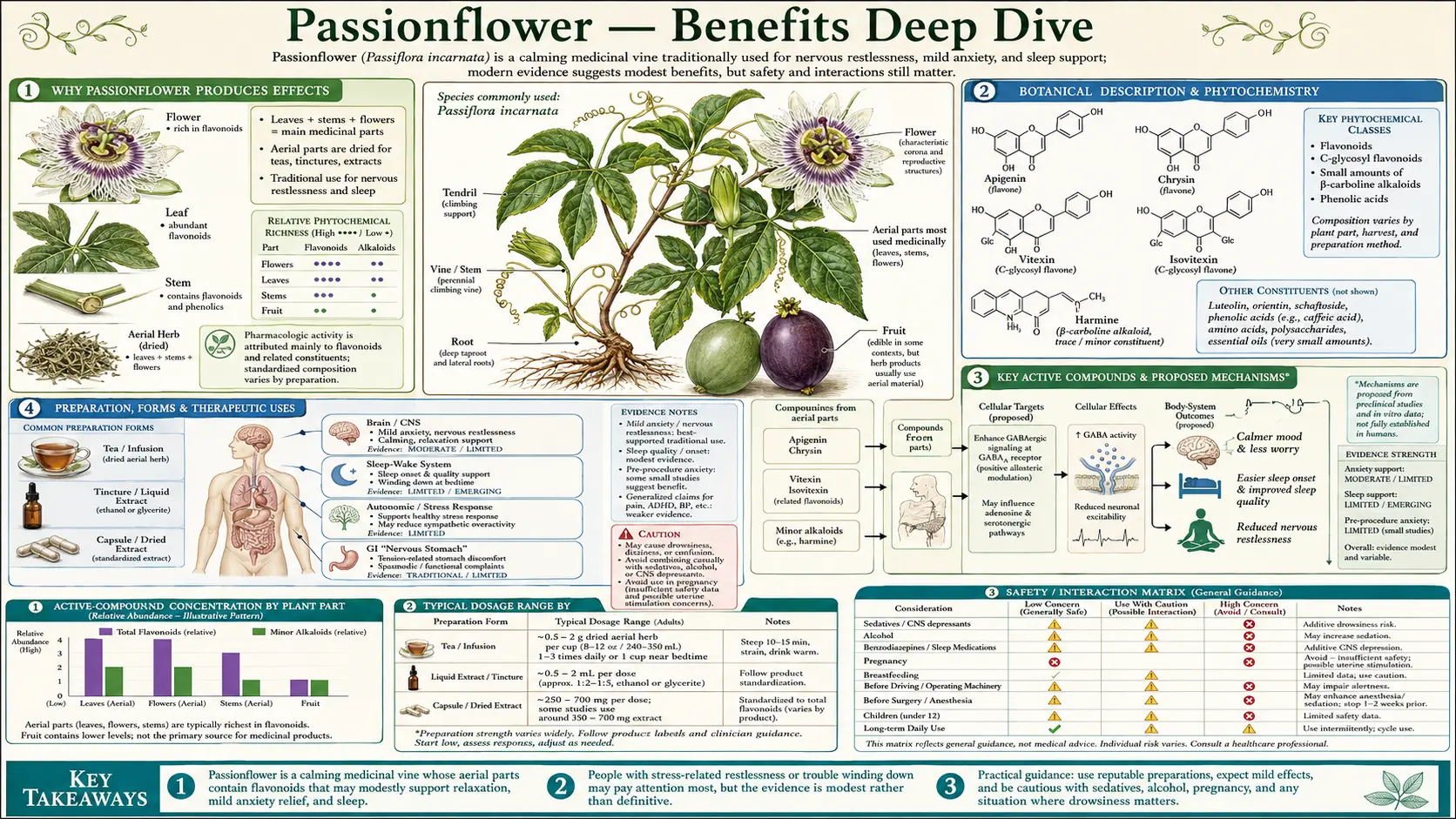
Passionflower (Passiflora incarnata, also called maypop) is a gentle Native American nervine with lavender-purple corona flowers and trailing vines, studied in a small number of trials for anxiety. A 2007 Cochrane review found 2 eligible studies with 198 participants and concluded that the trials were too few to permit any conclusions; a 2020 systematic review of nine trials concluded that it may be helpful for some symptoms. How it works is not settled. Chrysin, a flavone that binds the benzodiazepine site on the gamma-aminobutyric acid-A receptor (the same allosteric pocket where diazepam, lorazepam, and alprazolam exert their effects), was isolated from a different species, Passiflora coerulea, and the benzoflavone proposed for this plant turned up only in trace amounts in one of three plant samples a later laboratory tested. In the Akhondzadeh 2001 randomized double-blind trial of 36 outpatients with generalized anxiety disorder, passionflower extract and oxazepam showed no significant difference after 4 weeks; oxazepam worked faster, and significantly more job-performance problems were reported on oxazepam (the Cochrane review notes that this was a post-hoc outcome that did not reach statistical significance in its analysis). Four benefit pages below explore the uses most studied — situational and generalized anxiety, sleep latency and quality, the gamma-aminobutyric acid (GABA) receptor pharmacology, and adjunct use in withdrawal, where the human evidence is one 65-person trial in opiate withdrawal and the alcohol and nicotine findings so far come from mice and rats.
Deep-Dive Articles
Anxiety Relief
The 2001 Akhondzadeh randomized double-blind trial in generalized anxiety disorder showing passionflower extract produced anxiolytic effect comparable to oxazepam 30 mg/day but with significantly less impairment of job performance. The 2008 Movafegh pre-operative anxiety trial in same-day surgery patients. The proposed mechanisms at the gamma-aminobutyric acid-A receptor, situational versus generalized anxiety dosing, and where passionflower fits between chamomile (milder) and kava (stronger).
Read the deep dive →Sleep Quality
The Ngan and Conduit 2011 double-blind crossover trial of passionflower tea showing a better sleep quality rating, one of six sleep-diary measures analysed, in 41 healthy adults aged 18-35 with mild fluctuations in sleep quality. The synergistic Passiflora-Valerian-Hops combinations used in European phytopharmaceuticals. People who use it describe gentle sedation without next-day grogginess; the trials read for this page report no sleep-latency, hangover or rapid eye movement (REM) sleep result.
Read the deep dive →Gamma-Aminobutyric Acid Modulation
The receptor-level pharmacology: chrysin (5,7-dihydroxyflavone), a benzodiazepine-site ligand isolated from the related species Passiflora coerulea, the disputed benzoflavone moiety, comparison with apigenin (chamomile) and bacosides (bacopa) at the same allosteric pocket, the weak monoamine oxidase A (MAO-A) inhibition by harman beta-carboline alkaloids and its theoretical interaction concerns with selective serotonin reuptake inhibitors (SSRIs), monoamine oxidase inhibitors (MAOIs), and tyramine-containing foods, and why passionflower's multi-mechanism profile produces gentler effects than single-target benzodiazepine drugs.
Read the deep dive →Withdrawal & Addiction Support
The Akhondzadeh 2001 double-blind randomized trial pairing clonidine with passionflower extract for opiate withdrawal — the addition of passionflower significantly reduced the psychological symptoms of withdrawal (anxiety, irritability, insomnia) without affecting clonidine's control of autonomic symptoms. Alcohol-withdrawal findings in mice and rats. Traditional use for nicotine withdrawal, with mouse findings, the proposed autonomic stabilization mechanism, and the practical integration of passionflower with conventional addiction medicine.
Read the deep dive →Table of Contents
- Deep-Dive Articles
- Why Passionflower Produces Effects
- Reported Harm From Passionflower
- Research Papers: Anxiety
- Research Papers: Sleep
- Research Papers: Gamma-Aminobutyric Acid Pharmacology
- Research Papers: Withdrawal & Addiction
- Research Papers: Cross-Cutting (Phytochemistry, Safety)
- External Authoritative Resources
- Connections
- Featured Videos
Why Passionflower Produces Effects
Most single-molecule anxiolytic drugs hit one molecular target with high affinity — benzodiazepines, for example, are pure positive allosteric modulators of the gamma-aminobutyric acid-A receptor benzodiazepine-binding site. This high-affinity single-target profile produces fast, predictable, and powerful anxiolysis, but it also drives the characteristic side-effect spectrum: cognitive impairment, sedation, motor incoordination, tolerance, dependence, and a difficult withdrawal syndrome. Passionflower is the opposite: a low-to-moderate-affinity multi-target botanical that produces a gentler clinical effect with a much narrower side-effect spectrum.
- Gamma-aminobutyric acid-A receptor benzodiazepine site (chrysin, proposed benzoflavones) — the flavone chrysin (5,7-dihydroxyflavone) and a proposed benzoflavone are the compounds most often named. Chrysin displaces benzodiazepines from the same allosteric pocket on the gamma-aminobutyric acid-A receptor, and its discoverers postulate that it is a partial agonist, but it was isolated from a different species, Passiflora coerulea (Wolfman 1994, in mice). In a Passiflora incarnata extract, the major flavonoids found were homoorientin, orientin, vitexin and isovitexin (Grundmann 2008). The benzoflavone's only proposer postulates a different, neurosteroidal mechanism (Dhawan 2003), and a later laboratory found only trace amounts of a benzoflavone-like compound in one of three plant samples (Holbik 2010). A laboratory study in rat brain preparations found the extract did not affect the benzodiazepine site at all but did bind gamma-aminobutyric acid-A and -B receptors and inhibit gamma-aminobutyric acid uptake (Appel 2011), and another found the extract's direct currents came from gamma-aminobutyric acid in the extract itself: they were absent when amino acids were removed (Elsas 2010). Which compound stands behind the reported anxiolytic and sleep-promoting effects is not established.
- Gamma-aminobutyric acid-A receptor direct potentiation by aglycones — it has been proposed that, beyond the benzodiazepine site, several flavone aglycones in passionflower potentiate gamma-aminobutyric acid-A currents through a separate allosteric mechanism. In mice, the anti-anxiety effect of one extract at its active dose was effectively blocked by flumazenil, a drug that blocks the benzodiazepine site (Grundmann 2008).
- Weak monoamine oxidase A (MAO-A) inhibition (harman beta-carboline alkaloids) — passionflower contains trace beta-carboline alkaloids (harman, harmine, harmaline, harmol) that are weak reversible inhibitors of monoamine oxidase A. The clinical concentrations achieved with normal therapeutic doses are too low to produce a meaningful monoamine oxidase inhibitor (MAOI) effect, but the presence of these alkaloids creates a theoretical concern for combination with selective serotonin reuptake inhibitors, prescribed monoamine oxidase inhibitors, and tyramine-containing foods that is reviewed in detail on the gamma-aminobutyric acid Modulation page.
- Autonomic nervous system stabilization — a reduction in sympathetic tone (heart rate, blood pressure, sweating) under stress, through central gamma-aminobutyric acid potentiation flowing downstream to brainstem cardiovascular control nuclei, is the proposed mechanism behind traditional use in opiate, alcohol, and nicotine withdrawal — conditions characterized by autonomic hyperactivity. The human premedication trial read for this page did not find it: 60 patients before spinal anesthesia showed no change in hemodynamics (Aslanargun 2012), and in the 65-person opiate trial the physical symptoms of withdrawal responded equally with or without passionflower.
The proposed unifying principle is that passionflower produces gentle, broad-spectrum nervous system calming through multiple complementary low-affinity mechanisms rather than one powerful high-affinity target hit. The trial results are less uniform than that picture. A 2020 systematic review of nine trials reports that most found lower anxiety, with the effect less evident in people with mild anxiety symptoms, and no adverse effects including memory loss. The trade-off is that passionflower is less powerful than a benzodiazepine for severe acute anxiety — it occupies a clinical niche between chamomile (milder, primarily apigenin) and kava (stronger, kavalactones) for mild-to-moderate situational and generalized anxiety where preservation of cognitive function is important.
What the human trials measured:
- Generalized anxiety: 36 outpatients, 45 drops of extract a day against oxazepam 30 mg a day for 4 weeks (Akhondzadeh 2001). No significant difference at the end; oxazepam acted faster.
- Opiate withdrawal: 65 people on clonidine, with 60 drops of extract a day or placebo drops for 14 days (Akhondzadeh 2001). Physical symptoms responded equally; mental symptoms did better with the extract. The authors write that a larger study is warranted.
- Before surgery: 60 patients, 500 mg or placebo, 90 minutes beforehand (Movafegh 2008). Anxiety scores were lower on the extract, without sedation.
- Before spinal anesthesia: 60 patients, extract or placebo (Aslanargun 2012). The rise in anxiety was smaller on the extract, with no difference in psychomotor tests, sedation or hemodynamics.
- Dental treatment: 63 patients (Kaviani 2013). Anxiety scores after premedication were 8.47 on passionflower, 10.52 on placebo and 11.23 with no treatment.
- Third molar extraction: 40 people in a crossover trial, 260 mg against midazolam 15 mg (Dantas 2017). Over 70% felt quiet or a little anxious under both; 20% reported amnesia on midazolam.
- Insomnia: a 2020 double-blind trial measured sleep in a laboratory in 110 adults with insomnia disorder after 2 weeks (Lee 2020). Total sleep time rose 23 minutes on passionflower against almost no change on placebo (P=0.049). Sleep efficiency and time awake after falling asleep did not differ from placebo.
- Benzodiazepine tapering: a 2024 real-world follow-up looked at people with anxiety or depression tapering long-term benzodiazepines with a dry passionflower extract added (Carminati 2024). The authors report that the benefit lasted and that the extract was stopped with no rebound, withdrawal or psychological dependence. It was a retrospective study, and the abstract describes no comparison group.
Preparation can change the result. A 2010 study gave mice one of 5 extracts made from a single batch of plant for a week: instead of an anti-anxiety effect, all 5 raised anxiety behaviour in the elevated plus maze, and 2 of the 5 protected against chemically induced seizures (Elsas 2010).
Reported Harm From Passionflower
A published case describes a 34-year-old woman who developed severe nausea, vomiting, drowsiness, prolonged QTc on the heart tracing and episodes of nonsustained ventricular tachycardia after taking passionflower at usual doses. She needed hospital admission for heart monitoring and intravenous fluids (Fisher 2000). It is a single case.
Research Papers: Anxiety
What is not known: the 2007 Cochrane review wrote that trials of passiflora for anxiety "are too few in number to permit any conclusions to be drawn", and most of the trials listed here since then are premedication studies before a procedure rather than long-term treatment of an anxiety disorder.
- Akhondzadeh S, Naghavi HR, Vazirian M, Shayeganpour A, Rashidi H, Khani M (2001). Passionflower in the treatment of generalized anxiety: a pilot double-blind randomized controlled trial with oxazepam. J Clin Pharm Ther 26(5):363-7. — PubMed PMID: 11679026
- Movafegh A, Alizadeh R, Hajimohamadi F, Esfehani F, Nejatfar M (2008). Preoperative oral Passiflora incarnata reduces anxiety in ambulatory surgery patients: a double-blind, placebo-controlled study. Anesth Analg 106(6):1728-32. — PubMed PMID: 18499602
- Aslanargun P, Cuvas O, Dikmen B, Aslan E, Yuksel MU (2012). Passiflora incarnata Linneaus as an anxiolytic before spinal anesthesia. J Anesth 26(1):39-44. — PubMed PMID: 22048283
- Dantas LP, de Oliveira-Ribeiro A, de Almeida-Souza LM, Groppo FC (2017). Effects of passiflora incarnata and midazolam for control of anxiety in patients undergoing dental extraction. Med Oral Patol Oral Cir Bucal 22(1):e95-e101. — PubMed PMID: 27918731
- Kaviani N, Tavakoli M, Tabanmehr M, Havaei R (2013). The efficacy of passiflora incarnata linnaeus in reducing dental anxiety in patients undergoing periodontal treatment. J Dent (Shiraz) 14(2):68-72. — PubMed PMID: 24724122
- Miyasaka LS, Atallah AN, Soares BG (2007). Passiflora for anxiety disorder. Cochrane Database Syst Rev 2007(1):CD004518. — PubMed PMID: 17253512
- Akhondzadeh S, Mohammadi MR, Momeni F (2005). Passiflora incarnata in the treatment of attention-deficit hyperactivity disorder in children and adolescents. Therapy 2(4):609-614. — doi:10.2217/14750708.2.4.609
- Janda K, Wojtkowska K, Jakubczyk K, Antoniewicz J, Skonieczna-Żydecka K (2020). Passiflora incarnata in Neuropsychiatric Disorders-A Systematic Review. Nutrients 12(12):3894. — PubMed PMID: 33352740
- Grundmann O, Wähling C, Staiger C, Butterweck V (2009). Anxiolytic effects of a passion flower (Passiflora incarnata L.) extract in the elevated plus maze in mice. Pharmazie 64(1):63-4. — PubMed PMID: 19216234
- Grundmann O, Wang J, McGregor GP, Butterweck V (2008). Anxiolytic activity of a phytochemically characterized Passiflora incarnata extract is mediated via the GABAergic system. Planta Med 74(15):1769-73. — PubMed PMID: 19006051
- Soulimani R, Younos C, Jarmouni S, Bousta D, Misslin R, Mortier F (1997). Behavioural effects of Passiflora incarnata L. and its indole alkaloid and flavonoid derivatives and maltol in the mouse. J Ethnopharmacol 57(1):11-20. — PubMed PMID: 9234160
Research Papers: Sleep
- Ngan A, Conduit R (2011). A double-blind, placebo-controlled investigation of the effects of Passiflora incarnata (passionflower) herbal tea on subjective sleep quality. Phytother Res 25(8):1153-9. — PubMed PMID: 21294203
- Lee J, Jung HY, Lee SI, Choi JH, Kim SG (2020). Effects of Passiflora incarnata Linnaeus on polysomnographic sleep parameters in subjects with insomnia disorder: a double-blind randomized placebo-controlled study. Int Clin Psychopharmacol 35(1):29-35. — PubMed PMID: 31714321
- Maroo N, Hazra A, Das T (2013). Efficacy and safety of a polyherbal sedative-hypnotic formulation NSF-3 in primary insomnia in comparison to zolpidem: a randomized controlled trial. Indian J Pharmacol 45(1):34-9. — PubMed PMID: 23543804
- Schulz H, Jobert M, Hübner WD (1998). The quantitative EEG as a screening instrument to identify sedative effects of single doses of plant extracts in comparison with diazepam. Phytomedicine 5(6):449-58. — PubMed PMID: 23196028
- Spinella M (2001). The Psychopharmacology of Herbal Medicine: Plant Drugs That Alter Mind, Brain and Behavior. MIT Press (book). Reviewed in Psychological Medicine 2002. — doi:10.1017/s0033291702235618
- Wheatley D (2005). Medicinal plants for insomnia: a review of their pharmacology, efficacy and tolerability. J Psychopharmacol 19(4):414-21. — PubMed PMID: 15982998
- Guerrero FA, Medina GM (2017). Effect of a medicinal plant (Passiflora incarnata L) on sleep. Sleep Sci 10(3):96-100. — PubMed PMID: 29410738
- Toda K, Hitoe S, Takeda S, Shimizu N, Shimoda H (2017). Passionflower Extract Induces High-amplitude Rhythms without Phase Shifts in the Expression of Several Circadian Clock Genes in Vitro and in Vivo. Int J Biomed Sci 13(2):84-92. — PubMed PMID: 28824345
Research Papers: Gamma-Aminobutyric Acid Pharmacology
- Wolfman C, Viola H, Paladini A, Dajas F, Medina JH (1994). Possible anxiolytic effects of chrysin, a central benzodiazepine receptor ligand isolated from Passiflora coerulea. Pharmacol Biochem Behav 47(1):1-4. — PubMed PMID: 7906886
- Medina JH, Paladini AC, Wolfman C, Levi de Stein M, Calvo D, Diaz LE, Peña C (1990). Chrysin (5,7-di-OH-flavone), a naturally-occurring ligand for benzodiazepine receptors, with anticonvulsant properties. Biochem Pharmacol 40(10):2227-31. — PubMed PMID: 2173925
- Dhawan K, Kumar S, Sharma A (2001). Anti-anxiety studies on extracts of Passiflora incarnata Linneaus. J Ethnopharmacol 78(2-3):165-70. — PubMed PMID: 11694362
- Brown AC (2017). An overview of herb and dietary supplement efficacy, safety and government regulations in the United States with suggested improvements. Part 1 of 5 series. Food Chem Toxicol 107(Pt A):449-471. — PubMed PMID: 27818322
- Salgueiro JB, Ardenghi P, Dias M, Ferreira MB, Izquierdo I, Medina JH (1997). Anxiolytic natural and synthetic flavonoid ligands of the central benzodiazepine receptor have no effect on memory tasks in rats. Pharmacol Biochem Behav 58(4):887-91. — PubMed PMID: 9408191
- Marder M, Paladini AC (2002). GABA(A)-receptor ligands of flavonoid structure. Curr Top Med Chem 2(8):853-67. — PubMed PMID: 12171576
- Appel K, Rose T, Fiebich B, Kammler T, Hoffmann C, Weiss G (2011). Modulation of the γ-aminobutyric acid (GABA) system by Passiflora incarnata L. Phytother Res 25(6):838-43. — PubMed PMID: 21089181
- Elsas SM, Rossi DJ, Raber J, White G, Seeley CA, Gregory WL, Mohr C, Pfankuch T, Soumyanath A (2010). Passiflora incarnata L. (Passionflower) extracts elicit GABA currents in hippocampal neurons in vitro, and show anxiogenic and anticonvulsant effects in vivo, varying with extraction method. Phytomedicine 17(12):940-9. — PubMed PMID: 20382514
- Avula B, Wang YH, Rumalla CS, Smillie TJ, Khan IA (2012). Simultaneous determination of alkaloids and flavonoids from aerial parts of Passiflora species and dietary supplements using UPLC-UV-MS and HPTLC. Nat Prod Commun 7(9):1177-80. — PubMed PMID: 23074901
- Dhawan K (2003). Drug/substance reversal effects of a novel tri-substituted benzoflavone moiety (BZF) isolated from Passiflora incarnata Linn.--a brief perspective. Addict Biol 8(4):379-86. — PubMed PMID: 14690874
- Holbik M, Krasteva S, Mayer N, Kählig H, Krenn L (2010). Apparently no sedative benzoflavone moiety in passiflorae herba. Planta Med 76(7):662-4. — PubMed PMID: 20301055
Research Papers: Withdrawal & Addiction
- Akhondzadeh S, Kashani L, Mobaseri M, Hosseini SH, Nikzad S, Khani M (2001). Passionflower in the treatment of opiates withdrawal: a double-blind randomized controlled trial. J Clin Pharm Ther 26(5):369-73. — PubMed PMID: 11679027
- Dhawan K, Kumar S, Sharma A (2002). Reversal of cannabinoids (delta9-THC) by the benzoflavone moiety from methanol extract of Passiflora incarnata Linneaus in mice: a possible therapy for cannabinoid addiction. J Pharm Pharmacol 54(6):875-81. — PubMed PMID: 12079005
- Dhawan K, Kumar S, Sharma A (2002). Beneficial effects of chrysin and benzoflavone on virility in 2-year-old male rats. J Med Food 5(1):43-8. — PubMed PMID: 12511112
- Dhawan K, Kumar S, Sharma A (2002). Reversal of morphine tolerance and dependence by Passiflora incarnata – a traditional medicine to combat morphine addiction. Pharmaceutical Biology 40(8):576-580. — doi:10.1076/phbi.40.8.576.14660
- Dhawan K, Kumar S, Sharma A (2002). Nicotine reversal effects of the benzoflavone moiety from Passiflora incarnata Linneaus in mice. Addict Biol 7(4):435-41. — PubMed PMID: 14578021
- Dhawan K, Kumar S, Sharma A (2002). Suppression of alcohol-cessation-oriented hyper-anxiety by the benzoflavone moiety of Passiflora incarnata Linneaus in mice. J Ethnopharmacol 81(2):239-44. — PubMed PMID: 12065157
- Schunck RVA, Macedo IC, Laste G, de Souza A, Valle MTC, Salomón JLO, Nunes EA, Campos ACW, Gnoatto SCB, Bergold AM, Konrath EL, Dallegrave E, Arbo MD, Torres ILS, Leal MB (2017). Standardized Passiflora incarnata L. Extract Reverts the Analgesia Induced by Alcohol Withdrawal in Rats. Phytother Res 31(8):1199-1208. — PubMed PMID: 28568647
- Sarris J, McIntyre E, Camfield DA (2013). Plant-based medicines for anxiety disorders, part 2: a review of clinical studies with supporting preclinical evidence. CNS Drugs 27(4):301-19. — PubMed PMID: 23653088
Research Papers: Cross-Cutting (Phytochemistry, Safety)
- Miroddi M, Calapai G, Navarra M, Minciullo PL, Gangemi S (2013). Passiflora incarnata L.: ethnopharmacology, clinical application, safety and evaluation of clinical trials. J Ethnopharmacol 150(3):791-804. — PubMed PMID: 24140586
- Krenn L (2002). [Passion Flower (Passiflora incarnata L.)--a reliable herbal sedative]. Wien Med Wochenschr 152(15-16):404-6. — PubMed PMID: 12244887
- Patel SS, Mohamed Saleem TS, Ravi V, Shrestha B, Verma NK, Gauthaman K (2009). Passiflora incarnata Linn: a phytopharmacological review. International Journal of Green Pharmacy 3(4):277. — doi:10.4103/0973-8258.59731
- EMA / HMPC (2014). Community herbal monograph on Passiflora incarnata L., herba — European Medicines Agency
- Sarris J, Panossian A, Schweitzer I, Stough C, Scholey A (2011). Herbal medicine for depression, anxiety and insomnia: a review of psychopharmacology and clinical evidence. Eur Neuropsychopharmacol 21(12):841-60. — PubMed PMID: 21601431
- Fisher AA, Purcell P, Le Couteur DG (2000). Toxicity of Passiflora incarnata L. J Toxicol Clin Toxicol 38(1):63-6. — PubMed PMID: 10696928
- Carrasco MC, Vallejo JR, Pardo-de-Santayana M, Peral D, Martín MA, Altimiras J (2009). Interactions of Valeriana officinalis L. and Passiflora incarnata L. in a patient treated with lorazepam. Phytother Res 23(12):1795-6. — PubMed PMID: 19441067
- Carminati M, Tondello M, Zanardi R (2024). Passiflora incarnata L., herba, in benzodiazepine tapering: long-term safety and efficacy in a real-world setting. Front Psychiatry 15:1471083. — PubMed PMID: 39429529
External Authoritative Resources
- European Medicines Agency — Community Herbal Monograph on Passiflora incarnata herba — the single most authoritative regulatory document on therapeutic use, dosing, and safety
- U.S. National Center for Complementary and Integrative Health (NCCIH) — Passionflower Fact Sheet
- LiverTox (U.S. National Institutes of Health, NIH) — Passionflower (drug interactions, dosing, evidence summary)
- American Botanical Council — Passionflower Monograph (HerbalEGram)
- PubMed — All research on Passiflora incarnata (~2,000+ papers)
Connections
- All Herbs
- Passionflower (Main Page)
- Passionflower for Anxiety Relief
- Passionflower for Sleep Quality
- Passionflower Gamma-Aminobutyric Acid Modulation
- Passionflower Withdrawal & Addiction Support
- Lavender
- Valerian
- Lemon Balm
- Chamomile
- Kava
- Magnesium
- Anxiety
- Insomnia
- Sleep Hygiene
- Natural Anxiety Relief
- Stress Management
- History