⚠ Evidence warning: Clinical trials or other evidence do not support the claim that passionflower is a benzodiazepine-sparing adjunct in alcohol withdrawal or eases benzodiazepine tapers; the alcohol and benzodiazepine data on this page come from mice, and no human trial of passionflower in either setting is cited. This page keeps it as a report of what people, websites or other media say.
Passionflower for Withdrawal & Addiction Support
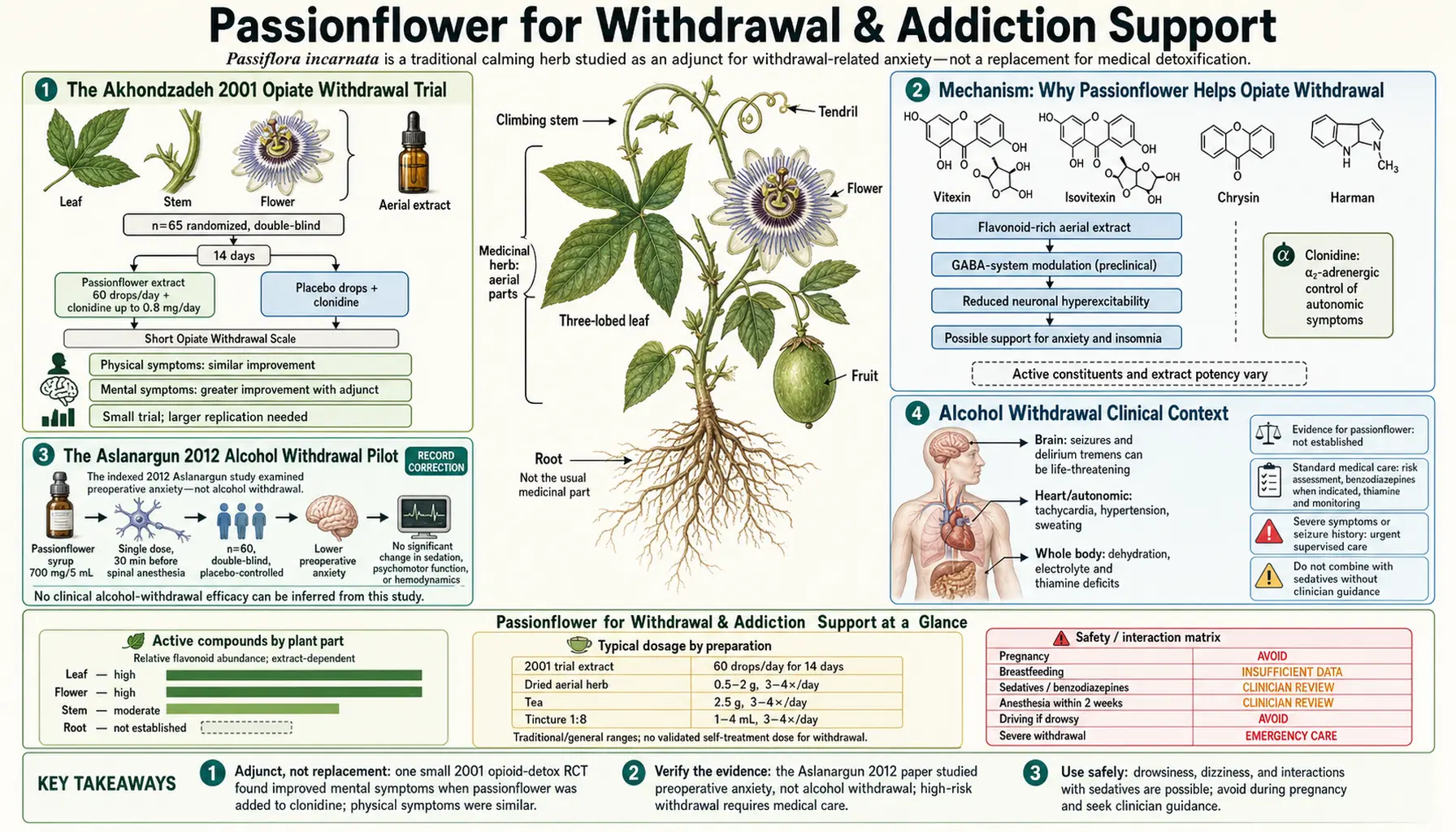
Some of the most clinically intriguing evidence for passionflower comes from the addiction medicine literature. In the 2001 Akhondzadeh randomized double-blind trial published in Journal of Clinical Pharmacy and Therapeutics, 65 opiate-addicted patients undergoing outpatient detoxification were assigned to either clonidine plus placebo drops (clonidine is the standard alpha-2 agonist used to control autonomic withdrawal symptoms) or clonidine plus passionflower extract for 14 days. The addition of passionflower produced significant additional reduction in the psychological symptoms of opiate withdrawal — anxiety, irritability, insomnia, restlessness, and dysphoria — without affecting clonidine's control of the autonomic symptoms (sweating, tachycardia, lacrimation, rhinorrhea). Dhawan's rodent work reported reversal of tolerance and dependence for morphine, nicotine, alcohol, diazepam and cannabinoids by the benzoflavone moiety isolated from Passiflora incarnata. The unifying theme: passionflower's gentle gamma-aminobutyric acid-A potentiation and central calming effect address the central nervous system hyperexcitability that drives the psychological symptoms of withdrawal across multiple substance classes. This deep-dive walks through the trial evidence in opiate, alcohol, and nicotine withdrawal, the autonomic stabilization mechanism, the practical integration with conventional addiction medicine, and the limitations of botanical adjunct therapy in severe substance use disorder.
Table of Contents
- The Akhondzadeh 2001 Opiate Withdrawal Trial
- Mechanism: Why Passionflower Helps Opiate Withdrawal
- Alcohol Withdrawal — Evidence From Mice
- Alcohol Withdrawal Clinical Context
- Nicotine Withdrawal — Traditional Use and Dhawan Rodent Data
- The Dhawan Tolerance-Reversal Studies
- Autonomic Stabilization Mechanism
- Benzodiazepine Tapering Protocols
- Integration with Conventional Addiction Medicine
- Limitations and What Passionflower Cannot Do
- Cautions in Addiction Patients
- Key Research Papers
- Connections
- Featured Videos
The Akhondzadeh 2001 Opiate Withdrawal Trial
Akhondzadeh and colleagues published two landmark passionflower trials in 2001. One was the generalized anxiety disorder (GAD) trial against oxazepam discussed on the Anxiety Relief page. The other, less widely known but equally well-designed, tested passionflower as an adjunct to clonidine in opiate detoxification.
Sixty-five opiate-addicted patients, all meeting the DSM-IV criteria for opioid dependence, undergoing outpatient detoxification were randomized to either:
- Clonidine (the alpha-2 adrenergic agonist standard for opiate withdrawal autonomic symptoms) plus placebo drops
- Clonidine plus passionflower extract (a fixed 60 drops/day of passiflora extract)
The 14-day detoxification protocol used clonidine up to a maximum daily dose of 0.8 mg, given in three divided doses (the same in both arms), with passionflower added on top in the active arm. The double-blind design used placebo drops in the clonidine-only arm. Withdrawal symptoms were scored on days 0, 1, 2, 3, 4, 7 and 14 using the Short Opiate Withdrawal Scale (SOWS), which separates physical symptoms (yawning, lacrimation, rhinorrhea, sweating, gooseflesh, tremor, restlessness, vomiting, abdominal cramps, muscle aches) from mental/affective symptoms (anxiety, irritability, dysphoria, insomnia).
Results:
- Both treatment arms showed similar control of physical withdrawal symptoms by clonidine — the alpha-2 mechanism produced equivalent suppression of autonomic discharge regardless of passionflower addition
- The passionflower plus clonidine arm showed “a significant superiority over clonidine alone in the management of mental symptoms,” in the authors' words
- Anxiety, irritability, and insomnia were the symptoms most clearly reduced by passionflower addition
- No serious adverse events attributable to passionflower
- The authors wrote that “a larger study to confirm our results is warranted”
The clinical relevance: opiate detoxification has a well-recognized two-component symptom structure. Clonidine, lofexidine, and related alpha-2 agonists control the autonomic and physical symptoms by reducing sympathetic outflow from the locus coeruleus, but they do not adequately address the equally distressing mental/affective component — the anxiety, restlessness, dysphoria, and insomnia that lead so many patients to abort detoxification and return to use. The Akhondzadeh trial provided one of the few well-designed randomized demonstrations of a botanical adjunct meaningfully reducing this mental/affective component, with reasonable safety and good tolerability.
Mechanism: Why Passionflower Helps Opiate Withdrawal
The mechanism behind passionflower's utility in opiate withdrawal is best understood through the neurobiology of opiate dependence and withdrawal:
Chronic opiate use produces adaptive changes in multiple brain systems. The locus coeruleus, a brainstem norepinephrine-producing nucleus, becomes hyperexcitable with chronic opiate exposure as it adapts to the inhibitory effect of mu-opioid agonism. When the opiate is withdrawn, this adaptive hyperexcitability is unmasked — the locus coeruleus fires excessively, producing the autonomic storm of opiate withdrawal: tachycardia, hypertension, sweating, mydriasis, piloerection, rhinorrhea, lacrimation. Clonidine and lofexidine address this by activating presynaptic alpha-2 autoreceptors on the locus coeruleus neurons, reducing their firing rate.
Simultaneously, chronic opiate use downregulates GABAergic tone in mesolimbic and prefrontal circuits, contributing to the dysphoria and anxiety of withdrawal once opiate-mediated reward is removed. Passionflower's gamma-aminobutyric acid-A potentiation directly addresses this GABAergic shortfall, modestly amplifying basal inhibitory tone in the cortical and limbic regions that produce the affective component of withdrawal. The benzoflavone moiety may have additional effects on opiate tolerance and dependence (per the Dhawan tolerance-reversal work discussed below).
The complementary mechanisms — alpha-2 agonism for autonomic symptoms, gamma-aminobutyric acid-A potentiation for mental/affective symptoms — explain the additive clinical benefit observed in the Akhondzadeh trial. Neither mechanism alone is sufficient to address both symptom components, and their combination produces more complete symptom control than either alone.
This combination approach has informed several integrative addiction medicine protocols that pair conventional alpha-2 agonists (clonidine or lofexidine) with botanical GABAergic adjuncts (passionflower, valerian, kava, or chamomile) during the acute withdrawal period. Buprenorphine remains the gold-standard opiate detoxification agent in current practice (essentially eliminating physical withdrawal symptoms through partial mu-opioid agonism), but practitioners also use passionflower as an adjunct in buprenorphine-mediated detoxification to address residual anxiety and sleep disturbance.
Alcohol Withdrawal — Evidence From Mice
The alcohol evidence for passionflower comes from mice. In a 2002 study, mice were made dependent on alcohol (2 g/kg twice daily for 6 days) and given the passionflower benzoflavone moiety by mouth at 10, 20 or 50 mg/kg, either twice daily alongside the alcohol or as a single dose on the seventh day. Both ways, the benzoflavone significantly reduced the anxiety-type behaviour of alcohol withdrawal in the mice, and daily dosing alongside the alcohol prevented withdrawal effects better than the single dose.
Practitioners describe passionflower as a possible benzodiazepine-sparing adjunct in alcohol withdrawal, reducing total benzodiazepine exposure during the acute withdrawal period. This matters because excessive benzodiazepine use during alcohol detoxification carries its own risks — oversedation, respiratory depression, prolongation of cognitive impairment, and risk of secondary benzodiazepine dependence in vulnerable patients.
Passionflower does not replace the standard symptom-triggered benzodiazepine protocol, which remains the gold standard for severe withdrawal and delirium tremens prophylaxis.
Alcohol Withdrawal Clinical Context
Alcohol withdrawal is a medical condition with a wide severity spectrum, from mild anxiety and tremor after a few days of reduced intake to life-threatening delirium tremens with seizures, cardiovascular collapse, and death. Risk stratification matters enormously for treatment choice:
- Mild withdrawal (CIWA-Ar < 10) — minor symptoms, often managed at home with hydration, thiamine, and supportive care. Practitioners use passionflower as an adjunct to ease anxiety and sleep disturbance in this group
- Moderate withdrawal (CIWA-Ar 10-18) — symptomatic, often benefits from benzodiazepine treatment. Passionflower can be adjunctive but is not a substitute for the benzodiazepine
- Severe withdrawal (CIWA-Ar > 18, or history of seizure/delirium tremens (DTs), autonomic instability, advanced age, comorbid medical illness) — requires inpatient management with structured benzodiazepine protocol. Passionflower is not used as primary or even significant adjunct in this setting; established medical management takes precedence
- Delirium tremens — medical emergency requiring intensive care unit-level care, intravenous (IV) benzodiazepines, and intensive monitoring. Botanical adjuncts have no role
The key principle: practitioners describe passionflower's gentle gamma-aminobutyric acid-A modulation as a comfort and benzodiazepine-sparing adjunct for low-acuity alcohol withdrawal, but it is not a substitute for proper medical management of severe alcohol withdrawal. Detoxification of patients with a history of withdrawal seizures or DTs takes place in a supervised medical setting.
Nicotine Withdrawal — Traditional Use and Dhawan Rodent Data
Passionflower has traditional use as part of smoking-cessation herbal protocols dating to early 20th century North American eclectic and herbal medicine practice. The mechanism behind this traditional use was characterized in the rodent literature by Dhawan, Kumar and Sharma in 2002, who reported that the benzoflavone moiety isolated from the aerial parts of Passiflora incarnata reduced the signs of nicotine dependence in mice.
The Dhawan nicotine work gave mice nicotine (2 mg/kg under the skin four times a day) for 7 or 14 days, alone or with the benzoflavone at 1, 5, 10 or 20 mg/kg, and then measured withdrawal signs:
- After 7 days, when withdrawal was brought on with naloxone, mice given 10 or 20 mg/kg of the benzoflavone alongside nicotine showed significantly fewer withdrawal jumps than mice given nicotine alone
- After 14 days, mice given 5, 10 or 20 mg/kg showed milder withdrawal on stopping; at 10 and 20 mg/kg they had significantly fewer withdrawal jumps and normal ambulatory behaviour. Benzoflavone treatment also prevented weight loss and gave normal performance in a swimming endurance test
- A single 20 mg/kg dose prevented some of the withdrawal effects; lower doses were almost inert
- Dhawan later proposed a hormonal (neurosteroidal) mode of action rather than an effect at the nicotine receptor (see the Dhawan section below)
Human clinical trials of passionflower specifically for smoking cessation are notably scarce — the field has been dominated by nicotine replacement therapy (NRT), bupropion, and varenicline, which have strong direct mechanisms targeting the nicotinic receptor and the dopaminergic reward circuitry. Passionflower's plausible mechanism in nicotine withdrawal is the same gamma-aminobutyric acid-A potentiation and central calming effect that addresses the anxiety, irritability, and insomnia of nicotine withdrawal — symptoms that drive many quit attempts to fail in the first week.
Practitioners describe the role of passionflower in smoking cessation as a comfort adjunct in the first 1-2 weeks of nicotine withdrawal, supporting the mental/affective symptoms of withdrawal while nicotine replacement therapy or pharmaceutical agents address the receptor-specific component. Used this way, passionflower complements rather than replaces evidence-based smoking-cessation pharmacotherapy.
The Dhawan Tolerance-Reversal Studies
The series of papers by Dhawan, Sharma, and colleagues (1999-2003) is the most extensive body of preclinical research on passionflower's effects in addiction-relevant models. In Dhawan's 2003 summary of this work, the benzoflavone moiety isolated from the Passiflora incarnata methanol extract showed reversal of tolerance and dependence for five addiction-prone drugs in animal studies — morphine, nicotine, ethanol (alcohol), diazepam and delta-9-tetrahydrocannabinol:
- Morphine — mice given chronic morphine developed tolerance to morphine's antinociceptive effect and exhibited withdrawal signs upon naloxone challenge. Co-administration of the benzoflavone reduced both tolerance development and withdrawal severity
- Nicotine — as discussed above, benzoflavone reduced withdrawal behavior in chronic nicotine models in mice
- Alcohol — as discussed above, benzoflavone reduced anxiety-type withdrawal behaviour in alcohol-dependent mice
- Diazepam (a benzodiazepine) — in a 21-day mouse study, benzoflavone given with diazepam (20 mg/kg) kept movement normal after the drugs were stopped, with 100 mg/kg working better than 10 or 50 mg/kg; benzoflavone given alone showed no dependence of its own, even on abrupt stopping
- Delta-9-THC (cannabinoid) — chronic tetrahydrocannabinol (THC) tolerance was reduced and withdrawal-equivalent behavior was attenuated by benzoflavone co-administration
The cross-class effect (opiates, nicotine, alcohol, benzodiazepines, cannabinoids) suggests the benzoflavone acts on a common downstream pathway rather than directly competing at any one substance's receptor. The hypothesis offered by Dhawan was hormonal: the benzoflavone is a tri-substituted derivative of alpha-naphthoflavone (7,8-benzoflavone), a well-known aromatase-enzyme inhibitor, so its mode of action was postulated to be a neurosteroidal mechanism in which it prevents the metabolic breakdown of testosterone and raises blood testosterone levels.
This is interesting basic-science work, and its translation to human addiction medicine is uncertain. Rodent models of tolerance and dependence are useful screening tools but do not fully recapitulate the complex behavioral, social, and reward-system disruption of human substance use disorder. In clinical use passionflower is described as adjunctive comfort therapy supporting evidence-based addiction medicine, not as a replacement for the medications, therapy, and supportive services that constitute the standard of care.
Autonomic Stabilization Mechanism
A unifying feature of withdrawal from multiple substance classes (opiates, alcohol, benzodiazepines, nicotine) is autonomic hyperactivity — the sympathetic nervous system runs in an unopposed hyperexcitable state, producing tachycardia, hypertension, sweating, mydriasis, tremor, and anxiety. The locus coeruleus is the principal upstream driver of this autonomic discharge, and it becomes adaptively hyperexcitable in chronic substance exposure.
Passionflower's contribution to autonomic stabilization is indirect but real. The gamma-aminobutyric acid-A potentiation in cortical and limbic circuits dampens the perceptual amplification of withdrawal symptoms (the patient feels less distressed by a given autonomic discharge), and the brainstem GABAergic projections to the locus coeruleus contribute modestly to downstream sympathetic outflow reduction. Several animal studies document reduced heart rate and blood pressure responses to stress with passionflower pretreatment.
The real 2012 Aslanargun trial was not a withdrawal study: 60 adults aged 25-55 scheduled for spinal anaesthesia were randomized to passionflower extract by mouth or placebo before the procedure. Passionflower suppressed the rise in anxiety score (State-Trait Anxiety Inventory) before the spinal anaesthetic compared with placebo, without changing psychomotor function test results, sedation level, or heart rate and blood pressure (hemodynamics).
The observation from the Akhondzadeh opiate trial is that patients on passionflower had better control of the mental symptoms of withdrawal, while the physical symptoms were controlled equally well in both groups. This phenomenologic gap — reduction of suffering disproportionate to reduction of physical signs — is one of the most valued attributes of any addiction medicine adjunct, because subjective intolerability is what drives so many detoxification failures.
Benzodiazepine Tapering Protocols
An increasingly important clinical context for passionflower is supporting patients tapering long-term benzodiazepine therapy. The standard Ashton manual approach to benzodiazepine taper involves switching shorter-acting agents to diazepam, then reducing the diazepam dose by 5-10% every 1-4 weeks over months. This process produces predictable rebound anxiety, insomnia, and a constellation of physical symptoms (the protracted benzodiazepine withdrawal syndrome) that drives many tapers to fail.
Practitioners report that passionflower's gentle gamma-aminobutyric acid-A modulation can ease the rebound anxiety and insomnia of the taper period without becoming a substitute dependence target. The use they describe:
- 300-600 mg of standardized passionflower extract daily during the taper, divided into 2-3 doses, with a larger evening dose for sleep
- Continued throughout the taper period and for several weeks after the final benzodiazepine dose
- Valerian or chamomile added if passionflower alone is insufficient
- Magnesium glycinate (300-400 mg/day) combined to support normal gamma-aminobutyric acid-A function
- The underlying anxiety or sleep issues that drove the original benzodiazepine prescription addressed with non-pharmacologic approaches (cognitive behavioral therapy (CBT) for anxiety or insomnia, mindfulness practices, exercise, social support)
The taper schedule, monitoring for withdrawal seizures, and decisions about taper acceleration or deceleration are medical decisions made by the prescribing physician managing the taper. Passionflower is an adjunct supporting the patient through the taper, not a replacement for proper medical management.
Integration with Conventional Addiction Medicine
Modern addiction medicine has multiple effective pharmacotherapies for substance use disorders, and passionflower's role is best understood as adjunctive rather than primary:
- Opiate use disorder — medications for opioid use disorder (MOUD) including buprenorphine/naloxone, methadone, and extended-release naltrexone are the standard of care for long-term management. Practitioners use passionflower as an adjunct during induction and stabilization; it does not replace MOUD
- Alcohol use disorder — U.S. Food and Drug Administration-approved medications include naltrexone, acamprosate, and disulfiram. Practitioners use passionflower as an adjunct during the acute withdrawal phase and early sobriety; it does not replace these
- Tobacco use disorder — nicotine replacement therapy (patch, gum, lozenge, inhaler), bupropion, and varenicline are standard. Passionflower as comfort adjunct in the first 1-2 weeks of withdrawal complements but does not replace
- Stimulant use disorder — no U.S. Food and Drug Administration-approved pharmacotherapy. Passionflower may help anxiety and sleep disturbance of stimulant withdrawal but is not a definitive treatment
- Benzodiazepine use disorder — structured slow tapering is the established approach; passionflower as adjunct as discussed above
For the clonidine-type medicines used in the Akhondzadeh trial, a 2016 Cochrane review of 26 randomised controlled trials (1,728 participants) found that alpha2-adrenergic agonists such as clonidine and lofexidine were more effective than placebo for opioid withdrawal: severe withdrawal was less likely (risk ratio 0.32; 3 studies, 148 participants) and completion of treatment more likely (risk ratio 1.95; 3 studies, 148 participants). Low blood pressure and other adverse effects were more likely with these drugs than with reducing doses of methadone (risk ratio 1.92), and the available data suggest that lofexidine does not reduce blood pressure to the same extent as clonidine.
Behavioral and social interventions remain critical components of addiction treatment that no medication or botanical replaces. Cognitive behavioral therapy, motivational interviewing, contingency management, mutual-help group participation (12-step or alternatives), and recovery support services produce durable outcomes that pharmacotherapy alone cannot match.
For broader natural approaches to anxiety that often accompany addiction recovery, see our Natural Anxiety Relief page and the Stress Management page.
Limitations and What Passionflower Cannot Do
Honest practice requires acknowledging what passionflower cannot do:
- Cannot replace MOUD — buprenorphine and methadone work directly at the mu-opioid receptor and produce dramatically better long-term outcomes than detoxification alone. Passionflower is adjunctive, not a substitute for medications for opioid use disorder
- Cannot prevent severe alcohol withdrawal — patients with history of withdrawal seizures or DTs are treated with structured medical management with benzodiazepines, not botanical alternatives
- Cannot address the underlying psychology of addiction — substance use disorders are complex behavioral, neurobiological, social, and often trauma-related conditions. No medication or herb alone produces durable recovery; behavioral and social interventions are essential
- Limited evidence base in stimulant withdrawal — the one withdrawal trial is in opiates; the alcohol and nicotine data come from mice. Stimulant withdrawal has not been specifically studied
- Cannot address co-occurring psychiatric disorders — depression, post-traumatic stress disorder (PTSD), bipolar disorder, and severe anxiety disorders that often co-occur with substance use disorder require proper psychiatric evaluation and treatment. Passionflower may help low-grade anxiety but does not replace antidepressants, mood stabilizers, or trauma-focused therapy
- Modest effect size — the documented benefit in the withdrawal trial is real but modest. Patients expecting transformation are likely to be disappointed; the realistic framing is improved comfort during a difficult period
- Wider anxiety evidence — a 2020 systematic review found nine randomized clinical trials of Passiflora incarnata in neuropsychiatric conditions, lasting from one day up to 30 days, all in adults. Most reported reduced anxiety after passionflower, with the effect less evident in people with mild anxiety symptoms, and no adverse effects such as memory loss or loss of psychometric function were observed
Cautions in Addiction Patients
- Active opiate or alcohol use — passionflower taken during active opiate or alcohol use adds to their central nervous system (CNS) depression, and outside a supervised detoxification setting that additive effect is unpredictable in active intoxication
- Severe withdrawal — passionflower is not appropriate as primary therapy for severe alcohol withdrawal (CIWA-Ar > 18), opiate withdrawal with significant medical comorbidity, or benzodiazepine withdrawal with seizure history. These are handled with proper medical management
- Mixed substance use — patients using multiple substances may have complex interaction profiles. Passionflower's safety record is good but the combination with active polysubstance use is poorly characterized
- Liver disease — alcohol use disorder commonly produces hepatic dysfunction. Most passionflower preparations are well tolerated even with mild-moderate hepatic impairment, but rare hepatotoxicity case reports exist with multi-herb passionflower-containing formulations
- Concurrent psychiatric medications — theoretical interactions with selective serotonin reuptake inhibitors (via harman, an inhibitor of monoamine oxidase A (MAO-A)) and additive sedation with benzodiazepines or other sedatives apply
- Pregnancy — pregnant women in addiction treatment have specific protocols (methadone or buprenorphine for opiate use, etc.). There is no good safety data on passionflower in pregnancy
- Children and adolescents — pediatric and adolescent addiction medicine has its own specialized protocols. There is no good safety data on passionflower for young people in addiction treatment
- Long-term use — while no significant tolerance or dependence develops with passionflower, practitioners reassess sustained use beyond 3-6 months in recovery, asking whether other interventions are addressing the underlying needs
Key Research Papers
- Akhondzadeh S, Kashani L, Mobaseri M, Hosseini SH, Nikzad S, Khani M (2001). Passionflower in the treatment of opiates withdrawal: a double-blind randomized controlled trial. Journal of Clinical Pharmacy and Therapeutics, 26(5), 369-373. — PubMed PMID: 11679027
- Aslanargun P, Cuvas O, Dikmen B, Aslan E, Yuksel MU (2012). Passiflora incarnata Linneaus as an anxiolytic before spinal anesthesia. Journal of Anesthesia, 26(1), 39-44. — PubMed PMID: 22048283
- Dhawan K, Kumar S, Sharma A (2002). Reversal of cannabinoids (delta9-THC) by the benzoflavone moiety from methanol extract of Passiflora incarnata Linneaus in mice: a possible therapy for cannabinoid addiction. Journal of Pharmacy and Pharmacology, 54(6), 875-881. — PubMed PMID: 12079005
- Dhawan K, Kumar S, Sharma A (2002). Nicotine reversal effects of the benzoflavone moiety from Passiflora incarnata Linneaus in mice. Addiction Biology, 7(4), 435-441. — PubMed PMID: 14578021
- Dhawan K, Kumar S, Sharma A (2002). Reversal of Morphine Tolerance and Dependence by Passiflora incarnata – A Traditional Medicine to Combat Morphine Addiction. Pharmaceutical Biology, 40(8), 576-580. — doi:10.1076/phbi.40.8.576.14660
- Dhawan K (2003). Drug/substance reversal effects of a novel tri-substituted benzoflavone moiety (BZF) isolated from Passiflora incarnata Linn.—a brief perspective. Addiction Biology, 8(4), 379-386. — PubMed PMID: 14690874
- Dhawan K, Kumar S, Sharma A (2002). Suppression of alcohol-cessation-oriented hyper-anxiety by the benzoflavone moiety of Passiflora incarnata Linneaus in mice. Journal of Ethnopharmacology, 81(2), 239-244. — PubMed PMID: 12065157
- Dhawan K, Dhawan S, Chhabra S (2003). Attenuation of benzodiazepine dependence in mice by a tri-substituted benzoflavone moiety of Passiflora incarnata Linneaus: a non-habit forming anxiolytic. Journal of Pharmacy and Pharmaceutical Sciences, 6(2), 215-222. — PubMed PMID: 12935433
- Soulimani R, Younos C, Jarmouni S, Bousta D, Misslin R, Mortier F (1997). Behavioral effects of Passiflora incarnata L. and its indole alkaloid and flavonoid derivatives and maltol in the mouse. Journal of Ethnopharmacology, 57(1), 11-20. — PubMed
- Sarris J, Panossian A, Schweitzer I, Stough C, Scholey A (2011). Herbal medicine for depression, anxiety and insomnia: a review of psychopharmacology and clinical evidence (including addiction-comorbid anxiety). European Neuropsychopharmacology, 21(12), 841-860. — PubMed
- Akhondzadeh S, Naghavi HR, Vazirian M, Shayeganpour A, Rashidi H, Khani M (2001). Passionflower in the treatment of generalized anxiety: a pilot double-blind randomized controlled trial with oxazepam. Journal of Clinical Pharmacy and Therapeutics, 26(5), 363-367. — PubMed PMID: 11679026
- Brady KT, Sinha R (2005). Co-occurring mental and substance use disorders: the neurobiological effects of chronic stress. American Journal of Psychiatry, 162(8), 1483-1493. — PubMed
- Janda K, Wojtkowska K, Jakubczyk K, Antoniewicz J, Skonieczna-Žydecka K (2020). Passiflora incarnata in Neuropsychiatric Disorders—A Systematic Review. Nutrients, 12(12), 3894. — PubMed PMID: 33352740
- Gowing L, Farrell M, Ali R, White JM (2016). Alpha₂-adrenergic agonists for the management of opioid withdrawal. Cochrane Database of Systematic Reviews, 2016(5), CD002024. — PubMed PMID: 27140827
PubMed Topic Searches
Connections
- All Herbs
- Passionflower Overview
- Passionflower Benefits Hub
- Passionflower for Anxiety Relief
- Passionflower for Sleep Quality
- Passionflower Gamma-Aminobutyric Acid Modulation
- Anxiety
- Depression
- Insomnia
- Valerian
- Chamomile
- Lavender
- Kava
- Magnesium
- Natural Anxiety Relief
- Stress Management
- Sleep Hygiene
- History