Calendula Sources and Preparations
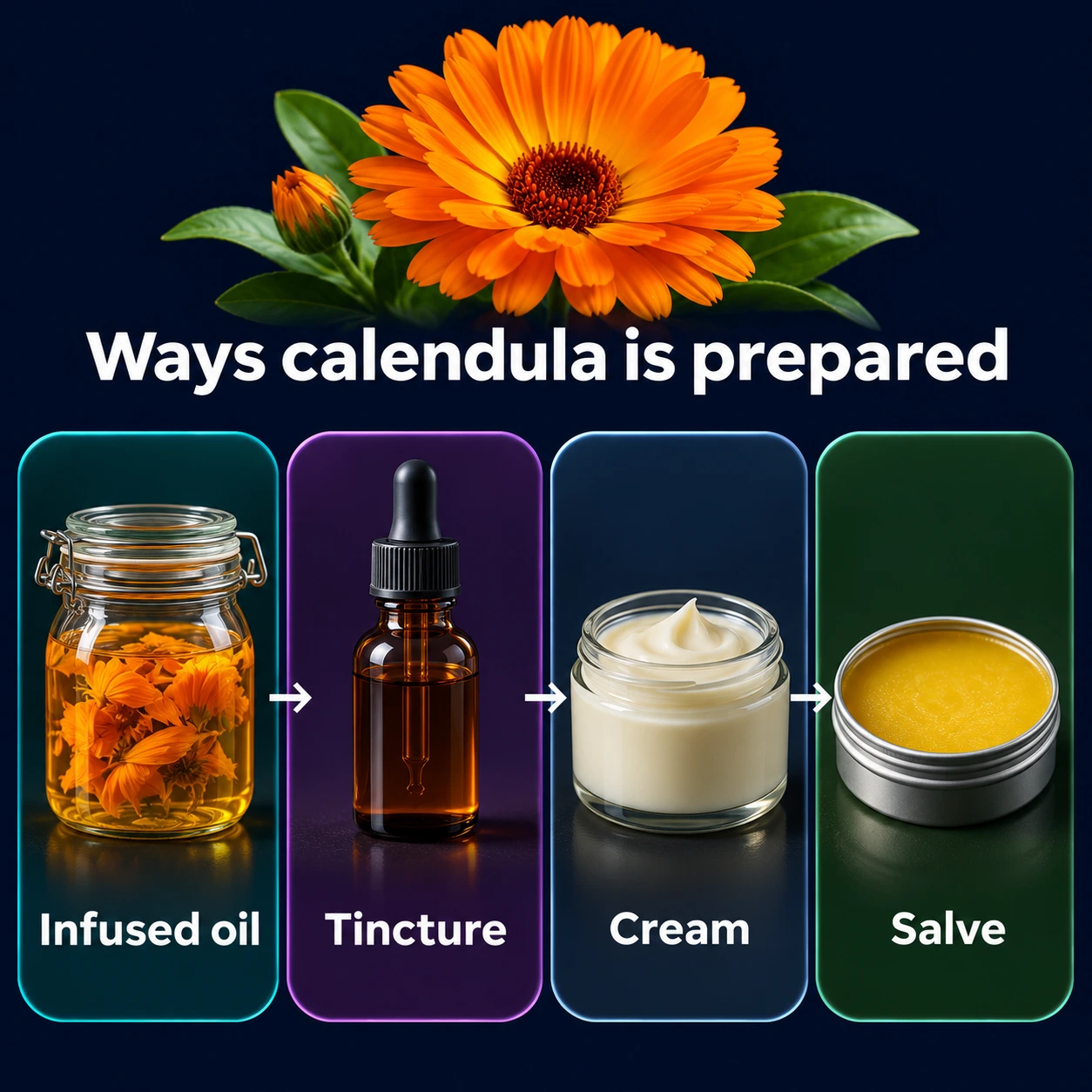
Calendula is one of the easiest herbs to use well — and one of the easiest to buy wrong. The first job is getting the right plant: the medicinal herb is Calendula officinalis (pot marigold), not the ornamental Tagetes "marigolds" that share the name. From there, the key idea is that calendula's soothing power lives in fat-soluble triterpenoids concentrated in the flower, so the way it is extracted — infused oil, alcohol tincture, cream, salve, or supercritical CO2 — strongly shapes how much active material ends up in the jar. This page is a practical guide to the forms of calendula, how to make a simple infused petal oil at home, how to choose a quality product, and — most importantly — the one safety caution that matters most: the daisy-family (Asteraceae) allergy risk, and how a patch test, read after 24–48 hours, works.
Table of Contents
- Which Plant: Calendula vs Tagetes
- What's in the Flower
- Forms: Creams, Ointments, Salves & Tinctures
- Making an Infused (Macerated) Oil
- Extraction Methods & Product Quality
- Choosing a Good Product
- Dried Flowers, Tea & Growing Your Own
- The Asteraceae Allergy Caution
- Other Safety Notes
- Key Research Papers
- External Resources
- Connections
- Featured Videos
Which Plant: Calendula vs Tagetes
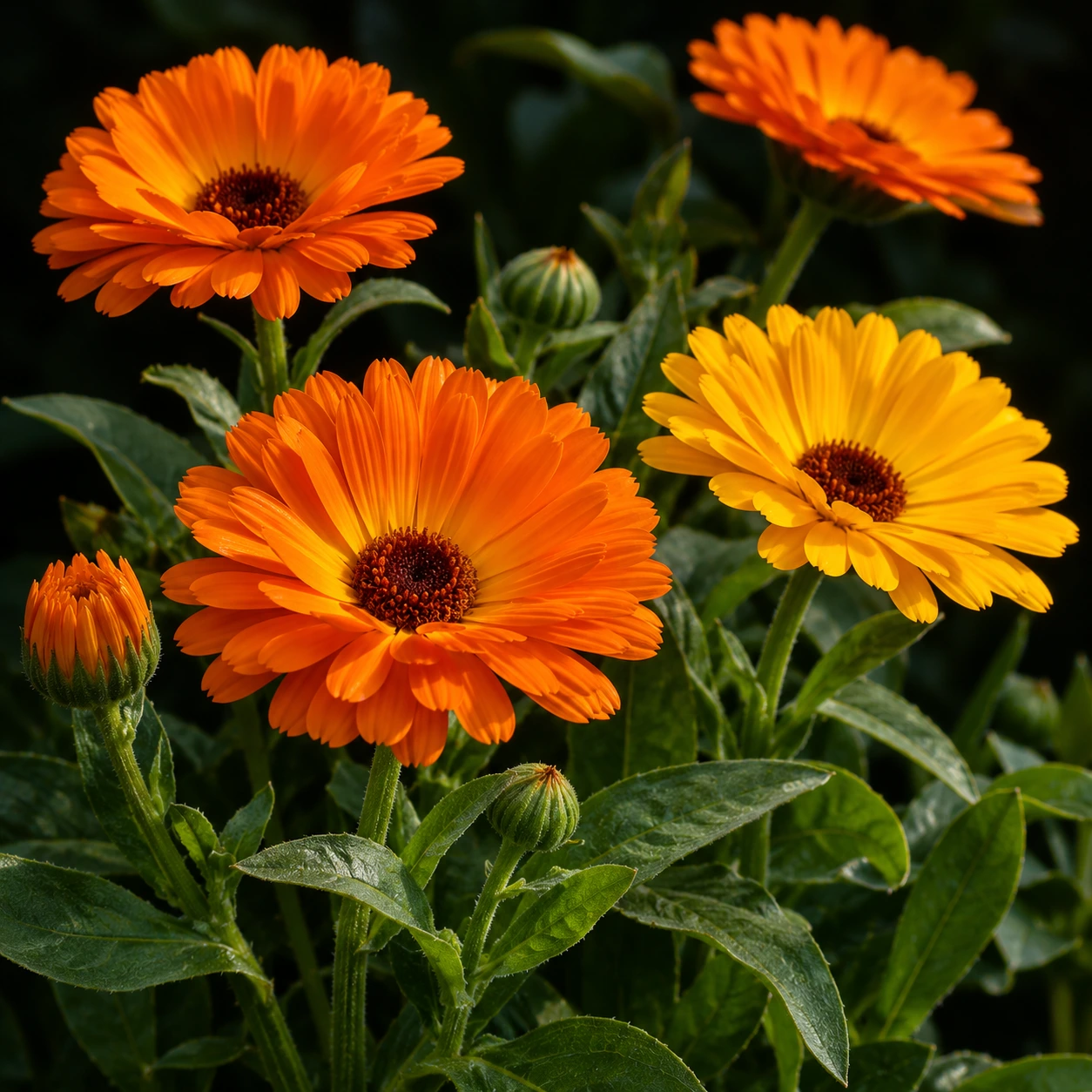
The most common mistake with calendula happens before you even open the jar: buying the wrong plant. The medicinal herb is Calendula officinalis, the "pot marigold" — a bright orange-and-yellow flower in the daisy (Asteraceae) family. It is not the same as the ornamental bedding "marigolds" sold at most garden centers, which are usually Tagetes species (French and African marigolds).
They look similar and share the folk name "marigold," but they are different plants with different chemistry, and essentially all the skin, wound, and mouth research is on Calendula officinalis. The Latin name Calendula officinalis on a label of dried flowers, seeds, or a product identifies the medicinal plant; "marigold" alone does not. Reputable herbal suppliers and pharmacopoeias (the flower is officially Calendulae flos) will always specify it.
What's in the Flower
The medicinal part is the flower — the petals (ligulate florets) and sometimes the whole flower head. It carries several groups of active compounds, covered in more detail on the anti-inflammatory and antimicrobial page:
- Triterpenoids (faradiol esters and related pentacyclic triterpenes) — the main anti-inflammatory and anti-swelling compounds. These are fat-soluble, which is why oil-based and lipophilic extracts capture them well.
- Flavonoids and polyphenols — water- and alcohol-soluble antioxidants; captured well by tinctures and aqueous infusions.
- Carotenoids — the orange-yellow pigments; fat-soluble, and a rough visual cue that petals are rich and fresh.
- Small amounts of essential (volatile) oil — contributing to the mild antimicrobial activity.
Because the two most important groups — triterpenoids and flavonoids — differ in solubility, no single preparation captures everything. That is the key to understanding why the form of calendula matters.
Forms: Creams, Ointments, Salves & Tinctures
- Creams and lotions. Water-and-oil emulsions that are light, absorb quickly, and suit everyday use on irritated or dry skin. Good for larger areas and daytime use.
- Ointments and salves. Oil- or wax-based (for example, in a beeswax base), thicker and more occlusive. They hold the fat-soluble triterpenoids well and form a protective layer — the type used in the radiation-dermatitis trial context. Good for focused, dry, or chapped areas.
- Infused (macerated) oils. Petals steeped in a carrier oil (see below). A simple, traditional base for salves and a soothing oil in their own right.
- Tinctures (alcohol extracts). Concentrated liquid extracts that capture the flavonoids and some other compounds. Used diluted — for example, added to water for a compress or (well diluted) a mouth rinse. Not usually applied neat to broken skin because of the alcohol.
- Dried petals. For making infusions (teas) for a mouth rinse or gargle, or for making your own oil.
Making an Infused (Macerated) Oil
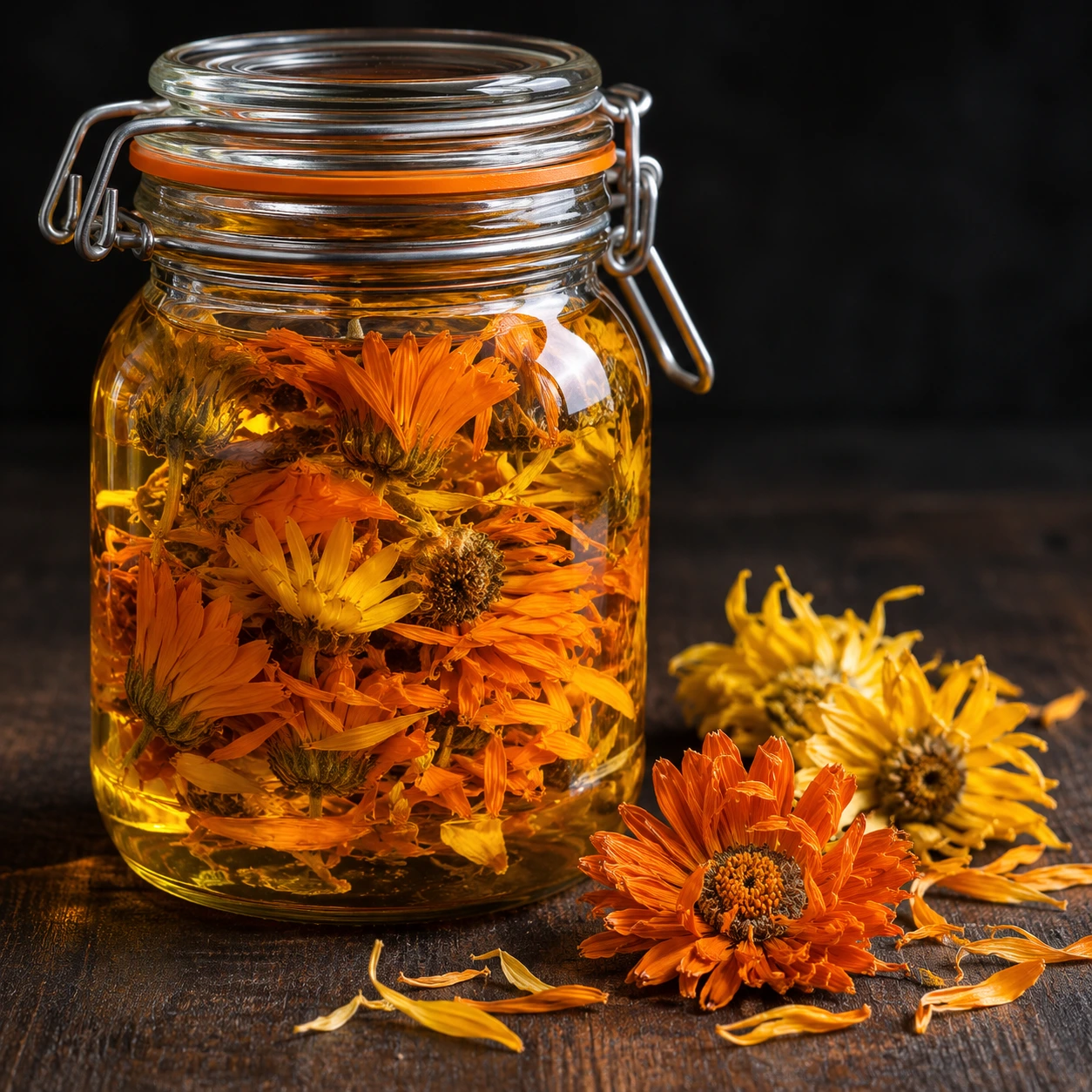
A calendula infused oil is one of the simplest herbal preparations to make at home, and it becomes the base for salves and balms.
- Start with fully dried petals. Moisture is the enemy — any water left in fresh petals can spoil the oil. Use well-dried Calendula officinalis flowers.
- Cover with a carrier oil. Place the dried petals in a clean, dry jar and cover completely with a stable oil such as olive, sweet almond, jojoba, or sunflower oil. Keeping petals fully submerged prevents mold.
- Steep. Either the slow way — seal and leave in a warm spot, shaking occasionally, for 2–4 weeks — or the fast way — warm gently in a double boiler (kept well below a simmer) for a few hours. Gentle heat protects the delicate compounds.
- Strain and store. Strain through cheesecloth, squeeze out the oil, and store in a clean, dark glass bottle away from light and heat. Label it with the date; use within about a year.
To turn the oil into a salve, gently melt it with beeswax (a common ratio is roughly a handful of beeswax to a cup of oil, adjusted to the firmness you want) and pour into tins to set.
Extraction Methods & Product Quality
How calendula is extracted determines what ends up in the finished product. Because the signature anti-inflammatory triterpenoids are fat-soluble, extraction chemistry matters:
- Oil maceration favors the fat-soluble triterpenoids and carotenoids — the classic soothing salve chemistry.
- Alcohol tinctures pull out flavonoids and a broader spread of compounds, but less of the very lipophilic material.
- Supercritical CO2 extraction is a modern industrial method that can concentrate the lipophilic fraction efficiently and cleanly. A study of supercritical CO2 extraction of marigold at high pressures (Baumann and colleagues, 2004) examined how pressure and conditions affect the yield of these compounds — the kind of optimization behind standardized commercial extracts. In that study the anti-inflammatory faradiol esters were extracted most completely, and at the highest concentration, with 0.5% ethanol added at the maximum pressure of 689 bar (at 50 °C). Adding more ethanol pulled out more total material, but that extra material diluted the faradiol esters, so the extract held a lower concentration of them.
- Why faradiol esters are the yardstick. An earlier study that split a CO2 extract of calendula flowers into its parts (Della Loggia and colleagues, 1994) found the triterpenoids were the main anti-inflammatory compounds, with the faradiol monoester the most important because there is so much of it. The anti-inflammatory activity of different CO2 extracts was proportional to their faradiol monoester content, and the authors proposed that content as a quality-control measure for calendula preparations.
A comprehensive pharmaceutical review of calendula's applications and formulations (Molina and colleagues, 2025) surveys how these approaches are used to build creams, gels, and other products. The practical upshot: a well-made product from true Calendula officinalis flowers, ideally standardized to its active constituents, is more likely to deliver the soothing effect than a vaguely labeled "marigold" cream of unknown origin.
Choosing a Good Product
- The Latin name. A label that says Calendula officinalis names the medicinal plant; "marigold" alone does not.
- The ingredient list. Ingredients are listed by amount, so calendula extract or infused oil near the end of the list is a token amount. Simpler formulas mean fewer things to react to.
- Form and job. Traditionally, a richer salve or ointment for dry, focused patches; a lighter cream for everyday or larger areas; a 2% mouthwash or a made-fresh infusion for the mouth and throat.
- Added irritants. Added fragrances, essential oils, and preservatives can themselves irritate reactive skin.
- Supplier quality. Herbal product quality varies widely with the supplier's sourcing and quality control.
Dried Flowers, Tea & Growing Your Own
Calendula is an easy annual to grow, which makes home-dried petals a practical option. Harvest open flower heads on a dry day, dry them out of direct sun with good airflow until crisp, and store in an airtight jar away from light. Home-grown flowers give you certainty about the species and freedom from unwanted additives — just confirm you planted true Calendula officinalis, not Tagetes.
For a mouth or throat rinse, steep 1–2 teaspoons of dried petals in a cup of just-boiled water for 10–15 minutes, strain, cool, then swish or gargle and spit — details on the oral and throat page. Calendula petals are also edible and are sometimes used as a mild culinary garnish or a "poor man's saffron" for color, though that is a food use rather than a medicinal one.
The Asteraceae Allergy Caution
This is the single most important safety point for calendula. Calendula belongs to the Asteraceae (Compositae, or daisy) family, alongside ragweed, chamomile, echinacea, arnica, feverfew, and ornamental marigolds. People sensitized to this family can develop allergic contact dermatitis — an itchy, red, sometimes blistering rash — from calendula products.
How often this happens is only partly known. A 2002 review of contact sensitization from Compositae-containing herbal remedies and cosmetics (Paulsen) lists marigold among at least 15 daisy-family species suspected of causing Compositae dermatitis; good population figures existed only for arnica and German chamomile, and the evidence for marigold and the others was anecdotal. The review found that sensitization occurs rarely with most of these herbs, and that the risk of a rash when Compositae-sensitive people use these products is by-and-large unknown.
A dedicated study of contact sensitization to arnica and marigold (Reider and colleagues, 2001) gives real numbers: of 443 consecutive patients patch-tested at an Austrian clinic, 9 (about 2%) reacted to marigold and 5 (about 1%) to arnica. The standard Compositae mix used in patch testing picked up only 4 of the 9 marigold reactions, so the authors concluded that marigold allergy cannot be judged from the Compositae or sesquiterpene lactone mixes alone. In the daisy family as a whole the main allergens are sesquiterpene lactones (Paulsen, 2002); for marigold itself the allergen is less clear.
A larger Australian series (Punchihewa and colleagues, 2022) reviewed 3,679 people patch-tested at one Melbourne dermatology centre between 2011 and 2020: 44 (1.2%) reacted to the Compositae mix, and 19 of those reactions were judged relevant to the person's rash. Gardening and direct handling of the plants caused most of the relevant cases (13); personal-care products caused the other 6 (almost one-third), all in women, and the face was often involved.
A 2025 review of the allergy potential of daisy-family medicinal plants (Ključevšek and Kreft) adds two points: sesquiterpene lactones can cause whole-body (systemic) reactions in sensitized people when the plant is swallowed, not only skin rashes; and shared pollen allergens, found mainly in ragweed and mugwort, explain some of the cross-reactions between daisy-family plants. The authors note that many questions about these allergens remain open.
What the safety literature describes:
- Allergy history. People who already react to ragweed, chamomile, echinacea, arnica, or daisies are the group the cross-reactivity reports concern most.
- Home patch test. A home patch test puts a small amount on a small area of intact skin (for example, the inner forearm) and checks it after 24–48 hours for redness, itching, or irritation before wider use.
- A reaction. A rash or worsening irritation is the sign of a reaction; the Australian series above names avoiding the plant as the most important part of managing Compositae contact dermatitis.
For the condition itself, see our contact dermatitis page.
Other Safety Notes
- Topical is the well-supported use. Calendula's evidence is for use on the skin and as a spit-out mouth rinse. There is little proven benefit — and less safety data — for taking concentrated calendula internally as a supplement.
- Pregnancy and breastfeeding. There is no safety data for medicinal or oral calendula (strong extracts, tinctures, large amounts of tea) in pregnancy, and traditional sources list pregnancy as a reason not to take it by mouth. Occasional topical skin use is a lower-exposure, different situation.
- Theoretical interactions. Because it is used topically at low systemic exposure, calendula has few documented drug interactions; some sources note a theoretical additive effect with sedatives if taken internally in quantity, which is another reason to keep use topical.
- Serious problems need real care. Deep or infected wounds, burns, non-healing ulcers, and severe rashes require medical attention — calendula is a comfort measure, not a treatment for these.
Key Research Papers
All references below are real, peer-reviewed studies linked to their PubMed records, spanning constituents, extraction and formulation, and the contact-allergy evidence.
- Molina JAP, et al. Calendula: general aspects, applications, and formulations in the pharmaceutical industry. Int J Pharm Compd. 2025. — PubMed PMID: 40961475
- Baumann D, Adler S, Grüner S, et al. Supercritical carbon dioxide extraction of marigold at high pressures: comparison of analytical and pilot-scale extraction. Phytochem Anal. 2004. — PubMed PMID: 15311841
- Della Loggia R, Tubaro A, Sosa S, et al. The role of triterpenoids in the topical anti-inflammatory activity of Calendula officinalis flowers. Planta Med. 1994. — PubMed PMID: 7809203
- Zitterl-Eglseer K, Sosa S, Jurenitsch J, et al. Anti-oedematous activities of the main triterpendiol esters of marigold (Calendula officinalis L.) J Ethnopharmacol. 1997. — PubMed PMID: 9254116
- Lohani A, Mishra AK, Verma A. Cosmeceutical potential of geranium and calendula essential oil: antioxidant activity and in vitro sun protection factor. J Cosmet Dermatol. 2019. — PubMed PMID: 30251317
- Lohani A, Verma A, Hema G, Pathak K. Topical delivery of geranium/calendula essential oil-entrapped ethanolic lipid vesicular cream to combat skin aging. Biomed Res Int. 2021;2021:4593759. — PubMed PMID: 34552986
- Efstratiou E, Hussain AI, Nigam PS, et al. Antimicrobial activity of Calendula officinalis petal extracts against fungi and clinical bacterial pathogens. Complement Ther Clin Pract. 2012. — PubMed PMID: 22789794
- Paulsen E. Contact sensitization from Compositae-containing herbal remedies and cosmetics. Contact Dermatitis. 2002. — PubMed PMID: 12492516
- Reider N, Komericki P, Hausen BM, et al. The seamy side of natural medicines: contact sensitization to arnica (Arnica montana L.) and marigold (Calendula officinalis L.) Contact Dermatitis. 2001. — PubMed PMID: 11722485
- Punchihewa N, Palmer A, Nixon R. Allergic contact dermatitis to Compositae: an Australian case series. Contact Dermatitis. 2022;87(4):356-362. — PubMed PMID: 35603484
- Ključevšek T, Kreft S. Allergic potential of medicinal plants from the Asteraceae family. Health Sci Rep. 2025;8(2):e70398. — PubMed PMID: 39995792
- Givol O, Kornhaber R, Visentin D, et al. A systematic review of Calendula officinalis extract for wound healing. Wound Repair Regen. 2019. — PubMed PMID: 31145533
PubMed Topic Searches
External Resources
- European Medicines Agency — Calendulae flos herbal monograph — the EU assessment of traditional topical preparations
- Memorial Sloan Kettering — About Herbs: Calendula
- MedlinePlus — Marigold (Calendula)
- Drugs.com — Calendula monograph (dosing and cautions)