Calendula: Anti-Inflammatory and Antimicrobial Actions
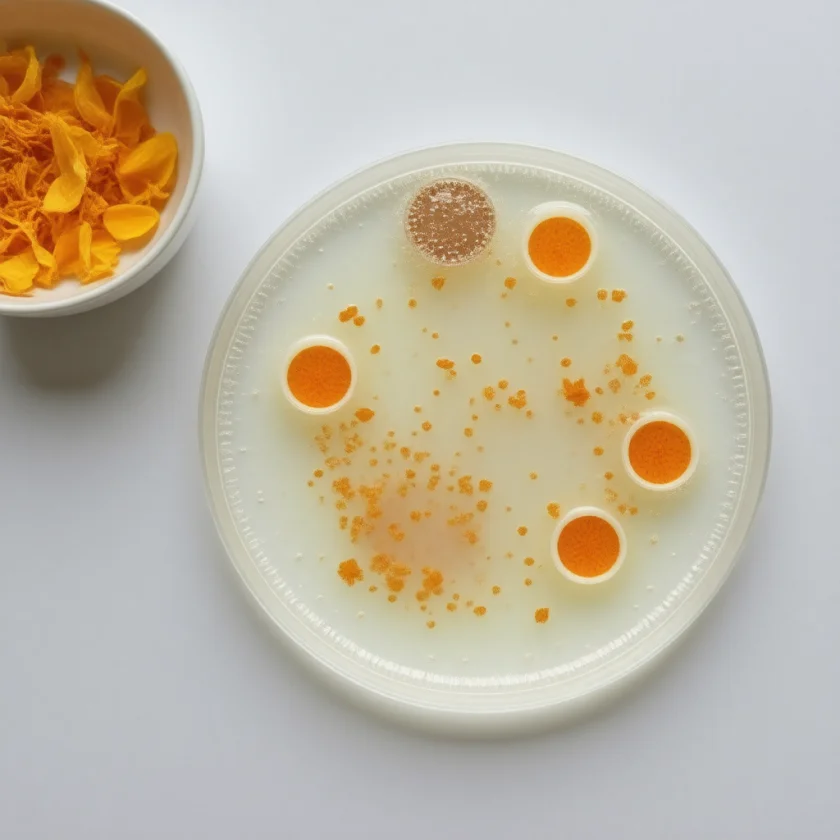
Behind calendula's gentle, soothing reputation are two distinct actions: it calms inflammation, and it has some ability to hold back microbes. The anti-inflammatory side is the better established — classic isolation studies pinned most of the effect on a group of triterpenoid compounds (faradiol esters), backed by flavonoid antioxidants that blunt oxidative stress. The antimicrobial side is real in the test tube but far more preliminary: flower extracts show measurable activity against certain fungi, bacteria, and even viruses in the laboratory, yet very little of this has been proven to matter at the doses found in an ordinary cream. This page separates the two, explains the mechanisms as far as they are understood, and draws a careful line between what happens in a Petri dish and what a jar of calendula ointment can honestly be expected to do on your skin.
Table of Contents
- Two Reputations, One Flower
- The Anti-Inflammatory Engine: Faradiol Triterpenoids
- Flavonoids, Antioxidants & Ultraviolet B Protection
- How Calendula Calms Inflamed Skin
- Antifungal Activity
- Antibacterial Activity
- Antiviral Activity in the Laboratory
- Laboratory Promise vs Clinical Proof
- What This Means in Practice
- Cautions
- Key Research Papers
- External Resources
- Connections
- Featured Videos
Two Reputations, One Flower
Calendula is asked to do two different jobs in traditional skin care. The first is to calm inflammation — take the heat, redness, and swelling out of irritated skin. The second is to fight germs — keep a graze or a sore mouth from becoming infected. These are separate biological effects with separate evidence bases, and it is worth keeping them apart because they are supported very unevenly.
In short: the anti-inflammatory action is the stronger, better-characterized claim, with isolated compounds and defined mechanisms behind it. The antimicrobial action is genuine in laboratory tests but largely unproven in people at the concentrations found in everyday products. Read on with that asymmetry in mind.
The Anti-Inflammatory Engine: Faradiol Triterpenoids
The most important discovery about how calendula works came from careful fractionation studies in the 1990s. When Della Loggia and colleagues (1994) separated calendula flower extract into its chemical fractions and tested each in a standard skin-inflammation model (croton-oil-induced ear oedema in mice), they found that the anti-inflammatory activity tracked almost entirely with the triterpenoid fraction — and within it, with a family of compounds called faradiol esters. Remove the triterpenoids, and you remove most of the effect.
In that mouse-ear swelling test, the faradiol monoester was the most important single contributor because it is the most plentiful triterpenoid in the extract. Unesterified (free) faradiol, which is not present in the extract itself, was the most active compound tested and equalled indomethacin (a standard anti-inflammatory drug) in activity. The anti-inflammatory strength of different CO2 extracts rose in proportion to their faradiol monoester content, which the authors proposed as a quality-control marker for calendula preparations.
A follow-up study by Zitterl-Eglseer and colleagues (1997) isolated the individual triterpendiol esters — faradiol-3-O-myristate and faradiol-3-O-palmitate — and confirmed that they are the principal anti-oedematous (anti-swelling) constituents, with nearly the same activity as each other in the mouse-ear test; free faradiol was more active than its esters and matched an equimolar dose of indomethacin. These pentacyclic triterpenes are now generally accepted as calendula's signature anti-inflammatory compounds, which is why good-quality calendula preparations are sometimes standardized to their triterpenoid content.
This matters for practical reasons discussed on the sources and preparations page: because the active compounds are fat-soluble triterpenoids concentrated in the flower, the way calendula is extracted (oil maceration, alcohol tincture, or CO2 extraction) strongly affects how much active material ends up in the finished product.
Flavonoids, Antioxidants & Ultraviolet B Protection
Alongside the triterpenoids, calendula flowers are rich in flavonoids and other polyphenols — plant antioxidants that neutralize reactive oxygen species. Inflammation and oxidative stress are tightly linked in the skin, so an antioxidant contribution supports the anti-inflammatory picture.
The clearest demonstration is in ultraviolet-light protection. Fonseca and colleagues (2010) gave hairless mice a calendula extract by mouth (150 and 300 mg/kg) and found it protected their skin against ultraviolet B-induced oxidative stress, keeping glutathione (the skin's own antioxidant) close to the levels of mice not exposed to the light and affecting the enzymes MMP-2 and MMP-9, which break down skin tissue. A related study (2011) built the extract into topical formulations; a gel was the best at delivering it into the skin, and in hairless mice it kept glutathione close to normal and reduced ultraviolet B damage to the skin's collagen, but it did not change two other damage markers (gelatinase-9 and myeloperoxidase) raised by the light — an important step, since a compound is only useful if it survives being put into a product.
It is worth being precise: this is antioxidant protection against oxidative damage, not a proven sunscreen. Laboratory spectroscopic tests, not tests on people, measured a sun protection factor (SPF) of 8.36 for calendula essential oil (Lohani and colleagues, 2019) and 18.54 for a cream carrying the oil inside tiny ethanol-and-fat vesicles (Lohani and colleagues, 2021). That cream study was aimed at skin ageing: it also measured antioxidant capacity and inhibition of collagenase and elastase, the enzymes that break down collagen and elastin. Neither study tested calendula as a sunscreen on human skin.
How Calendula Calms Inflamed Skin
Beyond identifying which compounds are active, researchers have begun to map how they act. A bio-guided fractionation study (Colombo and colleagues, 2015), done in human stomach-lining (gastric epithelial) cells in the laboratory and aimed at stomach inflammation rather than skin, found that a calendula flower extract blocked NF-κB-driven transcription, a central switch for inflammatory signals. The most active compounds were faradiol-3-myristate and its aglycone (free faradiol), along with a fraction containing loliolide and fucoside acetates of β-eudesmol and viridiflorol.
Putting the pieces together, calendula appears to soothe inflamed skin through a combination of:
- Triterpenoid inhibition of the inflammatory response — reducing oedema (swelling) and the local inflammatory signal.
- Antioxidant buffering — flavonoids limiting the oxidative stress that both drives and follows inflammation.
- Support for tissue repair — the same actions that quiet inflammation help set the stage for the healing described on the skin and wound healing page.
These are coherent, plausible mechanisms grounded in laboratory and animal data. What they do not tell us is the size of the effect on a real person's skin — for that we still lean on the modest human trials, which show gentle benefit rather than dramatic change.
Antifungal Activity
On the antimicrobial side, the most consistent laboratory finding is antifungal activity. Efstratiou and colleagues (2012) tested calendula petal extracts and reported measurable activity against fungi, alongside effects on Gram-positive and Gram-negative bacteria. The antifungal effect is often the most notable, which fits calendula's traditional use for irritated, itchy skin where low-grade fungal involvement is common. In those laboratory disc-diffusion tests on microbes taken from hospital patients, both methanol and ethanol petal extracts showed what the authors called “excellent antifungal activity” when compared with fluconazole (a standard antifungal drug).
Human evidence is limited but not absent. A randomized trial (Saffari and colleagues, 2017) compared calendula with clotrimazole (a standard antifungal drug) for vaginal candidiasis. The trial enrolled 150 women, who used 5 g of vaginal cream every night for seven nights. At 10–15 days after treatment, fewer women tested negative for yeast in the calendula group than in the clotrimazole group (49% vs 74%), but at 30–35 days more did (77% vs 34%); the authors describe a delayed but greater long-term effect than clotrimazole. This is an interesting result, but a single trial against a specific infection does not make calendula a first-line antifungal — conventional antifungals remain the proven choice, especially when speed matters. For related conditions, see our pages on athlete's foot and fungal skin infections.
Antibacterial Activity
Calendula extracts also show some antibacterial activity in the laboratory. The Efstratiou study above documented inhibition of clinical bacterial pathogens, with the methanol extract more active than the ethanol extract against most of the bacteria tested.
There is also indirect human evidence from a different setting: a double-blind randomized trial in 80 women with bacterial vaginosis (Pazhohideh and colleagues, 2018) compared a calendula vaginal cream with metronidazole vaginal cream (5 g for one week, 40 women in each group). One week after treatment, all women in both groups were free of symptoms, and none reported side effects. It was a single small trial, and it tested a vaginal cream, not calendula on infected skin. A 2024 systematic review of 20 randomized trials of plant treatments for bacterial vaginosis (2,685 participants) listed calendula among the single-plant products with therapeutic effects similar to metronidazole. For herbs with stronger antimicrobial reputations, see antibacterial herbs, tea tree, and manuka honey.
Antiviral Activity in the Laboratory
Some of the most eye-catching claims about calendula come from antiviral laboratory studies. Kalvatchev and colleagues (1997) tested organic and water-based extracts of calendula flowers; both were relatively non-toxic to human cells in culture, but only the organic extract showed anti-HIV activity in vitro — protecting cells in culture from the virus and cutting the activity of its reverse-transcriptase enzyme by up to 85% in a cell-free test.
This kind of finding is genuinely interesting for understanding the plant's chemistry, but it must be framed carefully and honestly: it is a test-tube (in vitro) result. It does not mean calendula treats, prevents, or has any role in human immunodeficiency virus (HIV) or any other viral illness in people. The gap between "inhibits a virus in a dish" and "helps a patient" is enormous, and for calendula that gap has never been bridged for any viral disease. These are basic-science results, not evidence of a treatment.
Laboratory Promise vs Clinical Proof
The antimicrobial story is a textbook example of a general truth about herbal medicine: laboratory activity is common; proven clinical benefit is rare. Many plant extracts inhibit microbes in a Petri dish because they contain concentrated bioactive compounds. Whether that translates to a real effect depends on:
- Concentration. The amount of active compound in a Petri dish is often far higher than what reaches tissue from a cream or rinse.
- Delivery. The compound has to reach the site of infection at an effective dose and stay there — a real hurdle on skin and mucous membranes.
- The living context. A dish has no immune system, no biofilm, no competing flora, and no blood flow washing compounds away.
For calendula, the anti-inflammatory action clears these hurdles better than the antimicrobial one — which is why the plant's most defensible role is soothing inflammation, with any germ-fighting benefit treated as a minor bonus rather than a reason to skip proper treatment of an infection.
What This Means in Practice
- Calming is the best-supported use. The research best supports calendula as a soother for minor, inflamed, irritated skin. For infections, the human evidence is limited to the small vaginal-cream trials described above; calendula has not been shown to replace an antifungal or antibiotic for an infection of the skin.
- Triterpenoid-rich preparations carry the active compounds. Because the anti-inflammatory activity rides on the flower's fat-soluble triterpenoids, an oil- or CO2-based extract of true Calendula officinalis flowers is more likely to carry the active compounds. See the sources and preparations page.
- Warning signs of infection. Spreading redness, warmth, pus, fever, or a wound that worsens are signs of a spreading infection that clinics and hospitals treat as urgent; no study shows an herbal salve treats them.
Cautions
- Daisy-family (Asteraceae) allergy. Calendula can cause allergic contact dermatitis in people sensitive to ragweed, chamomile, echinacea, arnica, and related plants. In a patch-test study of 443 consecutive patients, 9 (about 2%) reacted to marigold (calendula), and only 4 of those 9 also reacted to the standard Compositae (daisy-family) test mix, so a calendula allergy can be missed by the usual daisy-family patch test.
- Antimicrobial effects are mostly laboratory findings. The antifungal, antibacterial, and antiviral effects come mostly from laboratory tests; in people, the evidence is limited to small trials of vaginal creams, and calendula has not been shown to replace proven treatment for a diagnosed infection.
- Pregnancy. Concentrated calendula taken by mouth is traditionally kept out of pregnancy. For skin and mouth use, the European Medicines Agency's calendula monograph states that safety during pregnancy and breastfeeding has not been established and, in the absence of sufficient data, does not recommend use during pregnancy and breastfeeding.
Key Research Papers
All references below are real, peer-reviewed studies linked to their PubMed records. Note how much of the antimicrobial evidence is laboratory-level, while the anti-inflammatory mechanism rests on classic isolation studies.
- Della Loggia R, Tubaro A, Sosa S, et al. The role of triterpenoids in the topical anti-inflammatory activity of Calendula officinalis flowers. Planta Med. 1994. — PubMed PMID: 7809203
- Zitterl-Eglseer K, Sosa S, Jurenitsch J, et al. Anti-oedematous activities of the main triterpendiol esters of marigold (Calendula officinalis L.) J Ethnopharmacol. 1997. — PubMed PMID: 9254116
- Colombo E, Sangiovanni E, D'Ambrosio M, Bosisio E, Ciocarlan A, Fumagalli M, et al. A bio-guided fractionation to assess the inhibitory activity of Calendula officinalis L. on the NF-κB driven transcription in human gastric epithelial cells. Evid Based Complement Alternat Med. 2015;2015:727342. — PubMed PMID: 26491463
- Fonseca YM, Catini CD, Vicentini FT, et al. Protective effect of Calendula officinalis extract against UVB-induced oxidative stress in skin. J Ethnopharmacol. 2010. — PubMed PMID: 20026397
- Fonseca YM, Catini CD, Vicentini FT, et al. Efficacy of marigold extract-loaded formulations against UV-induced oxidative stress. J Pharm Sci. 2011. — PubMed PMID: 21491442
- Efstratiou E, Hussain AI, Nigam PS, et al. Antimicrobial activity of Calendula officinalis petal extracts against fungi, as well as Gram-negative and Gram-positive clinical pathogens. Complement Ther Clin Pract. 2012. — PubMed PMID: 22789794
- Saffari E, Mohammad-Alizadeh-Charandabi S, Adibpour M, et al. Comparing the effects of Calendula officinalis and clotrimazole on vaginal candidiasis: a randomized controlled trial. Women Health. 2017. — PubMed PMID: 27880086
- Pazhohideh Z, Mohammadi S, Bahrami N, et al. The effect of Calendula officinalis versus metronidazole on bacterial vaginosis in women: a double-blind randomized controlled trial. J Adv Pharm Technol Res. 2018. — PubMed PMID: 29441319
- Kalvatchev Z, Walder R, Garzaro D. Anti-HIV activity of extracts from Calendula officinalis flowers. Biomed Pharmacother. 1997. — PubMed PMID: 9207986
- Lohani A, Verma A, Hema G, Pathak K. Topical delivery of geranium/calendula essential oil-entrapped ethanolic lipid vesicular cream to combat skin aging. Biomed Res Int. 2021;2021:4593759. — PubMed PMID: 34552986
- Lohani A, Mishra AK, Verma A. Cosmeceutical potential of geranium and calendula essential oil: determination of antioxidant activity and in vitro sun protection factor. J Cosmet Dermatol. 2019. — PubMed PMID: 30251317
- Kamali M, Sarhadynejad Z, Tajadini H, et al. Evaluation of the efficacy of medicinal plants in treating bacterial vaginosis: a comprehensive systematic review of interventional studies. Iran J Nurs Midwifery Res. 2024;29(6):649-659. — PubMed PMID: 39759925
- Reider N, Komericki P, Hausen BM, et al. The seamy side of natural medicines: contact sensitization to arnica (Arnica montana L.) and marigold (Calendula officinalis L.). Contact Dermatitis. 2001;45(5):269-72. — PubMed PMID: 11722485