Aloe Vera for Skin and Wound Healing
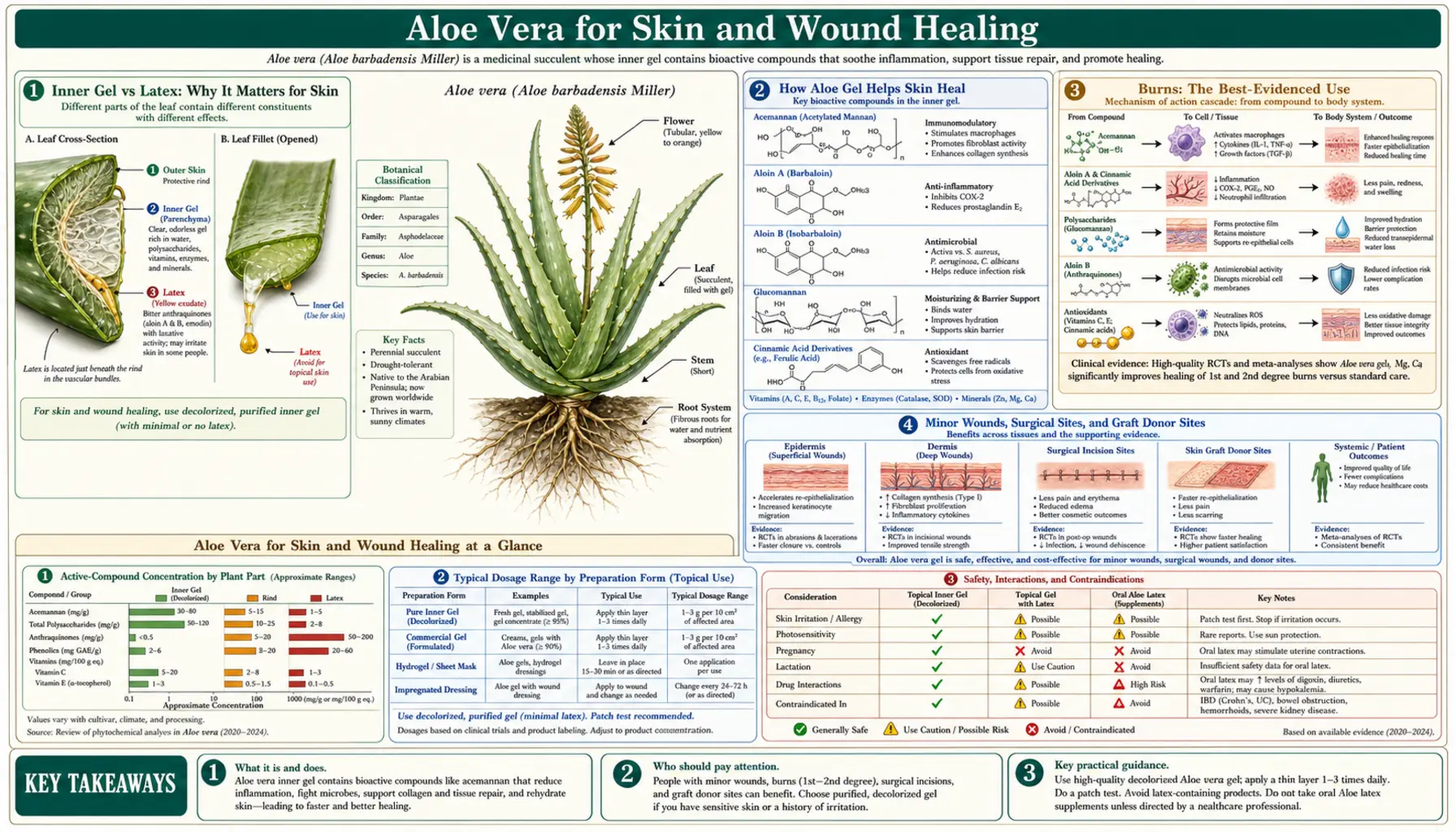
Topical aloe gel is the single best-evidenced use of the plant. For centuries the clear inner-leaf gel has been smeared on burns, cuts, and irritated skin, and modern trials give that tradition real — if modest — support: several meta-analyses of small randomized studies report that aloe shortens the healing time of superficial and partial-thickness burns compared with some standard dressings. The gel works through simple, well-understood physiology (a moist wound environment plus polysaccharides that nudge skin cells to divide) rather than anything miraculous. This page walks through what the evidence supports, what it does not, and how to use aloe on skin safely.
Table of Contents
- Inner Gel vs Latex: Why It Matters for Skin
- How Aloe Gel Helps Skin Heal
- Burns: The Best-Evidenced Use
- Minor Wounds, Surgical Sites, and Graft Donor Sites
- Psoriasis and Seborrheic Dermatitis
- Radiation Dermatitis (An Honest Look)
- Pressure Ulcers (Bedsores)
- Sunburn, Frostbite, Herpes, Acne, Dry Skin
- How to Choose and Use Aloe on Skin
- Cautions and Allergy
- Key Research Papers
- Connections
- Featured Videos
Inner Gel vs Latex: Why It Matters for Skin
For skin, you want the clear inner-leaf gel — the slippery, nearly odorless material in the center of the leaf. You do not want the bitter yellow latex that seeps from just under the green rind; it is an anthraquinone-rich stimulant laxative meant for the gut, and on the skin it offers no wound-healing advantage while adding the risk of irritation. If you fillet a fresh leaf at home, let the cut leaf drain the yellow sap for a few minutes and rinse the gel before applying it. Commercial products intended for skin are made from the inner gel, but cheaper "whole-leaf" preparations can carry latex residue, so a purified or decolorized product is preferable.
How Aloe Gel Helps Skin Heal
Aloe's skin effects come from several overlapping mechanisms, none of them mystical:
- Moist wound healing. Because the gel is about 99% water held in a polysaccharide matrix, it keeps a superficial wound bed moist and covered. Decades of wound science show that keratinocytes re-surface a moist wound faster than a dry, scabbed one — much of aloe's benefit on minor burns and abrasions is this straightforward occlusive-hydration effect.
- Acemannan and fibroblast stimulation. The signature polysaccharide acemannan (an acetylated mannan) has been shown in cell and animal studies to activate macrophages, stimulate fibroblast proliferation, and increase collagen synthesis and growth-factor expression (including keratinocyte growth factor and vascular endothelial growth factor).
- Anti-inflammatory activity. Aloe compounds inhibit cyclooxygenase and reduce prostaglandin E2 and thromboxane, dampening the redness, swelling, and pain of minor skin injury.
- Mild antimicrobial and cooling effects. Aloe has modest in-vitro activity against some bacteria and fungi, and the cool, evaporating gel provides genuine symptomatic relief from the sting of sunburn even where it does not measurably speed healing.
An important caveat: much of the fibroblast and growth-factor evidence comes from laboratory and animal models. The human clinical benefit is real for minor burns but is smaller and less certain than the mechanistic enthusiasm sometimes implies.
Burns: The Best-Evidenced Use
Burns are where aloe's evidence is strongest. An influential 2007 systematic review by Maenthaisong and colleagues pooled four controlled trials and estimated that aloe shortened the healing time of first- and second-degree burns by roughly nine days compared with control dressings. More recent meta-analyses of randomized trials — including a 2024 review in the Journal of Burn Care & Research and a 2022 analysis comparing aloe with silver sulfadiazine — have broadly agreed that aloe is associated with faster healing of superficial and partial-thickness burns, and is at least comparable to silver sulfadiazine, a standard topical burn agent.
The honest qualifiers matter. These trials are small, use different aloe preparations, and carry a high risk of bias (blinding is hard when one dressing is obviously aloe). The benefit applies to superficial and superficial partial-thickness burns — the kind that are painful and red but not deep. Aloe is not a treatment for deep partial-thickness or full-thickness burns, large burns, chemical or electrical burns, or any burn involving the face, hands, feet, genitals, or a major joint. Those need professional medical care. For a small kitchen or sun burn, cool running water first, then a layer of pure aloe gel, is a reasonable and evidence-consistent approach.
Minor Wounds, Surgical Sites, and Graft Donor Sites
For everyday cuts and scrapes, aloe provides the same moist-healing and soothing benefits as for minor burns. For chronic wounds (pressure ulcers, venous leg ulcers, diabetic foot ulcers), the evidence is weaker: a 2012 Cochrane review by Dat and colleagues concluded there was insufficient evidence to determine whether aloe improves healing of acute or chronic wounds, largely because the available trials were few and poor quality.
One well-designed 2018 randomized controlled trial found that aloe gel accelerated healing of split-thickness skin-graft donor sites compared with conventional dressing. Interestingly, the picture is not uniformly positive: a frequently cited study of surgical wounds healing by primary intention after caesarean section and laparotomy actually found delayed healing with aloe, a reminder that a moist, occlusive gel is not always appropriate for a clean, sutured surgical incision. Use aloe for superficial open wounds, not for closed surgical wounds unless a clinician advises it.
Psoriasis and Seborrheic Dermatitis
Aloe has been studied as a topical for plaque psoriasis with genuinely mixed results. A small 1996 placebo-controlled trial by Syed and colleagues reported that an aloe hydrophilic cream cleared plaques in a large majority of patients, a striking result that generated enthusiasm. Later studies were less impressive: some found aloe no better, or even less effective, than a topical corticosteroid such as triamcinolone. The reasonable reading is that aloe may help mild psoriasis as a soothing, moisturizing adjunct, but it is not a substitute for established therapies. It has also been used for seborrheic dermatitis with limited supporting data. For the underlying condition, see our Psoriasis page.
Radiation Dermatitis (An Honest Look)
Aloe is one of the most commonly tried remedies for the skin reaction that develops during radiotherapy, but here the evidence is genuinely disappointing. A 2022 systematic review and cumulative analysis of randomized trials found that aloe did not reliably prevent or reduce radiation-induced dermatitis compared with standard care, and several individual trials were neutral. A self-controlled clinical trial reported some benefit, but the overall body of evidence does not support routine use of aloe for this purpose. This is a good example of a popular use that sounds plausible but is not backed by the trials — patients undergoing radiotherapy should follow their radiation-oncology team's skin-care guidance.
Pressure Ulcers (Bedsores)
A small 2018 triple-blind randomized trial in orthopedic patients reported that applying aloe gel to pressure points reduced the incidence of pressure ulcers, and a few other single-center trials have compared aloe with olive oil or standard care for prevention. The signal is encouraging but the trials are small and not independently replicated at scale, so aloe should be seen as a possible adjunct to — not a replacement for — proven pressure-ulcer prevention (repositioning, pressure-redistributing surfaces, skin care, nutrition).
Sunburn, Frostbite, Herpes, Acne, Dry Skin
- Sunburn. Aloe's cooling, anti-inflammatory gel provides real symptomatic relief. Evidence that it speeds recovery of the sunburn itself is weak, but comfort is a legitimate goal.
- Frostbite. Topical aloe has been used in frostbite protocols as an anti-prostaglandin agent to limit tissue loss; evidence is limited and it is only ever an adjunct to rewarming and medical care.
- Genital and cold-sore herpes. Small trials of aloe cream for genital herpes lesions reported faster healing, but the data are old and thin.
- Acne. Aloe has mild antibacterial and anti-inflammatory effects and is sometimes combined with tretinoin; on its own it is a weak acne treatment. See our Acne page.
- Dry skin and eczema. As a light, water-based moisturizer aloe can soothe dry or itchy skin, though heavier emollients are usually better for eczema. See our Eczema page.
How to Choose and Use Aloe on Skin
- Pick a clean gel. Fresh inner-leaf gel from a filleted leaf, or a commercial gel with a high aloe percentage and minimal additives. For wounds, avoid products with added alcohol, fragrance, or color, which can sting and irritate.
- Prepare the skin. Cool a burn under running water for several minutes first; gently clean a wound. Apply a thin layer of gel two to three times a day.
- Patch test. Dab a small amount on the inner forearm and wait 24 hours before wider use, especially if you have plant allergies.
- Know the limits. Do not use aloe as sole care for deep, large, infected, or full-thickness burns, or on closed surgical incisions unless advised. Seek care for any wound that is spreading, weeping pus, or not improving.
Cautions and Allergy
- Allergic contact dermatitis. Aloe belongs to the same broad plant grouping (Liliaceae / Asphodelaceae) as garlic, onion, and tulip; people sensitive to these can react to aloe with redness, itching, or rash. Stop if irritation develops.
- Surgical wounds. As noted, aloe may delay healing of clean sutured incisions — use it on open superficial wounds, not closed ones, unless a clinician recommends otherwise.
- Use the gel, not the latex. Skin products should be inner-leaf gel; the yellow latex adds irritation risk without benefit.
- No substitute for medical care. Serious burns and non-healing wounds need professional evaluation.
Key Research Papers
- Maenthaisong R, Chaiyakunapruk N, Niruntraporn S, Kongkaew C (2007). The efficacy of aloe vera used for burn wound healing: a systematic review. Burns. — PubMed PMID: 17499928
- Huang YN, Wang Y, et al. (2024). Effects of Aloe vera on burn injuries: a systematic review and meta-analysis of randomized controlled trials. J Burn Care Res. — PubMed PMID: 38605441
- Sharma S, Kaur J, et al. (2022). Second-degree burns and aloe vera: a meta-analysis and systematic review. Adv Skin Wound Care. — PubMed PMID: 36264753
- Levin NJ, Erben Y, et al. (2022). A systematic review and meta-analysis comparing burn healing outcomes between silver sulfadiazine and aloe vera. Cureus. — PubMed PMID: 36337821
- Dat AD, Poon F, Pham KB, Doust J (2012). Aloe vera for treating acute and chronic wounds. Cochrane Database Syst Rev. — PubMed PMID: 22336851
- Burusapat C, Supawan M, et al. (2018). Topical aloe vera gel for accelerated wound healing of split-thickness skin graft donor sites: a double-blind, randomized, controlled trial and systematic review. Plast Reconstr Surg. — PubMed PMID: 29649056
- Syed TA, Ahmad SA, Holt AH, et al. (1996). Management of psoriasis with Aloe vera extract in a hydrophilic cream: a placebo-controlled, double-blind study. Trop Med Int Health. — PubMed PMID: 8765459
- Vogler BK, Ernst E (1999). Aloe vera: a systematic review of its clinical effectiveness. Br J Gen Pract. — PubMed PMID: 10885091
- Wang T, Gao Y, et al. (2022). Aloe vera for prevention of radiation-induced dermatitis: a systematic review and cumulative analysis of randomized controlled trials. Front Pharmacol. — PubMed PMID: 36249738
- Hekmatpou D, Mehrabi F, Rahzani K, Aminiyan A (2018). The effect of aloe vera gel on prevention of pressure ulcers in patients hospitalized in the orthopedic wards: a randomized triple-blind clinical trial. BMC Complement Altern Med. — PubMed PMID: 30268162
- Xing W, Guo W, et al. (2015). Acemannan accelerates cell proliferation and skin wound healing through AKT/mTOR signaling pathway. J Dermatol Sci. — PubMed PMID: 26049685
- Jettanacheawchankit S, Sasithanasate S, et al. (2009). Acemannan stimulates gingival fibroblast proliferation; expressions of keratinocyte growth factor-1, vascular endothelial growth factor, and type I collagen; and wound healing. J Pharmacol Sci. — PubMed PMID: 19372635
PubMed Topic Searches
- PubMed: Aloe vera burn wound healing (RCTs)
- PubMed: Aloe vera wound healing reviews
- PubMed: Acemannan wound healing
- PubMed: Aloe vera psoriasis
- PubMed: Aloe vera radiation dermatitis
External Authoritative Resources
Connections
- All Herbs
- Aloe Vera Overview
- Aloe Vera Benefits Hub
- Aloe Vera for Digestive Health
- Aloe Vera for Oral & Dental Health
- Psoriasis
- Eczema
- Acne
- Dermatology (All Conditions)
- Tea Tree
- Calendula
- Chamomile
- Antibacterial Herbs
- Natural Remedies