Aloe Vera for Oral and Dental Health
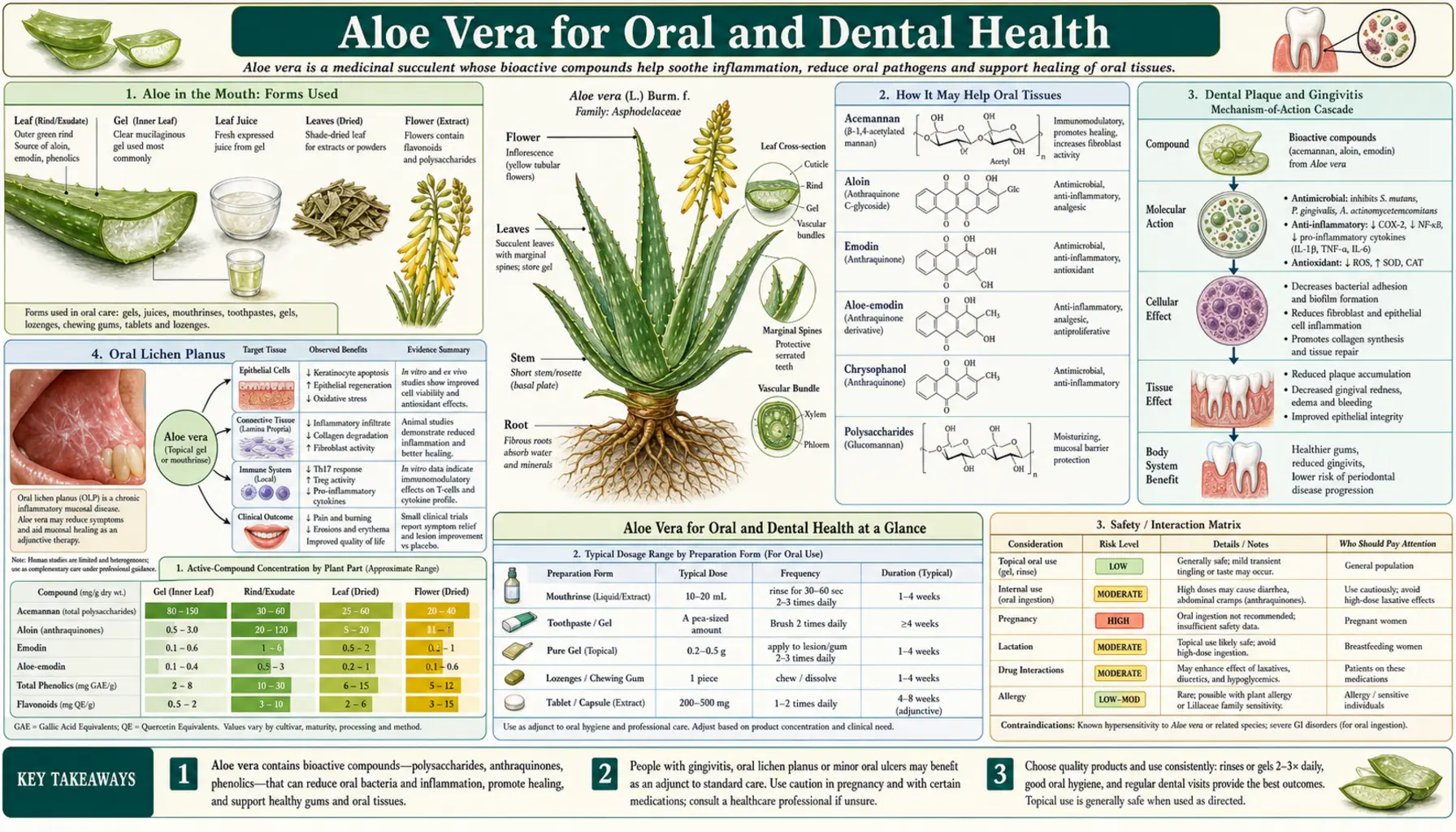
The mouth may be aloe's most underrated application. Aloe mouthwash reduces dental plaque and gum inflammation about as well as chlorhexidine — the gold-standard antiseptic rinse — in several short randomized trials, but without chlorhexidine's tooth staining and taste changes. Topical aloe gel also helps painful mucosal conditions such as oral lichen planus and oral submucous fibrosis, and the polysaccharide acemannan supports healing after tooth extraction. As always, the inner-leaf gel is the part used; this page reviews the dental evidence, what it does and does not establish, and how to use aloe oral-care products sensibly.
Table of Contents
- Aloe in the Mouth: Forms Used
- How It May Help Oral Tissues
- Dental Plaque and Gingivitis
- Oral Lichen Planus
- Oral Submucous Fibrosis
- Mouth Ulcers, Denture Stomatitis, Dry Mouth
- Healing After Tooth Extraction
- Choosing and Using Oral-Care Aloe
- Cautions
- Key Research Papers
- Connections
- Featured Videos
Aloe in the Mouth: Forms Used
Oral-care research uses the inner-leaf gel in three main forms: as a mouthwash / rinse (the most studied), as a topical gel painted onto sore mucosa or lesions, and blended into a toothgel or dentifrice. Because these products are swished and sometimes swallowed in small amounts, a low-aloin, decolorized inner-leaf preparation is preferable — you do not want the anthraquinone latex in something you rinse with daily.
How It May Help Oral Tissues
- Anti-inflammatory action on inflamed gums and mucosa, reducing redness, swelling, and pain.
- Antimicrobial activity against plaque-forming bacteria and against Candida, relevant to gingivitis and denture stomatitis.
- Wound-healing support from acemannan, which stimulates gingival fibroblasts and growth-factor expression — useful for healing ulcers and extraction sockets.
- Soothing mucosal coating that provides symptomatic relief for raw or ulcerated tissue.
Dental Plaque and Gingivitis
This is aloe's best oral-health evidence. A 2020 systematic review by Al-Maweri and colleagues concluded that aloe vera mouthwash was comparable to chlorhexidine in reducing dental plaque and gingivitis, and comparable or superior to placebo — a notable finding because chlorhexidine, while highly effective, causes tooth staining, taste alteration, and (with long use) calculus buildup that many people dislike. Individual randomized trials since then — including work by Boyapati and colleagues (2024), Kamath and colleagues (2023) in orthodontic patients, and Penmetsa and colleagues (2019) — have reproduced the pattern: aloe rinses lower plaque and gingival indices, roughly on par with chlorhexidine over the short study periods.
The honest limits: these trials are short (usually 2 to 4 weeks), use varied aloe formulations, and show aloe as comparable to chlorhexidine, not clearly better. Aloe is therefore a reasonable choice for people who want to reduce gum inflammation but cannot tolerate chlorhexidine's side effects — not a replacement for brushing, flossing, and professional cleaning. For the condition, see our Gum Disease page.
Oral Lichen Planus
Oral lichen planus is a chronic inflammatory condition that causes painful white patches and erosions in the mouth. A 2017 systematic review and meta-analysis by Ali and Wahbi found that topical aloe vera reduced pain and clinical signs compared with placebo. Head-to-head trials have compared aloe with standard topical steroids: a 2023 randomized trial by Vaidya and colleagues compared aloe with clobetasol propionate, and a 2022 trial by Bhatt and colleagues compared aloe with low-level laser therapy, both suggesting aloe is a useful option for milder disease. Aloe is best viewed as a reasonable, low-side-effect adjunct or alternative for mild symptomatic oral lichen planus — more severe or erosive disease still needs specialist care. See our Lichen Planus page.
Oral Submucous Fibrosis
Oral submucous fibrosis is a pre-malignant condition, driven mainly by areca (betel) nut chewing, in which the mouth's lining stiffens and mouth opening becomes progressively limited. A 2019 systematic review and meta-analysis by Al-Maweri and colleagues found that aloe vera improved the burning sensation and mouth opening in these patients, generally as an adjunct to stopping areca-nut use and to other therapies. The evidence is low-to-moderate quality, so aloe is a supportive measure, not a cure; the essential intervention is complete cessation of areca/betel nut and close monitoring for malignant change.
Mouth Ulcers, Denture Stomatitis, Dry Mouth
- Aphthous ulcers (canker sores). Small studies suggest topical aloe gel can reduce ulcer pain and size and speed healing, consistent with its soothing and wound-healing properties.
- Denture stomatitis. Aloe's activity against Candida has led to its study as a denture-soak and topical treatment for the inflamed, yeast-associated mucosa under dentures.
- Dry mouth (xerostomia). As a moist, soothing coating, aloe can provide symptomatic comfort, though it does not restore saliva production.
A 2016 systematic review by Nair and colleagues summarized aloe's role across several oral mucosal diseases, concluding it shows promise as an adjunct while noting the need for larger, higher-quality trials.
Healing After Tooth Extraction
The polysaccharide acemannan has been studied as an aid to socket healing after tooth extraction. Laboratory and model work by Boonyagul and colleagues showed acemannan promotes bone-marrow stromal cell proliferation, differentiation, and bone formation in a tooth-extraction model, and Jettanacheawchankit and colleagues showed acemannan stimulates gingival fibroblast proliferation and wound healing. Some clinical work using acemannan sponges suggests faster, more comfortable socket healing and a lower risk of dry socket. This is a promising, mechanism-supported use that is still being established in larger clinical trials.
Choosing and Using Oral-Care Aloe
- Alcohol-free, low-aloin rinse. Choose a decolorized inner-leaf product; avoid alcohol-based rinses, which dry the mouth.
- Swish, do not chug. Rinse for about 30 seconds twice daily; do not swallow large amounts (to keep any latex exposure minimal).
- Adjunct, not replacement. Aloe complements — it does not replace — brushing, flossing, and professional dental care.
- For lesions, apply topical gel to the affected area as directed, and keep dental or specialist follow-up for persistent white patches, ulcers lasting more than two weeks, or limited mouth opening.
Cautions
- Allergy. Stop if you develop mouth irritation, swelling, or rash; aloe can cause allergic contact reactions.
- Do not swallow latex-containing products. Oral-care aloe should be decolorized inner-leaf gel, not whole-leaf or latex material.
- Persistent lesions need evaluation. Any white patch, ulcer, or lump that does not heal within two weeks should be assessed by a dentist or doctor to rule out serious disease — do not self-treat indefinitely with aloe.
- Not a substitute for professional care of gum disease (scaling and root planing) or oral pre-malignant conditions.
Key Research Papers
- Al-Maweri SA, Nassani MZ, Alaizari N, et al. (2020). Efficacy of aloe vera mouthwash versus chlorhexidine on plaque and gingivitis: a systematic review. Int J Dent Hyg. — PubMed PMID: 30829440
- Boyapati R, Cherukuri SA, et al. (2024). Comparative evaluation of the efficacy of probiotic, aloe vera, povidone-iodine, and chlorhexidine mouthwashes in the treatment of gingival inflammation: a randomized controlled trial. Dent Med Probl. — PubMed PMID: 38652926
- Kamath DG, Nadimpalli H, et al. (2023). Comparison of antiplaque and anti-gingivitis effects of aloe vera mouthwash with chlorhexidine in fixed orthodontic patients: a randomized controlled trial. Int J Dent Hyg. — PubMed PMID: 35943370
- Penmetsa GS, Vivek B, et al. (2019). Efficacy of Ocimum sanctum, Aloe vera and chlorhexidine mouthwash on gingivitis: a randomized controlled comparative clinical study. Ayu. — PubMed PMID: 31831965
- Ali S, Wahbi W (2017). The efficacy of aloe vera in management of oral lichen planus: a systematic review and meta-analysis. Oral Dis. — PubMed PMID: 28029732
- Bhatt G, Gupta S, et al. (2022). Comparative efficacy of topical aloe vera and low-level laser therapy in the management of oral lichen planus: a randomized clinical trial. Lasers Med Sci. — PubMed PMID: 34853932
- Vaidya AU, et al. (2023). Efficacy of aloe vera and clobetasol propionate in the management of oral lichen planus: a randomized parallel clinical trial. Front Dent. — PubMed PMID: 37312826
- Al-Maweri SA (2019). Aloe vera in treatment of oral submucous fibrosis: a systematic review and meta-analysis. J Oral Pathol Med. — PubMed PMID: 30329174
- Nair GR, Naidu GS, et al. (2016). Clinical effectiveness of aloe vera in the management of oral mucosal diseases: a systematic review. J Clin Diagn Res. — PubMed PMID: 27656587
- Boonyagul S, Banlunara W, et al. (2014). Effect of acemannan, an extracted polysaccharide from Aloe vera, on BMSCs proliferation, differentiation, extracellular matrix synthesis, mineralization, and bone formation in a tooth extraction model. Odontology. — PubMed PMID: 23315202
- Jettanacheawchankit S, Sasithanasate S, et al. (2009). Acemannan stimulates gingival fibroblast proliferation; expressions of keratinocyte growth factor-1, vascular endothelial growth factor, and type I collagen; and wound healing. J Pharmacol Sci. — PubMed PMID: 19372635
PubMed Topic Searches
- PubMed: Aloe vera mouthwash gingivitis
- PubMed: Aloe vera oral lichen planus
- PubMed: Aloe vera oral submucous fibrosis
- PubMed: Aloe vera vs chlorhexidine
- PubMed: Acemannan and oral healing
External Authoritative Resources
- NCCIH — Aloe Vera
- MedlinePlus — Aloe
- American Dental Association — Mouthrinses
- PubMed — Aloe Vera Oral / Dental Research
Connections
- All Herbs
- Aloe Vera Overview
- Aloe Vera Benefits Hub
- Aloe Vera for Skin & Wound Healing
- Aloe Vera for Digestive Health
- Gum Disease
- Lichen Planus
- All ENT & Oral Conditions
- Tea Tree
- Chamomile
- Calendula
- Peppermint
- Antibacterial Herbs
- Natural Remedies
- Conditions on this site that reference this page: Gingivitis · Halitosis (Chronic Bad Breath) · Periodontitis (Gum Disease) · Dentistry & Oral Health