Aloe Vera — Benefits Deep Dive
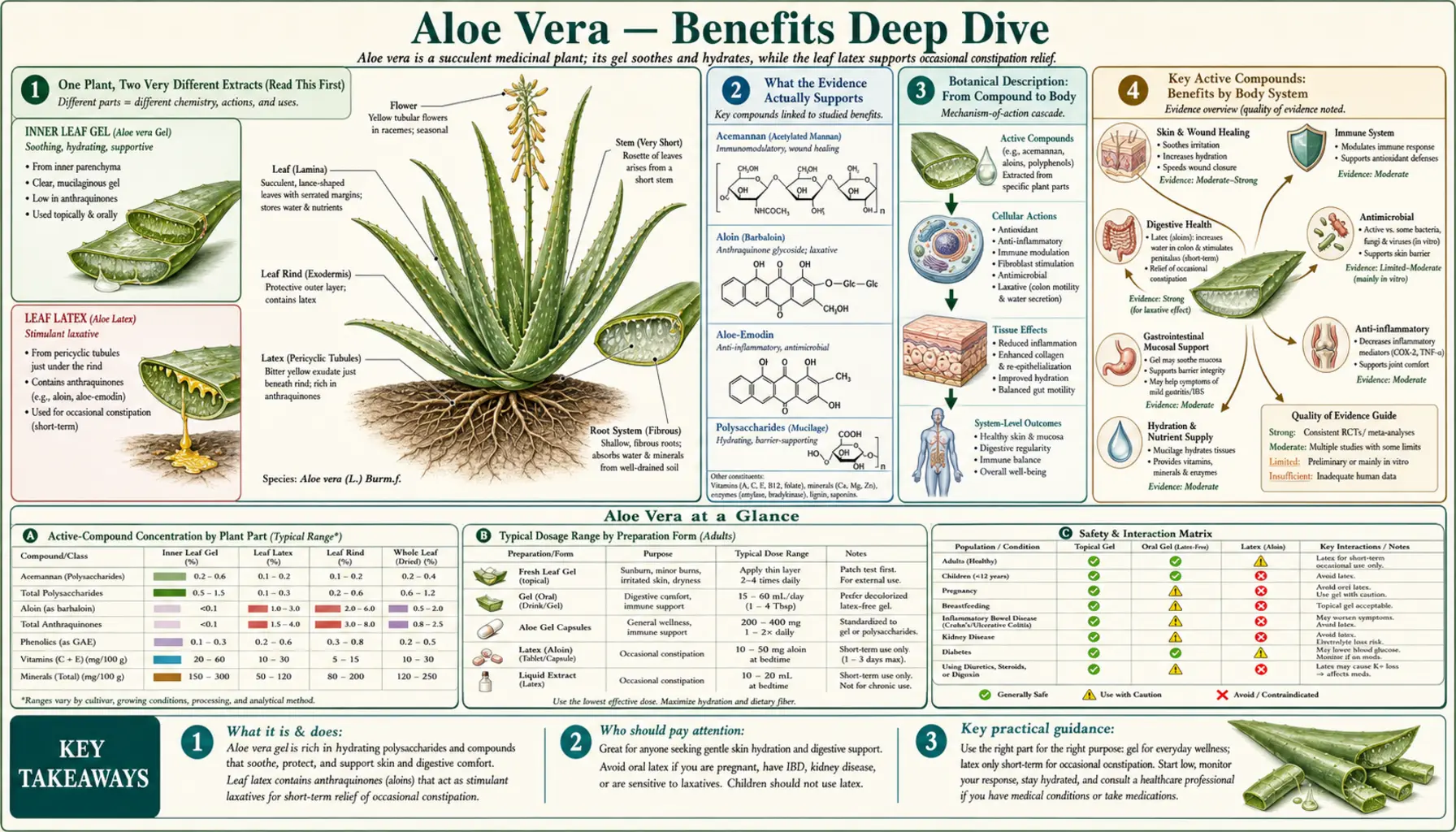
Aloe vera is one of the most widely used medicinal plants in the world, but the phrase "aloe vera" actually covers two very different substances that come from the same leaf: the clear inner-leaf gel and the bitter yellow latex just beneath the rind. Almost all of the benefits people want come from the inner gel, while almost all of the safety problems come from the latex. These four deep-dive pages separate the genuinely well-evidenced use (topical gel for burns and minor wounds) from the promising-but-preliminary ones (blood sugar, digestion, oral health), and they are honest about where the evidence is thin and where the latex form carries real, documented risk.
Deep-Dive Articles
Skin & Wound Healing
The best-evidenced use of the plant. Topical gel for sunburn, superficial and partial-thickness burns, minor wounds, psoriasis, and radiation dermatitis — what the burn meta-analyses actually show, how acemannan and moist-wound-healing physiology work, and the honest limits (deep burns, surgical wounds, allergy).
Digestive Health
Oral aloe for IBS, ulcerative colitis, and reflux — and a clear warning that aloe latex is a harsh anthraquinone stimulant laxative with genuine safety concerns (FDA de-listing, IARC 2B, EFSA restriction). How to tell inner-leaf gel from latex and choose a decolorized product.
Blood Sugar & Metabolic
Small randomized trials and meta-analyses suggest oral aloe gel may modestly lower fasting glucose and HbA1c, with the clearest signal in prediabetes and early type 2 diabetes. Effects on cholesterol and triglycerides, the proposed mechanisms, and why the evidence is still low-certainty.
Oral & Dental
Aloe mouthwash for dental plaque and gingivitis (comparable to chlorhexidine in short trials, without the staining), plus topical gel for oral lichen planus, oral submucous fibrosis, mouth ulcers, and post-extraction socket healing via acemannan.
Table of Contents
- Deep-Dive Articles
- One Plant, Two Very Different Extracts
- What the Evidence Actually Supports
- Key Research Papers
- External Authoritative Resources
- Connections
- Featured Videos
One Plant, Two Very Different Extracts (Read This First)
Understanding aloe vera starts with a cross-section of the leaf. Cut one open and you find two distinct materials that behave nothing alike:
- Inner-leaf gel — the clear, slippery mucilage that fills the center of the leaf (the parenchyma). It is roughly 99% water held in a matrix of polysaccharides — most notably acemannan, an acetylated polymannose — along with glycoproteins, enzymes, and small amounts of vitamins and minerals. This is the part used for burns, skin, mouthwash, and oral juice. It is generally safe on the skin and, when properly purified, reasonably well tolerated by mouth.
- Latex (also called "aloe") — the bitter, yellow exudate that seeps from the pericyclic cells just under the green rind. It is rich in anthraquinone glycosides, chiefly aloin A and B (barbaloin) and aloe-emodin. These compounds are potent stimulant laxatives, and they are the source of aloe's real safety concerns.
The regulatory record makes the distinction concrete. In 2002 the U.S. Food and Drug Administration removed aloe latex from the list of ingredients "generally recognized as safe and effective" for over-the-counter laxatives, because manufacturers did not supply the safety and efficacy data required. The International Agency for Research on Cancer classifies whole-leaf aloe vera extract (which contains the latex) as Group 2B, "possibly carcinogenic to humans," based largely on a U.S. National Toxicology Program study that found large-intestine tumors in rats given non-decolorized whole-leaf extract in drinking water. In 2021 the European Union restricted hydroxyanthracene derivatives such as aloe-emodin, emodin, and preparations containing them from use in food over genotoxicity concerns.
The practical takeaway repeated across all four pages: for anything taken by mouth, choose a decolorized (purified) inner-leaf product — look for an aloin content typically below 10 parts per million and, in the United States, a seal from the International Aloe Science Council (IASC). Avoid products labeled "whole leaf" or "aloe latex" for regular use, and do not use aloe latex as a routine laxative.
What the Evidence Actually Supports
Aloe vera is surrounded by more marketing than data. Sorting the claims by the strength of the human evidence gives a realistic picture:
- Best-supported — topical gel for superficial and partial-thickness burns. Several systematic reviews and meta-analyses of small randomized trials report shorter healing times with aloe than with some standard dressings, though the trials are small and of low-to-moderate quality.
- Moderate but mixed — oral gel producing a modest drop in fasting glucose and HbA1c in prediabetes and early type 2 diabetes; aloe mouthwash reducing dental plaque and gingivitis about as well as chlorhexidine in short studies; topical or oral gel easing oral lichen planus.
- Preliminary / promising — irritable bowel syndrome, ulcerative colitis, gastro-oesophageal reflux, psoriasis, radiation dermatitis, and pressure-ulcer prevention. Each rests on a handful of small trials with inconsistent results.
- Not recommended — aloe latex as a routine laxative, and any whole-leaf product for long-term oral use.
Throughout, the honest framing is that aloe is a reasonable adjunct for a few specific problems — not a cure, and never a replacement for medical care of serious burns, inflammatory bowel disease, or diabetes.
Key Research Papers
Skin & Wound Healing
- Maenthaisong R, Chaiyakunapruk N, Niruntraporn S, Kongkaew C (2007). The efficacy of aloe vera used for burn wound healing: a systematic review. Burns. — PubMed PMID: 17499928
- Huang YN, Wang Y, et al. (2024). Effects of Aloe vera on burn injuries: a systematic review and meta-analysis of randomized controlled trials. J Burn Care Res. — PubMed PMID: 38605441
- Dat AD, Poon F, Pham KB, Doust J (2012). Aloe vera for treating acute and chronic wounds. Cochrane Database Syst Rev. — PubMed PMID: 22336851
- Vogler BK, Ernst E (1999). Aloe vera: a systematic review of its clinical effectiveness. Br J Gen Pract. — PubMed PMID: 10885091
Digestive Health
- Langmead L, Feakins RM, Goldthorpe S, et al. (2004). Randomized, double-blind, placebo-controlled trial of oral aloe vera gel for active ulcerative colitis. Aliment Pharmacol Ther. — PubMed PMID: 15043514
- Hong SW, Chun J, Park S, et al. (2018). Aloe vera is effective and safe in short-term treatment of irritable bowel syndrome: a systematic review and meta-analysis. J Neurogastroenterol Motil. — PubMed PMID: 30153721
- Muller SO, Eckert I, Lutz WK, Stopper H (1996). Genotoxicity of the laxative drug components emodin, aloe-emodin and danthron in mammalian cells. Mutat Res. — PubMed PMID: 9008718
Blood Sugar & Metabolic
- Suksomboon N, Poolsup N, Punthanitisarn S (2016). Effect of Aloe vera on glycaemic control in prediabetes and type 2 diabetes: a systematic review and meta-analysis. J Clin Pharm Ther. — PubMed PMID: 27009750
- Dick WR, Fletcher EA, Shah SA (2016). Reduction of fasting blood glucose and hemoglobin A1c using oral aloe vera: a meta-analysis. J Altern Complement Med. — PubMed PMID: 27152917
Oral & Dental
- Al-Maweri SA, Nassani MZ, Alaizari N, et al. (2020). Efficacy of aloe vera mouthwash versus chlorhexidine on plaque and gingivitis: a systematic review. Int J Dent Hyg. — PubMed PMID: 30829440
- Ali S, Wahbi W (2017). The efficacy of aloe vera in management of oral lichen planus: a systematic review and meta-analysis. Oral Dis. — PubMed PMID: 28029732
Safety & Toxicology
- Dunnick JK, Nyska A (2013). The toxicity and pathology of selected dietary herbal medicines. Toxicol Pathol. — PubMed PMID: 23262639
- Hoogenboom TCH, et al. (2020). The effect of aloe vera juice on liver enzymes and hepatic structure in a healthy population. Integr Med (Encinitas). — PubMed PMID: 33132775
External Authoritative Resources
- NCCIH (U.S. National Center for Complementary and Integrative Health) — Aloe Vera
- MedlinePlus — Aloe
- National Toxicology Program — Aloe Vera Studies
- EFSA — Hydroxyanthracene Derivatives in Food (Safety Opinion)
- PubMed — All Aloe Vera Clinical Trials
Connections
- All Herbs
- Aloe Vera (Main Page)
- Aloe Vera for Skin & Wound Healing
- Aloe Vera for Digestive Health
- Aloe Vera for Blood Sugar & Metabolic Health
- Aloe Vera for Oral & Dental Health
- Tea Tree
- Calendula
- Chamomile
- Slippery Elm
- Antibacterial Herbs
- Psoriasis
- Ulcerative Colitis
- Type 2 Diabetes
- Gum Disease
- Natural Remedies