Ashwagandha for Cognitive Function
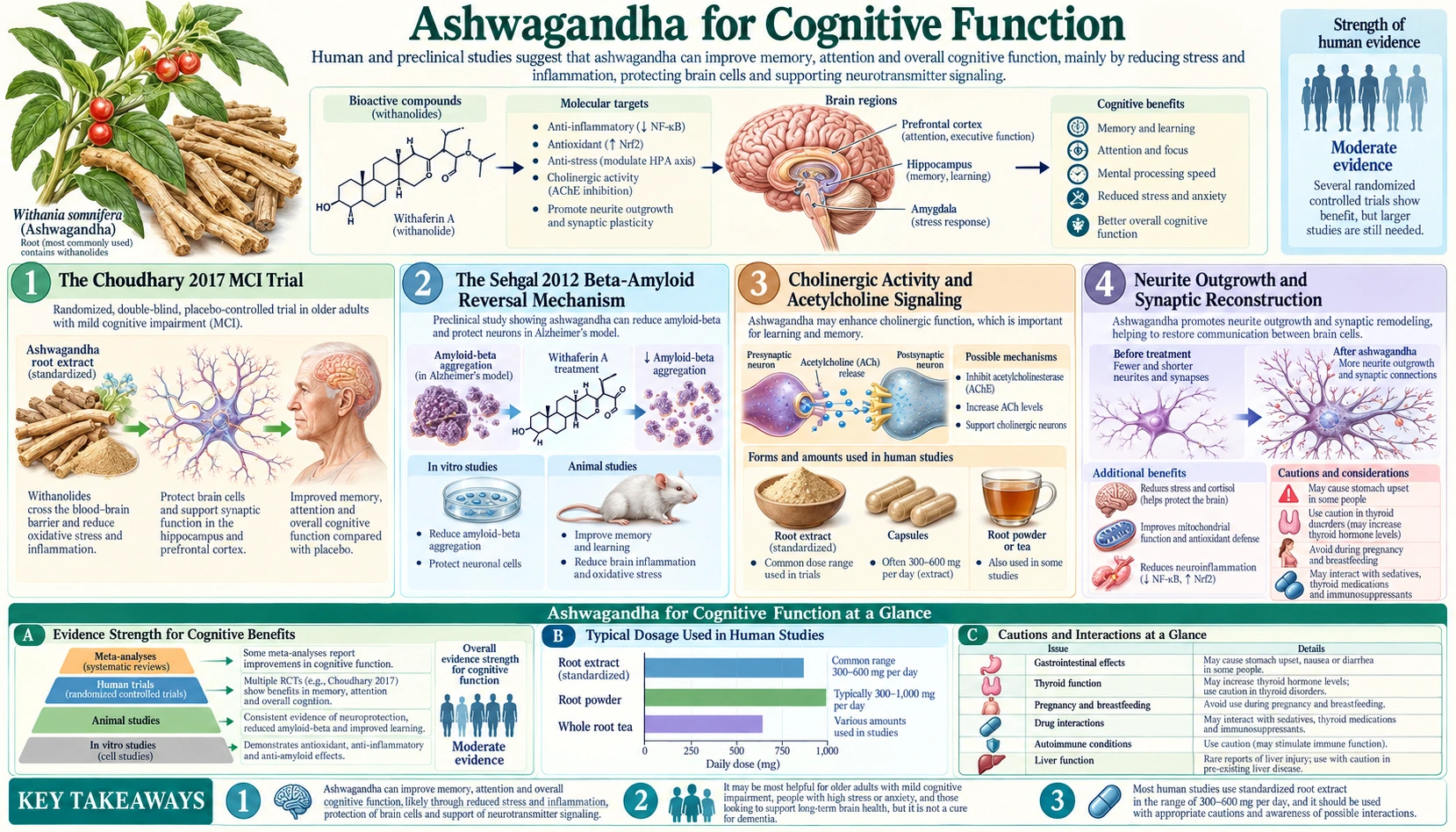
Ashwagandha is one of a small number of botanicals with documented cognitive benefit in randomized controlled trials — not just in healthy young adults seeking mental performance enhancement, but in older adults with mild cognitive impairment (MCI), a population where most interventions fail. The pivotal trial — Choudhary, Bhattacharyya, and Bose 2017, published in the Journal of Dietary Supplements — randomized 50 adults with MCI to 300 mg of ashwagandha root extract twice daily or placebo for 8 weeks in a pilot study. The active treatment group showed statistically significant improvements in immediate and general memory (Wechsler Memory Scale) and in executive function, sustained attention, and information-processing speed (Eriksen Flanker task, Wisconsin Card Sort test, Trail-Making test part A, and Mackworth Clock test). The mechanism has been studied in cells and animals: Kuboyama, Tohda, and Komatsu reported in 2005 and 2006 that withanolide A and withanoside IV regenerate axons, dendrites, and synapses in cultured rat neurons damaged by beta-amyloid, and Sehgal and colleagues reported in a 2012 PNAS paper that an oral root extract reversed Alzheimer-like plaque pathology in mice by raising the clearance protein LRP in the liver, with downstream implications for Alzheimer's and Parkinson's research. This page covers the cognitive trial evidence, the cellular mechanisms (cholinergic activity, brain-derived neurotrophic factor (BDNF), neurite outgrowth, beta-amyloid reversal), the comparison with bacopa, lion's mane, and other nootropic botanicals, and the practical application to mild cognitive impairment, normal age-related cognitive decline, and exam-period mental performance in younger adults.
Table of Contents
- The Choudhary 2017 MCI Trial
- The Sehgal 2012 Beta-Amyloid Reversal Mechanism
- Cholinergic Activity and Acetylcholine Signaling
- Neurite Outgrowth and Synaptic Reconstruction
- Brain-Derived Neurotrophic Factor and Adult Neuroplasticity
- Nrf2 Activation and Neuroprotection from Oxidative Stress
- Alzheimer's Disease Research and Translation Status
- Parkinson's Disease and Neurodegenerative Models
- Application in Young Adults and Exam-Period Performance
- The Pooled Trial Evidence on Ashwagandha and Thinking
- Comparison with Bacopa, Lion's Mane, and Other Nootropics
- Dosing for Cognitive Indications
- Cautions
- Key Research Papers
- Connections
- Featured Videos
The Choudhary 2017 MCI Trial
Choudhary, Bhattacharyya, and Bose published the most cited cognitive trial of Ashwagandha in the Journal of Dietary Supplements in 2017. The design was a prospective, randomized, double-blind, placebo-controlled study in 50 adults aged 35-75 with mild cognitive impairment (MCI) — defined as subjective cognitive complaint with objective evidence of impairment on neuropsychological testing, but without dementia.
Subjects were randomized 1:1 to receive either 300 mg of ashwagandha root extract twice daily, or matched placebo, for 8 weeks. The authors describe it as a pilot study. The neuropsychological battery included the Wechsler Memory Scale-III (logical memory, faces, family pictures, verbal paired associates), the Trail-Making test part A, the Wisconsin Card Sort test, the Eriksen Flanker task (selective attention, response inhibition), and the Mackworth Clock test (sustained attention and vigilance).
Results at 8 weeks (Ashwagandha vs placebo):
- Logical memory (immediate) — 13.8% improvement vs 4.5%
- Logical memory (delayed recall) — 22.0% improvement vs 9.5%
- Verbal paired associates (immediate and delayed) — significantly greater improvement than placebo (p = 0.042 and p = 0.031)
- Faces (immediate and delayed) — significantly greater improvement than placebo (p = 0.020 and p = 0.014)
- Trail-Making test part A (visual scanning, motor speed) — significantly greater improvement than placebo (p = 0.006)
- Wisconsin Card Sort test (executive function) — significantly greater improvement than placebo (p = 0.014)
- Eriksen Flanker task — significantly greater improvement than placebo (p = 0.002)
- Mackworth Clock test (sustained attention) — significantly greater improvement than placebo (p = 0.009)
- Adverse events — mild and indistinguishable from placebo
The pattern of improvement is notable for being broad — multiple cognitive domains improved, not just one. This is consistent with a mechanism that affects general neural function (cholinergic transmission, brain-derived neurotrophic factor, oxidative stress) rather than one that targets a specific cognitive faculty (a pure mnemonic, for example).
A 2014 Pingali crossover trial in 20 healthy male subjects (no cognitive impairment) gave two 250 mg capsules twice daily of a dried aqueous extract of ashwagandha roots and leaves, or placebo, for 14 days. Reaction times improved significantly compared with placebo on simple reaction, choice discrimination, digit symbol substitution, digit vigilance, and card sorting tests; the finger tapping test showed no effect. The effect in healthy subjects is smaller in absolute magnitude than in the MCI population but still measurable.
A second placebo-controlled pilot trial in mild cognitive impairment was published in 2025. Rai and Mishra randomized 40 adults with MCI in India to 250 mg daily of an ashwagandha extract standardized to sominone, or placebo, for 60 days. The treated group did better than placebo on immediate, general, and working memory (Wechsler Memory Scale-III) and on a mental rotation test. Montreal Cognitive Assessment (MoCA) scores rose 14.77% and Mini-Mental State Examination (MMSE) scores 19.21% from baseline at 60 days, a significant improvement compared with the placebo group. With this trial, the MCI evidence now rests on two small Indian pilot trials, not one.
A third, larger placebo-controlled trial, by Kale and colleagues (published online in 2024), enrolled 120 adults aged 30-75 who reported problems with thinking and energy. They took 600 mg a day of ashwagandha root extract (60 people) or an identical placebo (60 people) for 8 weeks. On a computerized test battery, the ashwagandha group improved more than the placebo group in episodic memory, working memory and accuracy of attention. Its scores on questionnaires for mood, mental fatigue and executive function (planning and organising) also improved. No serious adverse events were reported in either group.
The Sehgal 2012 Beta-Amyloid Reversal Mechanism
The most striking mechanistic finding in Ashwagandha cognitive pharmacology came from Neha Sehgal and colleagues, with senior author Vijayalakshmi Ravindranath, at the National Brain Research Centre in Manesar, Haryana, India. Their 2012 paper in Proceedings of the National Academy of Sciences demonstrated that Withania somnifera root extract can reverse cognitive deficits and beta-amyloid pathology in a mouse model of Alzheimer's disease.
The experimental design used APP/PS1 transgenic mice that overexpress mutant human amyloid precursor protein and presenilin-1 — producing the cardinal pathology of Alzheimer's disease (extracellular amyloid plaque deposition in cortex and hippocampus, synaptic loss, cognitive deficits in spatial learning and memory). Middle-aged and old APP/PS1 mice were given a 30-day oral course of a semipurified Withania somnifera root extract made up mainly of withanolides and withanosides. A second Alzheimer's mouse line (APPSwInd, line J20) was also tested.
Findings:
- Plaque load reduction — the extract reversed plaque pathology in APP/PS1 mice and reduced plaque load in J20 mice
- Beta-amyloid reduction — the build-up of beta-amyloid peptides and oligomers in the brain was reversed
- Behavioural reversal — behavioural deficits were reversed in both mouse lines
- Timing — within 7 days, beta-amyloid rose in the blood plasma and fell in the brain, which the authors read as increased transport of beta-amyloid from the brain to the periphery
- Mechanism is peripheral, not central — the surprising finding. Liver LRP (low-density lipoprotein receptor-related protein) and the beta-amyloid-degrading enzyme neprilysin rose at 7 days, together with soluble LRP in plasma, a peripheral sink for brain beta-amyloid. The same proteins rose in brain blood vessels only 14-21 days later. When liver LRP was selectively switched down, the extract's therapeutic effect was lost; switching down neprilysin did not have that effect.
This peripheral-sink mechanism was a major conceptual contribution — it provided a rationale for how a botanical might affect brain pathology without itself crossing the blood-brain barrier in pharmacologically meaningful concentrations. The withanolide compounds enter the liver, upregulate hepatic LRP, and the peripheral clearance of amyloid pulls brain amyloid down through equilibrium.
Separately, a different group — Kuboyama, Tohda, and Komatsu at the Institute of Natural Medicine in Toyama, Japan — had reported in 2005 and 2006 that withanolide A and withanoside IV (through its metabolite sominone) regenerate axons and dendrites and rebuild synapses in cultured rat cortical neurons damaged by beta-amyloid. The combined picture is one of both clearance (peripheral sink) and rebuilding (synaptic regeneration) — the two arms of any plausible disease-modifying therapy for Alzheimer's disease.
The translation to human clinical Alzheimer's disease has not yet been established with adequate trials. The Choudhary 2017 MCI trial is the closest evidence and is encouraging, but a Phase 3 trial in mild-to-moderate Alzheimer's disease has not been completed. Ashwagandha remains experimental and adjunctive in the Alzheimer's disease context, not a substitute for U.S. Food and Drug Administration-approved disease-modifying therapies.
Cholinergic Activity and Acetylcholine Signaling
Acetylcholine is the principal neurotransmitter of the basal forebrain cholinergic system, which projects to the cortex and hippocampus and is essential for attention, learning, and memory consolidation. The progressive loss of basal forebrain cholinergic neurons is one of the cardinal pathologies of Alzheimer's disease, and the cholinesterase-inhibitor Alzheimer's disease drugs approved by the U.S. Food and Drug Administration (donepezil, rivastigmine, galantamine) work by inhibiting acetylcholinesterase to prolong synaptic acetylcholine action. Not every approved Alzheimer's drug works this way: lecanemab (first U.S. approval in January 2023) and donanemab (U.S. approval in 2024) are antibodies directed against amyloid-beta.
Schliebs and colleagues at the Paul Flechsig Institute in Leipzig reported in Neurochemistry International in 1997 that a defined Withania somnifera fraction (sitoindosides VII-X plus withaferin A, injected into the abdominal cavity at 40 mg/kg daily for 7 days) increased muscarinic acetylcholine receptor binding in rats: M1 binding rose in the septum and frontal cortex, and M2 binding sites rose in several cortical regions. Acetylcholinesterase activity moved in both directions by region — reduced in the vertical diagonal band, slightly raised in the lateral septum and globus pallidus. The authors suggested that the increase in cortical muscarinic receptor capacity might partly explain the memory effects. The proposed functional consequence is enhanced cholinergic transmission with the same amount of released acetylcholine — the post-synaptic side of the synapse becomes more responsive.
Subsequent work has shown that withanolides also support choline acetyltransferase activity (the enzyme that synthesizes acetylcholine from choline and acetyl-CoA), modestly increase basal forebrain cholinergic neuron survival in toxin-lesion models, and may have weak direct acetylcholinesterase-inhibitory activity at high concentrations.
The cholinergic mechanism is the most likely explanation for the cognitive performance improvements in the Choudhary and Pingali trials — attention, working memory, and reaction time are all cholinergic-sensitive cognitive domains.
Neurite Outgrowth and Synaptic Reconstruction
Beyond neurotransmitter signaling, Ashwagandha withanolides act as direct trophic factors for neurons. The Kuboyama, Tohda, and Komatsu series of papers (in NeuroReport 2000, British Journal of Pharmacology 2005, European Journal of Neuroscience 2006, and subsequent extensions) demonstrated that withanolide A and withanoside IV — the latter through its main metabolite sominone — stimulate neurite outgrowth in cultured neurons.
The relevant findings:
- In human neuroblastoma SK-N-SH cells, a methanol extract of ashwagandha root increased the share of cells growing neurites and raised the dendrite markers MAP2 and PSD-95 (2000)
- In cultured rat cortical neurons damaged by the beta-amyloid 25-35 fragment, withanolide A (2005) and sominone (2006) regenerated axons and dendrites and rebuilt pre- and post-synapses (stained for synaptophysin and PSD-95)
- In mice injected in the brain with the beta-amyloid 25-35 fragment, oral withanolide A (13 days) and oral withanoside IV improved memory deficits; withanolide A largely restored axons, dendrites, and synapses in cortex and hippocampus, and withanoside IV prevented their loss
- The main metabolite found after oral withanoside IV was identified as sominone, the aglycone of withanoside IV
The implication is dramatic: Ashwagandha withanolides do not merely slow neurodegeneration; in cell-culture and rodent models, they actively rebuild synaptic networks that have been damaged. Whether this translates to clinical neurodegenerative disease in humans is the open Phase 3 question. The existing MCI trial evidence is consistent with a regenerative effect but not definitive.
Brain-Derived Neurotrophic Factor and Adult Neuroplasticity
Brain-derived neurotrophic factor (BDNF) is the master regulator of adult neuroplasticity — the protein that supports neuron survival, the growth of new dendritic spines and synapses, and the expression of long-term potentiation that underlies learning. Chronic stress, depression, and aging all reduce brain-derived neurotrophic factor expression in the hippocampus and prefrontal cortex. Exercise, learning, and most effective antidepressants increase brain-derived neurotrophic factor.
Ashwagandha increases brain-derived neurotrophic factor expression in both rodent models and limited human studies. The mechanism appears to involve direct withanolide-mediated upregulation of brain-derived neurotrophic factor gene transcription, combined with reduced cortisol (which itself suppresses brain-derived neurotrophic factor), combined with Nrf2-mediated reduction in oxidative stress (which damages brain-derived neurotrophic factor signaling).
The brain-derived neurotrophic factor mechanism is particularly relevant for the antidepressant signal seen in some Ashwagandha trials, and for the cognitive-protective effect under chronic stress conditions. It also links Ashwagandha to other interventions that increase brain-derived neurotrophic factor — aerobic exercise, intermittent fasting, ketogenic diet, lion's mane mushroom, and saffron extract — that may be additively beneficial when combined.
Nrf2 Activation and Neuroprotection from Oxidative Stress
Withaferin A — the most pharmacologically active withanolide, present at high concentration in the leaves and at modest concentration in the roots — is a potent activator of the Nrf2 (nuclear factor erythroid 2-related factor 2) transcription factor. Nrf2 normally exists in the cytoplasm bound to its inhibitor Keap1, but cellular oxidative stress modifies Keap1 cysteine residues and releases Nrf2 to translocate to the nucleus, where it binds antioxidant response elements (AREs) in the promoters of more than 200 cytoprotective genes.
The Nrf2-induced gene set includes:
- Glutathione synthesis enzymes (GCLC, GCLM) that produce the cell's primary intracellular antioxidant
- Reduced nicotinamide adenine dinucleotide (phosphate) [NAD(P)H] quinone dehydrogenase 1 (NQO1) for detoxification of quinone metabolites
- Heme oxygenase 1 (HO-1) for heme catabolism and anti-inflammatory bilirubin production
- Superoxide dismutase 1 (SOD1) and catalase
- Phase 2 detoxification enzymes (glutathione S-transferases, UDP-glucuronyltransferases)
Withaferin A is one of the most potent natural Nrf2 activators known. In neurons, this translates to substantial protection against oxidative stress-induced damage from rotenone (Parkinson's model toxin), 6-hydroxydopamine (6-OHDA, another Parkinson's disease model), 1-methyl-4-phenyl-1,2,3,6-tetrahydropyridine (MPTP), and beta-amyloid. The neuroprotective effect is mechanistically separate from the cholinergic and neurite-outgrowth effects and may be additively beneficial in any neurodegenerative process where oxidative damage is a driving factor.
The Nrf2 mechanism is also the basis for the anti-inflammatory and anti-cancer signal in withaferin A — the same Nrf2 program reduces NF-kappa-B-driven inflammation and induces apoptosis in transformed cells. Pharmaceutical chemistry programs have been pursuing withaferin A derivatives as anti-cancer leads.
Alzheimer's Disease Research and Translation Status
The translation of Ashwagandha's preclinical Alzheimer's disease activity to human clinical trials has been slow. The most directly relevant clinical data is the Choudhary 2017 MCI trial discussed above. There is no completed Phase 3 trial of Ashwagandha in diagnosed Alzheimer's disease.
The barriers are familiar:
- Funding for botanical medicine trials in Alzheimer's disease is limited (pharmaceutical sponsors prefer patentable single molecules)
- Standardization concerns — even within standardized root-only and root-and-leaf ashwagandha extracts, batch-to-batch variation in withanolide content is real
- Trial design challenges — Alzheimer's disease progression is slow, requiring 18-36 month trials with hundreds to thousands of subjects to detect modest disease-modifying effects
- The U.S. Food and Drug Administration (FDA) pathway for botanical drugs is narrow (a review by FDA staff published in February 2020, drawing on botanical drug applications received up to 2018, reports that as of that review only two botanical new drug applications had been approved in the U.S.: sinecatechins for genital warts in 2006 and crofelemer in 2012)
In integrative-medicine practice, Ashwagandha is used as an add-on supplement for people with MCI or early Alzheimer's disease, alongside standard cardiovascular risk-factor management, exercise, sleep, social engagement, and (when indicated) cholinesterase inhibitors and the amyloid-targeting monoclonal antibodies (donanemab, lecanemab). It is not a substitute for or alternative to evidence-based Alzheimer's disease care.
See our Alzheimer's Disease page for the broader clinical context.
Parkinson's Disease and Neurodegenerative Models
The Parkinson's disease preclinical literature is smaller but encouraging. Ashwagandha root extract has been shown to protect dopaminergic neurons in the substantia nigra against MPTP, rotenone, and 6-OHDA toxin lesions in rodent models. The mechanism involves both Nrf2-mediated antioxidant induction and modulation of dopamine receptor expression.
Ahmad and colleagues reported in 2005 that rats given Withania somnifera extract by mouth for 3 weeks before a 6-OHDA lesion showed dose-dependent reversal of the behavioural, antioxidant, and dopamine-system changes the toxin caused. Sankar and colleagues reported in 2007 that oral root extract (100 mg/kg) improved behaviour and antioxidant status in MPTP-treated mice. RajaSankar and colleagues reported in Journal of Ethnopharmacology in 2009 that oral root extract (100 mg/kg for 7 or 28 days) raised striatal dopamine and its breakdown products, normalized a lipid-peroxidation marker, raised glutathione and glutathione peroxidase (at 28 days), and improved motor performance on hang and rotarod tests (at 7 days) in MPTP-treated mice. Subsequent work has confirmed the protective effect with extracts standardized to varying withanolide content.
Clinical translation in Parkinson's disease has been even more limited than in Alzheimer's disease. There is no Phase 3 randomized controlled trial (RCT). The mechanistic plausibility is strong, but the human evidence is essentially absent. For Parkinson's disease specifically, Ashwagandha remains an adjunctive and unproven add-on; its trial support is for the stress, sleep, and cognitive problems that people with Parkinson's disease often also have alongside their dopaminergic therapy.
Application in Young Adults and Exam-Period Performance
The Pingali 2014 crossover trial in 20 healthy men reported that, even in cognitively normal adults, two 250 mg capsules twice daily of a root-and-leaf aqueous extract for 14 days improved reaction times on simple reaction, choice discrimination, digit symbol substitution, digit vigilance, and card sorting tests compared with placebo. This is the basis for the popular use of Ashwagandha as a "natural nootropic" by students, professionals in cognitively demanding fields, and athletes.
The honest assessment is that the magnitude of cognitive benefit in healthy young adults is modest, and the effect is most pronounced under conditions of stress, fatigue, or sleep restriction (which Ashwagandha's cortisol-lowering and sleep-supporting mechanisms naturally address). In a well-rested, well-fed, low-stress young adult performing optimally already, Ashwagandha's pure cognitive enhancement effect is small.
The use most consistent with these findings in young adults is therefore as a stress-resilience aid during high-demand periods (exam weeks, project deadlines, competitive athletic seasons) where the secondary cognitive benefit emerges from prevented cognitive decline rather than from baseline enhancement. For pure mental performance enhancement in healthy adults, modafinil or caffeine produce larger and faster effects with their own respective trade-offs.
The Pooled Trial Evidence on Ashwagandha and Thinking
A 2026 systematic review and meta-analysis by Zhu and colleagues in Frontiers in Pharmacology pooled 20 randomized controlled trials with 1,249 adults. Compared with placebo, Ashwagandha significantly improved:
- Memory — standardized mean difference (SMD) 0.52 (95% confidence interval 0.27-0.78)
- Attention and processing speed — SMD 0.29 (0.07-0.51)
- Executive function — a significant improvement (p = 0.004)
- Visuospatial ability — improved after one study that differed strongly from the others was left out
Only one included study measured global cognition (overall thinking ability). In the same analysis, Ashwagandha did not change body weight or body fat percentage. The authors rated most included studies as high or moderate quality.
Comparison with Bacopa, Lion's Mane, and Other Nootropics
Among botanical cognitive supports with reasonable evidence:
- Bacopa monnieri — the most established botanical nootropic in the literature, with multiple randomized controlled trials (RCTs) demonstrating improvement in memory and learning in both older adults and healthy young adults. Bacosides A and B are the active compounds. Effect emerges over 8-12 weeks of consistent use. Mechanism includes cholinergic facilitation and antioxidant activity. Often paired with Ashwagandha in Ayurvedic medhya rasayana (mind-rejuvenating) formulas. See our Bacopa page.
- Lion's mane (Hericium erinaceus) — the most promising mushroom nootropic. Hericenones and erinacines stimulate nerve growth factor (NGF) production, supporting peripheral and central nervous system repair. One Japanese randomized controlled trial (Mori 2009) gave 30 adults aged 50-80 with MCI four 250 mg tablets of dried lion's mane powder three times a day, or placebo, for 16 weeks; cognitive scores were significantly higher than placebo at weeks 8, 12, and 16 and fell again 4 weeks after the tablets were stopped. Mechanistically complementary to Ashwagandha (NGF vs brain-derived neurotrophic factor).
- Ginkgo biloba — the most widely sold cognitive supplement globally. Multiple randomized controlled trials in older adults; meta-analyses are mixed with publication-bias concerns. Vasodilation and antioxidant mechanisms. Less impressive evidence base than its market share would suggest.
- Ginseng (Panax ginseng and Panax quinquefolius) — modest cognitive effects in some trials, particularly for sustained attention and reaction time. American ginseng (Panax quinquefolius) has a particularly good randomized controlled trial in working memory.
- Phosphatidylserine — not a botanical but worth mentioning. A membrane phospholipid that supports memory in older adults with cognitive complaints. Most data with bovine-derived phosphatidylserine; modern products use soy-derived.
Combinations of Ashwagandha, Bacopa, and Lion's Mane are used as a botanical cognitive-support stack. The doses in the single-herb trials described on this page were ashwagandha root extract 300 mg twice daily for 8 weeks (Choudhary 2017) and lion's mane, four 250 mg tablets three times a day for 16 weeks (Mori 2009); Bacopa is commonly taken as 300 mg standardized to 50% bacosides daily. All three are slow-acting (6-12 weeks for full effect), all are well-tolerated, and the mechanisms are complementary.
Dosing for Cognitive Indications
- Mild cognitive impairment / older adults with cognitive complaints — the Choudhary trial used 300 mg of ashwagandha root extract twice daily for 8 weeks; the 2025 Rai trial used 250 mg daily of an extract standardized to sominone for 60 days, and measured progress with the Montreal Cognitive Assessment and the Mini-Mental State Examination. A 500 mg root-extract dose once daily, taken with meals, is also in common use. The effect is described as building over 8-12 weeks.
- Healthy adult cognitive support — the Pingali trial in healthy men used two 250 mg capsules of a root-and-leaf extract twice daily for 14 days. Doses of 300-500 mg of root extract daily, taken with breakfast, are in common use. The effect is modest: small gains under stress rather than large gains at baseline.
- Stacked nootropic use — combinations described in practice pair Ashwagandha 300 mg twice daily with Bacopa 300 mg daily and Lion's Mane 1000 mg daily, taken with meals. The three botanicals are described as complementary, with full effect at 8-12 weeks.
- Adjunctive use in Alzheimer's or Parkinson's disease — where it is used as an add-on to standard medical therapy, the dose described is the Choudhary dose of 300 mg of root extract twice daily; no completed Phase 3 trial exists in either disease. It does not replace cholinesterase inhibitors, N-methyl-D-aspartate (NMDA) antagonists, amyloid-targeting antibodies, or dopaminergic therapy.
Cautions
- Not a substitute for evidence-based dementia care — for Alzheimer's disease or vascular dementia, the measures with the strongest evidence base are neurologist evaluation, cholinesterase inhibitors where indicated, blood pressure and lipid control, regular exercise, and structured social and cognitive engagement.
- Pregnancy — absolute contraindication.
- Hyperthyroidism — relative contraindication. In an overactive thyroid, the thyroid disease itself can cause cognitive complaints.
- Sedative interaction — additive with benzodiazepines, opioids, alcohol; relevant for older adults at risk of falls or cognitive impairment from polypharmacy.
- Thyroid medication interaction — in an 8-week placebo-controlled trial in 50 adults with subclinical hypothyroidism, 600 mg of ashwagandha root extract daily significantly improved thyroid-stimulating hormone (TSH), triiodothyronine (T3), and thyroxine (T4) levels compared with placebo, moving them toward normal. For people on levothyroxine, this means thyroid levels can shift after Ashwagandha is started.
- Liver injury case reports — rare, but now described in several case series. In Iceland and the US, 5 people developed jaundice, with nausea, tiredness, itching, and abdominal discomfort, 2-12 weeks after starting ashwagandha-containing supplements; the injury was cholestatic or mixed, no one developed liver failure, and liver tests returned to normal within 1-5 months in the four who were followed up. In India, 8 cases from single-ingredient products were reported; of 5 people with existing chronic liver disease, 3 developed acute-on-chronic liver failure and all 3 died. A 2026 scoping review of 13 publications (25 patients) found a reproducible pattern of mostly cholestatic liver injury: most people recovered after stopping, but one needed a liver transplant and three with pre-existing cirrhosis died. Jaundice (yellow skin or eyes) and persistent itching are signs of liver injury that hospitals treat as urgent.
- Driving and cognitive testing — in the first 1-2 weeks some people report mild grogginess, which can affect driving and the results of a cognitive evaluation taken in that period.
Key Research Papers
- Choudhary D, Bhattacharyya S, Bose S (2017). Efficacy and safety of ashwagandha (Withania somnifera (L.) Dunal) root extract in improving memory and cognitive functions. Journal of Dietary Supplements. — PubMed PMID: 28471731
- Rai HP, Mishra DN (2025). Effect of ashwagandha (Withania somnifera) extract with Sominone (Somin-On™) to improve memory in adults with mild cognitive impairment: a randomized, double-blind, placebo-controlled study. Journal of Psychopharmacology. — PubMed PMID: 40099725
- Kale S, Lopresti A, Suri R, Garg N, Langade D (2026). Safety and efficacy of ashwagandha root extract on cognition, energy and mood problems in adults: prospective, randomized, placebo-controlled study. Journal of Psychoactive Drugs. — PubMed PMID: 39498904
- Zhu X, Zeng Q, Lei Y, Xu D (2026). Effects of Withania somnifera (L.) Dunal (Ashwagandha) on cognitive and physical function in adults: a systematic review and meta-analysis. Frontiers in Pharmacology. — PubMed PMID: 42199854
- Sehgal N, Gupta A, Valli RK, Joshi SD, Mills JT, Hamel E, Khanna P, Jain SC, Thakur SS, Ravindranath V (2012). Withania somnifera reverses Alzheimer's disease pathology by enhancing low-density lipoprotein receptor-related protein in liver. PNAS. — PubMed PMID: 22308347
- Kuboyama T, Tohda C, Komatsu K (2005). Neuritic regeneration and synaptic reconstruction induced by withanolide A. British Journal of Pharmacology. — PubMed PMID: 15711595
- Kuboyama T, Tohda C, Komatsu K (2006). Withanoside IV and its active metabolite, sominone, attenuate Abeta(25-35)-induced neurodegeneration. European Journal of Neuroscience. — PubMed PMID: 16553605
- Tohda C, Kuboyama T, Komatsu K (2000). Dendrite extension by methanol extract of ashwagandha (roots of Withania somnifera) in SK-N-SH cells. NeuroReport. — PubMed PMID: 10884056
- Pingali U, Pilli R, Fatima N (2014). Effect of standardized aqueous extract of Withania somnifera on tests of cognitive and psychomotor performance in healthy human participants. Pharmacognosy Research. — PubMed PMID: 24497737
- Schliebs R, Liebmann A, Bhattacharya SK, Kumar A, Ghosal S, Bigl V (1997). Systemic administration of defined extracts from Withania somnifera and shilajit differentially affect cholinergic but not glutamatergic and GABAergic markers in rat brain. Neurochemistry International. — PubMed PMID: 9017665
- RajaSankar S, Manivasagam T, Sankar V, Prakash S, Muthusamy R, Krishnamurti A, Surendran S (2009). Withania somnifera root extract improves catecholamines and physiological abnormalities seen in a Parkinson's disease model mouse. Journal of Ethnopharmacology. — PubMed PMID: 19666100
- Ahmad M, Saleem S, Ahmad AS, Ansari MA, Yousuf S, Hoda MN, Islam F (2005). Neuroprotective effects of Withania somnifera on 6-hydroxydopamine induced Parkinsonism in rats. Human & Experimental Toxicology. — PubMed PMID: 15901053
- Sankar SR, Manivasagam T, Krishnamurti A, Ramanathan M (2007). The neuroprotective effect of Withania somnifera root extract in MPTP-intoxicated mice: an analysis of behavioral and biochemical variables. Cellular & Molecular Biology Letters. — PubMed PMID: 17415533
- Mori K, Inatomi S, Ouchi K, Azumi Y, Tuchida T (2009). Improving effects of the mushroom Yamabushitake (Hericium erinaceus) on mild cognitive impairment: a double-blind placebo-controlled clinical trial. Phytotherapy Research. — PubMed PMID: 18844328
- Sharma AK, Basu I, Singh S (2018). Efficacy and safety of ashwagandha root extract in subclinical hypothyroid patients: a double-blind, randomized placebo-controlled trial. Journal of Alternative and Complementary Medicine. — PubMed PMID: 28829155
- Björnsson HK, Björnsson ES, Avula B, Khan IA, Jonasson JG, Ghabril M, Hayashi PH, Navarro V (2020). Ashwagandha-induced liver injury: a case series from Iceland and the US Drug-Induced Liver Injury Network. Liver International. — PubMed PMID: 31991029
- Philips CA, Valsan A, Theruvath AH, Ravindran R, Oommen TT, Rajesh S, Bishnu S, Augustine P; Liver Research Club India (2023). Ashwagandha-induced liver injury — a case series from India and literature review. Hepatology Communications. — PubMed PMID: 37756041
- McIntyre D, Nguyen P, Kim Y, Meyer B, Salloum M (2026). Ashwagandha (Withania somnifera)-associated liver injury: a scoping review of clinical characteristics and safety considerations. Cureus. — PubMed PMID: 42367407
- Wu C, Lee SL, Taylor C, Li J, Chan YM, Agarwal R, Temple R, Throckmorton D, Tyner K (2020). Scientific and regulatory approach to botanical drug development: a U.S. FDA perspective. Journal of Natural Products. — PubMed PMID: 31977211
- Hoy SM (2023). Lecanemab: first approval. Drugs. — PubMed PMID: 36856953
- Kang C (2024). Donanemab: first approval. Drugs. — PubMed PMID: 39237715
- Manchanda S, Mishra R, Singh R, Kaur T, Kaur G (2017). Aqueous leaf extract of Withania somnifera as a potential neuroprotective agent in sleep-deprived rats. Molecular Neurobiology. — PubMed PMID: 27037574
- Choudhary D, Bhattacharyya S, Joshi K (2017). Body weight management in adults under chronic stress through treatment with ashwagandha root extract: a double-blind, randomized, placebo-controlled trial. Journal of Evidence-Based Complementary and Alternative Medicine. — PubMed PMID: 27055824
- Singh N, Bhalla M, de Jager P, Gilca M (2011). An overview on ashwagandha: a rasayana (rejuvenator) of Ayurveda. African Journal of Traditional, Complementary and Alternative Medicines. — PubMed PMID: 22754076
- Mishra LC, Singh BB, Dagenais S (2000). Scientific basis for the therapeutic use of Withania somnifera (ashwagandha): a review. Alternative Medicine Review. — PubMed PMID: 10956379
- Kuboyama T, Tohda C, Komatsu K (2014). Effects of ashwagandha (roots of Withania somnifera) on neurodegenerative diseases. Biological and Pharmaceutical Bulletin. — PubMed PMID: 24882401
PubMed Topic Searches
- PubMed: Ashwagandha cognitive RCTs
- PubMed: Withania and Alzheimer's
- PubMed: Withanolide neurite outgrowth
- PubMed: Ashwagandha BDNF
- PubMed: Withaferin A Nrf2
- PubMed: Cholinergic mechanism
- PubMed: Ashwagandha and Parkinson's
- PubMed: Withania and MCI
- PubMed: Ashwagandha as nootropic
- PubMed: Medhya rasayana
- PubMed: Sominone metabolite
- PubMed: Ashwagandha neuroprotection