⚠ Evidence warning: Clinical trials or other evidence do not support the claims that ashwagandha raises luteinizing hormone and follicle-stimulating hormone in men with low sperm counts, and that root-only extracts are better for testosterone and exercise while root-and-leaf extracts are better for sleep and acute anxiety. This page keeps it as a report of what people, websites or other media say.
Ashwagandha — Benefits Deep Dive
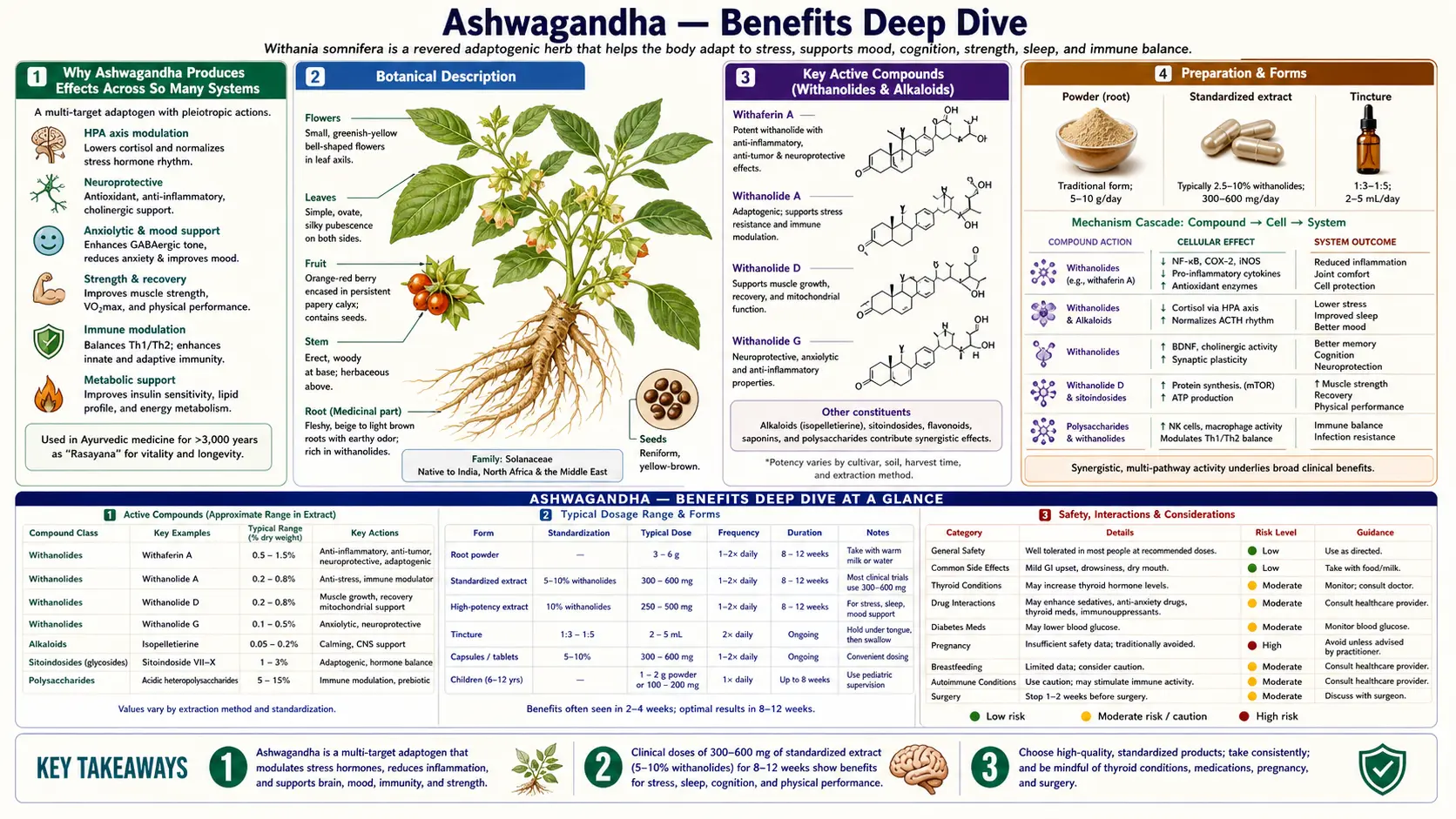
Withania somnifera — the Sanskrit name ashwagandha literally means "smell of the horse," referring both to the distinctive odor of the fresh root and to the traditional Ayurvedic claim that the root confers the strength and stamina of a stallion. For more than three thousand years it has been classified in Ayurveda as a rasayana — a rejuvenative tonic taken to extend lifespan, restore vitality, and build resilience against physical and psychological stress. Modern phytochemistry has isolated the active constituents responsible for these effects: a family of steroidal lactones called withanolides (withaferin A, withanolide A, withanolide D, withanone), plus the alkaloids somniferine and tropine, sitoindosides VII-X, and the unusual sleep-promoting sugar derivative triethylene glycol. Four benefit pages below explore the conditions where Ashwagandha has produced the largest measured clinical effects in randomized controlled trials — reduction of perceived stress and cortisol, improvement in sleep onset latency and quality, gains in working memory and processing speed, and increases in serum testosterone and reproductive function in men.
Deep-Dive Articles
Stress & Anxiety
The Chandrasekhar 2012 trial of a full-spectrum root extract in 64 adults showing 27.9% reduction in serum cortisol versus 7.9% in placebo over 60 days, trials of a root-and-leaf extract, gamma-aminobutyric acid-A receptor modulation by withanolides as the proximate anxiolytic mechanism, hypothalamic-pituitary-adrenal-axis adaptation, the foundational Bhattacharya 2000 anxiolytic activity research, and how Ashwagandha compares with a selective serotonin reuptake inhibitor, benzodiazepine, or buspirone.
Read the deep dive →Sleep Quality
The Langade 2021 randomized trial demonstrating improvement in Pittsburgh Sleep Quality Index (PSQI), sleep onset latency, and total sleep time in insomniacs; the 2017 mouse study in which triethylene glycol from the leaves increased non-rapid eye movement sleep while the withanolide-rich alcoholic extract did not induce sleep; the cortisol-lowering effect that improves sleep architecture; comparison with melatonin, magnesium glycinate, and L-theanine.
Read the deep dive →Cognitive Function
The Choudhary 2017 trial showing improvements in immediate and general memory, executive function, attention, and information-processing speed in adults with mild cognitive impairment; the Sehgal 2012 mouse study in which a root extract rich in withanolides and withanosides reversed memory deficits and amyloid plaque in Alzheimer's-model mice by raising a liver protein that clears beta-amyloid; cholinergic activity, neurite outgrowth, and the neuroprotective implications for Alzheimer's and Parkinson's research.
Read the deep dive →Testosterone & Vitality
The Wankhede 2015 trial in 57 young men with little resistance-training experience (testosterone rose 96.2 ng/dL versus 18.0 ng/dL with placebo, bench-press gain 46.0 kg versus 26.4 kg, and only the chest-size gain roughly doubled, 3.3 cm versus 1.4 cm); the Ambiye 2013 pilot trial in oligospermic men (sperm count up 167%, semen volume up 53% and sperm motility up 57% over 90 days); luteinizing hormone (LH) and follicle-stimulating hormone (FSH) modulation; the steroidogenic mechanism by which withanolides upregulate the StAR protein and cholesterol side-chain cleavage.
Read the deep dive →Table of Contents
Why Ashwagandha Produces Effects Across So Many Systems
Most botanical medicines act through a single dominant mechanism (caffeine antagonizes adenosine receptors, willow bark salicin inhibits prostaglandin synthesis, valerian potentiates gamma-aminobutyric acid (GABA)). Ashwagandha is unusual in that its withanolide constituents engage at least five distinct molecular targets, and the clinical effects across stress, sleep, cognition, and vitality emerge from the combined modulation of all five. This is the mechanistic basis for the Ayurvedic classification of Ashwagandha as a rasayana rather than a treatment for any single symptom.
- Hypothalamic-pituitary-adrenal-axis modulation and cortisol reduction — the proximate driver of the anti-stress effect. Withanolides act at the hypothalamic and pituitary level to dampen corticotropin-releasing hormone (CRH) and adrenocorticotropic hormone (ACTH) output, reducing adrenal cortisol secretion. Multiple randomized trials with standardized root and root-and-leaf extracts have measured serum or salivary cortisol reductions of 14-32% over 8-12 weeks at doses of 300-600 mg/day. This is the unifying mechanism behind the stress and anxiety, much of the sleep-quality, and a contributing piece of the testosterone effects (chronic high cortisol suppresses the hypothalamic-pituitary-gonadal axis).
- GABAergic activity at the gamma-aminobutyric acid-A receptor — the proximate driver of the acute anxiolytic and sleep effects. Withanolides are described as positive allosteric modulators at the gamma-aminobutyric acid-A receptor (the same family of receptors targeted by benzodiazepines, alcohol, and barbiturates, but with a different binding site and a much milder, non-sedating effect at therapeutic doses). The Bhattacharya laboratory at Banaras Hindu University published the foundational pharmacology, in rats, in the late 1990s and early 2000s describing this GABAergic mechanism. The leaf compound triethylene glycol is a separate story: in a 2017 mouse study (Kaushik 2017) a leaf water extract and triethylene glycol (10-30 mg per mouse) increased non-rapid eye movement sleep, while the alcoholic leaf extract rich in withanolides did not induce sleep; that study did not report a gamma-aminobutyric acid-A receptor mechanism.
- Cholinergic activity and neurite outgrowth — the proximate driver of the cognitive effects. Withanolide A and withanoside IV (a glycoside metabolized in vivo to the active sominone) have been shown in cell culture and rodent models to enhance acetylcholine signaling, promote neurite outgrowth, and increase brain-derived neurotrophic factor (BDNF) expression. In the Sehgal 2012 mouse study, a 30-day oral root extract made up mostly of withanolides and withanosides reversed memory deficits and amyloid plaque in Alzheimer's-model mice; it worked through the liver, raising low-density lipoprotein receptor-related protein (LRP), which draws beta-amyloid out of the brain into the blood, and blocking liver LRP cancelled the benefit. The cognitive-function deep dive covers these mechanisms and the clinical translation in mild cognitive impairment.
- Nrf2 activation and antioxidant defense — the unifying mechanism behind the neuroprotective and the anti-fatigue effects. Withaferin A is a potent activator of the Nrf2 (nuclear factor erythroid 2-related factor 2) pathway, which upregulates the cellular antioxidant defense system (glutathione synthesis, superoxide dismutase, catalase, nicotinamide adenine dinucleotide (NAD)(P)H quinone dehydrogenase 1). Reduced oxidative stress in brain tissue translates to neuroprotection, and reduced oxidative stress in skeletal muscle translates to improved exercise recovery.
- Steroidogenic upregulation and luteinizing hormone/follicle-stimulating hormone modulation — the proximate driver of the testosterone and reproductive effects. Withanolides upregulate steroidogenic acute regulatory protein (StAR), the rate-limiting transporter that moves cholesterol into the inner mitochondrial membrane where it becomes pregnenolone (the precursor to all steroid hormones including testosterone). Ashwagandha supplementation has been shown to increase serum luteinizing hormone (LH) and follicle-stimulating hormone (FSH) in oligospermic men, restoring the pituitary signal that drives Leydig and Sertoli cell function. In people, the Ambiye 2013 pilot trial in 46 oligospermic men (675 mg/day of root extract for 90 days) reported a significantly greater improvement in serum hormone levels than placebo; the abstract does not give separate luteinizing hormone (LH) or follicle-stimulating hormone (FSH) figures.
Which results come from people and which from animals. The cortisol, stress, sleep, memory, strength and semen results come from randomized trials in people (Chandrasekhar 2012, Langade 2021, Choudhary 2017, Wankhede 2015, Ambiye 2013). The receptor and molecular mechanisms in the list above — action at the gamma-aminobutyric acid-A receptor, neurite outgrowth, Nrf2 activation and StAR upregulation — come from cell-culture and animal studies; the amyloid-clearing result (Sehgal 2012) and the triethylene glycol sleep result (Kaushik 2017) were found in mice, and the Bhattacharya anxiety work in rats. These mechanisms have not been measured directly in people.
The therapeutic complication is that effects depend critically on extract type and standardization. Most of the published randomized controlled trial (RCT) evidence comes from standardized extracts: a root-only extract (about 5% withanolides) and a root-and-leaf extract (about 10% withanolides). These two extracts produce different clinical profiles — the root-only extract is favored for testosterone and exercise outcomes, the root-and-leaf extract is favored for sleep and acute anxiety. Raw root powder at 3-5 grams per day is the traditional Ayurvedic preparation, but its active withanolide dose is harder to quantify. The trials used standardized extracts; unstandardized products have no comparable test data.
What Pooled Trials Found for Stress and Sleep
Two meta-analyses (studies that combine the results of several randomized trials) give an overall picture in people:
- Stress and anxiety — a 2024 meta-analysis of 9 randomized trials with 558 people found that ashwagandha lowered Perceived Stress Scale scores (mean difference -4.72), Hamilton Anxiety Scale scores (-2.19) and serum cortisol (-2.58) compared with placebo. Four of the trials reported mild to moderate side effects, and the authors note that safety with long-term use is not known.
- Sleep — a 2021 meta-analysis of 5 randomized trials with 400 adults found a small but significant improvement in overall sleep (standardized mean difference -0.59). The effect was larger in adults diagnosed with insomnia, at 600 mg/day or more, and with 8 weeks or more of use. No serious side effects were reported, but the authors note that data on serious side effects are limited.
Liver Injury Reports
Case series describe liver injury after taking ashwagandha supplements:
- Iceland and the United States (2020) — five patients (mean age 43) developed jaundice, with nausea, tiredness, itching and stomach discomfort, 2 to 12 weeks after starting an ashwagandha-containing supplement. The itching and high bilirubin lasted 5 to 20 weeks. None developed liver failure, and liver tests returned to normal within 1 to 5 months in the four patients who were followed. Chemical testing found ashwagandha in the products and no other toxic compounds.
- India (2023) — of 23 patients with liver injury from ashwagandha, 8 had taken a single-ingredient product. Five of those 8 already had chronic liver disease; 3 of them developed acute-on-chronic liver failure, and all 3 died. In the others the liver injury was prolonged but resolved on its own. Chemical testing found only natural plant compounds, with no adulteration or contamination.
Yellowing of the skin or eyes (jaundice), dark urine and severe itching are signs of liver injury that hospitals treat as urgent. The Indian series found the highest risk in people who already had liver disease.
Key Research Papers
- Chandrasekhar K, Kapoor J, Anishetty S (2012). A prospective, randomized double-blind, placebo-controlled study of safety and efficacy of a high-concentration full-spectrum extract of ashwagandha root in reducing stress and anxiety in adults. Indian Journal of Psychological Medicine. — PubMed PMID: 23439798
- Langade D et al. (2021). Clinical evaluation of the pharmacological impact of ashwagandha root extract on sleep in healthy volunteers and insomnia patients: a double-blind, randomized, parallel-group, placebo-controlled study. Journal of Ethnopharmacology. — PubMed PMID: 32818573
- Choudhary D, Bhattacharyya S, Bose S (2017). Efficacy and safety of ashwagandha (Withania somnifera (L.) Dunal) root extract in improving memory and cognitive functions. Journal of Dietary Supplements. — PubMed PMID: 28471731
- Wankhede S, Langade D, Joshi K, Sinha SR, Bhattacharyya S (2015). Examining the effect of Withania somnifera supplementation on muscle strength and recovery: a randomized controlled trial. Journal of the International Society of Sports Nutrition. — PubMed PMID: 26609282
- Ambiye VR, Langade D, Dongre S, Aptikar P, Kulkarni M, Dongre A (2013). Clinical evaluation of the spermatogenic activity of the root extract of ashwagandha in oligospermic males: a pilot study. Evidence-Based Complementary and Alternative Medicine. — PubMed PMID: 24371462
- Sehgal N, Gupta A, Valli RK, Joshi SD, Mills JT, Hamel E, Khanna P, Jain SC, Thakur SS, Ravindranath V (2012). Withania somnifera reverses Alzheimer's disease pathology by enhancing low-density lipoprotein receptor-related protein in liver. Proceedings of the National Academy of Sciences of the United States of America. — PubMed PMID: 22308347
- Kaushik MK, Kaul SC, Wadhwa R, Yanagisawa M, Urade Y (2017). Triethylene glycol, an active component of Ashwagandha (Withania somnifera) leaves, is responsible for sleep induction. PLoS One. — PubMed PMID: 28207892
- Bhattacharya SK, Bhattacharya A, Sairam K, Ghosal S (2000). Anxiolytic-antidepressant activity of Withania somnifera glycowithanolides: an experimental study. Phytomedicine. — PubMed PMID: 11194174
- Arumugam V, Vijayakumar V, Balakrishnan A, B Bhandari R, Boopalan D, Ponnurangam R, Sankaralingam Thirupathy V, Kuppusamy M (2024). Effects of Ashwagandha (Withania Somnifera) on stress and anxiety: a systematic review and meta-analysis. Explore (NY). — PubMed PMID: 39348746
- Cheah KL, Norhayati MN, Husniati Yaacob L, Abdul Rahman R (2021). Effect of Ashwagandha (Withania somnifera) extract on sleep: a systematic review and meta-analysis. PLoS One. — PubMed PMID: 34559859
- Björnsson HK, Björnsson ES, Avula B, Khan IA, Jonasson JG, Ghabril M, Hayashi PH, Navarro V (2020). Ashwagandha-induced liver injury: a case series from Iceland and the US Drug-Induced Liver Injury Network. Liver International. — PubMed PMID: 31991029
- Philips CA, Valsan A, Theruvath AH, Ravindran R, Oommen TT, Rajesh S, Bishnu S, Augustine P; Liver Research Club India (2023). Ashwagandha-induced liver injury — a case series from India and literature review. Hepatology Communications. — PubMed PMID: 37756041
PubMed Topic Searches
External Authoritative Resources
- U.S. National Institutes of Health (NIH) National Center for Complementary and Integrative Health — Ashwagandha — official US-government overview, safety considerations, and research status
- U.S. National Institutes of Health Office of Dietary Supplements — Botanical Dietary Supplements Background
- LiverTox — Ashwagandha (hepatotoxicity case literature, important for the safety-conscious clinician)
- PubMed — All research on Withania somnifera (~1,800+ papers)
Connections
- All Herbs
- Ashwagandha (Main Page)
- Ashwagandha for Stress & Anxiety
- Ashwagandha for Sleep Quality
- Ashwagandha for Cognitive Function
- Ashwagandha for Testosterone & Vitality
- Rhodiola Rosea
- Holy Basil (Tulsi)
- Bacopa Monnieri
- Ginseng
- Anxiety
- Insomnia
- Depression
- Post-Traumatic Stress Disorder
- Testosterone
- Stress Management
- Sleep Hygiene
- Natural Anxiety Relief
- History