Bone Broth — Benefits Deep Dive
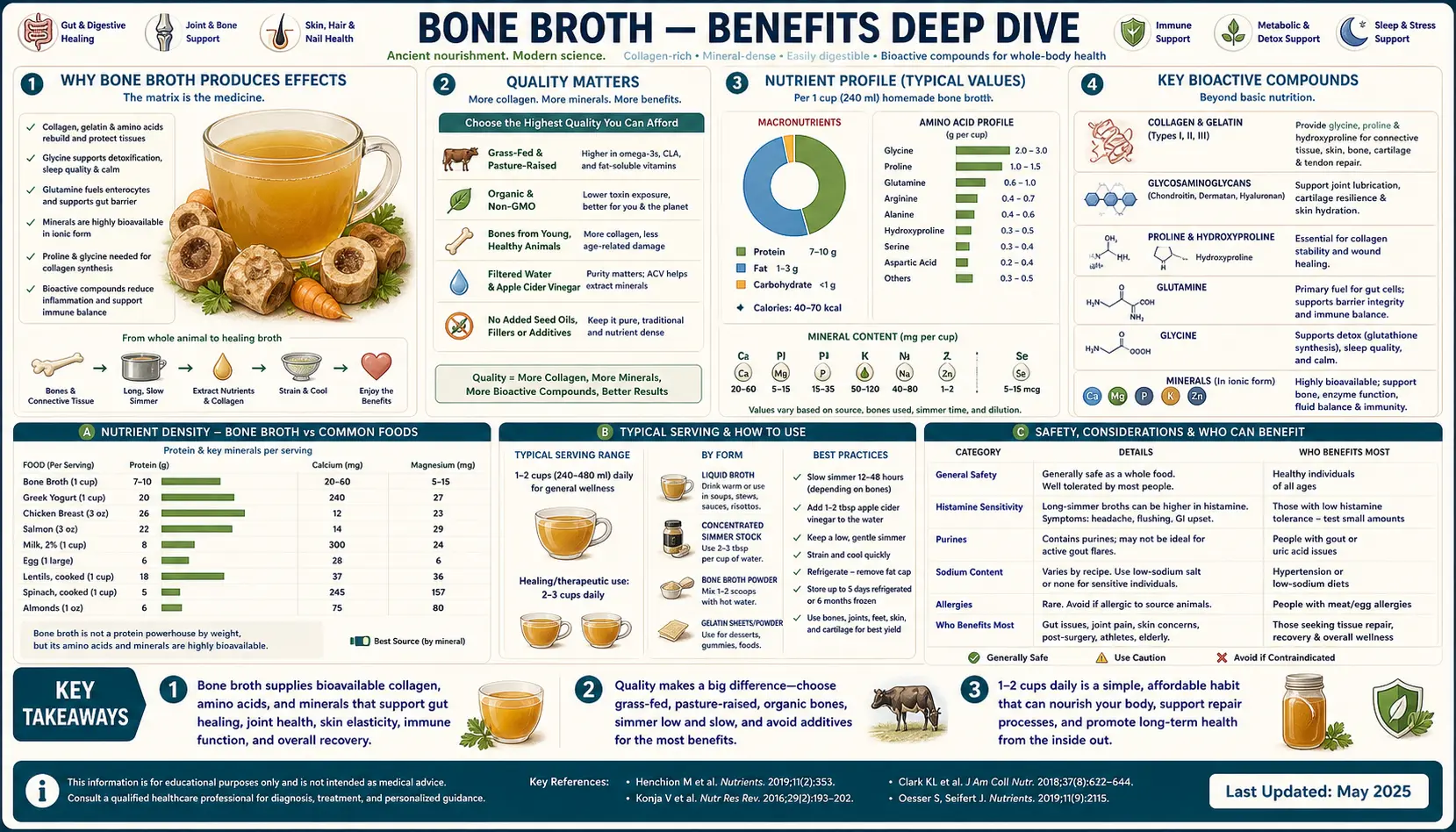
Bone broth is a slow-simmered stock made from animal bones and connective tissue — typically beef, chicken, or fish carcasses cooked in water and a splash of acid (apple cider vinegar) for 12 to 24 hours. The long simmer extracts gelatin (denatured collagen), free amino acids (especially glycine, proline, hydroxyproline, and glutamine), minerals (calcium, magnesium, phosphorus, potassium), and cartilage-derived glycosaminoglycans (glucosamine, chondroitin, hyaluronic acid). It is the centerpiece of the Weston A. Price Foundation / Sally Fallon "nourishing traditions" revival of ancestral whole-animal cooking, and the gateway food for patients moving from convenience-food eating toward whole-animal nutrition. Four benefit pages below explore the conditions where bone broth produces the largest clinical effect — intestinal-mucosa repair in "leaky gut" syndromes, joint cartilage support via collagen peptides, calcium / magnesium / phosphorus repletion in convalescence, and sleep-architecture improvement via 3 g pre-bed glycine.
Deep-Dive Articles
Gut Healing
Gelatin, glycine, and glutamine for intestinal mucosa repair. The "leaky gut" / intestinal permeability framework, mucin layer maintenance, tight-junction proteins, traditional convalescence use of broth across cultures, the Weston A. Price Foundation revival, and how broth complements an elimination diet during gut healing.
Read the deep dive →Joints & Collagen
Gelatin breaks down to hydroxyproline-rich peptides that signal joint-cartilage chondrocytes. The Choi 2014 osteoarthritis RCT, Proksch 2014 skin-elasticity RCT, comparison to standardized hydrolyzed collagen peptide supplements for cost and convenience, and when broth vs powder is the right choice.
Read the deep dive →Mineral Repletion
The calcium, magnesium, phosphorus, and potassium content actually extracted from bones during a 12-24 hour simmer. The honest controversy — published mineral content per cup is modest, not the "calcium-rich" claim — and the legitimate role of broth as a vehicle for traditional postpartum and convalescent feeding when solid food is poorly tolerated.
Read the deep dive →Sleep & Glycine
Bone broth delivers roughly 1-2 g of glycine per cup from the gelatin matrix. The Bannai sleep-architecture trials demonstrating that 3 g of glycine taken before bed reduces sleep latency, increases slow-wave sleep, and improves next-day subjective fatigue. The "cup before bed" protocol, and when to use broth vs powdered glycine.
Read the deep dive →Table of Contents
Why Bone Broth Produces Effects
Bone broth is not a single bioactive compound — it is a complex traditional food whose effects come from four overlapping components. Each component maps to a distinct clinical domain.
- Gelatin (denatured collagen) — the long simmer hydrolyzes the triple-helical collagen in bones, hides, tendons, and cartilage into gelatin, a heterogeneous mixture of partially degraded collagen polypeptides. Gelatin is what makes a properly made broth gel when chilled — the visual test for an extraction-rich batch. Once eaten, gut and serum peptidases further break gelatin into short di- and tri-peptides (notably prolyl-hydroxyproline and glycyl-prolyl-hydroxyproline) and free amino acids. The hydroxyproline-rich peptides have been detected intact in human plasma after collagen-peptide ingestion and appear to signal chondrocytes in joint cartilage and fibroblasts in skin to upregulate their own extracellular-matrix synthesis. This is the mechanism behind the joint and skin effects.
- Free amino acids (especially glycine, proline, and glutamine) — gelatin is roughly 33% glycine and 22% proline plus hydroxyproline by weight — the most glycine-rich food in the human diet. A typical cup of well-made bone broth contains 1-2 g of glycine. Glycine acts as an inhibitory neurotransmitter at glycine receptors in the brainstem and spinal cord, as a methyl-buffer in one-carbon metabolism, and as a substrate for glutathione and heme synthesis. The free glutamine in broth (modest, perhaps 100-300 mg per cup) is the preferred fuel for enterocytes (small-intestinal absorptive cells). These free amino acids drive the sleep-architecture effects of 3 g pre-bed glycine and contribute to the gut-healing effects.
- Minerals (calcium, magnesium, phosphorus, potassium) — the long simmer with an acidic medium (apple cider vinegar) extracts some, but not the headline-grabbing amounts, of mineral content from bones. Published analyses (notably the often-cited but methodologically modest 1934 Archives of Diseases in Childhood paper, and more rigorous modern analyses) put calcium at approximately 5-20 mg per cup of broth — perhaps 1-2% of the adult daily requirement, not a primary calcium source. Magnesium, phosphorus, and potassium content are similarly modest. The legitimate value is as a vehicle for traditional postpartum and convalescent feeding when solid food is poorly tolerated, not as a calcium supplement.
- Cartilage-derived glycosaminoglycans (glucosamine, chondroitin, hyaluronic acid) — broth made from joint cartilage (chicken feet, oxtail, knuckle bones) extracts measurable amounts of GAGs. The systemic bioavailability and joint-targeting of dietary GAGs is debated, but the same molecules are sold as standalone joint supplements with modest evidence for symptomatic osteoarthritis benefit. This contribution overlaps with the joint and collagen effects.
Because the active components are a complex mixture rather than an isolated drug-like compound, the clinical evidence base for bone broth itself is limited — most published research uses standardized gelatin or hydrolyzed collagen peptides as the test substance, not whole broth. The benefit pages below cite the relevant peptide and amino-acid trials and discuss how to translate them to whole-broth practice.
A Note on Quality (Grass-Fed, Pasture-Raised, Organic)
The quality of the source animal matters more for bone broth than for most foods, because the long simmer extracts fat-soluble compounds — including any fat-soluble contaminants — from the marrow and connective tissue. Practical guidance:
- Grass-fed / pasture-raised beef bones — preferred over conventional feedlot beef. Pastured cattle have a more favorable omega-6 to omega-3 fatty-acid ratio in their marrow fat, and pastured animals are less exposed to feed-borne contaminants. The fat that floats to the top of beef broth concentrates whatever lipid-soluble compounds the animal accumulated, which makes pasture source matter.
- Pasture-raised / organic chicken — conventional broiler chickens raised in confined operations have been shown to accumulate trace antibiotic residues and higher omega-6 content. Pasture-raised birds make a better broth.
- Wild-caught fish heads and frames — for fish broth (and for the iodine and DHA content) wild-caught Pacific or Atlantic species are preferred over farmed salmon. Avoid large predatory species (swordfish, shark) for broth due to mercury concentration in the head.
- Lead-in-bones concern — an often-cited 2013 Monro et al. paper in Medical Hypotheses reported elevated lead in chicken-bone broth made from supermarket organic chickens. Subsequent analyses have produced mixed results, and the concern is now considered probably overstated for modern US/EU supply chains, but it remains a reason to choose grass-fed and pasture-raised sources where possible.
- Marrow vs joint bones — if the goal is collagen and gelatin extraction (for joints, skin, gut), use joint bones (knuckle, oxtail, chicken feet, neck). If the goal is mineral and fat extraction (for convalescence), use marrow bones. The classic French and traditional Chinese broths use a mixture of both.
Key Research Papers
- Choi FD et al. (2014). Oral collagen supplementation: a systematic review of dermatological applications. Journal of Drugs in Dermatology. — PubMed
- Proksch E et al. (2014). Oral supplementation of specific collagen peptides has beneficial effects on human skin physiology. Skin Pharmacology and Physiology. — PubMed PMID: 23949208
- Bannai M, Kawai N (2012). New therapeutic strategy for amino acid medicine: glycine improves the quality of sleep. Journal of Pharmacological Sciences. — PubMed
- Hsu DJ et al. (2017). Essential and toxic metals in animal bone broths. Food and Nutrition Research. — PubMed
- Rennard BO et al. (2000). Chicken soup inhibits neutrophil chemotaxis in vitro. Chest. — PubMed PMID: 11035691
External Authoritative Resources
- Weston A. Price Foundation — Broth is Beautiful (Sally Fallon Morell) — the foundational essay of the modern bone-broth revival
- Nourishing Traditions (Sally Fallon Morell & Mary Enig) — the cookbook that introduced two generations to traditional broth preparation
- PubMed — bone broth research
- PubMed — collagen peptide oral supplementation
- PubMed — gelatin amino-acid composition
Connections
- All Food
- Bone Broth (Main Page)
- Bone Broth for Gut Healing
- Bone Broth for Joints & Collagen
- Bone Broth for Mineral Repletion
- Bone Broth for Sleep & Glycine
- Collagen
- Glycine
- Proline
- Glutamine
- Gut Healing
- Elimination Diet
- Arthritis
- Osteoporosis
- Calcium
- Magnesium
- Phosphorus
- Organ Meats
- Beef
- Weston A. Price Diet: Bone Broth and Nutrient-Dense Foods
- History