⚠ Evidence warning: Clinical trials or other evidence do not support the traditional and practitioner claims that bone broth supports mineral repletion and recovery after childbirth or illness, or that a salty-broth routine helps postural orthostatic tachycardia syndrome. This page keeps it as a report of what people, websites or other media say.
Bone Broth for Mineral Repletion
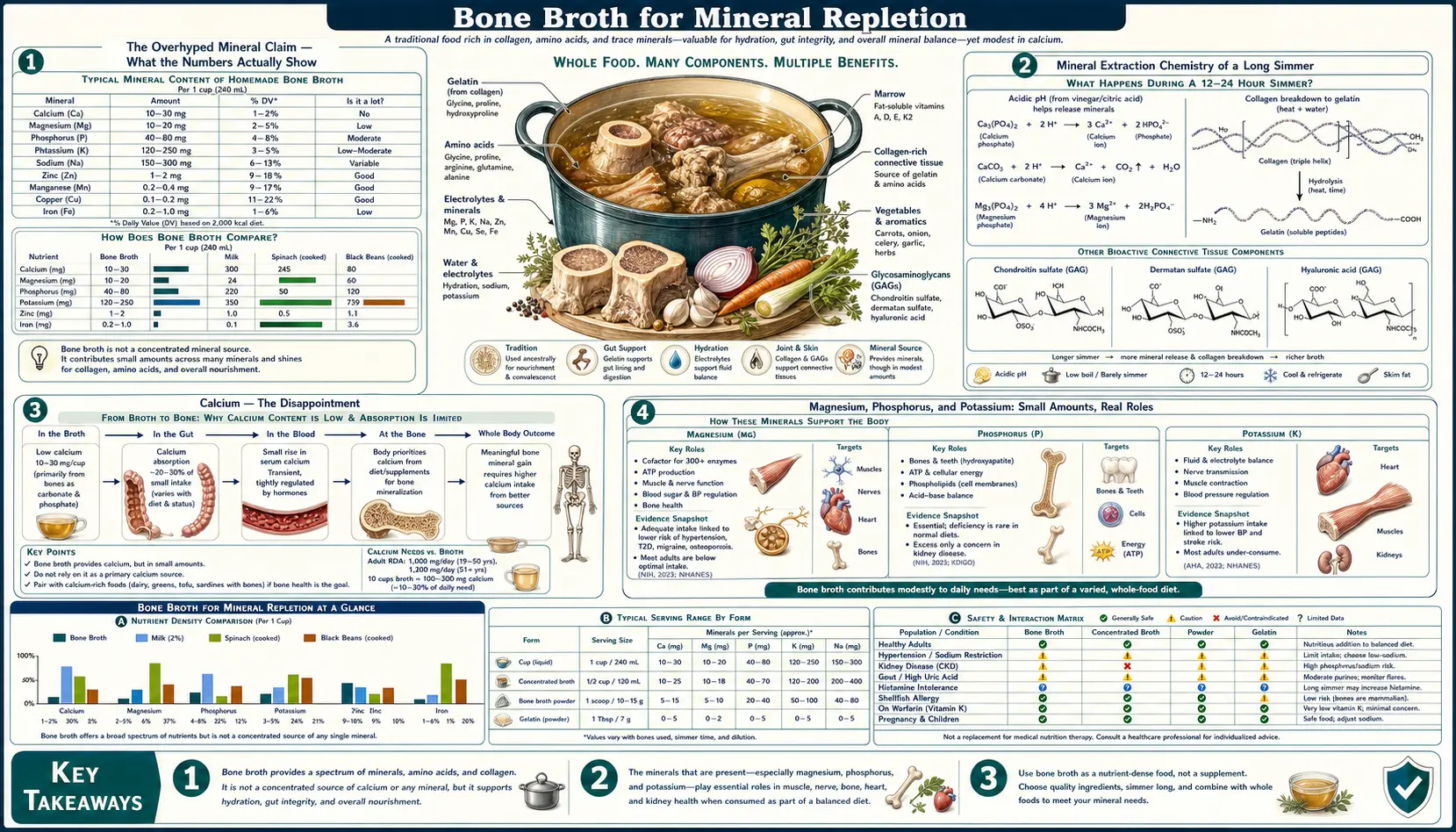
The "bone broth is rich in minerals" claim is the single most commonly overstated benefit of broth in the popular health-food press, and the one most likely to disappoint patients who expect it to be a calcium supplement. The reality is more nuanced and arguably more interesting. Measured analyses of bone broth, such as the Hsu 2017 paper in Food and Nutrition Research, show that a long simmer with an acid such as vinegar extracts modest, not large, quantities of calcium and magnesium from animal bones: in that study the calcium and magnesium in home-made and commercial broths stayed under 5% of the daily recommended levels per serving. A typical cup of well-made beef broth contains roughly 5-20 mg of calcium — about 1-2% of the adult daily requirement, not the "10%" or "20%" sometimes claimed. The legitimate role of broth in mineral repletion is therefore not as a primary calcium source, but as a vehicle for traditional postpartum and convalescent feeding, where the easily absorbed warm liquid (with its modest but real mineral content alongside the gelatin and amino acids) supports recovery in patients who cannot tolerate solid food. This page tells the honest story.
Table of Contents
- The Overhyped Mineral Claim — What the Numbers Actually Show
- Mineral Extraction Chemistry of a Long Simmer
- Calcium — The Disappointment
- Magnesium, Phosphorus, and Potassium
- Sodium — Often Higher Than You'd Expect
- The Role of Apple Cider Vinegar in Extraction
- The Postpartum and Convalescent Tradition
- Where Broth Genuinely Helps — Electrolytes, Hydration, Convalescence
- What Broth Is Not (Primary Calcium, Iron, or Zinc Source)
- Real Mineral-Rich Foods for Comparison
- Key Research Papers
- Connections
- Featured Videos
The Overhyped Mineral Claim — What the Numbers Actually Show
Walk into any health-food store, open any modern "bone broth is a superfood" magazine article, and you will encounter some version of the claim that bone broth is "rich in calcium," "loaded with magnesium," or "a top dietary source of bioavailable minerals." This characterization is the principal point on which the popular bone-broth literature departs from the actual measurement data. Honest commentary requires saying so.
The original "bone broth is rich in calcium" claim is popular lore with a few roots: some midcentury Australian analyses of long-simmered stocks, and a tradition of Asian and European cooking lore that long predated quantitative chemistry. None of these sources actually quantified calcium per cup at the level that would justify the modern "calcium-rich" framing.
Modern analytical chemistry of bone broth has been done by several groups, with reasonably consistent results:
- Hsu DJ et al. 2017 (Food and Nutrition Research) — ran three sets of controlled experiments on how acidity, cooking time and bone type change the metals that leave animal bones, and tested three kinds of bone-broth-based foods. In the authors' words, the calcium and magnesium levels in home-made or commercial broth or soup were "found not to exceed low tenths of milligram per serving, or <5% of the daily recommended levels." Lead and cadmium were in the range of a few micrograms per serving.
- Monro JA et al. 2013 (Medical Hypotheses) — a small, blinded, controlled study set up to test whether bone broth carries lead, which bones store. Broth made from chicken skin and cartilage and broth made from chicken bones contained 9.5 and 7.01 micrograms of lead per litre, against 0.89 micrograms per litre in tap water treated the same way. The study measured lead, not calcium.
- U.S. Department of Agriculture (USDA) FoodData Central — standard beef broth lists approximately 19 mg calcium per cup, but this figure is for commercial bouillon, not long-simmered home broth, and likely includes added ingredients.
- Stronger numbers reported by some commercial brands in their own marketing literature (50-100 mg calcium per cup) have not been independently verified; the variance between brands and batches is large, but published independent analyses consistently come in low.
For context: the adult Recommended Dietary Allowance (RDA) for calcium is 1,000-1,200 mg/day. A cup of bone broth at 10 mg calcium provides roughly 1% of the daily requirement. A cup of whole milk provides about 300 mg calcium — 30× more. A cup of plain Greek yogurt provides about 200 mg. A small can of sardines with bones provides 350 mg. Bone broth is simply not in the same league as these foods as a calcium source.
The honest framing: bone broth is a respectable contributor of small amounts of multiple minerals as part of a varied diet, not a primary calcium source. For people with diagnosed osteoporosis, low blood calcium (hypocalcemia), or the high calcium demand of pregnancy and breastfeeding, broth supplies only a small fraction of daily calcium; the larger calcium sources are dairy, calcium-set tofu, sardines with bones, or supplements, and the cofactors (Vitamin D, K2, magnesium, Vitamin K) help determine where the calcium ends up.
Mineral Extraction Chemistry of a Long Simmer
The reason long-simmered bone broth does not yield as much mineral content as intuition suggests is a matter of basic chemistry. The calcium and phosphorus in bone are bound up as hydroxyapatite — a crystalline calcium phosphate complex (Ca10(PO4)6(OH)2) that is one of the most chemically stable forms of calcium in nature. This is why your skeleton is rigid: hydroxyapatite is hard. It is also why hydroxyapatite does not readily dissolve in mildly acidic water at simmering temperatures — the energy required to break the calcium-phosphate ionic lattice is substantial.
The simmer extracts what is accessible: the surface-layer calcium that is not deeply embedded in the hydroxyapatite matrix, plus any minerals (potassium, magnesium, some calcium) that are present in the cellular cytoplasm of bone marrow and connective tissue rather than in the mineralized matrix itself. The acidic vinegar improves this extraction by protonating phosphate groups and partially demineralizing the bone surface; in relative terms the rise can be large (see the vinegar section below), but the absolute amounts stay small. Over a 24-hour simmer you can see this on the bones themselves — the surfaces become slightly more porous and softer, but the bones do not dissolve.
The fact that you cannot crush a simmered bone with your bare hands after 24 hours of cooking is the visual proof that most of the calcium remains in the bone, not in the broth. Pressure-cooker preparation does not change this fundamentally — while the higher temperature and pressure modestly increase extraction, the mineral content of pressure-cooker broth is in the same general range as long-simmer broth, not orders of magnitude higher.
What this means in practice: at the amounts measured, broth cannot stand in for dairy as a calcium source; the foods compared below contain calcium in far larger quantity.
Calcium — The Disappointment
To put the calcium discussion in perspective with a concrete comparison:
- 1 cup whole milk — 276 mg calcium
- 1 cup Greek yogurt — 250 mg calcium
- 1 oz hard cheese — 200 mg calcium
- 1 cup calcium-set tofu — 250-500 mg calcium (varies by brand)
- 3 oz sardines with bones — 325 mg calcium
- 3 oz canned salmon with bones — 180 mg calcium
- 1 cup cooked collard greens — 270 mg calcium
- 1 cup cooked bok choy — 160 mg calcium
- 1 cup almonds — 380 mg calcium
- 1 cup blackstrap molasses — 940 mg calcium (1 tbsp ~60 mg)
- 1 cup well-made bone broth — 5-20 mg calcium
Bone broth is at the bottom of this list by a substantial margin. For people who tolerate dairy, one cup of whole-milk yogurt or kefir delivers more calcium than ten cups of broth.
The patient population for whom bone broth's modest calcium content is still meaningful is those who are dairy-intolerant, on a low-FODMAP diet (low in fermentable oligosaccharides, disaccharides, monosaccharides and polyols), oxalate-avoiding (which rules out greens and almonds), or eating an autoimmune protocol (AIP) diet that restricts most calcium-rich plant foods. For these patients, broth's small contribution to an otherwise calcium-poor diet matters more than it would for someone with full dietary diversity. Sardines and other bone-in fish remain the most practical concentrated calcium source for AIP / Paleo / strictly animal-based diets; broth is a supporting player.
For deeper discussion of calcium itself — the K2 / D / magnesium cofactor system, the bone-density story, and why supplementation in isolation is problematic — see our Calcium page.
Magnesium, Phosphorus, and Potassium
The other major minerals follow similar patterns to calcium — modest absolute amounts in broth, with broth being a minor contributor relative to other dietary sources:
- Magnesium — typical bone broth contains 5-12 mg per cup. Adult Recommended Dietary Allowance is 310-420 mg/day. A handful of pumpkin seeds (1 oz) provides 150 mg. Real magnesium repletion requires either magnesium-rich foods (pumpkin seeds, almonds, cashews, spinach, dark chocolate) or supplementation (magnesium glycinate, citrate, or threonate are well-absorbed forms). For deeper treatment see our Magnesium page.
- Phosphorus — broth contains 30-100 mg per cup, more than calcium because phosphate is somewhat more soluble than calcium during extraction. Adult Recommended Dietary Allowance is 700 mg/day. Phosphorus deficiency is uncommon in the developed world because phosphorus is abundant in animal protein, dairy, nuts, and grains. Broth contributes meaningfully to phosphorus but is rarely needed for it.
- Potassium — broth contains 100-300 mg per cup, depending on the vegetables added during the simmer (celery, onion, carrot all contribute potassium). Adult Adequate Intake (AI) is 3,400 mg/day for men, 2,600 mg/day for women. A banana provides 420 mg, a baked potato provides 900 mg. Broth is a real source but modest; for active patients with heavy sweating, coconut water or fruit are more efficient potassium sources.
The phosphorus point matters because phosphorus is one mineral that broth actually does contribute meaningfully to in the context of a low-phosphorus diet — for people with chronic kidney disease (CKD) on a phosphorus-restricted diet, broth counts toward the phosphorus limit. This is the inverse of the calcium story — broth's phosphorus content is enough to matter for chronic kidney disease patients but not enough to provide therapeutic phosphorus repletion for someone with documented hypophosphatemia. For broader discussion see our Phosphorus page.
Sodium — Often Higher Than You'd Expect
One mineral content that is sometimes high in bone broth is sodium — not from the bones themselves, but from added salt during preparation. Commercial bone broth often contains 400-800 mg of sodium per cup, which can be 25-35% of the recommended daily limit in a single serving. Homemade broth can be made with minimal or no added salt, but the convention is to salt during cooking to taste, and most home recipes end up at 200-500 mg sodium per cup.
For most patients this is fine — broth is consumed as part of a meal, not in addition to other high-sodium foods, and the salt is part of the convalescent appeal (warm salty liquid is what the body craves after illness, with good physiological reason — the loss of sodium during illness through vomiting, diarrhea, and reduced intake leaves most acutely ill patients sodium-depleted).
For patients on aggressive sodium restriction (severe heart failure, advanced chronic kidney disease with hypertension, ascites from cirrhosis), broth sodium content matters. Low-sodium commercial broths exist (labelled at under 100 mg per cup); homemade broth can be made entirely without added salt.
Conversely, for patients with adrenal-insufficiency-pattern postural orthostatic tachycardia syndrome (POTS), the "salty broth" approach promoted in a traditional-diet foundation's community — deliberately well-salted homemade broth, 2-3 cups daily — is described by its proponents as a useful adjunct to other electrolyte-supplementation strategies. The convergence of sodium, potassium, and small amounts of magnesium and chloride in a warm liquid vehicle resembles the homemade electrolyte solutions used in clinical practice.
The Role of Apple Cider Vinegar in Extraction
Every traditional bone broth recipe includes "a splash of apple cider vinegar" in the cold-water start. The rationale is that the mild acidity helps extract minerals from the bone matrix. Measurement bears this out: in the Hsu 2017 experiments, lowering the broth's pH (making it more acidic) from 8.38 to 5.32 raised the amount of calcium drawn out of the bones about 17-fold (a factor of 17.4) and of magnesium about 15-fold (15.3). Acid works by protonating phosphate groups in hydroxyapatite and speeding up surface demineralization. The same study found that cooking longer than 8 hours drew out significantly more calcium and magnesium than shorter cooking times.
A large rise from a very small starting point still leaves a small amount: even so, the home-made and commercial broths and soups in the same study contained under 5% of the daily recommended calcium and magnesium per serving, and lead and cadmium were in the range of a few micrograms per serving. Traditional cooks include vinegar for both the extraction and the slight clarification effect it has on the finished broth (the acid helps denature surface proteins that would otherwise produce more scum), but it does not transform broth into a high-calcium food.
An over-acidic broth (excessive vinegar) is unpalatable and counterproductive. The traditional ratio is 1-2 tablespoons of vinegar per gallon of water — enough to lower pH modestly without making the broth taste sour. Some traditional recipes use lemon juice or white wine instead of vinegar with similar acidification effect.
The Postpartum and Convalescent Tradition
The single context in which the mineral-repletion framing of bone broth is most defensible is the traditional postpartum and convalescent feeding pattern. Across cultures — the Chinese "doing the month" (zuo yue zi) postpartum tradition, the Korean miyeokguk seaweed-and-beef-bone soup served to new mothers, the Mexican caldo de pollo for both postpartum mothers and convalescent patients, the Jewish chicken soup tradition, the French consommé — long-simmered broths are the centerpiece of recovery feeding.
The mechanism of benefit in this context is not that broth is a calcium supplement (which it isn't), but that broth is:
- Easily digestible when the gut is compromised by pregnancy hormones, surgery, anesthesia, or acute illness
- Warm and savory, providing comfort, satiety, and sodium replacement in a patient who has been losing electrolytes
- Calorically variable depending on how much fat is left in the broth — can be made high-calorie for a patient who needs energy, or skimmed clear for a patient who needs only fluid replacement
- Rich in glycine and proline, supporting glutathione synthesis and tissue repair at exactly the moment the body needs to rebuild
- A vehicle for additional nutrients — the soft-cooked vegetables, soft rice or noodles, or carefully selected herbs that traditional recipes incorporate add specific nutritional or therapeutic value beyond what broth alone provides
- A delivery vehicle for modest amounts of multiple minerals in a population (postpartum, post-surgical, post-illness) where any oral intake is welcome and where the gut may not yet tolerate solid food
For postpartum mothers specifically, a traditional-diet foundation advocates daily bone broth (often 2-3 cups) during the first 6 weeks postpartum, alongside organ meats, raw or pasteurized dairy if tolerated, and minimal grain restriction. The mineral contribution of the broth is modest; the broader nutritional density of the dietary pattern is substantial. The same applies to elderly patients recovering from hip fractures, hospitalized patients transitioning back to oral nutrition, and patients in chronic-disease flares (inflammatory bowel disease (IBD), severe irritable bowel syndrome (IBS), post-infectious enteritis) when whole food is poorly tolerated.
Where Broth Genuinely Helps — Electrolytes, Hydration, Convalescence
Bone broth's legitimate "mineral" contribution is best framed as electrolyte and convalescent fluid rather than as a calcium supplement:
- Salty homemade chicken soup for cold and flu — the Rennard 2000 Chest paper was a laboratory (in vitro) test of white-cell movement: chicken soup slowed the movement of neutrophils (a type of white blood cell) toward an inflammatory signal (neutrophil chemotaxis), more strongly at higher concentrations, and commercial soups varied greatly in this effect. In a 1978 Chest study of 15 healthy people (Saketkhoo and colleagues), sipping hot chicken soup raised the speed at which nasal mucus moves from 6.9 to 9.2 mm per minute at 5 minutes, more than hot water did (6.2 to 8.4 mm per minute); the effect had gone by 30 minutes, and nasal airflow resistance did not change. The clinical benefit is real and traditional — the steam loosens mucus, the sodium replaces what is being lost in fever-driven sweat, the warm fluid is comforting, and the modest mineral content helps. See our Cold and Flu Treatments page.
- Postural orthostatic tachycardia syndrome / dysautonomia electrolyte support — patients with postural orthostatic tachycardia syndrome benefit from increased sodium intake to expand plasma volume. Salty broth is one of multiple sodium-replacement strategies (alongside electrolyte drink mixes, vegetable juice, pickle juice). The potassium and modest magnesium content of broth round out the electrolyte profile in a way that simple salt water does not.
- Endurance athlete recovery — following long training sessions or competitions, warm broth replaces sodium and fluid more palatably than cold sports drinks and provides modest amino-acid input for muscle repair
- Acute gastroenteritis recovery — once a patient with norovirus, rotavirus, or food poisoning is past the acute vomiting phase, warm clear broth is often the first oral intake tolerated. Sodium and fluid replacement combine with the modest mineral content and easily absorbed amino acids.
- Postpartum first 6 weeks — as above, daily broth alongside whole-food recovery feeding
These applications are legitimate and well-supported by traditional practice and modest published evidence. None of them require broth to be a "calcium superfood" — they all rest on broth being an excellent vehicle for sodium, modest other minerals, amino acids, and the warm-liquid format that compromised patients tolerate.
What Broth Is Not (Primary Calcium, Iron, or Zinc Source)
To close out the honest assessment, here is the explicit list of nutritional roles bone broth does not fill, despite occasional claims to the contrary:
- Primary calcium source — covered above. Real dietary calcium sources are dairy, calcium-set tofu, bone-in fish, dark leafy greens, and almonds. Broth is a tiny supplementary contributor.
- Iron source — broth contains essentially no iron. The iron in bone marrow is in the marrow cells, not in the broth liquid. For iron-deficiency anemia, the iron sources are red meat, organ meats (liver is the premier source), or supplements; broth adds essentially none.
- Zinc source — similar to iron. Zinc is in the cellular content of meat, not in the broth. Oysters, red meat, organ meats are the zinc sources. See our Zinc page.
- Vitamin D source — broth contains no Vitamin D. The Vitamin D in the source animal is in the liver and fatty tissues, not in the bones. Cod liver oil, fatty fish, eggs, and sunlight are the Vitamin D sources.
- B-vitamin source — broth contains minimal B vitamins. The B vitamins in meat are in the muscle and organ tissue. Liver is the premier B-vitamin source; broth is not.
- Complete protein source — though broth contains 9-15 g of protein per cup, that protein is gelatin-derived and limiting in tryptophan, methionine, and cysteine. It is not a complete dietary protein. The amino-acid profile complements rather than replaces muscle-meat protein.
The pattern that emerges: bone broth complements organ meats and muscle meats; it does not replace either. The full nourishing-traditions framework recognizes this — bone broth is one component of nose-to-tail whole-animal eating, sitting alongside muscle meat, organ meats (especially liver), pastured eggs, raw or fermented dairy, and traditionally-prepared plant foods. As the broth-only intervention, it does not deliver complete nutrition; as the gelatin / glycine / convalescent-feeding component of a broader whole-food pattern, it shines.
Real Mineral-Rich Foods for Comparison
To close the loop: for patients who came to bone broth hoping for a calcium or magnesium boost and now want to know where to actually find these minerals in concentrated form:
- Calcium — whole-milk yogurt, kefir, hard cheese, sardines with bones, canned salmon with bones, collard greens, calcium-set tofu, almonds, blackstrap molasses
- Magnesium — pumpkin seeds, almonds, cashews, dark chocolate, spinach, swiss chard, black beans, avocado, supplemental magnesium glycinate or threonate
- Phosphorus — ubiquitous in animal protein; rarely a deficiency concern
- Potassium — baked potato, sweet potato, banana, avocado, white beans, coconut water, leafy greens, fish
- Iron (heme) — red meat, beef liver, dark-meat poultry, oysters, sardines
- Zinc — oysters (the single best source by far), red meat, beef liver, pumpkin seeds, lamb
- Sodium — sea salt, broth (yes, broth genuinely helps here), olives, fermented foods
- Selenium — Brazil nuts, tuna, sardines, beef, eggs
- Iodine — seaweed (kelp, nori, wakame), iodized salt, fish, dairy
The complement to bone broth in the nourishing-traditions framework is the systematic inclusion of these mineral-rich whole foods in regular cooking. Broth alone does not replete minerals; broth as part of a whole-foods animal-and-plant pattern does.
Key Research Papers
- Hsu DJ, Lee CW, Tsai WC, Chien YC (2017). Essential and toxic metals in animal bone broths. Food and Nutrition Research. — PubMed PMID: 28804437
- Monro JA et al. (2013). The risk of lead contamination in bone broth diets. Medical Hypotheses. — PubMed PMID: 23375414
- Rennard BO et al. (2000). Chicken soup inhibits neutrophil chemotaxis in vitro. Chest. — PubMed PMID: 11035691
- Saketkhoo K, Januszkiewicz A, Sackner MA (1978). Effects of drinking hot water, cold water, and chicken soup on nasal mucus velocity and nasal airflow resistance. Chest. — PubMed PMID: 359266
- Weaver CM et al. (2016). Calcium plus vitamin D supplementation and risk of fractures. Osteoporosis International. — PubMed PMID: 26510847
- Heaney RP (2009). Dairy and bone health. Journal of the American College of Nutrition. — PubMed PMID: 19571166
- Ross AC, Manson JE, Abrams SA, et al. (2011). The 2011 report on dietary reference intakes for calcium and vitamin D from the Institute of Medicine: what clinicians need to know. Journal of Clinical Endocrinology and Metabolism. — PubMed PMID: 21118827
- Tang AL, Walker KZ, Wilcox G, et al. (2010). Calcium absorption in Australian osteopenic post-menopausal women: an acute comparative study of fortified soymilk to cows' milk. Asia Pacific Journal of Clinical Nutrition. — PubMed PMID: 20460239
- Bonjour JP (2011). Calcium and phosphate: a duet of ions playing for bone health. Journal of the American College of Nutrition. — PubMed PMID: 22081690