Bone Broth for Joints and Collagen
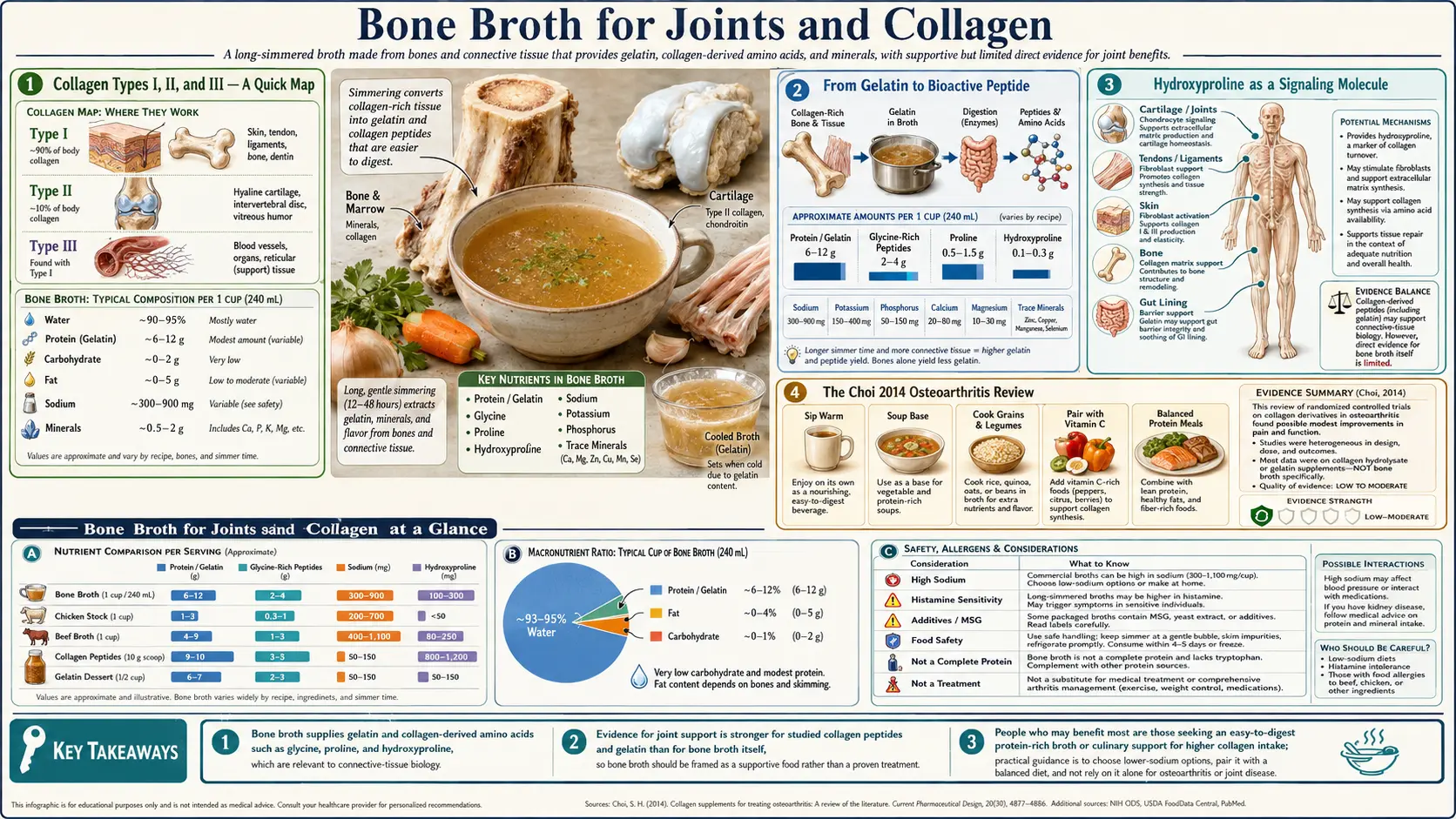
The joint-and-collagen application is the most rigorously studied of bone broth's effects, because the active compound — hydrolyzed gelatin / collagen peptides — has been isolated, standardized, and tested in dozens of randomized trials. The mechanism is now reasonably well-mapped: gut peptidases hydrolyze ingested gelatin to short di- and tri-peptides (notably prolyl-hydroxyproline) that are absorbed intact, circulate to joints and skin, and signal chondrocytes and fibroblasts to upregulate their own extracellular-matrix synthesis. The trials most often cited — Proksch 2014 (skin elasticity), Clark 2008 (athletes' activity-related joint pain), Bruyère 2012 (joint pain), and the 24-week McAlindon pilot trial of 40 mL collagen hydrolysate — together with a 2024 meta-analysis of 35 osteoarthritis trials, make up much of the evidence base for collagen peptide supplementation. A practical question that remains is how bone broth compares with standardized hydrolyzed collagen peptide powder — the two differ in cost, convenience and dose precision.
Table of Contents
- Collagen Types I, II, and III — A Quick Map
- From Gelatin to Bioactive Peptide
- Hydroxyproline as a Signaling Molecule
- The Osteoarthritis and Joint-Pain Trials
- Proksch 2014 and the Skin-Elasticity Trials
- Clark 2008 and Activity-Related Joint Pain in Athletes
- Bone Broth vs Hydrolyzed Collagen Peptide Powder
- Dose, Timing, and Co-Factors (Vitamin C)
- Product Types, Type I vs Type II, and Quality Markers
- Realistic Expectations and Timeline
- Key Research Papers
- Connections
- Featured Videos
Collagen Types I, II, and III — A Quick Map
Collagen is not one molecule but a family of structurally related triple-helical proteins encoded by at least 28 distinct gene products. For the bone-broth and supplement conversation, three types matter most:
- Type I collagen — the most abundant in the body, comprising approximately 90% of all collagen. Found in skin, bone, tendons, ligaments, the dura, the cornea, the dentin of teeth, and the fibrous capsules of organs. This is the collagen extracted from beef hides (the dominant source of commercial gelatin and most type-I collagen-peptide supplements) and from bones during a bone-broth simmer. Predominantly responsible for the skin-elasticity, hair, nail, and bone applications.
- Type II collagen — the dominant collagen in joint cartilage (specifically hyaline cartilage) and the vitreous humor of the eye. Type II collagen-peptide supplements are typically extracted from chicken sternum cartilage and sold as undenatured type II (UC-II) or hydrolyzed chicken collagen. The most relevant for osteoarthritis applications — the joint cartilage being repaired or maintained is type II by composition, and there is evidence that the immunomodulatory effect of low-dose undenatured UC-II (40 mg/day) at the gut-associated lymphoid tissue produces oral-tolerance effects that suppress autoimmune joint inflammation. Chicken-cartilage broth (chicken feet, necks, chicken backs) is the bone-broth source of type II.
- Type III collagen — found alongside type I in skin, blood vessels, and internal organs. Most commercial type-I supplements actually contain a type-I-plus-type-III mixture because they co-extract from hide.
The conventional shorthand: type I and III for skin / hair / nails / bone / general connective tissue; type II for joint cartilage. Bone broth made from a mixture of beef joint bones (for type I), chicken feet (for type II), and skin / hide pieces (for type I and III) covers all bases. Most commercial collagen peptide powders are pure type I + III (from bovine hide or marine fish skin) unless specifically marketed as joint formulas with added type II.
From Gelatin to Bioactive Peptide
The collagen triple helix in raw bone and cartilage is a highly cross-linked, water-insoluble structural protein. The long simmer in bone-broth preparation accomplishes two transformations: denaturation (the triple helix unwinds into individual polypeptide chains, becoming heat-soluble gelatin) and partial hydrolysis (the long peptide chains are progressively broken at random points by the heat and the modest acidity of the simmer). The result is gelatin — a heterogeneous mixture of polypeptide fragments ranging from roughly 10,000 to 200,000 Daltons.
Commercial hydrolyzed collagen peptide powder is produced by taking this gelatin one step further with controlled enzymatic hydrolysis (typically using a food-grade protease at controlled temperature and pH) to break the polypeptides into much shorter fragments — typically 2,000 to 5,000 Daltons. These shorter peptides are water-soluble at all temperatures (unlike gelatin, which gels when cool), tasteless and odorless, and rapidly absorbed.
Once eaten, both gelatin and hydrolyzed collagen peptides face the same gut peptidases — brush-border enzymes that cleave peptides down to free amino acids and to short di- and tri-peptides that can be transported intact across the enterocyte via peptide transporter 1 (PEPT1), the proton-coupled oligopeptide transporter. The Iwai et al. 2005 paper in the Journal of Agricultural and Food Chemistry was the first to demonstrate that specific collagen-derived peptides appear intact in human blood after healthy volunteers ate 9.4-23 g of gelatin hydrolysate: the main one was prolyl-hydroxyproline (Pro-Hyp), with small amounts of others such as alanyl-hydroxyproline (Ala-Hyp) and prolyl-hydroxyprolyl-glycine (Pro-Hyp-Gly). The peptide form of hydroxyproline peaked at 20-60 nmol/mL of plasma roughly 1-2 hours after dosing and was down to half that level at 4 hours. Subsequent work (Shigemura, Sato, others) has identified additional bioactive peptides and confirmed their persistence in plasma for several hours post-ingestion.
This intact-peptide absorption is the molecular foundation for the joint and skin effects. If collagen were simply digested to free amino acids like any other dietary protein, there would be no reason to think it had any benefit beyond the modest glycine and proline contribution. The detection of intact collagen-derived peptides in plasma at biologically relevant concentrations is what makes the mechanism work.
Hydroxyproline as a Signaling Molecule
Hydroxyproline is the modified amino acid that gives collagen its unique structural stability. The triple helix of collagen depends on hydroxylation of approximately half of its proline residues, and this hydroxylation requires Vitamin C as a cofactor for the prolyl-hydroxylase enzymes — the reason that scurvy, the historical Vitamin C deficiency syndrome, presented with collapsed collagen-dependent tissues (bleeding gums, easy bruising, poor wound healing, joint pain).
Hydroxyproline does not occur in significant quantities in any other dietary protein source — it is essentially a collagen-specific signature amino acid. When the body detects rising plasma hydroxyproline (in the form of Pro-Hyp and other hydroxyproline-containing peptides), it appears to interpret this as a signal of collagen breakdown somewhere in the body, and to upregulate matrix synthesis in cells that build collagen-rich tissues. Animal studies have shown that oral collagen peptides increase chondrocyte expression of type II collagen, aggrecan, and lubricin in joint cartilage; increase fibroblast collagen synthesis in skin; and accelerate fracture healing in bone-injury models.
The signal-amplification idea is what makes the seemingly small daily dose of collagen peptides (10-15 g, providing maybe 1.5 g of hydroxyproline) plausibly effective. The peptides themselves are not the structural building blocks for new joint cartilage — that synthesis happens locally in the chondrocyte using free amino acids from the broader amino-acid pool. The peptides are a signaling input that tells chondrocytes to build more.
The Osteoarthritis and Joint-Pain Trials
The Choi FD et al. 2019 systematic review in the Journal of Drugs in Dermatology covers skin only: it included 11 randomized placebo-controlled trials (805 patients) of collagen for pressure ulcers, dry skin (xerosis), skin aging and cellulite, and no osteoarthritis trials. The trial most directly addressing joint cartilage is McAlindon et al. (2011, Osteoarthritis and Cartilage), a pilot randomized trial in 30 people with mild knee osteoarthritis that used 40 mL/day of collagen hydrolysate for 24 weeks. On magnetic resonance imaging (MRI), a cartilage measure called delayed gadolinium-enhanced MRI of cartilage (dGEMRIC), which reflects the cartilage's proteoglycan content, rose in two of six knee regions (the medial and lateral tibia, median increases of 29 and 41 ms) with collagen and fell with placebo. The other four regions, every T2-mapping value, and the pain and function scores did not differ between the groups; the authors called the results preliminary.
The Bruyère et al. 2012 trial (Complementary Therapies in Medicine) gave 1,200 mg (1.2 g) a day of collagen hydrolysate or placebo for 6 months to 200 people aged 50 or older with joint pain. At 6 months, 51.6% of the collagen group and 36.5% of the placebo group were "responders" — pain in the most painful joint down by 20% or more on a visual analogue scale (VAS) (p<0.05); at 3 months the groups did not differ (44.1% vs 39.6%). The Bello and Oesser 2006 review (Current Medical Research and Opinion) pooled the available evidence on collagen hydrolysate for osteoarthritis and concluded that the supplement was generally well-tolerated and produced modest but consistent symptomatic improvement.
The Lugo et al. 2016 trial gave 191 people with knee osteoarthritis 40 mg/day of undenatured type II collagen (UC-II, a low dose), glucosamine 1,500 mg plus chondroitin 1,200 mg, or placebo for 180 days. At day 180 the total Western Ontario and McMaster Universities Osteoarthritis Index (WOMAC) score had fallen more in the type II collagen group than with placebo (p = 0.002) and than with glucosamine-chondroitin (p = 0.04), and side effects did not differ among the groups. UC-II is thought to work by a different mechanism (oral tolerance induction at the gut-associated lymphoid tissue) than the hydrolyzed-peptide signaling mechanism, but both are forms of "collagen for joint pain" and both have published evidence.
The honest summary of the joint-pain evidence: collagen peptide supplementation produces statistically significant but clinically modest improvements in osteoarthritis pain scores at doses from 1.2 g (Bruyère) to 10 g per day for type-I hydrolysate or 40 mg per day for type-II UC-II. Effects emerge over 8-24 weeks of consistent use, not days. The effect size is comparable to glucosamine and chondroitin (which themselves have a mixed evidence base) and considerably smaller than nonsteroidal anti-inflammatory drugs (NSAIDs) for acute pain — but collagen has a near-perfect safety profile and may produce additive benefit when combined with other interventions.
A 2024 meta-analysis in Osteoarthritis and Cartilage (Liang and colleagues) pooled 35 randomized trials (3,165 patients) of collagen products for osteoarthritis. Compared with control groups, collagen gave small-to-moderate improvements in pain (standardized mean difference -0.35, moderate-certainty evidence) and in function (-0.31, high-certainty evidence), and it did not increase side effects or drop-outs.
Proksch 2014 and the Skin-Elasticity Trials
The Proksch E et al. 2014 trial in Skin Pharmacology and Physiology is the most-cited skin trial of collagen peptide supplementation. Sixty-nine women aged 35-55 received 2.5 g or 5.0 g of a specific collagen-peptide preparation or placebo daily for 8 weeks. Skin elasticity (measured by cutometer) improved significantly with both collagen doses compared to placebo, and 4 weeks after the last dose it was still significantly higher in the older women. Skin moisture and transepidermal water loss showed nonsignificant trends.
The Proksch group's follow-up trial (2014, second publication) gave 114 women aged 45-65 either 2.5 g a day of a specific collagen peptide or placebo for 8 weeks: eye-wrinkle volume fell by 20% compared with placebo, and in a subgroup tested by suction-blister biopsy, skin procollagen type I was 65% higher and elastin 18% higher than with placebo. The Asserin et al. 2015 trial in 106 women similarly demonstrated improvements in skin hydration, dermal collagen density (measured by ultrasound), and the collagen-elastin-glycosaminoglycan complex with 10 g/day collagen peptide over 12 weeks. The Borumand and Sibilla 2014 trial of a multi-ingredient collagen-plus-antioxidant drink reported wrinkle-depth improvements at 90 days.
The skin-elasticity evidence is more robust than the joint evidence in some ways — effect sizes are similar (small-to-modest), but the measurement endpoints (cutometer elasticity, ultrasound dermal collagen) are objective and quantifiable rather than dependent on subjective pain scoring. The dose-response is established (2.5-10 g/day works; below 1 g/day does not appear to). The latency to visible effect is 8-12 weeks of consistent daily use — not the 24 weeks of joint trials, perhaps because skin turnover is faster than cartilage turnover.
A 2025 meta-analysis in The American Journal of Medicine (Myung and Park) of 23 randomized trials (1,474 people) found that collagen supplements improved skin hydration, elasticity and wrinkles when all the trials were pooled. But the trials not funded by pharmaceutical companies found no effect on any of the three, and neither did the high-quality trials; the authors concluded that there is currently no clinical evidence to support collagen supplements to prevent or treat skin aging.
Bone-broth practitioners reason that 1-2 cups of well-made bone broth daily, providing 10-20 g of gelatin, delivers a collagen dose comparable to the 2.5-10 g/day of collagen peptides used in the Proksch and Asserin trials — though with less precision, because broth gelatin content varies batch to batch, and broth itself was not what these trials tested.
Clark 2008 and Activity-Related Joint Pain in Athletes
The Clark KL et al. 2008 trial in Current Medical Research and Opinion tested 10 g/day of collagen hydrolysate (in 25 mL of liquid) vs placebo over 24 weeks in 147 varsity and club-sport athletes with activity-related joint pain and no evidence of joint disease; data from 97 of the 147 could be analysed. The collagen group showed significant improvement in pain at rest, pain when walking, pain when standing, pain when carrying objects, and pain when lifting — on a visual analog scale — compared to placebo. The difference was larger in the 63 athletes with knee pain. The population was not osteoarthritic patients but symptomatic athletes, and the authors wrote that collagen hydrolysate might possibly reduce the risk of joint deterioration in this high-risk group.
The Zdzieblik et al. 2017 follow-up trial in Applied Physiology, Nutrition, and Metabolism tested 5 g/day of collagen peptides or placebo for 12 weeks in 139 young athletes with functional knee pain. Pain during activity on a visual analogue scale fell more with collagen than with placebo (19.5 vs 13.9 points, p = 0.046), and the physicians' assessment agreed; pain at rest also fell, but not significantly more than with placebo, and the collagen group used fewer additional treatments. Subsequent work has tested collagen peptide for tendon healing (Praet et al. 2019), Achilles tendinopathy, and recovery after anterior cruciate ligament (ACL) reconstruction, with generally positive but heterogeneous results.
The mechanistic interpretation is that the joint and tendon collagen turnover demands of athletic activity exceed the rate at which the body can synthesize replacement collagen from baseline amino-acid intake, and that exogenous collagen peptide signaling increases the chondrocyte and tenocyte synthesis rate enough to keep up. This is a different mechanism from the autoimmune-modulation hypothesis of UC-II (oral tolerance induction) — both can be true simultaneously for different forms of collagen at different doses.
The Clark and Zdzieblik trials were done in athletes rather than sedentary people, so their results apply most directly to active people — recreational runners, lifters, court-sports players — whose collagen turnover is thought to be higher.
Bone Broth vs Hydrolyzed Collagen Peptide Powder
For the specific outcome of joint and skin collagen support, hydrolyzed collagen peptide powder has several practical advantages over bone broth:
- Dose precision — a 10 g scoop of powder reliably delivers 10 g of collagen; a cup of homemade broth might deliver anywhere from 6 to 20 g depending on the batch
- Cost — powder runs approximately $1-1.50 per 10 g serving; commercial bone broth runs $5-8 per cup; homemade broth runs $1-2 per cup but requires hours of kitchen time
- Convenience — powder dissolves in any beverage (coffee, smoothie, water) at any temperature; broth must be heated and consumed as a savory liquid
- Taste neutrality — hydrolyzed peptide powder is essentially tasteless; broth is meaty and salty (which is desirable in some contexts and not in others)
- Travel compatibility — powder in stick packs travels anywhere; broth requires refrigeration or freezer storage
- Shelf stability — powder lasts years sealed; broth lasts 4-5 days refrigerated or 3-6 months frozen
- Histamine — powder is histamine-free; broth is high-histamine (relevant for the mast cell activation syndrome (MCAS) / small intestinal bacterial overgrowth (SIBO) / postural orthostatic tachycardia syndrome (POTS) population)
Bone broth has its own advantages that powder cannot match:
- Whole-food complexity — broth delivers minerals, fat-soluble vitamins, free glutamine, glycosaminoglycans, and the rest of the gelatin matrix in their natural relative proportions, rather than an isolated peptide fraction
- Warm-liquid vehicle — the convalescent and gut-healing applications benefit from the warm-liquid format; powder dissolved in cold water is not the same experience
- Satiety and meal-replacement value — a cup of broth with skimmed fat is a small meal; powder is a supplement
- Tradition and cooking integration — broth becomes the cooking liquid for grains, soups, stews, sauces — integrating into the broader diet rather than being a standalone supplement
- Cost per ingredient — for a household already buying meat with bones for other cooking, the broth is essentially free incremental nutrition
The trade-off, as practitioners describe it: hydrolyzed collagen peptide powder gives a precise daily collagen dose cheaply and conveniently, which is the form the joint and skin trials tested; homemade broth brings the broader gut-healing, convalescent and everyday-cooking uses of broth. Many people use both — powder in the morning coffee, broth in the evening as part of cooking.
Dose, Timing, and Co-Factors (Vitamin C)
Effective doses in published trials:
- Type I hydrolyzed collagen for joint pain — 1.2 g/day in the Bruyère 2012 trial, 5 g/day in the Zdzieblik 2017 athlete trial, 10 g/day in the Clark 2008 athlete trial, 40 mL (about 10 g protein) per day in the McAlindon trial
- Type I hydrolyzed collagen for skin — 2.5-10 g/day in the Proksch and Asserin trials
- Undenatured type II (UC-II) — 40 mg/day in the Lugo and Crowley trials, taken on empty stomach
- Bone broth equivalent — 1-3 cups daily of well-gelling homemade broth, approximately equivalent to 10-30 g of gelatin/collagen
Timing: The bioavailability of collagen peptides is well-established to be reasonably robust regardless of meal context, but consistency matters more than precise timing. The trials ran for 8-24 weeks of daily use; skin effects were measured at 8 weeks, and in the Bruyère joint-pain trial the difference from placebo appeared at 6 months but not at 3.
Vitamin C co-factor: The prolyl hydroxylase enzymes that hydroxylate proline residues during collagen synthesis are absolutely dependent on Vitamin C. The reasoning that follows is that people on low-Vitamin-C diets or with malabsorption (smokers, alcohol overuse, after bariatric surgery, inflammatory bowel disease) may not get full benefit from collagen peptide supplementation without adequate Vitamin C status. A commonly quoted practitioner figure is 500 mg of Vitamin C alongside collagen, though much smaller amounts suffice for replete individuals. The trial protocols generally do not control for Vitamin C intake, which may explain some of the heterogeneity in trial results — deficient-baseline patients may respond more dramatically than replete patients.
For more on Vitamin C and collagen, see our Vitamin C page.
Product Types, Type I vs Type II, and Quality Markers
Powdered collagen peptide products fall into a few types:
- Bovine-hide collagen peptides — often from pasture-raised or grass-fed cattle, type I + III, unflavored; the most widely sold type in the US, and among the more expensive.
- Hydrolysed bovine collagen powders — long used in the nourishing-traditions community associated with the Weston A. Price Foundation (WAPF), a nonprofit.
- Multi-source collagen blends — bovine, chicken, fish, and eggshell membrane — covering type I, II, III, V, and X in a single product, for people who want type II joint coverage in one powder.
- Commodity-grade collagen peptides — much cheaper per gram than premium products.
- Marine collagen peptides — from fish skin; some products in this and the bovine group are third-party tested.
- Undenatured type II collagen products — 40 mg, the dose used in the Lugo and Crowley trials, for joint-specific use.
Commercial bone broth (when home preparation is not feasible) comes in a few forms:
- Frozen long-simmered broths — typically gel firmly when thawed; the premium restaurant-style versions are expensive.
- Shelf-stable carton broths — more convenient and widely available in grocery stores; gelatin content varies from carton to carton (see the protein marker below).
- Warehouse-club bone broths — a middle-tier price option.
Quality markers commonly described for broth:
- Gels firmly when chilled — the single best practical test of gelatin content. In the usual home test a cup is chilled overnight; broth that sets to a jelly firm enough to resist a spoon is real, gelatin-rich broth.
- Pasture-raised / grass-fed sourcing — an explicit label claim, sometimes backed by certification (American Grassfed Association, Animal Welfare Approved)
- Ingredient list is bones, water, vinegar, vegetables — nothing else — "natural flavor," yeast extract, gum thickeners, or added collagen are flags for a reconstituted product rather than a real long-simmer broth
- Protein content per cup > 9 g — real broth from joint bones runs 9-15 g protein per cup; shelf-stable stocks run 2-5 g. The protein content is the gelatin content.
Realistic Expectations and Timeline
What the trials and user reports describe over time for collagen peptides (whether broth or powder) taken for joint pain or skin elasticity:
- Weeks 1-4 — subjective changes are usually minimal. Some patients report mild improvement in nail strength or skin texture in the first month; most do not.
- Weeks 4-8 — for active patients with activity-related joint pain, subjective improvement often begins to be noticeable around week 6-8. Skin changes (measured) appear at 8 weeks in the Proksch trials.
- Weeks 8-12 — the typical window when most responders report meaningful improvement in osteoarthritic joint pain, skin elasticity, hair and nail strength
- Months 3-6 — the McAlindon pilot trial found a rise in one MRI cartilage measure (dGEMRIC, reflecting proteoglycan content) in two of six knee regions at 24 weeks, with no difference in T2 values or in pain; whether lasting structural benefit is achievable is not known
- Beyond 6 months — the trials reported no toxicity signals (the 2024 meta-analysis found no increase in side effects or drop-outs); how long benefits last after stopping is not well studied — in both Proksch skin trials, effects were still measurable 4 weeks after the last dose
Practitioners report that people who notice no benefit after 12 weeks of consistent 10 g/day use rarely respond to higher doses or longer use. Suggested reasons for non-response include inadequate Vitamin C status, severe established osteoarthritis with bone-on-bone changes (collagen peptide cannot reverse advanced joint structural disease), and individual non-response that is not yet understood. Other approaches used for osteoarthritis include physical therapy, joint (intra-articular) injections, glucosamine plus chondroitin, and low-dose curcumin or boswellia.
Collagen peptide supplementation is studied as symptom and structural support, not as a cure for arthritis. The trials on this page were in osteoarthritis, joint pain and athletes; none tested collagen in rheumatoid arthritis, psoriatic arthritis or other autoimmune joint disease, or as a replacement for the disease-modifying anti-rheumatic drugs (DMARDs) used for them. For more on arthritis management, see our Arthritis page.
Key Research Papers
- Choi FD, Sung CT, Juhasz ML, Mesinkovsk NA (2019). Oral collagen supplementation: a systematic review of dermatological applications. Journal of Drugs in Dermatology. 18(1):9-16. — PubMed PMID: 30681787
- Proksch E, Schunck M, Zague V, Segger D, Degwert J, Oesser S (2014). Oral intake of specific bioactive collagen peptides reduces skin wrinkles and increases dermal matrix synthesis. Skin Pharmacology and Physiology. 27(3):113-9. — PubMed PMID: 24401291
- Proksch E et al. (2014). Oral supplementation of specific collagen peptides has beneficial effects on human skin physiology: a double-blind, placebo-controlled study. Skin Pharmacology and Physiology. — PubMed PMID: 23949208
- Clark KL et al. (2008). 24-week study on the use of collagen hydrolysate as a dietary supplement in athletes with activity-related joint pain. Current Medical Research and Opinion. — PubMed PMID: 18416885
- McAlindon TE et al. (2011). Change in knee osteoarthritis cartilage detected by delayed gadolinium enhanced magnetic resonance imaging following treatment with collagen hydrolysate: a pilot RCT. Osteoarthritis and Cartilage. — PubMed PMID: 21251991
- Iwai K et al. (2005). Identification of food-derived collagen peptides in human blood after oral ingestion of gelatin hydrolysates. Journal of Agricultural and Food Chemistry. — PubMed PMID: 16076145
- Lugo JP et al. (2016). Efficacy and tolerability of an undenatured type II collagen supplement in modulating knee osteoarthritis symptoms. Nutrition Journal. — PubMed PMID: 26822714
- Asserin J et al. (2015). The effect of oral collagen peptide supplementation on skin moisture and the dermal collagen network. Journal of Cosmetic Dermatology. — PubMed PMID: 26362110
- Zdzieblik D et al. (2017). Improvement of activity-related knee joint discomfort following supplementation of specific collagen peptides. Applied Physiology, Nutrition, and Metabolism. — PubMed PMID: 28177710
- Bello AE, Oesser S (2006). Collagen hydrolysate for the treatment of osteoarthritis and other joint disorders. Current Medical Research and Opinion. — PubMed PMID: 17076983
- Bruyère O et al. (2012). Effect of collagen hydrolysate in articular pain: a 6-month randomized, double-blind, placebo-controlled study. Complementary Therapies in Medicine. — PubMed PMID: 22500661
- Crowley DC et al. (2009). Safety and efficacy of undenatured type II collagen in the treatment of osteoarthritis of the knee: a clinical trial. International Journal of Medical Sciences. — PubMed PMID: 19847319
- Liang CW, Cheng HY, Lee YH, Liao CD, Huang SW (2024). Efficacy and safety of collagen derivatives for osteoarthritis: a trial sequential meta-analysis. Osteoarthritis and Cartilage. 32(5):574-584. — PubMed PMID: 38218227
- Myung SK, Park Y (2025). Effects of collagen supplements on skin aging: a systematic review and meta-analysis of randomized controlled trials. The American Journal of Medicine. 138(9):1264-1277. — PubMed PMID: 40324552
- Shaw G et al. (2017). Vitamin C-enriched gelatin supplementation before intermittent activity augments collagen synthesis. American Journal of Clinical Nutrition. — PubMed PMID: 27852613