⚠ Evidence warning: Clinical trials or other evidence do not support the claims that bee pollen desensitizes people to seasonal allergies, works as an endurance aid for athletes, and is a complete food that can sustain life on its own. This page keeps it as a report of what people, websites or other media say.
Bee Pollen — Benefits Deep Dive
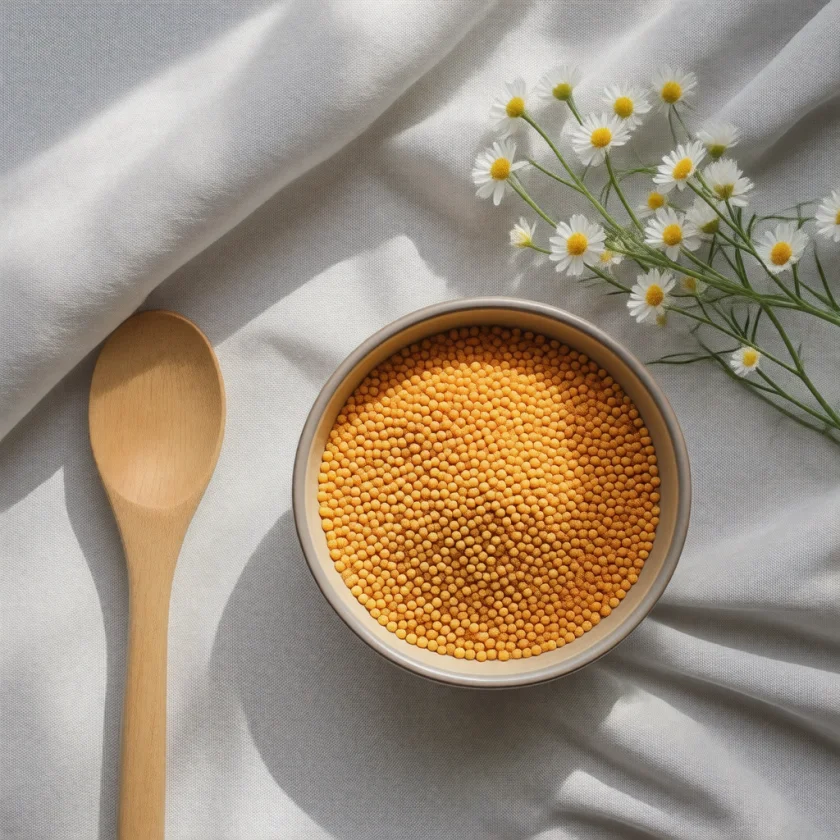
Bee pollen is honeybee-collected flower pollen agglutinated into small granules with nectar and bee saliva, then packed into the hive's pollen baskets as the colony's primary protein and micronutrient source. Bee pollen is one of the most nutrient-dense whole foods known — chemical analyses identify 22 amino acids (including all nine essentials), the complete B-complex vitamin spectrum (B1, B2, B3, B5, B6, B7, B9, B12-analogs), minerals (iron, zinc, magnesium, selenium, potassium, calcium), more than 100 flavonoids and phenolic acids (notably quercetin, rutin, and kaempferol), live digestive enzymes (amylase, invertase, phosphatase), and trace bioactive lipids. Some authorities call it a "complete food" capable of sustaining mammalian life as the sole nutritional input, though that claim rests on animal studies rather than human trials. The four benefit pages below explore where bee pollen produces its largest documented effects — the contested but persistent claim of seasonal-allergy desensitization, the well-documented Soviet/Eastern European tradition of using it as an endurance ergogen for athletes, its dense nutrient stack as a near-complete protein and micronutrient profile, and its strong antioxidant and anti-inflammatory flavonoid load. Safety fact: bee pollen can cause anaphylaxis (a severe whole-body allergic reaction) — a 2015 case report describes it one hour after a single tablespoon in a man with seasonal pollen allergy, and its authors flag the risk especially for people with pollen allergy.
Deep-Dive Articles
Allergy Desensitization
The oral-immunotherapy hypothesis — local bee pollen contains trace amounts of regional airborne allergens, and slow oral introduction may build tolerance via the same regulatory T-cell (Treg)-mediated mechanism as sublingual immunotherapy. The folk tradition of local-honey-plus-pollen, the limited but suggestive seasonal-allergy pilot data, the contested mechanism (bee-collected pollens are mostly entomophilous, not the anemophilous tree/grass/weed pollens that cause hay fever), and a head-to-head comparison with U.S. Food and Drug Administration-approved sublingual immunotherapy.
Read the deep dive →Athletic Performance
The Soviet and Eastern European tradition of bee pollen for Olympic-class athletes, the Maughan 1982 swimming study and the Steben 1978 cross-country running trial that defined the early Western literature, why the B-vitamin and 22-amino-acid load plausibly supports endurance recovery, the negative strength-and-power trials, the placebo-controlled crossover methodology problems, and the contemporary positioning as a recovery food rather than a performance-enhancing ergogen.
Read the deep dive →Nutrient Density Profile
The "250+ nutrients in concentrated form" claim broken down honestly — 22 amino acids (all nine essentials), the complete B-complex including notable B5/pantothenic acid and B7/biotin, minerals (iron, zinc, magnesium, selenium, potassium, calcium), more than 100 flavonoids and phenolic acids, live enzymes, beneficial fatty acids, and the "complete food" claim that bee pollen alone could sustain mammalian life — with the honest caveat that this rests on rodent studies, not human trials.
Read the deep dive →Antioxidant & Anti-Inflammatory
The flavonoid catalog — quercetin, rutin, kaempferol, myricetin, isorhamnetin, naringenin, and phenolic acids including chlorogenic and caffeic acid. Bee pollen's oxygen radical absorbance capacity (ORAC) value compared to blueberries, dark chocolate, and pomegranate. The cyclooxygenase-1 (COX-1)/cyclooxygenase-2 (COX-2) inhibition pilot data, the Mediterranean and Greek-Bulgarian dietary tradition, the in vitro NF-kappaB suppression, and the realistic translation to in-vivo anti-inflammatory effect.
Read the deep dive →Table of Contents
- Deep-Dive Articles
- Why Bee Pollen Produces Effects
- Research Papers: Allergy & Immunology
- Research Papers: Athletic Performance & Ergogenics
- Research Papers: Nutrient Composition
- Research Papers: Antioxidant & Anti-Inflammatory
- Research Papers: Cross-Cutting (Safety, Standards, Mechanism)
- External Authoritative Resources
- Connections
- Featured Videos
Why Bee Pollen Produces Effects
Bee pollen does not act through a single dominant active compound the way an isolated flavonoid drug or a vitamin pill does. It is a botanical-matrix superfood whose claimed effects rest on three overlapping mechanisms, each of which maps to a different cluster of the documented benefits.
- Broad nutrient density — bee pollen supplies 22 amino acids (all nine essentials, in ratios that approximate the Food and Agriculture Organization / World Health Organization (FAO/WHO) reference protein for human nutrition), the complete water-soluble B-complex, an unusually high content of pantothenic acid (B5) and biotin (B7), the fat-soluble vitamins A (as carotene precursors) and E, and a generous mineral profile including iron, zinc, magnesium, selenium, potassium, and calcium. This dense nutrient stack plausibly explains the endurance recovery and Soviet ergogenic tradition, as well as the historical use of bee pollen as a convalescent food for cachectic and underweight patients. It is also the foundation of the "complete food" claim — the assertion that rodents fed only bee pollen and water can grow, reproduce, and survive multiple generations.
- Flavonoid antioxidant load — bee pollen carries more than 100 distinct flavonoids and phenolic acids, with quercetin, rutin, kaempferol, myricetin, isorhamnetin, naringenin, chlorogenic acid, and caffeic acid as the most abundant. The total oxygen radical absorbance capacity (ORAC) value of bee pollen, expressed per gram, exceeds that of most berries, dark chocolate, and pomegranate. This flavonoid stack is the mechanistic basis for the antioxidant and anti-inflammatory effects, with the proviso that oxygen radical absorbance capacity measures in-vitro radical scavenging, not in-vivo physiologic effect.
- Speculative immunomodulation via low-dose allergen exposure — the most contested mechanism. Bee pollen contains trace amounts of regional flower pollen, and the oral-immunotherapy hypothesis is that slow daily ingestion of these trace allergens may build immune tolerance through the same regulatory T-cell mechanism that drives modern sublingual immunotherapy. This is the proposed basis for the seasonal-allergy desensitization tradition, though the human trial data are scarce and the entomophilous-vs-anemophilous problem (bee-collected pollens are mostly insect-pollinated species, not the wind-pollinated species that cause hay fever) is a substantial mechanistic challenge to the hypothesis.
The bee-pollen story is therefore mixed evidence, not pure folk medicine. The nutrient density is unambiguous chemistry. The antioxidant flavonoid load is unambiguous chemistry. The endurance/recovery effect has been tested only in small placebo-controlled trials, and the one with a published abstract (Maughan and Evans 1982) found no performance benefit from pollen. The allergy desensitization is largely tradition with weak supporting trial data and a real mechanistic challenge. None of this changes the anaphylaxis warning: bee pollen is a real protein-allergen exposure, and individuals with bee venom allergy or significant pollen allergy can experience anaphylactic shock to as little as one granule. The best-documented case points to pollen allergy rather than bee-venom allergy: a 40-year-old man with autumn hay fever developed hives all over, facial swelling, breathlessness, vomiting and an oxygen level of 91% one hour after eating one tablespoon of bee pollen. The granules contained Japanese hop, chrysanthemum, ragweed and dandelion pollen; his blood carried allergy antibodies (IgE) to ragweed, chrysanthemum and dandelion pollen, while tests for honey-bee and yellow-jacket venom antibodies were negative — so a bee-pollen sample can carry weed pollens to which a hay-fever sufferer is already sensitized. His symptoms resolved after injections of epinephrine, an antihistamine and a steroid. Practitioners describe starting with a quarter-teaspoon test dose taken where epinephrine and emergency care are at hand.
Two further safety facts come from published sources. Bee pollen has been reported to raise the effect of the blood thinner warfarin: in a 2010 case report, a 71-year-old man whose warfarin dose had been stable for nine months reached an International Normalized Ratio (INR, a blood-clotting test) of 7.1, against a target range of 2.0 to 3.0, one month after starting one teaspoon of bee pollen granules twice a day; the authors rated the interaction "probable". On the liver, the U.S. government's LiverTox reference states that bee products, bee pollen included, "are generally well tolerated and there is no evidence that they cause liver injury, either in the form of ALT elevations or clinically apparent liver injury" (ALT, alanine aminotransferase, is a liver enzyme measured in blood tests).
Research Papers: Allergy & Immunology
- Oral immunotherapy for seasonal allergic rhinitis — mechanism and Treg induction — PubMed: Oral immunotherapy mechanism
- Sublingual immunotherapy (SLIT) for grass pollen allergy — PubMed: SLIT grass pollen
- Bee pollen composition and identification of palynological sources — PubMed: Bee pollen palynology
- Local honey for seasonal allergic rhinitis — the contested folk tradition — PubMed: Local honey hay fever
- Bee pollen anaphylaxis case reports and risk assessment — PubMed: Bee pollen anaphylaxis
- Choi JH, Jang YS, Oh JW, Kim CH, Hyun IG (2015). Bee Pollen-Induced Anaphylaxis: A Case Report and Literature Review. Allergy Asthma Immunol Res 7(5):513-7 — PubMed PMID: 25749764
- Entomophilous vs anemophilous pollen and human allergic disease — PubMed: Pollen vector and allergy
- Bee pollen and Th1/Th2 immune balance in animal models — PubMed: Bee pollen Th1/Th2
- Apitherapy — clinical applications of bee products in allergy — PubMed: Apitherapy allergy
- Cross-reactivity between bee venom proteins and bee-collected pollen — PubMed: Bee venom cross-reactivity
- Major birch pollen allergen Bet v 1 and oral tolerance induction — PubMed: Bet v 1 oral tolerance
Research Papers: Athletic Performance & Ergogenics
- Maughan RJ, Evans SP (1982). Effects of pollen extract upon adolescent swimmers. British Journal of Sports Medicine 16(3):142-5 — PubMed PMID: 7139223
- Steben RE, Boudreaux P (1978). The effects of pollen and protein extracts on selected blood factors and performance of athletes. J Sports Med Phys Fitness 18(3):221-6 — PubMed PMID: 732296
- Bee pollen and physical work capacity — controlled trial — PubMed: Bee pollen physical capacity
- Pollen extract supplementation and aerobic performance in runners — PubMed: Pollen aerobic performance
- B-vitamin status and endurance exercise capacity — PubMed: B-vitamins endurance
- Branched-chain amino acid intake and exercise recovery — PubMed: BCAA recovery
- Soviet sports nutrition history and apitherapy traditions — PubMed: Soviet sports nutrition
- Anti-fatigue properties of bee pollen in rodent forced-swim assays — PubMed: Bee pollen anti-fatigue
- Bee pollen, hemoglobin, and erythropoiesis in athletes — PubMed: Bee pollen hemoglobin
- Pollen extract and oxygen uptake (VO2 max) in trained athletes — PubMed: Pollen VO2 max
What the Maughan and Evans 1982 trial found: 20 adolescent swimmers in daily training took pollen extract or a placebo for six weeks. Maximum oxygen uptake (VO2 max, a standard fitness measure) rose in both groups with no difference between them; lung volume (vital capacity) rose significantly only in the pollen group. The authors concluded that "no positive benefit was obtained from the use of pollen supplementation." The one large difference was in training days lost to colds and other upper-airway infections — 4 days in the pollen group against 27 in the placebo group — which the authors said could help performance in a longer study through fewer interruptions to training. The 1978 Steben and Boudreaux trial has no abstract in PubMed.
Research Papers: Nutrient Composition
- Bee pollen amino acid profile and protein quality assessment — PubMed: Bee pollen amino acids
- Vitamin content of bee-collected pollen (B-complex, A, E) — PubMed: Bee pollen vitamins
- Mineral composition of bee pollen (Fe, Zn, Mg, Se, K, Ca) — PubMed: Bee pollen minerals
- Flavonoid and phenolic acid profiling of multifloral bee pollen — PubMed: Bee pollen flavonoids
- Bee pollen lipid and fatty acid composition — PubMed: Bee pollen lipids
- Enzymes in bee pollen — amylase, invertase, phosphatase activity — PubMed: Bee pollen enzymes
- Bee pollen as the sole protein source — rodent multi-generational feeding studies — PubMed: Bee pollen sole protein
- Geographic and botanical variability in bee pollen nutritional composition — PubMed: Bee pollen variability
- FAO/WHO reference protein and bee pollen amino acid score — PubMed: FAO/WHO reference
- Bee pollen carbohydrate, fiber, and ash content — PubMed: Bee pollen macronutrients
Research Papers: Antioxidant & Anti-Inflammatory
- Bee pollen ORAC (oxygen radical absorbance capacity) and antioxidant ranking — PubMed: Bee pollen ORAC
- Quercetin in bee pollen and anti-inflammatory mechanism — PubMed: Quercetin bee pollen
- Rutin content of bee pollen and vascular effects — PubMed: Rutin bee pollen
- Kaempferol pharmacology and bee pollen content — PubMed: Kaempferol bee pollen
- Bee pollen COX-1 and COX-2 inhibition pilot data — PubMed: Bee pollen COX inhibition
- NF-kappaB suppression by polyphenol-rich bee pollen extracts — PubMed: Bee pollen NF-kappaB
- Mediterranean dietary pattern and pollen-rich superfoods — PubMed: Mediterranean superfoods
- Bee pollen and hepatic oxidative stress markers (MDA, GSH, SOD) — PubMed: Bee pollen oxidative stress
- Bee pollen and lipid peroxidation in cardiovascular models — PubMed: Bee pollen lipid peroxidation
- Phenolic acids (chlorogenic, caffeic) in bee pollen — bioactivity — PubMed: Bee pollen phenolic acids
Research Papers: Cross-Cutting (Safety, Standards, Mechanism)
- Bee pollen as functional food — comprehensive review (Komosinska-Vassev et al.) — PubMed: Bee pollen functional food review
- Bee pollen contamination — pesticides, heavy metals, mycotoxins — PubMed: Bee pollen contamination
- Bee pollen quality standards — international codex and EU regulation — PubMed: Bee pollen standards
- Bee pollen drug interactions — warfarin and anticoagulant case reports — PubMed: Bee pollen warfarin
- Hurren KM, Lewis CL (2010). Probable interaction between warfarin and bee pollen. Am J Health Syst Pharm 67(23):2034-7 — PubMed PMID: 21098375
- Bee Products: Beeswax, Bee Pollen, Propolis. In: LiverTox: Clinical and Research Information on Drug-Induced Liver Injury. Bethesda (MD): National Institute of Diabetes and Digestive and Kidney Diseases; 2012– (updated 2022 May 1) — PubMed PMID: 35593876
- Bee pollen hepatotoxicity rare case report — PubMed: Bee pollen hepatotoxicity
- Bee pollen processing — fresh vs frozen vs dried vs fermented — PubMed: Bee pollen processing
- Bee bread vs bee pollen — fermentation, bioavailability, and nutrient density — PubMed: Bee bread vs pollen
- Rye-grass pollen extract (a manufactured pollen extract, not bee-collected pollen) and benign prostatic hyperplasia: MacDonald R, Ishani A, Rutks I, Wilt TJ (2000). A systematic review of Cernilton for the treatment of benign prostatic hyperplasia. BJU Int 85(7):836-41 — PubMed PMID: 10792162
- Bee pollen in menopause symptom management — PubMed: Bee pollen menopause
- Bee pollen and pediatric weight gain in failure to thrive — PubMed: Bee pollen pediatric
External Authoritative Resources
- LiverTox (U.S. National Institutes of Health, NIH) — Bee Products: Beeswax, Bee Pollen, Propolis — National Institute of Diabetes and Digestive and Kidney Diseases (NIDDK) reference on drug- and supplement-induced liver injury, covering bee pollen, honey, propolis, and royal jelly
- CABI — Bee Pollen Composition and Botanical Origin (palynological reference)
- FAO — Value-Added Products from Beekeeping (Chapter on Pollen)
- PubMed — All research on bee pollen (3,000+ papers)
Connections
- All Food
- Bee Pollen (Main Page)
- Bee Pollen for Allergy Desensitization
- Bee Pollen for Athletic Performance
- Bee Pollen Nutrient Density Profile
- Bee Pollen Antioxidant & Anti-Inflammatory
- Honey
- Spirulina
- Quercetin
- Allergies
- Immune Boosting
- Oxidative Stress
- Vitamin C
- Zinc
- Iron
- Elderberry
- History
- Nutrients