⚠ Evidence warning: Clinical trials or other evidence do not support the claim that eating (local) bee pollen desensitizes people to seasonal pollen allergy and reduces hay-fever symptoms: no controlled human trial of bee pollen for hay fever has been published, the one randomized trial of the related local-honey tradition found no benefit over corn syrup, and published case reports describe anaphylaxis after eating bee pollen, mostly in people with pollen allergy. This page keeps it as a report of what people, websites or other media say.
Bee Pollen for Allergy Desensitization
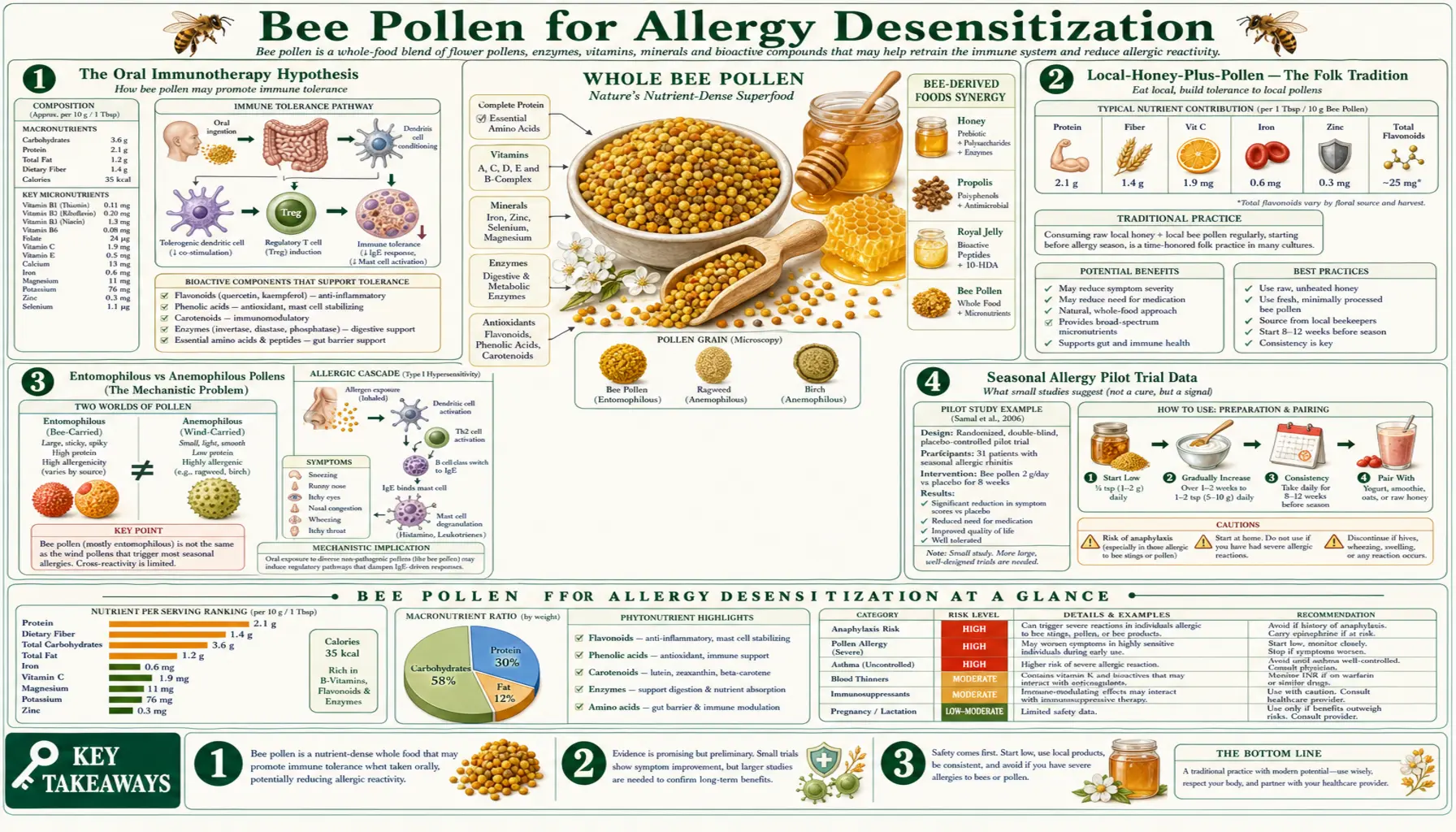
The claim that bee pollen desensitizes seasonal allergy sufferers is one of the oldest and most contested in apitherapy. The folk-medicine tradition — "eat a teaspoon of local raw honey and bee pollen every morning for three months before pollen season" — rests on a plausible oral-immunotherapy hypothesis: trace amounts of regional flower pollen ingested daily over months might induce immune tolerance through the same regulatory-T-cell mechanism that drives U.S. Food and Drug Administration-approved sublingual immunotherapy for grass and ragweed allergy. The mechanistic challenge is that bee-collected pollens are predominantly entomophilous (insect-pollinated species like clover, dandelion, and wildflowers), while the pollens that cause hay fever are anemophilous (wind-pollinated trees, grasses, and ragweed). Whether bee pollen contains enough of the right allergens, in the right form, to deliver clinically meaningful desensitization is a genuinely open question: no controlled human trial of bee pollen for hay fever was found in PubMed. This deep-dive walks through the immunology, what has and has not been studied, the entomophilous-anemophilous problem, the head-to-head with sublingual immunotherapy, the protocol apitherapy practitioners describe, and the published anaphylaxis cases.
Table of Contents
- The Oral Immunotherapy Hypothesis
- Local-Honey-Plus-Pollen — The Folk Tradition
- Entomophilous vs Anemophilous Pollens (The Mechanistic Problem)
- Seasonal Allergy Research Data
- Comparison with Sublingual Immunotherapy (SLIT)
- The Regulatory T-Cell (Treg) Tolerance Mechanism
- Practical Dosing and Test-Dose Protocol
- Why "Local" Bee Pollen Matters
- Who the Research Raises Concerns For
- The Anaphylaxis Warning
- Key Research Papers
- Connections
- Featured Videos
The Oral Immunotherapy Hypothesis
The general principle that small repeated oral doses of an allergen can induce immune tolerance is well established in modern allergology. Oral immunotherapy (OIT) for peanut allergy is now a U.S. Food and Drug Administration-approved treatment (a peanut (Arachis hypogaea) allergen powder) in which patients ingest precisely measured, slowly escalating doses of peanut protein over six to twelve months and graduate to a daily maintenance dose that prevents serious reactions on accidental exposure. The mechanism is induction of regulatory T cells (Tregs) that produce interleukin-10 (IL-10) and TGF-beta, suppressing the allergen-specific Th2 response that drives the immunoglobulin E-mediated mast cell activation responsible for the allergic reaction.
The bee-pollen allergy desensitization hypothesis is the same general idea applied to airborne pollen allergens. Bee pollen contains, by virtue of how it is collected, small amounts of regional flower pollen proteins. Daily ingestion of bee pollen over months would, in this hypothesis, deliver an oral immunotherapy dose of these allergens and shift the immune balance from Th2/immunoglobulin E-dominant toward Treg-dominant, reducing or eliminating the symptomatic response to seasonal pollen exposure.
The hypothesis is mechanistically plausible. The challenge is whether bee pollen actually contains enough of the right allergens to produce a measurable Treg shift. Modern OIT uses precisely titrated, single-allergen, standardized extracts. Bee pollen is a heterogeneous botanical mixture whose composition varies by hive, season, geography, and forage. The allergen dose per gram is unmeasured, the allergen identity is mostly entomophilous-species protein rather than the anemophilous-species proteins that cause hay fever, and the bioavailability of intact allergen protein after passage through the stomach is poorly characterized.
Local-Honey-Plus-Pollen — The Folk Tradition
The "eat local honey for hay fever" tradition predates modern allergology by centuries. It exists in some form in nearly every honey-producing culture, from Greek and Bulgarian apitherapy to Appalachian folk medicine to the Eastern European samogon-and-honey tonic traditions. The standard protocol is similar across these traditions: start two to three months before the local pollen season, take one to three teaspoons of raw local honey and bee pollen daily, continue through and past the peak of symptoms.
The biological argument for combining honey with bee pollen is that honey itself contains trace pollen (the contamination is unavoidable during nectar collection), while bee pollen as a separate granular product is far more concentrated. A 2002 trial in Annals of Allergy, Asthma, and Immunology tested the folk claim directly: 36 people with allergic rhinoconjunctivitis (hay fever with itchy, watery eyes) were randomly given one tablespoon a day of locally collected unpasteurized, unfiltered honey, nationally collected filtered and pasteurized honey, or corn syrup with synthetic honey flavouring, and kept a diary of 10 allergy symptoms. Neither honey group had more relief than the corn-syrup group (Rajan 2002). Several later trials have shown similarly negative or marginal results for local honey alone.
The results for honey-plus-bee-pollen are sparser. The Eastern European literature contains uncontrolled case series suggesting benefit, but these do not meet modern randomized-trial standards.
The folk tradition therefore has persistence as evidence but not rigor. Whether it works at the population level — reducing total seasonal symptom burden in a way that would show up as a positive randomized controlled trial — remains unproven.
Entomophilous vs Anemophilous Pollens (The Mechanistic Problem)
This is the central scientific objection to the bee-pollen allergy hypothesis. Flowering plants are divided into two pollination strategies:
- Entomophilous (insect-pollinated) plants — clover, dandelion, sunflower, fruit trees, most ornamental flowers. These produce pollen grains that are sticky, heavy, and packed with sugar and protein to attract and reward pollinators. Honeybees collect mostly from these, because the energy economics work — nectar plus protein in one stop. Entomophilous pollens are NOT a significant cause of human allergic rhinitis because they do not become airborne in significant concentrations.
- Anemophilous (wind-pollinated) plants — grasses, ragweed, oak, birch, elm, pine. These produce pollen grains that are small, dry, and dispersed by wind in massive quantities (a single ragweed plant releases approximately one billion pollen grains per season). Anemophilous pollens are the dominant cause of human seasonal allergic rhinitis. Bees are often said not to collect these, but measured samples show they sometimes do, in large amounts (see below).
The mismatch is the classic objection: critics hold that the pollens that cause hay fever are mostly absent from bee pollen because bees do not work the species that produce them, so the pollens present in bee pollen are mostly not the ones causing the symptoms. Critics argue this makes the oral-immunotherapy mechanism implausible: even if oral immunotherapy can desensitize, you are immunotherapizing against the wrong allergens.
Defenders of bee pollen allergy desensitization make two counterarguments. First, bee pollen is not 100% entomophilous — bees do incidentally pick up small amounts of anemophilous pollen, particularly grass and tree pollens, that have settled on flowers they visit. The proportion is small but non-zero, and chronic daily dosing might still deliver a clinically meaningful cumulative exposure. Second, there may be cross-reactivity between entomophilous and anemophilous allergens at the protein level — many pollen proteins share conserved domains (the pan-allergens like profilin and polcalcin), so immune tolerance induced to an entomophilous protein might cross-protect against the anemophilous homolog.
Laboratory measurements show the content varies far more than the objection assumes. A 2006 Greek study counted the pollen in bee-pollen samples and skin-tested 202 volunteers (145 with respiratory allergy): every sample held olive-family (Oleaceae) pollen in high concentrations, some held small amounts of wind-borne daisy-family and goosefoot-family pollen, and skin reactions to the bee-pollen extracts tracked closely with allergy to olive, grass and mugwort pollen (Pitsios 2006). A 2016 French study found one bee-pollen sample that was 0.983 mg of corn (Zea, a wind-pollinated grass) pollen per mg and another with 0.168 mg of forage-grass pollen per mg; in 10 grass-allergic patients, skin reactions grew in proportion to the grass-pollen mass, and the grass allergens seemed little altered by bee secretions (Nonotte-Varly 2016). Samples tied to allergic reactions have contained ragweed (Greenberger 2001; Choi 2015) and mesquite (Mansfield 1981). In plain terms: what a jar of bee pollen holds depends on the hive and the season, it can include the very pollens that cause hay fever, and that is both the basis of the desensitization idea and the reason for the anaphylaxis cases below.
Both counterarguments are partially supported but neither has been formally demonstrated in a controlled allergy trial. The mechanistic question therefore remains genuinely open.
Seasonal Allergy Research Data
No randomized controlled trial of bee pollen for seasonal allergic rhinitis was found in PubMed (searches for bee pollen with rhinitis or hay fever return only case reports and laboratory studies). What has been published:
- Ishikawa et al. 2008 — a mouse and cell study, not a human trial. In mice, daily oral bee pollen reduced IgE-triggered mast-cell activation in the skin, and in lab-grown mast cells it reduced degranulation by blocking IgE from binding to the cells.
- Rajan et al. 2002 — the randomized local-honey trial described above (36 participants); neither honey beat corn syrup. It tested honey, not bee pollen.
- Bulgarian apitherapy clinic case series (multiple, 1980s-2000s) — apitherapy clinics report large but methodologically limited series claiming 70-80% benefit; no published reference for them was found. Selection bias and lack of controls make these uninterpretable as efficacy evidence.
Because no controlled human trial has been published, the size of any effect is unknown, and so is how bee pollen compares with standard medicines (intranasal corticosteroids, oral antihistamines) or with sublingual immunotherapy with standardized grass or ragweed extracts.
Comparison with Sublingual Immunotherapy (SLIT)
Sublingual immunotherapy is the modern, U.S. Food and Drug Administration-approved, evidence-based version of allergy desensitization. SLIT tablets containing precisely measured doses of a single standardized allergen extract (timothy grass pollen allergen extract, short ragweed pollen allergen extract, a five-grass mixed pollens allergen extract, and house dust mite allergen extract) are placed under the tongue daily for three to five years. The mechanism is the same Treg induction described above, but with measured allergen doses that have been validated against symptom scores in randomized trials.
Comparison table:
- Allergen content — SLIT: single standardized recombinant or purified allergen, exact known mass per tablet. Bee pollen: heterogeneous botanical mixture with unmeasured allergen content varying by hive, season, and geography.
- Allergen relevance — SLIT: the exact species causing the patient's symptoms (Timothy grass for Timothy grass allergy, ragweed for ragweed allergy). Bee pollen: whatever the bees gathered; tested samples have held mostly olive-family pollen, or mostly corn pollen, or ragweed, daisy-family or mesquite pollen, in amounts that differ from hive to hive.
- Trial evidence — SLIT: dozens of large randomized controlled trials (RCTs) showing 30-60% reduction in symptom and medication scores. Bee pollen: no controlled trial found; the one randomized trial of the related local-honey tradition found no benefit over corn syrup.
- Duration of treatment — SLIT: three to five years of daily dosing for lasting tolerance. Bee pollen: typically two to three months before and through season, repeated annually.
- Cost — SLIT: $100-$400/month for the prescription tablets, often covered by insurance. Bee pollen: $15-30/month for raw local granules from a beekeeper.
- Safety — SLIT: the U.S. prescribing label for the timothy grass pollen tablet carries a boxed warning that it can cause life-threatening allergic reactions such as anaphylaxis, requires patients to be watched in the office for at least 30 minutes after the first dose, and has prescribers give patients an epinephrine auto-injector and train them to use it. Bee pollen: documented anaphylaxis case reports (13 published by 2022), mostly in people who already had pollen allergy; no supervised start and no label warning.
The honest read is that SLIT is far better evidenced and more potent. Bee pollen is cheaper, available without prescription, and has a long folk-medicine tradition. For seasonal rhinitis, SLIT is the option with randomized-trial evidence behind it. Bee pollen is the low-cost folk-medicine option: no controlled trial has tested it for hay fever, and published case reports document anaphylaxis after eating it.
For more on conventional allergy management, see our Allergies page. For other natural-medicine approaches to seasonal allergy, see our pages on Quercetin (a mast-cell stabilizing flavonoid present in bee pollen itself), Elderberry, and Vitamin C.
The Regulatory T-Cell (Treg) Tolerance Mechanism
The molecular mechanism of any allergen immunotherapy — oral, sublingual, or subcutaneous — is induction of allergen-specific regulatory T cells (Tregs) that suppress the Th2 / immunoglobulin E (IgE) response responsible for allergic symptoms.
The simplified picture: when an antigen enters the body through the gut or sublingual mucosa, it is taken up by tolerogenic dendritic cells that present the antigen to naive T cells in a context (low costimulation, high TGF-beta and retinoic acid) that biases differentiation toward the FoxP3+ Treg phenotype. These Tregs migrate to lymphoid tissue and to the airway mucosa, where they produce interleukin-10 and TGF-beta locally. On subsequent encounter with the same allergen, the interleukin-10 / TGF-beta cytokine milieu suppresses Th2 differentiation, reduces B-cell class switching to immunoglobulin E, and dampens mast-cell degranulation.
For bee pollen specifically, the questions are: (1) Do dietary protein antigens from bee pollen actually reach the gut-associated lymphoid tissue (GALT) intact, in dose sufficient to engage tolerogenic dendritic cells? (2) Are the resulting Tregs specific enough to the entomophilous bee pollen proteins to be useful, and is there enough cross-reactivity with anemophilous allergens to translate to symptom relief?
The Treg induction concept overlaps with the broader mechanism of immune-mediated mucosal tolerance discussed in our Vitamin A immune function page. Retinoic acid (the active form of Vitamin A) is itself a critical co-signal for Treg differentiation in the gut. Whether bee pollen's carotene content contributes to its potential immunomodulatory effect (by boosting local retinoic acid production in mucosal dendritic cells) is interesting speculation but not proven.
Practical Dosing and Test-Dose Protocol
Apitherapy practitioners describe the following protocol for bee pollen in seasonal allergy. It is a folk-practice protocol; no trial has tested it:
- Test dose first — before any regular dosing, the protocol starts with a single granule chewed slowly, then a 30-minute wait; with no reaction, five granules and another 30 minutes; then a quarter teaspoon and another 30 minutes. Practitioners describe doing this test-dose phase where emergency epinephrine is at hand and someone can call for help, not alone at home.
- Build-up phase — starting two to three months before the expected pollen season: 1/4 teaspoon daily for one week, then 1/2 teaspoon daily for one week, then 1 teaspoon daily for one week.
- Maintenance phase — 1 to 2 teaspoons daily through the pollen season. Some practitioners continue it year-round.
- Taken with food — mixed into yogurt, oatmeal, smoothies, or honey, which practitioners say slows absorption and lowers the chance of a reaction to any single dose.
- Raw, unprocessed local pollen — practitioners hold that heat processing destroys the enzyme content and may damage the proteins in ways that affect the immunotherapy claim. See the next section.
- Symptom tracking — sneezing, congestion, eye itching, and antihistamine use recorded weekly. In this protocol, no improvement after one full season counts as failure for that person.
The protocol resembles a much-slower, less-controlled version of sublingual immunotherapy. Practitioners present the slow titration as the safety step. In published case reports, reactions followed small amounts: one woman had an anaphylactic reaction on her first ingestion of a small quantity of bee pollen (Greenberger 2001).
Why "Local" Bee Pollen Matters
The folk tradition specifically calls for local honey and bee pollen, and the rationale is straightforward: the regional pollen flora bees forage from is the regional pollen flora the allergic patient is exposed to in the air. If the immunotherapy mechanism is even partially operative, the relevant allergens to deliver are the ones in the patient's actual environment, not Chinese or Spanish or generic mass-market bee pollen with a completely different botanical profile.
"Local" in practice means bee pollen collected within roughly a 50-mile radius of the patient. Most commercial bee pollen sold in health food stores is imported and is geographically mismatched to most North American or European consumers. For the allergy-desensitization application specifically, the tradition holds that sourcing matters: it calls for buying directly from a regional beekeeper, ideally one whose hives are within driving distance of where the person lives and breathes.
Local sourcing has the secondary benefit of supporting regional pollinator economics and getting fresher, less-processed product. Most commercial bee pollen has been frozen or heat-dried for shipping; local beekeepers often sell fresh granules that have been chilled but not heated, preserving the enzyme activity and the protein structure of the contained allergens.
The downside of local sourcing is the lack of any quality standardization. Commercial product at least has batch consistency. Local beekeepers vary in handling practices, hive sanitation, and pollen-trap design (which affects botanical purity). Followers of the tradition generally prefer local-and-imperfect-quality over imported-and-quality-controlled for this use.
The local match cuts both ways. A 1981 case report describes a man who took locally produced bee pollen to treat his spring hay fever and had an anaphylactic reaction. Testing showed he was extremely sensitive to mesquite pollen, a major component of the local bee pollen he had eaten, and the authors noted four other allergic patients known to have had whole-body (systemic) reactions after taking bee pollen (Mansfield 1981). Local bee pollen can carry exactly the pollens a hay-fever sufferer reacts to.
Who the Research Raises Concerns For
The people apitherapy practitioners describe as candidates:
- Adults with mild to moderate seasonal allergic rhinitis (sneezing, congestion, eye itching during specific months)
- Patients who have tried over-the-counter antihistamines with incomplete relief or unwanted side effects
- Patients interested in folk-medicine approaches who can access raw local bee pollen
- Patients with NO history of bee sting allergy or severe pollen allergy
- Patients who can perform the test-dose protocol safely with someone present
People for whom the case reports and research raise concerns:
- Anyone with known bee venom allergy — often listed in apitherapy cautions, but in the published case reports the reactions were to the plant pollen in the granules, not to bee proteins: the 1979 patients were sensitive to daisy-family (Compositae) pollen “rather than to insect-derived antigens”, and a 2015 Korean patient tested negative for honey-bee and yellow-jacket venom antibodies (Cohen 1979; Choi 2015)
- Anyone with pollen allergy already — the group the case literature points to: most published anaphylaxis cases after eating bee pollen were in people who already had allergic rhinitis (hay fever), and ingesting concentrated pollen can trigger severe systemic reactions
- Patients with prior anaphylaxis to any cause — no safety data exist for bee pollen in this group; the timothy grass SLIT tablet label also lists a history of any severe systemic allergic reaction as a reason not to give that tablet
- Pregnant women — insufficient safety data; modest theoretical concern about immune modulation during pregnancy
- Children under 5 — immunologically immature and at higher risk if reaction occurs
- Patients on warfarin — a 2010 case report describes a 71-year-old man whose warfarin dose had been stable for nine months; one month after he started one teaspoon of bee pollen twice daily, his international normalized ratio (INR, the blood-clotting test) was 7.1 against a target range of 2.0-3.0. The authors rated it a probable interaction (Hurren 2010); a high INR means a higher risk of bleeding
- Immunocompromised patients (human immunodeficiency virus (HIV), post-transplant, active chemotherapy) — bee pollen is a raw food and carries microbial contamination risk
The Anaphylaxis Warning
This warning is repeated because it is the single most important practical consideration. Bee pollen is not a generic dietary supplement — it is a concentrated protein-allergen exposure. The published case reports include:
- Three patients who had an immediate allergic reaction after eating bee pollen; the pollen contained dandelion pollen, from the same daisy family (Compositae) as ragweed, and the patients were allergic to that plant family rather than to anything from the bees (Cohen 1979)
- A man who took locally produced bee pollen for his spring hay fever and had an anaphylactic reaction; he was extremely sensitive to mesquite pollen, a major component of that bee pollen (Mansfield 1981)
- A woman with allergies who had an anaphylactic reaction, not life-threatening, the first time she ate a small quantity of bee pollen; allergen immunotherapy given earlier, which had reduced her rhinitis symptoms, did not prevent it, and her sample contained ragweed pollen and fungi (Greenberger 2001)
- A 4-year-old boy who had developed rhinitis the previous spring and autumn and had an allergic reaction after eating bee pollen; tests pointed to daisy-family (Asteraceae) pollen in it (Martín-Muñoz 2010)
- A 40-year-old man with autumn hay fever who reached the emergency room 1 hour after one tablespoon of bee pollen with hives over his body, facial swelling, shortness of breath, nausea, vomiting, abdominal pain and diarrhea; his blood oxygen was 91%, and his symptoms resolved after epinephrine, an antihistamine (chlorpheniramine) and a steroid (dexamethasone) (Choi 2015)
- A 15-year-old boy in Western Australia with a history of allergic rhinitis, the first reported paediatric case in Australia; exercise after eating the bee pollen was a possible co-factor (Leang 2022)
- Multiple cases of delayed (4-12 hour) urticaria and angioedema, suggesting a non-IgE-mediated mechanism in some patients
How often bee pollen causes anaphylaxis is not known. A 2015 review called bee pollen-induced anaphylaxis rarely reported (Choi 2015). By 2022, 13 cases of anaphylaxis after eating bee pollen had been published; most were in people who already had allergic rhinitis, and pollen of the daisy family (Compositae) was the most often implicated allergen (Leang 2022). The reactions are real, life-threatening, and not preventable by titration alone — some people simply cannot tolerate bee pollen at any dose.
The precautions apitherapy practitioners describe: (1) the test-dose protocol done where epinephrine and emergency care are immediately accessible; (2) never a first dose alone; (3) an epinephrine auto-injector kept available by anyone with a history of allergic reactions to anything. Itching of the palms or soles, throat tightness, difficulty breathing, dizziness, or rapid swelling after any dose are signs of anaphylaxis that hospitals treat as an emergency; in the U.S. the emergency number is 911. No controlled trial has measured a benefit for hay fever; the anaphylaxis risk is documented in case reports and can be life-threatening.
Key Research Papers
- Ishikawa Y et al. (2008). Inhibitory effect of honeybee-collected pollen on mast cell degranulation in vivo and in vitro. Journal of Medicinal Food. — PubMed PMID: 18361733
- Rajan TV et al. (2002). Effect of ingestion of honey on symptoms of rhinoconjunctivitis. Annals of Allergy, Asthma, and Immunology. — PubMed PMID: 11868925
- Asam C et al. (2015). Tree pollen allergens — an update from a molecular perspective. Allergy. — PubMed PMID: 26186076
- Akdis M, Akdis CA (2014). Mechanisms of allergen-specific immunotherapy: multiple suppressor factors at work in immune tolerance to allergens. Journal of Allergy and Clinical Immunology. — PubMed PMID: 24581429
- Pitsios C et al. (2006). Bee pollen sensitivity in airborne pollen allergic individuals. Annals of Allergy, Asthma, and Immunology. — PubMed PMID: 17165283
- Greenberger PA, Flais MJ (2001). Bee pollen-induced anaphylactic reaction in an unknowingly sensitized subject. Annals of Allergy, Asthma, and Immunology. — PubMed PMID: 11258697
- Cohen SH et al. (1979). Acute allergic reaction after composite pollen ingestion. Journal of Allergy and Clinical Immunology. — PubMed PMID: 479479
- Choi JH et al. (2015). Bee pollen-induced anaphylaxis: a case report and literature review. Allergy, Asthma & Immunology Research. — PubMed PMID: 25749764
- Mansfield LE, Goldstein GB (1981). Anaphylactic reaction after ingestion of local bee pollen. Annals of Allergy. — PubMed PMID: 7270986
- Martín-Muñoz MF et al. (2010). Bee pollen: a dangerous food for allergic children. Identification of responsible allergens. Allergologia et Immunopathologia. — PubMed PMID: 20447747
- Leang ZX, Thalayasingam M, O'Sullivan M (2022). A paediatric case of exercise-augmented anaphylaxis following bee pollen ingestion in Western Australia. Asia Pacific Allergy. — PubMed PMID: 35966155
- Nonotte-Varly C (2016). Allergenicity of Gramineae bee-collected pollen is proportional to its mass but is highly variable and depends on the members of the Gramineae family. Allergologia et Immunopathologia. — PubMed PMID: 26321600
- Hurren KM, Lewis CL (2010). Probable interaction between warfarin and bee pollen. American Journal of Health-System Pharmacy. — PubMed PMID: 21098375
- Komosinska-Vassev K et al. (2015). Bee pollen: chemical composition and therapeutic application. Evidence-Based Complementary and Alternative Medicine. — PubMed PMID: 25861358
- Mucida D et al. (2007). Reciprocal TH17 and regulatory T cell differentiation mediated by retinoic acid. Science. — PubMed PMID: 17569825
PubMed Topic Searches
Connections
- All Food
- Bee Pollen Overview
- Bee Pollen Benefits Hub
- Bee Pollen for Athletic Performance
- Bee Pollen Nutrient Density
- Bee Pollen Antioxidant & Anti-Inflammatory
- Allergies
- Quercetin (Mast Cell Stabilizer)
- Honey
- Elderberry
- Vitamin C
- Vitamin A for Immune Function
- Immune Boosting
- Zinc
- Spirulina
- History
- Nutrients