Salmon — Benefits Deep Dive
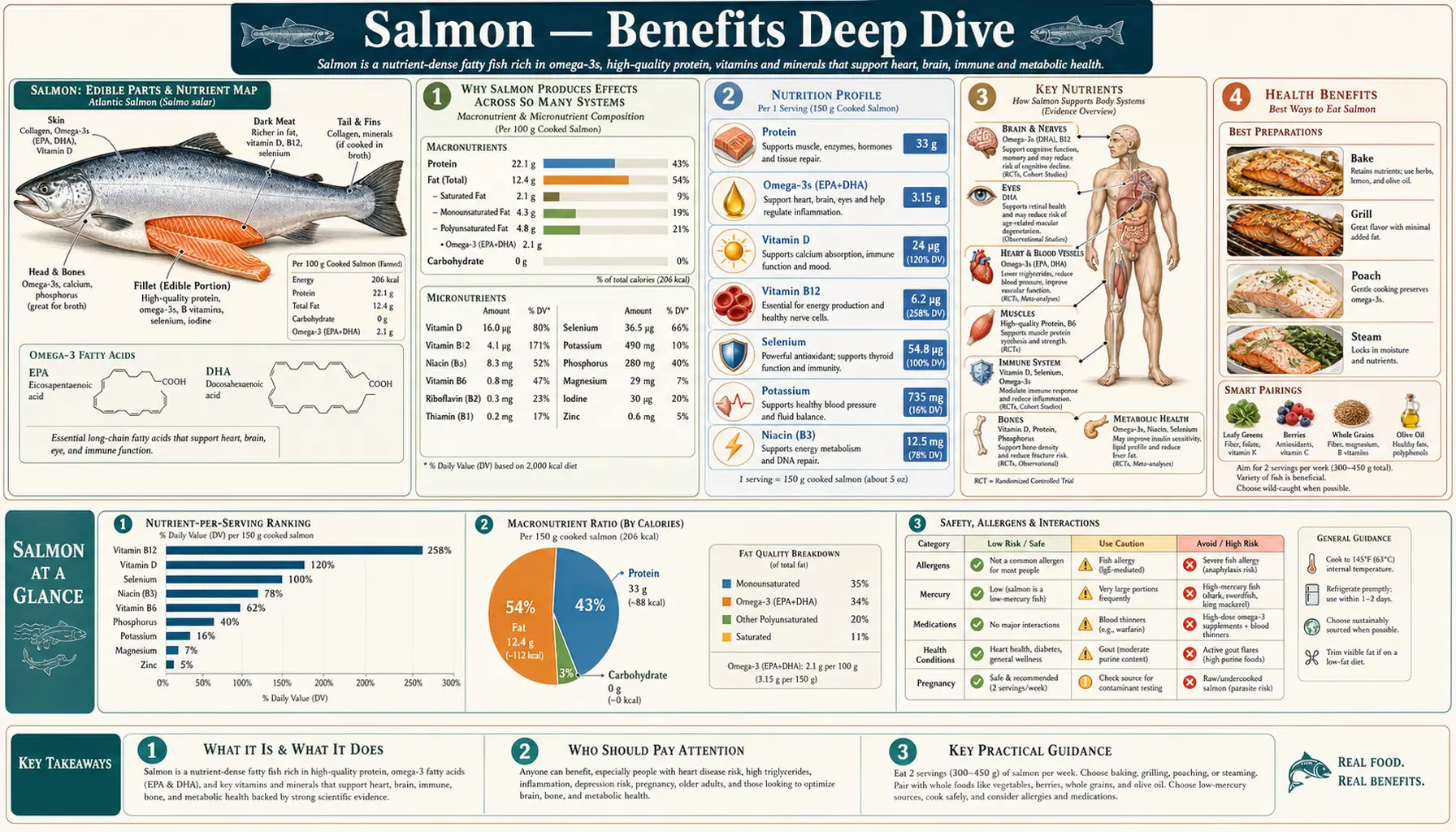
Salmon is one of the few whole foods that simultaneously delivers all four of the most under-consumed nutrients in the Western diet: long-chain omega-3 fatty acids (EPA and DHA), bioavailable Vitamin D3 (cholecalciferol), high-quality complete protein with all nine essential amino acids, and the carotenoid antioxidant astaxanthin. Each pink-orange fillet is, at a molecular level, a concentrated package of marine-derived fat-soluble nutrients that humans evolved to obtain from cold-water fish. Four benefit pages below explore the conditions where salmon produces the largest measurable health effect — cardiovascular and cognitive protection from EPA/DHA, skin photoprotection and antioxidant defense from astaxanthin, bone and immune support from natural Vitamin D, and the wild-versus-farmed quality question that determines what nutrient profile you actually get on the plate.
Deep-Dive Articles
Omega-3 EPA & DHA
Why long-chain EPA (eicosapentaenoic acid) and DHA (docosahexaenoic acid) from oily fish outperform plant-source ALA: the inefficient ALA → EPA → DHA elongation pathway, EPA's role in resolvin and protectin production, DHA's structural role in neuronal membranes and the retina, the GISSI-Prevenzione and REDUCE-IT cardiovascular trials, dosing for cardiovascular prevention vs triglyceride lowering, and why 2-3 servings of salmon per week meets the AHA recommendation for the general population.
Astaxanthin & Skin
The carotenoid pigment that gives salmon flesh its pink-red color is one of the most potent antioxidants in nature — roughly 6,000 times more effective than Vitamin C at quenching singlet oxygen. Mechanism of UV photoprotection, oral astaxanthin trials showing reduced wrinkle depth and improved skin elasticity, the lipophilic distribution that places astaxanthin in skin and eye tissues, anti-inflammatory effects on NF-kappa-B signaling, and dosing considerations (whole-food salmon vs concentrated Haematococcus pluvialis extract).
Vitamin D Content
Wild sockeye salmon delivers approximately 600-1000 IU of Vitamin D3 per 3.5 oz serving — one of the highest naturally occurring food sources of cholecalciferol. Why the form (D3 from animal tissue) is metabolically superior to plant-derived D2 (ergocalciferol), the seasonal advantage for northern-latitude populations who get inadequate UVB sunlight in winter, the synergy with marine omega-3s for skeletal and immune effects, and the difference between wild and farmed salmon Vitamin D content (wild typically 3-5x higher).
Wild vs Farmed
Wild Pacific salmon (sockeye, king, coho, pink, chum) and farmed Atlantic salmon are nutritionally very different products. Wild fish has 3-5x more astaxanthin, 2-3x more Vitamin D, a leaner protein-to-fat ratio, and lower contaminant load. Farmed fish has more total omega-3 (because of fatty feed) but also more omega-6, more PCBs and dioxins, and synthetic astaxanthin used as feed colorant. How to read labels, where to source genuine wild salmon, and the cost-benefit math.
Table of Contents
- Deep-Dive Articles
- Why Salmon Produces Effects Across So Many Systems
- Research Papers: Omega-3 EPA & DHA
- Research Papers: Astaxanthin & Skin
- Research Papers: Vitamin D Content
- Research Papers: Wild vs Farmed Quality
- Research Papers: Cross-Cutting (Protein, Brain, Mercury)
- External Authoritative Resources
- Connections
- Featured Videos
Why Salmon Produces Effects Across So Many Systems
Most "superfoods" earn the label on the strength of one or two nutrient peaks. Salmon is unusual because it delivers four genuinely scarce, biochemically distinct nutrients in a single whole-food matrix — each of which, taken alone, would be reason enough to recommend the food. The four mechanisms map to four different categories of clinical effect.
- Long-chain omega-3 fatty acids (EPA and DHA) — the marine omega-3s drive the cardiovascular benefit (triglyceride reduction, modest blood pressure lowering, reduction in sudden cardiac death) and the cognitive/neurodevelopmental benefit (DHA is approximately 30% of brain phospholipid and >50% of retinal phospholipid). Plant-source ALA from flax and chia is not a substitute — the human elongation pathway converts ALA to EPA at <10% efficiency and to DHA at <1%. See our EPA/DHA deep-dive page.
- Astaxanthin (3,3'-dihydroxy-beta-carotene-4,4'-dione) — the pink-red carotenoid pigment is among the most potent lipid-soluble antioxidants identified, with documented quenching activity against singlet oxygen, peroxyl radicals, and lipid peroxidation in cell membranes. Concentrated in salmon flesh because the fish accumulates it from krill and microalgae in the marine food chain. Drives skin photoprotection, eye health, and anti-inflammatory effects. See our astaxanthin deep-dive page.
- Vitamin D3 (cholecalciferol) — wild salmon is one of the few foods naturally rich in animal-form Vitamin D, the form humans synthesize in skin from UVB exposure. A 3.5 oz serving of wild sockeye provides 600-1000 IU, roughly the daily RDA. For northern-latitude adults who cannot make adequate D from winter sun, dietary fatty fish is a primary natural source. See our Vitamin D content deep-dive.
- High-quality complete protein — a 3.5 oz serving of salmon delivers approximately 22 g of protein with a PDCAAS score of 1.0 (the maximum), all nine essential amino acids present, and a particularly favorable leucine content for muscle protein synthesis. The protein is highly digestible (>90%), lacks the antinutrient content of plant proteins, and comes packaged with the iron, B12, selenium, and iodine that are co-required for protein utilization.
The integration matters. Eating salmon is not the same as taking a fish oil capsule plus a Vitamin D capsule plus an astaxanthin capsule plus a whey protein scoop — the whole-food matrix delivers these nutrients in their natural ratios, with the cofactors and lipid carriers that optimize absorption. The decision tree therefore reduces to two questions: how often (2-3 servings per week is the AHA-supported sweet spot for general health), and which salmon (wild vs farmed has meaningful nutritional consequences explored in our wild vs farmed deep-dive).
Research Papers: Omega-3 EPA & DHA
- GISSI-Prevenzione trial: omega-3 fatty acids and post-MI mortality — PubMed: GISSI-Prevenzione
- REDUCE-IT trial: icosapent ethyl (EPA) for cardiovascular event reduction — PubMed: REDUCE-IT
- JELIS trial: EPA in Japanese hypercholesterolemic patients — PubMed: JELIS trial
- ALA to EPA / DHA conversion efficiency in humans — PubMed: ALA conversion efficiency
- DHA in brain phospholipid and neuronal membrane fluidity — PubMed: DHA brain membrane
- EPA-derived resolvins (E-series) in inflammation resolution (Serhan) — PubMed: E-series resolvins
- Omega-3 and triglyceride reduction meta-analysis — PubMed: TG meta-analysis
- Fish consumption and stroke risk (large prospective cohorts) — PubMed: Fish and stroke
- DHA supplementation and cognitive function in older adults — PubMed: DHA cognition trials
- Omega-3 in pregnancy and infant neurodevelopment — PubMed: Pregnancy and infant brain
Research Papers: Astaxanthin & Skin
- Astaxanthin antioxidant capacity vs other carotenoids and Vitamin C — PubMed: Astaxanthin antioxidant capacity
- Oral astaxanthin and skin wrinkle / elasticity trials (Tominaga et al.) — PubMed: Tominaga skin trial
- Astaxanthin and UV-induced skin damage / photoprotection — PubMed: UV photoprotection
- Astaxanthin and lipid peroxidation in cell membranes — PubMed: Lipid peroxidation
- Astaxanthin anti-inflammatory effects on NF-kappa-B — PubMed: Astaxanthin NF-kB
- Haematococcus pluvialis natural source of astaxanthin — PubMed: Haematococcus source
- Salmon astaxanthin content (wild vs farmed) — PubMed: Salmon astaxanthin levels
- Astaxanthin and eye health / asthenopia — PubMed: Eye health
- Astaxanthin and exercise-induced muscle damage — PubMed: Exercise recovery
- Comparative carotenoid bioavailability (astaxanthin vs beta-carotene vs lutein) — PubMed: Carotenoid bioavailability
Research Papers: Vitamin D Content
- Vitamin D content of fatty fish (USDA database analysis) — PubMed: Vitamin D in fatty fish
- Wild vs farmed salmon Vitamin D content comparison (Lu et al.) — PubMed: Wild vs farmed Vitamin D
- D3 (cholecalciferol) vs D2 (ergocalciferol) bioactivity — PubMed: D3 vs D2 bioactivity
- Vitamin D and seasonal status in northern-latitude populations — PubMed: Seasonal Vitamin D
- Dietary Vitamin D from fish vs fortified milk — PubMed: Diet sources of D
- Salmon and serum 25-hydroxyvitamin D response (Lehmann et al.) — PubMed: Salmon and serum D
- Vitamin D and bone density / fracture prevention — PubMed: D and fracture prevention
- Vitamin D and respiratory infection prevention (Martineau meta-analysis) — PubMed: Martineau meta-analysis
- Vitamin D synergy with K2 in calcium metabolism — PubMed: D and K2 synergy
- Cod liver oil as combined Vitamin A / D historical reference — PubMed: Cod liver oil history
Research Papers: Wild vs Farmed Quality
- Hites RA et al. (2004). Global assessment of organic contaminants in farmed salmon. Science — PubMed: Hites Science 2004
- PCB and dioxin levels in farmed vs wild salmon — PubMed: PCB and dioxin levels
- Synthetic astaxanthin in salmon aquaculture (Carophyll Pink) — PubMed: Synthetic astaxanthin feed
- Fatty acid profile differences wild vs farmed salmon — PubMed: FA profile differences
- Omega-6 to omega-3 ratio shift in farmed salmon — PubMed: O6:O3 ratio in farmed fish
- Antibiotic use in salmon aquaculture and resistance concerns — PubMed: Aquaculture antibiotics
- Pacific salmon species (sockeye, king, coho, pink, chum) nutritional comparison — PubMed: Pacific species comparison
- Atlantic farmed salmon (Salmo salar) production and nutritional analysis — PubMed: Atlantic salmon analysis
- Mercury content in salmon species (typically very low) — PubMed: Mercury in salmon
- Sustainability and Marine Stewardship Council certification — PubMed: MSC certification
Research Papers: Cross-Cutting (Protein, Brain, Mercury)
- Salmon protein digestibility (PDCAAS = 1.0) and leucine content — PubMed: Salmon protein quality
- Fish consumption and dementia / Alzheimer's risk reduction — PubMed: Fish and dementia
- Selenium-mercury interaction in oceanic fish — PubMed: Selenium-mercury interaction
- AHA recommendation: 2 servings of oily fish per week — PubMed: AHA fish recommendation
- FDA / EPA mercury advisory for pregnant women on fish choice — PubMed: FDA-EPA pregnancy advisory
- B12 content of salmon (one of richest dietary sources) — PubMed: Salmon B12
- Iodine content of marine fish vs freshwater fish — PubMed: Iodine in marine fish
- Fish oil vs whole fish: are isolated omega-3 capsules equivalent? — PubMed: Capsule vs whole fish
- Mediterranean diet and oily fish: PREDIMED trial — PubMed: PREDIMED
- Linus Pauling Institute essential fatty acids review — PubMed: LPI fatty acids
External Authoritative Resources
- Linus Pauling Institute — Essential Fatty Acids — the most authoritative scientific summary of omega-3 biology
- NIH Office of Dietary Supplements — Omega-3 Fatty Acids Fact Sheet
- American Heart Association — Fish and Omega-3 Recommendations
- FDA — Advice About Eating Fish (Mercury Guidance)
- Monterey Bay Seafood Watch — Salmon Sustainability Guide
- PubMed — All research on salmon nutrition
Connections
- All Food
- Salmon (Main Page)
- Salmon Omega-3 EPA & DHA
- Salmon Astaxanthin & Skin
- Salmon Vitamin D Content
- Wild vs Farmed Salmon
- Sardines
- Herring
- Tuna
- Cod
- Omega-3 Fatty Acids
- Vitamin D3
- Vitamin A
- Astaxanthin
- Cardiology
- Dermatology