Salmon Astaxanthin and Skin Health
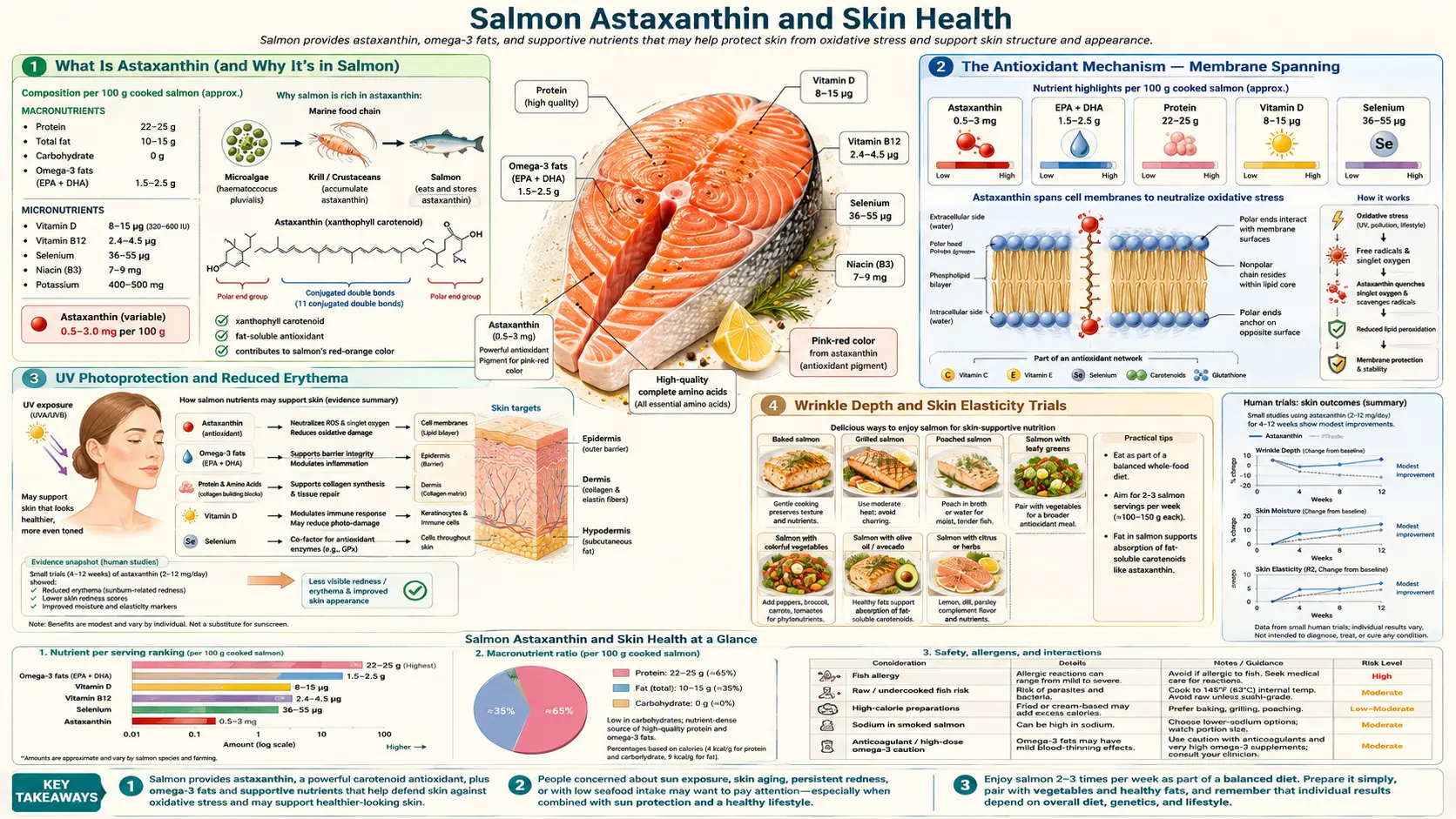
The vivid pink-red color of salmon flesh is not pigment in the conventional plant sense — it is astaxanthin, a xanthophyll carotenoid that the fish accumulates from its diet of krill and microalgae. In humans, astaxanthin behaves as one of the most potent lipid-soluble antioxidants ever characterized: roughly 6,000 times more efficient than ascorbic acid at quenching singlet oxygen, approximately 800 times more potent than CoQ10, and uniquely positioned to span the entire lipid bilayer of cell membranes. This page focuses on the skin: how dietary astaxanthin from salmon (and concentrated extracts) reduces UV-induced erythema, improves measured skin elasticity, decreases wrinkle depth, and provides systemic anti-inflammatory effects that translate to slower visible aging.
Table of Contents
- What Is Astaxanthin (and Why It's in Salmon)
- The Antioxidant Mechanism — Membrane Spanning
- UV Photoprotection and Reduced Erythema
- Wrinkle Depth and Skin Elasticity Trials
- Skin Moisture, Sebum, and Barrier Function
- Anti-Inflammatory Effects (NF-kappa-B Pathway)
- Dosing: Whole-Food Salmon vs Concentrated Extract
- Bioavailability and Lipid Co-Ingestion
- Beyond Skin: Eye, Muscle, and Cardiovascular Effects
- Cautions and Drug Interactions
- Key Research Papers
- Connections
- Featured Videos
What Is Astaxanthin (and Why It's in Salmon)
Astaxanthin (chemical name 3,3'-dihydroxy-beta-carotene-4,4'-dione) is a keto-carotenoid — structurally related to beta-carotene but with two additional hydroxyl groups and two additional ketone groups on the terminal rings. This substitution dramatically changes its biochemistry: unlike beta-carotene, astaxanthin cannot be converted to Vitamin A in the human body, and unlike beta-carotene it spans the entire width of a lipid bilayer rather than residing in the hydrophobic core. These two features together explain most of astaxanthin's distinctive biological behavior.
Astaxanthin is produced in nature primarily by the freshwater green microalga Haematococcus pluvialis, which synthesizes the pigment as a stress-response defense against UV light and oxidative damage when its pond habitat dries up. Krill and small crustaceans eat the algae and concentrate astaxanthin in their exoskeletons (this is what makes shrimp and lobster turn pink when cooked). Wild Pacific salmon feed heavily on krill and crustaceans during their open-ocean phase and accumulate astaxanthin into their muscle tissue, where it gives flesh its characteristic pink-red color.
Farmed Atlantic salmon, by contrast, would have white flesh if fed only the soy and corn-based pellets used in aquaculture. To produce the pink color that consumers expect, the industry adds synthetic astaxanthin (Carophyll Pink, produced by BASF and DSM) or natural astaxanthin from Haematococcus to feed pellets. Both forms color the flesh, but the synthetic form is a different stereoisomer mixture than the natural form found in wild salmon, with somewhat different bioavailability characteristics. This is one of the key nutritional distinctions explored in our wild vs farmed deep-dive.
Typical astaxanthin concentrations: wild sockeye salmon contains roughly 26-38 mg of astaxanthin per kilogram of flesh, wild king (chinook) about 8-26 mg/kg, wild coho 9-28 mg/kg, while farmed Atlantic salmon typically runs 6-8 mg/kg depending on feed formulation. A typical 3.5 oz (100 g) serving of wild sockeye therefore delivers 2-4 mg of astaxanthin alongside its omega-3s, Vitamin D, and complete protein.
The Antioxidant Mechanism — Membrane Spanning
The reason astaxanthin so dramatically outperforms other antioxidants in head-to-head comparisons traces to its unusual orientation in cell membranes. Most carotenoids (alpha- and beta-carotene, lycopene) are pure hydrocarbons and reside parallel to the membrane plane, embedded in the hydrophobic core of the lipid bilayer. They protect against radicals propagating through the membrane interior but are poorly positioned to intercept radicals at the membrane surface.
Astaxanthin's two terminal hydroxyl/keto-rings are polar, so the molecule orients perpendicular to the membrane plane — spanning the bilayer with the polar ends anchored at the inner and outer aqueous interfaces, and the long polyene chain (the conjugated double bonds) cutting through the lipid interior. This geometry produces several distinctive properties:
- It can quench radicals at the membrane surface AND in the lipid core simultaneously
- The 11 conjugated double bonds in the polyene chain absorb high-energy photons and quench singlet oxygen extraordinarily efficiently
- Unlike beta-carotene and lycopene, it does NOT become a pro-oxidant under high oxidative stress (this is the key safety distinction from the ATBC/CARET-trial concerns about isolated beta-carotene in smokers)
- It has been shown to regenerate other antioxidants (Vitamin C, Vitamin E) by donating electrons to oxidized tocopheryl radicals, restoring the active form
Quantitative comparisons in standardized assays: singlet-oxygen quenching constants (K-Q values) place astaxanthin at approximately 1.34 × 10¹¹ M-1s-1, compared to ascorbic acid at approximately 2.2 × 10⁷ M-1s-1. That ratio of approximately 6,000:1 is the source of the widely quoted "6,000 times more potent than Vitamin C" figure. The figures for peroxyl-radical scavenging and lipid-peroxidation inhibition are similar in magnitude.
This is not a marketing exaggeration — it is a real consequence of molecular geometry. The clinical question is whether the in-vitro potency translates to measurable effects in the human body, and the answer for skin in particular is well-supported by trials.
UV Photoprotection and Reduced Erythema
UV-induced skin damage occurs through generation of reactive oxygen species (ROS) in the dermis and epidermis. UVA penetrates deeper and generates singlet oxygen and superoxide; UVB causes direct DNA damage and additional oxidative species. The classic visible endpoint of acute UV damage is erythema (sunburn), and the long-term endpoints are photoaging (wrinkles, pigmentation, loss of elasticity) and skin cancer.
Multiple controlled trials have shown that oral astaxanthin (4-12 mg/day for 8-12 weeks) before controlled UV exposure measurably reduces erythema response. The mechanism is presumed to be lipid-soluble astaxanthin accumulating in keratinocyte and fibroblast cell membranes, where it quenches the ROS generated by UV photons before that ROS can damage DNA, lipid, and protein.
Astaxanthin is not a sunscreen — it does not absorb UV directly to block penetration. Rather, it provides a parallel antioxidant defense that reduces the consequences of UV that does penetrate. The practical implication: oral astaxanthin (whether from salmon or supplemental form) is complementary to, not a replacement for, topical sunscreen for fair-skinned populations or for prolonged sun exposure.
The most studied measure is "minimum erythemal dose" (MED) — the lowest UV dose that produces visible reddening of skin. Trials have shown that 8-12 weeks of 4 mg/day oral astaxanthin increases MED by approximately 10-15%, meaning the skin tolerates a measurably higher UV dose before reacting. This is a meaningful but modest effect, useful as a baseline antioxidant defense rather than a standalone photoprotectant.
Wrinkle Depth and Skin Elasticity Trials
The most influential clinical work on astaxanthin and skin appearance was published by Tominaga and colleagues at the FUJIFILM Healthcare Laboratory, with multiple subsequent trials by other groups. The pivotal study (Tominaga et al. 2012, Acta Biochimica Polonica) enrolled 30 healthy female volunteers, mean age 47, randomized to 6 mg/day oral astaxanthin or placebo for 8 weeks. Measured endpoints:
- Crow's feet wrinkle depth — measured by silicone replica analysis at the lateral canthus. Significantly reduced in the astaxanthin group vs placebo
- Skin elasticity — measured by Cutometer at the cheek. Significantly improved (less sag after suction release) in the astaxanthin group
- Skin moisture content — measured by corneometer. Improved in the astaxanthin group, particularly in dry-skin subjects
- Self-assessed skin texture and smoothness — significantly improved by subjective questionnaire
Follow-up trials have replicated these findings at similar doses (4-12 mg/day for 6-16 weeks) in different populations including Japanese, European, and American volunteers. A 2018 meta-analysis pooled 7 trials including over 400 participants and concluded that astaxanthin supplementation produced statistically and clinically meaningful improvements in skin wrinkle depth and skin elasticity.
The mechanism is presumed to be: reduced UV-induced collagen and elastin degradation (matrix metalloproteinase activity is reduced by astaxanthin in cell culture studies), reduced glycation end-product formation, and improved fibroblast function through reduced oxidative stress in the dermal extracellular matrix.
The whole-food translation: 2-3 servings of wild sockeye per week supplies approximately 6-12 mg of astaxanthin per week, in the same order of magnitude as supplement doses used in trials but spread over multiple days. Many clinicians who recommend salmon for skin health also recommend a Haematococcus-derived astaxanthin supplement (typically 4-8 mg/day) for those who do not eat fish regularly.
Skin Moisture, Sebum, and Barrier Function
Beyond wrinkle and elasticity measures, astaxanthin trials have looked at stratum corneum hydration, sebum production, and transepidermal water loss (TEWL) as markers of skin barrier function. The findings are generally consistent:
- Skin moisture — modestly improved, especially in dry-skin subjects. Mechanism may be through reduced inflammatory disruption of barrier lipids in the stratum corneum
- Sebum content — reduced in some trials, particularly relevant for individuals with oily or acne-prone skin. Astaxanthin may modulate sebaceous gland inflammation
- Transepidermal water loss — modestly reduced (better barrier function)
The barrier-function story dovetails with the omega-3 story (see our Omega-3 EPA & DHA page). Both nutrients in salmon contribute to skin lipid composition: EPA and DHA are incorporated into ceramide and sphingolipid precursors in the stratum corneum, while astaxanthin protects the assembled barrier lipids from oxidative degradation. This is one of the clearest examples of whole-food nutritional synergy — the salmon delivers both the building material and the antioxidant protection.
Anti-Inflammatory Effects (NF-kappa-B Pathway)
Astaxanthin's mechanism extends beyond direct radical scavenging into signal-transduction modulation. Multiple in vitro and in vivo studies have shown that astaxanthin inhibits activation of nuclear factor kappa-B (NF-kappa-B), the master transcription factor that drives expression of inflammatory cytokines (TNF-alpha, IL-1-beta, IL-6, IL-8), cyclooxygenase-2 (COX-2), and inducible nitric oxide synthase (iNOS).
The NF-kappa-B-suppressive effect is dose-dependent and has been demonstrated in:
- Cultured human umbilical vein endothelial cells (HUVEC) under TNF-alpha stimulation
- Macrophages stimulated with lipopolysaccharide (LPS)
- Human keratinocytes under UV irradiation
- Rat models of chemical-induced inflammation
- Human subjects in supplementation trials measuring C-reactive protein (CRP), IL-6, and other inflammatory markers
The most consistent human-trial finding is a modest reduction in CRP, typically in the range of 20-30% from baseline after 8-12 weeks of 6-12 mg/day astaxanthin in subjects with elevated baseline inflammation. The clinical relevance: chronic low-grade inflammation drives skin aging, cardiovascular disease, type 2 diabetes, and neurodegeneration, so a sustained anti-inflammatory effect from a well-tolerated whole-food source is a meaningful population-health lever.
Dosing: Whole-Food Salmon vs Concentrated Extract
For the average adult who simply enjoys salmon, the practical recommendation is straightforward: 2-3 servings (3.5-6 oz each) of wild Pacific salmon per week supplies approximately 6-15 mg of astaxanthin per week, plus the substantial omega-3, Vitamin D, and complete-protein contributions discussed across this hub. This intake places astaxanthin in the range demonstrated to produce skin-elasticity and wrinkle benefits in clinical trials.
For individuals who do not eat fish (vegetarians, those with fish allergy, or simply non-fish-eaters), the concentrated supplement option is Haematococcus-pluvialis-derived astaxanthin, the same natural form found in wild salmon. Typical dosing is 4-12 mg/day, taken with a fat-containing meal for absorption. Brands matter: AstaZine (BGG), AstaReal, AstaPure, and a few others use documented Haematococcus sources with verified astaxanthin content. Cheap supplements may use synthetic astaxanthin (Carophyll Pink), which has a different stereoisomer profile.
For acute applications like pre-summer skin preparation or athletic recovery, doses up to 12 mg/day for 4-8 weeks have been used safely in trials. For long-term general maintenance, 4-8 mg/day is commonly recommended. There is no established upper limit in the human safety literature, and trials at doses up to 100 mg/day for short periods have not produced clinically significant adverse effects.
One caveat: high doses of astaxanthin can produce visible pigmentation of the skin and palms (caroten-orange tint), generally considered cosmetic rather than clinical. This typically requires sustained intake above 30 mg/day.
Bioavailability and Lipid Co-Ingestion
Astaxanthin is highly lipophilic and follows the same intestinal absorption pathway as other dietary lipids: emulsification with bile acids, incorporation into mixed micelles in the small intestine, uptake into enterocytes, packaging into chylomicrons, and lymphatic transport to the systemic circulation. Critically, astaxanthin absorption is dramatically improved when consumed with dietary fat — some trials have shown 3-4 fold higher serum astaxanthin levels when supplements are taken with a fatty meal versus on an empty stomach.
This is a non-issue for whole-food salmon — the astaxanthin in the flesh is already embedded in the fish's own omega-3-rich lipid matrix, so co-absorption with fat is automatic. For supplements, the recommendation is consistent: take with breakfast or dinner, with food containing some fat (olive oil, avocado, nuts, or dairy fat are all sufficient).
Pharmacokinetic studies show astaxanthin appears in the bloodstream within a few hours of ingestion, with peak serum concentration around 6-8 hours. The serum half-life is approximately 16 hours, so single daily dosing produces near-steady-state concentrations within a few days. Astaxanthin accumulates preferentially in skin, eye (especially retina and lens), liver, and other tissues with high lipid content. Demonstrable skin and serum effects typically require 4-8 weeks of consistent intake.
Beyond Skin: Eye, Muscle, and Cardiovascular Effects
Although this page focuses on skin, astaxanthin's lipid-soluble distribution into eye and muscle tissue produces additional documented effects:
- Eye fatigue / asthenopia — astaxanthin accumulates in the ciliary body of the eye, the muscular structure that controls lens accommodation. Trials in subjects with computer-related eye strain (4-12 mg/day for 4-8 weeks) have shown reduced accommodation difficulty and reduced subjective eye fatigue
- Macular health — though astaxanthin is not the primary macular carotenoid (lutein and zeaxanthin are), it does cross the blood-retina barrier and contributes to retinal antioxidant defense
- Exercise recovery — multiple trials in trained athletes (4-20 mg/day for 4-12 weeks) have shown reduced creatine kinase elevation after eccentric exercise, suggesting reduced exercise-induced muscle damage
- Endurance performance — some trials have shown modest improvements in time-to-exhaustion in trained subjects, plausibly through improved muscle mitochondrial function and reduced exercise-induced oxidative stress
- Cardiovascular markers — modest reductions in oxidized LDL and improvements in HDL/LDL ratio in trials lasting 12+ weeks at 6-12 mg/day
The integrated picture is of a broadly distributed lipid-soluble antioxidant with meaningful effects in any tissue with high oxidative stress and high lipid content. For more on the dedicated antioxidant biology, see our Astaxanthin page.
Cautions and Drug Interactions
- Pregnancy and lactation — insufficient safety data for high-dose supplementation; whole-food salmon (within mercury-aware servings) is fine in pregnancy and indeed recommended by FDA-EPA guidance
- 5-alpha reductase inhibition — some in vitro work suggests astaxanthin may weakly inhibit 5-alpha reductase, potentially relevant for individuals on dutasteride or finasteride for benign prostatic hyperplasia (these patients may experience additive effects)
- Hormone-sensitive cancers — though no clinical evidence of harm, individuals with hormone-sensitive cancer should discuss high-dose supplementation with their oncologist
- Anticoagulants — theoretical concern about additive antiplatelet effect with high-dose astaxanthin combined with warfarin, dabigatran, or antiplatelet agents; the human clinical evidence is sparse and most experts consider the risk minimal at typical doses
- Calcium channel blockers — one small study suggested astaxanthin may inhibit cytochrome P450 3A4, the same enzyme that metabolizes many calcium channel blockers; potential for modestly increased drug levels
- Skin discoloration — cosmetic only, occurs at very high doses (>30 mg/day sustained); reversible on discontinuation
- Allergy — rare reports of allergy to Haematococcus pluvialis extracts; salmon itself is a top-9 allergen and individuals with fish allergy must avoid the whole-food source entirely
Key Research Papers
- Tominaga K et al. (2012). Cosmetic benefits of astaxanthin on humans subjects. Acta Biochimica Polonica. — PubMed
- Davinelli S, Nielsen ME, Scapagnini G (2018). Astaxanthin in skin health, repair, and disease: A comprehensive review. Nutrients. — PubMed
- Yamashita E (2002). The effects of a dietary supplement containing astaxanthin on skin condition. Carotenoid Science. — PubMed
- Camera E et al. (2009). Astaxanthin, canthaxanthin and beta-carotene differently affect UVA-induced oxidative damage and expression of oxidative stress-responsive enzymes. Experimental Dermatology. — PubMed
- Suganuma K et al. (2010). Anti-aging and functional improvement effects for the skin by functional foods intakes. Journal of Clinical Biochemistry and Nutrition. — PubMed
- Tominaga K et al. (2017). Protective effects of astaxanthin on skin deterioration. Journal of Clinical Biochemistry and Nutrition. — PubMed
- Ito N et al. (2018). The Protective Role of Astaxanthin for UV-Induced Skin Deterioration in Healthy People. Nutrients. — PubMed
- Goto S et al. (2001). Efficient radical trapping at the surface and inside the phospholipid membrane is responsible for highly potent antiperoxidative activity of the carotenoid astaxanthin. Biochimica et Biophysica Acta. — PubMed
- Choi SK et al. (2008). Effects of astaxanthin on the production of NO and the expression of COX-2 and iNOS. European Journal of Pharmacology. — PubMed
- Park JS et al. (2010). Astaxanthin decreased oxidative stress and inflammation and enhanced immune response in humans. Nutrition & Metabolism. — PubMed
- Saito M et al. (2012). Astaxanthin increases choroidal blood flow velocity. Graefes Archive for Clinical and Experimental Ophthalmology. — PubMed
- Stewart JS et al. (2008). Safety assessment of astaxanthin-rich microalgae biomass. Regulatory Toxicology and Pharmacology. — PubMed
PubMed Topic Searches
- PubMed: Astaxanthin skin wrinkle & elasticity
- PubMed: Astaxanthin UV photoprotection
- PubMed: Astaxanthin antioxidant capacity
- PubMed: Astaxanthin and NF-kappa-B
- PubMed: Salmon astaxanthin content
Connections
- All Food
- Salmon Overview
- Salmon Benefits Hub
- Salmon Omega-3 EPA & DHA
- Salmon Vitamin D Content
- Wild vs Farmed Salmon
- Astaxanthin
- All Antioxidants
- Omega-3 Fatty Acids
- Vitamin C
- Vitamin E
- Vitamin A for Skin
- Sardines
- Herring
- Dermatology
- Ophthalmology