Wild vs Farmed Salmon
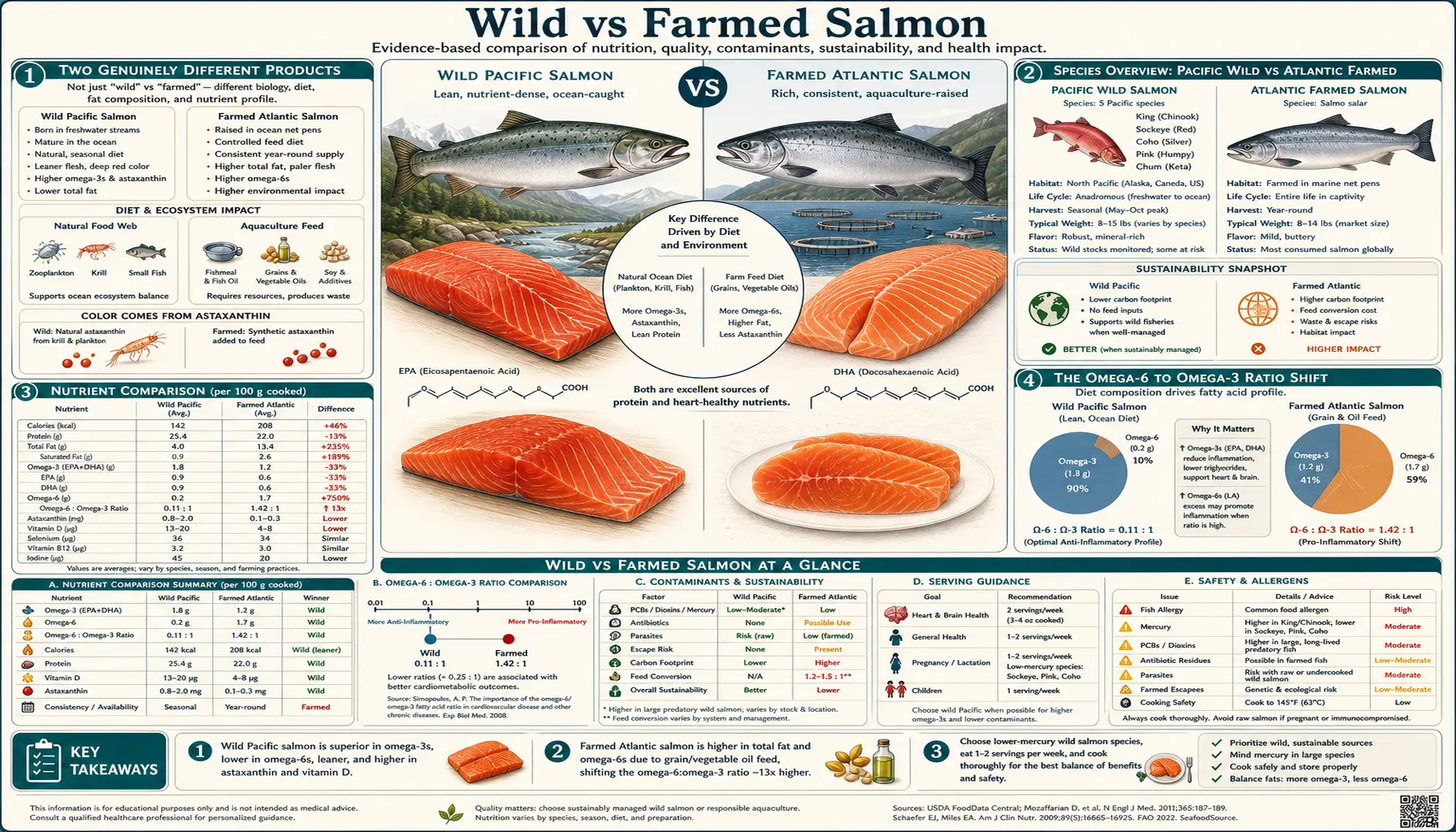
"Salmon" at the grocery counter is shorthand for two nutritionally distinct products. Wild Pacific salmon (sockeye, king/chinook, coho/silver, pink, chum) is an apex-predator fish that has spent its life eating krill, smaller fish, and zooplankton in the open ocean — it accumulates marine-derived nutrients in concentrations the species evolved to carry. Farmed Atlantic salmon (Salmo salar) is raised in net pens on a corn, soy, and vegetable-oil-based feed pellet, then dosed with synthetic or microalgal astaxanthin to produce the pink color consumers expect. The two products differ in omega-3 ratio, Vitamin D content, astaxanthin concentration, contaminant load, antibiotic exposure, and price by roughly 3-5x in most cases. This page is the practical guide to choosing intelligently between them.
Table of Contents
- Two Genuinely Different Products
- Species Overview: Pacific Wild vs Atlantic Farmed
- Nutrient Comparison Table
- The Omega-6 to Omega-3 Ratio Shift
- Astaxanthin: Natural vs Synthetic
- Vitamin D Content Differences
- PCBs, Dioxins, and Other Contaminants
- Antibiotics and Aquaculture Practices
- Mercury and the Selenium Buffer
- How to Read Labels at the Counter
- The Cost-Benefit Math
- Key Research Papers
- Connections
- Featured Videos
Two Genuinely Different Products
One of the most consequential consumer-education failures in fish marketing is the conflation of "salmon" as a single product. The label "Atlantic salmon" almost always means farmed Atlantic salmon (Salmo salar) raised in coastal net pens, primarily in Norway, Chile, Scotland, Canada, and the Faroe Islands. The wild Atlantic salmon population has collapsed and commercial wild harvest is largely banned — if you see "Atlantic salmon" in a US grocery store, it is functionally always farmed.
"Pacific salmon" or specific names — sockeye, king (chinook), coho (silver), pink, chum — are wild-caught from Alaska, British Columbia, Washington, and Oregon. There is essentially no commercial Pacific salmon farming in the United States; the entire Pacific commercial fishery is wild. (A small farming industry for king salmon exists in New Zealand and a few other places, but it is not the dominant farmed product in North American markets.)
So the practical decision tree at a US grocery counter reduces to: "Atlantic salmon" = farmed and "Pacific salmon" (any of sockeye, king, coho, pink, chum) = wild. The two products will look superficially similar in the case — both are pink fillets with the characteristic salmon-flesh color — but they have very different nutritional and contaminant profiles, very different ecological footprints, and very different price points.
Species Overview: Pacific Wild vs Atlantic Farmed
Pacific Wild Species (5 commercial):
- Sockeye (Oncorhynchus nerka) — the deepest-red flesh, highest astaxanthin content, leaner with strong flavor. Premium price among wild Pacific species. Population is robust in Alaska. Most concentrated nutrient profile per ounce.
- King / Chinook (Oncorhynchus tshawytscha) — the largest and fattiest wild species, highest omega-3 content among Pacific salmon. Pale to deep red depending on diet. Among the most expensive fish in the United States.
- Coho / Silver (Oncorhynchus kisutch) — medium oil content, milder flavor than sockeye, attractive bright red flesh. Middle of the wild-Pacific price range.
- Pink (Oncorhynchus gorbuscha) — the smallest and most abundant Pacific salmon, lower oil content, lighter color. Most often canned. Inexpensive entry-point to wild salmon nutrition.
- Chum / Keta (Oncorhynchus keta) — second-most-abundant Pacific species, very low oil, pale flesh, mild flavor. Most often sold as canned, smoked, or frozen products. The most affordable wild option.
Farmed Atlantic Salmon (Salmo salar):
- Raised in coastal net pens 12-30 months from smolt to harvest. Feed is approximately 15-30% fish meal and fish oil, with the rest from soy, corn, wheat, and vegetable oils. Astaxanthin added to feed to color the flesh. Often treated with antibiotics, anti-parasitics (most commonly emamectin benzoate against sea lice), and antifungals. Higher fat content than most wild species due to confinement and high-energy feed. Lower variability in flavor, texture, and appearance because of standardized rearing.
Nutrient Comparison Table
Values per 100 g (3.5 oz) cooked fillet, drawn from USDA Food Data Central and supporting nutritional analyses:
| Nutrient | Wild Sockeye | Farmed Atlantic | Wild King |
|---|---|---|---|
| Calories | ~180 kcal | ~210 kcal | ~230 kcal |
| Total fat | ~9 g | ~14 g | ~13 g |
| EPA + DHA (mg) | ~1,200 | ~2,400 | ~1,700 |
| Omega-6 (mg) | ~170 | ~1,940 | ~290 |
| Omega-6 : Omega-3 ratio | ~0.14 | ~0.81 | ~0.17 |
| Astaxanthin (mg) | ~3.0 | ~0.8 | ~1.2 |
| Vitamin D3 (IU) | ~570 | ~250 | ~990 |
| Protein | ~25 g | ~23 g | ~24 g |
| Selenium (mcg) | ~38 | ~32 | ~30 |
| Vitamin B12 (mcg) | ~5.3 | ~3.2 | ~3.5 |
The big surprise in this table for most readers is that farmed Atlantic salmon has more total EPA + DHA than wild sockeye. This is real and is the consequence of the high-fat farmed-fish diet — the fish accumulates more total lipid, including more omega-3. The catch is that it also accumulates much more omega-6 from the soy and corn-oil components of the feed, dramatically shifting the omega-6 to omega-3 ratio.
The other surprise: wild king salmon has roughly 4 times the Vitamin D of farmed Atlantic salmon. This is because wild Pacific fish accumulate D from their natural prey (krill and small fish that get D from phytoplankton and zooplankton consuming UVB-rich surface waters), while farmed fish in net pens get less natural-source Vitamin D.
The Omega-6 to Omega-3 Ratio Shift
Wild salmon evolved to eat krill, small fish, and zooplankton — all marine sources rich in EPA and DHA with very low omega-6 content. The natural omega-6 to omega-3 ratio in wild salmon flesh is approximately 0.14 to 0.20 (omega-3 dominates by 5-7 fold).
Farmed Atlantic salmon is fed pellets containing significant amounts of soy oil, corn oil, sunflower oil, and other vegetable oils as fish-oil substitutes. The aquaculture industry has been progressively replacing fish oil in feed with cheaper plant oils over the last 20 years to reduce wild-fish-meal dependency and cost. The consequence is that farmed salmon flesh now contains substantially more omega-6, with a ratio of roughly 0.7-1.0 (omega-3 still dominant but only by 1.0-1.4 fold).
Is this clinically meaningful? The total amount of omega-3 in farmed salmon is still substantial and still produces measurable cardiovascular benefit. But the omega-6 to omega-3 ratio in the overall Western diet matters — population estimates put the typical American at a dietary ratio of 15:1 to 20:1, far from the ancestral 1:1 to 4:1 that humans evolved with. Wild salmon helps push the ratio in the right direction; farmed salmon helps less.
For a deeper dive on the omega-3 biology, see our Omega-3 EPA & DHA page.
Astaxanthin: Natural vs Synthetic
Astaxanthin (the carotenoid responsible for salmon's pink color) follows the same wild-vs-farmed story. Wild Pacific salmon accumulates astaxanthin from its krill-and-microalgae diet, with sockeye reaching 30-38 mg/kg of muscle tissue. Farmed Atlantic salmon, raised on essentially astaxanthin-free pellets, would have white flesh unless astaxanthin is deliberately added to feed.
The industry adds astaxanthin to farmed-salmon feed in two forms:
- Synthetic astaxanthin (Carophyll Pink, produced by BASF and DSM) — chemically synthesized from petroleum precursors. Approximately 95% of farmed salmon worldwide uses synthetic astaxanthin because it is approximately 1/8 the cost of natural astaxanthin. Stereoisomer profile is approximately 25% 3S,3'S, 50% 3R,3'S, and 25% 3R,3'R. Bioactive but differs from natural form.
- Natural astaxanthin from Haematococcus pluvialis or Phaffia rhodozyma — used in some premium farmed-salmon brands and certified organic farmed salmon. Stereoisomer profile is almost entirely 3S,3'S, matching wild salmon. Premium price.
Wild Pacific salmon contains exclusively the natural 3S,3'S stereoisomer because that is what krill and microalgae produce. Salmon labeled "organic" (most common from Norway and the UK) must use natural astaxanthin per organic certification rules. The Marine Stewardship Council certification covers sustainability but not feed composition.
For the deep-dive on astaxanthin biology, see our Astaxanthin and Skin page.
Vitamin D Content Differences
Wild salmon contains substantially more Vitamin D3 than farmed salmon, in some species by 4-5 fold. The mechanism is straightforward: wild salmon eat krill, small fish, and zooplankton that get Vitamin D from phytoplankton, which produce it from UVB exposure at the ocean surface. The Vitamin D is bioconcentrated up the food chain into the fish flesh. Wild king salmon can deliver as much as 990 IU of Vitamin D3 per 100 g serving — more than the daily RDA for most adults in a single fillet.
Farmed salmon, fed primarily plant- and grain-based pellets, has less natural Vitamin D in the feed and accumulates less in the flesh. Typical farmed Atlantic salmon delivers 200-300 IU per 100 g. This is still useful but not the natural-source D powerhouse that wild salmon represents.
For the full Vitamin D story including form (D3 vs D2) and the seasonal sun-exposure context, see our Vitamin D Content page.
PCBs, Dioxins, and Other Contaminants
This is the most controversial topic in the wild-vs-farmed debate. The 2004 Hites et al. paper in Science generated wide media attention with its finding that farmed Atlantic salmon contained 5-10 times higher PCB (polychlorinated biphenyl), dioxin, dieldrin, and toxaphene concentrations than wild Pacific salmon — with European-farmed salmon being the worst offender and Chilean-farmed somewhat better.
The mechanism: PCBs and dioxins are lipid-soluble persistent pollutants that bioaccumulate up the food chain. They originate from industrial processes (electrical equipment, paper manufacturing) that contaminated rivers and oceans worldwide in the mid-20th century. Farmed salmon feed includes substantial amounts of fish meal and fish oil from Atlantic small fish (herring, anchovies), and the European Atlantic and Baltic happen to have higher persistent-pollutant contamination than the Pacific. The contaminants concentrate in feed, then concentrate again in the farmed fish.
The Hites paper recommended limiting farmed salmon consumption to no more than 1 serving per month based on EPA cancer risk thresholds for PCBs. This conclusion remains controversial — FDA and many epidemiologists argue that the cardiovascular benefit of omega-3 intake outweighs the modest cancer risk increase. The reality is that contaminant levels in farmed salmon have decreased substantially since 2004 as the industry has shifted feed sourcing and improved practices, but they remain meaningfully higher than wild Pacific salmon.
For anyone particularly concerned about persistent pollutants — pregnant women, those planning pregnancy, parents of young children — wild Pacific salmon is the clear choice. For general adult consumption, both products provide net health benefit, but wild remains cleaner.
Antibiotics and Aquaculture Practices
Farmed salmon are raised in dense net pens, which creates conditions favorable to bacterial and parasitic outbreaks. The industry uses three main categories of pharmaceutical interventions:
- Antibiotics — oxytetracycline, florfenicol, amoxicillin used to treat bacterial infections (especially salmon rickettsial syndrome). Use varies dramatically by country: Chile historically used 300-500x more antibiotics per ton of fish than Norway; Norwegian aquaculture has reduced antibiotic use by >99% since 1987 through vaccination programs.
- Anti-parasitics — emamectin benzoate (SLICE), deltamethrin, hydrogen peroxide bath treatments against sea lice (Lepeophtheirus salmonis). Sea lice resistance to multiple chemicals has been a growing problem.
- Anti-fungals and disinfectants — formalin, malachite green (banned in many jurisdictions but historically used).
Residue testing programs in the United States, EU, Norway, and Chile monitor finished farmed-salmon products for these residues, and detections above tolerance are rare. The larger concern is environmental: antibiotic-resistance genes in coastal sediment around salmon farms have been documented, and escaped farmed salmon can carry parasites into wild salmon populations.
Wild Pacific salmon, harvested from open ocean and rivers, has none of these concerns. Wild-fish concerns are different and concentrate on overfishing pressure, habitat loss, and dam-related river fragmentation.
Mercury and the Selenium Buffer
One area where wild and farmed salmon are similarly favorable: mercury content is low in both. Salmon are relatively short-lived (3-5 years) and lower on the marine food chain than apex predators like tuna, swordfish, and shark. Average mercury content for both wild Pacific and farmed Atlantic salmon is in the range of 0.02-0.05 ppm — far below the FDA action level of 1 ppm.
Additionally, salmon contain substantial selenium (30-40 mcg per 100 g serving), and selenium has a documented "buffering" effect against methylmercury toxicity — the selenoamino acid selenomethionine binds methylmercury and reduces its absorption and tissue uptake. This makes salmon a fundamentally safer fish for mercury exposure than the larger apex predators, regardless of wild or farmed source.
This is why the FDA and EPA include salmon in their "Best Choices" category for pregnant and nursing women in their joint fish advisory — up to 12 oz per week (2-3 servings) of low-mercury fish including salmon is recommended for pregnancy.
How to Read Labels at the Counter
What to look for and ask:
- "Wild Alaskan salmon" or "Wild-caught Pacific salmon" — the gold standard. Species named (sockeye, king, coho, pink, chum) is best. Alaska state law prohibits salmon farming in state waters, so "Alaska salmon" is essentially always wild.
- "Atlantic salmon" — almost always farmed. If buying farmed, look for ASC (Aquaculture Stewardship Council) certification, BAP (Best Aquaculture Practices) 4-Star, or "Organic" certification, which require improved feed sourcing, lower antibiotic use, and natural astaxanthin.
- "Norwegian salmon" or "Scottish salmon" or "Faroe Islands salmon" — almost always farmed Atlantic.
- "Chilean salmon" — farmed, historically higher antibiotic use than Norway.
- "New Zealand king salmon" or "Ora King" — farmed king salmon, generally higher quality than Atlantic-salmon farming, but still farmed.
- "Color-added" disclosure — required on US-sold farmed salmon when astaxanthin is added to feed. Wild salmon will not carry this notice.
- Frozen vs fresh — frozen-at-sea wild Alaskan salmon is often higher quality than "fresh" farmed Atlantic, which is usually 5-10 days from harvest by the time it reaches the case. Frozen has nutritional parity.
- Canned wild salmon — sockeye and pink canned salmon (bones included) is one of the most economical wild salmon options, with very high calcium content from the consumable soft bones.
The Cost-Benefit Math
Wild Pacific salmon typically costs $15-30 per pound at US retail. Farmed Atlantic salmon typically costs $8-14 per pound. The 2-3x price difference is meaningful, but the nutritional difference is also meaningful.
Practical strategies:
- Buy frozen wild Alaskan salmon — often $10-15 per pound at warehouse stores (Costco) or in 2-3 lb frozen-at-sea packs. Same nutrition as fresh, lower cost.
- Canned wild sockeye or pink salmon — $3-6 per 6-oz can. Excellent for salads, salmon patties, pasta. Includes consumable soft bones with calcium.
- Frozen Alaskan sockeye fillets in bulk — through online vendors (Vital Choice, Sitka Salmon Shares, Wild Alaskan Company) can reach $14-18 per pound delivered.
- Smoked wild salmon (lox) — a smaller portion (1-2 oz per serving) makes a meaningful nutritional contribution at a per-serving cost competitive with farmed.
- Mix and match — if budget is tight, use canned wild sockeye for everyday consumption (salads, sandwiches, salmon cakes) and reserve fresh fillets for special meals. The nutritional case for wild salmon does not require buying $25/lb fresh fillets every week.
The takeaway: wild Pacific salmon is meaningfully nutritionally superior to farmed Atlantic salmon on most metrics that matter (omega-6:omega-3 ratio, astaxanthin form and quantity, Vitamin D content, contaminant load). The cost gap closes substantially when you buy frozen or canned. For pregnancy, planning pregnancy, and feeding young children, wild Pacific is the clear choice. For everyday adult consumption, both products provide net health benefit and the choice can come down to budget and availability.
Key Research Papers
- Hites RA et al. (2004). Global assessment of organic contaminants in farmed salmon. Science 303(5655):226-229. — PubMed
- Foran JA et al. (2005). Risk-based consumption advice for farmed Atlantic and wild Pacific salmon contaminated with dioxins and dioxin-like compounds. Environmental Health Perspectives. — PubMed
- Cladis DP et al. (2014). Fatty acid profiles of commercially available finfish fillets in the United States. Lipids. — PubMed
- Blanchet C et al. (2005). Fatty acid composition of wild and farmed Atlantic salmon (Salmo salar) and rainbow trout. Lipids. — PubMed
- Lundebye AK et al. (2017). Lower levels of persistent organic pollutants, metals and the marine omega 3-fatty acid DHA in farmed compared to wild Atlantic salmon. Environmental Research. — PubMed
- Sprague M et al. (2016). Impact of sustainable feeds on omega-3 long-chain fatty acid levels in farmed Atlantic salmon, 2006-2015. Scientific Reports. — PubMed
- Bell JG et al. (2010). Replacement of dietary fish oil with increasing levels of linseed oil: modification of flesh fatty acid compositions in Atlantic salmon. Lipids. — PubMed
- Lu Z et al. (2007). An evaluation of the vitamin D3 content in fish: is the vitamin D content adequate to satisfy the dietary requirement for vitamin D? Journal of Steroid Biochemistry and Molecular Biology. — PubMed
- Burridge L et al. (2010). Chemical use in salmon aquaculture: A review of current practices and possible environmental effects. Aquaculture. — PubMed
- Cabello FC et al. (2013). Antimicrobial use in aquaculture re-examined: its relevance to antimicrobial resistance. Environmental Microbiology. — PubMed
- Mozaffarian D, Rimm EB (2006). Fish intake, contaminants, and human health: evaluating the risks and the benefits. JAMA. — PubMed
- Storelli MM et al. (2012). Polychlorinated biphenyls (PCBs), dioxins and furans (PCDD/Fs): occurrence in fishery products and dietary intake. Food Chemistry. — PubMed
PubMed Topic Searches
- PubMed: Wild vs farmed salmon nutritional comparison
- PubMed: Farmed salmon PCB & dioxin
- PubMed: Salmon aquaculture antibiotics
- PubMed: Astaxanthin wild vs farmed
- PubMed: Pacific salmon species nutrition
Connections
- All Food
- Salmon Overview
- Salmon Benefits Hub
- Salmon Omega-3 EPA & DHA
- Salmon Astaxanthin & Skin
- Salmon Vitamin D Content
- Sardines
- Herring
- Cod
- Tuna
- Omega-3 Fatty Acids
- Astaxanthin
- Vitamin D3
- PCBs
- Dioxins
- Mercury