Pumpkin
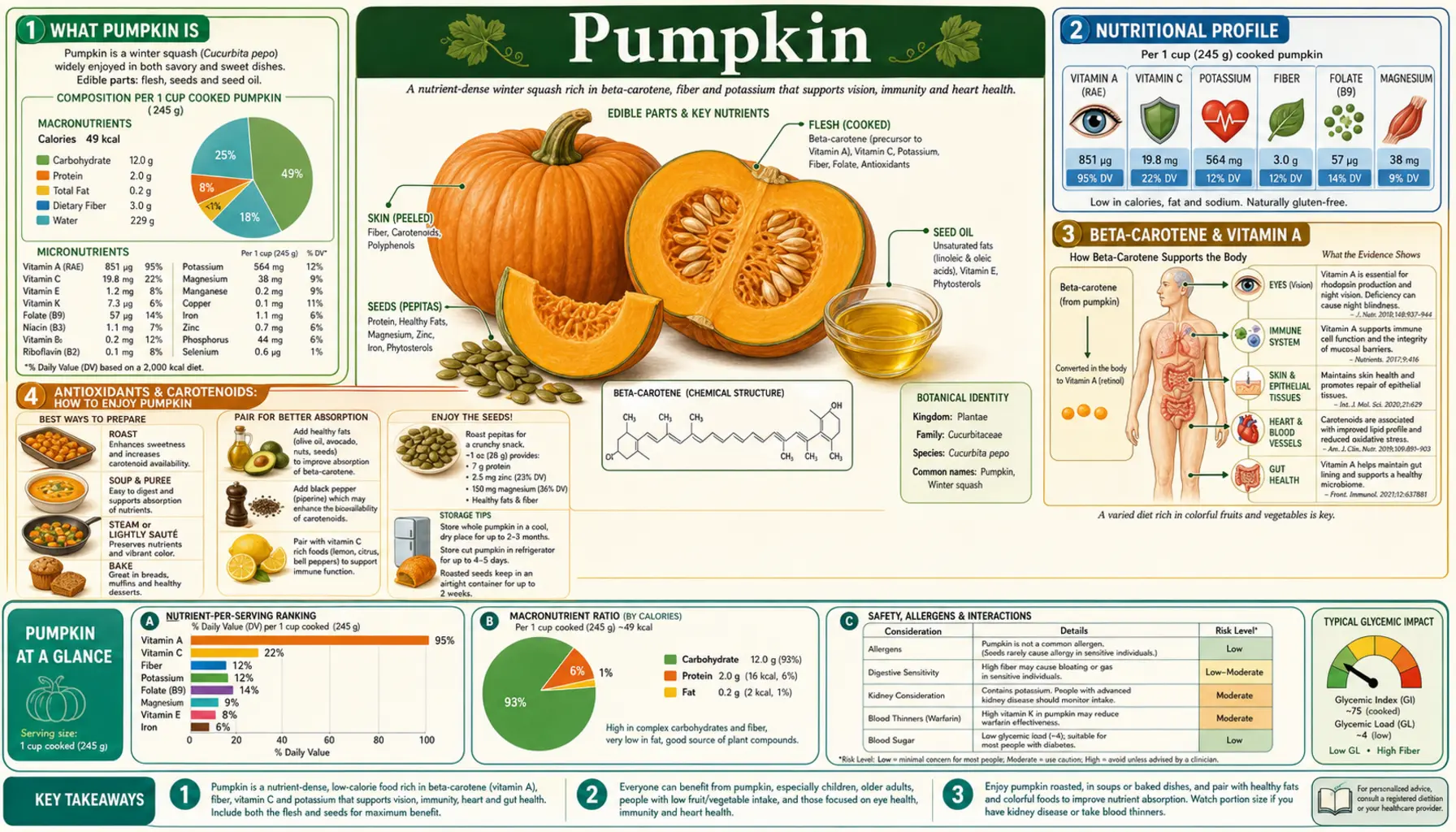
Pumpkin is a bright orange winter squash — a member of the gourd family (genus Cucurbita) that grows on a sprawling vine and stores well for months after harvest. Beyond its role as a Halloween lantern or a Thanksgiving pie, the flesh of a good cooking pumpkin is one of the more nutritious vegetables you can put on your plate: it is very low in calories, rich in fiber and potassium, and so loaded with the orange pigment beta-carotene that a single serving can cover a full day's worth of vitamin A. The seeds tucked inside are a separate little nutrition package of their own, prized for zinc, magnesium, and healthy fats. This page focuses on the flesh — what pumpkin is, what nutrients it delivers, why the carotenoids matter for your eyes and skin, how it fits into a heart-friendly, blood-sugar-friendly diet, and the honest practical details of choosing between a fresh pumpkin and a can of pure pumpkin puree. The evidence here is solid for the basics (pumpkin is a genuinely excellent source of provitamin A and potassium) and thinner for some of the more dramatic health claims, and we will be clear about which is which.
Table of Contents
- What Pumpkin Is
- Nutritional Profile
- Beta-Carotene & Vitamin A
- Antioxidants & Carotenoids
- Heart Health & Fiber
- Blood Sugar & Calorie Density
- A Word on Pumpkin Seeds
- How to Select, Cook & Store
- Safety
- Research Papers
- Connections
- Featured Videos
What Pumpkin Is
Pumpkin is the common name for several species of Cucurbita — most often Cucurbita pepo, Cucurbita moschata, and Cucurbita maxima — grown for their large, round, thick-skinned fruits. Botanically the pumpkin is a fruit (it develops from a flower and holds the seeds), but in the kitchen it is treated as a vegetable, much like tomatoes or squash. It belongs to the same family as cucumbers, melons, zucchini, and gourds.
Not every pumpkin is meant for eating. It helps to know the difference:
- Culinary (pie or sugar) pumpkins are smaller, denser, and sweeter, with fine-textured flesh that cooks down smoothly. Varieties such as "Sugar Pie," "Cinderella," and many C. moschata types (the same species used for most canned pumpkin) are grown for flavor.
- Field or carving pumpkins — the big jack-o'-lantern types — are bred for size and a sturdy shell, not taste. Their flesh tends to be stringy and watery. You can technically eat them, but the result is bland.
- Decorative gourds and "ornamental" pumpkins are grown purely for looks. Some are bitter and are best left as table decoration.
The edible parts are the flesh (the orange wall of the fruit, which is what this page is mostly about) and the seeds (the flat, cream-colored kernels inside, roasted as a snack or pressed for oil). Even the flowers and young leaves are eaten in some cuisines. Interestingly, the deep orange color that makes pumpkin so recognizable is also its nutritional signature: that pigment is beta-carotene, the plant form of vitamin A.
Nutritional Profile
Pumpkin flesh is roughly 90–94 percent water, which is exactly why it is so light: a full cup of cooked, mashed pumpkin has only about 50 calories. What is left after the water is a genuinely useful mix of vitamins, minerals, and fiber — and, unusually, one truly standout nutrient. Because canned pure pumpkin has some of the water cooked off, it is more concentrated than fresh, so the numbers below shift depending on which you use.
A one-cup (about 245 g) serving of cooked, mashed pumpkin provides, in round numbers:
- Calories: around 50 — very low for the volume you get.
- Vitamin A (as provitamin-A carotenoids): the headline nutrient. A serving easily exceeds a full day's target; canned pumpkin is especially concentrated and can supply several times the daily value. This comes almost entirely from beta-carotene, not from preformed retinol.
- Vitamin C: a modest but real amount, roughly a tenth of the daily value.
- Potassium: a meaningful source — around 500 mg per cup, more than you would get from a small banana.
- Fiber: about 2.5–3 g from fresh cooked pumpkin, and notably more — roughly 7 g per cup — from concentrated canned puree.
- Smaller amounts of vitamin E, vitamin K, several B vitamins (including folate and vitamin B6), copper, manganese, iron, and magnesium.
Two features make pumpkin nutritionally distinctive. First is its extraordinary carotenoid content — peer-reviewed compositional studies rank pumpkin among the richest common vegetable sources of provitamin-A carotenoids. Second is its very low energy density: you get a large, satisfying portion of food for very few calories, which is helpful for anyone watching their weight. It is worth remembering that the seeds are a completely different nutritional story from the flesh — higher in calories, protein, minerals, and fat — and are covered separately below and on the dedicated Pumpkin Seeds page.
Beta-Carotene & Vitamin A
If pumpkin has a superpower, this is it. The rich orange color comes from beta-carotene, a plant pigment that your body converts into vitamin A (retinol) as needed. Because your body only makes as much vitamin A as it requires from beta-carotene, food sources like pumpkin do not carry the risk of vitamin A overdose that high-dose retinol supplements can. Reviews of human data confirm that dietary beta-carotene is a genuinely important and safe route to meeting vitamin A needs, particularly for people who eat little animal-source food.
Vitamin A is essential for several everyday functions:
- Vision: vitamin A is a building block of rhodopsin, the light-sensitive pigment in the retina that lets you see in dim light. Vitamin A deficiency is the leading cause of preventable childhood blindness worldwide, and pumpkin-family crops are used in some regions specifically to help close that gap.
- Skin and the linings of the body: vitamin A helps maintain healthy skin and the mucous membranes that line the airways and gut — the body's first physical barriers against infection.
- Immune function: vitamin A supports the normal development and activity of immune cells, which is part of why it is sometimes called an "anti-infective" vitamin.
One practical tip: carotenoids are fat-soluble, so your body absorbs far more of pumpkin's beta-carotene when the meal contains a little fat — a drizzle of olive oil, a pat of butter, or the natural fat in a soup made with a splash of cream. Cooking also helps, because heat breaks down the plant cell walls and frees the pigment. Studies tracking carotenoids through pumpkin processing show that gentle cooking and pureeing make the beta-carotene more available, though prolonged high heat and long storage can slowly degrade it.
Antioxidants & Carotenoids
Beta-carotene is only the most famous of pumpkin's carotenoids. The flesh also contains alpha-carotene (another provitamin-A pigment) and, importantly, lutein and zeaxanthin — two carotenoids that the body does not turn into vitamin A but instead deposits directly in the retina of the eye. These act as antioxidants, mopping up reactive molecules that can damage cells over time, and lutein and zeaxanthin specifically concentrate in the macula, where they help filter damaging blue light.
Here is where honesty matters. The eye-protection story for lutein and zeaxanthin is strongest in the context of age-related macular degeneration, and it was studied using concentrated supplements, not vegetables. The large AREDS2 clinical trial found that adding lutein and zeaxanthin to a supplement formula modestly helped slow progression in people who already had intermediate macular degeneration. That is meaningful evidence that these carotenoids matter for the eye — but it does not prove that eating pumpkin prevents eye disease in healthy people. The reasonable takeaway is that pumpkin is a whole-food source of the same protective pigments, delivered alongside fiber, potassium, and vitamin C, with none of the downsides of a pill.
More broadly, pumpkin's mix of carotenoids and vitamin C contributes to the overall antioxidant capacity of a diet rich in colorful vegetables. This is the kind of benefit that shows up in population studies of vegetable-heavy eating patterns rather than in trials of pumpkin itself, so it is best understood as "pumpkin is a good member of a good team" rather than a standalone remedy.
Heart Health & Fiber
Several of pumpkin's nutrients line up with heart health, though again the strongest evidence is for the nutrients and dietary patterns rather than for pumpkin specifically.
- Potassium: pumpkin is a solid source, and potassium helps counterbalance sodium and relax blood vessel walls. A large systematic review and meta-analysis found that higher potassium intake was associated with lower blood pressure in adults and with a reduced risk of stroke — a well-supported reason to eat more potassium-rich plants.
- Fiber: the fiber in pumpkin (especially concentrated canned puree) adds to the daily total that helps lower cholesterol and steady digestion. A landmark series of systematic reviews and meta-analyses found that people who eat more dietary fiber have lower rates of heart disease, stroke, type 2 diabetes, and death from any cause — among the most consistent findings in all of nutrition.
- Low calorie density: by helping you feel full on fewer calories, pumpkin can support the healthy weight that underpins good cardiovascular health.
None of this makes pumpkin a "heart medicine." It makes pumpkin a sensible, nutrient-dense building block in the kind of vegetable-rich diet that decades of research link to healthier hearts.
Blood Sugar & Calorie Density
Pumpkin comes up a lot in conversations about blood sugar, and this is an area where the internet often gets ahead of the evidence, so it is worth slowing down.
The genuinely helpful facts: pumpkin flesh is very low in calories, fairly low in total carbohydrate per serving, and delivers fiber that slows digestion — all useful features for anyone managing weight or blood sugar. Laboratory and animal studies, summarized in review articles, have explored pumpkin polysaccharides and extracts for possible glucose-lowering effects, and some early results are promising. But these are mostly test-tube and animal experiments; the human clinical evidence is limited, and the amounts used in studies do not always resemble a normal plate of food. In plain terms: pumpkin is a smart vegetable choice for people watching their blood sugar, but it is not a proven treatment for diabetes, and it should not replace prescribed care.
There is one very practical point that trips people up. Canned pure pumpkin is not the same as canned pumpkin pie filling. Pure pumpkin (the kind whose only ingredient is pumpkin) is exactly the nutritious, low-sugar vegetable described on this page. Pumpkin pie filling, sold in similar cans, has added sugar and spices — often a lot of sugar — and behaves nutritionally more like dessert. And of course a slice of pumpkin pie, with its sweetened custard and pastry crust, is a treat, not a vegetable serving. When a recipe or label says "pumpkin," check whether it means the plain puree or the pre-sweetened filling.
A Word on Pumpkin Seeds
Scoop out a pumpkin and you will find its seeds — a genuinely different food from the flesh, and a nutritious one. Roasted pumpkin seeds (also called pepitas when hulled) are a concentrated source of:
- Zinc — important for immune function, wound healing, and taste and smell.
- Magnesium — involved in hundreds of enzyme reactions, including muscle and nerve function.
- Healthy unsaturated fats, plant protein, iron, and additional fiber.
Because the seeds are rich in fat, they are also much higher in calories than the flesh, so they are best thought of as a nutrient-dense snack rather than a free-for-all. Pumpkin-seed oil has been studied for specific uses — for example, a small human study reported that pumpkin-seed oil eased symptoms of an overactive bladder — but the everyday value of pumpkin seeds is simply as a wholesome, mineral-rich food. To keep the focus here on the flesh, the seeds have their own dedicated page: see Pumpkin Seeds.
How to Select, Cook & Store
You have two good routes to pumpkin's nutrition, and neither is "better" in an absolute sense — they suit different needs.
Choosing a fresh pumpkin
For eating, skip the giant carving pumpkins and look for a small sugar or pie pumpkin (usually 2–5 kg / 4–10 lb). Pick one that feels heavy for its size, with firm, unblemished skin and a bit of dry stem still attached. Avoid soft spots, cracks, or mold. A whole, uncut pumpkin keeps for weeks — even a couple of months — in a cool, dry spot.
Cooking it
The easiest method is to halve the pumpkin, scoop out the seeds and stringy pulp, and roast the halves cut-side down at a moderate oven temperature until the flesh is soft (usually 45–60 minutes). Then scoop the flesh from the skin and mash or puree it. You can also steam or boil chunks, though roasting concentrates the flavor and keeps it from getting waterlogged. Remember to add a little fat to the meal to boost carotenoid absorption. Cooked pumpkin puree freezes beautifully — portion it into containers and it keeps for months.
The case for canned
Canned pure pumpkin is a genuinely good option — nutritious, convenient, consistent, and available year-round. The canning process actually concentrates the flesh, so canned pumpkin is often higher in fiber and vitamin A per cup than the fresh version. The only cautions are to buy the plain product (ingredient list: "pumpkin") rather than the pre-sweetened pie filling, and to note that some canned "pumpkin" is actually made from closely related winter squash such as C. moschata — which is fine, and just as nutritious. Once opened, transfer leftover canned pumpkin to a sealed container and refrigerate for a few days, or freeze it.
Safety
Pumpkin flesh is one of the safest foods around. It is not a common allergen, it is gentle on the digestive system, and it is a standard first food for babies precisely because it is easy to tolerate. A few minor, honest notes:
- Harmless orange skin. Eating very large amounts of carotene-rich foods (pumpkin, carrots, sweet potatoes) over time can tint the skin a faint orange-yellow — a condition called carotenemia. It is harmless and fades when intake drops; it is not the same as jaundice.
- Watch the add-ons, not the pumpkin. The health concern with "pumpkin" foods is almost always the sugar, cream, butter, and pastry added to pies, lattes, and pie filling — not the vegetable itself.
- Very rare bitterness. On rare occasions a squash or gourd (usually a decorative or wild one, or a home-saved seed that has cross-pollinated) can accumulate bitter compounds called cucurbitacins that cause stomach upset. If a pumpkin or squash tastes intensely bitter, do not eat it — but ordinary store-bought cooking pumpkins are not a concern.
- Pumpkin seeds are calorie-dense and, like any nut or seed, a choking risk for very young children; otherwise they are safe for most people.
For the overwhelming majority of people, pumpkin is a wholesome, everyday vegetable that you can enjoy freely. As always, this page is general information, not medical advice for your specific situation.
Research Papers
- Yadav M, Jain S, Tomar R, et al. Medicinal and biological potential of pumpkin: an updated review. Nutrition Research Reviews. 2010;23(2):184-190. doi:10.1017/S0954422410000107 — broad review of pumpkin's nutrient and phytochemical content and its studied biological activities.
- Kim MY, Kim EJ, Kim Y, et al. Comparison of the chemical compositions and nutritive values of various pumpkin (Cucurbitaceae) species and parts. Nutrition Research and Practice. 2012;6(1):21-27. doi:10.4162/nrp.2012.6.1.21 — measured how nutrients differ across pumpkin species and between flesh, seeds, and other parts.
- Caili F, Huan S, Quanhong L. A review on pharmacological activities and utilization technologies of pumpkin. Plant Foods for Human Nutrition. 2006;61(2):70-77. doi:10.1007/s11130-006-0016-6 — surveys pumpkin's reported pharmacological effects and its polysaccharide and carotenoid components.
- Men X, Choi S, Han X, et al. Physicochemical, nutritional and functional properties of Cucurbita moschata: a review. Food Science and Biotechnology. 2021;30(2):171-183. doi:10.1007/s10068-020-00835-2 — focused review of the species used for most canned pumpkin, including its carotenoids and fiber.
- Grune T, Lietz G, Palou A, et al. β-Carotene is an important vitamin A source for humans. The Journal of Nutrition. 2010;140(12):2268S-2285S. doi:10.3945/jn.109.119024 — expert consensus that dietary beta-carotene is a safe, meaningful route to meeting vitamin A needs.
- Provesi JG, Dias CO, Amante ER. Changes in carotenoids during processing and storage of pumpkin puree. Food Chemistry. 2011;128(1):195-202. doi:10.1016/j.foodchem.2011.03.027 — tracked how cooking and storage affect pumpkin's beta-carotene and lutein levels.
- Age-Related Eye Disease Study 2 (AREDS2) Research Group. Lutein + zeaxanthin and omega-3 fatty acids for age-related macular degeneration: the AREDS2 randomized clinical trial. JAMA. 2013;309(19):2005-2015. doi:10.1001/jama.2013.4997 — landmark trial showing lutein and zeaxanthin (the pigments also found in pumpkin) modestly aided the aging eye.
- Aburto NJ, Hanson S, Gutierrez H, et al. Effect of increased potassium intake on cardiovascular risk factors and disease: systematic review and meta-analyses. BMJ. 2013;346:f1378. doi:10.1136/bmj.f1378 — higher potassium intake (pumpkin is a good source) linked to lower blood pressure and stroke risk.
- Reynolds A, Mann J, Cummings J, et al. Carbohydrate quality and human health: a series of systematic reviews and meta-analyses. The Lancet. 2019;393(10170):434-445. doi:10.1016/S0140-6736(18)31809-9 — large synthesis linking higher dietary fiber to lower heart disease, diabetes, and mortality.
- Adams GG, Imran S, Wang S, et al. The hypoglycaemic effect of pumpkins as anti-diabetic and functional medicines. Food Research International. 2011;44(4):862-867. doi:10.1016/j.foodres.2011.03.016 — reviews the mostly preclinical evidence for pumpkin's glucose-lowering compounds (promising but not yet proven in humans).
- Dotto JM, Chacha JS. The potential of pumpkin seeds as a functional food ingredient: a review. Scientific African. 2020;10:e00575. doi:10.1016/j.sciaf.2020.e00575 — summarizes the nutrient density of pumpkin seeds, including zinc, magnesium, protein, and healthy fats.
- Nishimura M, Ohkawara T, Sato H, et al. Pumpkin seed oil extracted from Cucurbita maxima improves urinary disorder in human overactive bladder. Journal of Traditional and Complementary Medicine. 2014;4(1):72-74. doi:10.4103/2225-4110.124355 — small human study reporting symptom improvement from pumpkin-seed oil.
Connections
- All Food
- Pumpkin Seeds
- Sweet Potatoes
- Carrots
- Spinach
- Vitamin A
- Vitamin C
- Beta-Carotene
- Lutein
- Zeaxanthin
- Potassium
- Zinc
- Magnesium
- Pumpkin Seeds for Parasites — how cucurbitin from this gourd's seeds paralyzes tapeworms and roundworms.