Pomegranate — Benefits Deep Dive
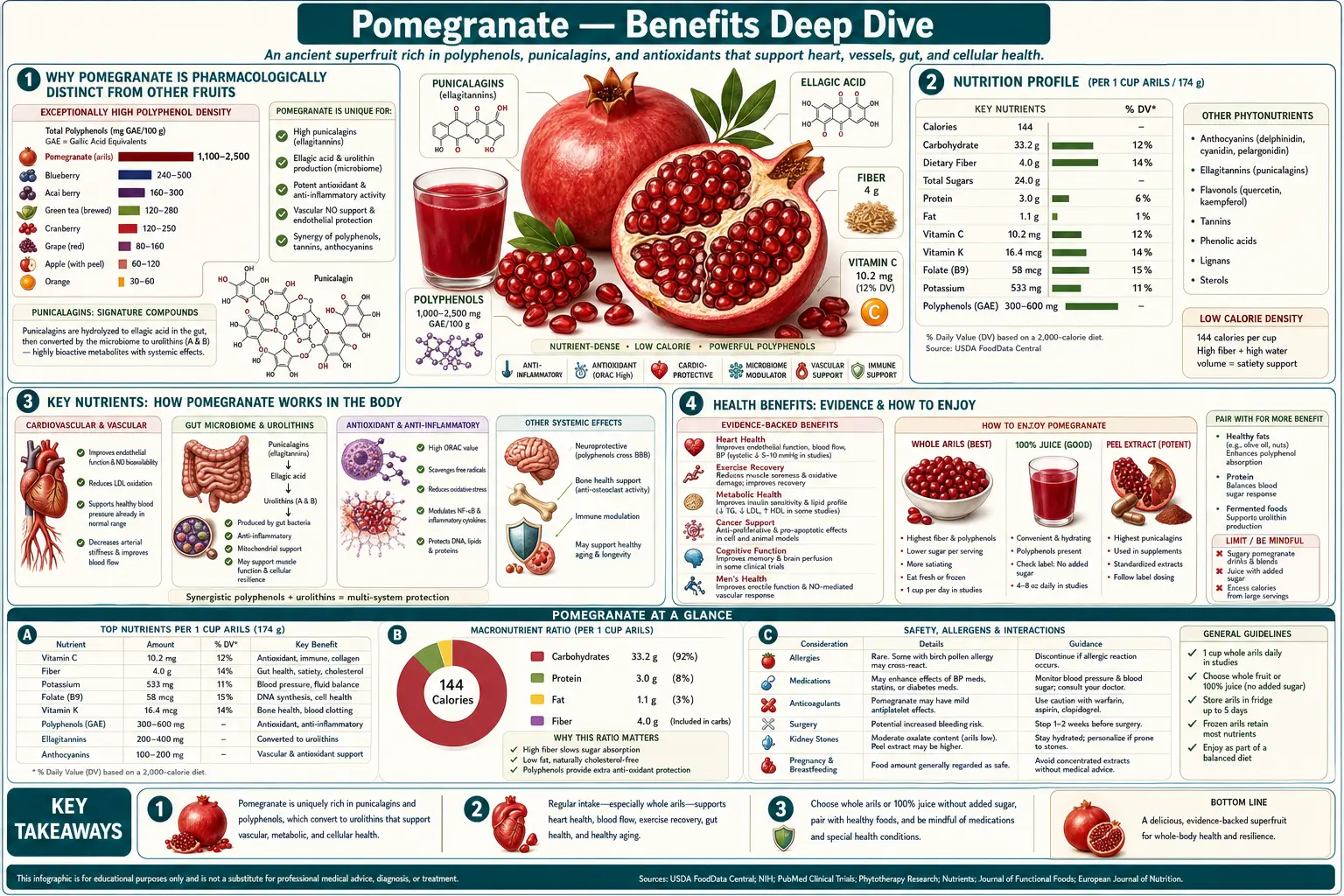
Pomegranate (Punica granatum) is one of the most antioxidant-dense fruits on Earth, ranking higher than green tea, red wine, blueberries, and acai by most ORAC and FRAP assays. Its bioactivity is not driven by Vitamin C or generic polyphenols but by a specific class of large-molecule ellagitannins — punicalagins — that are unique to pomegranate and largely absent from any other commonly consumed food. These ellagitannins are hydrolyzed in the upper gut and then metabolized by colonic bacteria into urolithins, which are the actual circulating bioactives responsible for most of the cardiovascular, prostate, mitochondrial, and anti-inflammatory effects measured in human trials. Four deep-dive pages below explore the chemistry of the punicalagin-to-urolithin conversion, the prostate cancer PSA-doubling-time evidence (Pantuck UCLA Phase II), the cardiovascular reversibility data (Aviram carotid IMT regression), and the practical question of whether whole arils, juice, or extract delivers the most consistent dose of the active urolithin metabolite.
Deep-Dive Articles
Punicalagins & Antioxidants
The pomegranate-specific large-molecule ellagitannins (punicalagins A and B, punicalin, pedunculagin) that are unique to Punica granatum. Hydrolysis to free ellagic acid in the upper gut, conversion by Gordonibacter and Ellagibacter colonic bacteria to urolithins A, B, C, and D, and the urolithin-metabotype concept (UM-A vs UM-B vs UM-0) that explains inter-individual variation in clinical response.
Prostate & PSA
The Pantuck UCLA Phase II trial showing PSA doubling time extended from 15 to 54 months in men with rising PSA after primary therapy. Mechanism through inhibition of androgen receptor signaling, AKT/mTOR pathway suppression, and direct cytotoxicity to LNCaP, PC-3, and DU-145 prostate cancer cell lines. Practical dosing, the Carducci follow-up that did not replicate, and how to interpret the discrepancy.
Cardiovascular
Aviram's landmark trial showing carotid intima-media thickness regression with daily pomegranate juice over three years. Blood pressure reduction (systolic 5-7 mmHg in meta-analysis), LDL oxidation resistance, paraoxonase-1 (PON1) enzyme upregulation, ACE inhibition, and endothelial nitric oxide preservation. Why pomegranate may be one of the few foods that demonstrably reverses early atherosclerosis.
Juice vs Whole
The practical question every patient asks: should I eat the arils, drink the juice, or take an extract? Differential delivery of punicalagins (highest in juice because they leach from the pith), ellagic acid (similar across forms), fiber (whole arils only), and sugar load (8 oz juice = 32g sugar = same as cola). Why fresh arils may be best for daily use and concentrated juice best for time-limited therapeutic protocols.
Table of Contents
- Deep-Dive Articles
- Why Pomegranate Is Pharmacologically Distinct From Other Fruits
- Research Papers: Punicalagins & Urolithin Metabolism
- Research Papers: Prostate Cancer & PSA
- Research Papers: Cardiovascular & Atherosclerosis
- Research Papers: Forms, Dose, and Bioavailability
- Research Papers: Cross-Cutting (Mitochondria, Inflammation, Safety)
- External Authoritative Resources
- Connections
- Featured Videos
Why Pomegranate Is Pharmacologically Distinct From Other Fruits
Most antioxidant-rich foods exert their effects through one of three well-characterized mechanisms: anthocyanins (blueberries, blackberries, red wine), flavanols (green tea, cocoa), or carotenoids (tomatoes, sweet potato, leafy greens). Pomegranate is unusual because it sits in a fourth class largely by itself — the ellagitannins, and specifically a pair of large-molecule ellagitannins called punicalagin A and punicalagin B that are essentially unique to Punica granatum.
- Punicalagins are huge molecules — molecular weight roughly 1,084 Da, far too large to be absorbed intact. They are hydrolyzed slowly in the upper gut to release free ellagic acid (302 Da), some of which is absorbed and conjugated by phase-II enzymes in the liver.
- The colonic microbiome creates the actual bioactives — the bulk of the unabsorbed ellagitannins and ellagic acid pass to the colon, where specific gut bacteria (genera Gordonibacter and Ellagibacter) sequentially dehydroxylate them to produce urolithins A, B, C, and D. Urolithin A in particular is the principal circulating metabolite and the most extensively studied bioactive.
- Urolithin metabotypes explain inter-individual variation — about 10-15% of adults are "urolithin metabotype 0" (UM-0), meaning their microbiome cannot perform the conversion at all. These individuals get little or no urolithin from pomegranate intake. The remaining 85-90% split into metabotype A (urolithin A dominant) and metabotype B (urolithin A plus isourolithin A plus urolithin B). UM-A responders typically show stronger clinical effects.
The therapeutic implication is twofold. First, no other commonly consumed food delivers a meaningful punicalagin dose — not green tea, not red wine, not blueberries. If you want urolithins, pomegranate (or walnuts and certain berries at much smaller doses) is the practical source. Second, the microbiome dependence means that pomegranate's effects are not uniform across individuals. The same 8 oz juice that produces dramatic cardiovascular and prostate effects in a UM-A patient may do almost nothing in a UM-0 patient with poor gut bacterial diversity. This is also why direct urolithin A supplements (Mitopure / urolithin A by Amazentis) have entered the market — they bypass the microbiome conversion step entirely.
The downstream effects of urolithin A include mitophagy induction (selective autophagy of damaged mitochondria), androgen receptor inhibition (the basis of the prostate effects), LDL oxidation resistance (the basis of the cardiovascular effects), ACE inhibition (modest blood-pressure lowering), and NF-kB inhibition (broad anti-inflammatory action). All four deep-dive pages below trace these effects back to the punicalagin-to-urolithin conversion as the unifying mechanism.
Research Papers: Punicalagins & Urolithin Metabolism
- Cerda B et al. (2003). The potent in vitro antioxidant ellagitannins from pomegranate juice are metabolised into bioavailable but poor antioxidant hydroxy-6H-dibenzopyran-6-one derivatives by the colonic microflora Search PubMed
- Tomas-Barberan FA et al. (2014). Urolithins, the rescue of "old" metabolites to understand a "new" concept: metabotypes as a nexus between phenolic metabolism, microbiota dysbiosis, and host health status — PubMed: PMID 27158799
- Espin JC et al. (2013). Biological significance of urolithins, the gut microbial ellagic acid-derived metabolites: the evidence so far Search PubMed
- Garcia-Villalba R et al. (2017). Gordonibacter urolithinfaciens sp. nov., a urolithin-producing bacterium isolated from the human gut PubMed search
- Selma MV et al. (2014). The human gut microbial ecology associated with overweight and obesity determines ellagic acid metabolism PubMed search
- Seeram NP et al. (2005). Pomegranate juice ellagitannin metabolites are present in human plasma and some persist in urine for up to 48 hours — PubMed: PMID 15795435
- Gil MI et al. (2000). Antioxidant activity of pomegranate juice and its relationship with phenolic composition and processing — PubMed: PMID 11052704
- Heber D (2008). Multitargeted therapy of cancer by ellagitannins — PubMed: PMID 18585855
- Larrosa M et al. (2010). Anti-inflammatory properties of a pomegranate extract and its metabolite urolithin-A in a colitis rat model Search PubMed
- Cortes-Martin A et al. (2020). Where to look for the urolithin-A metabotype? Toward an automated detection of urolithins A, B and C in urine PubMed search
Research Papers: Prostate Cancer & PSA
- Pantuck AJ et al. (2006). Phase II study of pomegranate juice for men with rising prostate-specific antigen following surgery or radiation for prostate cancer. Clinical Cancer Research. — PubMed: PMID 16818701
- Pantuck AJ et al. (2015). A randomized, double-blind, placebo-controlled study of the effects of pomegranate extract on rising PSA levels in men following primary therapy for prostate cancer Search PubMed
- Carducci MA et al. (2018). A phase 3 randomized, placebo-controlled study of pomegranate extract in men with rising PSA following initial therapy for localized prostate cancer PubMed search
- Albrecht M et al. (2004). Pomegranate extracts potently suppress proliferation, xenograft growth, and invasion of human prostate cancer cells — PubMed: PMID 15383219
- Malik A et al. (2005). Pomegranate fruit juice for chemoprevention and chemotherapy of prostate cancer Search PubMed
- Hong MY et al. (2008). Effects of pomegranate juice on androgen-sensitive prostate cancer cells PubMed search
- Sanchez-Gonzalez C et al. (2014). Urolithin A causes p21 up-regulation in prostate cancer cells PubMed search
- Adhami VM et al. (2009). Cancer chemoprevention by pomegranate: laboratory and clinical evidence Search PubMed
- Paller CJ et al. (2013). A randomized phase II study of pomegranate extract for men with rising PSA following initial therapy for localized prostate cancer — PubMed: PMID 22689141
- Stenner-Liewen F et al. (2013). Daily pomegranate intake has no impact on PSA levels in patients with advanced prostate cancer PubMed search
Research Papers: Cardiovascular & Atherosclerosis
- Aviram M et al. (2004). Pomegranate juice consumption for 3 years by patients with carotid artery stenosis reduces common carotid intima-media thickness, blood pressure and LDL oxidation — PubMed: PMID 15158307
- Aviram M et al. (2000). Pomegranate juice consumption reduces oxidative stress, atherogenic modifications to LDL, and platelet aggregation: studies in humans and in atherosclerotic apolipoprotein E-deficient mice Search PubMed
- Sahebkar A et al. (2017). Effects of pomegranate juice on blood pressure: a systematic review and meta-analysis of randomized controlled trials — PubMed: PMID 27888156
- Asgary S et al. (2014). Clinical evaluation of blood pressure lowering, endothelial function improving, hypolipidemic and anti-inflammatory effects of pomegranate juice in hypertensive subjects PubMed search
- Sumner MD et al. (2005). Effects of pomegranate juice consumption on myocardial perfusion in patients with coronary heart disease — PubMed: PMID 16169367
- Aviram M, Dornfeld L (2001). Pomegranate juice consumption inhibits serum angiotensin converting enzyme activity and reduces systolic blood pressure Search PubMed
- Davidson MH et al. (2009). Effects of consumption of pomegranate juice on carotid intima-media thickness in men and women at moderate risk for coronary heart disease Search PubMed
- Mathew AS et al. (2012). Endothelial function and tissue antioxidant capacity following pomegranate juice consumption PubMed search
- Kelishadi R et al. (2011). Pomegranate juice consumption is associated with reduced cardiovascular disease risk factors in adolescents PubMed search
- Tsang C et al. (2018). Daily consumption of polyphenol-rich pomegranate juice for 28 days alters salivary microbiome composition in healthy adults PubMed search
Research Papers: Forms, Dose, and Bioavailability
- Seeram NP et al. (2006). Comparison of antioxidant potency of commonly consumed polyphenol-rich beverages in the United States Search PubMed
- Mertens-Talcott SU et al. (2006). Absorption, metabolism, and antioxidant effects of pomegranate (Punica granatum) polyphenols after ingestion of a standardized extract in healthy human volunteers Search PubMed
- Gonzalez-Sarrias A et al. (2010). Phase II metabolism limits the antiproliferative activity of urolithins in human colon cancer cells PubMed search
- Andreux PA et al. (2019). The mitophagy activator urolithin A is safe and induces a molecular signature of improved mitochondrial and cellular health in humans PubMed search
- Singh A et al. (2022). Direct supplementation with Urolithin A overcomes limitations of dietary exposure and gut microbiome variability in healthy adults to achieve consistent levels across the population PubMed search
- Ryu D et al. (2016). Urolithin A induces mitophagy and prolongs lifespan in C. elegans and increases muscle function in rodents — PubMed: PMID 27400265
- Heber D et al. (2007). Safety and antioxidant activity of a pomegranate ellagitannin-enriched polyphenol dietary supplement in overweight individuals with increased waist size PubMed search
- Khalil OAK et al. (2014). Polyphenols, hydrolyzable tannins, and antioxidant capacity in different parts of the pomegranate PubMed search
- Tezcan F et al. (2009). Antioxidant activity and total phenolic, organic acid and sugar content in commercial pomegranate juices PubMed search
- Stoner GD, Mukhtar H (1995). Polyphenols as cancer chemopreventive agents PubMed search
Research Papers: Cross-Cutting (Mitochondria, Inflammation, Safety)
- D'Amico D et al. (2021). Impact of the natural compound urolithin A on health, disease, and aging Search PubMed
- Liu S et al. (2019). Effect of urolithin A supplementation on muscle endurance and mitochondrial health in older adults PubMed search
- Adams LS et al. (2006). Pomegranate juice, total pomegranate ellagitannins, and punicalagin suppress inflammatory cell signaling in colon cancer cells PubMed search
- Aviram M et al. (1998). Interactions of paraoxonases with low-density lipoprotein, high-density lipoprotein, and macrophages PubMed search
- Rosenblat M et al. (2006). Anti-oxidative effects of pomegranate juice consumption by diabetic patients on serum and on macrophages PubMed search
- Komperda KW (2009). Potential interaction between pomegranate juice and warfarin Search PubMed
- Hidaka M et al. (2005). Effects of pomegranate juice on human cytochrome p450 3A (CYP3A) and carbamazepine pharmacokinetics in rats PubMed search
- Forest CP et al. (2007). Efficacy and safety of pomegranate juice on improvement of erectile dysfunction in male patients with mild to moderate erectile dysfunction — PubMed: PMID 17568759
- Trombold JR et al. (2011). Ellagitannin consumption improves strength recovery 2-3 d after eccentric exercise PubMed search
- Vidal A et al. (2003). Studies on the toxicity of Punica granatum L. (Punicaceae) whole fruit extracts Search PubMed
External Authoritative Resources
- Linus Pauling Institute — Pomegranate (where available)
- NIH Office of Dietary Supplements
- NCI — Pomegranate (PDQ) Patient Summary
- Memorial Sloan Kettering — Pomegranate (About Herbs)
- PubMed — All research on pomegranate / Punica granatum (~6,000+ papers)
Connections
- All Food
- Pomegranate (Main Page)
- Punicalagins & Antioxidants
- Prostate & PSA
- Cardiovascular
- Juice vs Whole
- Prostate Cancer
- Atherosclerosis
- Hypertension
- Vitamin C
- Green Tea (EGCG)
- Resveratrol
- Antioxidant Therapy
- Walnuts (Other Ellagitannin Source)