Pomegranate Juice vs Whole Arils — Which Form Delivers the Benefits
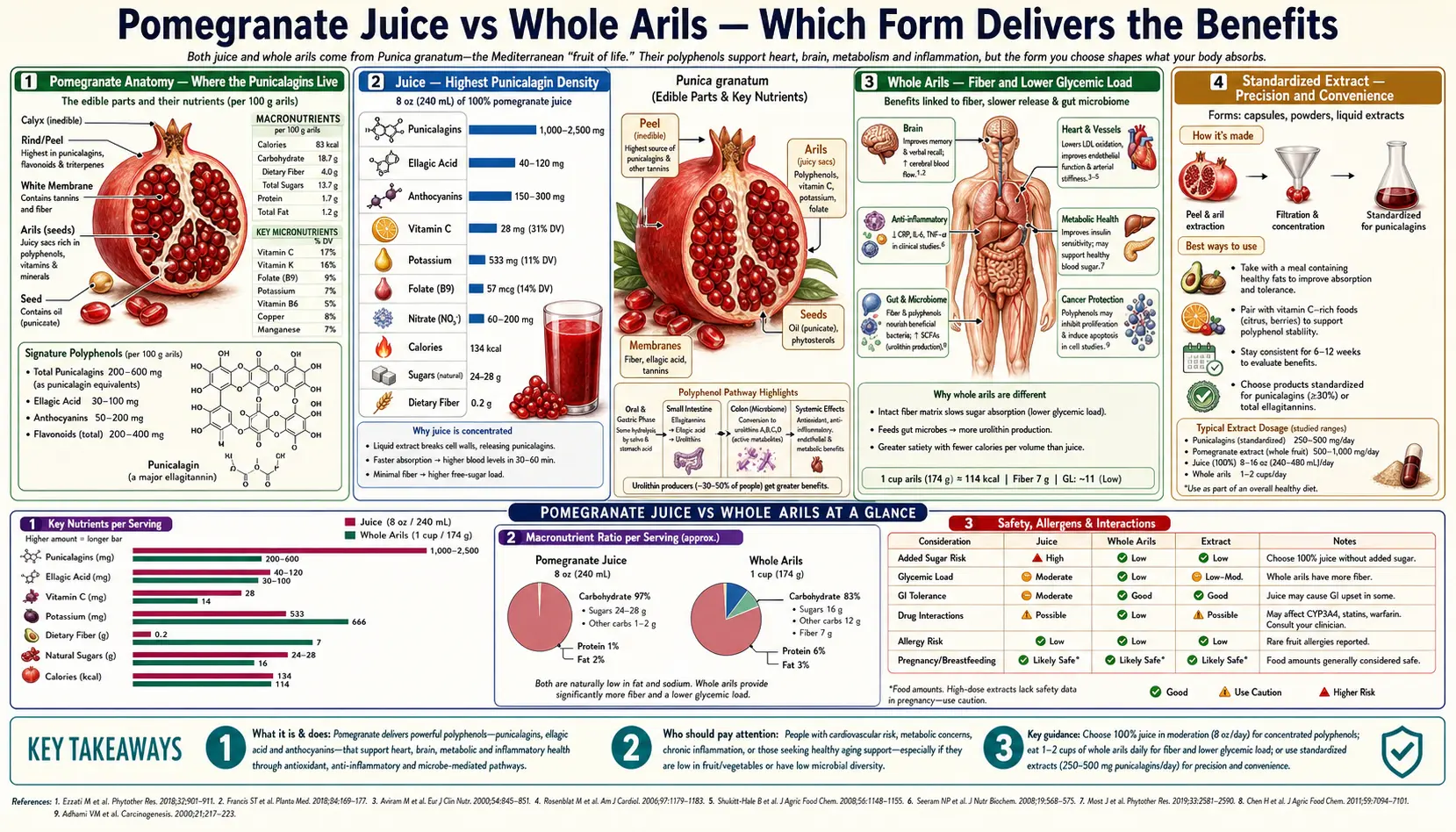
The single most common practical question patients ask about pomegranate is whether they should eat the arils (the juicy seed sacs), drink the juice, or take a standardized extract capsule. Each form has trade-offs in punicalagin content, sugar load, fiber, cost, convenience, and seasonal availability. The juice often contains more punicalagins per serving than the arils alone because commercial juicing presses also extract polyphenols from the pith (the white spongy material between arils), which is the highest-concentration punicalagin tissue in the whole fruit. The whole arils win on fiber, sugar regulation, and food-matrix synergy. Concentrated extract wins on dose precision and avoidance of sugar. This deep-dive walks through the differences in punicalagin and ellagic acid content, the glycemic implications, the practical scenarios where each form is preferable, and the answer for most healthy adults (whole arils daily, with juice or extract as occasional dose boosts for specific therapeutic targets).
Table of Contents
- Pomegranate Anatomy — Where the Punicalagins Live
- Juice — Highest Punicalagin Density
- Whole Arils — Fiber and Lower Glycemic Load
- Standardized Extract — Precision and Convenience
- Direct Urolithin A Supplements (Mitopure)
- Sugar Content and Glycemic Impact
- Cost and Practical Considerations
- Seasonal Availability and Storage
- Form Recommendation by Clinical Goal
- Key Research Papers
- Connections
- Featured Videos
Pomegranate Anatomy — Where the Punicalagins Live
A whole pomegranate has four distinct tissue compartments, each with very different polyphenol composition:
- Outer leathery rind (pericarp) — the reddish-tan tough outer skin. Inedible. Very high punicalagin content (5-10% by dry weight in some varieties), but not consumed.
- Inner pith / mesocarp — the white spongy material that divides the fruit into compartments and holds the arils. Inedible in the raw fruit but contributes substantially to commercial juice production. Very high punicalagin content (3-7% by dry weight).
- Arils (the juicy seed sacs) — the red gel-like sacs that contain the juice and seed. The edible portion. Moderate punicalagin content (the juice fraction within the aril), high anthocyanin content (the red pigments), high vitamin C.
- Seeds (within the arils) — the woody seed at the center of each aril. Contains punicic acid (a conjugated linolenic acid) and is the source of pomegranate seed oil. Most people swallow the seeds with the aril juice; some spit them out.
Khalil et al. (2014) characterized the polyphenol distribution across pomegranate parts and confirmed that the highest punicalagin concentration is in the rind and pith, followed by the aril juice, with the seeds containing relatively little punicalagin but the bulk of the punicic acid. This anatomy explains why commercial juicing — which crushes the whole fruit including the pith and partially the rind — produces juice with higher punicalagin content than the arils alone would suggest. Manual extraction of just the arils (without pith pressing) yields a beverage with less punicalagin per ounce than commercial juice.
Juice — Highest Punicalagin Density
Commercial 100% pomegranate juice (POM Wonderful is the largest-selling brand in the US) is produced by pressing the entire fruit including the pith. The resulting juice typically contains 1,500-2,500 mg of total polyphenols per 240 mL serving, of which roughly 700-1,500 mg are punicalagins. This is several times higher than what arils alone deliver, because the pith contributes a substantial fraction of the punicalagin load.
Tezcan et al. (2009) compared commercial pomegranate juice brands and found substantial variation in punicalagin content depending on processing method, variety, and fruit ripeness. The dark color and the characteristic tannic astringency of pure pomegranate juice both correlate with punicalagin content. Heavily diluted juices, juices with added apple or grape juice, and "from concentrate" reconstituted products typically have lower active punicalagin content than freshly pressed 100% juice.
Advantages of juice:
- Highest punicalagin dose per serving of any commonly available form
- Used as the intervention in most positive clinical trials (Pantuck, Aviram, Sumner)
- Convenient daily dosing — just pour 4-8 oz
- Year-round availability (commercial juice has a long shelf life)
- Easily incorporated into smoothies, sparkling water, or as a salad-dressing ingredient
Disadvantages of juice:
- High sugar load: 8 oz contains roughly 30-32 g of sugar (similar to a 12 oz cola)
- Expensive: $5-8 per 16 oz bottle in most US grocery stores
- No fiber (extraction process discards the aril skin and pith)
- Some commercial juices include preservatives or are blended with other juices
- Once opened, refrigerated shelf life is typically 5-7 days
Whole Arils — Fiber and Lower Glycemic Load
Eating whole pomegranate arils is the most traditional form of consumption and the form most aligned with the broader principles of whole-food nutrition. A typical medium pomegranate yields about 1 cup of arils (approximately 175 g), containing roughly 24 g of sugar and 7 g of dietary fiber.
The fiber matters for two reasons. First, it slows the absorption of the sugar, producing a much smaller glycemic excursion than the equivalent amount of juice. Second, fiber feeds the colonic microbiome — including Gordonibacter and Ellagibacter species that perform the punicalagin-to-urolithin conversion. A higher-fiber baseline diet supports the microbial conversion machinery that determines whether you get the urolithin payoff from any pomegranate intake.
The aril punicalagin content is moderate — per gram, roughly 30-50% of what commercial juice delivers, because the pith contribution is absent. But the calorie- and sugar-adjusted comparison is more favorable than the raw punicalagin comparison suggests: per gram of sugar consumed, arils deliver substantially more punicalagin than juice does, because the juice's extra punicalagin comes alongside extra sugar.
Advantages of whole arils:
- Fiber benefit — both glycemic and microbiome-supporting
- Lower glycemic load per serving than juice
- Whole-food matrix synergy (vitamin C, anthocyanins, fiber, polyphenols together)
- Satiety — arils require chewing and produce more meaningful satiety than juice
- Often less expensive per gram of polyphenol than premium juices
Disadvantages of whole arils:
- Lower absolute punicalagin dose than juice (so for therapeutic protocols requiring large punicalagin loads, juice or extract may be more practical)
- Seasonal availability — fresh whole pomegranates are widely available October through January in the northern hemisphere; spring and summer availability is limited and prices rise
- Aril extraction is messy and time-consuming if not buying pre-extracted
- Pre-extracted refrigerated arils have a short shelf life (3-5 days)
- Frozen arils are an excellent year-round alternative but texture is slightly altered
Standardized Extract — Precision and Convenience
Pomegranate extract supplements are concentrated polyphenol preparations, typically standardized to 30-40% punicalagins by weight. A 500 mg capsule of 40%-punicalagin extract delivers approximately 200 mg of punicalagins — a substantial fraction of the punicalagin dose of an 8 oz juice serving but with zero sugar.
The Paller 2013 randomized trial used 1 g/day or 3 g/day of pomegranate extract (POMx, a POM Wonderful product) and showed similar PSA effects to those reported in the original Pantuck juice trial. The Pantuck 2015 placebo-controlled trial also used extract and showed similar pomegranate-arm effects, though the lack of difference from placebo complicates interpretation.
Advantages of standardized extract:
- Zero sugar — ideal for diabetic patients, ketogenic dieters, calorie-restricted protocols
- Precise dosing — you know exactly how many milligrams of punicalagins per capsule
- Long shelf life (1-2 years in the closed bottle)
- Compact and travel-friendly
- Less expensive per unit polyphenol than premium juice
Disadvantages of standardized extract:
- Lacks the whole-food matrix — no fiber, no vitamin C, no anthocyanins (depending on the specific product formulation)
- Quality variation between brands — choose products with third-party testing (USP, NSF, ConsumerLab)
- Less psychologically satisfying than whole food for many people
- Most clinical trials of pomegranate used juice, not extract; the extract evidence base is smaller
For most patients seeking the cardiovascular or prostate benefits of pomegranate without the sugar load, a 500-1,000 mg/day standardized extract is the most practical choice. Look for products specifying punicalagin content (not just generic "pomegranate extract") and ideally with third-party certification.
Direct Urolithin A Supplements (Mitopure)
The newest option is direct urolithin A supplementation, bypassing the pomegranate-to-microbiome conversion step entirely. Mitopure (by the Swiss company Amazentis) is the leading branded product, providing 500 mg of urolithin A per daily dose. Several generic urolithin A products have followed.
The rationale for direct urolithin A supplementation:
- Bypasses urolithin metabotype variability — UM-0 individuals (about 5-10% of adults) who cannot convert ellagitannins to urolithins get no benefit from dietary pomegranate but get full benefit from direct urolithin A. UM-B individuals (about 20-25%) get intermediate conversion and may benefit from supplementation.
- Consistent plasma concentrations — direct urolithin A produces predictable, reproducible pharmacokinetics, whereas dietary pomegranate produces highly variable urolithin A levels depending on the day's microbiome state, recent antibiotic use, and substrate-loading history.
- Higher achievable plasma concentrations — direct supplementation can reach plasma urolithin A levels several-fold higher than dietary intake, which may be necessary for some therapeutic effects (particularly mitophagy induction in muscle).
The trade-off is cost. Mitopure is substantially more expensive than pomegranate juice or extract on a per-day basis. For mitophagy-targeted indications (sarcopenia, age-related muscle decline, mitochondrial dysfunction), the direct urolithin A approach is supported by the cleanest clinical evidence (Andreux 2019, Singh 2022) but at a premium price. For general cardiovascular and prostate support in a person with a normal microbiome, dietary pomegranate is probably adequate at much lower cost.
Sugar Content and Glycemic Impact
The sugar content of pomegranate forms:
- 8 oz commercial pomegranate juice: roughly 30-32 g sugar (mostly fructose and glucose). Glycemic index 53 (moderate). Glycemic load roughly 18 per serving (high).
- 1 cup arils (1 medium pomegranate): roughly 24 g sugar with 7 g fiber. Glycemic load roughly 14 per serving (moderate; fiber moderates the load).
- 1/2 cup arils: roughly 12 g sugar with 3.5 g fiber. Glycemic load roughly 7 per serving (low).
- 500 mg pomegranate extract capsule: less than 1 g carbohydrate. Glycemic load essentially zero.
- Direct urolithin A 500 mg capsule: less than 1 g carbohydrate. Glycemic load essentially zero.
For comparison: 12 oz Coca-Cola contains 39 g sugar; 8 oz orange juice contains 22 g; 1 medium apple contains 19 g sugar plus 4 g fiber.
For a diabetic patient or anyone monitoring glycemic load:
- Avoid drinking 8 oz of pomegranate juice as a routine daily intake
- Use whole arils (1/2 to 1 cup) for the fiber benefit
- Use standardized extract or direct urolithin A to bypass the sugar issue entirely
- Reserve juice for occasional consumption as part of a meal that includes protein, fat, and fiber to slow absorption
Cost and Practical Considerations
Approximate cost comparison for a daily dose delivering roughly 200-400 mg of punicalagins (US grocery store and supplement retailer pricing, 2026):
- 8 oz 100% pomegranate juice (POM Wonderful or similar): $2-3 per serving. Roughly $60-90 per month for daily intake.
- 1 medium fresh pomegranate (in season): $2-4 per fruit, roughly 1 cup of arils. Comparable cost to juice when in season; significantly more expensive out of season.
- Frozen arils (1 cup serving): roughly $3-4 per serving from frozen-fruit bags. Year-round availability at predictable cost.
- Standardized pomegranate extract (500 mg/day): $15-25 per month from reputable brands. Most cost-effective per milligram of punicalagin.
- Direct urolithin A (Mitopure, 500 mg/day): $60-100 per month at retail. Most expensive option.
For most patients, a combination approach makes the most sense: whole arils when in season for the fiber and food-matrix benefit, frozen arils or juice during off-season months, and standardized extract as a backup or for diabetic patients who need to avoid the sugar load.
Seasonal Availability and Storage
Fresh pomegranates are a fall-and-early-winter fruit in the northern hemisphere — widely available October through January, with peak quality and lowest pricing in November and December. Imported southern-hemisphere fruit extends availability into spring at higher cost. By summer, fresh whole pomegranates are typically unavailable or of poor quality at extreme prices.
Storage:
- Whole intact pomegranates store well at room temperature for 1-2 weeks, or refrigerated for 2-3 months without significant polyphenol loss
- Pre-extracted fresh arils (refrigerated tubs from grocery stores) keep 3-5 days refrigerated
- Frozen arils keep 12 months in a household freezer with minimal polyphenol loss; texture softens slightly on thawing
- Commercial pomegranate juice (sealed) has a 9-12 month shelf life; once opened, refrigerated shelf life is 5-7 days
- Standardized extract capsules have 1-2 year shelf life if stored at room temperature in a closed bottle
The frozen arils option is particularly useful for year-round access at predictable cost — most US grocery stores carry frozen pomegranate arils (POM Wonderful frozen arils, Cascadian Farm, or store brand) at around $5-6 per 12 oz bag.
Form Recommendation by Clinical Goal
Different therapeutic targets call for different forms:
- General cardiovascular and antioxidant support — whole arils 1/2 to 1 cup per day when in season; standardized extract 500 mg/day during off-season. Or 4-8 oz juice with a meal.
- Targeted PSA-doubling-time extension in biochemical recurrence — matching the Pantuck 2006 protocol: 8 oz juice daily, or 1 g/day pomegranate extract. Continue for at least 6 months with serial PSA monitoring.
- Carotid intima-media thickness regression in atherosclerosis — matching the Aviram 2004 protocol: 50 mL (1.7 oz) juice daily, or proportional extract dose. Long-term (years) for measurable IMT change.
- Blood pressure reduction — 4-8 oz juice daily, or 500-1,000 mg/day extract. Effect visible within 2-4 weeks.
- Diabetic patient seeking cardiovascular benefit — standardized extract 500-1,000 mg/day, avoiding juice entirely. Whole arils 1/2 cup with a mixed meal is acceptable.
- Mitophagy and sarcopenia (older adults) — direct urolithin A (Mitopure) 500 mg/day is the most evidence-supported option. Dietary pomegranate is a less reliable second choice given metabotype variability with age.
- Anti-inflammatory or general healthspan — whole arils when available, frozen arils otherwise. The fiber and microbiome benefits add value beyond pure punicalagin delivery.
- Cost-constrained but motivated patient — standardized extract 500 mg/day at roughly $15-20/month is the most cost-effective entry point.
Key Research Papers
- Khalil OAK et al. (2014). Polyphenols, hydrolyzable tannins, and antioxidant capacity in different parts of the pomegranate. PubMed search
- Tezcan F et al. (2009). Antioxidant activity and total phenolic, organic acid and sugar content in commercial pomegranate juices. Food Chemistry. PubMed search
- Gil MI et al. (2000). Antioxidant activity of pomegranate juice and its relationship with phenolic composition and processing. Journal of Agricultural and Food Chemistry. — PubMed: PMID 11052704
- Seeram NP et al. (2008). Comparison of antioxidant potency of commonly consumed polyphenol-rich beverages in the United States. Journal of Agricultural and Food Chemistry. — Search PubMed
- Paller CJ et al. (2013). A randomized phase II study of pomegranate extract for men with rising PSA following initial therapy for localized prostate cancer (extract vs juice). Prostate Cancer and Prostatic Diseases. — PubMed: PMID 22689141
- Mertens-Talcott SU et al. (2006). Absorption, metabolism, and antioxidant effects of pomegranate (Punica granatum L.) polyphenols after ingestion of a standardized extract in healthy human volunteers. Journal of Agricultural and Food Chemistry. — Search PubMed
- Andreux PA et al. (2019). The mitophagy activator urolithin A is safe and induces a molecular signature of improved mitochondrial and cellular health in humans (direct urolithin A vs dietary). Nature Metabolism. — PubMed: PMID 32694802
- Singh A et al. (2022). Direct supplementation with Urolithin A overcomes limitations of dietary exposure and gut microbiome variability in healthy adults to achieve consistent levels across the population. PubMed search
- Heber D et al. (2007). Safety and antioxidant activity of a pomegranate ellagitannin-enriched polyphenol dietary supplement in overweight individuals with increased waist size. Journal of Agricultural and Food Chemistry. PubMed search
- Tomas-Barberan FA et al. (2014). Urolithins, the rescue of "old" metabolites to understand a "new" concept: metabotypes as a nexus between phenolic metabolism, microbiota dysbiosis, and host health status. Molecular Nutrition & Food Research. — PubMed: PMID 27158799
- Rosenblat M et al. (2006). Anti-oxidative effects of pomegranate juice consumption by diabetic patients on serum and on macrophages. Atherosclerosis. PubMed search
- Aviram M et al. (2004). Pomegranate juice consumption for 3 years by patients with carotid artery stenosis (50 mL/day dose). Clinical Nutrition. — PubMed: PMID 15158307
PubMed Topic Searches
- PubMed: Pomegranate extract vs juice
- PubMed: Pomegranate bioavailability
- PubMed: Urolithin A supplementation in humans
- PubMed: Pomegranate aril vs pith polyphenols
- PubMed: Pomegranate and glycemic load
Connections
- All Food
- Pomegranate (Main Page)
- Pomegranate Benefits Hub
- Punicalagins & Antioxidants
- Pomegranate for Prostate & PSA
- Pomegranate for Cardiovascular Health
- Type 2 Diabetes
- Metabolic Syndrome
- Mitochondrial Support
- Antioxidant Therapy
- Walnuts (Ellagitannin Source)
- Raspberries (Ellagitannin Source)
- Vitamin C
- Hemoglobin A1c