Oats — Benefits Deep Dive
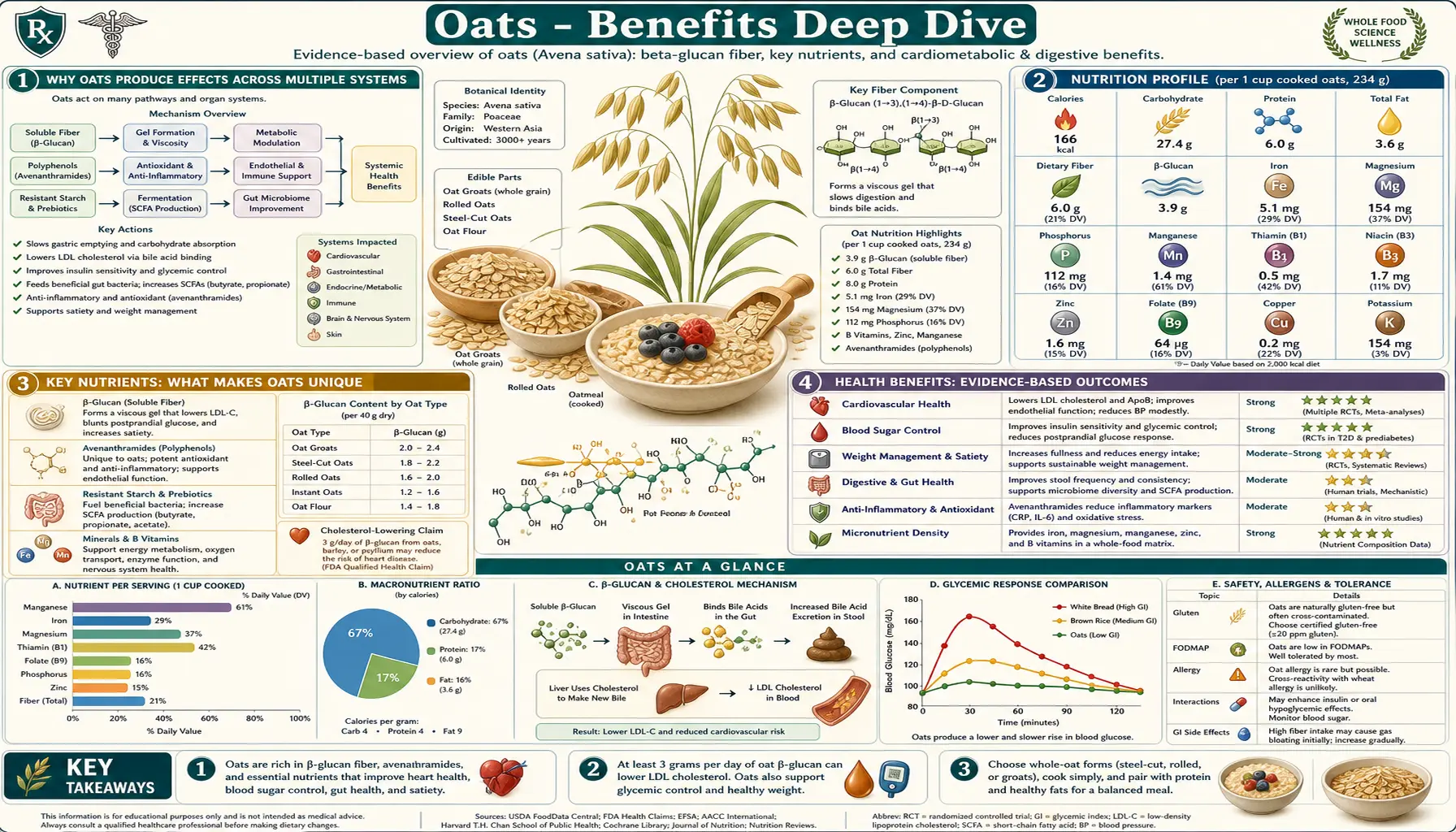
Oats (Avena sativa) are one of the soluble-fiber sources named in the U.S. Food and Drug Administration-authorized health claim on soluble fiber and the risk of coronary heart disease (21 CFR 101.81, which also covers barley and psyllium husk); separate authorized heart-disease claims exist for soy protein, plant sterol and stanol esters, and fruits, vegetables and grain products that contain fiber. The active fraction is a viscous, fermentable soluble fiber called beta-glucan, which traps bile acids in the gut and forces the liver to recycle cholesterol into new bile, lowering circulating low-density lipoprotein (LDL) by 5–10% at a daily intake of 3 g. But oats are biochemically unusual in other ways too — they are the only commercial cereal to contain avenanthramides (a polyphenol class found nowhere else in the human diet), they produce a distinctive blunted glycemic response despite their starch load, and the difference between steel-cut and rolled oat forms creates a measurable difference in postprandial glucose curves. Four deep-dive pages below unpack the mechanisms, the trials, and the kitchen-level decisions that determine whether oats are delivering their full clinical effect or being squandered as a high-glycemic carbohydrate breakfast.
Deep-Dive Articles
Beta-Glucan & Cholesterol
The 1997 U.S. Food and Drug Administration (FDA) health claim, the molecular mechanism of bile-acid sequestration, viscosity as the key physical property, the Ho et al. 2016 meta-analysis pooling 58 randomized controlled trials (RCTs), which found low-density lipoprotein 0.19 mmol/L lower at a median 3.5 g of beta-glucan a day, and why processing (extrusion, fine milling, instant oats) destroys viscosity and abolishes the cholesterol effect.
Read the deep dive →Glycemic Response
Steel-cut oats GI ~55 versus instant oats GI ~83, the role of beta-glucan viscosity in slowing gastric emptying, second-meal effect on lunch glycemia via colonic fermentation and short-chain fatty acid release, postprandial insulin curves in type 2 diabetes, and why "oat milk" sits at the opposite end of the glycemic spectrum from whole-grain oats.
Read the deep dive →Avenanthramides
The unique polyphenol class found only in oats among commercial cereals, nuclear factor kappa B (NF-kB) inhibition and the anti-inflammatory mechanism, antioxidant capacity exceeding many flavonoids on a molar basis, the colloidal oatmeal topical eczema mechanism, and emerging data on endothelial function and post-exercise inflammation.
Read the deep dive →Steel-Cut vs Rolled
The processing spectrum from whole groats through steel-cut, rolled (old-fashioned), quick-cooking, and instant — what each step does to particle size, gelatinization, glycemic index, and beta-glucan extractability. Cooking time and ratio tradeoffs, overnight oats as a compromise, and the glyphosate residue and gluten cross-contamination considerations when sourcing.
Read the deep dive →Colloidal Oatmeal for Skin
Eczema and itchy skin: the over-the-counter monograph, trial numbers and oat sensitization in children.
Read the deep dive →Table of Contents
- Deep-Dive Articles
- Why Oats Produce Effects Across Multiple Systems
- How Oats Fit a Gluten-Free Diet
- Research Papers: Beta-Glucan & Cholesterol
- Research Papers: Glycemic Response & Diabetes
- Research Papers: Avenanthramides & Inflammation
- Research Papers: Processing, Forms, & Bioavailability
- Research Papers: Cross-Cutting (Microbiome, Satiety, Safety)
- External Authoritative Resources
- Connections
- Featured Videos
Why Oats Produce Effects Across Multiple Systems
Most whole grains produce one or two clinically measurable effects beyond their basic nutritional value. Oats produce at least four, each through a distinct mechanism that maps to a separate clinical endpoint.
- Beta-glucan viscosity (cardiovascular) — the soluble fiber forms a gel in the small intestine that traps bile acids, preventing their reabsorption in the terminal ileum. The liver compensates by synthesizing new bile acids from circulating cholesterol, lowering low-density lipoprotein at the U.S. Food and Drug Administration-validated 3 g/day intake: in a 2014 meta-analysis of 28 randomized trials, 3 g or more of oat beta-glucan a day lowered low-density lipoprotein by 0.25 mmol/L and total cholesterol by 0.30 mmol/L, with no change in high-density lipoprotein (HDL) or triglycerides, and a 2016 analysis of 58 trials found low-density lipoprotein 0.19 mmol/L lower at a median 3.5 g a day. This is the same mechanism as bile-acid sequestrant drugs (cholestyramine, colesevelam) but achieved through a food. Detailed in the Beta-Glucan and Cholesterol deep-dive.
- Slowed gastric emptying and glucose absorption (metabolic) — the same beta-glucan viscosity that lowers cholesterol also slows the rate at which gastric contents enter the small intestine and the rate at which glucose is absorbed across the brush border. This produces a flatter postprandial glucose curve compared with refined-flour breakfasts. In a 2015 meta-analysis of 14 controlled trials in people with type 2 diabetes, eating oats lowered HbA1c (glycosylated hemoglobin, a measure of average blood sugar over about three months) by 0.42 percentage points, fasting blood glucose by 0.39 mmol/L and low-density lipoprotein by 0.29 mmol/L. The effect is dose-dependent and form-dependent — explored in the Glycemic Response deep-dive.
- Avenanthramide polyphenol signaling (anti-inflammatory) — oats are the only commercial cereal that synthesizes avenanthramides, a class of phenolic alkaloids that, in cell studies, inhibit NF-kB activation in endothelial cells and reduce expression of pro-inflammatory adhesion molecules (vascular cell adhesion molecule-1, VCAM-1, and intercellular adhesion molecule-1, ICAM-1). The same compounds are responsible for the well-documented topical anti-pruritic effect of colloidal oatmeal preparations. Covered in Avenanthramides.
- Resistant starch and short-chain fatty acid production (microbiome) — oats deliver a significant load of resistant starch (resistant starch type 3, or RS3: retrograded amylose, particularly after cooking and cooling) that escapes small-intestinal digestion and is fermented in the colon by Bifidobacterium, Bacteroides, and Akkermansia muciniphila. The fermentation byproducts (butyrate, propionate, acetate) feed colonocytes, modulate appetite via peptide YY (PYY) and glucagon-like peptide-1 (GLP-1), and produce the "second-meal effect" on lunchtime glycemia.
The fifth axis is more subtle but practically important: oats are exceptionally satiating per calorie. Holt's 1995 Satiety Index ranked porridge oats second among 38 common foods (after boiled potatoes) at 209 on a scale where white bread = 100. The mechanism is a combination of beta-glucan viscosity in the stomach, slowed gastric emptying, and downstream glucagon-like peptide-1 and PYY release driven by colonic short-chain fatty acid signaling. This has direct implications for body weight regulation and is the reason oat-based breakfasts produce measurably lower lunch energy intake in controlled feeding trials.
The therapeutic ceiling is set by processing. Industrial extrusion, fine milling, and the alpha-amylase pre-digestion used to make "instant" and "quick" oats progressively shorten the beta-glucan molecule and destroy its viscosity. By the time the product is a single-serve instant oatmeal packet, much of the cholesterol-lowering effect has been engineered out and the glycemic index has risen by about half. The Steel-Cut vs Rolled deep-dive maps this processing spectrum and the resulting trade-offs.
How Oats Fit a Gluten-Free Diet
Oats are naturally free of wheat gluten, but whether people with coeliac (celiac) disease can eat them has long been debated. A 2017 systematic review and meta-analysis in Gastroenterology found 28 eligible studies on adding oats to a gluten-free diet, including 6 randomised trials, all of which used pure, uncontaminated oats. Eating oats for up to 12 months did not change symptoms, gut-lining biopsy (histology) findings, or blood antibody tests, and results were similar in adults and children. The authors rated the overall quality of the evidence as low, and noted that trials using ordinary, commonly available oats from different regions are still needed.
Research Papers: Beta-Glucan & Cholesterol
- Ho HV et al., the effect of oat beta-glucan on LDL-cholesterol, non-HDL-cholesterol and apoB, meta-analysis of 58 RCTs (Br J Nutr 2016) — PubMed PMID: 27724985
- Whitehead A et al., cholesterol-lowering effects of oat beta-glucan, a meta-analysis of randomized controlled trials (Am J Clin Nutr 2014) — PubMed PMID: 25411276
- Ripsin CM et al., oat products and lipid lowering meta-analysis (JAMA 1992) — Search PubMed
- Wolever TMS et al., physicochemical properties of oat beta-glucan and LDL response (Am J Clin Nutr 2010) — Search PubMed
- EFSA Panel, oat beta-glucan blood cholesterol Article 14 health claim (EFSA Journal 2010) PubMed: EFSA Article 14
- FDA 21 CFR 101.81 health claim final rule, soluble fiber from whole oats and coronary heart disease (CHD) risk (1997) PubMed: FDA 21 CFR 101.81
- Davidson MH et al., the hypocholesterolemic effects of beta-glucan in oatmeal and oat bran, a dose-controlled study (JAMA 1991) — PubMed PMID: 2005733
- Anderson JW et al., oat bran cereal lowers serum total and LDL cholesterol in hypercholesterolemic men (Am J Clin Nutr 1984) PubMed: Anderson 1984
- Wang Y, Ames NP et al., effects of molecular weight of oat beta-glucan on LDL (Br J Nutr 2017) PubMed: Beta-glucan molecular weight
- Andersson KE, Hellstrand P, dietary oats and modulation of atherogenic pathways (Mol Nutr Food Res 2012) PubMed: Atherogenic pathways
Research Papers: Glycemic Response & Diabetes
- Jenkins DJA et al., effect of beta-glucan on glucose response and insulin requirement (Am J Clin Nutr 2002) PubMed: Jenkins 2002
- Tappy L et al., oat beta-glucan glycemic response in type 2 diabetes (Diabetes Care 1996) PubMed: Tappy 1996
- Tosh SM, review of the role of beta-glucan in glycemic and insulin response (Eur J Clin Nutr 2013) — Search PubMed
- Hou Q et al., the metabolic effects of oats intake in patients with type 2 diabetes, systematic review and meta-analysis (Nutrients 2015) — PubMed PMID: 26690472
- Atkinson FS, Foster-Powell K, Brand-Miller JC, international tables of glycemic index and glycemic load values (Diabetes Care 2008) — PubMed PMID: 18835944
- Wolever TMS et al., second-meal effect of oat bran on lunch glycemia (Am J Clin Nutr 1988) PubMed: Wolever second-meal
- Granfeldt Y, Bjorck I, Hagander B, on the importance of processing conditions, product thickness and egg addition for the glycemic and hormonal responses to oat porridge (Eur J Clin Nutr 1995) PubMed: Oat porridge processing
- Holt SH, Brand Miller JC, Petocz P, an insulin index of foods (Am J Clin Nutr 1997) — PubMed PMID: 9356547
- Maki KC et al., whole-grain oats and glycemic control in adults with type 2 diabetes (J Am Coll Nutr 2007) PubMed: Maki oats type 2 diabetes
- Steinert RE et al., oats — from food to whole-grain functional food and the link to metabolic health (Br J Nutr 2016) PubMed: Oats functional food
Research Papers: Avenanthramides & Inflammation
- Meydani M, potential health benefits of avenanthramides of oats (Nutr Rev 2009) — Search PubMed
- Guo W et al., avenanthramides inhibit proliferation of human colon cancer cell lines in vitro (Nutr Cancer 2010) — PubMed PMID: 21058188
- Guo W et al., avenanthramides, polyphenols from oats, inhibit IL-1beta-induced NF-kappaB activation in endothelial cells (Free Radic Biol Med 2008) — PubMed PMID: 18062932
- Sur R et al., avenanthramides, polyphenols from oats, exhibit anti-inflammatory activity in human skin (Arch Dermatol Res 2008) — PubMed PMID: 18461339
- Koenig RT et al., avenanthramide supplementation attenuates eccentric exercise-inflicted blood inflammatory markers in women (Eur J Appl Physiol 2016) — PubMed PMID: 26289619
- Reynertson KA et al., anti-inflammatory activities of colloidal oatmeal (J Drugs Dermatol 2015) — PubMed PMID: 25607907
- Dimberg LH, Theander O, Lingnert H, avenanthramides — a group of phenolic antioxidants in oats (Cereal Chem 1993) PubMed: Dimberg avenanthramides
- Chen CY et al., avenanthramides and phenolic acids from oats are bioavailable and act synergistically with vitamin C (J Nutr 2004) — Search PubMed
- Nie L et al., avenanthramide, a polyphenol from oats, inhibits vascular smooth muscle cell proliferation and enhances nitric oxide production (Atherosclerosis 2006) — PubMed PMID: 16139284
- Tripathi V et al., avenanthramides from oats — chemistry, biosynthesis, and biological activities (Front Plant Sci 2018) PubMed: Avenanthramide biosynthesis
Research Papers: Processing, Forms, & Bioavailability
- Wood PJ, cereal beta-glucans in diet and health (J Cereal Sci 2007) PubMed: Wood beta-glucan
- Tosh SM et al., processing affects the physicochemical properties of beta-glucan in oat bran muffins (J Agric Food Chem 2010) PubMed: Processing affects beta-glucan
- Regand A et al., influence of processing on the cholesterol-lowering effect of oat beta-glucan (J Agric Food Chem 2009) PubMed: Regand beta-glucan processing
- Rasane P et al., nutritional advantages of oats and opportunities for its processing as value added foods, review (J Food Sci Technol 2015) PubMed: Oats nutritional review
- Beck EJ et al., oat beta-glucan increases postprandial cholecystokinin levels (Mol Nutr Food Res 2009) PubMed: Beta-glucan and CCK
- Bach Knudsen KE, microbial degradation of whole-grain complex carbohydrates and impact on short-chain fatty acid production (Br J Nutr 2015) PubMed: Whole grain SCFAs
- Welch RW, Brown JCW, Leggett JM, interspecific and intraspecific variation in the grain and groat characteristics of wild oat (Avena) species (Euphytica 2000) PubMed: Oat grain variation
- Comino I et al., diversity in oat potential immunogenicity, basis for the selection of oat varieties safe for celiac disease (Gut 2011) — PubMed PMID: 21317420
- Pinto-Sánchez MI et al., safety of adding oats to a gluten-free diet for patients with celiac disease, systematic review and meta-analysis of clinical and observational studies (Gastroenterology 2017) — PubMed PMID: 28431885
- Hyun-Sook Kim et al., effects of oat beta-glucan structure on rheology in vitro digestion and bile acid binding (J Agric Food Chem 2014) PubMed: Beta-glucan rheology
Research Papers: Cross-Cutting (Microbiome, Satiety, Safety)
- Connolly ML et al., wholegrain oat-based cereals have prebiotic potential and low glycemic index (Br J Nutr 2010) PubMed: Oats prebiotic potential
- Holt SH, Brand-Miller JC, Petocz P, Farmakalidis E, a satiety index of common foods (Eur J Clin Nutr 1995) — PubMed PMID: 7498104
- Rebello CJ et al., the role of oats in appetite, satiety, and food intake review (Nutr Rev 2016) — Search PubMed
- Pol K et al., whole grain and body weight changes in apparently healthy adults systematic review and meta-analysis (Am J Clin Nutr 2013) — Search PubMed
- Aune D et al., whole grain consumption and risk of cardiovascular disease cancer and all cause and cause specific mortality systematic review meta-analysis (BMJ 2016) — PubMed PMID: 27301975
- Kelly SAM et al., whole grain cereals for the primary or secondary prevention of cardiovascular disease (Cochrane Database Syst Rev 2017) — PubMed PMID: 28836672
- Sang S, Chu Y, whole grain oats — cardiovascular and other health benefits and bioactive compounds (J Food Sci Technol 2017) PubMed: Sang Chu oats
- Hutchins AM, Brown BD et al., oat bran consumption reduces blood pressure in mildly hypercholesterolemic adults (Nutr Res 2013) PubMed: Oats and blood pressure
- Andersson AAM et al., contents of dietary fiber components and their relation to associated bioactive components in whole grain wheat samples from the HEALTHGRAIN diversity screen (Food Chem 2013) PubMed: HEALTHGRAIN fiber
External Authoritative Resources
- HEART UK — Oats and Beta-Glucan — the UK national charity's patient-facing summary of the U.S. Food and Drug Administration/European Food Safety Authority (EFSA) cholesterol claim
- European Food Safety Authority — Scientific Opinion on the substantiation of health claims related to oat beta-glucan and lowering of blood cholesterol (the 2010 Article 14 ruling)
- U.S. Food and Drug Administration — Authorized Health Claims: Soluble Fiber and Coronary Heart Disease (21 CFR 101.81)
- Oldways Whole Grains Council — Oats
- PubMed — All research on oat beta-glucan (~3,500+ papers)