Drinking Coffee with Coffee Grounds
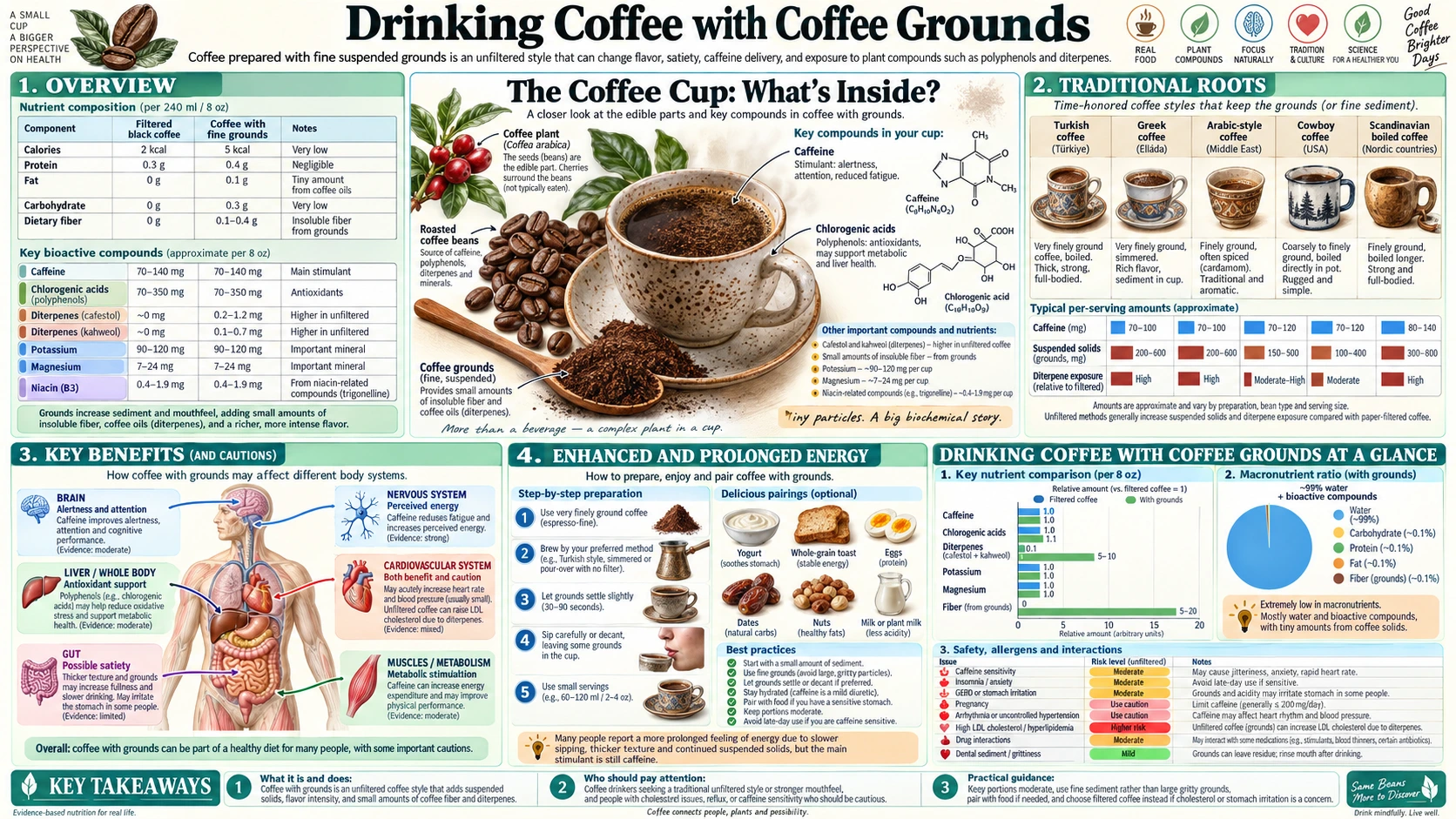
Table of Contents
- Overview
- Traditional Roots
- Key Benefits
- Enhanced and Prolonged Energy
- Digestion and Dietary Fiber
- Concentrated Antioxidants
- Appetite Control and Weight Management
- Coffee, Grounds and the Liver
- Mental Focus and Cognitive Function
- How to Prepare and Consume
- Precautions and Considerations
- Research Studies
- Connections
- Featured Videos
Overview
Most of the world drinks coffee as a filtered liquid, discarding the spent grounds as waste. A small but growing community of health-conscious drinkers is reversing that pattern, consuming the coffee grounds alongside or instead of the filtered brew. The practice sounds unusual at first, but it has deep historical roots, plausible physiological rationale, and an emerging body of research on the bioactive compounds retained in the solid fraction of the coffee bean.
When you drink filtered coffee, roughly 70 to 80 percent of the coffee bean's mass is thrown away. The discarded grounds still contain significant amounts of dietary fiber, polyphenols, melanoidins, and diterpenes that never make it into the cup. Consuming the grounds directly, in moderation, delivers these compounds, which the liquid alone leaves behind in the filter.
Traditional Roots
The idea of consuming coffee solids is not new. Turkish and Greek coffee, one of the oldest continuous coffee traditions, is prepared by boiling finely ground coffee with water and serving it unfiltered. Drinkers routinely ingest fine particles suspended in the liquid, with a layer of sediment settling at the bottom of the cup. Ethiopian buna, prepared in a clay jebena, similarly leaves residual grounds in the cup. In parts of Southeast Asia, coffee is sometimes chewed as roasted beans or consumed in a paste form.
What's new is the conscious use of coffee grounds as a dietary fiber and polyphenol source, often added to smoothies, yogurt, oatmeal, or energy balls as a functional ingredient.
Key Benefits
The rationale for consuming whole coffee grounds rests on six main benefits that distinguish the practice from drinking filtered coffee alone.
Enhanced and Prolonged Energy
Liquid coffee delivers caffeine rapidly, with blood levels peaking within 30 to 45 minutes of ingestion and declining steadily over the following 4 to 6 hours. This produces the characteristic sharp lift followed by a mid-morning dip that many drinkers describe as a "crash."
People who eat coffee grounds describe the caffeine held inside the plant matrix as being released more slowly as the fiber is digested; none of the studies listed on this page measured caffeine release from eaten grounds in people. Supporters describe combining liquid coffee with a small amount of grounds as a “dual-release” effect: the liquid gives the quick lift, and the grounds are said to stretch it over a longer window. Many who adopt the practice report a smoother, more sustained lift without the sharp post-coffee crash.
Supporters compare the idea to medicines that combine immediate-release and extended-release parts to keep drug levels steady, and some users report less urge for a second cup in the late morning or early afternoon.
Digestion and Dietary Fiber
Coffee grounds are high in dietary fiber. A 2016 laboratory analysis found that spent coffee grounds had a higher total fiber content than coffee beans; figures of roughly 50 to 60 percent fiber by weight, most of it insoluble, are often quoted for spent grounds, which would be more fiber per gram than oats, whole grains, or most vegetables.
In the same 2016 laboratory study, human gut bacteria fermented the fiber of spent grounds into short-chain fatty acids (acetate, propionate and butyrate) over 24 hours, and the fermented material cut nitric oxide, an inflammation signal, by 55% in immune cells grown in a dish (RAW 264.7 macrophages). This was a test-tube result, not a study in people.
Insoluble fiber serves several important roles in digestive health:
- Adds bulk to stool and promotes regular bowel movements
- Feeds beneficial gut bacteria, particularly those that produce short-chain fatty acids such as butyrate
- Slows the absorption of carbohydrates, blunting post-meal blood sugar spikes
- Binds to bile acids, which may support cholesterol clearance by the liver
- Reduces transit time, decreasing the gut's exposure to potential carcinogens
The natural laxative effect of coffee that many people experience in the morning is largely driven by the bioactive compounds stimulating colonic contractions. People who add coffee grounds describe the extra fiber as adding to this effect, and some use it for constipation.
Concentrated Antioxidants
Spent coffee grounds retain a substantial portion of the polyphenolic antioxidants originally present in the unroasted bean. Analyses have shown that they contain high concentrations of chlorogenic acid derivatives, caffeic acid, melanoidins, and the diterpenes cafestol and kahweol. A 2012 study of spent grounds from filter, espresso and plunger coffee makers measured 6.22 to 13.24 mg of caffeoylquinic (chlorogenic) acids per gram, 4 to 7 times more than in their brews, along with 3.59 to 8.09 mg of caffeine per gram; grounds from stovetop mocha pots held less.
By consuming the grounds, drinkers access polyphenols that would otherwise be discarded. These compounds:
- Neutralize reactive oxygen species that drive cellular aging
- Support phase II liver detoxification enzymes
- Act as prebiotics in the colon, feeding beneficial microbes
- Reduce systemic inflammation markers
- Protect lipid membranes from oxidative damage
Appetite Control and Weight Management
The combination of bitter compounds and high fiber content in coffee grounds is a natural appetite suppressor. Bitter phytochemicals stimulate the release of satiety hormones such as cholecystokinin (CCK) and glucagon-like peptide-1 (GLP-1) from the intestinal lining, which signal fullness to the brain. Fiber adds mechanical volume in the stomach and slows gastric emptying, prolonging the sensation of satiety between meals.
For individuals pursuing weight management, people who add a small portion of coffee grounds to a morning beverage or breakfast dish report less mid-morning snacking and steadier blood sugar. The effect they describe is modest but additive with other dietary strategies, and it comes with the bonus of increased polyphenol intake and improved regularity.
Coffee, Grounds and the Liver
Coffee's protective effect on the liver is among the most consistently reported findings in nutritional epidemiology. Regular coffee drinkers show lower rates of cirrhosis, non-alcoholic fatty liver disease, and liver cancer. The compounds most strongly credited are cafestol, kahweol, chlorogenic acids, and melanoidins, all of which are retained in the grounds and only partially extracted into the brew.
The one human trial of eating coffee grounds points the other way for two of those compounds. The diterpenes cafestol and kahweol raise blood cholesterol and the liver enzyme alanine aminotransferase (ALT), and a 1995 Dutch study tested whether they reach the body from spent grounds. Healthy volunteers who ate 8 g of fine grounds a day for 3 weeks had cholesterol 0.65 mmol/L higher and ALT 18 U/L higher than people who did not eat them (7 people per group). In a second test with 15 people, ALT was 29 U/L after 10 days on fine grounds and 21 U/L on coarse grounds. Eating the grounds therefore delivers the cholesterol-raising diterpenes rather than avoiding them. The same study found that Turkish or Scandinavian boiled coffee carries 2 to 5 g of floating fine grounds per litre, and French press coffee 1.5 g per litre.
Mental Focus and Cognitive Function
Caffeine's effects on cognition, focus, and mood are well documented. Added to those are the polyphenols and antioxidants concentrated in the grounds, which support neuronal health and reduce oxidative stress in brain tissue. The extended-release caffeine effect also produces steadier cognitive performance, avoiding the sharp peaks and troughs of liquid coffee alone.
Users often report improved afternoon focus and less need for a second caffeinated drink, which may translate into better sleep quality at night because the total daily caffeine load is reduced.
How to Prepare and Consume
Amounts People Describe
Coffee grounds are concentrated. People who follow the practice describe starting with 1/4 to 1/2 teaspoon per day and building up to no more than 1 to 2 teaspoons daily, using finely ground coffee (Turkish-fine) to ease digestion and give a less gritty texture.
Preparation Methods
- Turkish-style coffee: Boil water with finely ground coffee (and optionally sugar), let the grounds settle, and drink the unfiltered brew along with its sediment
- Coffee smoothie: Blend 1/2 to 1 teaspoon of fine coffee grounds with a banana, cocoa, and milk or plant milk for a smooth breakfast drink
- Stirred into yogurt or oatmeal: Mix a small amount directly into the morning meal
- Energy balls: Combine grounds with dates, nuts, and cocoa for a no-bake snack
- Added to an existing brewed cup: Stir 1/4 teaspoon of fresh grounds into a standard filtered coffee
Quality Matters
Because grounds are consumed directly rather than extracted, the quality of the coffee bean matters more than ever. People who eat grounds describe looking for:
- Organic beans, to limit pesticide residues that may not be washed out in the brewing process
- Mold-tested or specialty grade coffee to reduce mycotoxin exposure
- Freshly ground beans rather than pre-ground coffee that has been sitting for weeks
- Medium roast or lighter to retain more chlorogenic acids
Precautions and Considerations
Several caveats apply to eating coffee grounds:
- Cholesterol and liver enzymes: In the one human trial of eating grounds, 8 g of fine grounds a day for 3 weeks raised blood cholesterol by 0.65 mmol/L and the liver enzyme ALT by 18 U/L compared with people who did not eat them (see Coffee, Grounds and the Liver above)
- Caffeine load: Coffee grounds contain caffeine: a 2012 analysis of spent grounds from common coffee makers measured 3.59 to 8.09 mg of caffeine per gram. This adds to the caffeine in the brewed cup, which matters most for people who are sensitive to caffeine or already drink multiple cups
- Digestive upset: Coarse grounds may cause abdominal discomfort or irregular stools in sensitive individuals. People who use the practice describe starting very small and using finely ground beans only
- Mineral absorption: Coffee can inhibit absorption of iron, calcium, and zinc. In a 1983 study of brewed coffee (not grounds), a cup of coffee cut iron absorption from a hamburger meal by 39%; coffee drunk 1 hour before a meal did not lower iron absorption, but coffee drunk 1 hour after the meal lowered it as much as coffee taken with the meal. This matters most for people at risk of iron deficiency
- Pregnancy: The American College of Obstetricians and Gynecologists (ACOG) states that moderate caffeine intake in pregnancy, under 200 mg a day, does not appear to be a major factor in miscarriage or preterm birth. The caffeine in eaten grounds adds to the drink’s and can push intake past that level without being noticed
- Acid reflux and gastritis: Coffee grounds can aggravate acid-sensitive conditions, which makes the practice a concern for people with gastroesophageal reflux disease (GERD) or gastric ulcers; some use decaffeinated grounds instead
- Medication interactions: Caffeine can interact with stimulants, monoamine oxidase (MAO) inhibitors, certain antibiotics, and thyroid medications, and the caffeine from eaten grounds adds to the caffeine from the drink
- Mycotoxins: Conventional coffee can contain trace amounts of ochratoxin A and other mold-derived toxins. Using specialty grade or mold-tested coffee reduces this risk
- Acrylamide and heavy metals: A 2025 review of spent coffee grounds as a food ingredient names acrylamide formation and heavy-metal contamination as safety concerns that research still needs to address before grounds are widely used in food
Research Studies
- Bravo J, Juániz I, Monente C, Caemmerer B, Kroh LW, De Peña MP, Cid C (2012). "Evaluation of spent coffee obtained from the most common coffeemakers as a source of hydrophilic bioactive compounds." Journal of Agricultural and Food Chemistry. 2012;60(51):12565-12573. — PubMed PMID: 23214450
- Panusa A, Zuorro A, Lavecchia R, Marrosu G, Petrucci R (2013). "Recovery of natural antioxidants from spent coffee grounds." Journal of Agricultural and Food Chemistry. 2013;61(17):4162-4168. — PubMed PMID: 23577588
- Murthy PS, Naidu MM (2012). "Sustainable management of coffee industry by-products and value addition: A review." Resources, Conservation and Recycling. 2012;66:45-58. — doi:10.1016/j.resconrec.2012.06.005
- Mussatto SI, Machado EMS, Martins S, Teixeira JA (2011). "Production, Composition, and Application of Coffee and Its Industrial Residues." Food and Bioprocess Technology. 2011;4(5):661-672. — doi:10.1007/s11947-011-0565-z
- López-Barrera DM, Vázquez-Sánchez K, Loarca-Piña MG, Campos-Vega R (2016). "Spent coffee grounds, an innovative source of colonic fermentable compounds, inhibit inflammatory mediators in vitro." Food Chemistry. 2016;212:282-290. (Laboratory study.) — PubMed PMID: 27374534
- Jiménez-Zamora A, Pastoriza S, Rufián-Henares JA (2015). "Revalorization of coffee by-products. Prebiotic, antimicrobial and antioxidant properties." LWT - Food Science and Technology. 2015;61(1):12-18. — doi:10.1016/j.lwt.2014.11.031
- Urgert R, Schulz AG, Katan MB (1995). "Effects of cafestol and kahweol from coffee grounds on serum lipids and serum liver enzymes in humans." American Journal of Clinical Nutrition. 1995;61(1):149-154. — PubMed PMID: 7825527
- Morck TA, Lynch SR, Cook JD (1983). "Inhibition of food iron absorption by coffee." American Journal of Clinical Nutrition. 1983;37(3):416-420. — PubMed PMID: 6402915
- American College of Obstetricians and Gynecologists (2010). "ACOG Committee Opinion No. 462: Moderate caffeine consumption during pregnancy." Obstetrics and Gynecology. 2010;116(2 Pt 1):467-468. — PubMed PMID: 20664420
- Choe U (2025). "Valorization of spent coffee grounds and their applications in food science." Current Research in Food Science. 2025;10:101010. — PubMed PMID: 40104522
Connections
- All Food
- Caffeine, Adenosine & Why Coffee Stops Working — interactive animation
- Coffee
- Coffee (Food)
- Coffee Health Benefits
- Coffee & Kidney Injury
- Gut Healing
- Non-Alcoholic Fatty Liver Disease
- Cirrhosis
- Cancer
- Blood Sugar
- Oxidative Stress
- Iron
- Zinc
- Calcium
- Constipation
- Gut-Brain Axis
- Reflux
- Remedies Overview