Arugula
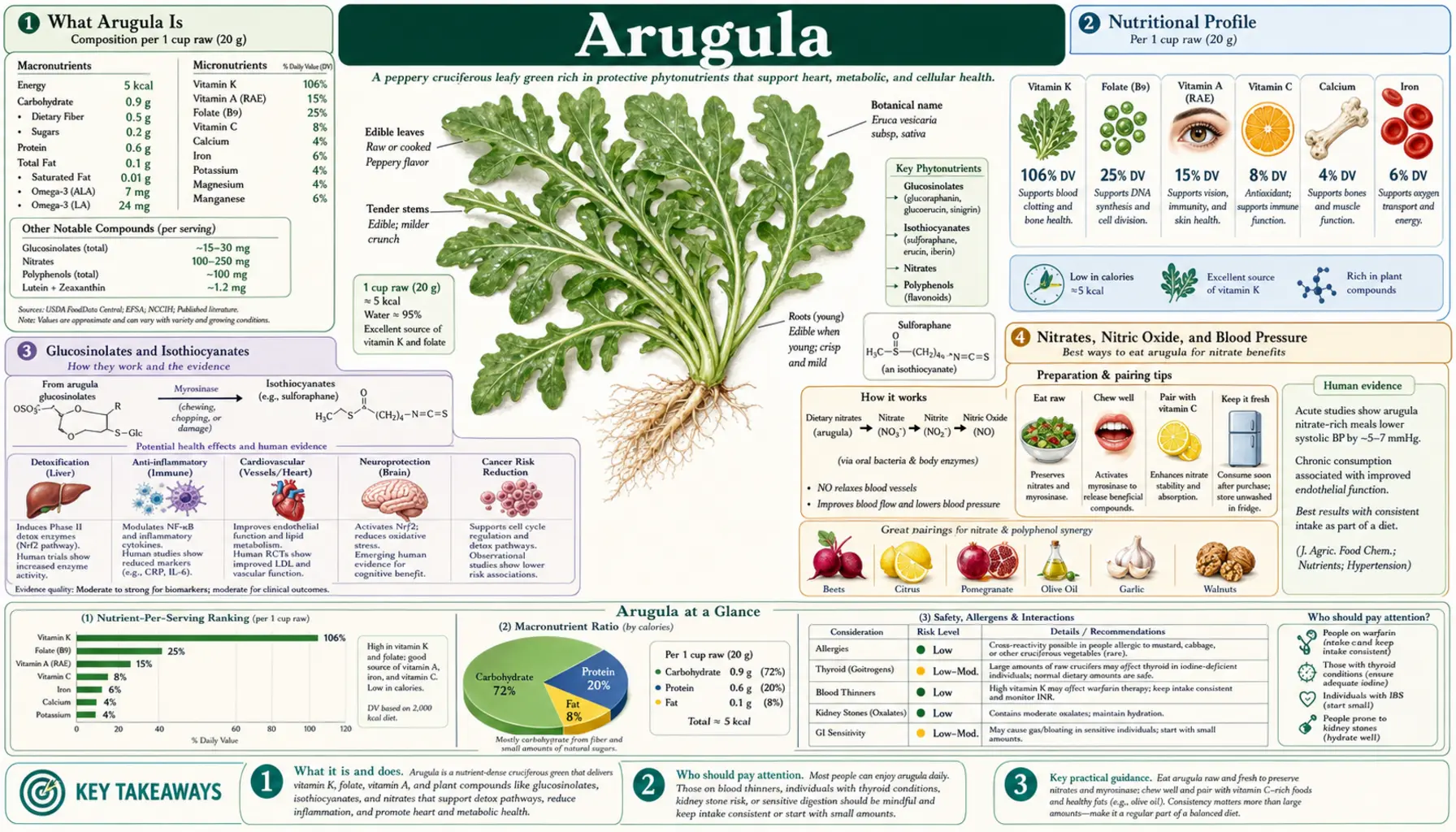
Arugula is a peppery salad green with a bright, mustardy bite that sets it apart from mild lettuces. Botanically it is Eruca vesicaria (also catalogued as Eruca sativa), a member of the Brassicaceae — the cruciferous family that also includes broccoli, kale, cabbage, and mustard. In Britain and much of the world it goes by the name rocket (or rocket salad), while "arugula" is the American term borrowed from Italian dialect. A Mediterranean staple for centuries, it is eaten raw in salads, wilted into pasta and pizza, and pounded into a sharp, nutty pesto. Nutritionally it is remarkably low in calories yet delivers a genuinely useful spread of vitamin K, folate, vitamin A, and calcium — and, most distinctively, it is one of the highest-nitrate vegetables there is, a trait it shares with beets and spinach that connects it to some of the more interesting research on blood pressure and exercise. This page walks through what arugula actually contains, what the cruciferous and dietary-nitrate research does and does not show, and the practical side: how to pick it, keep it, and use it, plus who has honest reasons to eat it with a little care.
Table of Contents
- What Arugula Is
- Nutritional Profile
- Glucosinolates and Isothiocyanates
- Nitrates, Nitric Oxide, and Blood Pressure
- Bone Health and Vitamin K
- Folate
- Eye Health and Antioxidants
- How to Select, Store, and Use
- Safety and Who Should Be Cautious
- Research Papers
- Connections
- Featured Videos
What Arugula Is
Arugula is a fast-growing leafy green with slender, deeply lobed leaves and a flavor that is often described as peppery, mustardy, or nutty. That bite is the giveaway to its botany: arugula is a cruciferous vegetable, part of the Brassicaceae family, and the same class of sulfur-containing compounds that make mustard sharp and broccoli faintly bitter is what gives arugula its zip. The plant most commonly sold as salad arugula is Eruca vesicaria (frequently listed under the older name Eruca sativa); a close relative with a narrower, even spicier leaf, wild rocket (Diplotaxis tenuifolia), is often sold alongside it under the same everyday name.
The name changes by country. Americans call it arugula — a word that traveled with Italian immigrants from a southern-Italian dialect term. Most of the rest of the English-speaking world calls the very same plant rocket, or rocket salad, from the Italian rucola and French roquette. It has been cultivated and eaten around the Mediterranean since antiquity, valued both as a salad leaf and, historically, as a folk remedy, and it remains a defining green of Italian cooking — scattered over pizza as it comes out of the oven, tossed with shaved Parmesan and lemon, or bundled into sandwiches. Because it grows quickly and tolerates cool weather, it is also a favorite of home gardeners and a common "baby leaf" in bagged salad mixes.
Nutritional Profile
Arugula's headline feature is how much it offers for how little. It is a genuinely low-calorie food — on the order of 25 calories per 100 grams — and because arugula leaves are so light, a typical salad-sized serving of a cup or two weighs only about 20 grams. That is worth keeping in mind: the per-100-gram figures below look impressive, and per calorie they are, but a small handful of leaves delivers a modest fraction of them. Even so, arugula packs a broad, useful mix of vitamins, minerals, and plant compounds into a very light, very low-energy package, which is exactly what makes leafy greens such an efficient addition to a plate.
Measured per 100 grams of raw leaves, the nutrients that stand out are:
- Vitamin K1 (phylloquinone) — the standout, at roughly 90–110 micrograms per 100 grams, most of a day's worth. Vitamin K matters for blood clotting and bone metabolism, and it is also the basis of the warfarin note in the safety section below.
- Folate (vitamin B9) — a meaningful contribution, around 95–100 micrograms per 100 grams, useful for cell division and especially important before and during pregnancy.
- Vitamin A (as carotenoids) — the green leaves are rich in beta-carotene and other carotenoid pigments that the body can convert toward vitamin A, supporting vision and immune function.
- Vitamin C — a modest amount (around 15 milligrams per 100 grams), part of the leaf's antioxidant contribution.
- Calcium — relatively generous for a leafy green (roughly 150–160 milligrams per 100 grams). Importantly, arugula is low in oxalate compared with spinach, so the calcium it provides is more readily absorbed — a real advantage of Brassica greens over higher-oxalate leaves.
- Potassium, magnesium, manganese, and iron in smaller supporting amounts, plus a light dose of fiber.
The trait that truly distinguishes arugula, though, is not on most nutrition labels at all: it is one of the richest common vegetables in dietary nitrate, a naturally occurring compound that plants pull from the soil. That is the same feature that puts arugula in the company of beets and spinach, and it is interesting enough — and misunderstood enough — to deserve its own section below.
Glucosinolates and Isothiocyanates
Arugula's peppery kick is not just a flavor quirk — it is chemistry that ties the plant to the whole cruciferous family. Like broccoli, kale, and mustard, arugula stores sulfur-containing compounds called glucosinolates. On their own these are stable and flavorless, kept in one compartment of the leaf. When you chew, chop, or crush the leaf, you break cell walls and bring the glucosinolates into contact with an enzyme called myrosinase, which converts them into pungent, biologically active molecules called isothiocyanates. That enzymatic reaction is what produces the sharp, mustardy heat in the moment you bite down.
Chemical analyses of rocket have mapped this in detail. Arugula's characteristic glucosinolate is glucoerucin, which yields the isothiocyanate erucin — a compound closely related to, and partly interconvertible with, sulforaphane, the much-studied isothiocyanate from broccoli. Researchers who profiled Eruca and wild rocket found a distinctive blend of these glucosinolates and flavonols that varies with variety, growing conditions, and storage.
Here honesty matters. Isothiocyanates such as sulforaphane and erucin are of real scientific interest: in laboratory and animal studies they activate the body's own antioxidant and detoxification defenses (the Nrf2 pathway) and have been explored for cell-protective and possible cancer-preventive effects. But most of that evidence comes from concentrated extracts, broccoli sprouts, or cell and animal models — not from eating salad arugula, and not from human outcome trials on arugula specifically. The fair takeaway is that arugula belongs to a plant family with genuinely promising, actively researched compounds, and eating a variety of cruciferous vegetables is a sensible, food-first way to include them — but a bowl of arugula is a nourishing salad, not a proven medicine.
Nitrates, Nitric Oxide, and Blood Pressure
This is arugula's most interesting and most misunderstood feature. Arugula is one of the highest-nitrate vegetables commonly eaten. When researchers rank vegetables by their natural nitrate content, rocket lands in the very-high category alongside beetroot, celery, lettuce, and spinach — often well above 250 milligrams of nitrate per 100 grams of fresh leaf. Plants take up nitrate from the soil and use it to build proteins; leafy greens simply store a lot of it.
The word "nitrate" sets off alarm bells for many people, so it is worth being clear: the nitrate naturally present in vegetables is now understood as favorable, not harmful, and it behaves very differently from the nitrate and nitrite added to cured and processed meats. The concern with processed meat is that, under high heat and in the presence of certain proteins, nitrite can form nitrosamines, some of which are carcinogenic. Vegetables are a different story: their nitrate arrives packaged together with vitamin C, polyphenols, and other antioxidants that actually inhibit harmful nitrosamine formation, and decades of research now tie vegetable nitrate to beneficial, not harmful, effects.
The nitrate–nitrite–nitric oxide pathway
Here is how the benefit works. After you eat a nitrate-rich green, some of that nitrate is absorbed and then concentrated in your saliva. Friendly bacteria on the surface of the tongue reduce it to nitrite, which you swallow; in the body, nitrite can be converted further into nitric oxide (NO), a signaling molecule that relaxes and widens blood vessels. This "enterosalivary" route gives the body a dietary, food-based way to top up nitric oxide — complementing the NO your blood-vessel lining makes on its own. It is a genuinely elegant piece of physiology, and it is the reason a salad green can plausibly touch something as important as blood pressure.
Blood pressure and exercise
The clinical evidence for dietary nitrate is real, though most of it comes from concentrated beetroot juice rather than from arugula specifically. Controlled studies have shown that a dose of dietary nitrate can modestly lower blood pressure in healthy volunteers, and a randomized trial in people with high blood pressure found that daily dietary nitrate produced a sustained, measurable reduction in blood pressure over several weeks. Separately, sports-science studies have found that dietary nitrate can lower the oxygen cost of exercise — in effect making muscles work a little more efficiently — and improve tolerance to hard efforts, which is why nitrate-rich foods have become popular with endurance athletes.
The honest bridge to arugula is this: arugula contains nitrate at levels comparable to the beetroot and spinach used in these studies, so it plausibly feeds the very same pathway. But arugula itself has not been trialed to anywhere near the depth of beetroot juice, and a light salad serving delivers less nitrate than a concentrated shot of juice. So the reasonable framing is that arugula is a smart, whole-food member of the high-nitrate vegetable group that supports a heart-healthy, nitric-oxide-friendly eating pattern — not a substitute for blood-pressure treatment, and not something to megadose. As a bonus, one practical tip follows straight from the biology: strong antibacterial mouthwash kills the tongue bacteria that make the pathway work, so it can blunt the nitrate-to-nitrite conversion.
Bone Health and Vitamin K
Arugula is a strong source of vitamin K1, and vitamin K does more than help blood clot — it is also required to activate proteins involved in building and maintaining bone. The best-known is osteocalcin, a protein that helps bind calcium into the bone matrix; vitamin K is the cofactor that switches it on. On top of that, arugula supplies absorbable calcium (helped by its low oxalate content) and magnesium, so a serving contributes several of the raw materials skeletal health depends on.
As always, it is worth keeping expectations grounded. Reviews of vitamin K and bone find that adequate intake is associated with better bone metabolism and, in some studies, lower fracture risk, but the evidence that extra vitamin K prevents fractures in well-nourished people is mixed and far from settled. The sensible message is not that arugula is a bone treatment, but that leafy greens are a natural, food-first way to get the vitamin K your bones use every day — part of a bigger picture that also includes weight-bearing activity, adequate calcium and vitamin D, and overall protein.
Folate
Arugula is a respectable source of folate, the natural form of vitamin B9. Folate is essential for making and repairing DNA and for producing red blood cells, and it is especially important around conception and in early pregnancy, when adequate folate dramatically lowers the risk of neural tube defects in a developing baby. Dark leafy greens like arugula are, quite literally, where the name comes from — "folate" traces to the Latin folium, meaning leaf.
Two honest points round this out. First, arugula's folate is real but a salad serving is small, so leafy greens are best thought of as one contributor among many — legumes, other greens, and (in many countries) fortified grains all add up. Second, and importantly, women who are pregnant or trying to conceive are advised by health authorities to take a dedicated folic-acid supplement to reach the protective dose reliably; a bowl of arugula is a healthy habit, not a replacement for that supplement. For everyone else, the folate in greens is a solid, everyday part of a good diet.
Eye Health and Antioxidants
The deep green color of arugula signals a group of pigments that are good news for the eyes. Arugula supplies the carotenoids lutein and zeaxanthin, which the body concentrates in the macula — the central part of the retina responsible for sharp vision. There they act as a natural filter for damaging blue light and as antioxidants that help protect delicate retinal tissue. Arugula also delivers the beta-carotene that converts to vitamin A, itself indispensable for vision, particularly in dim light.
The strongest evidence for these pigments comes from large studies of eye disease. A major clinical trial found that a supplement containing lutein and zeaxanthin had a role in the management of age-related macular degeneration, the leading cause of vision loss in older adults, and observational research links diets rich in these carotenoids with better long-term eye health. Those trials used supplements rather than salad, so the honest framing is that arugula is one tasty, whole-food source of the same protective pigments — best eaten as part of a colorful, vegetable-rich diet rather than counted on as a single fix. A small practical note: because lutein, zeaxanthin, and beta-carotene are fat-soluble, dressing your arugula with a little olive oil helps your body absorb them.
How to Select, Store, and Use
Arugula is one of the easiest greens to enjoy, but it is also delicate and best eaten fresh.
Selecting
- Look for leaves that are vibrant green, crisp, and perky, with no yellowing, dark slimy spots, or wilting. Smaller "baby" leaves are milder and tender; larger, more mature leaves and wild rocket are spicier and more assertive.
- Give it a sniff if you can — fresh arugula smells green and faintly peppery, not sour or musty.
Storing
- Arugula is perishable and does not keep long — plan to use it within a few days. Store it unwashed in the refrigerator, loosely wrapped or in its clamshell, ideally with a dry paper towel to absorb excess moisture, which is what turns leaves slimy.
- Wash it only right before you eat it, swishing the leaves in cold water to release any grit and then drying them well (a salad spinner is ideal) — wet leaves wilt and spoil faster.
Using
Arugula's pepperiness is a feature to play with, and it shines both raw and lightly cooked:
- Raw salads: The classic use. Arugula loves acid — a simple dressing of lemon juice or good vinegar with olive oil, plus shaved Parmesan, tames its bite beautifully. It also pairs naturally with sweet or rich partners like pear, fig, beet, prosciutto, or nuts.
- Wilted: Stir a big handful into hot pasta, risotto, soup, or scrambled eggs at the last second; the residual heat softens it and mellows the sharpness without cooking it to mush.
- On top: Pile it fresh onto pizza or flatbread straight from the oven, or onto sandwiches and burgers in place of lettuce for far more flavor.
- Pesto: Blend arugula (alone or with basil) with olive oil, garlic, nuts, and cheese for a sharp, nutty pesto — a great way to use up leaves before they turn.
Because it is fat-soluble carotenoids and a little acid that bring out the best of arugula both nutritionally and in flavor, a squeeze of lemon and a drizzle of olive oil is close to the perfect default.
Safety and Who Should Be Cautious
For almost everyone, arugula is an exceptionally safe, wholesome food that can be enjoyed freely and often. A few honest, specific notes are worth knowing:
- Vitamin K and blood thinners (warfarin): Arugula is high in vitamin K, which the anticoagulant warfarin works against. The issue is not that arugula is dangerous — it is consistency. People on warfarin are advised to keep their intake of vitamin-K-rich greens steady from week to week rather than swinging from none to a big salad, so the medication dose stays balanced. If you take warfarin you do not have to avoid arugula; just be consistent and follow your clinician's guidance. (Newer anticoagulants such as apixaban or rivaroxaban are not affected by dietary vitamin K.)
- The nitrate question — favorable, not a warning: Some people worry when they hear that arugula is high in nitrate. For a vegetable, this is a good thing, not a hazard: as explained above, vegetable nitrate is packaged with protective antioxidants and is linked to benefits like better blood-vessel function, unlike the added nitrite in processed meats. There is no need to limit arugula on account of its nitrate. (Nitrate content is only a genuine consideration for the water and purees fed to very young infants, which is a separate, specialized topic.)
- Thyroid (goitrogens): As a cruciferous vegetable, arugula contains the same glucosinolate-derived compounds that, in very large raw amounts and against a background of iodine deficiency, can theoretically interfere with the thyroid's uptake of iodine. In practice, the amounts in a normal diet are negligible, and people with healthy thyroids and adequate iodine have no reason to avoid arugula. Those with a known thyroid condition can simply favor variety and normal portions.
- Wash it well: Like all raw leafy greens eaten uncooked, arugula should be rinsed before eating to remove grit and reduce any surface contamination — a sensible habit, not a special risk of arugula.
None of these caveats change the basic picture: arugula is a nutrient-dense, low-calorie, genuinely beneficial green that the vast majority of people can enjoy as often as they like.
Research Papers
- Hord NG, Tang Y, Bryan NS. Food sources of nitrates and nitrites: the physiologic context for potential health benefits. Am J Clin Nutr. 2009;90(1):1–10. doi:10.3945/ajcn.2008.27131 — classifies vegetables by nitrate content and places rocket (arugula) in the highest tier alongside beetroot and spinach.
- Lundberg JO, Weitzberg E, Gladwin MT. The nitrate–nitrite–nitric oxide pathway in physiology and therapeutics. Nat Rev Drug Discov. 2008;7(2):156–167. doi:10.1038/nrd2466 — the foundational review of how dietary nitrate is converted to nitric oxide in the body.
- Larsen FJ, Ekblom B, Sahlin K, Lundberg JO, Weitzberg E. Effects of dietary nitrate on blood pressure in healthy volunteers. N Engl J Med. 2006;355(26):2792–2793. doi:10.1056/NEJMc062800 — showed a modest blood-pressure reduction from dietary nitrate in healthy adults.
- Kapil V, Khambata RS, Robertson A, Caulfield MJ, Ahluwalia A. Dietary nitrate provides sustained blood pressure lowering in hypertensive patients: a randomized, phase 2, double-blind, placebo-controlled study. Hypertension. 2015;65(2):320–327. doi:10.1161/HYPERTENSIONAHA.114.04675 — a controlled trial finding lasting blood-pressure benefit in people with high blood pressure.
- Bailey SJ, Winyard P, Vanhatalo A, et al. Dietary nitrate supplementation reduces the O2 cost of low-intensity exercise and enhances tolerance to high-intensity exercise in humans. J Appl Physiol. 2009;107(4):1144–1155. doi:10.1152/japplphysiol.00722.2009 — the exercise-efficiency effect behind nitrate-rich foods' popularity with athletes.
- Bell L, Wagstaff C. Glucosinolates, myrosinase hydrolysis products, and flavonols found in rocket (Eruca sativa and Diplotaxis tenuifolia). J Agric Food Chem. 2014;62(20):4481–4492. doi:10.1021/jf501096x — characterizes the peppery glucosinolates and their isothiocyanate products in arugula.
- Bell L, Oruna-Concha MJ, Wagstaff C. Identification and quantification of glucosinolate and flavonol compounds in rocket salad (Eruca sativa, Eruca vesicaria and Diplotaxis tenuifolia). Food Chem. 2015;172:852–861. doi:10.1016/j.foodchem.2014.09.116 — quantifies how these compounds vary across rocket species and cultivars.
- Fahey JW, Zalcmann AT, Talalay P. The chemical diversity and distribution of glucosinolates and isothiocyanates among plants. Phytochemistry. 2001;56(1):5–51. doi:10.1016/S0031-9422(00)00316-2 — the comprehensive survey of the cruciferous compounds that give arugula its bite.
- Houghton CA. Sulforaphane: its "coming of age" as a clinically relevant nutraceutical in the prevention and treatment of chronic disease. Oxid Med Cell Longev. 2019;2019:2716870. doi:10.1155/2019/2716870 — reviews the isothiocyanate biology relevant to arugula's cruciferous relatives (mostly preclinical and broccoli-based).
- Age-Related Eye Disease Study 2 (AREDS2) Research Group. Lutein + zeaxanthin and omega-3 fatty acids for age-related macular degeneration. JAMA. 2013;309(19):2005–2015. doi:10.1001/jama.2013.4997 — the major trial of the eye-protective carotenoids arugula supplies.
- Palermo A, Tuccinardi D, D'Onofrio L, et al. Vitamin K and osteoporosis: myth or reality? Metabolism. 2017;70:57–71. doi:10.1016/j.metabol.2017.01.032 — a balanced review of vitamin K's role in bone, the nutrient arugula is richest in.
- Bailey LB, Stover PJ, McNulty H, et al. Biomarkers of Nutrition for Development—folate review. J Nutr. 2015;145(7):1636S–1680S. doi:10.3945/jn.114.206599 — authoritative review of folate's roles, including its importance in pregnancy.
Connections
- All Food
- Spinach
- Beets
- Kale
- Broccoli
- Cabbage
- Vitamin K
- Vitamin A
- Vitamin C
- Folate (Vitamin B9)
- Lutein
- Cardiology