Apricots
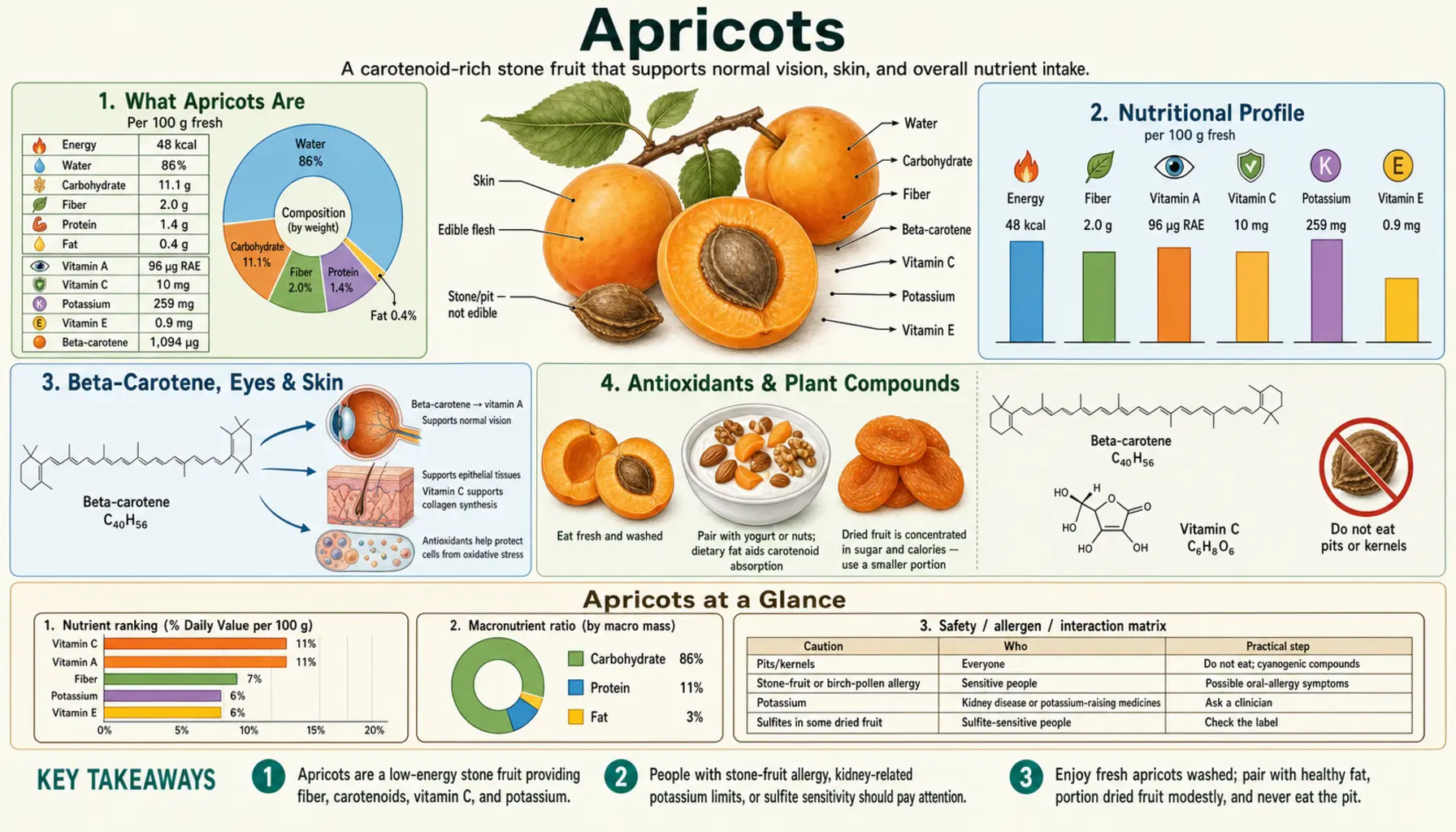
The apricot (Prunus armeniaca) is a small, velvety, orange-gold stone fruit — sweet-tart, fragrant, and holding a single hard pit at its center. It is a close cousin of the peach, plum, cherry, and almond, and it is one of the most concentrated fruit sources of beta-carotene, the orange pigment your body turns into vitamin A. Apricots come to us in two very different forms: fresh, a fleeting early-summer treat that bruises easily and does not travel well, and dried, a chewy pantry staple in which the water is gone and the potassium, iron, and fiber are concentrated several-fold. This page explains what apricots are, what is actually inside them, their gentle benefits for eyes, skin, digestion, and the heart, how fresh honestly compares with dried (including the sulfur preservative that keeps dried apricots bright orange), and one important safety topic that is often glossed over: the bitter kernel inside the pit, the amygdalin it contains, and why "laetrile" or "vitamin B17" is a debunked and genuinely dangerous cancer claim. As always here, the goal is warmth and honesty — apricots are a lovely, wholesome fruit, not a miracle.
Table of Contents
- What Apricots Are
- Nutritional Profile
- Beta-Carotene, Eyes & Skin
- Antioxidants & Plant Compounds
- Digestion & Fiber
- Heart Health & Potassium
- Fresh vs Dried Apricots
- The Kernel, Amygdalin & "Laetrile"
- How to Select, Ripen & Store
- Safety & Who Should Take Care
- Research Papers
- Connections
- Featured Videos
What Apricots Are
An apricot is the fruit of Prunus armeniaca, a small tree in the rose family (Rosaceae). Botanically it is a drupe, or stone fruit — a fleshy fruit built around a single hard pit — which places it in the same close family as peaches, plums, cherries, and almonds. A ripe apricot is smaller than a peach, with a soft, faintly fuzzy skin, a sweet-tart flavor, and flesh that runs from pale yellow to deep sunset orange.
The species name armeniaca means "Armenian," reflecting the old belief that the fruit came from Armenia, but that is a historical accident of the trade routes. The best evidence points to apricots being domesticated much farther east, in Central Asia and China, thousands of years ago, before travelling west along the Silk Road into Persia, the Mediterranean, and eventually the Americas.
The most striking thing about an apricot is its color. That orange-gold comes almost entirely from carotenoids — chiefly beta-carotene, along with beta-cryptoxanthin and gamma-carotene — the same family of fat-soluble pigments that color carrots, sweet potatoes, and pumpkins. The deeper and more uniform the orange, the more of these pigments the fruit carries. A greenish or very pale apricot was usually picked underripe, and unlike some fruit, apricots sweeten very little after harvest; they mostly just soften.
Two forms dominate how we eat them:
- Fresh apricots have a short season (roughly late spring into midsummer), bruise easily, and do not ship well, which is why good fresh ones can feel like a seasonal luxury. They are light, juicy, and mostly water.
- Dried apricots are the same fruit with the water removed. They keep for months, and because drying concentrates everything left behind, they carry far more potassium, iron, fiber — and sugar — per bite than the fresh fruit. They are a genuinely different food nutritionally, covered in its own section below.
Nutritional Profile
A fresh apricot is a light, low-calorie fruit — about 86% water, with only around 17 calories in a single fruit (roughly 35 grams) or about 48 calories per 100 grams. Its value is not in any one dramatic nutrient but in a pleasant, honest spread of vitamins, a useful dose of potassium, some fiber, and that generous load of orange carotenoids. Here is what fresh apricots, eaten with the skin, typically provide:
- Beta-carotene / provitamin A — this is the apricot's standout. Among common fruits, apricots are one of the richest sources of beta-carotene, which the body converts into vitamin A. A couple of fresh apricots supply a meaningful slice of a day's vitamin A activity, and dried apricots more so.
- Vitamin C — a modest amount (roughly 10 mg per 100 grams of fresh fruit), enough to make a small, real contribution to the antioxidant defense and collagen-building that vitamin C supports. Note that drying and heat largely destroy vitamin C, so dried apricots have very little.
- Vitamin E — apricots carry a little vitamin E (about 0.9 mg per 100 grams), which is more than most fruits offer. It is a small amount against daily needs, but a genuine and somewhat unusual one for a fruit.
- Potassium — fresh apricots give roughly 260 mg per 100 grams, a solid amount of this blood-pressure-friendly mineral. In dried apricots the potassium is concentrated dramatically — well over 1,000 mg per 100 grams — making them one of the best plant sources of potassium you can keep in a cupboard.
- Fiber — fresh apricots offer about 2 grams per 100 grams, a mix of soluble pectin and insoluble fiber. Dried apricots concentrate this to around 7 grams per 100 grams, which is part of why they act as a gentle laxative.
- Iron — fresh apricots contain little, but dried apricots concentrate it to roughly 2.7 mg per 100 grams. This is nonheme (plant) iron, which is less easily absorbed than the iron in meat, but pairing dried apricots with a vitamin-C source improves uptake.
- Natural sugars — a fresh apricot's sugar is small and comes bundled with water and fiber. Drying removes the water, so dried apricots are roughly half sugar by weight; more on that below.
- Small amounts of many others — including vitamin K, niacin, folate, magnesium, copper, and manganese, each in minor but real quantities.
The single most useful nutrition point about apricots: they are a carotenoid and potassium fruit, and the difference between fresh and dried is enormous. Fresh apricots are a light, hydrating, vitamin-C-bearing snack; dried apricots are a concentrated, potassium- and fiber-dense, higher-sugar food. Both are good; they simply do different jobs.
Beta-Carotene, Eyes & Skin
The best-supported reason to enjoy apricots is their beta-carotene. Beta-carotene is a provitamin A carotenoid: it has no vitamin A activity of its own, but your intestine can split it into retinal and, from there, into the active forms of vitamin A your body uses. Reviews of human nutrition confirm that plant beta-carotene, from foods like apricots, carrots, and leafy greens, is a real and important dietary source of vitamin A worldwide — especially valuable where animal-source vitamin A is scarce.
For the eyes, vitamin A is not optional. The retina uses a vitamin-A-derived molecule (retinal) to detect light, which is why the classic sign of vitamin A deficiency is night blindness. A diet with enough provitamin A helps keep the surface of the eye healthy and vision working in dim light. Apricots contribute to that supply as part of a colorful diet.
For the skin, vitamin A governs the normal turnover and repair of skin cells, and the carotenoids themselves act as antioxidants within skin tissue. Vitamin C, also present in fresh apricots, is separately essential for making collagen, the protein that gives skin its structure. None of this makes apricots a skincare treatment — but they feed the very nutrient pathways that skin and eye health depend on.
A sensible, honest caveat: this is about food, not high-dose supplements. Beta-carotene from fruits and vegetables is safe and self-limiting — the worst that eating a great many carrots or apricots will do is tint your palms and soles faintly orange (a harmless condition called carotenemia). High-dose beta-carotene pills, by contrast, were found in large trials to raise lung-cancer risk in smokers, so the lesson is to get carotenoids from whole foods like apricots, not from megadose capsules. For the fuller story, see Beta-Carotene and Vitamin A.
Antioxidants & Plant Compounds
Beyond straightforward nutrition, apricots deliver a varied mix of antioxidant plant compounds, and where they sit in the fruit matters.
- Carotenoids (in the flesh). The orange flesh is where the fat-soluble carotenoids live — beta-carotene, beta-cryptoxanthin, gamma-carotene, and smaller amounts of lutein. These are both pigments and antioxidants, and the first few also serve as vitamin A precursors. Surveys of different apricot varieties have found their carotenoid content can vary several-fold, tracking closely with how deep the flesh and skin color is.
- Phenolic acids and flavonoids (throughout, but rich in the skin). Apricots carry chlorogenic and neochlorogenic acids — the same phenolic-acid antioxidants found in coffee and many fruits — along with catechins and quercetin, a widely studied flavonoid. Reviews of apricot phytochemistry describe this phenolic mix as the main driver of the fruit's measured antioxidant activity.
- Anthocyanins (in the blushed skin). The rosy or red blush some apricots wear comes from anthocyanins, the same red-purple pigments that color berries. They sit in the skin, not the pale interior, so a blushed apricot eaten whole gives you a little more of this particular antioxidant — another reason not to peel the fruit.
Two honest points keep this in proportion. First, the antioxidant numbers vary enormously by variety, ripeness, and growing conditions, so there is no single "apricot" antioxidant value. Second, much of the specific health evidence for these compounds is still laboratory work — test-tube and cell studies — which is a long way from proving that apricots prevent disease in people. What is fair to say is that apricots contribute a genuine, colorful dose of antioxidants as part of a whole-food diet. See also Anthocyanins and Quercetin.
Digestion & Fiber
Apricots are gentle and friendly to digestion, and this is one area where dried apricots clearly outshine fresh. Three things do the work:
- Fiber. Fresh apricots carry a modest 2 grams or so per 100 grams — a blend of soluble pectin, which holds water and keeps stool soft, and insoluble fiber, which adds bulk and helps things move. Drying concentrates this to around 7 grams per 100 grams, so a small handful of dried apricots is a genuinely fiber-rich snack.
- Sorbitol. Like prunes and other stone fruits, apricots contain sorbitol, a natural sugar alcohol the gut absorbs slowly. Sorbitol draws water into the bowel, which softens stool and encourages movement. It is concentrated in dried apricots, which is exactly why dried apricots have a long folk reputation as a gentle, natural laxative for occasional constipation.
- Water (fresh). A ripe fresh apricot is mostly water, which on its own helps keep things moving.
The practical takeaway: a few dried apricots are a reasonable, food-first option if you are prone to occasional constipation — think of them alongside prunes as a gentle nudge rather than a drug. The same mechanism explains the flip side: eaten in large amounts, the sorbitol and fiber can cause gas, bloating, or loose stools. Because apricots contain sorbitol (and some excess fructose), they are a FODMAP fruit, so people with irritable bowel syndrome or fructose or sorbitol intolerance may need to keep portions small. Start with a few and see how you do. See also Constipation for the bigger picture on fiber and regularity.
Heart Health & Potassium
Apricots fit naturally into a heart-healthy way of eating, and the clearest reason is potassium. Potassium is the mineral that partly counterbalances sodium: it helps relax blood-vessel walls and helps the kidneys shed excess sodium, which together support healthy blood pressure. A large systematic review and meta-analysis found that increasing potassium intake lowered blood pressure in adults and was associated with a lower risk of stroke — and most people fall short of the recommended intake.
This is where dried apricots earn their place: with well over 1,000 mg of potassium per 100 grams, they are a genuinely potassium-dense food, one of the easiest cupboard sources there is. Fresh apricots contribute too, in smaller amounts. Paired with their fiber and skin polyphenols — which add anti-inflammatory and cholesterol-nudging value — apricots belong in the same broad pattern of whole-fruit eating that population studies link with better heart health.
The honest limitation is the same one that applies to most single fruits: there are essentially no large human trials showing that apricots on their own prevent heart disease. The case for them rests on the well-established benefit of potassium and on their being a whole, low-calorie, satisfying fruit — not on any dramatic effect from apricots specifically. Enjoy them as part of a heart-healthy diet, not as a heart medicine. See Potassium for more.
Fresh vs Dried Apricots
Fresh and dried apricots are the same fruit, but nutritionally they behave so differently that it is worth treating them as two foods.
Dried apricots concentrate the good and the sugar alike. When the water is removed, everything left behind is packed into a smaller, chewier bite: the potassium, iron, and fiber all rise several-fold (a real plus), but so do the calories and sugar — dried apricots are roughly half sugar by weight. A handful adds up fast, so they are best treated as a concentrated snack rather than something to eat by the bowlful. Drying does cost some of the more fragile nutrients: vitamin C is largely lost to heat and time, and studies tracking apricots through the drying process show that a portion of the beta-carotene degrades as well, especially with air and light exposure. The potassium, iron, and fiber, being sturdier, largely survive.
The color tells you how they were preserved. This is the honest detail many people never hear:
- Bright-orange dried apricots have almost always been treated with sulfur dioxide (a sulfite preservative), which stops the fruit from browning and locks in that vivid color, while also extending shelf life and preserving some of the carotenoids. The sulfur is why supermarket dried apricots look almost as orange as fresh.
- Unsulfured dried apricots are brown. Without the sulfite treatment, natural browning reactions turn the fruit a deep amber-brown — sometimes almost like a dried fig. They are not spoiled or lower quality; brown is simply the natural color of a dried apricot. Many people actually find the unsulfured ones richer and more caramel-like in flavor.
For most people, sulfites in dried fruit are harmless. But sulfites can trigger reactions in sensitive individuals, particularly some people with asthma, in whom they can provoke wheezing or other symptoms; reactions in the general population are uncommon but real. If you are sulfite-sensitive, the simple answer is to buy the brown, unsulfured dried apricots — check the label, which by law must declare added sulfites. It is a genuinely useful thing to know, and it is why the brown ones exist.
Bottom line: fresh apricots for a light, hydrating, vitamin-C-bearing snack in season; dried apricots (in a small handful) for a concentrated hit of potassium, iron, and fiber year-round; and unsulfured brown apricots if sulfites bother you.
The Kernel, Amygdalin & "Laetrile"
This is the most important safety topic on the page, and it is one that marketing often distorts, so it deserves a clear, calm explanation.
Crack open an apricot's hard pit and you find a single seed, or kernel, that looks much like a small almond — unsurprising, since almonds are the apricot's close cousin. Apricot kernels come in two types. Sweet kernels (used to flavor amaretto and marzipan-style sweets) contain relatively little of the compound in question. Bitter kernels contain a great deal of it: amygdalin, a natural cyanogenic glycoside. When a bitter kernel is chewed and digested, the body breaks amygdalin down and releases hydrogen cyanide — the same fast-acting poison it sounds like.
The risk here is real, not theoretical. European food-safety regulators, reviewing the evidence in a formal risk assessment, concluded that even a few bitter apricot kernels can push an adult past the safe one-time dose of cyanide, and that a single small kernel can do so for a toddler. Published poisoning cases bear this out: an adult who chewed roughly 30 apricot kernels as a health remedy developed severe cyanide toxicity, and a four-year-old given amygdalin and apricot kernels as an alternative cancer treatment was severely poisoned. The plain guidance is simple: do not eat bitter apricot kernels in quantity, and never give them to children. An accidentally swallowed whole pit is not a cyanide danger — the hard shell passes through undigested — but the kernel inside is not food, and the bitter taste that makes people spit them out is nature's warning.
"Laetrile" and "vitamin B17." This same amygdalin is the basis of a long-running and dangerous piece of medical folklore. Starting in the mid-20th century, a semi-synthetic form of amygdalin was marketed under the name laetrile, and rebranded as "vitamin B17" — a name chosen to make it sound like an essential nutrient your body needs. It is not a vitamin at all; no such vitamin exists, and there is no deficiency disease from lacking it. It was promoted as a natural cancer cure, on the theory that cancer cells would selectively release the cyanide and destroy themselves.
That theory has been tested and it fails. A Cochrane systematic review — the most rigorous kind of evidence summary — examined the trials and found no reliable evidence that laetrile or amygdalin has any anticancer effect, while documenting a real risk of cyanide poisoning, especially when taken by mouth alongside foods or enzymes that speed amygdalin's breakdown. In other words, it does not work, and it can hurt or kill you. The U.S. Food and Drug Administration has never approved it, and it remains banned or restricted in many countries precisely because people have been poisoned by it. If you want the fuller history and the specific evidence, see our dedicated page on Laetrile and Amygdalin ("Vitamin B17").
None of this should make you nervous about the apricot itself. The flesh of the fruit is completely safe and wholesome; this warning applies only to the bitter seed hidden inside the stone, which no one should be eating as a remedy.
How to Select, Ripen & Store
Because apricots barely sweeten after picking, choosing well at the store matters more than with many fruits.
- Choosing fresh. Look for apricots that are plump, uniformly orange to golden-orange, and fragrant, with a slight give when gently pressed. Avoid ones that are pale, greenish-yellow, or hard — those were picked underripe and will only soften, not truly sweeten. Skip any that are bruised, shriveled, or mushy. A fresh, ripe apricot should smell faintly sweet at the stem end.
- Ripening. A firm-but-not-hard apricot will soften over a day or two at room temperature; tucking it in a paper bag speeds this along. Once it yields to gentle pressure and smells fragrant, it is ready.
- Storing fresh. Ripe apricots are fragile. Keep them at room temperature if you will eat them within a day; otherwise refrigerate them in a loose bag and use within a few days. Cold air blunts their flavor and texture, so bring them back to room temperature before eating for the best taste.
- Storing dried. Keep dried apricots in an airtight container in a cool, dark place; they last for months, and the refrigerator or freezer extends that further. If they harden, a short soak in warm water plumps them back up.
- Eating them. Wash fresh apricots and eat them whole, skin and all — the skin holds anthocyanins and fiber. Halve and twist to remove the pit (many apricots are freestone and release it easily). They are lovely fresh, halved into yogurt or oatmeal, roasted, or added to both sweet and savory dishes; dried ones are excellent in trail mix, tagines, and baking.
Safety & Who Should Take Care
For nearly everyone, apricots are a safe, wholesome fruit. A few honest notes cover the exceptions:
- The kernel, not the fruit. As above, the flesh is safe; the bitter kernel inside the pit is not. Do not eat bitter apricot kernels in quantity, and never treat laetrile or "vitamin B17" as medicine.
- Sulfite sensitivity. Bright-orange dried apricots usually contain sulfites, which can trigger symptoms in sensitive people, especially some with asthma. Choose brown, unsulfured dried apricots if that is you.
- Portion and the gut. The sorbitol and fiber that make dried apricots a gentle laxative can cause gas, bloating, or loose stools in larger amounts, and can bother people with IBS or a sensitivity to FODMAPs. Keep portions modest.
- Sugar in dried apricots. Because dried apricots are roughly half sugar, people managing blood sugar or weight should treat them as a concentrated food and mind the portion. Whole fresh fruit, by contrast, has a gentle effect on blood sugar — large cohort studies link eating whole fruit (apricots among them) with a lower risk of type 2 diabetes, even as fruit juice goes the other way.
- Oral allergy syndrome. A minority of people with birch-pollen allergy get an itchy mouth or lips from raw apricots (and other stone fruits) — a cross-reaction called oral allergy syndrome. It is usually mild, and cooked or dried apricots are often tolerated. True, severe apricot allergy is uncommon.
- Carotenemia. Eating a very large amount of apricots (or carrots) over time can tint the palms and soles faintly orange. It is harmless and fades when intake drops — not a sign of anything wrong.
As with any whole fruit, the sensible approach is variety and moderation: a couple of fresh apricots in season, or a small handful of dried ones, is a genuinely good addition to most diets.
Research Papers
- Alajil O, Sagar VR, Kaur C, et al. Nutritional and phytochemical traits of apricots (Prunus armeniaca L.) for application in nutraceutical and health industry. Foods. 2021;10(6):1344. doi:10.3390/foods10061344 — a broad review of apricot nutrients, carotenoids, and phenolic compounds and their potential health roles.
- Erdogan-Orhan I, Kartal M. Insights into research on phytochemistry and biological activities of Prunus armeniaca L. (apricot). Food Research International. 2011;44(5):1238–1243. doi:10.1016/j.foodres.2010.11.014 — reviews the fruit's phenolics, flavonoids, and measured antioxidant activity.
- Ruiz D, Egea J, Tomás-Barberán FA, Gil MI. Carotenoids from new apricot (Prunus armeniaca L.) varieties and their relationship with flesh and skin color. Journal of Agricultural and Food Chemistry. 2005;53(16):6368–6374. doi:10.1021/jf0480703 — shows beta-carotene is the dominant pigment and that carotenoid content tracks the depth of the orange color.
- Grune T, Lietz G, Palou A, et al. β-Carotene is an important vitamin A source for humans. The Journal of Nutrition. 2010;140(12):2268S–2285S. doi:10.3945/jn.109.119024 — a consensus review confirming that dietary beta-carotene is a genuine, safe source of vitamin A.
- Fratianni A, Niro S, Alam MDR, et al. Degradation of carotenoids in apricot (Prunus armeniaca L.) during the drying process. Plant Foods for Human Nutrition. 2013;68(3):241–246. doi:10.1007/s11130-013-0369-6 — measures how much beta-carotene is lost when apricots are dried.
- Aburto NJ, Hanson S, Gutierrez H, Hooper L, Elliott P, Cappuccio FP. Effect of increased potassium intake on cardiovascular risk factors and disease: systematic review and meta-analyses. BMJ. 2013;346:f1378. doi:10.1136/bmj.f1378 — higher potassium intake lowered blood pressure and was linked to lower stroke risk (apricots, especially dried, are potassium-dense).
- Muraki I, Imamura F, Manson JE, et al. Fruit consumption and risk of type 2 diabetes: results from three prospective longitudinal cohort studies. BMJ. 2013;347:f5001. doi:10.1136/bmj.f5001 — eating whole fruit was linked to lower diabetes risk while fruit juice was linked to higher risk.
- Keast DR, O'Neil CE, Jones JM. Dried fruit consumption is associated with improved diet quality and reduced obesity in US adults. Nutrition Research. 2011;31(6):460–467. doi:10.1016/j.nutres.2011.05.009 — a national survey linking dried-fruit eaters (a category that includes dried apricots) with better overall diet quality.
- Vally H, Misso NLA, Madan V. Clinical effects of sulphite additives. Clinical & Experimental Allergy. 2009;39(11):1643–1651. doi:10.1111/j.1365-2222.2009.03362.x — reviews sulfite sensitivity, relevant to the sulfur dioxide used on bright-orange dried apricots.
- EFSA Panel on Contaminants in the Food Chain (CONTAM). Acute health risks related to the presence of cyanogenic glycosides in raw apricot kernels and products derived from raw apricot kernels. EFSA Journal. 2016;14(4):4424. doi:10.2903/j.efsa.2016.4424 — a formal risk assessment finding even a few bitter apricot kernels can exceed the safe acute cyanide dose.
- Suchard JR, Wallace KL, Gerkin RD. Acute cyanide toxicity caused by apricot kernel ingestion. Annals of Emergency Medicine. 1998;32(6):742–744. doi:10.1016/S0196-0644(98)70077-0 — a documented case of severe cyanide poisoning after an adult ate roughly 30 apricot kernels.
- Milazzo S, Horneber M. Laetrile treatment for cancer. Cochrane Database of Systematic Reviews. 2015;(4):CD005476. doi:10.1002/14651858.CD005476.pub4 — the definitive evidence review: no reliable proof that laetrile/amygdalin ("vitamin B17") treats cancer, with a real risk of cyanide poisoning.
Connections
- All Food
- Peaches
- Prunes
- Pears
- Beta-Carotene
- Anthocyanins
- Quercetin
- Vitamin A
- Vitamin C
- Vitamin E
- Laetrile and Amygdalin ("Vitamin B17")
- Potassium
- Iron
- Constipation
- Asthma