Prunes
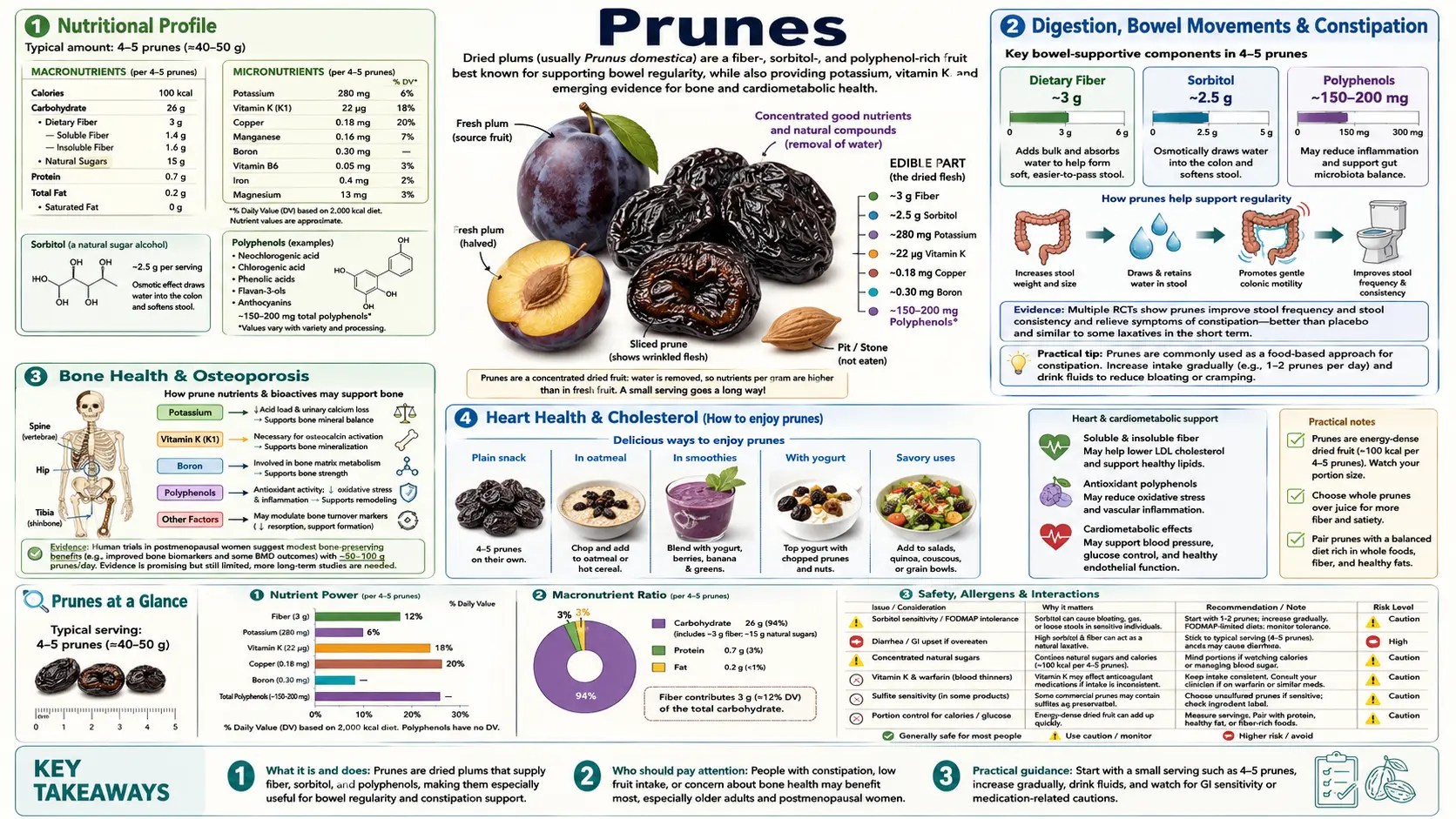
Prunes (dried plums, Prunus domestica) are the classic and best-studied natural food for constipation and regular bowel movements — in a head-to-head trial they actually outperformed psyllium. They get things moving through sorbitol (a sugar alcohol that draws water into the gut), plenty of dietary fiber, and gut-stimulating polyphenols, working as a gentle natural laxative. Prunes have a second, unusually well-evidenced benefit too: several human trials show about 5–6 prunes a day help preserve bone density in postmenopausal women. They are also good for the heart and are loaded with antioxidants — just remember they are a concentrated dried fruit, so portion size matters.
Deep-Dive Articles
Digestion, Bowel Movements & Constipation Relief
The flagship guide. How sorbitol pulls water into the intestine to soften stool and trigger a bowel movement, how fiber and polyphenols add to the gentle natural-laxative effect, the randomized trial in which prunes beat psyllium, exactly how many prunes to eat for constipation, and the gas/bloating and FODMAP flip side.
Bone Health & Osteoporosis
Prunes' standout, RCT-backed benefit. How about 50 grams a day helped preserve hip and bone mineral density in postmenopausal women (the Prune Study and others), why prunes may slow the cells that break down bone, and the boron, vitamin K, and polyphenols behind it — with honest limits.
Heart Health & Cholesterol
How prunes' soluble fiber can nudge LDL cholesterol down, how their high potassium and low sodium support healthy blood pressure, and the anti-inflammatory polyphenols they are unusually rich in — framed honestly as a modest, supportive effect, not a drug.
Blood Sugar, Weight & Antioxidants
Why prunes have a relatively low glycemic index for a dried fruit, how their fiber promotes fullness, why they are among the highest-antioxidant foods — and the honest portion-control caveat, since dried fruit is calorie- and sugar-dense.
Table of Contents
- Deep-Dive Articles
- Nutritional Profile
- Digestion, Bowel Movements & Constipation
- Bone Health & Osteoporosis
- Heart Health & Cholesterol
- Blood Sugar, Weight & Antioxidants
- How to Choose, Store & Eat Prunes
- Considerations
- Research Papers
- Connections
- Featured Videos
Nutritional Profile
Prunes are simply plums with most of the water removed, which concentrates both their nutrients and their sugars. A serving of about 5 prunes (roughly 45–50 grams) is about 110–120 calories. Per 100 grams they run about 240 calories — so they are nutrient-dense but also energy-dense, which is why portion size matters.
- Dietary fiber — about 3–3.5 grams per serving (around 7 grams per 100 grams), a mix of soluble and insoluble fiber that supports regularity and feeds gut bacteria.
- Sorbitol — prunes are very high in sorbitol (roughly 12–15 grams per 100 grams), the natural sugar alcohol that is the main reason prunes are such a reliable, gentle laxative.
- Natural sugars — concentrated by drying (about 18 grams per serving), mostly glucose and fructose. Despite this, prunes have a relatively low glycemic index because of their fiber and sorbitol.
- Potassium — prunes are notably high in potassium (about 350 mg per serving; 732 mg per 100 grams), supporting healthy blood pressure.
- Vitamin K — a meaningful source (about 28 mcg per serving), relevant to both bone and blood health.
- Boron and copper — prunes are one of the better food sources of boron, a trace mineral involved in bone metabolism, plus copper, which also supports bone.
- Polyphenols — prunes are among the most antioxidant-rich foods, especially in chlorogenic and neochlorogenic acid, plant compounds with anti-inflammatory effects.
The honest headline: prunes pack an unusual amount of fiber, sorbitol, potassium, and antioxidants into a small, sweet, shelf-stable package — but because drying concentrates the calories and sugar, a sensible serving is a small handful, not an open bag.
Digestion, Bowel Movements & Constipation
This is what prunes are famous for, and unusually for a food remedy, it is backed by a clinical trial. Prunes are one of the most reliable foods for relieving constipation and restoring regular bowel movements, working as a gentle, natural laxative through several ingredients at once.
- Sorbitol — the main driver. Sorbitol is a sugar alcohol the small intestine absorbs slowly and incompletely. The unabsorbed part acts as an osmotic laxative: it pulls water into the bowel, which softens the stool and stimulates the urge to go. Drying concentrates sorbitol, so prunes deliver a lot of it — one reason they work even better than fresh plums.
- Fiber — bulk and softness. The 3–3.5 grams of fiber per serving add bulk and hold water, helping move things through the colon and keeping stool soft.
- Polyphenols — a likely extra nudge. The chlorogenic-acid polyphenols in prunes may help stimulate the bowel, though this part of the picture is less firmly established than the sorbitol and fiber effects.
The evidence: in a randomized trial, people with constipation who ate prunes had more complete spontaneous bowel movements and better stool consistency than those taking psyllium, the common fiber supplement. A systematic review reached the same encouraging conclusion. That is stronger evidence than most "natural remedies" can claim.
How to use prunes for constipation: a typical effective amount is about 4 to 12 prunes a day (roughly 50–100 grams), or a glass of prune juice. Start low — around 3–4 prunes — and build up over a few days, drinking water alongside, since fiber works best with fluid. Prune juice also works (more concentrated sorbitol, but without the fiber of whole prunes).
The flip side. The same sorbitol and fiber that help can cause gas, bloating, cramping, or loose stools if you eat too many, and dried fruit is easy to over-eat. People with irritable bowel syndrome (IBS) or on a low-FODMAP plan should be cautious — prunes are high in FODMAPs (sorbitol and fructose). Build up gradually. The full guide, including dosing and cautions, is in Prunes for Digestion, Bowel Movements, and Constipation Relief. For the condition itself, see Constipation; fresh pears work through the same sorbitol mechanism.
Bone Health & Osteoporosis
Prunes' second claim to fame is genuinely well-supported: several human trials suggest they help protect bone. In the 12-month "Prune Study," postmenopausal women who ate about 50 grams of prunes a day (5–6 prunes) preserved hip bone mineral density, while the group eating no prunes lost bone over the same period. Earlier trials found prunes outperformed dried apple for bone markers, and a more recent study found prunes helped preserve the density and estimated strength of the shin bone. Prunes appear to work mainly by slowing the breakdown of bone, helped by their polyphenols plus bone-relevant nutrients like boron, vitamin K, potassium, and copper. This is one of the strongest food-and-bone evidence bases there is — though prunes preserve bone rather than rebuild it, the data are strongest in postmenopausal women, and they complement (not replace) calcium, vitamin D, exercise, and any prescribed medication. Full detail in Prunes for Bone Health and Osteoporosis; see also Osteoporosis.
Heart Health & Cholesterol
Prunes fit a heart-healthy diet. Their soluble fiber can help nudge LDL cholesterol down, their high potassium and low sodium support healthy blood pressure, and they are rich in anti-inflammatory polyphenols. A small trial comparing daily prunes with a daily apple in postmenopausal women looked at cardiovascular risk factors with modest, mixed results — so the honest read is that prunes are a sensible part of a heart-healthy pattern with a real but modest effect, not a treatment. More in Prunes for Heart Health and Cholesterol.
Blood Sugar, Weight & Antioxidants
Despite being a sweet dried fruit, prunes have a relatively low glycemic index — their fiber, sorbitol, and fructose slow the sugar response. Their fiber and chewiness also make them fairly filling, which can help a portion-controlled sweet craving stand in for candy. And prunes are among the most antioxidant-rich foods, thanks to their polyphenols. The honest caveat: prunes are calorie- and sugar-dense, so they are not a "free" snack — a serving is a few prunes, not a handful eaten repeatedly. More in Prunes for Blood Sugar, Weight, and Antioxidants.
How to Choose, Store & Eat Prunes
- Choose unsweetened prunes. Plain dried prunes need no added sugar. Look for soft, glossy, plump ones; avoid those that are rock-hard.
- Mind the portion. Because drying concentrates calories and sugar, a sensible serving is about 4–6 prunes — enough for the bone and digestion benefits without overdoing energy intake. For constipation you can go higher (up to ~10–12/day), building up gradually.
- Whole prunes or juice. Whole prunes keep the fiber; prune juice is a convenient option for constipation (concentrated sorbitol) but loses the fiber and is easy to overdrink.
- Store airtight. Keep them in a sealed container; refrigerating extends shelf life and keeps them soft. If they dry out, soak briefly in warm water.
- Easy ways to eat them: as a snack (pair with nuts to blunt the sugar), chopped into oatmeal or yogurt, simmered into a compote, or used to add moisture and sweetness to baking.
Considerations
Prunes are safe and beneficial for most people. A few practical points:
- Gas, bloating, and loose stools. The sorbitol and fiber that relieve constipation can cause gas or diarrhea in larger amounts. Build up slowly and find your amount.
- IBS and FODMAP sensitivity. Prunes are high in FODMAPs (sorbitol plus fructose) and can trigger symptoms in people with irritable bowel syndrome. Smaller portions may be tolerated.
- Calorie and sugar density. Dried fruit is easy to over-eat; mind portions if you are watching weight or blood sugar.
- Dental health. Prunes are sticky and sugary, so they cling to teeth — rinse or brush after, especially for children.
- Advanced kidney disease. Prunes are high in potassium, which is usually a benefit, but people with advanced kidney disease on a potassium-restricted diet should check with their care team.
Research Papers
- Attaluri A, et al. Randomised clinical trial: dried plums (prunes) vs. psyllium for constipation. Alimentary Pharmacology & Therapeutics. 2011. doi:10.1111/j.1365-2036.2011.04594.x — A head-to-head trial in which prunes produced more complete spontaneous bowel movements and better stool consistency than psyllium.
- Lever E, et al. Systematic review: the effect of prunes on gastrointestinal function. Alimentary Pharmacology & Therapeutics. 2014. doi:10.1111/apt.12913 — A review concluding prunes improve stool frequency and consistency, supporting their use for constipation.
- Stacewicz-Sapuntzakis M, et al. Chemical composition and potential health effects of prunes: a functional food? Critical Reviews in Food Science and Nutrition. 2001. doi:10.1080/20014091091814 — A foundational review of prune nutrients (fiber, sorbitol, potassium, boron, polyphenols) and their potential health roles.
- Lederle FA, et al. Cost-effective treatment of constipation in the elderly: a randomized double-blind comparison of sorbitol and lactulose. The American Journal of Medicine. 1990. doi:10.1016/0002-9343(90)90177-f — Shows sorbitol — the sugar alcohol concentrated in prunes — relieves constipation as effectively as the laxative lactulose.
- De Souza MJ, et al. Prunes preserve hip bone mineral density in a 12-month randomized controlled trial in postmenopausal women: the Prune Study. The American Journal of Clinical Nutrition. 2022. doi:10.1093/ajcn/nqac189 — About 50 g/day of prunes preserved hip bone mineral density over a year while the control group lost bone.
- Wallace TC. Dried Plums, Prunes and Bone Health: A Comprehensive Review. Nutrients. 2017. doi:10.3390/nu9040401 — A thorough review of the trial evidence that prunes help protect bone, especially in postmenopausal women.
- Chai SC, et al. Daily apple versus dried plum: impact on cardiovascular disease risk factors in postmenopausal women. Journal of the Academy of Nutrition and Dietetics. 2012. doi:10.1016/j.jand.2012.05.005 — A small trial comparing daily prunes with a daily apple on cardiovascular risk factors, with modest results.
- Slavin J. Fiber and prebiotics: mechanisms and health benefits. Nutrients. 2013. doi:10.3390/nu5041417 — How fermentable fibers feed gut bacteria and produce beneficial short-chain fatty acids.
PubMed Topic Searches
- PubMed: Prunes, constipation & bowel function
- PubMed: Sorbitol, constipation & osmotic laxatives
- PubMed: Prunes & bone mineral density
- PubMed: Prune polyphenols & antioxidants
Connections
- All Food
- Prunes Benefits Hub
- Prunes for Digestion & Constipation
- Prunes for Bone Health & Osteoporosis
- Prunes for Heart Health & Cholesterol
- Prunes for Blood Sugar, Weight & Antioxidants
- Natural Constipation Relief (Foods Ranked)
- Constipation
- Irritable Bowel Syndrome (IBS)
- Osteoporosis
- Pears
- Apples
- Bananas