Tremor
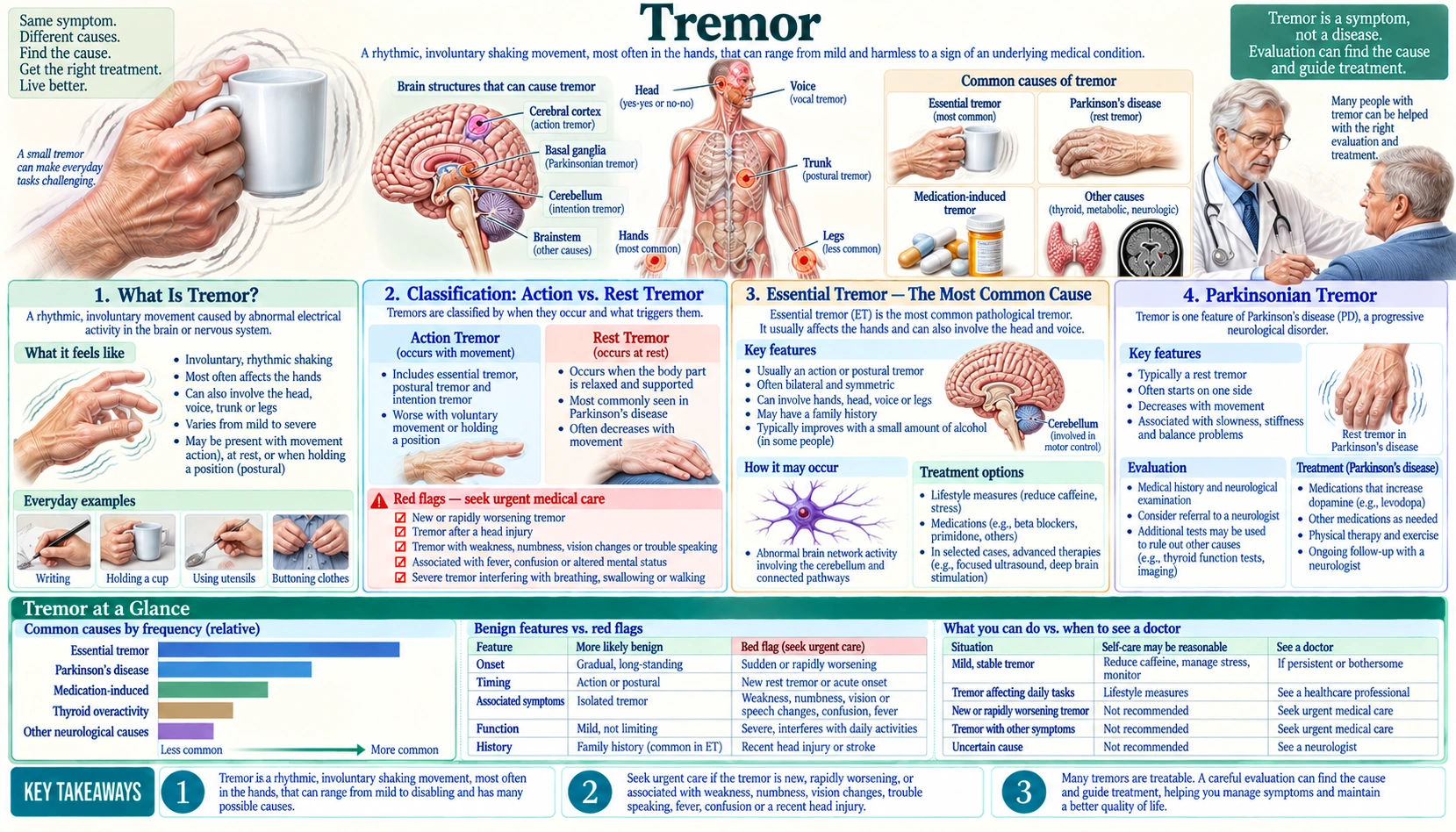
- What Is Tremor?
- Classification: Action vs. Rest Tremor
- Essential Tremor — The Most Common Cause
- Parkinsonian Tremor
- Physiologic and Enhanced Physiologic Tremor
- Cerebellar and Intention Tremor
- Other Tremor Types
- Diagnostic Evaluation
- Treatment Options
- When to See a Neurologist
- Key Research Papers
- PubMed Topic Searches
- Connections
What Is Tremor?
Tremor is an involuntary, rhythmic, oscillatory movement of a body part — most commonly the hands, but also the head, voice, trunk, or legs. It is the most common movement disorder seen in clinical practice, affecting millions of people across all age groups, though its prevalence rises sharply with age. Tremor is classified by the situation in which it occurs (rest vs. action), its frequency (typically 3–12 Hz), its amplitude, and its body distribution. These characteristics, taken together with a patient's age, medications, family history, and associated symptoms, usually allow a clinical diagnosis without requiring imaging or advanced testing.
The most important initial distinction is between rest tremor — present when the limb is supported and at rest, and characteristic of Parkinson's disease — and action tremor, which is present during voluntary movement and characteristic of essential tremor, physiologic tremor, and cerebellar disease. Getting this distinction right early determines the entire diagnostic and therapeutic path that follows. A careful clinical examination, performed systematically and with attention to the tremor's behavior under different conditions, remains the cornerstone of tremor diagnosis even in the age of advanced neuroimaging.
Classification: Action vs. Rest Tremor
Rest tremor occurs when the body part is fully supported against gravity and the person is relaxed — for example, hands resting in the lap while sitting. It diminishes or disappears entirely with voluntary movement. Rest tremor is the hallmark of Parkinson's disease and basal ganglia pathology more broadly, including drug-induced parkinsonism and other parkinsonian syndromes such as multiple system atrophy and progressive supranuclear palsy. The frequency of rest tremor is characteristically low, in the 3–6 Hz range, and the amplitude can range from barely perceptible to coarse and disabling.
Action tremor encompasses all tremors that occur during voluntary muscle contraction, and it is subdivided into several clinically meaningful categories. Postural tremor occurs when maintaining a position against gravity — such as holding the arms outstretched — and is the signature finding in essential tremor and enhanced physiologic tremor. Kinetic tremor occurs during any voluntary movement; it is further subdivided into simple kinetic tremor (during non-targeted movements such as pronation-supination), intention tremor (which worsens as the limb approaches a target during the finger-to-nose test, characteristic of cerebellar disease), and task-specific tremor (which occurs only during particular skilled activities, such as writing tremor or musician's focal dystonia). Isometric tremor occurs when contracting a muscle against a stationary object without movement, as when gripping a fixed handle.
Frequency is an additional classifier with diagnostic value. Low-frequency tremors in the 3–5 Hz range are associated with Parkinson's disease and cerebellar pathology. Medium-frequency tremors in the 5–8 Hz range are the territory of essential tremor. High-frequency tremors in the 8–12 Hz range are typical of physiologic, enhanced physiologic, and drug-induced tremors. These frequency bands overlap enough that they cannot be used as the sole diagnostic criterion, but they add meaningfully to the clinical picture established by the rest-vs.-action distinction and the examination of tremor distribution and behavior.
Essential Tremor — The Most Common Cause
Essential tremor (ET) is the most common movement disorder in the world, affecting an estimated 1% of the general population and up to 5% of people over age 65. The defining clinical picture is bilateral, predominantly postural and kinetic tremor of the hands and forearms. Head tremor (titubation — a nodding or side-to-side oscillation) is present in about 30% of cases, and voice tremor occurs in roughly 20%. The tremor typically worsens with fatigue, anxiety, and caffeine, and is partially or dramatically suppressed with small amounts of alcohol — a diagnostic clue that is so characteristic it is formally recognized in clinical criteria and helps distinguish ET from Parkinson's disease and other tremor types.
A family history of tremor is present in 50–70% of cases, suggesting autosomal dominant inheritance with variable penetrance. Despite decades of research, specific causative genes have been elusive — several loci have been linked to familial ET but no single gene accounts for most cases. Contrary to its historical name "benign essential tremor," ET causes significant disability in writing, eating, drinking, and fine motor tasks in many patients, and it carries an increased lifetime risk of mild cognitive impairment. The pathophysiology involves dysfunction of olivocerebellar circuits, and post-mortem studies have identified Purkinje cell degeneration and Lew body-like inclusions (distinct from Parkinson's) in a subset of severe ET brains. The cerebellar involvement explains why intention tremor can emerge later in the disease course alongside the dominant postural tremor.
The clinical examination in ET shows bilateral postural and kinetic tremor with no rigidity, no bradykinesia, no resting tremor, and no other parkinsonian features. DaTscan — a dopamine transporter SPECT imaging study — is normal in ET (in contrast to Parkinson's disease, where it shows reduced striatal dopamine uptake). When the clinical picture is ambiguous, DaTscan is the most useful single test to separate the two conditions.
First-line pharmacotherapy for ET is propranolol (a non-selective beta-blocker, 40–320 mg/day), which reduces tremor amplitude by approximately 50% in responders, or primidone (an anticonvulsant metabolized to phenobarbital, 50–750 mg/day), which achieves comparable efficacy but causes sedation and dizziness at initiation. Second-line medications include topiramate, alprazolam, gabapentin, clonazepam, and atenolol. For medication-refractory disabling ET, deep brain stimulation (DBS) targeting the ventral intermediate nucleus (VIM) of the thalamus achieves approximately 70–80% tremor reduction and is the most effective intervention available. Focused ultrasound thalamotomy (FUS-T) is a U.S. Food and Drug Administration-approved non-invasive ablative alternative for unilateral ET that produces immediate tremor suppression without surgical implantation of hardware, making it an increasingly preferred option for patients with a dominant hand tremor who want to avoid surgery.
Parkinsonian Tremor
The tremor of Parkinson's disease is a resting tremor — typically 4–6 Hz, unilateral at onset, and often described as "pill-rolling" because of its rhythmic opposition of the thumb against the index and middle fingers. It diminishes or disappears with voluntary movement and during sleep. In the early stages, the tremor may appear only under stress or emotional arousal. It is the most socially visible symptom of Parkinson's disease and the symptom most immediately recognized by family members, though it is not the most functionally disabling feature — bradykinesia (slowness of movement) and rigidity cause greater impairment of daily activities. The tremor typically spreads from one hand to the ipsilateral leg, then crosses to the contralateral side as the disease progresses.
PD tremor may paradoxically be one of the more difficult features to suppress with medication. Dopaminergic therapy — levodopa-carbidopa (the gold standard) and dopamine agonists such as pramipexole and ropinirole — reliably improves bradykinesia and rigidity, but its effect on tremor is variable; some patients respond well and others gain little tremor control despite excellent overall PD management. Anticholinergic medications (trihexyphenidyl, benztropine) can be modestly effective for tremor-predominant PD, but they carry significant cognitive, urinary, and gastrointestinal side effects that make them poorly tolerated in older patients. For severe medication-refractory PD tremor, both VIM-DBS and subthalamic nucleus (STN)-DBS are effective surgical options, with STN-DBS having the additional advantage of reducing medication requirements.
Distinguishing PD from essential tremor is a common clinical challenge. PD is characterized by resting tremor plus bradykinesia, cogwheel rigidity, micrographia, hypophonia, masked facies, and a shuffling, small-stepped gait with reduced arm swing. Essential tremor features action tremor only, bilateral symmetric onset, a family history, alcohol suppression, and no motor signs other than tremor. When the clinical picture is genuinely ambiguous — for example, in a patient with a postural tremor that may be either ET or the "re-emergent tremor" of early PD — DaTscan imaging resolves the question in most cases by demonstrating the characteristic reduced striatal dopamine uptake of Parkinson's disease against a normal background in ET.
Physiologic and Enhanced Physiologic Tremor
All humans have a physiologic tremor — a fine, rapid (8–12 Hz) postural tremor that is normally invisible and imperceptible under ordinary circumstances. It arises from the mechanical-reflex properties of the limb (mass, stiffness, and damping characteristics), amplified by rhythmic motor unit firing and cardiac-synchronous forces transmitted through the vasculature. Under baseline conditions it has too small an amplitude to interfere with function. Enhanced physiologic tremor (EPT) is an exaggeration of this normal tremor made visible and symptomatic by conditions that increase its amplitude without causing underlying neurological disease. The key feature of EPT is that it resolves completely when the precipitating cause is identified and removed.
Common causes of EPT include anxiety and acute stress (catecholamine surges increase tremor amplitude and frequency, which is why hands visibly shake during public speaking or a job interview), fatigue, caffeine and stimulants (including energy drinks and decongestants), hyperthyroidism (a fine rapid postural tremor of outstretched hands is one of the earliest and most sensitive physical signs of thyrotoxicosis — thyroid-stimulating hormone (TSH) is mandatory in any new tremor evaluation), hypoglycemia (low blood sugar triggers catecholamine release that amplifies physiologic tremor), and fever. A wide array of medications cause EPT by pharmacological mechanisms: bronchodilators (salbutamol, salmeterol — tremor is a dose-dependent side effect), valproate, lithium, amiodarone, selective serotonin reuptake inhibitors (SSRIs), corticosteroids, theophylline, stimulant attention-deficit/hyperactivity disorder (ADHD) medications, and immunosuppressants including cyclosporine and tacrolimus. Withdrawal states — alcohol withdrawal, benzodiazepine withdrawal, and opiate withdrawal — produce a severe action tremor that can progress to life-threatening autonomic instability (delirium tremens in alcohol withdrawal) and always warrant urgent medical attention. A careful and systematic medication review is mandatory in every patient presenting with a new tremor; drug-induced tremor is one of the most common and most completely reversible causes in clinical practice.
Cerebellar and Intention Tremor
Cerebellar tremor is a low-frequency (3–5 Hz) tremor that is absent at rest, minimal at the beginning of movement, and worsens progressively as the limb approaches a target — a pattern called intention tremor or terminal tremor. It is produced by dysfunction of the cerebellar error-correction system that normally modulates limb trajectory in real time. On examination, cerebellar tremor produces characteristic past-pointing on the finger-to-nose test, dysmetria on the heel-shin test, and impaired tandem gait. The tremor is typically unilateral when caused by a focal cerebellar lesion (stroke, tumor) and bilateral when caused by diffuse cerebellar disease. Common causes include multiple sclerosis (cerebellar lesions are among the most disabling features of multiple sclerosis (MS), and cerebellar tremor in multiple sclerosis is notoriously difficult to treat), posterior circulation stroke (particularly those involving the cerebellum or dentate nucleus), chronic alcohol use (acute intoxication produces reversible cerebellar signs; chronic heavy use causes alcoholic cerebellar degeneration through Purkinje cell loss, which is only partially reversible with abstinence and thiamine repletion), cerebellar tumors, and spinocerebellar ataxias (hereditary degenerative conditions such as SCA1, SCA2, SCA3, and SCA6).
Wilson's disease — an autosomal recessive disorder of copper metabolism caused by ATP7B mutations — deserves special mention because it produces a characteristic "wing-beating" tremor through combined cerebellar and basal ganglia copper deposition, and it is one of the few causes of tremor that is completely correctable with early treatment (copper chelation with penicillamine or trientine). It must be considered in any patient under age 40 presenting with a movement disorder, liver disease, or psychiatric symptoms. Cerebellar tremor is the form of tremor most resistant to pharmacological treatment — medications such as clonazepam, carbamazepine, and isoniazid offer modest benefit at best. For severely disabling cerebellar tremor in MS, VIM-DBS is sometimes pursued, though outcomes are less predictable and durable than for ET or PD tremor.
Other Tremor Types
Several less common but clinically important tremor types complete the differential. Orthostatic tremor is a rapid (13–18 Hz), high-frequency tremor of the legs and trunk that appears immediately upon standing and disappears when the patient sits, walks, or is supported — causing an unsteadiness that patients often describe as feeling like their legs will give way, despite the tremor being largely invisible to the naked eye; electromyography (EMG) recording the characteristic 13–18 Hz pattern is required for diagnosis, as the tremor frequency is too fast to be perceived as oscillation. Neuropathic tremor occurs in the setting of peripheral neuropathy — conditions such as Charcot-Marie-Tooth disease, chronic inflammatory demyelinating polyneuropathy (CIDP), and immunoglobulin M (IgM) paraproteinemic neuropathy can produce a postural and kinetic tremor that resembles ET in its distribution but is associated with sensory loss, areflexia, and nerve conduction abnormalities; it typically responds poorly to the medications used for ET. Psychogenic (functional) tremor has several characteristic features that distinguish it from organic tremors: the frequency is variable and inconsistent on repeated examination; the amplitude changes during distraction tasks (when attention is directed elsewhere, the tremor diminishes or stops); entrainment occurs (when the patient is asked to perform a rhythmic voluntary task with the contralateral hand, the tremor in the affected hand adopts the same frequency, unlike organic tremors); and onset may be abrupt, sometimes following a minor injury or stressful event. DaTscan and magnetic resonance imaging (MRI) are normal. Treatment focuses on physical and occupational therapy combined with psychotherapy — confronting the patient with the "functional" label in a validating, non-accusatory manner is the first step toward engagement with treatment, and many patients improve significantly with multidisciplinary rehabilitation.
Diagnostic Evaluation
The clinical examination differentiates the vast majority of tremor types without expensive testing. A systematic approach covers four key observations: (1) Observe the patient at rest with hands relaxed in the lap — a visible resting tremor is Parkinson's disease until proven otherwise. (2) Ask the patient to hold the arms outstretched against gravity for at least 10 seconds — postural tremor emerging during this maneuver points to essential tremor, physiologic tremor, or drug-induced tremor. (3) Perform the finger-to-nose and heel-shin tests — a tremor that emerges or worsens as the limb nears the target is an intention tremor and localizes pathology to the cerebellum or cerebellar pathways. (4) Assess gait — tandem walking, Romberg test, and observation of arm swing and stride length provide additional localizing information.
Laboratory workup for a new tremor is targeted rather than exhaustive. Thyroid function tests (thyroid-stimulating hormone and free T4) are mandatory — hyperthyroidism is common, causes a fine rapid postural tremor, and is entirely reversible. Serum copper and ceruloplasmin should be checked in any patient under 40, given that Wilson's disease is treatable if caught early. A fasting glucose, comprehensive metabolic panel, and complete blood count round out the basic evaluation and may reveal metabolic contributors (hypomagnesemia can worsen tremor, hepatic encephalopathy causes flapping asterixis often confused with tremor). A meticulous medication review, ideally with a pharmacist, is among the highest-yield steps in the workup — a long list of commonly prescribed drugs causes tremor as a dose-dependent side effect, and stopping or dose-reducing the offending agent may achieve complete resolution.
Neuroimaging is indicated when a central structural cause is suspected. Magnetic resonance imaging of the brain with and without contrast is the modality of choice — it identifies posterior fossa lesions, cerebellar atrophy, white matter lesions of multiple sclerosis, and brainstem pathology with far greater sensitivity than computed tomography (CT). DaTscan (ioflupane I-123 SPECT) is the most useful single test when clinical differentiation between Parkinson's disease and essential tremor is genuinely uncertain — it demonstrates reduced striatal dopamine transporter uptake in PD, parkinsonian syndromes, and Lewy body disease, while returning a normal result in ET, physiologic tremor, drug-induced tremor, and functional tremor. Genetic testing is indicated in selected circumstances: early-onset parkinsonism warrants a panel for LRRK2, PARK7, PINK1, and SNCA pathogenic variants; hereditary cerebellar ataxia warrants spinocerebellar ataxia repeat expansion testing; Wilson's disease requires ATP7B sequencing when copper studies are abnormal.
Treatment Options
The first and most important principle of tremor treatment is to identify and correct any reversible underlying cause. For drug-induced tremor, stopping or substituting the offending agent is often curative; for hyperthyroidism, restoring euthyroid state eliminates the tremor; for Wilson's disease, copper chelation with penicillamine or trientine (or zinc maintenance therapy) halts and partially reverses the tremor and other neurological manifestations. For alcohol or benzodiazepine withdrawal tremor, medically supervised detoxification with benzodiazepine taper is both treatment and life-saving intervention.
For essential tremor specifically, first-line pharmacotherapy is propranolol (40–320 mg/day, non-selective beta-blocker — reduces amplitude by approximately 50% in responders) or primidone (50–750 mg/day — comparable efficacy to propranolol; begin at 25 mg at bedtime to minimize the sedation and dizziness of initial dosing). Second-line medications for ET include topiramate (50–400 mg/day, shown in a randomized trial to reduce tremor amplitude by approximately 37%), gabapentin, alprazolam, clonazepam, and atenolol. Combination propranolol plus primidone is used when monotherapy provides insufficient control. For Parkinson's tremor, levodopa-carbidopa is the foundation of treatment; when tremor is disproportionately resistant to dopaminergic therapy, anticholinergics (trihexyphenidyl) can add tremor control in patients young enough to tolerate their cognitive side effects. Situational tremor driven by anxiety — the tremor of stage fright, performance anxiety, or social anxiety — responds well to propranolol taken 30–60 minutes before the triggering situation (10–40 mg as a single dose), and to longer-term anxiolytic treatment when anxiety disorder is the underlying driver.
Surgical treatment offers the most powerful tremor suppression for medication-refractory cases. Deep brain stimulation of the ventral intermediate nucleus (VIM) of the thalamus is the established gold-standard surgical intervention for essential tremor, producing approximately 70–80% reduction in tremor amplitude and meaningful improvements in handwriting, drinking from a cup, and activities of daily living; bilateral implantation is possible for bilateral ET but carries a higher risk of speech and balance side effects. Focused ultrasound thalamotomy (FUS-T) was U.S. Food and Drug Administration-approved in 2016 for unilateral medication-refractory ET; it uses converging transcranial ultrasound beams to create a precisely targeted thermal lesion in the VIM thalamus without any incision or implanted hardware, producing immediate and durable tremor suppression in the contralateral hand. The major limitation of FUS-T compared to DBS is that it is a permanent lesion (not adjustable) and U.S. Food and Drug Administration (FDA) approval currently covers only unilateral treatment — bilateral lesioning carries unacceptable speech and swallowing risks. Radiosurgical thalamotomy (Gamma Knife) achieves similar effects via ionizing radiation but with a delay of weeks to months before full tremor suppression appears.
Occupational therapy and adaptive devices play a meaningful role in bridging the gap between the tremor that persists despite medication and the functional independence patients need in daily life. Weighted utensils and weighted wrist cuffs attenuate tremor amplitude by increasing limb inertia and can meaningfully improve the ability to eat and drink. Adaptive writing tools, large-handled utensils, non-slip mats, button hooks, and electric razors reduce injury risk and frustration. Voice-to-text software addresses writing tremor for patients who use keyboards. These measures should be offered early alongside medication, not reserved as a last resort after everything else has been tried.
When to See a Neurologist
Tremor warrants prompt neurological evaluation — ideally within days to a week — in several situations where the differential includes serious or rapidly treatable conditions. Tremor that appeared suddenly over hours to days suggests stroke (particularly posterior circulation stroke involving the cerebellum or midbrain), drug toxicity, or acute metabolic crisis; this pattern should prompt emergency evaluation. Any tremor that is present at rest, rather than only with movement, must be evaluated to rule out Parkinson's disease and other parkinsonian syndromes — early diagnosis allows earlier treatment and preserves quality of life. Tremor accompanied by other neurological symptoms — balance problems or falls, slurred speech, swallowing difficulty, double vision, facial asymmetry, limb weakness, or loss of coordination — suggests structural brain disease (stroke, demyelination, tumor) and warrants magnetic resonance imaging brain imaging on an urgent basis. Tremor that significantly impairs daily function — interfering with eating, writing, dressing, or employment — regardless of its cause deserves specialist evaluation because effective treatments exist for most tremor types. Tremor in a person under age 40 has a broader differential that includes Wilson's disease (treatable and curable if caught before irreversible neurological injury), early-onset Parkinson's disease (often genetic in this age group), drug-induced causes, and juvenile essential tremor; all of these diagnoses have specific implications that require specialist evaluation.
For tremor that is less urgent but still deserves timely attention, see your doctor within a week if tremor has appeared for the first time, if it is worsening over several weeks, if it is accompanied by new weakness or sensory changes in the same limb, or if you have recently started or increased the dose of any medication from the list of tremor-inducing drugs. In many cases, a single visit to your primary physician to review medications and check a thyroid test is all that is needed to explain and resolve the tremor entirely.
Key Research Papers
- Bhatia KP et al. Consensus Statement on the classification of tremors from the task force on tremor of the International Parkinson and Movement Disorder Society. Mov Disord 2018. — PubMed PMID: 29193359
- Louis ED. Essential tremor. Lancet Neurol 2005;4(2):100–110. — Search PubMed
- Bhidayasiri R. Differential diagnosis of common tremor syndromes. Postgrad Med J 2005;81(962):756–762. — Search PubMed
- Elble RJ. Essential tremor frequency decreases with time. Neurology 2000;55(10):1547–1551. — Search PubMed
- Deuschl G et al. A randomized trial of deep-brain stimulation for Parkinson's disease. N Engl J Med 2006;355(9):896–908. — PubMed PMID: 16943402
- Elias WJ et al. A randomized trial of focused ultrasound thalamotomy for essential tremor. N Engl J Med 2016;375(8):730–739. — Search PubMed
- Zesiewicz TA et al. Practice guideline summary: Pharmacologic treatment for patients with essential tremor. Report of the Guideline Development, Dissemination, and Implementation Subcommittee of the American Academy of Neurology. Neurology 2011;77(19):1752–1755. — Search PubMed
- Krack P et al. Deep brain stimulation in movement disorders: from experimental surgery to evidence-based therapy. Mov Disord 2010;25(Suppl 1):S140–S149. — Search PubMed
- Benito-Leon J et al. Population-based case-control study of cognitive function in essential tremor. Neurology 2006;66(1):69–74. — PubMed PMID: 16401849
- Morgan JC, Sethi KD. Drug-induced tremors. Lancet Neurol 2005;4(12):866–876. — Search PubMed
- Hallett M. Physiology of psychogenic movement disorders. J Clin Neurosci 2010;17(8):959–965. — Search PubMed
- Bhidayasiri R. Epidemiology, pathophysiology and treatment of Parkinson tremor. Expert Rev Neurother 2008;8(9):1351–1362. — Search PubMed
PubMed Topic Searches
Connections
- All Symptoms
- Neurological conditions: Parkinson's Disease · Multiple Sclerosis · Peripheral Neuropathy
- Endocrine: Graves' Disease (hyperthyroidism) · Diabetes (peripheral neuropathy)
- Psychiatric: Anxiety · Alcohol Use Disorder
- Related symptoms: Numbness and Tingling · Dizziness and Vertigo · Brain Fog
- Essential Tremor — the most common cause of action tremor.
- Lab Tests