Sore Throat
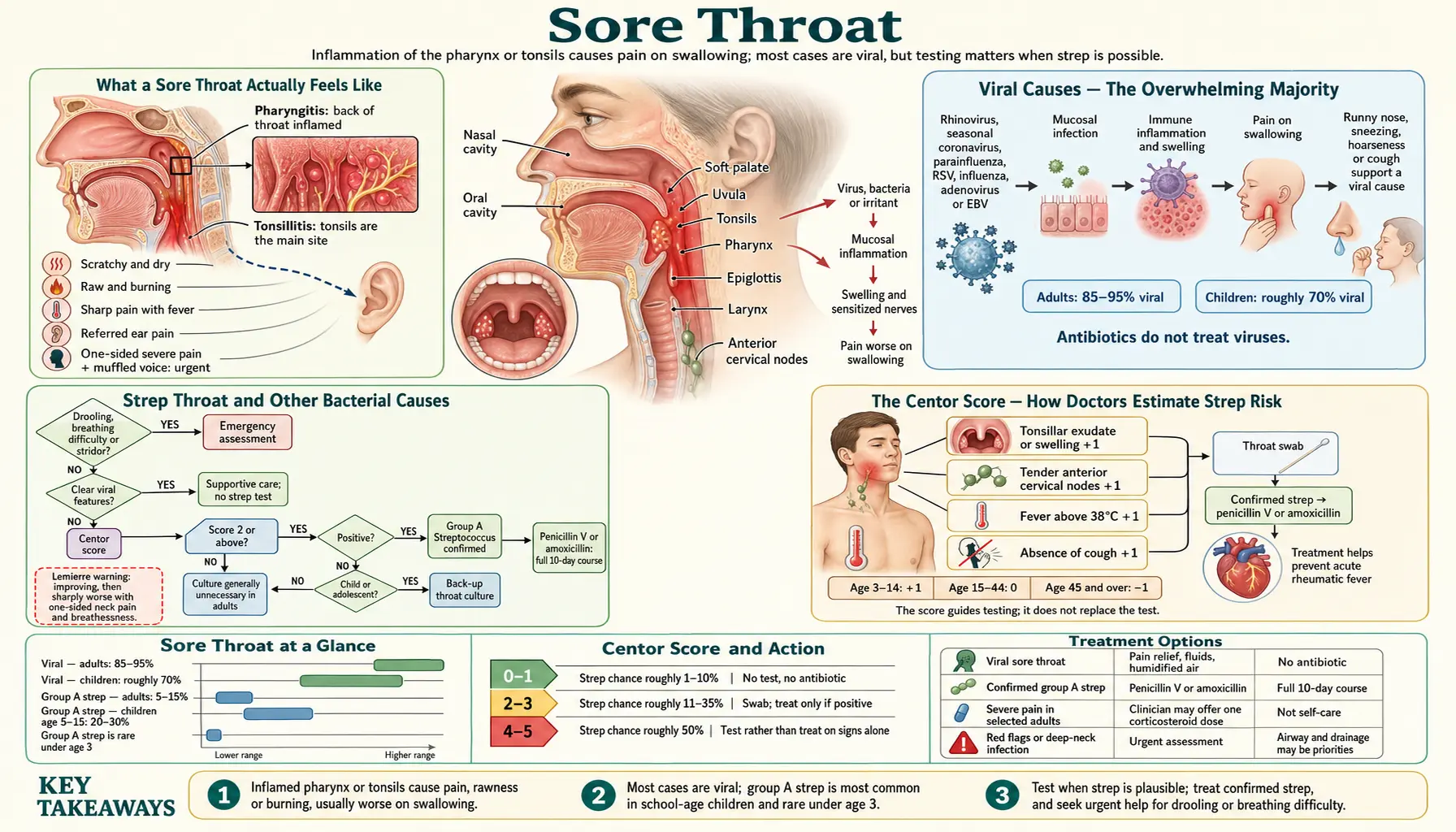
Table of Contents
- What a Sore Throat Actually Feels Like
- Viral Causes — The Overwhelming Majority
- Strep Throat and Other Bacterial Causes
- The Centor Score — How Doctors Estimate Strep Risk
- Sore Throats That Are Not Infections
- Red Flags — When to Get Help Urgently
- How a Sore Throat Is Evaluated
- Why Most Sore Throats Need No Antibiotic
- What Actually Helps
- What to Expect Over Time
- Connections
- Key Research Papers
- Featured Videos
What a Sore Throat Actually Feels Like
A sore throat — pharyngitis when the back of the throat is inflamed, tonsillitis when the tonsils are the main site — is pain, rawness or burning in the throat, almost always worse on swallowing. It is one of the commonest reasons people see a doctor, and most of those visits end with a diagnosis that needs no prescription at all.
How it feels is genuinely useful information:
- Scratchy and dry, worst on waking — the first day of a cold, or simply dry air, mouth breathing and snoring.
- Raw and burning across the whole throat — typical viral pharyngitis. Swallowing food and swallowing saliva both hurt.
- Sharp, knife-like pain on swallowing, with fever — more suggestive of streptococcus. People say it feels like swallowing broken glass, and they stop eating.
- Pain shooting into one ear. Throat and ear share nerve supply, so throat inflammation is often referred to a normal ear. Harmless acutely — but one-sided ear pain past three weeks needs looking at.
- Tightness or a lump without real pain — usually not inflammation but reflux, muscle tension or globus sensation.
- One-sided and severe, with a muffled voice and trouble opening the mouth — the pattern of pus beside the tonsil. Urgent.
The company a sore throat keeps matters as much as the throat itself. Runny nose, sneezing, hoarseness and cough point strongly to a virus. High fever, tender glands in the front of the neck, pus on the tonsils and no cough shift the odds toward strep. Crushing fatigue with swollen glands at the back of the neck, in a teenager or young adult, raises the question of glandular fever.
Viral Causes — The Overwhelming Majority
Between 85% and 95% of sore throats in adults are viral, and roughly 70% in children. No antibiotic touches a virus, so knowing which one you have changes what to expect, not what to take.
Cold Viruses, Influenza and Adenovirus
Rhinoviruses are the largest single cause; seasonal coronaviruses, parainfluenza and RSV behave the same way. The sore throat is a brief opening act, peaking on day one or two, giving way to nasal congestion and fading in three to five days — see Common Cold. Influenza puts a sore throat inside a whole-body illness: fever of 38.5–40 °C, chills, headache, deep muscle aching, exhaustion arriving over hours rather than days.
Adenovirus is the great imitator: white patches on the tonsils, high fever and tender neck glands that look bacterial to the naked eye. The tell is often red, gritty conjunctivitis alongside. It can run seven to ten days, and it is a large part of why looking at a throat is not good enough to diagnose strep.
Epstein-Barr Virus and Glandular Fever
Epstein-Barr virus causes infectious mononucleosis, the classic sore throat of adolescence. The pattern is distinctive: a throat that keeps getting worse over five to ten days, hugely enlarged tonsils that can nearly meet in the middle, a thick grey-white membrane, swollen glands at the back of the neck and in the armpits and groin, and fatigue out of all proportion to everything else. About half have an enlarged spleen.
Two practical points matter enormously. Amoxicillin or ampicillin given during mono causes a florid itchy rash in a large share of patients — not a true penicillin allergy, but a common reason people are mislabelled penicillin-allergic for life. And because the spleen can rupture, contact sports and heavy lifting are avoided for at least three to four weeks. The fatigue often lasts a month or more; see Fatigue.
Mouth-Ulcer Viruses, and Acute HIV
Discrete ulcers or blisters inside the mouth are one of the most reliable signals that a sore throat is viral, because streptococcus does not produce them: coxsackieviruses cause herpangina and hand, foot and mouth disease, and herpes simplex causes a primary gingivostomatitis with fever and drooling. (Recurrent ulcers without fever are a different problem — see Canker Sores.) Two to four weeks after HIV exposure, many people develop an acute retroviral syndrome mimicking mono: fever, sore throat, generalised swollen glands, muscle aches, trunk rash. A fourth-generation antigen/antibody test is appropriate for any mono-like illness with a negative EBV workup — see HIV/AIDS.
Strep Throat and Other Bacterial Causes
Group A Streptococcus
Group A Streptococcus (Streptococcus pyogenes) is the bacterium worth identifying, and it is far less common than most people assume: roughly 5–15% of sore throats in adults and 20–30% in children aged 5 to 15. It is genuinely rare under age three. See Strep Throat and Streptococcus pyogenes.
The classic picture is fever, tender glands in the front of the neck, pus or swelling on the tonsils and no cough. Supporting features: pinpoint red spots on the soft palate, a strawberry-red tongue, bad breath, headache and — in children especially — nausea, vomiting and abdominal pain. Some develop scarlet fever, a fine sandpaper-textured rash starting on the trunk and sparing the skin around the mouth. None of this is diagnostic alone: clinicians predicting strep from the throat are right only about half the time, which is exactly why testing exists.
Why Strep Is Treated At All
Strep throat is self-limited — untreated, fever settles in three to five days and pain in about a week. Antibiotics are given for four reasons, in descending order of importance:
- To prevent acute rheumatic fever, an immune reaction days to weeks later that can permanently scar heart valves. In high-income countries incidence has fallen well below one case per 100,000 per year, so the benefit to an average patient is small; in Indigenous, Pacific Island and many low- and middle-income populations it remains substantial.
- To reduce suppurative complications — peritonsillar abscess, ear infection, sinus infection.
- To shorten contagiousness. Untreated strep is transmissible for two to three weeks; after 12–24 hours of an effective antibiotic and no fever, a person can generally return to school or work.
- To shorten symptoms modestly — real, but small (see below).
Antibiotics do not prevent post-streptococcal glomerulonephritis.
What Strep Is Treated With
Remarkably, after seventy years of use, Streptococcus pyogenes has never developed penicillin resistance — not one confirmed resistant clinical isolate. Penicillin V or amoxicillin remain first-line for a full 10-day course; the 10 days is for rheumatic-fever prevention, not symptom relief, which is why finishing matters even though you feel fine by day three. Typical adult dosing is penicillin V 500 mg two to three times daily or amoxicillin 500 mg twice daily; children commonly get amoxicillin 50 mg/kg once daily to a 1000 mg maximum. For non-anaphylactic penicillin allergy, cephalexin; for true anaphylaxis, clindamycin or a macrolide — noting macrolide resistance of a few percent up to over 20% by region.
Other Bacteria, and Lemierre Syndrome
Fusobacterium necrophorum is an under-appreciated anaerobic cause in adolescents and young adults, found in university-clinic sore throats at rates comparable to group A strep. It can invade the neck and cause Lemierre syndrome — septic clotting of the internal jugular vein throwing infected emboli to the lungs. The warning pattern: a sore throat that seems to be improving, then sharply worsens after about a week, with rigors, severe one-sided neck pain or swelling, and breathlessness. Rare, lethal, and missed precisely because the first week looked ordinary. Less often: groups C and G streptococci (outbreaks in young adults, no rheumatic fever); Neisseria gonorrhoeae, missed unless a sexual history is taken because strep tests will not find it; Mycoplasma pneumoniae, with a prolonged dry cough; and diphtheria, a tough grey membrane that bleeds when scraped — an airway emergency wherever vaccination coverage has collapsed.
The Centor Score — How Doctors Estimate Strep Risk
Because no single sign separates viral from streptococcal pharyngitis, clinicians use a simple point score — published by Robert Centor and colleagues in 1981, modified by Warren McIsaac in 1998 to add age. It is the reason a doctor may examine your throat and then decline to swab it. The Centor criteria award one point each for:
- Tonsillar exudate or swelling — pus, white patches or enlarged tonsils.
- Tender, swollen anterior cervical nodes — glands in the front of the neck, along the jaw line.
- History of fever above 38 °C (100.4 °F).
- Absence of cough. This one surprises people: a cough counts against strep, because it reflects the lower-airway irritation of a viral illness.
The McIsaac modification adds +1 for ages 3–14, 0 for ages 15–44 and −1 for age 45 and over, reflecting the real biology that strep pharyngitis is a disease of school-age children and becomes uncommon in middle age. Approximate chance of group A strep by score:
- 0 to 1 — roughly 1–10%. No test, no antibiotic. Testing here mostly finds asymptomatic carriers, and treating carriers has no benefit.
- 2 to 3 — roughly 11–35%. This is where testing earns its keep: swab, treat only if positive.
- 4 to 5 — roughly 50%. Still a coin flip, which is why Infectious Diseases Society of America guidance recommends testing rather than treating on clinical grounds alone.
That last line is the crux of the subject. A perfect score — pus, swollen glands, fever, no cough — feels like certainty to the person suffering it, and is still wrong half the time, because adenovirus and EBV produce exactly that picture. The score decides whom to test; it does not replace the test.
Sore Throats That Are Not Infections
If a sore throat has lasted more than two or three weeks, or keeps returning without fever, infection is probably not the answer. These causes are common, frequently missed, and frequently met with pointless repeat antibiotics.
Reflux, especially the silent kind. Stomach contents reaching the throat cause morning hoarseness, throat clearing, a lump sensation, postnasal drip and a burning throat worst on waking that eases through the day. Many people with laryngopharyngeal reflux have no heartburn at all, which is why it is missed — see also GERD and Reflux and Heartburn. Not eating within three hours of bed, raising the head of the bed and cutting alcohol often help throat symptoms more than acid-suppressing drugs do.
Dry air, mouth breathing, allergy and irritants. A throat sore on waking and fine by mid-morning, in a heated bedroom in winter, is a dry throat. Nasal obstruction from allergic rhinitis, nasal polyps, a deviated septum or sinusitis forces overnight mouth breathing, and snoring or sleep apnea adds vibratory trauma. Allergy gives an itchy throat with sneezing and itchy eyes — never fever or pus. Smoke, vaping aerosol and occupational dusts irritate directly; shouting strains the larynx (see Laryngitis and Vocal Cord Dysfunction); and inhaled asthma steroids cause irritation and thrush unless the mouth is rinsed after each dose.
Medication and bone-marrow causes — the dangerous exception. Methimazole and carbimazole (overactive thyroid), clozapine, sulfasalazine, methotrexate and chemotherapy can all cause agranulocytosis, a collapse in neutrophils presenting as severe sore throat and mouth ulceration. Anyone on these drugs with fever and a sore throat needs a same-day full blood count, not wait-and-see. This is a true emergency with no dramatic local findings.
Thyroid, autoimmune and malignant causes. Subacute thyroiditis causes anterior neck pain read as a sore throat, the giveaway being exquisite tenderness of the gland itself; Sjögren's syndrome causes chronic dryness; Kawasaki disease in small children includes a red throat and lips. Cancers of the tonsil, tongue base and larynx present as a persistent, often one-sided sore throat, and HPV-associated oropharyngeal cancer now occurs in non-smokers, often first showing as a painless neck lump — see Laryngeal Cancer.
Red Flags — When to Get Help Urgently
Almost every sore throat is harmless. A small number are airway or deep-tissue emergencies, and they announce themselves fairly specifically.
Airway Danger — Go Now
- Drooling, or spitting because swallowing saliva is impossible. Someone who cannot manage their own secretions has significant swelling between mouth and voice box. This is the single most important red flag on this page.
- Difficulty breathing, noisy breathing or stridor — a high-pitched sound on breathing in.
- Sitting bolt upright, leaning forward, chin thrust out, refusing to lie down. That posture is the body maximising a narrowed airway, and it is classic for epiglottitis — swelling of the flap above the voice box that can close the airway within hours, now more common in adults than children. Do not poke at the throat with a spoon or tongue depressor; get to an emergency department.
- Severe pain with a throat that looks surprisingly normal, especially with a muffled voice — deep-neck and supraglottic infection sits below the visible pharynx.
- Throat or tongue swelling with hives, lip swelling or wheeze — anaphylaxis or angioedema, not pharyngitis. Use adrenaline if prescribed and call emergency services.
Deep-Neck Infection — Same-Day Assessment
- One-sided swelling pushing the uvula across to the other side, a hot-potato or muffled voice, and inability to open the mouth fully (trismus) — a peritonsillar abscess (quinsy). It needs drainage plus antibiotics; antibiotics alone usually are not enough.
- Neck stiffness, refusal to turn the head, or firm swelling under the jaw or in the floor of the mouth — retropharyngeal abscess or Ludwig's angina, both of which can close the airway.
- Improvement then sharp worsening after about a week in a teenager or young adult, with rigors and one-sided neck pain — the Lemierre pattern.
- Spreading redness of the neck skin (see Cellulitis), or confusion, low blood pressure, racing pulse and mottled skin (see Sepsis).
Urgent, Though Not an Emergency
- Fever plus sore throat on methimazole, carbimazole, clozapine, methotrexate or chemotherapy — same-day blood count to exclude agranulocytosis.
- A sore throat lasting more than three weeks, especially one-sided, or with hoarseness beyond three weeks, one-sided referred ear pain, a neck lump, blood in the saliva or unexplained weight loss. In a current or former smoker or heavy drinker this warrants urgent ENT referral. Progressive trouble swallowing solids belongs here too — see Dysphagia.
- A sandpaper rash with a strawberry tongue — likely scarlet fever, which should be treated.
- Any sore throat in someone immunosuppressed — transplant recipients, people on biologics or high-dose steroids, advanced HIV. The reassuring rules do not apply.
- New joint swelling, chest pain, breathlessness, or dark or bloody urine two to four weeks after a sore throat — possible rheumatic fever or post-streptococcal kidney disease.
- In a child: not drinking, no urine passed for eight hours or more, unusual drowsiness, or drooling.
How a Sore Throat Is Evaluated
For a typical sore throat, evaluation is a conversation and a look in the mouth. Nothing more — blood tests and imaging are for the exceptions.
History and Examination
The clinician is establishing duration and trajectory (days suggest infection, weeks suggest reflux, allergy, irritant or tumour); whether there is cough, runny nose, hoarseness or red eyes, each shifting probability toward a virus; fever; one side or both, since strictly one-sided pain always earns extra attention; and whether you can swallow your own saliva, the single most important question. Also sick contacts (a household member with confirmed strep raises the odds considerably), the full medication list, and a sexual history for pharyngeal gonorrhoea and acute HIV, which is not asked often enough.
The examination covers temperature and pulse; whether the person can speak in full sentences, is drooling, and how the voice sounds; tonsil size and symmetry, exudate, palatal petechiae, uvular position, ulcers, and whether the mouth opens fully; the neck — anterior nodes (strep) versus posterior and generalised nodes (mono, HIV), any firm, fixed or painless node, thyroid tenderness; the spleen when mono is suspected; and the chest for pneumonia or the septic emboli of Lemierre syndrome.
Tests, and When They Are Justified
- Rapid antigen detection test (RADT) for group A strep — a throat swab read in minutes. Specificity is high, around 95%, so a positive can be acted on directly; sensitivity is lower and more variable, roughly 85% pooled in children, so a negative does not fully exclude strep. Guidance is to test those with a suggestive presentation (Centor 2 or above) and not those with clear viral features.
- Throat culture — the reference standard at roughly 90–95% sensitivity, but 24 to 48 hours for a result. Guidelines advise backing up a negative rapid test with culture in children and adolescents, where strep prevalence and rheumatic-fever risk are higher, and call it generally unnecessary in adults. Molecular (PCR) testing is more sensitive still, but also detects carriers who need no treatment.
- Heterophile antibody test (Monospot) — for suspected mono, but frequently negative in the first week and unreliable in young children; repeat it or send EBV-specific antibodies. A full blood count supports the diagnosis (lymphocytosis with atypical lymphocytes) — and a neutrophil count near zero is agranulocytosis, which changes everything.
- Fourth-generation HIV antigen/antibody test for any mono-like illness, and pharyngeal NAAT for gonorrhoea and chlamydia when the sexual history warrants it.
- Anti-streptolysin O (ASO) titre — not a test for an acute sore throat. It reflects past infection and takes weeks to rise; its role is diagnosing rheumatic fever or post-streptococcal kidney disease retrospectively. Ordering it acutely is a common and unhelpful mistake.
- Contrast CT of the neck for suspected abscess or Lemierre syndrome, and flexible nasolaryngoscopy for suspected epiglottitis — and mandatory for any unexplained sore throat, hoarseness or one-sided ear pain past three weeks.
What a doctor is chiefly ruling out, in order of urgency: airway obstruction, deep-neck abscess, sepsis, agranulocytosis, Lemierre syndrome — then group A strep, then malignancy in the persistent cases.
Why Most Sore Throats Need No Antibiotic
Stated plainly, because it is the commonest source of frustration in a sore-throat consultation: for the great majority of sore throats an antibiotic will not make you better faster, and it carries real costs.
The evidence is unusually solid. The Cochrane systematic review of antibiotics for sore throat, pooling many thousands of participants across decades of randomised trials, found that antibiotics shorten symptoms by about 16 hours on average across the whole week of illness. Sixteen hours — and the review's authors are explicit that the absolute benefits are modest.
Against that sit real harms: diarrhoea, nausea, rash and thrush, affecting roughly one in ten people taking a course; allergic reactions including rare anaphylaxis; Clostridioides difficile colitis; the amoxicillin–mono rash that mislabels people as penicillin-allergic for decades; resistance, in your own flora and at population level; and medicalisation — people given an antibiotic for a viral sore throat return for one next time, multiplying every harm above. A UK general-practice randomised trial comparing a clinical score, a rapid antigen test and delayed prescribing found score- or test-guided strategies cut antibiotic use without leaving patients worse off, and a parallel cohort of thousands of presentations found suppurative complications such as quinsy genuinely uncommon — around 1.3% — with clinical severity, not prescribing, the main predictor.
So: antibiotics are for confirmed or strongly suspected group A strep, for scarlet fever, quinsy and deep-neck infection where they are essential, for people at elevated rheumatic-fever risk, and for the immunosuppressed and seriously unwell. For everyone else a delayed or "back-up" prescription — fill it only if you are not improving in three to five days — is a well-validated middle path that most people are content with once the reasoning is explained.
What Actually Helps
Pain Relief, Which Is the Main Event
Since most sore throats are self-limiting viral illnesses, treatment is symptom control — and it deserves to be taken seriously rather than dismissed.
- Ibuprofen or another NSAID — generally the most effective simple analgesic here, because the pain is inflammatory; several trials found it better than paracetamol for pharyngitis specifically. Take it with food, and check first if you have kidney disease, ulcer disease or take anticoagulants.
- Paracetamol (acetaminophen) — effective, better tolerated, and can be alternated with ibuprofen for continuous cover. No aspirin for children or teenagers with a viral illness, because of Reye's syndrome.
- Medicated sprays and lozenges — benzydamine spray, and lozenges with benzocaine, lidocaine, amylmetacresol or flurbiprofen, give real short-term relief, partly by stimulating saliva. Avoid lozenges in young children (choking).
A Single Dose of Steroid, in Selected Cases
A single dose of corticosteroid, typically dexamethasone 10 mg in adults, measurably speeds resolution of severe sore throat. A 2017 systematic review and meta-analysis in the BMJ found steroids roughly doubled the chance of complete pain resolution at 24 hours, with about one extra person pain-free at 48 hours for every four treated; the large UK TOAST trial the same year found no significant benefit at 24 hours but a clear one at 48, without any antibiotic. This is an option a clinician may offer an adult in severe pain — not a self-care measure — and it is avoided in diabetes, immunosuppression, suspected abscess and pregnancy without specific advice.
Physical Measures
- Salt-water gargle — half a teaspoon of salt in a cup of warm water, several times a day. The trial evidence is weak, the mechanism plausible, the harm zero, and many people find it genuinely soothing.
- Cold things. Ice chips, ice lollies and frozen fruit numb the pharynx, and in a child refusing fluids they are often the single most effective intervention. Warm drinks help others equally well — follow your preference rather than a rule.
- Fluids. Dehydration makes a sore throat worse and is the commonest reason viral pharyngitis ends in a hospital visit, particularly in children and older adults.
- Humidified air; rest the voice and avoid whispering, which strains the larynx more than quiet speech; stop smoking and vaping at least for the duration; and stick to soft, bland food.
Honey, Herbs and Nutrients
Honey has the best evidence of any traditional remedy here: a 2021 systematic review and meta-analysis in BMJ Evidence-Based Medicine concluded that honey improves upper respiratory infection symptoms — particularly cough frequency and severity — more effectively than usual care. It coats the pharynx, stimulates salivation and is mildly antibacterial; a teaspoon plain or in warm water works. Never give honey to an infant under 12 months, because of infant botulism. See Honey.
Demulcent herbs — those forming a soothing mucilaginous film — are traditional remedies with limited but not absent evidence: Slippery Elm, Marshmallow Root and Licorice work by physical coating, though liquorice raises blood pressure and lowers potassium with sustained use. Sage has the most direct trial data — a sage-and-echinacea spray performed comparably to a chlorhexidine–lidocaine spray in a randomised trial of acute pharyngitis — while Echinacea and Elderberry have mixed evidence for shortening colds. Zinc lozenges started on day one appear to shorten a cold somewhat, though they commonly cause nausea and taste disturbance, and high-dose Vitamin C does not prevent colds. None treat strep, and none substitute for evaluating a red flag.
What does not help: antibiotics for a viral sore throat, antiseptic mouthwashes as a treatment for pharyngitis, and repeated antibiotic courses for a chronic sore throat — once three weeks have passed the answer lies in reflux, allergy, dryness, irritants or something that needs looking at, not in a fourth prescription.
What to Expect Over Time
Knowing the normal course is what lets you recognise the abnormal one.
- Viral pharyngitis with a cold: pain peaks on day two or three and is largely gone by day five to seven, with nasal symptoms and cough outlasting it. About 90% of people with an ordinary sore throat are better within a week — whatever the cause, whatever the treatment. Adenovirus runs seven to ten days; influenza gives three to five days of fever, then one to two weeks of fatigue.
- Untreated group A strep: fever settles in three to five days, pain in about a week; contagious two to three weeks. Treated: noticeably better in 24 to 48 hours and non-infectious after 12–24 hours of antibiotics plus resolution of fever — but the course still needs finishing, and no improvement after 48 to 72 hours means the diagnosis or a complication needs revisiting.
- Infectious mononucleosis: the throat is worst in the second week, then improves over two to three weeks; fatigue commonly lasts a month or more, with spleen precautions for at least three to four weeks.
- Recurrent tonsillitis: surgery is considered only for frequent, documented episodes — the widely used Paradise threshold is roughly seven in one year, five a year for two years, or three a year for three years, each with objective findings. See Tonsillitis.
Go back to a clinician if you are worse rather than better after three days; it has lasted more than a week without improving; the pain becomes one-sided or you cannot open your mouth; a fever returns after settling; you cannot drink enough to stay hydrated; or any red flag above appears. And go back at three weeks regardless of how mild it is — a sore throat that will not leave is a different diagnostic problem from one that has just arrived.
Connections
- All Symptoms
- Fever
- Swollen Lymph Nodes
- Chronic Cough
- Reflux and Heartburn
- Fatigue
- Strep Throat
- Tonsillitis
- Peritonsillar Abscess
- Epiglottitis
- Mononucleosis
- Streptococcus pyogenes
- Herbs covered on this site that discuss this condition: Self-Heal (Prunella vulgaris) · Agrimony · Baheda (Terminalia bellirica) · Chrysanthemum (Chrysanthemum morifolium) · Coltsfoot
- Discussed in depth on these pages: Strep Throat · Sage for Antimicrobial Use & Sore Throat
Key Research Papers
Key Research Papers
- Shulman ST, Bisno AL, Clegg HW, et al. Clinical practice guideline for the diagnosis and management of group A streptococcal pharyngitis: 2012 update by the Infectious Diseases Society of America. Clinical Infectious Diseases. 2012;55(10):e86-e102. — Search PubMed
- Spinks A, Glasziou PP, Del Mar CB. Antibiotics for treatment of sore throat in children and adults. Cochrane Database of Systematic Reviews. 2021;Issue 12:CD000023. — Search PubMed
- Centor RM, Witherspoon JM, Dalton HP, Brody CE, Link K. The diagnosis of strep throat in adults in the emergency room. Medical Decision Making. 1981;1(3):239-246. — Search PubMed
- McIsaac WJ, White D, Tannenbaum D, Low DE. A clinical score to reduce unnecessary antibiotic use in patients with sore throat. Canadian Medical Association Journal. 1998;158(1):75-83. — Search PubMed
- Ebell MH, Smith MA, Barry HC, Ives K, Carey M. Does this patient have strep throat? JAMA. 2000;284(22):2912-2918. — Search PubMed
- Cohen JF, Bertille N, Cohen R, Chalumeau M. Rapid antigen detection test for group A streptococcus in children with pharyngitis. Cochrane Database of Systematic Reviews. 2016;Issue 7:CD010502. — Search PubMed
- Sadeghirad B, Siemieniuk RAC, Brignardello-Petersen R, et al. Corticosteroids for treatment of sore throat: systematic review and meta-analysis of randomised trials. BMJ. 2017;358:j3887. — Search PubMed
- Hayward GN, Hay AD, Moore MV, et al. Effect of oral dexamethasone without immediate antibiotics vs placebo on acute sore throat in adults: a randomized clinical trial. JAMA. 2017;317(15):1535-1543. — PubMed PMID: 28418482
- Little P, Stuart B, Hobbs FDR, et al. Predictors of suppurative complications for acute sore throat in primary care: prospective clinical cohort study. BMJ. 2013;347:f6867. — PubMed PMID: 24277339
- Abuelgasim H, Albury C, Lee J. Effectiveness of honey for symptomatic relief in upper respiratory tract infections: a systematic review and meta-analysis. BMJ Evidence-Based Medicine. 2021;26(2):57-64. — PubMed PMID: 32817011