Self-Heal (Prunella vulgaris)
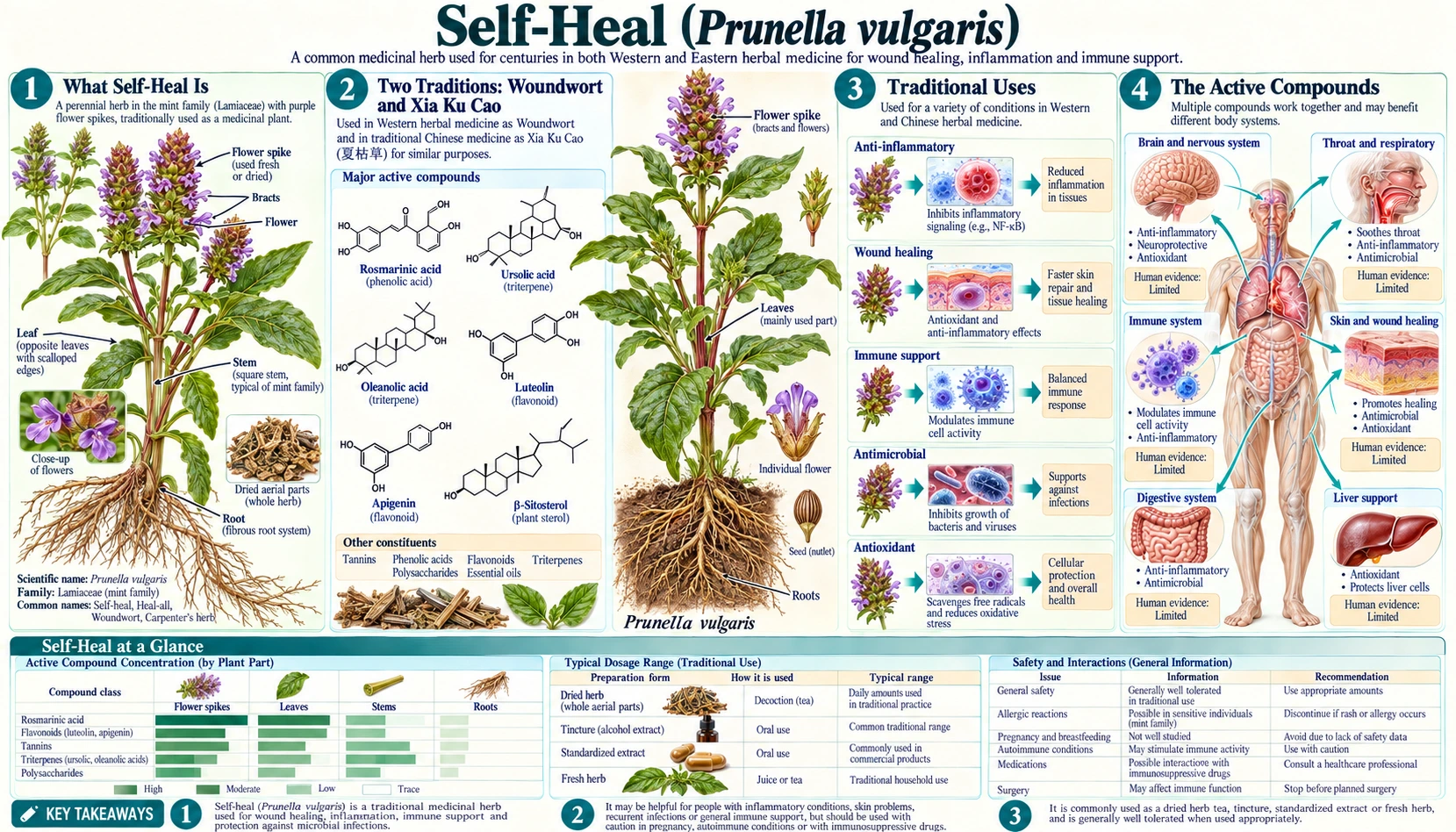
Some plants earn their reputation the hard way, and Self-Heal is one of them. Botanically it is Prunella vulgaris, a low, creeping member of the mint family that turns up in lawns, meadows, and roadside grass across much of the world, topped by short club-shaped spikes of violet flowers. Its common names read like a promise: heal-all, self-heal, woundwort, carpenter's herb. Half a world away, Chinese medicine independently adopted the very same plant as Xia Ku Cao (夏枯草) and made it a staple for the eyes, for swellings and lumps, and for what it called "liver heat." When two traditions that never spoke to each other reach for the same weed to close cuts and calm inflammation, it is worth a closer look.
This page explains what Self-Heal is, why both European and Chinese healers trusted it, which plant chemicals seem to do the work, and — honestly — what modern science has and has not shown. The short version: there is genuinely interesting laboratory and animal evidence that Self-Heal is anti-inflammatory, antioxidant, antimicrobial, and even antiviral (its activity against the herpes virus in cell studies is a real and intriguing finding), and, for the thyroid, Chinese randomised trials of Self-Heal added to standard thyroid drugs, which reviewers rate as low or uncertain quality; other human trials are almost absent. So most of its uses remain traditional and preclinical: a gentle, edible, low-risk herb worth knowing, not a proven cure.
Table of Contents
What Self-Heal Is
Self-Heal belongs to the mint family (Lamiaceae), and it shows the family traits if you look closely: a square stem, pairs of leaves set opposite each other, and small two-lipped flowers. It is a low, sprawling perennial, usually only 10–30 cm tall, that spreads sideways by creeping runners — which is exactly why it thrives in mown lawns and grazed meadows where taller plants get cut back. In summer each stem is tipped by a short, blunt, squarish flower spike, packed with hooded violet-to-purple blooms sitting among reddish-brown bracts. That spike is the important part.
The dried flowering spike is what herbalists collect and what pharmacies of traditional Chinese medicine dispense. In China the herb is called 夏枯草, which translates roughly as "summer-withering grass," a beautifully literal name: the spike ripens and browns in midsummer, so it is gathered just as it dries on the plant. The tan, cone-like dried spike almost looks like a tiny pine cone. The leaves are edible too — young ones are mild and only slightly bitter — which is one reason the plant has such a long, easy relationship with people.
Prunella vulgaris is close to cosmopolitan. It is native across Europe, temperate Asia, and North Africa, and it grows throughout North America, where botanists still argue over how much is native and how much arrived with settlers. Either way, for most readers it is a plant you have probably already walked past — and possibly mowed over — without knowing its name.
Two Traditions: Woundwort and Xia Ku Cao
What makes Self-Heal unusual is that two great herbal traditions adopted it separately, and both built their use around the ideas of healing and cooling.
The European "heal-all"
In Europe the plant's names tell its whole story. Self-heal, heal-all, and woundwort point to its reputation as a first-aid herb: crushed and pressed onto cuts, grazes, and minor wounds to stop bleeding and help skin knit back together, and steeped as a wash or gargle for sore throats and mouth sores. The German name for the plant, Brunelle, is traditionally tied to die Bräune, an old word for an inflamed, sore throat — the very condition it was used to soothe. Renaissance herbalists praised it as a wound herb that "there is not a better in the world," and country people kept it in the hedgerow first-aid kit for centuries.
The Chinese Xia Ku Cao
Chinese medicine took the same plant in a different direction. Classified as cooling and bitter, Xia Ku Cao was used to "clear liver heat" — a traditional pattern that maps loosely onto red, sore, swollen eyes, headaches, dizziness, and high blood pressure. Just as importantly, it was a classic remedy for scrofula, goiter, and "phlegm nodules": lumps, swollen lymph nodes, and thyroid swellings in the neck. That focus on the eyes, the head, and on dissolving lumps is quite different from Europe's wound emphasis, yet the underlying logic — a cooling, calming, anti-inflammatory herb — is strikingly similar. Two traditions, one plant, the same instinct.
Traditional Uses
Pulling both traditions together, here is what people have historically reached for Self-Heal to do. None of these are modern medical claims — they are the herb's traditional indications, some of which now have early laboratory support.
- Wound care: fresh crushed leaves as a poultice, or a strong cooled infusion as a wash, on minor cuts, scrapes, and small bleeds — the original "woundwort" use.
- Sore throats and mouth problems: a cooled tea used as a gargle or mouth rinse for sore throats, mouth ulcers, and inflamed gums.
- Cooling "heat" and fevers: a tea taken as a gentle cooling drink during feverish, inflammatory conditions.
- Eyes and head (traditional Chinese medicine, TCM): a decoction for red, irritated, or watery eyes, and for headaches and dizziness linked in tradition to high blood pressure.
- Lumps and swellings (TCM): Xia Ku Cao for goiter, swollen glands, and other "nodules" in the neck.
- Everyday skin irritation: a soothing wash for minor rashes and inflamed skin.
The through-line across every one of these is the same: a cooling, soothing, mildly astringent, anti-inflammatory herb. That consistency is part of why it is worth taking seriously — and also why the honest scientific picture below matters so much.
The Active Compounds
Self-Heal is chemically rich, and researchers have a good idea of which constituents are likely doing the work. The flowering spike concentrates most of them.
- Triterpenic acids — ursolic and oleanolic acid. These two closely related pentacyclic triterpenes are among the herb's best-studied constituents. They have well-documented anti-inflammatory activity, and when researchers isolated the anti-allergic, anti-inflammatory fraction of Self-Heal, ursolic and oleanolic acids were what they found.
- Rosmarinic acid. A caffeic-acid ester and a powerful antioxidant and anti-inflammatory compound. Self-Heal is one of the richer plant sources of it — the same compound gives lemon balm and sage much of their activity — and it is a strong candidate for many of the herb's effects, including its action on skin cells.
- Other phenolic acids and flavonoids. Caffeic and chlorogenic acids and a range of flavonoids (such as rutin, hyperoside, and quercetin glycosides) add to the antioxidant load.
- "Prunellin" — a sulfated polysaccharide. A large, sugar-based, sulfate-carrying molecule isolated from water extracts of the herb. This fraction is the one most studied for antiviral activity against human immunodeficiency virus (HIV) and herpes viruses in the laboratory.
- Triterpenoid saponins, an aromatic essential oil, and mineral salts. The herb is also notably high in potassium salts, which is one proposed (and still unproven) basis for the mild diuretic and blood-pressure ideas in tradition.
What the Evidence Shows
Here is where honesty matters most. The great majority of the science on Self-Heal is done in test tubes (in vitro) and in animals (in vivo). That work is genuinely interesting and remarkably consistent — but rigorous, well-controlled human clinical trials are essentially lacking outside the Chinese thyroid trials described below. So the fair way to think about Self-Heal is as a herb with a strong traditional record and encouraging laboratory science behind it, not one with proven cures in people.
Anti-inflammatory and antioxidant activity
This is the best-supported area. Driven mainly by rosmarinic acid and the triterpenic acids, Self-Heal extracts calm inflammatory signaling and mop up reactive oxygen in cell and animal studies. Extracts protect human skin cells from oxidative and light-induced damage, quench free radicals in the test tube and in tumor-bearing mice, and dampen inflammation in blood-vessel cells by switching on the protective Nrf2/HO-1 antioxidant pathway. It is a believable mechanistic basis for the herb's traditional "cooling" reputation.
Antimicrobial activity
Self-Heal extracts inhibit a range of bacteria and fungi in laboratory tests. That fits neatly with the old uses as a wound wash and a throat gargle — though it is important to say that inhibiting microbes in a dish is not the same as proving the tea disinfects a real wound or cures a real throat infection in a person.
Immune modulation
In laboratory models, Self-Heal extracts influence immune-cell behavior, nudging parts of the immune response up or down. This "immunomodulatory" activity is one reason the herb is studied for both infections and inflammatory conditions — and, as noted in the safety section, the basis of a theoretical concern alongside immune-affecting medications.
Antiviral activity
This is the herb's most eye-catching modern finding, and it gets its own section below. In short, Self-Heal extracts and their polysaccharides repeatedly block herpes simplex virus in cell culture.
Thyroid trials, and preliminary blood-pressure and cancer signals
The traditional Chinese medicine uses for goiter, high blood pressure, and lumps have attracted research. There are cell and animal studies suggesting anti-proliferative effects on some cancer cell lines, and the antioxidant, mineral, and anti-inflammatory chemistry gives a plausible (if unproven) rationale for the blood-pressure use. For blood pressure and cancer these are early signals in dishes and animals, not evidence that Self-Heal treats hypertension or cancer in people.
The thyroid is different: Chinese hospitals use Self-Heal (Xia Ku Cao) preparations alongside standard thyroid drugs, and randomised trials of that combination have been pooled in two reviews.
- Overactive thyroid (hyperthyroidism). A 2025 review of 17 randomised trials with 1,366 patients (Wei and colleagues) found that adding Self-Heal preparations to antithyroid drugs lowered the thyroid hormones free T3 and free T4 and the thyroid-stimulating antibody more, shrank the thyroid gland more, and came with fewer side effects (a risk ratio of 0.34) than antithyroid drugs alone. Relapse rates were similar either way. The authors state that, owing to the low strength of evidence from these trials, the conclusion needs checking in higher-quality trials.
- Thyroid nodules. A 2021 review of 13 randomised trials with 1,468 patients (Han and colleagues) found that Self-Heal preparations taken with levothyroxine gave a better overall response and reduced nodule diameter more than levothyroxine alone, with no rise in side effects. The authors call the quality of these trials uncertain.
In both sets of trials, Self-Heal was given alongside antithyroid drugs or levothyroxine, not instead of them.
A Closer Look at the Antiviral Research
Of all the laboratory findings, the antiviral work is the one that keeps drawing scientists back. Several independent research groups have shown that water extracts of Prunella vulgaris, and the sulfated polysaccharide fractions purified from them, strongly inhibit herpes simplex virus — both HSV-1 (the usual cause of cold sores) and HSV-2 — in cell culture. Strikingly, the activity has been reported even against some virus strains that resist the standard antiviral drug acyclovir.
The likely mechanism is easy to picture. The herb's big, sulfate-studded sugar molecules appear to interfere with the earliest step of infection: the virus's attachment to and entry into a cell. In plain terms, the polysaccharide seems to coat the virus or occupy the docking sites it needs, so far fewer virus particles ever get inside. Studies have also shown the extract reducing the amount of viral antigen the infected cells produce. The interest runs deep enough that a related anti-HIV polysaccharide from the same plant, nicknamed prunellin, was described back in 1989.
The numbers from one of the key studies (Xu and colleagues, 1999) show what this looks like. Their purified sugar molecule halved the number of herpes plaques (patches of infected cells) at 10 micrograms per millilitre, for both HSV-1 and HSV-2, and it worked equally well on virus taken from patients and on strains resistant to acyclovir. It did not work against cytomegalovirus, influenza A or B, poliovirus or vesicular stomatitis virus, so its action was specific to herpes. Mixing the virus with the polysaccharide before infection wiped out its infectivity, while treating the cells beforehand did not protect them; added up to 8 hours after infection, it still cut the yield of new virus inside cells by 94–100%. The authors concluded it may compete for the cell receptors the virus uses and also act in some unknown way after the virus has entered. It was not toxic to cells at the highest strength tested and showed no anticoagulant (blood-thinning) activity.
Now the essential caveat, stated plainly: all of this is laboratory work, in dishes of cultured cells — not in people. There is no good human clinical trial showing that drinking Self-Heal tea, or dabbing it on the skin, shortens a cold sore, controls genital herpes, or clears any viral infection. It is a lead for drug researchers: the antiviral story is a reason the plant is studied further, and no human study shows it treating a herpes outbreak or any other infection.
Forms and How It Is Used
Self-Heal is versatile and forgiving, which suits its gentle nature.
- Tea or infusion. The everyday form: dried flowering spikes (often with leaves) steeped in hot water. Drunk warm as a cooling tea, or cooled and reused as a wash or gargle.
- Tincture. An alcohol extract taken as drops in a little water, offering a more concentrated and shelf-stable option.
- Topical wash, compress, or poultice. A strong cooled infusion applied to minor cuts, grazes, or irritated skin; or, in the oldest tradition, fresh crushed leaves pressed onto a small wound.
- Mouth rinse and gargle. A cooled tea swished or gargled for sore throats, mouth ulcers, and inflamed gums.
- Food. Young leaves are edible raw or cooked — mild, faintly bitter — and can go into salads, soups, or be used as a cooked potherb.
On amounts: traditional Chinese practice commonly decocts roughly 9–15 grams of dried spike per day, while Western tea use tends to be lighter. There is no official, standardized modern dose. The amounts with a long food-and-tea history are the everyday ones; larger medicinal amounts have little formal safety data (see below).
Safety and Cautions
Self-Heal has one of the better traditional safety records among medicinal herbs. It has a long history as both a food and a tea — its young leaves are eaten as a vegetable and its spikes brewed as a pleasant drink — and it is generally regarded as safe in these everyday amounts. That said, formal modern safety data (careful toxicology, drug-interaction, and pregnancy studies) are limited, and that gap matters most for concentrated medicinal doses.
The cautions, mostly theoretical:
- Blood-pressure and diuretic medications. Because Self-Heal is traditionally used to lower blood pressure and is high in potassium salts, it could in theory add to the effect of antihypertensive or diuretic drugs; blood-pressure readings would show such an added effect.
- Blood thinners and antiplatelet drugs. Some constituents may affect platelets and clotting in laboratory work, so caution is reasonable if you take warfarin or antiplatelet medicines, or before surgery. The concern about warfarin, antiplatelet medicines and surgery is theoretical; in laboratory tests, the purified anti-herpes polysaccharide studied by Xu and colleagues in 1999 showed no anticoagulant (blood-thinning) activity.
- Immune-modulating drugs. Since the herb shifts immune activity in lab models, there is a theoretical concern alongside immunosuppressant therapy or treatment for autoimmune disease.
- Pregnancy and breastfeeding. Culinary amounts of the leaf are essentially food, but there is not enough safety data on large medicinal doses in pregnancy to know whether they are safe.
- Allergy. As a mint-family plant, rare allergic reactions are possible.
The practical bottom line: Self-Heal has a long record as a low-risk edible and tea for most healthy adults. Formal drug-interaction studies are limited; in the thyroid trials it was used alongside antithyroid drugs or levothyroxine, not in place of them; and the evidence for herpes, hypertension and cancer is laboratory and animal work.
The Honest Bottom Line
Self-Heal is a gentle, edible, deeply storied "heal-all" with a truly global reputation and some of the more interesting antiviral and anti-inflammatory laboratory data of any common herb — yet little human-trial evidence beyond low-quality Chinese thyroid trials. Its traditional uses are as a wound wash, a mouth-and-throat gargle and a cooling tea, uses with a long low-risk record, and its young leaves are eaten as a mild wild green.
No study shows it replacing medical care in serious illness. The antiviral and anti-cancer findings live in cell cultures and mice; the thyroid evidence comes from Chinese trials that add Self-Heal to standard drugs and that reviewers rate as low or uncertain quality; and the eye and blood-pressure uses remain traditional. The evidence is strong tradition and encouraging preclinical science, not proven clinical cures.
Key Research Papers
- Psotová J, Kolář M, Soušek J, et al. Biological activities of Prunella vulgaris extract. Phytotherapy Research. 2003;17(9):1082-1087. — found the extract was both antioxidant and active against herpes simplex virus in cell tests. — doi:10.1002/ptr.1324
- Chiu LCM, Zhu W, Ooi VEC. A polysaccharide fraction from medicinal herb Prunella vulgaris downregulates the expression of herpes simplex virus antigen in Vero cells. Journal of Ethnopharmacology. 2004;93(1):63-68. — a purified polysaccharide cut how much herpes-virus antigen infected cells produced. — doi:10.1016/j.jep.2004.03.024
- Xu HX, Lee SHS, Lee SF, White RL, Blay J. Isolation and characterization of an anti-HSV polysaccharide from Prunella vulgaris. Antiviral Research. 1999;44(1):43-54. — identified a sulfated sugar molecule that blocks herpes virus, including an acyclovir-resistant strain. — doi:10.1016/S0166-3542(99)00053-4
- Tabba HD, Chang RS, Smith KM. Isolation, purification, and partial characterization of prunellin, an anti-HIV component from aqueous extracts of Prunella vulgaris. Antiviral Research. 1989;11(5-6):263-273. — the original description of "prunellin," the herb's anti-HIV polysaccharide, in the laboratory. — doi:10.1016/0166-3542(89)90036-3
- Ryu SY, Oak MH, Yoon SK, et al. Anti-allergic and anti-inflammatory triterpenes from the herb of Prunella vulgaris. Planta Medica. 2000;66(4):358-360. — traced the anti-inflammatory and anti-allergic activity to ursolic and oleanolic acids. — doi:10.1055/s-2000-8531
- Psotová J, Svobodová A, Kolářová H, Walterová D. Photoprotective properties of Prunella vulgaris and rosmarinic acid on human keratinocytes. Journal of Photochemistry and Photobiology B: Biology. 2006;84(3):167-174. — the extract and rosmarinic acid protected human skin cells from UV and oxidative damage. — doi:10.1016/j.jphotobiol.2006.02.012
- Feng L, Jia X, Zhu M, Chen Y, Shi F. Antioxidant activities of total phenols of Prunella vulgaris L. in vitro and in tumor-bearing mice. Molecules. 2010;15(12):9145-9156. — the herb's phenolics showed antioxidant activity both in the test tube and in tumor-bearing mice. — doi:10.3390/molecules15129145
- Hwang SM, Lee YJ, Yoon JJ, et al. Prunella vulgaris suppresses HG-induced vascular inflammation via Nrf2/HO-1/eNOS activation. International Journal of Molecular Sciences. 2012;13(1):1258-1268. — the extract calmed inflammation in blood-vessel cells by switching on a protective antioxidant pathway. — doi:10.3390/ijms13011258
- Fang X, Chang RCC, Yuen WH, Zee SY. Immune modulatory effects of Prunella vulgaris L. International Journal of Molecular Medicine. 2005;15(3):491-496. — demonstrated that the herb modulates immune-cell activity in laboratory models. — doi:10.3892/ijmm.15.3.491
- Bai Y, Xia B, Xie W, Zhou Y, et al. Phytochemistry and pharmacological activities of the genus Prunella. Food Chemistry. 2016;204:483-496. — a broad review of the chemistry and pharmacology of Self-Heal and its relatives. — doi:10.1016/j.foodchem.2016.02.047
- Wang SJ, Wang XH, Dai YY, et al. Prunella vulgaris: a comprehensive review of chemical constituents, pharmacological effects and clinical applications. Current Pharmaceutical Design. 2019;25(3):359-369. — a comprehensive modern review of what is known, and still unknown, about the herb. — doi:10.2174/1381612825666190313121608
- Petersen M, Simmonds MSJ. Rosmarinic acid. Phytochemistry. 2003;62(2):121-125. — a foundational review of rosmarinic acid, the antioxidant phenolic that Self-Heal accumulates in high amounts. — doi:10.1016/S0031-9422(02)00513-7
- Wei M, Zhao Q, Yuan M, Fan Y, Li M. Efficacy and safety of Prunella vulgaris L. combined with antithyroid drugs for hyperthyroidism: a systematic review and meta-analysis. Frontiers in Pharmacology. 2025;16:1530152. — 17 randomised trials, 1,366 patients; better thyroid results with the combination, low strength of evidence. — doi:10.3389/fphar.2025.1530152
- Han Q, Xu N, Chen B, Wu W, Sheng L. Safety and efficacy of Prunella vulgaris preparation in adjuvant treatment of thyroid nodules: a meta-analysis. Medicine (Baltimore). 2021;100(41):e27490. — 13 randomised trials, 1,468 patients; smaller nodules with levothyroxine plus Self-Heal, trial quality uncertain. — doi:10.1097/MD.0000000000027490
For the newest studies, browse this live PubMed search: PubMed: Prunella vulgaris.
Connections
- All Herbs
- Calendula — a classic wound-and-skin healing herb
- Yarrow — another storied "woundwort"
- Plantain — the everyday poultice herb for cuts and stings
- Lemon Balm — a mint relative rich in rosmarinic acid, also studied against herpes
- Sage — mint-family herb used as a sore-throat gargle
- Thyme — an antimicrobial herb for coughs and sore throats
- Chamomile — a gentle cooling, anti-inflammatory herb
- Elderberry — a traditional antiviral herb
- Dermatology — skin conditions and wound healing
- Ophthalmology — eye conditions, echoing the TCM use for the eyes
- Hashimoto's Thyroiditis — thyroid disease, echoing the goiter tradition
- Conditions on this site that reference this page: Tonsillitis · ENT (Ear, Nose & Throat) · Herpes Simplex · Sore Throat