Glomerulonephritis
Glomerulonephritis (GN) is a heterogeneous group of inflammatory disorders affecting the glomeruli of the kidney, resulting in hematuria, proteinuria, hypertension, and varying degrees of renal impairment. It is a major cause of chronic kidney disease and of kidney failure (end-stage kidney disease, ESKD) — IgA nephropathy alone is described as a leading cause of both (Rodrigues 2017) — and encompasses both primary (idiopathic) and secondary (systemic disease-associated) forms.
Table of Contents
1. Overview
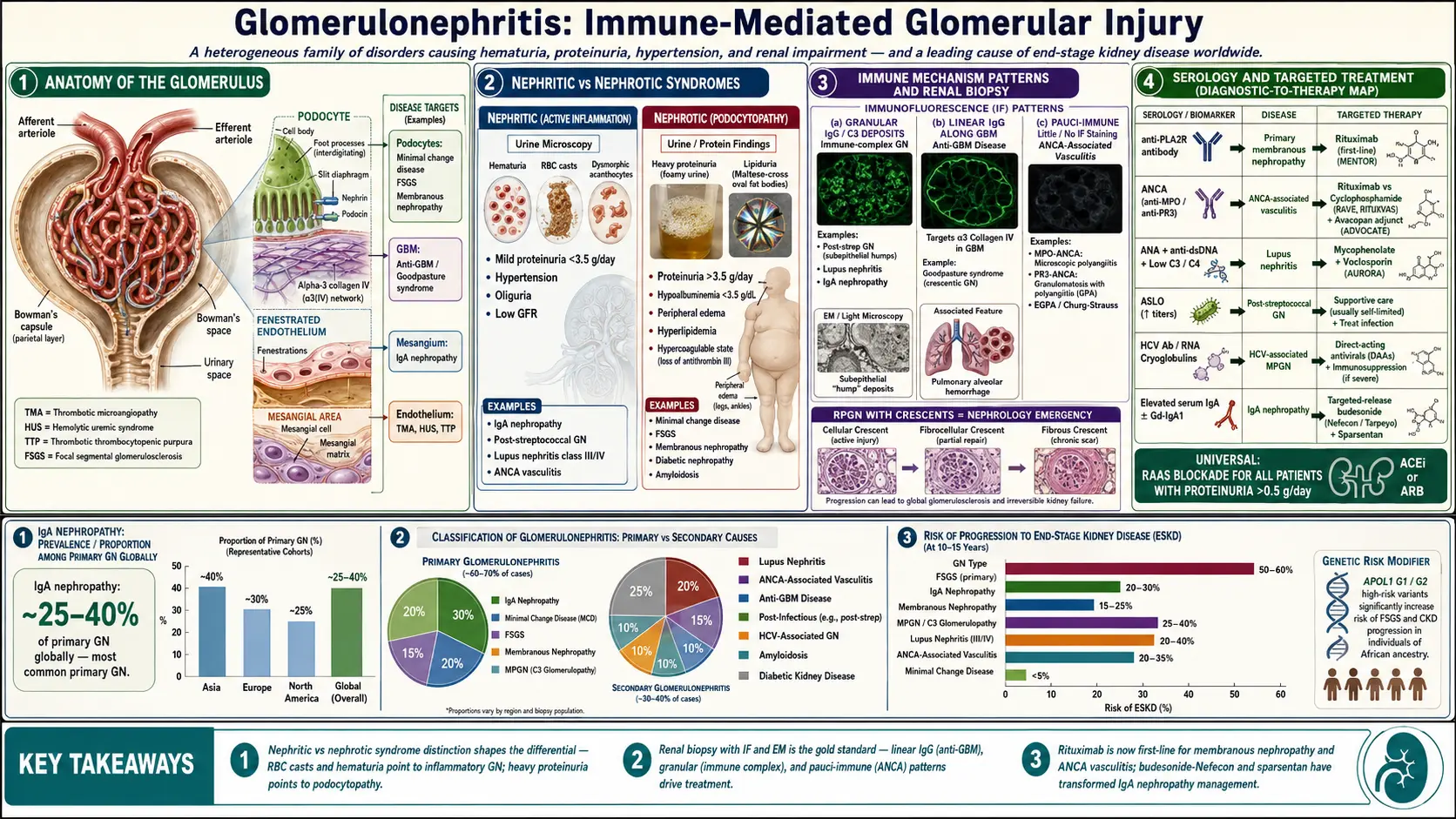
Glomerulonephritis encompasses a broad spectrum of glomerular diseases characterized by immune-mediated glomerular injury. It is clinically classified into distinct syndromes: the nephritic syndrome (hematuria, RBC casts, hypertension, oliguria, mild-to-moderate proteinuria) and the nephrotic syndrome (heavy proteinuria >3.5 g/day, hypoalbuminemia, edema, hyperlipidemia), though overlap is common.
A particularly severe form, rapidly progressive glomerulonephritis (RPGN), describes a rapid loss of kidney function over weeks to months, usually with crescents on biopsy; the 2021 KDIGO guideline, for example, defines rapidly progressive IgA nephropathy as a decline in eGFR of 50% or more over 3 months or less. RPGN is handled as an emergency: KDIGO 2021 states that anti-GBM disease should be diagnosed without delay in every patient with suspected RPGN, and that its treatment should start without delay when the diagnosis is suspected, even before it is confirmed. GN is classified pathologically (by light microscopy, immunofluorescence, and electron microscopy) and etiologically.
2. Epidemiology
GN is a major cause of chronic kidney disease and kidney failure. IgA nephropathy is described as a leading cause of CKD and kidney failure (Rodrigues 2017) and as the most common glomerulonephritis in the world (Barbour 2019). Membranous nephropathy is the most common cause of idiopathic nephrotic syndrome in non-diabetic white adults (Couser 2017).
Post-infectious GN (PIGN) most commonly follows group A streptococcal pharyngitis or impetigo. Post-streptococcal GN is now rare in industrialized nations; in lower-income settings a 2008 review put its burden at 9.5 to 28.5 new cases per 100,000 people per year, and described the long-term prognosis as excellent in children but significantly worse in elderly people (Rodriguez-Iturbe 2008). A 2022 meta-analysis of 25 studies estimated a worldwide pooled incidence of ANCA-associated vasculitis (AAV) of 17.2 per million person-years and a pooled prevalence of 198.0 per million people (Redondo-Rodriguez 2022). In an international inception cohort of 1,827 people with systemic lupus erythematosus (SLE), lupus nephritis (LN) developed in 38.3%; patients with nephritis were younger, more often men, and more often of African, Asian or Hispanic race/ethnicity (Hanly 2016).
3. Pathophysiology
GN results from immune-mediated glomerular injury through several distinct mechanisms:
Immune Complex-Mediated GN
Circulating antigen-antibody complexes deposit in the glomerular mesangium, subendothelial, or subepithelial space, or antibodies react in situ with planted antigens. Complement activation generates C3a and C5a (anaphylatoxins), the membrane attack complex (MAC, C5b-9), and recruits neutrophils and macrophages. This results in oxidative stress, protease release, and glomerular basement membrane (GBM) injury. Examples: post-infectious GN (subepithelial "humps"), lupus nephritis (subendothelial deposits in class III/IV), IgA nephropathy (mesangial deposits).
Anti-GBM Disease (Goodpasture Syndrome)
Autoantibodies directed against the alpha-3 chain of type IV collagen (alpha-3[IV]NC1) in the GBM and alveolar basement membrane cause linear IgG deposition on immunofluorescence. This results in rapidly progressive crescentic GN and, when pulmonary involvement occurs, diffuse alveolar hemorrhage. Genetic susceptibility involves HLA-DR15.
Pauci-Immune GN (ANCA-Associated Vasculitis)
MPO-ANCA or PR3-ANCA activate primed neutrophils, causing degranulation and endothelial injury without significant immunoglobulin deposition (pauci-immune on immunofluorescence). Microscopic polyangiitis (MPA), granulomatosis with polyangiitis (GPA, formerly Wegener's), and eosinophilic GPA (EGPA, formerly Churg-Strauss) are the three AAV subtypes. Crescentic GN with fibrinoid necrosis is the characteristic renal lesion.
Podocytopathy
In minimal change disease (MCD) and focal segmental glomerulosclerosis (FSGS), podocyte injury with effacement of foot processes is the primary pathological event, predominantly manifesting as nephrotic syndrome with variable GFR impairment. T-cell dysfunction and circulating permeability factors (suPAR, cardiotrophin-like cytokine-1) have been implicated in primary FSGS.
Complement-Mediated GN
C3 glomerulopathy (C3GN and dense deposit disease/MPGN type II) results from dysregulation of the alternative complement pathway (mutations in CFH, CFI, C3, CFB, or antibodies against factor H or C3 convertase). The older classification of membranoproliferative GN (MPGN) into types I, II (dense deposit disease) and III by electron microscopy has been replaced by one based on immunofluorescence: immunoglobulin-positive MPGN, which prompts a search for infection, autoimmune disease or a monoclonal gammopathy, versus complement-dominant disease, which includes C3 glomerulopathy (KDIGO 2021; Sethi 2012).
4. Etiology and Risk Factors
Primary GN
- IgA nephropathy (Berger's disease): Galactose-deficient IgA1 (Gd-IgA1) overproduction and autoantibody-mediated mesangial deposition
- Minimal change disease (MCD): Idiopathic (most common in children); secondary to NSAIDs, lymphoma (especially Hodgkin's)
- Focal segmental glomerulosclerosis (FSGS): Primary (circulating permeability factors), secondary (hyperfiltration, HIV, heroin, obesity, reflux nephropathy), genetic (podocin, nephrin, TRPC6 mutations)
- Membranous nephropathy (MN): Primary (circulating anti-PLA2R antibodies in about 70%, anti-THSD7A in 3–5%; Couser 2017); secondary (malignancy, hepatitis B, drugs, SLE)
- MPGN: Immune complex-mediated, C3 glomerulopathy, monoclonal immunoglobulin deposition disease
Secondary GN
- Lupus nephritis: SLE, classified by ISN/RPS 2018 into classes I–VI
- ANCA-associated vasculitis: GPA, MPA, EGPA
- Anti-GBM disease: Idiopathic; triggered by hydrocarbon inhalation, smoking, infections in genetically susceptible individuals
- Post-infectious GN: Streptococcal (pharyngitis, impetigo), staphylococcal (MRSA-associated GN), viral (hepatitis B/C, HIV)
- Cryoglobulinemic GN: Hepatitis C-associated mixed cryoglobulinemia (type II); monoclonal gammopathy
- Henoch-Schonlein Purpura (IgA vasculitis): Systemic IgA-mediated vasculitis
- Diabetic nephropathy and Amyloidosis (AL, AA)
Risk Factors
- Genetic predisposition: HLA alleles (HLA-DQ alleles in MN, HLA-DR15 in anti-GBM), APOL1 variants (G1/G2) significantly increase FSGS and ESKD risk in individuals of African ancestry
- Infections, autoimmune diseases, malignancies, medications
- Obesity, hypertension, smoking, illicit drug use
5. Clinical Presentation
Nephritic Syndrome
- Gross or microscopic hematuria (smoky or tea-colored urine), RBC casts on microscopy
- Hypertension (sodium and water retention, RAAS activation)
- Oliguria, edema (periorbital, peripheral)
- Mild-to-moderate proteinuria (typically <3.5 g/day)
- Elevated serum creatinine, reduced GFR
Nephrotic Syndrome
- Heavy proteinuria (>3.5 g/day), frothy urine
- Hypoalbuminemia, peripheral edema, ascites, pleural effusions
- Hyperlipidemia (elevated LDL, total cholesterol, triglycerides)
- Lipiduria (oval fat bodies, Maltese cross appearance under polarized light)
- Hypercoagulable state (including urinary loss of antithrombin III); KDIGO 2021 notes that thrombosis is more often venous than arterial, that deep vein and renal vein thrombosis are the most common forms, and that thrombotic events are most common in membranous nephropathy
RPGN Features
- Rapidly worsening renal function (weeks to months), often with hematuria and oliguria
- Constitutional symptoms: fever, malaise, weight loss (particularly with vasculitis)
- Pulmonary-renal syndrome: hemoptysis + GN (anti-GBM disease, ANCA vasculitis, SLE)
- Upper respiratory tract symptoms (saddle-nose deformity, sinusitis in GPA)
6. Diagnosis
Urinalysis and Urine Microscopy
- Dipstick and microscopy: hematuria (dysmorphic red cells, acanthocytes), RBC casts (characteristic of glomerular bleeding), granular casts, heavy proteinuria
- 24-hour urine protein or spot urine protein-to-creatinine ratio (PCR): quantify proteinuria
Serum Biomarkers
- Creatinine and eGFR: Baseline and serial monitoring
- Albumin, lipid panel: Assess nephrotic syndrome
- ANCA serology: MPO-ANCA (perinuclear pattern, p-ANCA) and PR3-ANCA (cytoplasmic pattern, c-ANCA); a 2017 international consensus states that high-quality PR3- and MPO-ANCA immunoassays can be used as the primary screening method without the categorical need for indirect immunofluorescence (Bossuyt 2017)
- Anti-GBM antibodies: ELISA against alpha-3(IV)NC1
- Anti-PLA2R antibodies: A 2014 meta-analysis (15 studies, 2,212 patients) gave a summary sensitivity of 78% and specificity of 99% for primary membranous nephropathy (Du 2014); in a Dutch cohort the titer correlated with baseline proteinuria (Hofstra 2012)
- ANA, anti-dsDNA, complement (C3, C4, CH50): Lupus nephritis (low C3/C4 with active disease)
- ASLO, anti-DNase B: Post-streptococcal GN
- Hepatitis B surface antigen/antibody, hepatitis C RNA, HIV: Viral-associated GN
- Cryoglobulins, serum protein electrophoresis, free light chains: Cryoglobulinemic GN, monoclonal gammopathy
- C3, C4, CH50, factor H, factor I levels: C3 glomerulopathy workup
Kidney Biopsy
The 2021 KDIGO guideline calls the kidney biopsy the “gold standard” for the diagnostic evaluation of glomerular diseases, while noting that under some circumstances treatment may proceed without biopsy confirmation. Biopsy findings are used in treatment decisions and give prognostic information. A full evaluation includes:
- Light microscopy: Identifies cellular pattern (diffuse, focal, segmental, global), mesangial expansion, crescents (cellular, fibrocellular, fibrous), necrosis, and sclerosis
- Immunofluorescence (IF): IgG, IgA, IgM, C3, C1q, kappa, lambda distribution and pattern (mesangial, subepithelial, subendothelial); linear IgG = anti-GBM; granular = immune complex; negative/pauci = ANCA
- Electron microscopy (EM): Location and character of electron-dense deposits; podocyte foot process effacement; GBM thickness; lamina densa alterations in dense deposit disease
Imaging
- Renal ultrasound: assess kidney size, echogenicity, symmetry; exclude obstruction
- Chest imaging: pulmonary infiltrates in pulmonary-renal syndromes
7. Treatment
The regimens below are summarized as guidelines and trials report them; decisions about treatment belong with a clinician.
General Measures
- Blood pressure: KDIGO 2021 suggests a systolic target below 120 mm Hg measured by standardized office measurement, and recommends an ACE inhibitor or ARB for proteinuria above 0.5 g/day (stated for IgA nephropathy and IgA vasculitis nephritis)
- Dietary sodium restriction and fluid management form part of edema management in nephrotic syndrome (KDIGO 2021)
- Statins are used for hyperlipidemia in nephrotic syndrome; KDIGO 2021 notes that a protective effect of statins on GFR decline has not been established
- Prophylactic anticoagulation: KDIGO 2021 describes it for nephrotic syndrome when the risk of thromboembolism exceeds the patient-specific risk of a serious bleeding event, and names the histologic diagnosis (membranous nephropathy carries a particularly high risk), the degree of proteinuria and a serum albumin below 2.5 g/dL (bromocresol green assay) as the best predictors of thrombotic risk
- Diuretics are used for edema, with attention to the risk of intravascular volume depletion
IgA Nephropathy
- KDIGO 2021 recommends an ACE inhibitor or ARB for all patients with proteinuria above 0.5 g/day, whether or not they have hypertension
- Targeted-release budesonide, an oral formulation designed to act at the gut mucosal level: in the NefIgArd trial (364 patients), 9 months of treatment gave a time-weighted average eGFR over 2 years that was 5.05 mL/min/1.73 m² better than placebo; peripheral edema, hypertension, muscle spasms and acne were more common on the drug (Lafayette 2023). Drugs@FDA lists its first US approval in December 2021 and an efficacy labeling change in December 2023.
- Systemic glucocorticoids: KDIGO 2021 suggests that patients who remain at high risk of progression (proteinuria above 0.75–1 g/day despite at least 90 days of optimized supportive care) be considered for a 6-month course, with the risk of toxicity discussed, particularly at eGFR below 50 mL/min/1.73 m². In the TESTING trial (503 patients, mean proteinuria 2.46 g/day), oral methylprednisolone reduced the composite of 40% eGFR decline, kidney failure or death from kidney disease (28.8% versus 43.1%; hazard ratio 0.53), but serious adverse events were more frequent (10.9% versus 2.8%), mainly at full dose; the dose was lowered during the trial after an excess of serious infections (Lv 2022).
- Sparsentan (dual endothelin–angiotensin receptor antagonist): in the PROTECT trial, urine protein-creatinine ratio fell by 49.8% at 36 weeks versus 15.1% with irbesartan (Heerspink 2023). Drugs@FDA lists its first US approval in February 2023 and an efficacy supplement for a new indication in September 2024.
Minimal Change Disease
- KDIGO 2021 recommends high-dose oral glucocorticoids for initial treatment of MCD in adults, given for no longer than 16 weeks; it describes prednisone 1 mg/kg/day (maximum 80 mg/day) as the conventional high-dose regimen and states that over 80% of patients achieve remission
- For frequently relapsing or steroid-dependent MCD, KDIGO 2021 recommends cyclophosphamide, rituximab, a calcineurin inhibitor (cyclosporine or tacrolimus) or a mycophenolic acid analog rather than prednisone alone or no treatment, noting limited evidence to favour one drug class over another
Membranous Nephropathy
- KDIGO 2021 states that immunosuppression is not required in MN with nephrotic syndrome and normal eGFR unless at least one risk factor for progression or a serious complication of nephrotic syndrome is present; supportive care (RAS blockade, lipid and thrombosis-risk management) applies throughout
- For MN with at least one risk factor for progression, KDIGO 2021 recommends rituximab, or cyclophosphamide with alternate-month glucocorticoids for 6 months, or calcineurin-inhibitor-based therapy for at least 6 months, chosen according to the risk estimate. In MENTOR (130 patients), rituximab was non-inferior to cyclosporine for complete or partial remission at 12 months (60% versus 52%) and superior at 24 months (60% versus 20%) (Fervenza 2019).
- Cyclophosphamide with glucocorticoids (the cyclical, Ponticelli-type regimen) is one of the KDIGO options; a 2014 review states that this cyclical therapy can induce remission and preserve kidney function in the long term (Ponticelli 2014)
- KDIGO 2021 states that anti-PLA2R levels measured 6 months after starting therapy may be useful for evaluating response and can guide adjustments to therapy
ANCA-Associated Vasculitis
- Induction: KDIGO 2021 recommends glucocorticoids with cyclophosphamide or rituximab for new-onset AAV, and the 2022 EULAR update recommends high-dose glucocorticoids with either drug for organ- or life-threatening disease (Hellmich 2024). In the RAVE trial of 197 ANCA-positive patients with GPA or MPA, rituximab (375 mg/m² weekly for 4 weeks) was non-inferior to daily oral cyclophosphamide (64% versus 53% in remission without prednisone at 6 months) and more effective in relapsing disease (67% versus 42%) (Stone 2010). In RITUXVAS (44 patients with kidney involvement), a rituximab-based regimen was not superior to intravenous cyclophosphamide (sustained remission at 12 months 76% versus 82%) and did not reduce early severe adverse events (Jones 2010).
- Cyclophosphamide (intravenous pulse or oral): KDIGO 2021 states that with markedly reduced or rapidly declining GFR (serum creatinine above 4 mg/dL) the data supporting rituximab are limited and cyclophosphamide with glucocorticoids is preferred
- Plasma exchange: in the PEXIVAS trial of severe ANCA-associated vasculitis (eGFR below 50 mL/min/1.73 m² or diffuse pulmonary hemorrhage), death from any cause or ESKD occurred in 100 of 352 patients (28.4%) with plasma exchange and 109 of 352 (31.0%) without it (hazard ratio 0.86, not statistically significant); a reduced-dose glucocorticoid regimen was non-inferior to standard dosing, with fewer serious infections at 1 year (Walsh 2020). KDIGO 2021 says plasma exchange can be considered with serum creatinine above 5.7 mg/dL requiring dialysis or rising rapidly, or with diffuse alveolar hemorrhage and hypoxemia; the 2022 EULAR update states that it may be considered in rapidly progressive glomerulonephritis (Hellmich 2024).
- Avacopan (oral C5a receptor antagonist): approved by the US FDA in October 2021 as an adjunctive treatment for adults with severe active ANCA-associated vasculitis (GPA and MPA), in combination with standard therapy including glucocorticoids; the US label states that it does not eliminate glucocorticoid use. The approval rested mainly on the ADVOCATE trial (Jayne et al., NEJM 2021, PubMed PMID: 33596356), whose published report was retracted by the journal on 29 June 2026 (retraction notice PubMed PMID: 42377355). The European Medicines Agency opened a review in January 2026 over the integrity of the ADVOCATE data and concluded that the trial was conducted in breach of good clinical practice and that the study data provided at the time of assessment were “incorrect and misleading”; the EU marketing authorisation was revoked on 4 August 2026 (EMA announcement, 26 June 2026). The EMA’s review also states that avacopan is associated with an increased risk of drug-induced liver injury and vanishing bile duct syndrome, including fatal cases (EMA referral record). Drugs@FDA still listed the US approval as of October 2026; any later FDA action could not be confirmed. The 2022 EULAR update, published before the retraction, had stated that avacopan may be considered as part of a strategy to reduce glucocorticoid exposure (Hellmich 2024).
- Maintenance: KDIGO 2021 recommends rituximab or azathioprine with low-dose glucocorticoids after remission; studies of rituximab maintenance have evaluated about 18 months. In MAINRITSAN (115 patients in complete remission after cyclophosphamide), rituximab 500 mg on days 0 and 14 and at months 6, 12 and 18 was compared with daily azathioprine: major relapse by month 28 occurred in 5% versus 29%, with similar rates of severe adverse events (Guillevin 2014). The 2022 EULAR update recommends rituximab for maintenance and lists azathioprine and methotrexate as alternatives (Hellmich 2024).
Anti-GBM Disease
- KDIGO 2021 recommends cyclophosphamide and glucocorticoids plus plasmapheresis in all patients with anti-GBM GN except those who are on dialysis at presentation, have 100% crescents or more than 50% global glomerulosclerosis in an adequate biopsy sample, and do not have pulmonary hemorrhage
- Plasma exchange, which removes circulating anti-GBM antibodies, is continued until anti-GBM titers are no longer detectable (KDIGO 2021)
- Cyclophosphamide is given for 2–3 months and glucocorticoids for about 6 months; KDIGO 2021 states that no maintenance therapy is needed, except in patients who are also ANCA-positive
- Dialysis support as required; KDIGO 2021 states that kidney transplantation is postponed until anti-GBM antibodies have remained undetectable for at least 6 months
Lupus Nephritis
- Class III/IV (proliferative LN): KDIGO 2021 recommends glucocorticoids plus either low-dose intravenous cyclophosphamide or a mycophenolic acid analog such as mycophenolate mofetil (MMF), with the MMF-based regimen preferred for patients at high risk of infertility, with moderate to high prior cyclophosphamide exposure, or of Asian, Hispanic or African ancestry. The low-dose cyclophosphamide option is the Euro-Lupus regimen — six fortnightly 500 mg intravenous pulses followed by azathioprine — which in its trial of 90 European patients had treatment failure in 16% versus 20% with a high-dose regimen, a difference that was not statistically significant (Houssiau 2002)
- Voclosporin (calcineurin inhibitor) added to MMF and low-dose steroids: in AURORA 1, complete renal response at 52 weeks was reached by 73 of 179 patients (41%) versus 40 of 178 (23%) on MMF and steroids alone (Rovin 2021); FDA-approved for active LN. KDIGO 2021 states that it can be added in patients with a baseline eGFR of at least 45 mL/min/1.73 m²
- Belimumab (anti-BLyS/BAFF): in BLISS-LN (448 adults with biopsy-proven active LN), a primary efficacy renal response at week 104 occurred in 43% versus 32% with standard therapy alone (Furie 2020); FDA-approved for active LN
- Pure class V (membranous LN): KDIGO 2021 states that treatment is warranted in patients with nephrotic-range proteinuria or nephrotic syndrome, citing a small trial in which remission was more likely with prednisone plus cyclophosphamide (60%) or prednisone plus cyclosporine (84%) than with prednisone alone (27%)
- KDIGO 2021 recommends hydroxychloroquine (or an equivalent antimalarial) for all patients with SLE, including those with LN, unless contraindicated
8. Complications
- Progression to CKD and ESKD: Risk varies by GN type and treatment response
- Hypertension: Major risk factor for accelerated GFR loss and cardiovascular events
- Thromboembolic disease: Deep vein thrombosis, renal vein thrombosis and pulmonary embolism, most common in membranous nephropathy (KDIGO 2021)
- Infections: Related to nephrotic syndrome and immunosuppression; KDIGO 2021 lists pneumococcal, influenza and herpes zoster vaccination, and states that prophylactic trimethoprim-sulfamethoxazole (against Pneumocystis pneumonia) should be considered with high-dose prednisone, rituximab or cyclophosphamide
- Cardiovascular disease: Leading cause of mortality in ESKD; hyperlipidemia, hypertension, uremia-related accelerated atherosclerosis
- Drug toxicity: Cyclophosphamide (hemorrhagic cystitis, gonadal toxicity, malignancy); corticosteroids (osteoporosis, diabetes, infection); calcineurin inhibitors (nephrotoxicity, hypertension)
- AKI: RPGN, crescentic GN requiring emergent RRT
9. Prognosis
Prognosis is highly variable by GN subtype, treatment response, and degree of chronicity on biopsy. Key prognostic indicators include degree of proteinuria reduction, rate of GFR decline, hypertension control, and the proportion of globally sclerosed glomeruli and interstitial fibrosis on biopsy.
- IgA nephropathy: in the UK RaDaR registry (2,299 adults and 140 children with proteinuria above 0.5 g/day or eGFR below 60), median kidney survival was 11.4 years, and almost all patients were at risk of kidney failure within their expected lifetime unless eGFR loss was held at 1 mL/min/1.73 m² per year or less (Pitcher 2023). Risk tools include the Oxford MEST-C biopsy score (Trimarchi 2017) and the International IgAN Prediction Tool (Barbour 2019); KDIGO 2021 notes that the prediction tool cannot be used to determine the likely impact of a particular treatment
- Membranous nephropathy: untreated, about one-third of patients with primary MN undergo spontaneous remission (especially with absent or low anti-PLA2R levels), one-third progress to ESKD over 10 years, and the remainder develop non-progressive CKD (Couser 2017); in a Dutch cohort, spontaneous remission occurred in 38% of patients in the lowest anti-PLA2R titer tertile versus 4% in the highest (Hofstra 2012)
- ANCA vasculitis: in a European cohort of 535 trial patients, mortality was 2.6 times that of an age- and sex-matched population, and an eGFR below 15 mL/min was among the factors associated with worse survival (Flossmann 2011); a meta-analysis of patients given cyclophosphamide induction estimated cumulative relapse (any relapse, not only kidney) at about 12% at 1 year, 33% at 3 years and 47% at 5 years (He 2021)
- Anti-GBM disease: in a UK series of 71 patients treated with plasma exchange, prednisolone and cyclophosphamide, 1-year kidney survival was 95% when creatinine at presentation was below 5.7 mg/dL but 8% in those who were dialysis-dependent at presentation; every patient who needed immediate dialysis and had 100% crescents remained dialysis-dependent (Levy 2001)
- Lupus nephritis: in the international inception cohort, the estimated 10-year incidence of ESKD was 10.1% in patients with nephritis (4.3% overall), and nephritis was associated with a higher risk of death (hazard ratio 2.98) (Hanly 2016)
- MCD: KDIGO 2021 states that long-term kidney survival is excellent in patients who respond to glucocorticoids, but less certain in those who do not
10. Prevention
- Post-streptococcal GN: a 2008 review describes prophylactic antibiotics as advisable in epidemics and for household contacts of cases in communities where the disease is common (Rodriguez-Iturbe 2008)
- Hepatitis B-associated GN: KDIGO 2021 recommends nucleos(t)ide analogue therapy (such as entecavir or tenofovir) for patients with replicative HBV infection and GN
- Hepatitis C-associated GN: KDIGO 2021 defers to the KDIGO 2018 hepatitis C guideline, which covers treatment with direct-acting antivirals (DAAs)
- Nephrotoxic drugs and contrast media are an added source of kidney injury in people with existing GN
- RAAS blockade (ACE inhibitor or ARB) is used to reduce proteinuria and slow GFR decline; KDIGO 2021 recommends it in IgA nephropathy with proteinuria above 0.5 g/day
- KDIGO 2021 recommends hydroxychloroquine for all patients with SLE unless contraindicated
- Follow-up after treatment is used to detect relapse early
11. Recent Research and Advances
- Sparsentan: dual endothelin–angiotensin receptor antagonist; in the 2-year PROTECT results the chronic eGFR slope was −2.7 versus −3.8 mL/min/1.73 m² per year with irbesartan (difference 1.1, p=0.037), while the total 2-year slope difference (1.0) did not reach statistical significance (p=0.058) (Rovin 2023); Drugs@FDA lists a first US approval in February 2023 and an efficacy supplement for a new indication in September 2024
- Targeted-release budesonide: FDA-approved for IgA nephropathy; the 2-year NefIgArd results showed less eGFR decline over 2 years after a 9-month course, compared with placebo (Lafayette 2023)
- Complement inhibition: in phase 3 trials, iptacopan (factor B inhibitor) lowered proteinuria at 9 months by 38.3% versus placebo in IgA nephropathy (Perkovic 2025) and changed it by −30.2% versus +7.6% with placebo at 6 months in C3 glomerulopathy (Kavanagh 2025); pegcetacoplan (C3 inhibitor) gave a 68.1% relative reduction in proteinuria versus placebo at 26 weeks in C3 glomerulopathy and primary immune-complex MPGN (Fakhouri 2025)
- Avacopan: C5aR1 antagonist approved by the US FDA in 2021 as an adjunct to standard ANCA-vasculitis therapy including glucocorticoids (the label states it does not eliminate glucocorticoid use); the ADVOCATE trial report behind the approval was retracted in June 2026 (notice PubMed PMID: 42377355), and the EU authorisation was revoked in August 2026 after the European Medicines Agency found breaches of good clinical practice (EMA announcement, 26 June 2026)
- CAR-T cell therapy: in the phase 1/2 CASTLE basket trial, 9 of 10 patients with treatment-resistant SLE reached DORIS remission after a single CD19 CAR-T infusion (Müller 2026); reports in ANCA vasculitis include a patient with refractory GPA who was in complete remission without further medication 12 months after CD19 CAR-T therapy (Schneider 2026)
- SGLT2 inhibitors in GN: in a prespecified DAPA-CKD analysis of 270 participants with IgA nephropathy, the primary composite outcome occurred in 4% on dapagliflozin versus 15% on placebo (hazard ratio 0.29) and albuminuria fell by 26% relative to placebo (Wheeler 2021); in the smaller FSGS subgroup (104 participants) the primary outcome did not differ significantly (hazard ratio 0.62, 95% CI 0.17–2.17), and the authors report a slower chronic eGFR decline that was not statistically significant (Wheeler 2022). In EMPA-KIDNEY (6,609 patients with CKD), empagliflozin reduced kidney-disease progression or cardiovascular death, with consistent results in patients with or without diabetes (EMPA-KIDNEY 2023)
- Anti-PLA2R monitoring: KDIGO 2021 states that anti-PLA2R levels 6 months after starting therapy may be useful for evaluating response; in MENTOR, anti-PLA2R antibodies fell faster and further with rituximab than with cyclosporine among patients in remission (Fervenza 2019)
Key Research Papers
- KDIGO 2021 Clinical Practice Guideline for the Management of Glomerular Diseases. Kidney International. 2021;100(4S):S1–S276. — doi:10.1016/j.kint.2021.05.021
- Rovin BH, Adler SG, Barratt J, et al. Executive summary of the KDIGO 2021 Guideline for the Management of Glomerular Diseases. Kidney International. 2021;100(4):753–779. — doi:10.1016/j.kint.2021.05.015
- Bomback AS, Appel GB. Updates on the treatment of lupus nephritis. Journal of the American Society of Nephrology. 2010;21(12):2028–2035. — doi:10.1681/ASN.2010050472
- Fervenza FC, Appel GB, Barbour SJ, et al. Rituximab or cyclosporine in the treatment of membranous nephropathy (MENTOR). New England Journal of Medicine. 2019;381(1):36–46. — doi:10.1056/NEJMoa1814427
- Rovin BH, Teng YKO, Ginzler EM, et al. Efficacy and safety of voclosporin versus placebo for lupus nephritis (AURORA 1). Lancet. 2021;397(10289):2070–2080. — doi:10.1016/S0140-6736(21)00578-X
- Furie RA, Rovin BH, Houssiau F, et al. Two-year, randomized, controlled trial of belimumab in lupus nephritis (BLISS-LN). New England Journal of Medicine. 2020;383(12):1117–1128. — doi:10.1056/nejmoa2001180
- Stone JH, Merkel PA, Spiera R, et al. Rituximab versus cyclophosphamide for ANCA-associated vasculitis (RAVE). New England Journal of Medicine. 2010;363(3):221–232. — doi:10.1056/NEJMoa0909905
- Jayne DRW, Merkel PA, Schall TJ, Bekker P. Avacopan for the treatment of ANCA-associated vasculitis (ADVOCATE). New England Journal of Medicine. 2021;384(7):599–609. — doi:10.1056/NEJMoa2023386 — Retracted (retraction notice: PubMed PMID: 42377355)
- Heerspink HJL, Radhakrishnan J, Alpers CE, et al. Sparsentan in patients with IgA nephropathy: a prespecified interim analysis from a randomised, double-blind, active-controlled clinical trial (PROTECT). Lancet. 2023;401(10388):1584–1594. — PubMed PMID: 37015244 (authors and title corrected 2026-10-14; the paper at this volume and page range is the interim analysis)
- Lv J, Wong MG, Hladunewich MA, et al. Effect of oral methylprednisolone on decline in kidney function or kidney failure in patients with IgA nephropathy: the TESTING randomized clinical trial. JAMA. 2022;327(19):1888–1898. — PubMed PMID: 35579642 (the DOI formerly given here, 10.1001/jama.2022.4950, resolves to an unrelated news item; corrected 2026-10-14)
- Sethi S, Fervenza FC. Membranoproliferative glomerulonephritis — a new look at an old entity. New England Journal of Medicine. 2012;366(12):1119–1131. — doi:10.1056/nejmra1108178
- Ponticelli C, Glassock RJ. Glomerular diseases: membranous nephropathy — a modern view. Clinical Journal of the American Society of Nephrology. 2014;9(3):609–616. — doi:10.2215/CJN.04160413
- Walsh M, Merkel PA, Peh CA, et al. Plasma exchange and glucocorticoids in severe ANCA-associated vasculitis (PEXIVAS). New England Journal of Medicine. 2020;382(7):622–631. — doi:10.1056/NEJMoa1803537
- Heerspink HJL, Stefansson BV, Correa-Rotter R, et al. Dapagliflozin in patients with chronic kidney disease (DAPA-CKD). New England Journal of Medicine. 2020;383(15):1436–1446. — doi:10.1056/NEJMoa2024816
- Trimarchi H, Barratt J, Cattran DC, et al. Oxford Classification of IgA nephropathy 2016: an update from the IgA Nephropathy Classification Working Group. Kidney International. 2017;91(5):1014–1021. — PubMed PMID: 28341274 (replaces “Roberts ISD. Oxford Classification of IgA nephropathy: an update. Kidney Int Suppl 2018;8(1):5–7”, which could not be found in PubMed or Crossref; its DOI resolves to an unrelated editorial on diabetic kidney disease)
- Rodrigues JC, Haas M, Reich HN. IgA nephropathy. Clin J Am Soc Nephrol. 2017;12(4):677–686. — PubMed PMID: 28159829
- Barbour SJ, Coppo R, Zhang H, et al. Evaluating a new international risk-prediction tool in IgA nephropathy. JAMA Intern Med. 2019;179(7):942–952. — PubMed PMID: 30980653
- Couser WG. Primary membranous nephropathy. Clin J Am Soc Nephrol. 2017;12(6):983–997. — PubMed PMID: 28550082
- Rodriguez-Iturbe B, Musser JM. The current state of poststreptococcal glomerulonephritis. J Am Soc Nephrol. 2008;19(10):1855–1864. — PubMed PMID: 18667731
- Redondo-Rodriguez R, Mena-Vázquez N, Cabezas-Lucena AM, et al. Systematic review and metaanalysis of worldwide incidence and prevalence of antineutrophil cytoplasmic antibody (ANCA) associated vasculitis. J Clin Med. 2022;11(9):2573. — PubMed PMID: 35566698
- Hanly JG, O'Keeffe AG, Su L, et al. The frequency and outcome of lupus nephritis: results from an international inception cohort study. Rheumatology (Oxford). 2016;55(2):252–262. — PubMed PMID: 26342222
- Bossuyt X, Cohen Tervaert JW, Arimura Y, et al. Position paper: revised 2017 international consensus on testing of ANCAs in granulomatosis with polyangiitis and microscopic polyangiitis. Nat Rev Rheumatol. 2017;13(11):683–692. — PubMed PMID: 28905856
- Du Y, Li J, He F, et al. The diagnosis accuracy of PLA2R-AB in the diagnosis of idiopathic membranous nephropathy: a meta-analysis. PLoS One. 2014;9(8):e104936. — PubMed PMID: 25136841
- Hofstra JM, Debiec H, Short CD, et al. Antiphospholipase A2 receptor antibody titer and subclass in idiopathic membranous nephropathy. J Am Soc Nephrol. 2012;23(10):1735–1743. — PubMed PMID: 22956816
- Lafayette R, Kristensen J, Stone A, et al. Efficacy and safety of a targeted-release formulation of budesonide in patients with primary IgA nephropathy (NefIgArd): 2-year results from a randomised phase 3 trial. Lancet. 2023;402(10405):859–870. — PubMed PMID: 37591292
- Rovin BH, Barratt J, Heerspink HJL, et al. Efficacy and safety of sparsentan versus irbesartan in patients with IgA nephropathy (PROTECT): 2-year results from a randomised, active-controlled, phase 3 trial. Lancet. 2023;402(10417):2077–2090. — PubMed PMID: 37931634
- Jones RB, Tervaert JW, Hauser T, et al. Rituximab versus cyclophosphamide in ANCA-associated renal vasculitis (RITUXVAS). N Engl J Med. 2010;363(3):211–220. — PubMed PMID: 20647198
- Guillevin L, Pagnoux C, Karras A, et al. Rituximab versus azathioprine for maintenance in ANCA-associated vasculitis (MAINRITSAN). N Engl J Med. 2014;371(19):1771–1780. — PubMed PMID: 25372085
- Hellmich B, Sanchez-Alamo B, Schirmer JH, et al. EULAR recommendations for the management of ANCA-associated vasculitis: 2022 update. Ann Rheum Dis. 2024;83(1):30–47. — PubMed PMID: 36927642
- Flossmann O, Berden A, de Groot K, et al. Long-term patient survival in ANCA-associated vasculitis. Ann Rheum Dis. 2011;70(3):488–494. — PubMed PMID: 21109517
- He P, Hu JP, Tian XJ, et al. Prevalence and risk factors of relapse in patients with ANCA-associated vasculitis receiving cyclophosphamide induction: a systematic review and meta-analysis of large observational studies. Rheumatology (Oxford). 2021;60(3):1067–1079. — PubMed PMID: 33677596
- Levy JB, Turner AN, Rees AJ, Pusey CD. Long-term outcome of anti-glomerular basement membrane antibody disease treated with plasma exchange and immunosuppression. Ann Intern Med. 2001;134(11):1033–1042. — PubMed PMID: 11388816
- Houssiau FA, Vasconcelos C, D'Cruz D, et al. Immunosuppressive therapy in lupus nephritis: the Euro-Lupus Nephritis Trial, a randomized trial of low-dose versus high-dose intravenous cyclophosphamide. Arthritis Rheum. 2002;46(8):2121–2131. — PubMed PMID: 12209517
- Pitcher D, Braddon F, Hendry B, et al. Long-term outcomes in IgA nephropathy. Clin J Am Soc Nephrol. 2023;18(6):727–738. — PubMed PMID: 37055195
- Perkovic V, Barratt J, Rovin B, et al. Alternative complement pathway inhibition with iptacopan in IgA nephropathy. N Engl J Med. 2025;392(6):531–543. — PubMed PMID: 39453772
- Kavanagh D, Bomback AS, Vivarelli M, et al. Oral iptacopan therapy in patients with C3 glomerulopathy: a randomised, double-blind, parallel group, multicentre, placebo-controlled, phase 3 study. Lancet. 2025;406(10512):1587–1598. — PubMed PMID: 41016405
- Fakhouri F, Bomback AS, Ariceta G, et al. Trial of pegcetacoplan in C3 glomerulopathy and immune-complex MPGN (VALIANT). N Engl J Med. 2025;393(22):2210–2220. — PubMed PMID: 41337715
- Müller F, Hagen M, Wirsching A, et al. CD19 CAR-T cells for treatment-refractory autoimmune diseases: the phase 1/2 CASTLE basket trial. Nat Med. 2026;32(3):1142–1151. — PubMed PMID: 41501497
- Schneider L, Pecher AC, Hensen L, et al. Anti CD19 targeting CAR T cell therapy in ANCA-associated vasculitis. Rheumatology (Oxford). 2026;65(3). — PubMed PMID: 41834136
- Wheeler DC, Toto RD, Stefánsson BV, et al. A pre-specified analysis of the DAPA-CKD trial demonstrates the effects of dapagliflozin on major adverse kidney events in patients with IgA nephropathy. Kidney Int. 2021;100(1):215–224. — PubMed PMID: 33878338
- Wheeler DC, Jongs N, Stefansson BV, et al. Safety and efficacy of dapagliflozin in patients with focal segmental glomerulosclerosis: a prespecified analysis of the DAPA-CKD trial. Nephrol Dial Transplant. 2022;37(9):1647–1656. — PubMed PMID: 34850160
- The EMPA-KIDNEY Collaborative Group; Herrington WG, Staplin N, Wanner C, et al. Empagliflozin in patients with chronic kidney disease. N Engl J Med. 2023;388(2):117–127. — PubMed PMID: 36331190
PubMed Topic Searches
Explore current literature on glomerulonephritis via PubMed topic searches. These links open live PubMed searches for the listed keywords — results update as new studies are indexed.
- Clinical trials on glomerulonephritis — PubMed search
- Clinical trials on IgA nephropathy — PubMed search
- Clinical trials on ANCA-associated vasculitis — PubMed search
- Clinical trials on anti-GBM disease Goodpasture — PubMed search
- Clinical trials on lupus nephritis — PubMed search
- Clinical trials on membranous nephropathy — PubMed search
- Clinical trials on rapidly progressive glomerulonephritis — PubMed search
Connections
- Nephrology & Hepatology
- Nephrotic Syndrome
- Kidney Disease
- Lupus
- Hypertension
- Diabetes
- Hepatitis C
- Acute Kidney Injury
- eGFR
- Creatinine
- Edema
- Hepatitis B
- Urinalysis
- Kidney Function Tests
- Cirrhosis
- Cardiovascular Disease
- Lymphoma
- Sjogrens Syndrome
- Lupus Nephritis and Kidney Involvement
- Strep Throat
- Polycystic Kidney Disease
- Vasculitis — the systemic vessel inflammation whose ANCA-associated forms produce pauci-immune crescentic GN.
- Covered in depth on its own page: Membranous Nephropathy · IgA Nephropathy
- Herbs