Pneumonia
Interactive Visualization Breathing & Gas Exchange — move the diaphragm yourself Fill the alveoli and watch oxygen diffuse into the blood while carbon dioxide leaves, with live pO₂/pCO₂ meters and an exercise mode. Launch →
Table of Contents
How Pneumonia Affects the Lungs
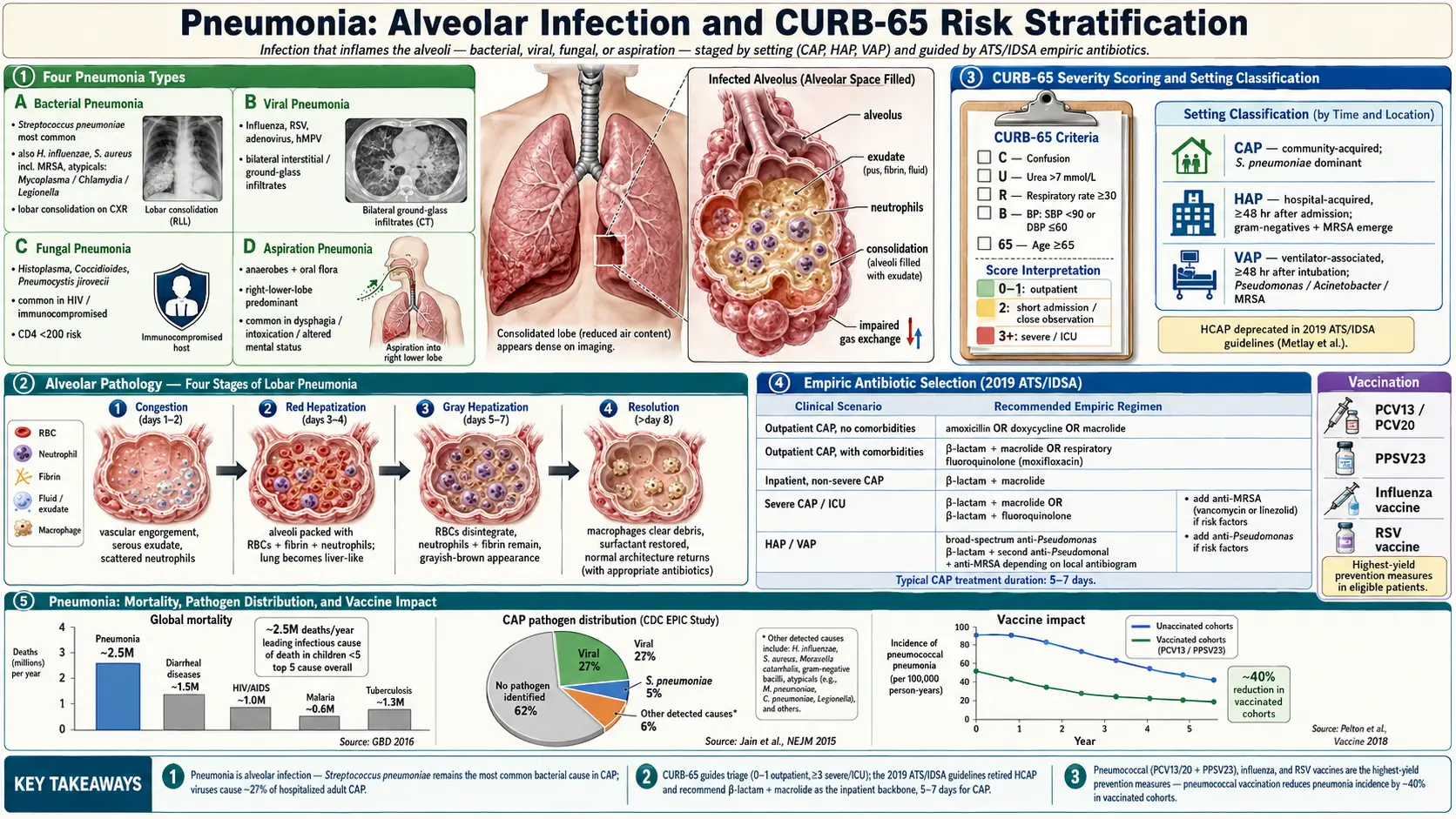
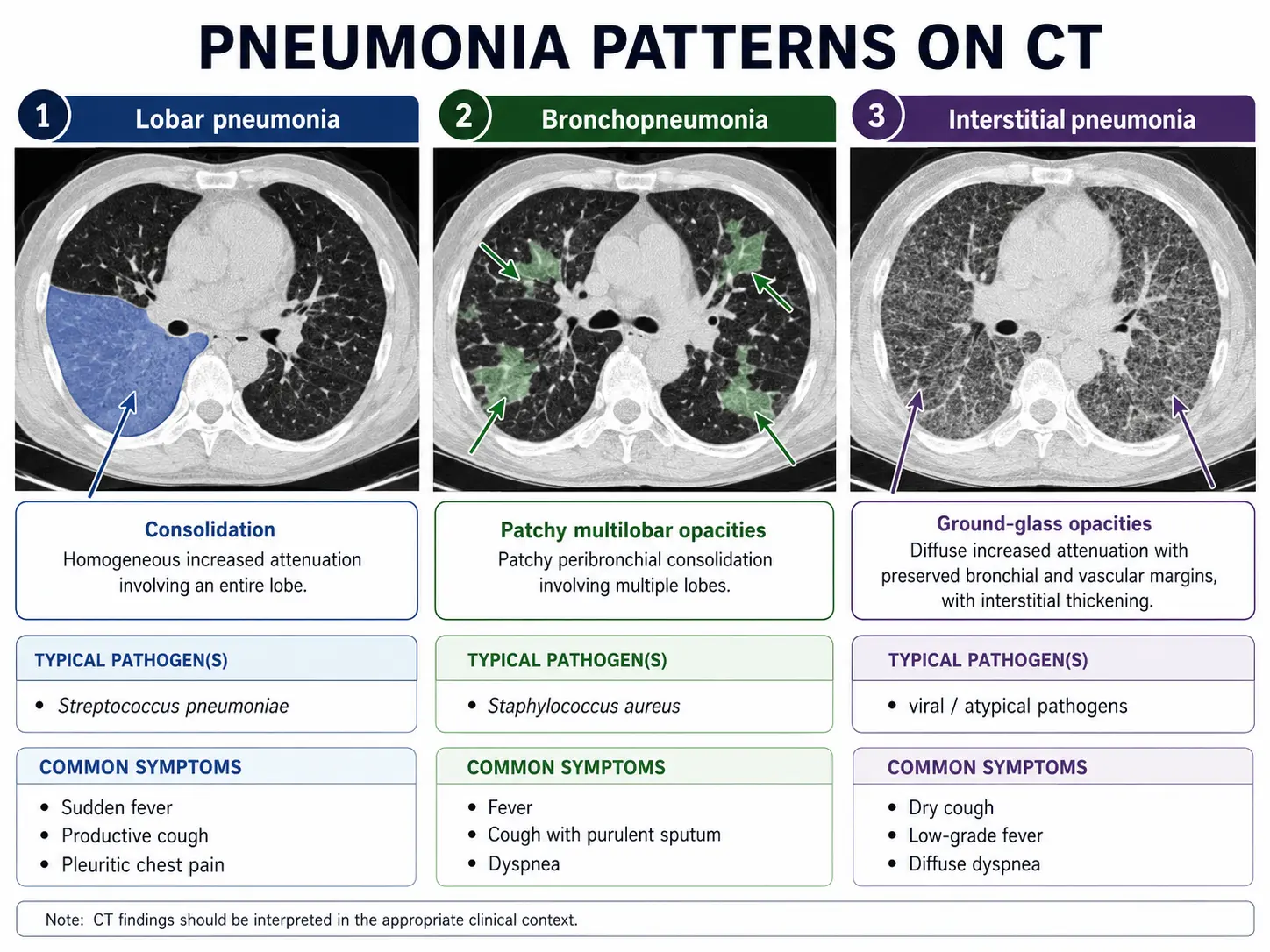
Pneumonia is an infection that inflames the air sacs (alveoli) in one or both lungs. The air sacs may fill with fluid or pus, leading to symptoms such as coughing, fever, chills, and difficulty breathing. Pneumonia can be caused by various organisms, including bacteria, viruses, and fungi.
Types of Pneumonia
1. Bacterial Pneumonia
- Most common cause: Streptococcus pneumoniae.
- Can affect people of all ages, but more severe in those with weakened immune systems or chronic health conditions.
2. Viral Pneumonia
- Common causes: Influenza virus, respiratory syncytial virus (RSV), parainfluenza virus, and adenovirus.
- Typically less severe but can become serious, especially in young children, older adults, or those with compromised immune systems.
- What US hospital studies find: In the CDC EPIC study of adults in hospital with pneumonia in Chicago and Nashville (2010–2012), a cause was found in only 38% of 2,259 fully tested patients. Viruses were found more often than bacteria (23% versus 11%), and the most common single germs were human rhinovirus (9%), influenza virus (6%) and Streptococcus pneumoniae (5%). Hospital pneumonia rates rose steeply with age, reaching 164 cases per 10,000 adults a year at age 80 and older.
3. Fungal Pneumonia
- More common in people with weakened immune systems.
- Common causes: Histoplasma, Coccidioides, and Pneumocystis jirovecii.
4. Aspiration Pneumonia
- Caused by inhaling food, liquid, or vomit into the lungs.
- Higher risk: People with swallowing difficulties or those who are intoxicated.
Common Symptoms of Pneumonia
- Cough: May produce green, yellow, or bloody mucus.
- Fever and chills
- Shortness of breath
- Chest pain when breathing or coughing
- Fatigue
- Nausea, vomiting, or diarrhea
- Confusion: Especially in older adults.
Causes and Risk Factors
- Bacteria, viruses, and fungi: The most common causes of pneumonia.
- Weakened immune system: Increases the risk of developing pneumonia.
- Chronic diseases: Such as asthma, chronic obstructive pulmonary disease (COPD), and heart disease.
- Smoking: Damages the lungs and reduces their ability to fight off infection.
- Age: Infants, young children, and older adults are at higher risk.
Diagnosis
- Medical history and physical examination: To check for signs like crackling or wheezing in the lungs.
- Chest X-ray: Confirms the presence and extent of the infection.
- Blood tests: To check for infection and identify the type of organism causing pneumonia.
- Sputum test: Analyzes mucus for the cause of the infection.
- Pulse oximetry: Measures the oxygen level in the blood.
Treatment Options
- Antibiotics: For bacterial pneumonia, tailored based on the specific bacteria.
- Antiviral medications: For viral pneumonia, such as those caused by influenza.
- Antifungal treatments: For fungal pneumonia.
- Supportive care:
- Rest and hydration
- Over-the-counter medications: To manage fever and pain.
- Oxygen therapy: For severe cases to improve breathing.
How long antibiotics are given. In the French PTC trial (2021), 310 adults in hospital wards (not intensive care) with community-acquired pneumonia who were stable after 3 days of a penicillin-type (β-lactam) antibiotic were randomised to 5 more days of amoxicillin–clavulanate or to placebo. Cure at day 15 was 77% in those who stopped at day 3 and 68% in those who took the full 8 days, which met the trial’s test for the shorter course being no worse, and digestive side effects were less common with the shorter course (11% versus 19%).
Steroids in severe pneumonia. In the CAPE COD trial (2023), 800 adults in intensive care with severe community-acquired pneumonia received intravenous hydrocortisone or placebo on top of antibiotics and standard care. Deaths by day 28 were 6.2% with hydrocortisone and 11.9% with placebo. Among patients not already on a ventilator, 18.0% on hydrocortisone and 29.5% on placebo needed a breathing tube. Patients on hydrocortisone needed higher insulin doses during the first week.
Prevention Strategies
- Good hygiene practices: Frequent handwashing and less close contact with sick people reduce the spread of the germs that cause pneumonia.
- Not smoking: Smoking damages the lungs and reduces their ability to fight off infection.
- Pneumococcal vaccination: On October 23, 2024, the US Advisory Committee on Immunization Practices (ACIP), which sets the Centers for Disease Control and Prevention (CDC) vaccine schedule, recommended a single dose of pneumococcal conjugate vaccine for all adults aged 50 or older who have not had one; before that, the age-based recommendation started at 65. Its recommendation for adults aged 19 to 49 with risk conditions for pneumococcal disease did not change.
- Healthy lifestyle: Balanced diet, regular exercise, and adequate sleep to strengthen the immune system.
Complications of Pneumonia
- Pleurisy and pleural effusion: Inflammation or fluid buildup in the space between the lungs and chest cavity.
- Lung abscess: Pus-filled cavity in the lung.
- Sepsis: Severe infection that spreads into the bloodstream and can lead to organ failure.
- Acute respiratory distress syndrome (ARDS): Severe inflammation that prevents the lungs from providing enough oxygen to the body.
- Chronic lung conditions: Increased risk of long-term breathing problems.
Key Research Papers
- Musher DM, Thorner AR. Community-acquired pneumonia. N Engl J Med. 2014;371(17):1619-1628. — doi:10.1056/NEJMra1312885
- Metlay JP, Waterer GW, Long AC, et al. Diagnosis and treatment of adults with community-acquired pneumonia: an official clinical practice guideline of the American Thoracic Society and Infectious Diseases Society of America. Am J Respir Crit Care Med. 2019;200(7):e45-e67. — doi:10.1164/rccm.201908-1581ST
- Jain S, Self WH, Wunderink RG, et al. Community-acquired pneumonia requiring hospitalization among U.S. adults (CDC EPIC Study). N Engl J Med. 2015;373(5):415-427. — doi:10.1056/NEJMoa1500245
- Torres A, Cilloniz C, Niederman MS, et al. Pneumonia. Nat Rev Dis Primers. 2021;7(1):25. — doi:10.1038/s41572-021-00259-0
- Kalil AC, Metersky ML, Klompas M, et al. Management of adults with hospital-acquired and ventilator-associated pneumonia: 2016 clinical practice guidelines by the Infectious Diseases Society of America and the American Thoracic Society. Clin Infect Dis. 2016;63(5):e61-e111. — doi:10.1093/cid/ciw353
- Postma DF, van Werkhoven CH, van Elden LJ, et al. Antibiotic treatment strategies for community-acquired pneumonia in adults. N Engl J Med. 2015;372(14):1312-1323. — doi:10.1056/nejmoa1406330
- Fine MJ, Auble TE, Yealy DM, et al. A prediction rule to identify low-risk patients with community-acquired pneumonia (the Pneumonia Severity Index, PSI/PORT score). N Engl J Med. 1997;336(4):243-250. — doi:10.1056/NEJM199701233360402
- Lim WS, van der Eerden MM, Laing R, et al. Defining community acquired pneumonia severity on presentation to hospital: an international derivation and validation study (CURB-65). Thorax. 2003;58(5):377-382. — doi:10.1136/thorax.58.5.377
- GBD 2016 Lower Respiratory Infections Collaborators. Estimates of the global, regional, and national morbidity, mortality, and aetiologies of lower respiratory infections in 195 countries, 1990-2016: a systematic analysis for the Global Burden of Disease Study 2016. Lancet Infect Dis. 2018;18(11):1191-1210. — doi:10.1016/S1473-3099(18)30310-4
- Wunderink RG, Waterer GW. Community-acquired pneumonia. N Engl J Med. 2014;370(6):543-551. — doi:10.1056/nejmcp1214869
- Dinh A, Ropers J, Duran C, et al. Discontinuing β-lactam treatment after 3 days for patients with community-acquired pneumonia in non-critical care wards (PTC): a double-blind, randomised, placebo-controlled, non-inferiority trial. Lancet. 2021;397(10280):1195-1203. — doi:10.1016/S0140-6736(21)00313-5
- Dequin PF, Meziani F, Quenot JP, et al. Hydrocortisone in severe community-acquired pneumonia. N Engl J Med. 2023;388(21):1931-1941. — doi:10.1056/NEJMoa2215145
- Kobayashi M, Leidner AJ, Gierke R, et al. Expanded recommendations for use of pneumococcal conjugate vaccines among adults aged ≥50 years: recommendations of the Advisory Committee on Immunization Practices — United States, 2024. MMWR Morb Mortal Wkly Rep. 2025;74(1):1-8. — doi:10.15585/mmwr.mm7401a1
- Flaumenhaft E, Flaumenhaft C. Evolution of America's pioneer bacteriologist: George M. Sternberg's formative years. Mil Med. 1993;158(7):448-457. — PubMed PMID: 8351046
Historical Background
Pneumonia has been recognized since antiquity, with Hippocrates describing it around 400 BCE as a disease "named by the ancients." In 1880 the American bacteriologist George M. Sternberg discovered the pneumococcus, the bacterium now known as the most common bacterial cause of pneumonia, before Louis Pasteur also isolated it, laying the groundwork for understanding its microbiology and eventually leading to antibiotic treatment.
PubMed Topic Searches
The following PubMed topic searches surface the current peer-reviewed literature on Pneumonia. Each link opens a live PubMed query; results update as new papers are indexed.
- PubMed: Search: community acquired pneumonia
- PubMed: Search: hospital acquired pneumonia
- PubMed: Search: ventilator associated pneumonia
- PubMed: Search: pneumonia antibiotic therapy
- PubMed: Search: streptococcus pneumoniae
- PubMed: Search: pneumococcal vaccine
- PubMed: Search: legionella pneumophila
- PubMed: Search: mycoplasma pneumoniae
- PubMed: Search: aspiration pneumonia
- PubMed: Search: pneumonia severity index
- PubMed: Search: pneumonia elderly
- PubMed: Search: fungal pneumonia
Connections
- Pulmonology
- Breathing & Gas Exchange — interactive animation
- Influenza
- Chronic Obstructive Pulmonary Disease
- Asthma
- Acute Respiratory Distress Syndrome
- Shortness of Breath
- Chest Pain
- Zinc
- Vitamin C
- Vitamin D3
- Oregano
- Sepsis
- Pleural Effusion
- Fatigue
- Eucalyptus
- Chronic Cough
- Cold and Flu Treatments
- Interstitial Lung Disease
- Magnesium
- Mullein
- Lung Cancer
- Common Cold
- Respiratory Syncytial Virus
- Measles
- Whooping Cough
- Dysphagia (Difficulty Swallowing) — impaired swallowing is the leading risk factor for aspiration pneumonia.
- Legionellosis (Legionnaires’ Disease) — a waterborne cause of severe pneumonia that routine cultures miss unless specifically tested for.
- Herbs covered on this site that discuss this condition: Andrographis (Andrographis paniculata) · Carum / Ajwain (Trachyspermum ammi) · Clove (Syzygium aromaticum) · Elecampane · Ginseng (Panax ginseng)