Narcissistic Personality Disorder
- Overview
- Epidemiology
- DSM-5 Diagnostic Criteria
- Grandiose vs. Vulnerable NPD Subtypes
- Narcissistic Injury and Narcissistic Rage
- Neurobiology and Brain Imaging
- Co-occurring Disorders
- Psychotherapy — Schema Therapy and TFP
- Pharmacotherapy — No FDA-Approved Medications
- Countertransference Challenges for Clinicians
- Research Papers
- Connections
Overview
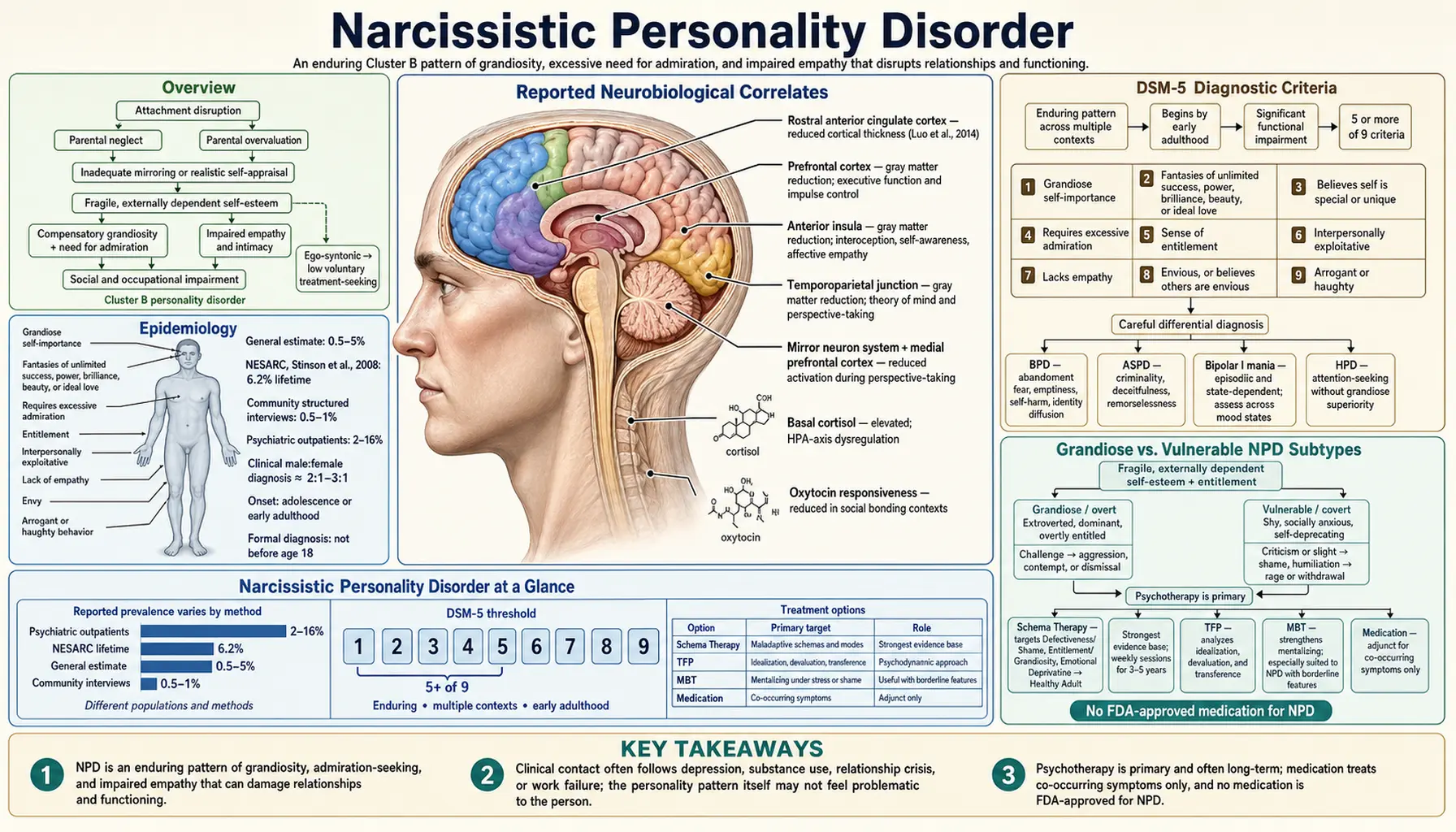
Narcissistic Personality Disorder (NPD) is a Cluster B personality disorder characterized by a pervasive pattern of grandiosity, an excessive need for admiration, and a pronounced lack of empathy for others. These traits are enduring, inflexible, and cause significant impairment in social and occupational functioning. NPD affects an estimated 0.5–5% of the general population and is diagnosed two to three times more often in men than women in clinical settings, though this disparity may partly reflect diagnostic bias — women with similar traits are more frequently labeled with Borderline Personality Disorder or Histrionic Personality Disorder.
The disorder was first formally codified in the Diagnostic and Statistical Manual of Mental Disorders, Third Edition (DSM-III) in 1980, though its theoretical foundations are considerably older. Sigmund Freud introduced the concept of narcissism in his 1914 essay "On Narcissism," describing a libidinal investment in the self rather than external objects. Heinz Kohut, writing in the 1960s and 1970s, reframed narcissism through his self psychology theory, arguing that narcissistic pathology arises from developmental failures in mirroring and idealization — when caregivers fail to reflect a child's emerging sense of self adequately, the child cannot develop a stable internal source of self-esteem and instead remains chronically dependent on external validation. Otto Kernberg approached NPD from an object relations perspective, linking it to severe early developmental disruptions and emphasizing its relationship to aggression and envy.
A critical clinical reality is that most individuals with NPD never voluntarily seek treatment. The disorder is ego-syntonic — the narcissistic individual typically does not experience his or her personality as the source of the problem. Others are the problem. Clinicians most often encounter NPD when co-occurring depression, substance use disorder, or a catastrophic relationship crisis forces the individual into contact with the mental health system. Yet the interpersonal harm caused by untreated NPD is profound: intimate partner psychological and physical abuse, workplace exploitation, financial predation, and severe disruption of family systems — particularly for the children of narcissistic parents. Understanding NPD is therefore not only a clinical priority but a public health concern.
Epidemiology
Prevalence estimates for NPD vary considerably depending on methodology and population studied. The landmark National Epidemiologic Survey on Alcohol and Related Conditions (NESARC), conducted by Stinson and colleagues and published in 2008, found a lifetime prevalence of 6.2% in the U.S. general population — considerably higher than earlier clinical estimates. Community-based studies using structured diagnostic interviews typically find rates of 0.5–1%, while clinical populations show rates of 2–16% among psychiatric outpatients. The wide range reflects heterogeneity in diagnostic thresholds, interview methods, and the challenge of capturing a disorder whose sufferers rarely self-identify.
The male-to-female ratio in clinical samples is approximately 2:1 to 3:1, though some researchers argue this gap reflects sociocultural norms around expressing entitlement and dominance rather than true biological sex differences in prevalence. Diagnostic bias likely plays a role: clinicians may be more prone to assign NPD to men and BPD or HPD to women with overlapping presentations. Age of onset is typically adolescence or early adulthood, consistent with the DSM-5 requirement that personality disorders reflect enduring patterns beginning no later than early adulthood; the diagnosis cannot formally be made before age 18, though narcissistic traits are observable earlier. Prevalence appears higher in individualistic, achievement-oriented Western cultures, though rigorous cross-cultural epidemiological data remain limited.
NPD is underrepresented in treatment settings relative to its community prevalence precisely because its ego-syntonic nature reduces treatment-seeking. When NPD does appear in clinical contexts, it is rarely the presenting complaint — patients typically present with depression, relationship problems, work failure, or substance use, and the underlying personality structure emerges over the course of treatment.
DSM-5 Diagnostic Criteria
According to the Diagnostic and Statistical Manual of Mental Disorders, Fifth Edition (DSM-5), NPD is defined as a pervasive pattern of grandiosity (in fantasy or behavior), need for admiration, and lack of empathy, beginning by early adulthood and present in a variety of contexts, as indicated by five or more of the following nine criteria:
- Has a grandiose sense of self-importance — exaggerates achievements and talents, expects to be recognized as superior without commensurate achievements to justify that recognition.
- Is preoccupied with fantasies of unlimited success, power, brilliance, beauty, or ideal love.
- Believes that he or she is "special" and unique and can only be understood by, or should associate with, other special or high-status people or institutions.
- Requires excessive admiration.
- Has a sense of entitlement — unreasonable expectations of especially favorable treatment or automatic compliance with his or her expectations.
- Is interpersonally exploitative — takes advantage of others to achieve his or her own ends.
- Lacks empathy — is unwilling to recognize or identify with the feelings and needs of others.
- Is often envious of others or believes that others are envious of him or her.
- Shows arrogant, haughty behaviors or attitudes.
The minimum diagnostic threshold is five of nine criteria. Importantly, the DSM-5 Alternative Model of Personality Disorders (Section III) also includes a dimensional representation of NPD that emphasizes moderate-to-severe impairment in self-functioning (identity and self-direction) and interpersonal functioning (empathy and intimacy), alongside the pathological trait of antagonism. This dimensional approach captures the spectrum nature of narcissistic pathology more accurately than the categorical threshold.
Differential diagnosis requires careful distinction from several overlapping conditions. Borderline Personality Disorder shares emotional dysregulation, interpersonal difficulties, and identity disturbance but is characterized by fear of abandonment, chronic emptiness, self-harm, and identity diffusion absent in NPD. Antisocial Personality Disorder overlaps with NPD in callousness and exploitativeness but is defined by criminality, deceitfulness, and remorselessness as trait features. Bipolar I disorder during a manic episode can produce grandiosity and inflated self-esteem that mimic NPD, but these are state-dependent and episodic rather than enduring personality traits — longitudinal assessment across mood states is essential. Histrionic Personality Disorder shares attention-seeking but lacks the grandiose self-concept and sense of superiority characteristic of NPD.
Grandiose vs. Vulnerable NPD Subtypes
Research and clinical observation have consistently identified two major phenotypic presentations of NPD that, despite their surface differences, share the same underlying core of fragile, externally dependent self-esteem and an inability to maintain stable self-worth without external validation.
Grandiose (overt) NPD represents the stereotypical "classic" presentation. These individuals are extroverted, dominant, and overtly entitled. They display superiority loudly and openly, are contemptuous of those they deem inferior, and show limited conscious anxiety or shame. They tend to be high-functioning professionally — their drive for recognition, willingness to self-promote, and comfort with authority can produce real-world success in competitive environments. When their grandiosity is challenged, they respond with aggression, contempt, or dismissal rather than with shame or withdrawal. Kohut described this as the "mirror-hungry personality" — constantly requiring audiences to reflect their magnificence back to them.
Vulnerable (covert or closet) NPD presents strikingly differently on the surface: these individuals appear shy, socially anxious, and even self-deprecating. Yet internally, they maintain the same grandiose self-image and sense of entitlement as their overt counterparts. The difference lies in the intensity of their shame reactivity. Minor criticisms, perceived slights, or failures to receive expected recognition produce intense shame, humiliation, rage, or social withdrawal. They are hypersensitive to evaluation, brood over perceived insults for extended periods, and experience chronic envy. Vulnerable NPD is frequently misdiagnosed as major depressive disorder, social anxiety disorder, or avoidant personality disorder — disorders with which it commonly co-occurs. Miller and colleagues formalized this distinction as "grandiose narcissism" versus "vulnerable/fragile narcissism," emphasizing that both share the same core dynamics of fragile self-esteem and entitlement.
Malignant narcissism, a concept elaborated by Otto Kernberg, represents the most severe and dangerous variant: NPD combined with prominent antisocial features, paranoid traits, and ego-syntonic aggression. These individuals are capable of calculated cruelty without remorse, use others as instruments to be discarded, and may pose genuine physical danger in intimate relationships. Malignant narcissism carries the worst prognosis of any narcissistic presentation and typically shows minimal response to psychotherapy.
Narcissistic Injury and Narcissistic Rage
Narcissistic injury refers to any real or perceived threat to the grandiose self-image that the narcissistic individual has constructed and depends upon for psychological stability. Because the narcissistic person's self-esteem is not robustly internalized — it depends on continuous external validation, or "mirroring," to remain stable — ordinary life events that most people absorb with equanimity become existential threats. Being criticized, overlooked, outperformed by a rival, failing at a task, being publicly corrected, or simply not receiving the recognition one expects can constitute a devastating narcissistic injury. Even minor slights — someone failing to acknowledge a greeting, not laughing at a joke, or praising someone else in the narcissist's presence — can trigger profound disruption to the individual's psychological equilibrium.
Narcissistic rage, a term introduced by Heinz Kohut, describes the intense, disproportionate, and often prolonged anger that follows narcissistic injury. Unlike ordinary anger, which is proportionate to the triggering event and aims at problem-solving or communication, narcissistic rage is driven by the need to restore the damaged grandiose self-image — through revenge, humiliation of the offender, or reassertion of dominance. It can manifest in multiple forms: explosive, openly aggressive rage; cold, methodical planning of retaliation; prolonged passive-aggressive campaigns; social or professional destruction of the perceived offender; or extended silent treatment as punishment. The intensity of the rage is proportional to the depth of felt humiliation rather than to the objective severity of the triggering event.
A critical conceptual distinction illuminates why standard therapeutic approaches often fail with NPD: narcissistic individuals experience shame rather than guilt when confronted with their harmful behavior. Guilt is a behavioral emotion — "I did something bad" — and motivates reparation and behavioral change. Shame is a global self-condemnation — "I am bad, defective, worthless" — and motivates concealment, defensive rage, or projection. When a clinician or partner attempts to provide feedback about harmful behavior, the narcissistic individual does not process it as useful information but as an annihilating attack on the core self, triggering defensive rage or complete denial. This shame-based architecture of NPD explains many of its most frustrating clinical and interpersonal features and is a primary target in schema therapy and mentalization-based approaches.
From a safety standpoint, narcissistic rage in intimate relationships is not a trivial phenomenon. Research on intimate partner violence consistently identifies narcissistic personality pathology as a significant predictor of psychological abuse, coercive control, and physical violence — particularly in response to perceived abandonment or public humiliation.
Neurobiology and Brain Imaging
Neurobiological research on NPD has expanded significantly in the past two decades, moving beyond purely psychodynamic formulations to identify structural and functional brain correlates of the disorder's core deficits — particularly in empathy, emotion regulation, and self-referential processing.
Structural neuroimaging studies have found reduced gray matter volume in several regions critical to social cognition and emotional processing. Luo and colleagues (2014) reported that NPD was associated with significantly reduced cortical thickness in the rostral anterior cingulate cortex — a region essential for empathic concern, emotional processing, and integrating cognitive and affective information. Additional studies have identified gray matter reductions in the prefrontal cortex (supporting executive function and impulse control), the anterior insula (supporting interoception, self-awareness, and affective empathy), and the temporoparietal junction (supporting theory of mind and perspective-taking). These structural deficits are consistent with the observable empathy impairment in NPD — not an unwillingness to understand others' perspectives so much as a neurobiological limitation in the automatic affective resonance that underlies empathic experience.
Functional MRI studies have found reduced activation in the mirror neuron system and medial prefrontal cortex during perspective-taking tasks in individuals with narcissistic traits, consistent with impaired empathic resonance. Reduced oxytocin responsiveness in social bonding contexts has also been documented, potentially contributing to the shallow, instrumentalized social relationships characteristic of NPD. Basal cortisol levels tend to be elevated in NPD, consistent with a chronic threat-appraisal mode and dysregulation of the hypothalamic-pituitary-adrenal (HPA) axis — a finding consistent with early developmental trauma and insecure attachment, which are prevalent in NPD developmental histories.
It is worth noting the developmental context: most cases of NPD involve significant early childhood attachment disruption, either through parental neglect (failure to adequately mirror the child's authentic self) or through parental overvaluation (praising the child as uniquely special without grounding in actual achievement, thus failing to equip the child with realistic self-appraisal). Both developmental pathways appear to interfere with the healthy internalization of stable self-esteem, producing the externally dependent, fragile self-regard that defines NPD.
Co-occurring Disorders
NPD rarely presents in clinical isolation. A comprehensive understanding of its comorbidity profile is essential for accurate diagnosis and treatment planning.
Major depressive disorder co-occurs in an estimated 40–50% of individuals with NPD over a lifetime. "Narcissistic depression" has a distinctive character: it is typically precipitated by failure, public humiliation, abandonment, or the loss of admiration rather than by neurobiological depression per se. The individual may present with profound demoralization, rage, and suicidal ideation after a business failure, divorce, or career setback that stripped away the external structures sustaining the grandiose self. Standard antidepressant pharmacotherapy often produces limited benefit if the underlying personality structure is not addressed — the depressive episode resolves when the narcissistic supply is restored, only to recur at the next major injury.
Substance use disorders affect approximately 30% of individuals with NPD. Alcohol and stimulants (cocaine, amphetamines) are most common. Stimulants in particular appeal to narcissistic psychology by temporarily enhancing the very qualities the narcissistic individual covets — confidence, energy, perceived charisma, and grandiosity. Alcohol may serve to numb the chronic shame and inner emptiness that underlies the grandiose facade. Substance use complicates treatment by providing an alternative source of narcissistic supply and by disinhibiting aggression and impulsivity.
Borderline Personality Disorder co-occurs with NPD more than chance would predict, producing a particularly challenging clinical combination characterized by intense idealization followed by catastrophic devaluation, splitting, explosive rage, and profound identity instability alongside narcissistic entitlement and grandiosity. This combination requires modified treatment protocols — standard DBT for BPD must be adapted to address the narcissistic resistance to the collaborative, validation-focused approach.
Antisocial Personality Disorder overlap is especially pronounced in malignant narcissism — callousness, exploitativeness, and contempt for social norms are shared features. Comorbid ASPD predicts significantly poorer treatment outcomes and higher risk of harm to others.
Social anxiety disorder is particularly common in vulnerable NPD, where hypersensitivity to evaluation and fear of humiliation produce social avoidance that superficially resembles social phobia. The distinction matters clinically: standard cognitive-behavioral treatment for social anxiety disorder does not address the underlying narcissistic dynamics driving the avoidance.
Bipolar spectrum disorders present a diagnostic challenge because grandiosity during hypomanic and manic episodes can closely mimic NPD features. Careful longitudinal assessment across mood states is essential — genuine NPD traits are stable across mood states, whereas bipolar grandiosity is episodic and mood-congruent. Misdiagnosing NPD as bipolar disorder leads to overreliance on mood stabilizers without addressing the personality pathology.
Psychotherapy — Schema Therapy and TFP
Psychotherapy is the primary treatment modality for NPD. No form of psychotherapy has FDA-approval status, as NPD is a personality disorder rather than a biological illness, but several structured approaches have accumulated meaningful clinical and research support.
Schema Therapy (ST), developed by Jeffrey Young, currently has the strongest evidence base among psychotherapy approaches for NPD. Schema therapy addresses the early maladaptive schemas — deeply entrenched, self-defeating cognitive-emotional patterns originating in childhood — that underlie narcissistic functioning. The key schemas in NPD include "Defectiveness/Shame" (the hidden core sense that one is fundamentally flawed or inferior), "Entitlement/Grandiosity" (the compensatory belief that one is special and above ordinary rules), and "Emotional Deprivation" (the expectation that one's core emotional needs will never be met). Schema therapy works through a "schema mode" framework, identifying four primary modes in NPD: the Lonely Child mode (the vulnerable, shame-filled core self), the Self-Aggrandizer mode (the grandiose, entitled compensatory state), the Detached Self-Soother mode (emotional numbing via substance use, fantasy, or detachment), and the Healthy Adult mode (the treatment goal — the integrated, reality-grounded self). The therapeutic relationship includes "limited reparenting" — the therapist provides a corrective emotional experience of being genuinely seen and valued without needing to perform superiority. Schema therapy for NPD typically requires three to five years of weekly sessions.
Transference-Focused Psychotherapy (TFP), developed by Otto Kernberg and colleagues, approaches NPD through an object relations lens. The central therapeutic mechanism is the systematic analysis of idealization and devaluation of the therapist as a window into the patient's internal object relations — the internalized representations of self and other that shape all relationships. TFP confronts grandiosity directly but carefully within a rigorously maintained therapeutic frame. Interpretation of transference distortions is the primary tool. Randomized controlled trials have demonstrated the effectiveness of TFP for Cluster B personality disorders, and it is considered the most evidence-based psychodynamic approach for severe personality pathology.
Mentalization-Based Treatment (MBT), developed by Peter Fonagy and Anthony Bateman, targets the capacity to mentalize — to understand one's own and others' mental states (thoughts, feelings, intentions, desires) as genuinely separate and real. Narcissistic individuals characteristically show impaired mentalization, particularly under stress or shame — they lose the ability to accurately model others' mental states and instead project their own experience or operate from rigid stereotypes. MBT is less directly confrontational than TFP and is particularly suited for patients with NPD combined with borderline features.
A fundamental challenge across all psychotherapies for NPD is the ego-syntonic nature of the disorder. Most individuals with NPD do not experience their personality structure as the problem — they experience other people as the problem. Dropout rates from psychotherapy are high. Effective engagement requires skilled alliance-building without colluding with grandiosity: the therapist must be able to validate genuine strengths and difficulties while gradually, persistently, and skillfully confronting the maladaptive beliefs and behaviors that perpetuate suffering and harm. Progress is typically slow, measured in years, and requires consistent tolerance of the patient's inevitable attempts to devalue, control, or idealize the therapeutic relationship.
Pharmacotherapy — No FDA-Approved Medications
There are no FDA-approved medications for Narcissistic Personality Disorder itself, and no pharmacological agent has been demonstrated to directly modify the core narcissistic personality structure — the grandiosity, entitlement, empathy impairment, and need for admiration that define the disorder. Medication plays a purely adjunctive role in NPD management, targeting co-occurring symptoms and conditions rather than the personality disorder per se.
Selective serotonin reuptake inhibitors (SSRIs) are the most commonly prescribed agents in patients with NPD, primarily for co-occurring major depressive disorder, anxiety disorders, or rage dyscontrol. Evidence for their efficacy in NPD-related rage or impulsivity specifically is modest, and their benefit in "narcissistic depression" is limited when the depressive episode is primarily driven by a narcissistic injury rather than neurobiological depression. Nonetheless, SSRIs may reduce the intensity and frequency of rage reactions in some patients and provide a symptomatic floor during psychotherapy.
Mood stabilizers — including valproate (divalproex sodium) and lithium — may be considered for explosive anger, mood lability, and impulsive aggressive behavior, particularly when bipolar spectrum disorder co-occurs or when the clinical presentation involves episodic rage disproportionate to provocation. Lithium has demonstrated efficacy in reducing aggressive behavior across several personality disorder populations.
Low-dose atypical antipsychotics (such as quetiapine or aripiprazole at low doses) are occasionally used for paranoid features in malignant narcissism, severe dissociative symptoms, or profound rage episodes that have not responded to mood stabilizers. Their use is off-label and should be time-limited with ongoing reassessment.
Clinicians should be aware that the narcissistic patient's relationship to medication is often complicated by the same dynamics that complicate psychotherapy. Some patients use medication as evidence that the problem is biological (and therefore not something they need to change behaviorally); others devalue medication and the prescribing clinician when effects are not immediately dramatic; still others may use psychotropic medications as a form of narcissistic supply — signaling to others that they are so unusually sensitive or special that they require chemical management. These dynamics should be explored explicitly in the therapeutic relationship.
Countertransference Challenges for Clinicians
NPD is widely recognized among mental health professionals as among the most challenging clinical presentations, not because of symptom complexity but because of the intense countertransference reactions it reliably evokes. Understanding and managing these reactions is not merely a matter of professional self-care — it is a clinical necessity, as unexamined countertransference in work with NPD patients directly compromises treatment efficacy and can harm both the patient and the clinician.
Admiration and collusion is perhaps the most insidious countertransference pattern. Many individuals with NPD are genuinely charming, intellectually impressive, or socially gifted, and they are skilled at identifying what a particular person values and projecting exactly that quality back at them. Therapists who find themselves consistently agreeing with the patient's self-assessments, sharing the patient's contempt for others in the patient's narrative, or deferring from appropriate confrontations are likely caught in a collusory transference-countertransference dynamic that is gratifying to the patient's grandiosity but antitherapeutic.
Devaluation-induced shame and anger represents the opposite pattern. When the patient shifts from idealization to devaluation of the therapist — attacking the therapist's competence, intelligence, training, or personal qualities — the therapist may experience intense shame, self-doubt, anger, or retaliatory impulses. Unexamined, these reactions may lead the therapist to withdraw emotionally, reduce therapeutic challenge, or subtly retaliate through excessive confrontation. Either response disrupts the therapeutic frame.
Boredom and demoralization arise from the relentless self-focus and absence of genuine reciprocity that characterize NPD. The therapy hour can become an extended monologue in which the patient's internal life is the only valid subject. Therapists may find sessions increasingly depleting, lose motivation to engage deeply, or begin to dread sessions — all signals that require supervision or consultation to process.
Rescue fantasies are particularly common with vulnerable NPD presentations, where the patient's evident pain and suffering evoke strong protective impulses in the clinician. Over-extension — extra session time, relaxed fees, boundary flexibility — may initially seem compassionate but typically reinforces the patient's sense of specialness and entitlement and impedes the development of the realistic self-appraisal that is the goal of treatment.
Regular supervision, peer consultation, and the clinician's own ongoing personal therapy or self-examination are not optional adjuncts in NPD work — they are structural requirements. Clinicians with their own unresolved narcissistic vulnerabilities are at particular risk of being exploited or destabilized by NPD patients and should engage in thorough personal processing before working extensively with this population.
Research Papers
- Search PubMed
- Search PubMed
- Search PubMed
- Search PubMed
- Search PubMed
- Search PubMed
- Search PubMed
- Search PubMed
- Search PubMed
- Search PubMed
- Search PubMed
- Search PubMed
PubMed Topic Searches
- narcissistic personality disorder DSM criteria
- NPD grandiose vulnerable subtypes
- narcissistic personality disorder schema therapy
- NPD transference-focused psychotherapy
- narcissistic personality disorder neurobiology
- NPD co-occurring depression substance use
- narcissistic injury narcissistic rage
- NPD countertransference clinician
- narcissistic personality disorder treatment outcomes
- NPD empathy brain imaging
- personality disorder psychotherapy Cluster B
- narcissistic personality comorbidity borderline
Connections
- Psychiatry
- Borderline Personality Disorder
- Antisocial Personality Disorder
- Depression
- Bipolar Disorder
- Social Anxiety Disorder
- Substance Use Disorder
- PTSD
- Histrionic Personality Disorder
- Schizophrenia
- Anxiety Disorders
- Seasonal Affective Disorder
- OCD