Diagnosing Entamoeba histolytica — Stool, Antigen, and Serology
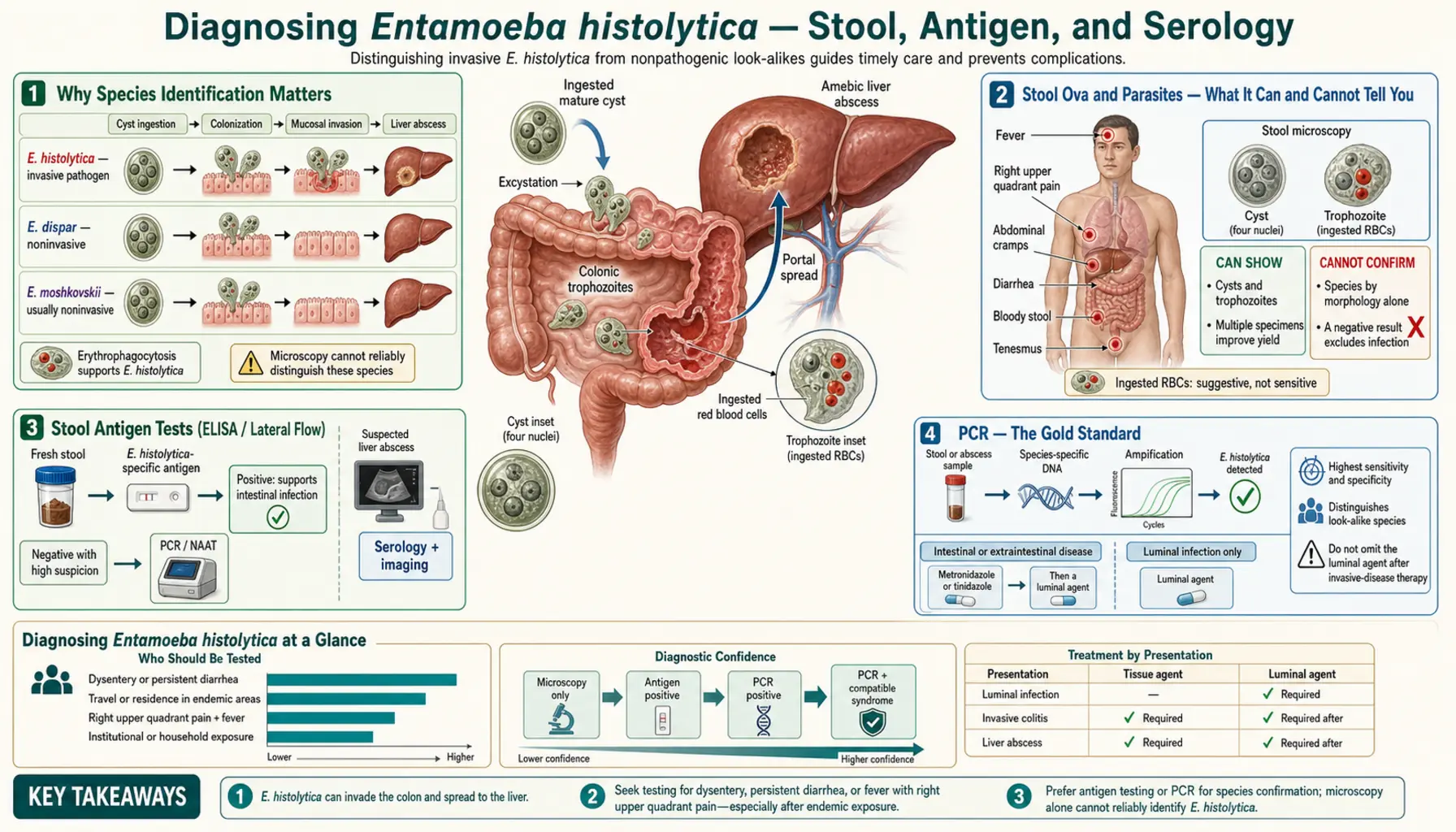
Table of Contents
- Why Species Identification Matters
- Stool Ova and Parasites — What It Can and Cannot Tell You
- Stool Antigen Tests (ELISA / Lateral Flow)
- PCR — The Gold Standard
- Serology — Blood Antibody Tests
- Imaging for Liver Abscess
- Colonoscopy and Biopsy
- Practical Diagnostic Algorithm
- Key Research Papers
- Connections
- Featured Videos
1. Why Species Identification Matters
The fundamental challenge in diagnosing amoebiasis is not simply finding an ameba — it is proving that the ameba found is Entamoeba histolytica rather than its harmless, morphologically identical look-alikes, most importantly Entamoeba dispar. This distinction has direct and serious clinical consequences:
- E. histolytica — the only species that invades tissue, causes disease, and requires treatment. Asymptomatic carriers of true E. histolytica should be treated with a luminal amebicide even if asymptomatic, particularly in non-endemic settings, to prevent future invasive disease and interrupt transmission.
- E. dispar — an entirely benign commensal. Carriers require no treatment at all. Treating them exposes patients unnecessarily to drug side effects and contributes to drug pressure without benefit.
- Entamoeba moshkovskii — a third species morphologically identical to the above; its pathogenicity in humans remains under investigation, and current guidance generally recommends no treatment in asymptomatic individuals pending further evidence.
Because the three species are indistinguishable by standard light microscopy — including on routine stool ova and parasites (O&P) examinations — a positive microscopy report for "ameba cysts" or even "E. histolytica/dispar" is not equivalent to a diagnosis of true amoebiasis requiring treatment. Species-specific testing is required.
2. Stool Ova and Parasites — What It Can and Cannot Tell You
Stool examination for ova and parasites (O&P) remains widely used in clinical practice, particularly in resource-limited endemic settings where more sophisticated tests are unavailable. Its role in amoebiasis diagnosis must be understood precisely:
What it can do:
- Detect the presence of ameba cysts or trophozoites in stool.
- Identify trophozoites that have ingested red blood cells (erythrophagocytosis). The presence of RBCs inside trophozoite cytoplasm is a strong morphological indicator of E. histolytica specifically (since only this species invades tissue and ingests blood). However, this finding is present in only a minority of positive microscopy specimens and its absence does not exclude E. histolytica.
- Detect other intestinal parasites (Giardia, Cryptosporidium, helminths) simultaneously — a significant practical advantage of O&P in a comprehensive parasitology workup.
What it cannot do:
- Reliably distinguish E. histolytica from E. dispar or E. moshkovskii by morphology alone in the absence of erythrophagocytosis.
- Confirm invasive disease from cyst shedding alone.
Sensitivity limitations: Three separate stool specimens examined on different days improve sensitivity, but even with multiple samples, sensitivity for detecting ameba cysts is imperfect, and intermittent cyst shedding means a negative O&P does not exclude amoebiasis. In amebic liver abscess, stool O&P is positive in only 10–40% of patients at the time of presentation.
3. Stool Antigen Tests (ELISA / Lateral Flow)
Stool antigen tests detect E. histolytica-specific proteins directly in fecal specimens. The most validated targets are the Gal/GalNAc lectin (galactose and N-acetyl-D-galactosamine–inhibitable lectin) — a surface protein critical to the parasite's ability to adhere to and kill host cells, and a protein uniquely expressed by E. histolytica (not E. dispar or E. moshkovskii).
Performance characteristics:
- Sensitivity: approximately 85–95% in symptomatic intestinal amoebiasis.
- Specificity: high when test is performed with validated E. histolytica-specific antibodies (some earlier kits cross-reacted with E. dispar; current-generation species-specific tests are more reliable).
- Sensitivity is lower in asymptomatic carriers (intermittent antigen shedding) and in amebic liver abscess (only 10–40% of ALA patients have a positive stool antigen at presentation).
Practical advantages: Rapid lateral-flow formats are available, requiring no laboratory equipment beyond a 15-minute incubation step. These point-of-care formats have been deployed in field settings in endemic regions. ELISA-format tests provide more quantitative results and are used in reference laboratory settings.
A positive species-specific stool antigen test in a patient with compatible symptoms is considered sufficient evidence of true E. histolytica infection to initiate treatment, without waiting for PCR confirmation, in most clinical guidelines.
4. PCR — The Gold Standard
Polymerase chain reaction (PCR) targeting species-specific gene sequences is the most accurate available method for differentiating E. histolytica, E. dispar, and E. moshkovskii in stool. It is considered the gold standard for species identification and is increasingly available in reference and research laboratories in both endemic and non-endemic countries.
Performance:
- Sensitivity: 85–99% for E. histolytica detection in symptomatic patients (varies by assay design and stool processing).
- Specificity: effectively 100% for species differentiation when validated primers targeting E. histolytica-specific sequences are used.
- Can be performed on fresh stool, preserved samples (SAF, sodium acetate-formalin), or formalin-ethyl acetate concentrated stool — making it compatible with samples collected and shipped from field settings.
- Real-time (quantitative) PCR formats can provide parasite load information, though the clinical significance of load thresholds remains under investigation.
Multiplex PCR panels: Many modern gastrointestinal pathogen panels (e.g., the BioFire FilmArray GI Panel) include E. histolytica-specific PCR as part of a broad syndromic test covering bacterial, viral, and parasitic causes of diarrhea simultaneously. These panels have substantially increased detection rates compared with conventional O&P microscopy in both endemic and non-endemic settings.
Limitation in ALA: PCR sensitivity on stool is reduced in amebic liver abscess (low stool positivity rate). PCR on aspirated abscess material from needle aspiration can be used directly if PCR testing of abscess fluid is available.
5. Serology — Blood Antibody Tests
Serological tests detect host antibodies against E. histolytica in blood. They are particularly valuable in amebic liver abscess, where stool-based tests are often negative but systemic infection reliably triggers a strong antibody response.
Methods and performance:
- Indirect fluorescent antibody test (IFAT) and ELISA targeting E. histolytica-specific antigens (including the lectin) are the most widely used formats.
- Sensitivity in amebic liver abscess: approximately 92–99% — serology is the most reliable single test for ALA when combined with compatible clinical and imaging findings.
- Sensitivity in amebic colitis: 70–85% — lower than in ALA because intestinal amoebiasis is more superficial and may trigger a weaker systemic antibody response, particularly early in infection.
- Antibodies persist for months to years after successful treatment. In endemic areas where repeated exposures are common, positive serology may reflect past infection rather than current active disease — a significant limitation in high-seroprevalence populations.
Practical interpretation: In a traveler from a non-endemic country presenting with fever, right upper quadrant pain, and a hepatic lesion on imaging, a positive serology combined with the clinical picture is sufficient to begin treatment for ALA without requiring diagnostic aspiration. In endemic residents with chronic or repeated exposures, serology is harder to interpret and must be integrated with antigen testing and clinical context.
6. Imaging for Liver Abscess
Imaging does not diagnose amoebiasis — it identifies an abscess cavity and characterizes it — but it is indispensable in suspected ALA and in planning management.
- Ultrasound is the first-line and most cost-effective modality. It can be performed rapidly at bedside, requires no radiation, and is highly sensitive for detecting hepatic abscesses >1 cm. ALA appears as a well-defined, round or oval hypoechoic lesion, typically in the right lobe. Ultrasound also guides needle aspiration when drainage is indicated.
- CT scan provides superior delineation of abscess size, location relative to hepatic vessels and bile ducts, presence of multiple abscesses, wall characteristics, and evidence of rupture or adjacent organ involvement (pleural, pericardial). CT is preferred when the ultrasound picture is ambiguous, when left-lobe involvement is suspected, or when surgical planning is required.
- MRI offers the best soft-tissue contrast and is useful in complex or recurrent cases, in patients in whom radiation must be minimized (e.g., pregnant women), and when CT findings are inconclusive. The pericardial and pleural extensions are particularly well seen on MRI.
- Chest X-ray: A simple, widely available first step that can reveal right-sided pleural effusion, elevated right diaphragm, or pulmonary infiltrate — all suggesting pleuropulmonary extension of hepatic disease.
Important caveat: Imaging alone cannot distinguish amebic from pyogenic (bacterial) liver abscess. Pyogenic abscess tends to be smaller, multiple, and associated with biliary disease or abdominal surgery; ALA tends to be large, single, and right-lobe. Serology and clinical context are essential to make this distinction, which determines treatment (antiparasitic vs. broad-spectrum antibiotics).
7. Colonoscopy and Biopsy
Direct visualization of the colon by colonoscopy is not routinely performed for suspected amebic colitis — stool-based tests and clinical assessment are usually sufficient — but colonoscopy plays an important role in specific circumstances:
- Diagnostic uncertainty: When stool antigen and PCR are unavailable or negative but clinical suspicion remains high, or when symptoms persist despite initial treatment.
- Differential diagnosis from IBD: When inflammatory bowel disease and amebic colitis cannot be distinguished on clinical grounds, colonoscopy with targeted biopsy from ulcer edges can confirm the diagnosis. The flask-shaped ulcers with normal intervening mucosa are characteristic on endoscopy. Histology of biopsy specimens from the ulcer margin can demonstrate E. histolytica trophozoites with PAS (periodic acid–Schiff) staining, which stains the glycogen-rich cytoplasm of trophozoites bright magenta.
- Evaluation of amoeboma: When a colonic mass suspicious for carcinoma is found on imaging, colonoscopy with biopsy — combined with antiparasitic treatment — may be diagnostic when the mass responds to therapy, confirming its inflammatory rather than malignant nature.
A practical and important rule: antiparasitic treatment should NOT be delayed pending colonoscopy results in patients with a high clinical probability of amebic colitis and a positive stool antigen or PCR. Endoscopy should be deferred until after initial treatment in severe or fulminant disease, as the inflamed bowel wall has increased perforation risk.
8. Practical Diagnostic Algorithm
A stepwise approach that reflects clinical reality in both endemic and non-endemic settings:
- Suspected intestinal amoebiasis (diarrhea, colitis symptoms): Obtain stool antigen test (species-specific for E. histolytica) as first-line test; add PCR if antigen test unavailable or negative with high suspicion. Send stool O&P for parallel parasite workup. Treat if antigen or PCR positive.
- Suspected ALA (fever + right upper quadrant pain ± hepatomegaly): Hepatic ultrasound immediately; add serology (IFAT or ELISA). If ultrasound shows abscess and serology is positive — treat without waiting for aspiration confirmation in most cases. Send stool antigen/PCR in parallel (positive in only 10–40%, but helpful when positive).
- Asymptomatic ameba cysts on stool microscopy: Do NOT treat based on microscopy alone. Obtain species-specific stool antigen or PCR. Treat only if E. histolytica confirmed.
- Negative tests but persistent clinical suspicion: Repeat stool antigen testing on 2–3 specimens collected on different days; obtain PCR; consider colonoscopy with biopsy if intestinal disease is strongly suspected.
9. Key Research Papers
Selected peer-reviewed literature on laboratory diagnosis of Entamoeba histolytica infection.
- Shirley DT et al. Global burden, diagnostics, and therapeutics for amebiasis. Open Forum Infect Dis. — Search PubMed.
- Haque R et al. Amebiasis. N Engl J Med. — Search PubMed.
- Petri WA Jr et al. Enteric infection and dehydration. Sci Transl Med. — Search PubMed.
- Moonah SN et al. Amebiasis pathogenesis. PLoS Pathog. — Search PubMed.
- Bercu TE et al. Amebic colitis — new insights. Curr Gastroenterol Rep. — Search PubMed.
- Espinosa-Cantellano M, Martínez-Palomo A. Pathogenesis of intestinal amebiasis. Clin Microbiol Rev. — Search PubMed.
- Blessmann J et al. Liver abscess epidemiology and treatment. Clin Microbiol Infect. — Search PubMed.
- Fotedar R et al. Laboratory diagnostic techniques for Entamoeba species. Clin Microbiol Rev. — Search PubMed.
- Shirley DT, Watanabe K, Moonah S. Significance of amebiasis. PLoS Negl Trop Dis. — Search PubMed.
- Marie C, Petri WA Jr. Virulence regulation in E. histolytica. Annu Rev Microbiol. — Search PubMed.
Live PubMed Searches
- Entamoeba histolytica PCR stool diagnosis
- Entamoeba histolytica antigen ELISA detection
- Amebic liver abscess serology
- Entamoeba species differentiation
Connections
- All Parasites
- Entamoeba Symptoms Overview
- Amoebic Dysentery and Colitis
- Liver Abscess and Extraintestinal Disease
- Entamoeba Treatments Overview
- Metronidazole and Tissue Amebicides
- Entamoeba histolytica Main Page
- Lab Tests